by Tom Gurney
Tom Gurney BSc (Hons) is an art history expert with over 20 years experience
Published on June 19, 2020 / Updated on November 5, 2026
Email: tomgurney1@gmail.com / Phone: +44 7429 011000
Woman
Three women occupy a wooded shore. One, dressed in white, looks towards the water; another faces us naked, with her arms raised behind her head; the third stands in dark clothing beside a red tree. A man appears at the far right, his hands lifted near his face. Their poses make the scene feel charged, although no single action explains how they belong together.
This is Edvard Munch's Woman of 1925, an oil painting in the collection of MUNCH in Oslo. The museum identifies it as MM.M.00375, Woll M 1564. It returns to a subject Munch had painted much earlier, but its date, colour and arrangement belong to this particular canvas. [1]
At a Glance
Three separately catalogued Woman paintings
Contents
Three figures, three directions
The white-clad woman on the left offers the least direct encounter. Her long pale shape lies between the foreground vegetation and the sea. Her turned head and body draw attention away from us, towards an opening in the landscape. We can follow her direction of looking without knowing what she sees or thinks.
The central woman reverses that relationship. Her frontally presented body and widely raised elbows create a conspicuous, open shape. Her arms bring the eye back towards her head, while her upright torso interrupts the shoreline behind her. The pose makes her visible without telling us whether it should be understood as confidence, display or something more ambiguous.
The woman in black is harder to separate from the surrounding darkness. Her pale, blue-toned face emerges above the long dark dress, while the nearby tree gives her body another upright companion. Where the central nude opens her silhouette, this figure seems gathered into a narrower form. Differences of visibility help distinguish the women before we assign them any symbolic roles.
Look across the three figures slowly. The sequence is not just white, flesh and black. It moves from a turned body to an exposed one and then to a more enclosed one. Munch allows posture and direction to do work that a simple colour key could never fully explain.
The man at the right
The male figure changes the scene. Without him, the three women might appear as an isolated arrangement of contrasting poses. His presence gives the picture another participant whose relation to them remains uncertain. Placed at the edge, he does not command the centre or establish an ordinary conversation.
His raised hands and blue-toned face make a particularly restless shape beside the dark-clad woman. They invite an emotional response, but the painting supplies no spoken explanation. To call him frightened, jealous or overwhelmed is already to interpret what we see. The gesture is more definite than the reason for it.
This distinction matters in a picture so readily turned into a story about desire. The figures do not form a clearly staged encounter with a beginning and an ending. None provides a reliable narrator. Our attention shifts between their bodies, and each new relationship changes the balance of the whole scene.
A shore of curves and uprights
The landscape is an active part of that balance. The curving shore opens a route into the distance, while the figures and tree trunks establish a series of vertical interruptions. Pale water gives the left-hand woman room around her; the wooded right-hand side compresses the other figures against darker forms.
Across the foreground, green growth and curling lines resist the stillness of the standing bodies. The ground does not settle into an evenly described stage. Its colour and movement continue around the figures, so that human outlines remain entangled with the wider painted surface.
The red tree is especially forceful. Its trunk offers a coloured vertical beside the women and the man, but its branching form also connects with the surrounding vegetation. Follow it upwards and then return to the lower edge: the picture repeatedly leads us from a body to a nearby plant or painted curve. The people appear within the landscape's rhythms rather than simply standing in front of scenery.
Colour and distance
The central body's pink tones create an immediate contrast with the greens around it. The white dress is brighter but less direct in its orientation. The black dress absorbs attention differently, with the face providing a small, concentrated point of light. Colour and pose sometimes reinforce one another and sometimes pull in different directions.
These contrasts help account for the picture's curious mixture of exposure and distance. We can see the nude clearly, yet that visibility does not make her an accessible personality. The turned woman withholds her face, while the dark woman offers a face whose expression is difficult to settle. Munch gives each figure a different way of resisting an easy reading.
The visible strokes contribute to that effect. Bodies, water and foliage remain recognisable, but their edges do not all receive the same firm treatment. Some forms are held by a strong boundary; others seem to merge with the colour beside them. The eye has to keep finding the figures within the painting.
An earlier motif reconsidered
Munch's subject has a history stretching back to the 1890s. MUNCH catalogues a smaller Woman. Sphinx of 1894, MM.M.00057, and another Woman of that year, PE.M.00475, belonging to the Bergen collections. These are separate objects, not alternative catalogue numbers for the 1925 painting. [2] [3]
Moderna Museet's interpretation of the early motif places it within Munch's Symbolist search for images of inner experience. It connects the white-clad woman, nude and black-clad woman with forms developed in earlier self-portraits. That account concerns the subject's early development; it does not turn the later canvas into an unchanged illustration of a fixed idea. [4]
The difference in dates is revealing. By 1925, Munch could return to an established configuration and make its relationships newly visible through colour, gesture and handling. Recognising the recurring motif helps us compare the pictures. Looking at the actual arrangement prevents the title from taking the place of the painting.
Reading the women as symbols
The opposition of white and black, clothed and naked, turned and frontal bodies invites symbolic interpretation. A viewer may read the figures as different states or roles, rather than three people meeting by chance. The singular title Woman strengthens that invitation by placing several female figures under one name.
Such an interpretation also has limits. An artist's arrangement of female types is evidence about the image he constructed, not a universal account of women's lives. Nor does a colour determine a figure's moral character. The painting becomes more interesting when we notice how its bodies complicate the categories that their contrasts first suggest.
Return to the left-hand woman looking out across the water. Her direction creates a possibility beyond the encounter at the right. Then look again at the central woman's expansive elbows and the narrow dark figure beside her. Their coexistence, rather than a single solved identity, gives Woman its persistent tension. The picture holds several ways of appearing together without allowing any one of them to explain the rest.
Selected Munch paintings
Selected paintings documented by MUNCH, SMK and the Getty. Repeated titles identify separate objects. Each collection record gives the source for its title, date and medium.
| Name | Date | Medium |
|---|---|---|
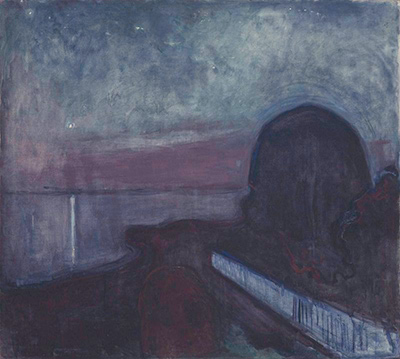
| Starry Night — Åsgårdstrand | 1893 | Oil on canvas |
| Metabolism | 1898–1899 | Oil on canvas |
| Red and White | 1899–1900 | Oil on canvas |
| Consul Christen Sandberg | 1901/1910 | Oil on canvas |
| The Researchers | 1911/1925–27? | Oil on canvas |
| On the Sofa | 1913 | Oil on canvas |
| Workers on their Way Home — Oslo | 1913–1914 | Oil on canvas |
| Workers on their Way Home — Copenhagen | 1914 | Oil on canvas |
| Starry Night — Ekely, upright version | 1922–1924 | Oil on canvas |
| Starry Night — another Ekely version | 1922–1924 | Oil on canvas |
| Woman | 1925 | Oil on canvas |
Frequently Asked Questions
It belongs to MUNCH in Oslo, inventory MM.M.00375. [1]
Discussion
Compare the figures’ poses, their directions and the wooded shore.
Reader Insights
How does each woman's direction of looking change your encounter with her?
What does the man at the edge contribute to the scene?
Where do the figures seem to merge with the surrounding landscape?
Join the Conversation
Share a detail, comparison or question about Woman below.
References
- MUNCH, Woman, 1925, MM.M.00375, Woll M 1564. Current object catalogue and image dimensions. View source.Splash image: Woman, 1925. Oil on canvas; image 152.5 × 227.5 cm. MUNCH, Oslo, MM.M.00375.
- MUNCH, Woman. Sphinx, 1894, MM.M.00057, Woll M 361. Separate earlier canvas. View source.
- MUNCH, Woman, 1894, PE.M.00475, Woll M 362. Cross-catalogue record for the Bergen painting. View source.
- Moderna Museet, Towards a new aesthetic, in Munch by himself. Interpretation of Munch's early Symbolist imagery and Woman motif. View source.