by Tom Gurney
Tom Gurney BSc (Hons) is an art history expert with over 20 years experience
Published on June 19, 2020 / Updated on November 5, 2026
Email: tomgurney1@gmail.com / Phone: +44 7429 011000
Red and White
A woman in a bright red dress faces us near the centre of a wooded shore. At the left, another woman, dressed in white, turns towards the pale water. Their clothes supply the title's contrast, but the difference between their poses is just as important. One presents herself frontally; the other directs our attention away from the viewer and out towards the sea.
Edvard Munch's Red and White belongs to MUNCH in Oslo. The current catalogue dates this oil painting 1899–1900 and identifies it as MM.M.00460, Woll M 463. Its image measures 93.5 × 129.5 centimetres. The strong colour opposition unfolds within a landscape of trees, curved ground and a distant horizon. [1]
At a Glance
Related paintings of contrasting figures
Contents
The woman in red
The central figure has an immediate presence. Her dress makes a broad red-orange shape against the cooler and darker surroundings. The long skirt extends down towards the foreground, while the bends of her arms introduce changes of direction nearer her waist.
Her head is comparatively small within that expanse of colour. The face does not compete with the dress through elaborate detail. It is the relation between the upright body, the quieter facial features and the conspicuous clothing that makes the encounter distinctive. We can recognise a person without having her expression fully explained.
The frontal pose also differs from a clear invitation to conversation. Her body faces the viewer, yet the scene offers no unmistakable exchange of looks or gestures. That combination of visibility and reserve gives her a stillness that the bright colour alone might lead us to underestimate.
The woman in white
The second woman occupies a narrower space at the left. Her light clothing separates her from the surrounding ground and connects her visually with the pale sea beyond. Long hair and the turned position of the head help establish her orientation towards the water.
Because her attention is directed elsewhere, she opens another route through the painting. We can move from the frontal red figure across to the white dress and then out towards the horizon. The two women do not simply compete for the same kind of attention. They create different relationships between the painted scene and the person looking at it.
Their separation matters. Munch leaves enough space between them for the landscape to participate in the comparison. The interval keeps the women from becoming a single compact group, while their shared upright positions still allow the eye to connect them across the shore.
Colour as a relationship
The title encourages us to notice red and white first. Yet each colour changes according to what surrounds it. The white dress becomes particularly clear against the darker nearby ground; the red dress gains force against the greens and blues around the central figure.
Colour therefore organises the picture before it supplies any fixed symbolic meaning. It distinguishes the women, creates a hierarchy of attention and links each body differently with its setting. The red is broad and concentrated, while the white offers a narrower, lighter passage towards the distance.
A reading that makes red stand for passion and white for innocence may seem immediately available. Such a reading remains an interpretation shaped by cultural associations. It should not prevent us from noticing the actual poses, or turn either painted figure into a simple moral category. The interaction of direction, scale and colour is more particular than that.
Shoreline and trees
The water introduces an opening behind the figures. Its lighter area contrasts with the wooded right-hand side, where vertical trunks compress the space. The result is an uneven setting: one side invites the eye outward, while the other keeps attention closer to the standing bodies and foreground.
Curving forms near the ground complicate those strong verticals. They give the shore a flowing movement around the figures' feet, and their warm colours echo aspects of the central dress. The women remain still, but the landscape provides paths along which our looking can move.
The dark tree trunks also make the bodies seem less isolated than they first appear. A standing woman and a nearby upright trunk can establish related shapes without becoming equivalent things. Munch uses that resemblance to bind figures and setting together, even as the dresses distinguish the women from their surroundings.
A changing image and a changing date
Older scholarship did not always give the painting its current date. Arne Eggum's essay in the National Gallery of Art's 1978 Munch catalogue labelled it 1894 and discussed a third female figure that had been overpainted. The present museum catalogue uses 1899–1900. These records should be read as different stages of the work's scholarship. [2] [1]
The earlier discussion is useful because the right-hand area is less straightforward than the two conspicuous dresses. Dark and partly legible forms complicate the space beside the central woman. A small reproduction cannot establish the exact sequence of alterations or reconstruct every earlier shape. The historical account supplies information that looking alone cannot safely provide.
It also encourages us to think of the composition as something Munch could change. The apparent simplicity of two contrasting women need not describe every stage of its making. Alteration could affect the balance between the figures and their setting, and therefore the kind of relationship the picture offers to the viewer.
The related Woman motif
Munch explored configurations of contrasting female figures elsewhere. The separately catalogued Woman. Sphinx of 1894, MM.M.00057, provides an earlier point of comparison. Its existence helps place Red and White within a broader inquiry without making the two paintings the same object. [3]
The comparison is most useful when it sharpens attention to arrangement. How many figures stand clearly apart? Which faces turn towards us? How much of the surrounding shore remains visible? These questions allow differences between paintings to matter, rather than treating a recurring motif as an explanation already completed.
In Red and White, the two dresses carry much of that work. Their differing widths, colours and orientations establish a strong relationship without supplying an ordinary narrative. The title names what is readily visible while leaving open how those visible contrasts should be understood.
Looking beyond the first contrast
From a distance, the painting may appear to resolve into two emphatic colour shapes. Spend longer with it and the space around them becomes increasingly important. The pale sea, darker trunks and curved foreground determine how separately or closely we experience the women.
The white figure offers a direction of looking beyond the frame of the encounter, while the red figure keeps returning our attention towards the picture's front. Neither cancels the other. Their coexistence makes the scene feel suspended between an outward view and an inward concentration. Munch gives a quiet shore an enduring tension through the simplest visible differences: the way two bodies stand, the colours they wear and the spaces they leave between them.
Selected Munch paintings
Selected paintings documented by MUNCH, SMK and the Getty. Repeated titles identify separate objects. Each collection record gives the source for its title, date and medium.
| Name | Date | Medium |
|---|---|---|
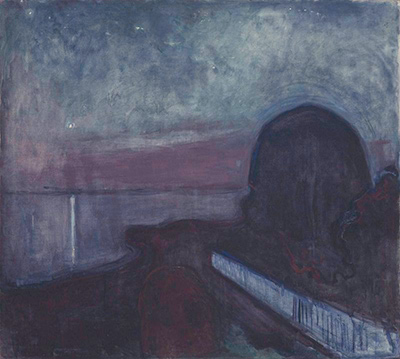
| Starry Night — Åsgårdstrand | 1893 | Oil on canvas |
| Metabolism | 1898–1899 | Oil on canvas |
| Red and White | 1899–1900 | Oil on canvas |
| Consul Christen Sandberg | 1901/1910 | Oil on canvas |
| The Researchers | 1911/1925–27? | Oil on canvas |
| On the Sofa | 1913 | Oil on canvas |
| Workers on their Way Home — Oslo | 1913–1914 | Oil on canvas |
| Workers on their Way Home — Copenhagen | 1914 | Oil on canvas |
| Starry Night — Ekely, upright version | 1922–1924 | Oil on canvas |
| Starry Night — another Ekely version | 1922–1924 | Oil on canvas |
| Woman | 1925 | Oil on canvas |
Frequently Asked Questions
Eggum's historical account discusses an overpainted third woman. The visible surface alone does not establish the full sequence of alterations. [2]
Discussion
Look at pose, colour and the spaces around the two dresses.
Reader Insights
How do the two women's poses differ from their colour contrast?
Where does the shoreline direct your attention beyond the figures?
What changes when you look at the space between the dresses?
Join the Conversation
Share a detail, comparison or question about Red and White below.
References
- MUNCH, Red and White, 1899–1900, MM.M.00460, Woll M 463. Current catalogue and dimensions. View source.Splash image: Red and White, 1899–1900. Oil on canvas; image 93.5 × 129.5 cm. MUNCH, Oslo, MM.M.00460.
- Arne Eggum, “Major Paintings,” in Edvard Munch: Symbols & Images, National Gallery of Art, Washington, 1978, p. 48. Historical dating and discussion of overpainting; not the current date authority. View source.
- MUNCH, Woman. Sphinx, 1894, MM.M.00057, Woll M 361. Separate related canvas. View source.