by Tom Gurney
Tom Gurney BSc (Hons) is an art history expert with over 20 years experience
Published on June 19, 2020 / Updated on November 5, 2026
Email: tomgurney1@gmail.com / Phone: +44 7429 011000
On the Sofa
A woman in a red dress reclines across a green sofa. Her head rests near a dark cushion at the left, one arm drops over the front edge, and her dark-stockinged legs extend towards the right. The dress spreads across the middle of the picture, turning a quiet pose into a conspicuous arrangement of colour.
MUNCH identifies the model in Edvard Munch's On the Sofa as Ingeborg Kaurin. Painted in 1913, the oil canvas measures 80 × 150 centimetres and is catalogued as MM.M.00501, Woll M 1082. Its broad format gives the reclining figure room to stretch, while keeping the furniture and body close to the picture's boundaries. [1]
At a Glance
Two paintings with Ingeborg Kaurin
Contents
A figure carried by the furniture
The sofa establishes the painting's main horizontal movement. Its high back fills much of the space behind Kaurin, while the seat supports the length of her body. The curved upper edge and the softer shapes beneath her keep that structure from becoming a rigid box.
Her pose follows the furniture but does not simply repeat it. The lowered arm creates a downward interruption near the left, the dress rises over the bent legs, and the shoes form a small pointed ending at the right. These changes make the figure legible as a body at rest rather than an evenly horizontal band.
The head is another interruption. Its pale face emerges from brown hair and the darker cushion, set slightly above the broad red mass of the dress. It provides a place to begin looking, but the fabric soon carries the eye away across the canvas. Munch distributes attention between a recognisable person and the larger arrangement containing her.
The red dress
The dress is the painting's most insistent colour. It covers much of the body, so the pose is understood partly through the rise and fall of fabric. Light strokes cross the red in changing directions, suggesting folds without describing every crease with the same precision.
Around the knees, the dress becomes a broad, angular shape. Towards the torso, it gathers differently, making the reclining position visible through changes of direction. The distinction between clothing and body remains useful: we see a clothed person, and the fabric both reveals and obscures how she occupies the sofa.
Red also alters our sense of stillness. The model's position is quiet, but the colour is visually active. It advances against the greens and blues of the furniture, while the shorter marks within it keep the surface lively. A resting subject need not produce a motionless experience of looking.
Green, blue and the painted surface
The sofa is built from many touches of green and blue rather than one smoothly applied local colour. In places the marks run vertically; elsewhere they change direction around the cushions and edge. Their differences make the furniture seem soft and irregular without requiring a carefully shaded account of upholstery.
These visible strokes give the sofa a strong presence alongside the woman. It is not merely an accessory needed to support the title. Its colour occupies a large part of the canvas and supplies the field against which the red dress becomes so striking.
Near the lower edge, the lighter and darker marks grow especially noticeable. They keep reminding us of paint on a surface, even as we recognise the furniture. Munch allows that double awareness to continue: the image remains readable, and its making remains available to the eye.
The lowered arm and the dark shoes
The arm extending over the sofa's front edge brings a different kind of weight into the picture. It crosses the furniture's boundary and turns down towards the lower margin. Compared with the broad dress, it is a small passage, but its direction makes it difficult to overlook.
The shoes at the opposite end answer it with a sharper form. Dark stockings lead towards their pointed, lighter-edged shapes. This change from the large red centre to the narrower extremities gives the figure a varied rhythm across the width of the painting.
Try tracing the outline from head to shoulder, through the dress and down towards the feet. Then follow the sofa's upper edge in the other direction. The two routes are related but never identical. Their differences help hold the figure and furniture together without making either disappear into the other.
Ingeborg Kaurin as a named model
The catalogue's identification gives the woman a name beyond the picture's descriptive title. MUNCH also records a separate oil portrait, Ingeborg Kaurin, dated 1911–1912, inventory MM.M.00046. The paintings belong to different formats and occasions; their shared model does not make them interchangeable images. [2]
Research published by Moss Historielag describes Kaurin as both model and housekeeper for Munch during part of his years around Moss. It also acknowledges the limited information about that employment. This context establishes a working relationship while leaving much of her own experience undocumented. [3]
That limitation is a reason to be precise about what the painting shows. The reclining pose does not tell us what Kaurin thought of being painted or what she was doing immediately before and after the sitting. Her relaxed arm is visible; an entire personal story cannot be recovered from it.
An interior with little narrative
The sofa fills the background so completely that we learn relatively little about the room beyond it. The image concentrates on the relation between figure and furniture. It gives us neither a broad domestic setting nor a series of activities through which to reconstruct an ordinary day.
The title is equally economical. On the Sofa identifies a position and a place within the picture. It leaves the encounter open, allowing the viewer to notice posture, colour and weight before searching for an event or an explanation outside the frame.
The face can suggest rest or absorption, but the painting does not establish sleep, illness or a particular state of mind. Those possibilities are easy to supply because reclining figures are familiar. Looking closely means attending to the actual painted evidence before allowing a familiar narrative to settle around it.
The effect of the wide canvas
The image is nearly twice as wide as it is high. That proportion makes the extended body feel appropriate to its setting, while limiting the empty space above and below. The sofa and the figure share the task of filling the rectangle. Their arrangement depends on breadth rather than the upright presence of a standing portrait.
The contrast between the small pale face and the broad red dress remains especially effective within that format. One attracts attention through its human features, the other through its scale and colour. Together with the green furniture, they sustain a picture in which a simple reclining pose becomes an absorbing study of how a body, its clothes and its surroundings occupy painted space.
Selected Munch paintings
Selected paintings documented by MUNCH, SMK and the Getty. Repeated titles identify separate objects. Each collection record gives the source for its title, date and medium.
| Name | Date | Medium |
|---|---|---|
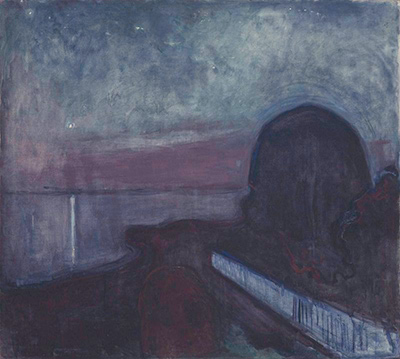
| Starry Night — Åsgårdstrand | 1893 | Oil on canvas |
| Metabolism | 1898–1899 | Oil on canvas |
| Red and White | 1899–1900 | Oil on canvas |
| Consul Christen Sandberg | 1901/1910 | Oil on canvas |
| The Researchers | 1911/1925–27? | Oil on canvas |
| On the Sofa | 1913 | Oil on canvas |
| Workers on their Way Home — Oslo | 1913–1914 | Oil on canvas |
| Workers on their Way Home — Copenhagen | 1914 | Oil on canvas |
| Starry Night — Ekely, upright version | 1922–1924 | Oil on canvas |
| Starry Night — another Ekely version | 1922–1924 | Oil on canvas |
| Woman | 1925 | Oil on canvas |
Frequently Asked Questions
MUNCH identifies the model as Ingeborg Kaurin. [1]
The reclining pose allows that impression, but the catalogue does not establish sleep. The painting shows her resting on the sofa.
Discussion
Follow the figure across the broad red and green composition.
Reader Insights
Where does the red dress first direct your attention?
How do the lowered arm and shoes change the horizontal pose?
Which marks make the sofa feel as active as the figure?
Join the Conversation
Share a detail, comparison or question about On the Sofa below.
References
- MUNCH, On the Sofa, 1913, MM.M.00501, Woll M 1082. Object record, model identification and dimensions. View source.Splash image: On the Sofa, 1913. Oil on canvas; image 80 × 150 cm. MUNCH, Oslo, MM.M.00501.
- MUNCH, Ingeborg Kaurin, 1911–1912, MM.M.00046, Woll M 994. Separate portrait of the model. View source.
- Moss Historielag, Edvard Munch i Moss 1913–1916, 3 November 2014. Norwegian local-history research, including Kaurin's employment and limits of the surviving information. View source.