by Tom Gurney
Tom Gurney BSc (Hons) is an art history expert with over 20 years experience
Published on June 19, 2020 / Updated on November 5, 2026
Email: tomgurney1@gmail.com / Phone: +44 7429 011000
Starry Night (1922–1924)
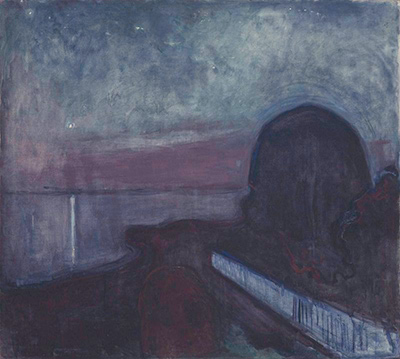
A flight of steps leads out into blue snow. Beyond a hedge, trees and scattered buildings stretch toward a sky crowded with stars. In Edvard Munch's Starry Night of 1922–1924, the view feels at once close enough to enter and strangely difficult to measure. The foreground seems to begin beneath our feet, while the sky opens above it like a second, more restless landscape. This is the winter world of Ekely, the property outside Oslo that became Munch's home in 1916. [1] [3]
Munch makes an ordinary act—looking out from a house—feel charged with attention. There is no dramatic incident to explain the scene. Its force comes from the meeting of heavy foreground shapes, luminous snow, distant windows and the shifting marks of the sky. Looking is enough to animate the night.
At a Glance
Two night landscapes
Contents
The Ekely painting
The upright painting belongs to MUNCH in Oslo. Its catalogue identifies it as Stjernenatt, or Starry Night, dates it to 1922–1924 and records oil on canvas, measuring 140 × 119 centimetres. Its inventory number is MM.M.00009 and its catalogue raisonné number is Woll M 1451. Those details distinguish this canvas from other paintings to which Munch gave the same title. [1]
The format matters to the experience of the image. Rather than spreading a panorama across a wide rectangle, Munch stacks the near ground, the middle distance and the sky. Our gaze has to travel upward through them. Yet each zone also pulls sideways: the rounded snowbank, the sweep of the hedge and the band of buildings resist a simple march toward the horizon. The result is a landscape that holds several directions of movement at once.
Looking down the steps
Begin at the bottom edge, where the darkest shapes are closest. The rails or low walls on either side of the steps narrow toward the garden, providing an immediate route into the scene. They give the viewer a bodily position, as though we have paused before going outside. Against the open snow, their compressed brown, green and blue tones look particularly dense.
The steps do not lead neatly into a straight path extending to the horizon. Beyond them, the ground bends and rises, and the hedge redirects the eye across the picture. This interruption keeps us aware of the difference between the space we could physically enter and the wider view that we can only survey. The garden feels familiar in its separate parts but less settled as a whole.
Notice how few crisp divisions are needed to suggest depth. A dark boundary establishes the garden's far edge. Trees and buildings collect beyond it. Small lights appear still farther away. Munch does not give each object an equally sharp outline; he makes distance through differences of scale, contrast and concentration. The nearby dark rails feel substantial because the distant buildings seem so slight.
Fondation Beyeler's interpretation of the nocturne draws attention to this relationship between the implied house, the snow and the illuminated distance. It is a useful way of seeing the composition: the house remains largely outside the picture, but its steps give the entire view a point of departure. [4]
How blue makes the night luminous
Blue is everywhere, but it does not perform the same task everywhere. In the foreground it can be dense and almost green; across the snow it becomes pale, lilac or milky; higher up it deepens into the surrounding sky. These changes prevent the surface from settling into one uniform darkness. The night contains a whole range of light.
The snow is especially important. A white field might have separated land from sky too decisively. Instead, Munch runs blue strokes and shadows through it, allowing the ground to share the sky's colour while keeping its own weight and curve. The warmer touches in the buildings then become conspicuous. They need not occupy much space to register as signs of human habitation.
The relationship works in both directions. Look first at the glowing windows and the surrounding blue seems colder. Look at the pale snow and the windows become small, concentrated points rather than the picture's only source of brightness. Munch invites these adjustments of attention. The light does not belong to one isolated object; it is distributed through relationships between adjacent colours.
The brushwork remains visible within that effect. Marks in the sky swirl and intersect, while strokes on the ground follow broader bends. We can recognise a night landscape without losing sight of the painted gestures that produce it. The image alternates between a place seen and a surface being read.
Stars and the painter's shadow
The stars are small but active presences. Some look like bright dots; others are surrounded by larger circles or unsettled patches of colour. They are distributed unevenly, leaving the eye to find its own connections. The sky does not resemble an astronomical chart, and identifying particular constellations is unnecessary to appreciate its movement.
Below, the dark foreground introduces a different kind of presence. MUNCH connects its Ekely night-sky series with views from the veranda steps and notes that the artist's silhouette appears in several paintings. Its interpretation describes the shadow here as an abstract shape. [2]
That distinction helps preserve the painting's ambiguity. We need not turn every dark mark into a portrait. A shadow can suggest the person looking without presenting a face, costume or recognisable body. It joins the viewer's position to the painter's while remaining part of the garden's arrangement of light and darkness. The human figure is felt through the act of seeing.
A home that supplied new subjects
Ekely gave Munch a stable base after years of travel. He bought it in 1916 and lived there for the rest of his life. The former nursery, its garden and its working spaces supplied subjects close at hand: trees, changing seasons, agricultural activity and the relationship between people and their surroundings. The museum emphasises that he also continued to revisit earlier motifs and make new compositions from them. [3]
This setting offers a more useful context for Starry Night than the idea of an artist simply withdrawing from the world. A view from home can be experimental. Its familiar structures allow attention to settle on changes of colour, darkness and viewpoint. The visible buildings beyond the garden also keep the wider inhabited landscape in view. Ekely is a place from which to look outward.
Why the title needs its date
Munch's Starry Night of 1893 is a different painting. Now in the J. Paul Getty Museum, that oil depicts the coast at Åsgårdstrand, where he spent summers. Its shoreline and sea belong to another setting, even though blue, darkness and the expressive possibilities of landscape connect the two works. The later Ekely painting should not inherit the earlier canvas's dimensions or history. [6]
There are also distinct late versions. MUNCH records another Starry Night of 1922–1924 as MM.M.00032, Woll M 1452, measuring 120.5 × 100.5 centimetres. The shared title and date range do not make it interchangeable with the upright canvas discussed here. [5]
Return to the steps after considering those differences. Their darkness anchors the picture in one particular position, but the colour carries the eye well beyond it. Near and far, shelter and exposure, stillness and movement remain in balance without becoming fully settled. That is the enduring pleasure of this Starry Night: a familiar view keeps opening into something less familiar as we continue to look.
Selected Munch paintings
Selected paintings documented by MUNCH, SMK and the Getty. Repeated titles identify separate objects. Each collection record gives the source for its title, date and medium.
| Name | Date | Medium |
|---|---|---|
| Starry Night — Åsgårdstrand | 1893 | Oil on canvas |
| Metabolism | 1898–1899 | Oil on canvas |
| Red and White | 1899–1900 | Oil on canvas |
| Consul Christen Sandberg | 1901/1910 | Oil on canvas |
| The Researchers | 1911/1925–27? | Oil on canvas |
| On the Sofa | 1913 | Oil on canvas |
| Workers on their Way Home — Oslo | 1913–1914 | Oil on canvas |
| Workers on their Way Home — Copenhagen | 1914 | Oil on canvas |
| Starry Night — Ekely, upright version | 1922–1924 | Oil on canvas |
| Starry Night — another Ekely version | 1922–1924 | Oil on canvas |
| Woman | 1925 | Oil on canvas |
Frequently Asked Questions
MUNCH interprets an abstract shadow within its account of the veranda night-sky series as a trace of the artist's presence, rather than a conventional painted portrait. [2]
Discussion
Compare the steps, snow, distant lights and star-filled sky.
Reader Insights
Which creates the strongest sense of distance: the steps, the hedge or the small lights?
How does the snow change when you compare it with the sky?
Where does the night seem most brightly lit?
Join the Conversation
Share a detail, comparison or question about Starry Night (1922–1924) below.
References
- MUNCH, Starry Night, MM.M.00009, Woll M 1451. Collection record. View source.Splash image: Starry Night, 1922–1924. Oil on canvas, 140 × 119 cm. MUNCH, Oslo, MM.M.00009.
- MUNCH, Starry Night, Ekely interpretation. View source.
- MUNCH, Edvard Munch's Ekely. Historical setting and working practice. View source.
- Fondation Beyeler, Northern Lights, English room guide, room 6, Stjernenatt, 1922–1924. View source.
- MUNCH, Starry Night, MM.M.00032, Woll M 1452. Distinct version. View source.
- J. Paul Getty Museum, Starry Night, 1893, 84.PA.681. View source.