by Tom Gurney
Tom Gurney BSc (Hons) is an art history expert with over 20 years experience
Published on June 19, 2020 / Updated on November 5, 2026
Email: tomgurney1@gmail.com / Phone: +44 7429 011000
Workers on Their Way Home
A man in a brown coat passes so close that the lower edge cuts across his body. Behind him, two other workers approach along a street crowded with figures. Blue coats, dark hats, pale trousers and restless marks on the road turn an everyday journey into an encounter with a moving crowd. Edvard Munch's Workers on their Way Home of 1914 belongs to Statens Museum for Kunst in Copenhagen. [1]
The painting offers no comfortable distance from which to watch. Its people are already on their way toward us, and the street seems to deliver more figures with every glance. Yet the crowd never becomes completely anonymous. Changes of face, posture, clothing and direction make us look from one person to another, even as the whole group presses forward.
At a Glance
Two versions of the workers motif
Contents
The Copenhagen painting
SMK records the work as an oil on canvas, 130.7 centimetres high by 160.8 wide, inventory KMS3823, acquired in 1928. Its dating note explains that Gerd Woll reads the signature's year as 1914, formerly interpreted as 1919. MUNCH's catalogue identifies the Copenhagen object separately as PE.M.00194, Woll M 1095. [1] [4]
Those distinctions matter because Munch made another well-known painting of the subject. A crowd coming toward the viewer is a motif he could return to and alter, rather than a scene fixed forever in one composition. In this version, the foreground man is one of the most effective devices for making the picture feel momentary: he seems about to leave it.
Meeting the crowd at the edge
Start with that nearest figure. His hat and bent head occupy a large area of the foreground, while his coat is described through strong, slanting strokes. His face is partly withheld by the brim. We are close enough to notice its tilt but cannot read it as easily as the faces behind him. Proximity and access are not the same thing.
The two men following him create another kind of presence. Their bodies are more fully visible, and the space between their legs allows the road to show through. They do not repeat one identical pose. One seems to stand more openly in the light; the other is held together by darker blue clothing. The slight differences keep the group from becoming a pattern of interchangeable silhouettes.
Farther back, individual features become less distinct. Heads and hats gather into a changing band, with enough interruptions to suggest that the procession continues beyond what we can clearly separate. Munch makes the movement of a crowd through the diminishing scale of its members. He does not need every person to be finished with the same degree of detail.
Notice, too, how the nearest man interrupts our view of those behind him. We cannot see all their bodies at once. The overlaps create the experience of meeting people in an actual street, where a face or coat appears and disappears as others move across it.
A road that carries the eye
The street does more than supply a setting. Its edges and the neighbouring buildings narrow toward the distance, giving the people a shared direction of travel. The pale ground between the dark figures remains conspicuous, so the road is never simply a neutral space waiting to be filled.
Its marks are particularly lively in the foreground. Curves, loops and short strokes suggest an uneven surface without carefully drawing each stone. They also move the eye around the workers' feet. Where we expect solid ground, we find a busy field of gestures that seems almost as active as the bodies above it.
The encounter feels unsettled because the nearest figure is seen differently from the people farther away. We look down toward his lowered head and shoulders, but the men behind him rise in front of us. The picture does not offer the detached stability of a street viewed from a distant window. It brings different degrees of nearness into the same field of vision.
Try following the road away from the foreground, then return to the figures. The recession draws us inward, while the approaching bodies draw our attention back out toward the edge. That opposition gives the scene much of its energy. It is difficult to remain only a spectator when the painting continually directs its movement toward our own position.
Clothes and individual presence
The repeated blues link many of the workers, but their clothes also break the crowd into separate rhythms. A dark jacket sits against light trousers; a brown coat crosses blue; pale shirt openings make small interruptions around faces and necks. Munch can establish the solidity of a body with a few decisive contrasts.
The hats are equally important. Their varied angles make a sequence of dark shapes across the upper bodies. Some heads face more directly toward us, others turn or incline. The group has a common direction without sharing one expression or one identical way of walking.
These details discourage an easy description of the figures as a single emotional type. The picture can suggest fatigue, determination or absorption, but it does not give us the private thoughts of each worker. Looking closely means preserving the differences that the painting allows us to see.
Colour and the visible mark
Colour does not merely fill the outlines. Blue and green touches cross faces and clothing; warmer passages collect around the buildings and the nearest coat. The contrast separates some bodies and draws others together. A face can emerge through a few light marks without being smoothed into an evenly modelled surface.
The same openness links figures and setting. The marks that describe a trouser leg belong to the same painted world as the marks that cross the road. Munch keeps the image legible while allowing its making to remain visible. We recognise cloth, flesh and pavement, but the gestures do not disappear behind those recognitions.
This is especially effective at the edge of the crowd. A person can be established by a head, a vertical band and the suggestion of legs. Our looking completes the connection. The picture becomes increasingly economical as the figures recede, without losing the sense of many distinct people occupying the street.
Munch and Moss
The subject belongs to Munch's years around Moss. Galleri F 15's research into the period places him at Grimsrød farm on Jeløy between 1913 and 1916. Its exhibition interpretation describes an artist who worked near both rural surroundings and urban life, while maintaining contact with collectors and the wider art world. [2]
That context helps explain why a working street can occupy such a prominent place in his art. The people do not appear as decorative additions to a landscape. They determine how its space is experienced. The road becomes meaningful through their use of it, and the buildings frame a collective movement rather than an empty view.
Another version of the same subject
The Oslo painting at MUNCH is a separate canvas, MM.M.00365, dated 1913–1914 and measuring 201.5 × 227 centimetres. It should not supply the Copenhagen work's dimensions or catalogue number. Galleri F 15 explicitly distinguished the two versions in its account of the Moss exhibition. [3] [2]
For the Copenhagen painting, the most revealing return is to the nearest man's lowered head. It gives the crowd an immediate, passing presence without turning the scene into a posed group portrait. The people share a road and a direction; their differences keep the movement alive. Munch makes the ordinary experience of passing others in the street difficult to overlook.
Selected Munch paintings
Selected paintings documented by MUNCH, SMK and the Getty. Repeated titles identify separate objects. Each collection record gives the source for its title, date and medium.
| Name | Date | Medium |
|---|---|---|
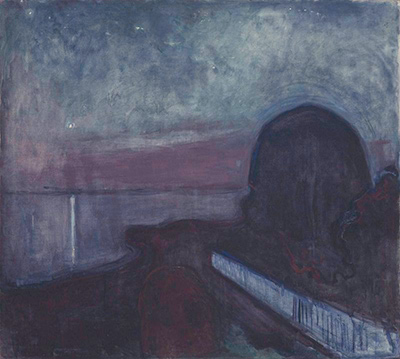
| Starry Night — Åsgårdstrand | 1893 | Oil on canvas |
| Metabolism | 1898–1899 | Oil on canvas |
| Red and White | 1899–1900 | Oil on canvas |
| Consul Christen Sandberg | 1901/1910 | Oil on canvas |
| The Researchers | 1911/1925–27? | Oil on canvas |
| On the Sofa | 1913 | Oil on canvas |
| Workers on their Way Home — Oslo | 1913–1914 | Oil on canvas |
| Workers on their Way Home — Copenhagen | 1914 | Oil on canvas |
| Starry Night — Ekely, upright version | 1922–1924 | Oil on canvas |
| Starry Night — another Ekely version | 1922–1924 | Oil on canvas |
| Woman | 1925 | Oil on canvas |
Frequently Asked Questions
No. MUNCH's MM.M.00365 is a different, larger canvas dated 1913–1914. [3]
Discussion
Follow the approaching figures and the painted marks of the street.
Reader Insights
Which figure first catches your attention, and what makes you notice him?
How does the painted road contribute to the feeling of movement?
Where does the crowd become difficult to separate into individuals?
Join the Conversation
Share a detail, comparison or question about Workers on Their Way Home below.
References
- Statens Museum for Kunst, Workers on their Way Home, 1914, KMS3823. Object catalogue, dating note and acquisition record; interface in English, some catalogue notes in Danish. View source.Splash image: Workers on their Way Home, 1914. Oil on canvas, 130.7 × 160.8 cm. Statens Museum for Kunst, Copenhagen, KMS3823.
- Galleri F 15, Munch og Moss 1913–1916, 2013. English exhibition interpretation. View source.
- MUNCH, Workers on their Way Home, 1913–1914, MM.M.00365. Separate Oslo canvas. View source.
- MUNCH, Workers on Their Way Home, 1914, PE.M.00194, Woll M 1095. Cross-catalogue record for the Copenhagen painting. View source.