by Tom Gurney
Tom Gurney BSc (Hons) is an art history expert with over 20 years experience
Published on June 19, 2020 / Updated on November 5, 2026
Email: tomgurney1@gmail.com / Phone: +44 7429 011000
The Researchers / Alma Mater
A mother nurses her baby at the centre of a broad shore. Around her, children bend towards the ground, sit with objects in their hands and explore the space beside the water. The pale sky and sea stretch across the background, while a green slope rises at the right. Learning appears here as bodily curiosity within a living landscape.
This monumental painting by Edvard Munch belongs to MUNCH in Oslo. The current catalogue calls it The Researchers, Norwegian Forskerne, inventory MM.M.01091, Woll M 969. Also known as The Scientists / Alma Mater, it is a separate canvas from the university's Alma Mater. MUNCH records its date as 1911/1925–27?, retaining uncertainty about its later revision. [1] [2]
At a Glance
Two monumental canvases
Contents
A mother at the centre
The seated woman establishes the painting's principal upright form. Her head rises above the surrounding figures, while the broad skirt gives her a stable base. The nursing baby brings attention towards her upper body, concentrating the idea of nourishment within an otherwise widely distributed scene.
Her pose differs from the bent and crouching bodies around her. She holds the centre through relative stillness, while the children create smaller, changing movements to either side. This contrast gives the picture a hierarchy without making the peripheral figures seem incidental. Their activities help explain what the central image can mean.
The upright child beside her makes another important transition. Standing close to the central group, the child links its vertical presence with the more scattered activity farther out. The figures form relationships through changes of height and posture, rather than through a single row of equally presented bodies.
Children discovering the shore
At the left, the clustered children bend towards the ground and towards one another. Their backs, heads and limbs create a sequence of curved forms against the more open sea. The repeated inclination of their bodies makes attention itself visible: they are absorbed in things close at hand.
At the right, seated figures create another concentration of activity. Knees and bent arms establish compact shapes near the slope, while the space between them suggests a small encounter around what they are examining. The painting allows curiosity to take several bodily forms across its length.
MUNCH's interpretation identifies the children's discoveries with stones, shells, plants and shore creatures. It reads their exploratory play as the beginning of research. That connection gives the title its force: inquiry starts with looking, touching and investigating the natural world. [2]
The bodies carry that meaning before we identify every small object. A child leaning forward and another sitting over something held near the knees demonstrate different kinds of concentration. The scene makes knowledge an activity taking place among people and their surroundings.
The long landscape
The canvas measures 428 × 1148 centimetres according to the current museum record. At more than eleven metres wide, it asks for a kind of looking very different from a small easel painting. Our attention travels across groups, returns to the mother and moves outward again. [1]
The sea and sky help hold those groups within one continuous setting. Their broad, comparatively open passages counter the changing human silhouettes below. Small shapes in the distance and scattered marks in the sky keep that openness active without competing equally with the foreground figures.
The rising green ground at the right creates an asymmetry. It gives one side of the picture a firmer enclosure, while the left opens more directly towards the shore and water. The mother remains central, but the landscape does not repeat itself identically on either side of her.
A university imagined through nourishment
The alternative title Alma Mater connects the nursing mother with the idea of a nourishing institution. In its account of the subject, MUNCH links the mother with enduring life and the children with the beginnings of investigation. Its interpretation places the motif in the landscape around Hvitsten on the Oslo Fjord. [2]
This makes the ordinary shore a setting for an ambitious public image. The picture can address education without surrounding its figures with a library, lecture room or formal apparatus. The relationship between mother, children and natural environment supplies a visual language for continuity and discovery.
The metaphor remains an artistic construction. The painting selects particular relationships and gives them a monumental form. Its account of learning is made persuasive through bodies, scale and rhythm, rather than by describing all the activities or people that a university contains.
The Aula commission
The subject developed within Munch's long effort to decorate the University of Oslo's Aula. The university's present history describes a prestigious commission and a dispute over the relationship between modern painting and the hall's classical architecture. The final group of eleven paintings was installed in 1916. [3]
MUNCH's archival commentary traces the competition back to 1909. Neither Munch's nor Emanuel Vigeland's proposed work was accepted for the 1911 celebrations, when the hall instead received temporary silk decoration. Further exhibitions and debate preceded the eventual installation. The finished scheme emerged through sustained work and reconsideration. [4]
That history gives the motif a public dimension beyond a family group on a beach. The nursing mother and exploring children had to work within an architectural setting and among other large images. Their legibility across a wide surface belongs to that ambition, even though this canvas now has a separate museum identity.
Two paintings, not one travelling canvas
The university's Alma Mater is catalogued as UiO.K.01405, Woll M 1220, dated 1915–1916 and measuring 455 × 1160 centimetres. Those details identify another painting. They should not be substituted for the museum work's uncertain revision date or its current recorded dimensions. [5]
MUNCH's interpretation explains that both versions were displayed in the Aula during the artist's lifetime. Its older account of a concert-hall display at the Munch Museum describes a historical arrangement, rather than a reliable guide to the museum's present rooms. The distinction between objects remains more useful than an inherited display label. [2]
The university's interpretation of its own Alma Mater similarly links nourishment with the continuation of knowledge. That shared conception helps explain why the titles overlap. The individual canvases nevertheless retain different catalogue records, dimensions and histories. [5]
Monumentality and close attention
Despite its enormous width, the picture repeatedly brings us towards small acts of looking. Bent heads, hands and knees make local centres of interest within the broader design. Scale does not remove intimacy; it distributes intimate activities across a public surface.
The central mother gives those activities a point of return. Looking from her to the shore's smaller groups, we experience both continuity and variation: one stable presence, many different investigations. Munch turns an expansive coastal scene into an image of how life sustains the curiosity through which the world is discovered.
Selected Munch paintings
Selected paintings documented by MUNCH, SMK and the Getty. Repeated titles identify separate objects. Each collection record gives the source for its title, date and medium.
| Name | Date | Medium |
|---|---|---|
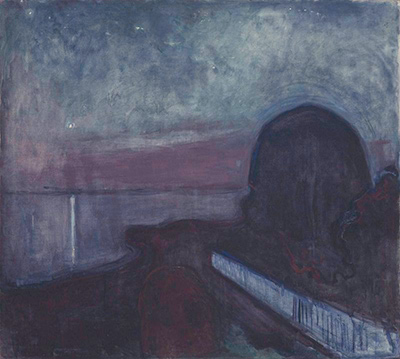
| Starry Night — Åsgårdstrand | 1893 | Oil on canvas |
| Metabolism | 1898–1899 | Oil on canvas |
| Red and White | 1899–1900 | Oil on canvas |
| Consul Christen Sandberg | 1901/1910 | Oil on canvas |
| The Researchers | 1911/1925–27? | Oil on canvas |
| On the Sofa | 1913 | Oil on canvas |
| Workers on their Way Home — Oslo | 1913–1914 | Oil on canvas |
| Workers on their Way Home — Copenhagen | 1914 | Oil on canvas |
| Starry Night — Ekely, upright version | 1922–1924 | Oil on canvas |
| Starry Night — another Ekely version | 1922–1924 | Oil on canvas |
| Woman | 1925 | Oil on canvas |
Frequently Asked Questions
It is a separate painting. The university canvas is UiO.K.01405, Woll M 1220, dated 1915–1916. [5]
MUNCH's current record uses 1911/1925–27?, distinguishing the earlier painting from a later, uncertain revision period. [1]
Discussion
Compare the stable central group with the exploring figures at either side.
Reader Insights
Which child's activity first draws you away from the central mother?
How does the landscape connect the separate groups?
What does the wide format contribute to the idea of discovery?
Join the Conversation
Share a detail, comparison or question about The Researchers / Alma Mater below.
References
- MUNCH, Forskerne / The Researchers, 1911/1925–27?, MM.M.01091, Woll M 969. Current catalogue, Norwegian interface; image dimensions 428 × 1148 cm. View source.Splash image: The Researchers / Alma Mater, 1911/1925–27?. Oil on canvas; image 428 × 1148 cm. MUNCH, Oslo, MM.M.01091.
- MUNCH, The Scientists / Alma Mater, interpretation contributed to Google Arts & Culture. Subject, Hvitsten context and two-version history. Its older approximate dimensions and display description are not used as current metadata. View source.
- University of Oslo, Edvard Munch and the art in the University Aula. Commission history and installation. View source.
- MUNCH digital archive, The Aula Decorations. Competition and 1911–1916 chronology. View source.
- University of Oslo, Alma mater, UiO.K.01405, Woll M 1220. Separate university canvas, 1915–1916. View source.