by Tom Gurney
Tom Gurney BSc (Hons) is an art history expert with over 20 years experience
Published on July 18, 2026 / Updated on July 18, 2026
Email: tomgurney1@gmail.com / Phone: +44 7429 011000
Corinne at Cape Miseno by Francois Gerard: Introduction
Francois Gerard's Corinne at Cape Miseno is a painting about memory, literature and performance after loss. It is not a court portrait, but it belongs to the same world of cultivated self-presentation that shaped many of Gerard's portraits. A woman poet has stopped speaking. Her listeners remain transfixed. The scene turns literary emotion into a large public image, poised between Neoclassical clarity and Romantic feeling.
The Musee des Beaux-Arts de Lyon identifies the work as Corinne au Cap Misene, painted by Francois Gerard between 1819 and 1821 [1]. It is a large oil on canvas, 256.6 by 277.5 cm, in the Lyon collection, inventory A 2840 [1]. The museum's record gives the painting a unusually rich social history: it was commissioned by Prince August of Prussia in 1819, with Juliette Recamier acting as intermediary, in homage to Germaine de Stael, who had died two years earlier [1].
At a Glance
- ArtistFrancois Gerard
- Date1819-1821
- Mediumoil on canvas
- Dimensions256.6 x 277.5 cm
- CollectionMusee des Beaux-Arts de Lyon
- Inventory
A 2840 - SubjectCorinne, from Germaine de Stael's novel Corinne ou l'Italie
- CommissionPrince August of Prussia, with Juliette Recamier as intermediary
Contents
- Introduction
- A Painting After Stael
- Germaine De Stael And Memorial Culture
- Juliette Recamier's Role
- Looking At The Scene
- Neoclassicism And Romantic Feeling
- A Woman Of Genius
- The Abbaye-Aux-Bois Salon
- Relation To Gerard's Portraits
- Why The Painting Matters
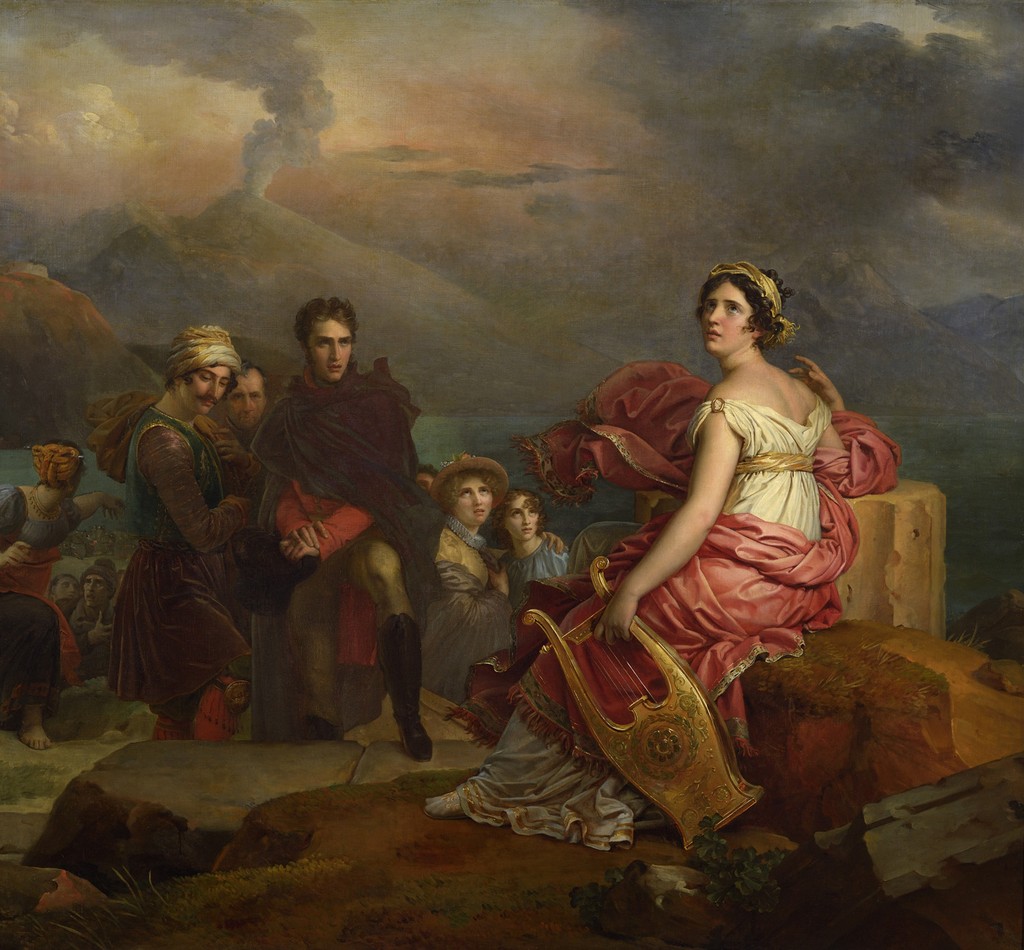
Francois Gerard, Corinne at Cape Miseno, 1819-1821. Musee des Beaux-Arts de Lyon, via Wikimedia Commons, CC BY-SA 3.0.
A Painting After Stael
The subject comes from Germaine de Stael's novel Corinne ou l'Italie, published in 1807 [1]. Stael's Corinne is a poet, performer and woman of genius whose art is inseparable from feeling, memory, nation and landscape. Gerard's painting does not try to summarize the whole novel. It gives visual form to a heightened moment of poetic exhaustion.
Lyon describes the scene as set at Cape Miseno, facing the Bay of Naples, with Vesuvius in the background [1]. Corinne has been summoning memories linked to the ancient sites around her. Overcome by emotion, she interrupts her improvisation and sets down her lyre [1]. Before her are Oswald, an English officer, and his companions, still held by the beauty of what they have heard [1].
The subject is therefore not action in the usual sense. It is aftermath. The poem has just filled the air. The listeners have not yet recovered. Gerard paints the pause after inspiration, the instant when language has stopped but feeling remains.
This choice makes the painting unusually subtle as a literary image. A more obvious painter might have shown Corinne in the middle of performance, lyre raised and body animated by speech. Gerard chooses the emotional recoil. The power of the poem is measured through exhaustion and response. Corinne's silence becomes the proof that something intense has happened.
The surrounding figures make that silence public. Oswald and the others are not secondary decoration. They give a model for reception: astonishment, sympathy and suspended attention. Gerard's art often depends on controlled looking, and here he turns looking itself into the subject.
Germaine De Stael And Memorial Culture
The commission gives the painting its emotional charge. Prince August of Prussia ordered it in homage to Stael, with Recamier as intermediary [1]. Stael had died in 1817, two years before the commission. The painting therefore belongs to a culture of mourning and remembrance as much as to literary illustration.
Lyon notes that the commission asked Gerard to give Corinne the features of Madame de Stael, but that Gerard instead created an idealized representation [1]. That choice is crucial. A literal portrait would have made the painting more directly commemorative, but perhaps less poetic. Gerard's ideal Corinne becomes both a memorial to Stael and an image of inspired womanhood.
This idealization should not be mistaken for emotional distance. Gerard's Corinne is not simply a classical figure placed into a novel. She is a literary presence caught at a moment when art overwhelms the artist. The painting honors Stael by turning her heroine into a lasting emblem of poetic genius.
The decision also avoided reducing Stael to portrait likeness. Stael's importance lay in writing, intellect, conversation and force of personality. A direct facial resemblance might have narrowed the memorial. Gerard instead created a figure who could carry Stael's memory through the fictional identity of Corinne. The result is less documentary, but more symbolic.
That symbolism suited the people involved in the commission. Prince August, Recamier and Stael belonged to a world in which feeling, literature and social bonds were deeply entwined. The painting is not a neutral illustration ordered from a text. It is an image made by a network of remembrance.
Juliette Recamier's Role
Juliette Recamier links the painting to Gerard's earlier portraiture and to the social life of literature. She acted as intermediary for the commission [1], and Prince August later gave the finished painting to her as a token of affection [1]. The work then occupied a prominent place in Recamier's apartment at the Abbaye-aux-Bois in Paris, at the center of her famous salon [1].
That history matters because Corinne at Cape Miseno was not only a painted literary subject. It became an object in a salon where art, literature and conversation met. The painting's meaning expanded through its setting. It remembered Stael, reflected Recamier's relationships, and shaped the atmosphere of a room where writers and artists gathered.
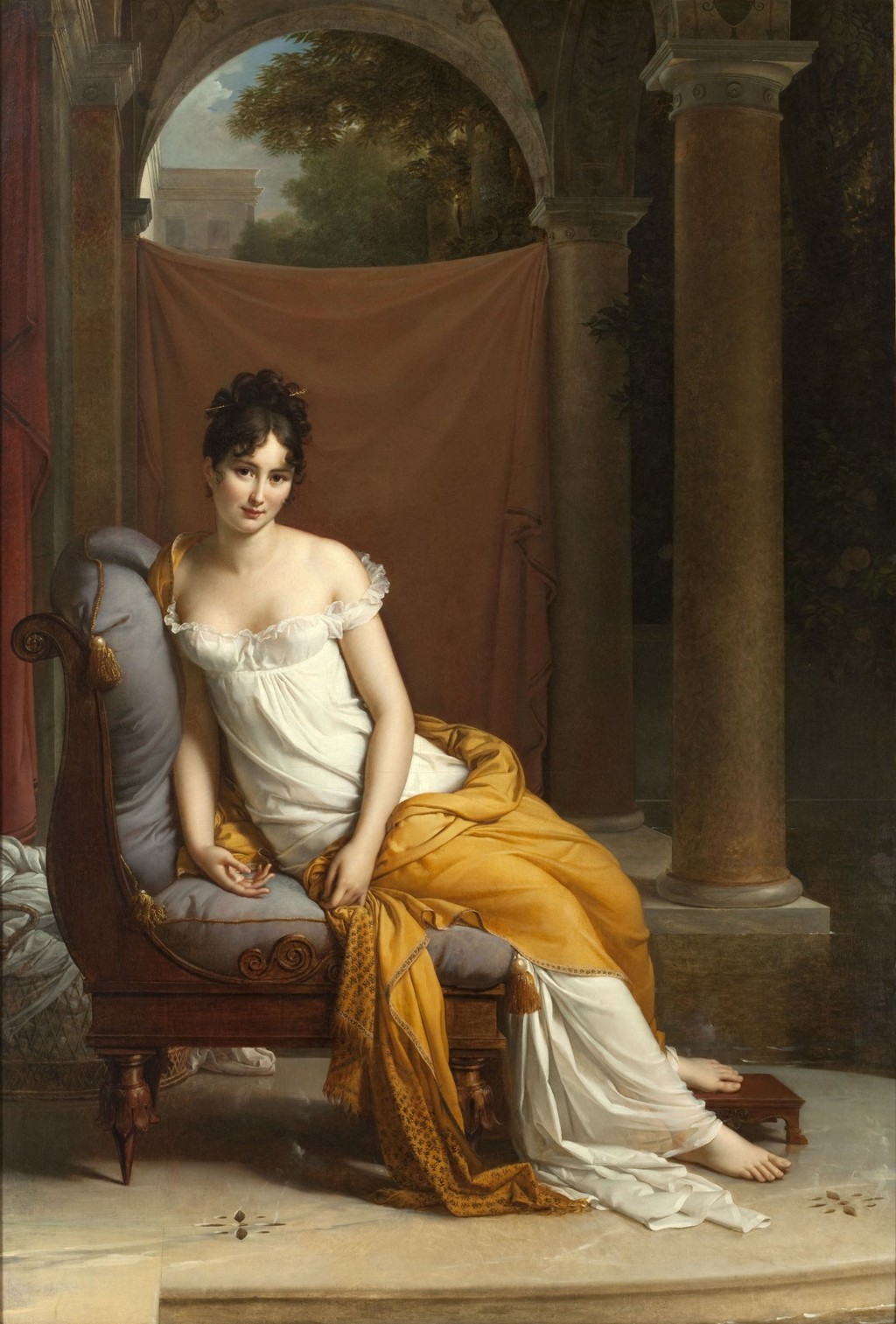
Gerard's earlier portrait of Recamier also belongs to this world. In that work, he helped create one of the key images of her public identity. In Corinne, he painted a literary memorial that later became part of her own social environment. The two paintings show how strongly Gerard's art was tied to the culture of salons and cultivated memory.
The Abbaye-aux-Bois setting also changed the painting's audience. In a museum, the work is encountered as a historical object. In Recamier's salon, it would have been seen among people who knew the relationships behind it. The painting was a memory-image, a conversation piece and a statement of literary allegiance at once.
Looking At The Scene
The painting's drama begins with interruption. Corinne has stopped improvising. The lyre, the traditional attribute of poetic inspiration, has been lowered. Her body and gesture must carry the emotional force that words no longer express.
The listeners are essential. Without Oswald and the surrounding figures, Corinne's feeling might become private absorption. With them, the painting becomes a scene of performance and reception. Gerard shows the power of poetry by showing its effect on an audience.
The landscape also matters. Cape Miseno, the Bay of Naples and Vesuvius are not neutral background. They connect Corinne's emotion to place, history and classical memory. The ancient sites around Naples had immense imaginative power for European artists and writers. Gerard uses that setting to make literary inspiration feel rooted in history.
The night sky and distant volcano introduce an atmosphere unlike the cooler clarity of Gerard's earlier mythological work. The emotion is still controlled, but the setting is more picturesque and expansive. The painting asks the viewer to feel the pressure of landscape on the imagination.
Vesuvius is especially important as more than a scenic detail. Its presence gives the background a latent energy, a natural counterpart to Corinne's inner force. The volcano does not erupt in theatrical excess; it broods. That restraint mirrors Gerard's treatment of the heroine. Feeling is powerful, but contained.
The scale of the canvas strengthens this effect. At 256.6 by 277.5 cm, the work is physically large enough to surround the viewer with the scene [1]. Gerard gives literary feeling the dimensions of history painting.
Neoclassicism And Romantic Feeling
Lyon's interpretation is especially useful because it places the painting between artistic languages. The museum notes that Gerard reconciles purity of line and a search for grace and idealism, inherited from Jacques-Louis David's Neoclassicism, with newer ideas leaning toward Romanticism in sentiment and picturesque detail [1].
That balance makes Corinne at Cape Miseno one of Gerard's most revealing later works. The painting does not abandon Neoclassical discipline. The figures remain composed, the line remains legible and the emotional scene is carefully staged. Yet the subject and atmosphere point toward a different kind of intensity.
This is not Romanticism as violent rupture. It is Romantic feeling filtered through Gerard's preference for order. Corinne is overcome, but the painting itself is not uncontrolled. Gerard's art bends toward emotion while retaining the poise that made him famous.
That blend also helps place Gerard between generations. He remained attached to the forms of Davidian training, but the cultural climate around him had changed. Literature, memory, exile, landscape and inward feeling had become more urgent artistic materials. Corinne at Cape Miseno shows Gerard responding to that shift without abandoning the habits of composition that defined him.
A Woman Of Genius
Corinne is a rare subject because she is not merely beautiful, noble or available for admiration. She is a poet whose genius is visible through performance. Gerard has to show inspiration, intelligence and emotional strain without turning the scene into theatrical excess.
The result is a painting about female creativity as public presence. Corinne does not write silently in private. She improvises before listeners. Her genius takes place in speech, sound, gesture and shared feeling. The moment Gerard paints is the charged silence after that performance.
The choice to idealize her rather than make her a direct portrait of Stael gives the image a broader force. Corinne can stand for Stael, but also for the idea of the woman poet as cultural authority. This is why the painting mattered in Recamier's salon. It gave visual form to a literary world in which women were not only muses but creators, patrons and hosts of intellectual life.
This point is crucial to the painting's modern interest. The work is built around a woman whose power comes from art and speech. Her audience includes men moved by what she has created. Gerard's composition therefore reverses a familiar pattern in which women are admired primarily for beauty. Corinne is admired for genius, even if Gerard's idealizing style makes beauty part of that genius.
The Abbaye-Aux-Bois Salon
After Prince August gave the painting to Recamier, it held a place of honor in her apartment at the Abbaye-aux-Bois [1]. This later setting is one of the most important facts in the painting's history. The work was not hidden in a private collection detached from conversation. It stood in a salon where art and literature continued to be performed socially.
In that room, Corinne at Cape Miseno would have functioned as memory and atmosphere. It recalled Stael, embodied literary feeling and marked Recamier's own relationships with August and Gerard. It also placed a large image of female poetic authority in a social space shaped by a famous woman host.
The painting was later bequeathed by Recamier in 1849 [1]. Its movement from commission to gift to salon object to museum collection preserves the social path of the work. Gerard painted a literary scene, but the painting's own life was also literary, social and commemorative.
The bequest gives the work a final connection to Recamier's legacy. She did not only receive and display the painting; she ensured its survival in a public collection. That later act continued the chain of mediation that had begun with the commission itself.
The Lyon record therefore preserves more than object facts. It preserves a social biography: Stael's novel, August's commission, Recamier's mediation, salon display, bequest and museum afterlife all remain attached to the canvas.
Few Gerard paintings carry so many relationships inside a single literary scene.
Relation To Gerard's Portraits
Although Corinne at Cape Miseno is not a portrait in the ordinary sense, it shares Gerard's portrait intelligence. The central figure must carry an identity through pose, expression, costume and setting. The surrounding space must clarify who she is and why she matters.
Gerard's portraits often show people who know they are being seen. Corinne is different: she is seen at the moment after artistic transport. Yet the painting still depends on the public body. Her genius is made visible through how she appears before others.
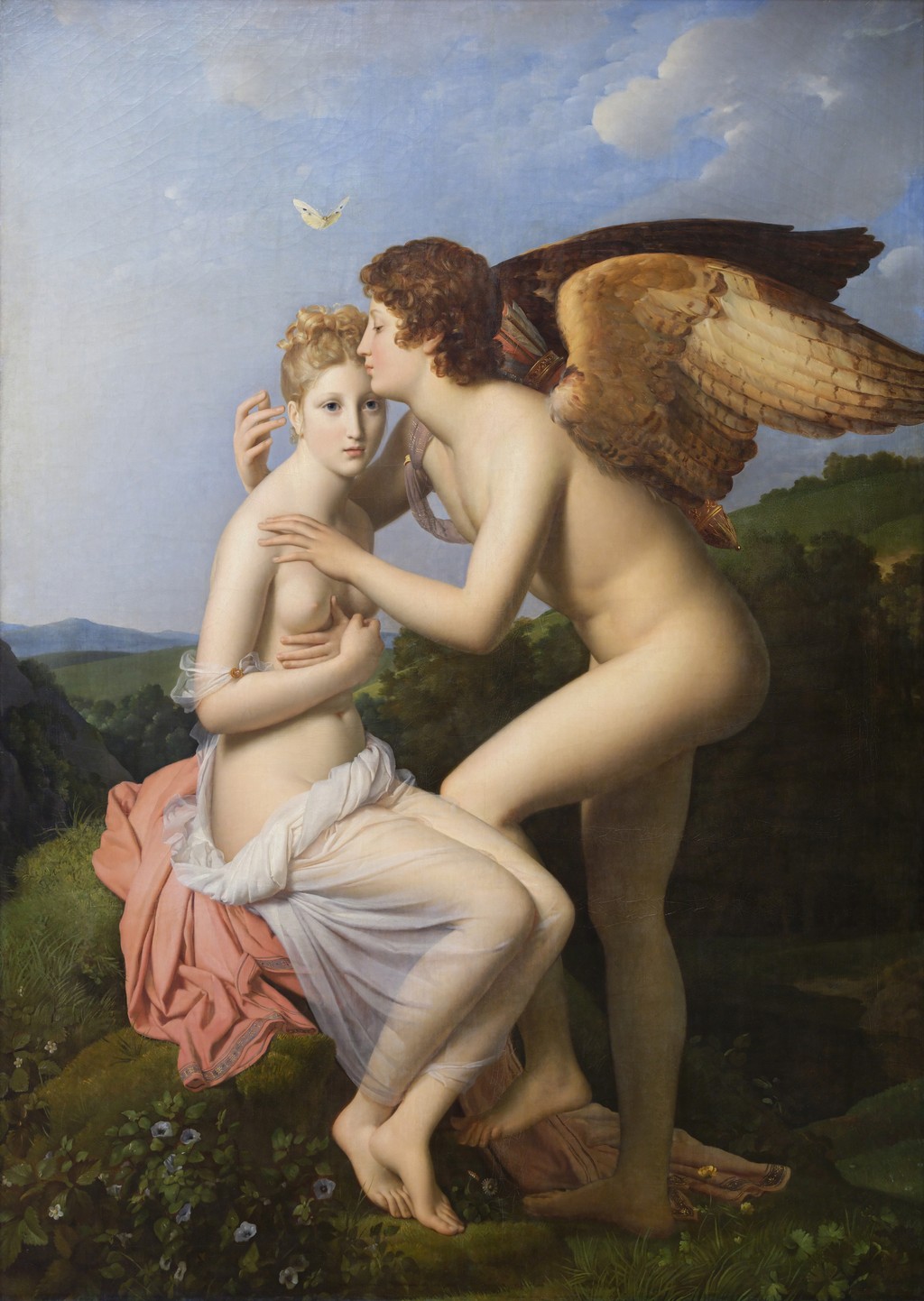
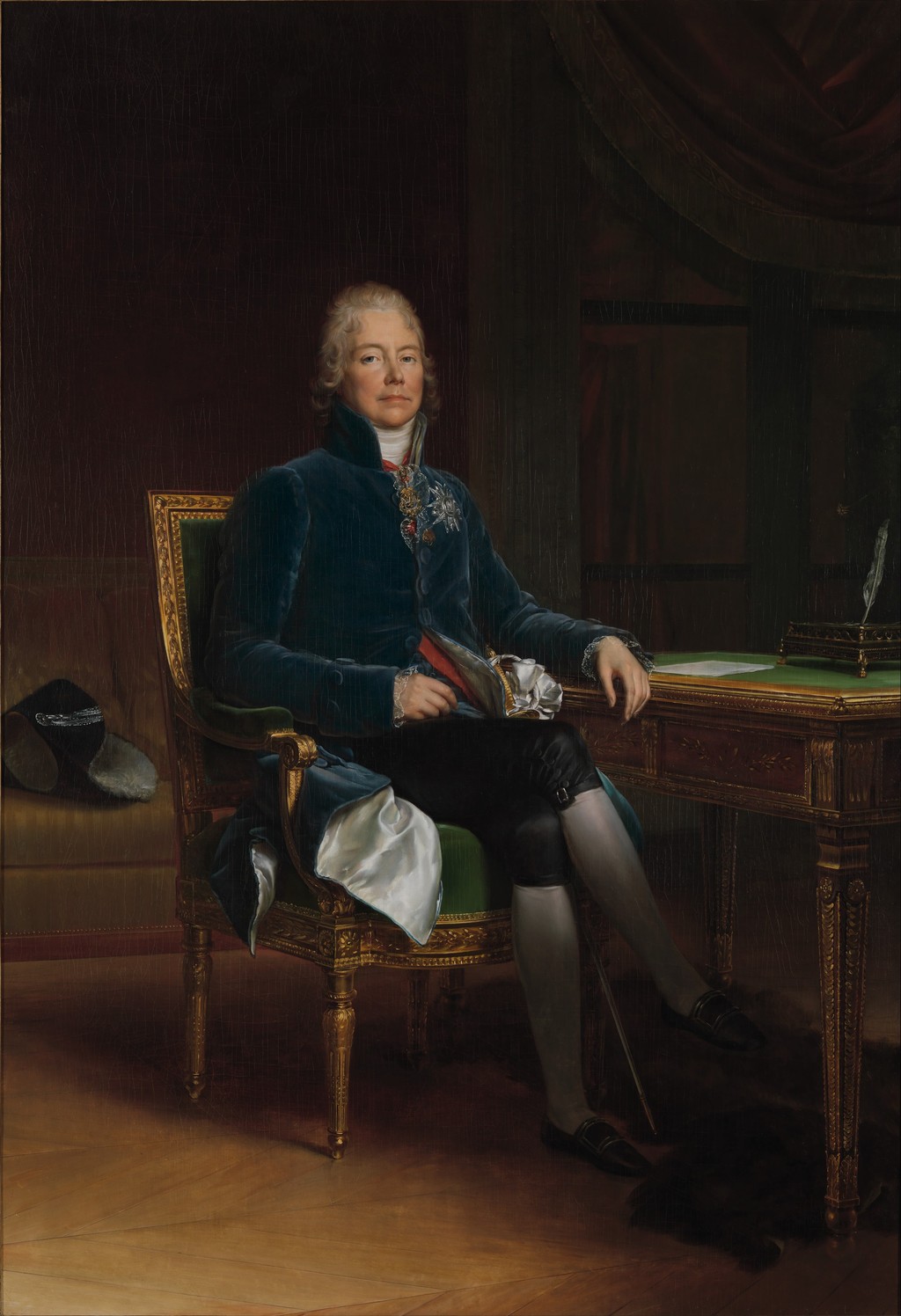
This connection helps place Corinne beside Juliette Recamier, Psyche and Cupid and Talleyrand. Each painting presents a figure under the pressure of being looked at. In Talleyrand, the pressure is political. In Recamier, it is social. In Psyche, it is erotic and mythological. In Corinne, it is poetic.
Why The Painting Matters
Corinne at Cape Miseno matters because it widens Gerard's career beyond official portraiture. It shows him engaging literature, memorial feeling, salon culture and the changing emotional atmosphere of post-Napoleonic art.
The painting also gives a different view of Gerard's restraint. In his official portraits, restraint often protects rank. In Corinne, restraint protects feeling from becoming melodrama. The subject is full of emotion, but Gerard keeps the composition clear enough for that emotion to endure.
The work is also important because it links three major figures: Stael, Recamier and Prince August of Prussia. Gerard becomes the painter through whom their literary, emotional and social relationships take visible form.
Above all, the painting shows that Gerard's elegance could serve memory as well as power. It makes a novel, a dead writer, a living salon, a prince's affection and a woman's poetic genius meet in one large canvas.
Frequently Asked Questions
The painting is based on Germaine de Stael's novel Corinne ou l'Italie, published in 1807.
Prince August of Prussia commissioned the painting in 1819, with Juliette Recamier acting as intermediary.
Recamier helped mediate the commission, later received the painting from Prince August and displayed it in her Abbaye-aux-Bois salon.
Lyon describes the work as joining Davidian purity of line and ideal grace with stronger sentiment and picturesque detail.
Discussion
Gerard's art often asks viewers to read public roles through small signs of pose, dress, surface and setting. Use the prompts below as starting points for looking closely.
Reader Insights
What detail most shapes your reading of Corinne at Cape Miseno: pose, setting, costume, expression or historical context?
How does Gerard balance public identity with a more personal or psychological presence?
Which comparison helps most: David's studio, Napoleonic portraiture, Restoration image-making or salon culture?
Join the Conversation
Share a thoughtful comment below about what you notice, question or compare when looking at this work.
References
- Musee des Beaux-Arts de Lyon, Corinne at Cape Miseno https://www.mba-lyon.fr/en/fiche-oeuvre/corinne-cape-miseno