by Tom Gurney
Tom Gurney BSc (Hons) is an art history expert with over 20 years experience
Published on July 18, 2026 / Updated on July 18, 2026
Email: tomgurney1@gmail.com / Phone: +44 7429 011000
Talleyrand by Francois Gerard: Introduction
Francois Gerard's portrait of Talleyrand is a painting about political intelligence made visible through restraint. The sitter does not need a dramatic gesture. He does not need military motion or heroic display. He sits with the calm of someone who has survived too many regimes to be easily read. Gerard turns that composure into an image of power: elegant, controlled, and deliberately difficult to penetrate.
The Metropolitan Museum of Art identifies the painting as Charles Maurice de Talleyrand Perigord, painted by Francois Gerard in 1808 [1]. It is an oil on canvas in the Met's European Paintings collection, object number 2012.348 [1]. The museum's record gives the painting its key historical tension: the portrait was made after Talleyrand had resigned as Napoleon's foreign minister, and Gerard knew him personally [1].
At a Glance
- ArtistFrancois Gerard
- Date1808
- Mediumoil on canvas
- CollectionThe Metropolitan Museum of Art
- Object number
2012.348 - SubjectCharles Maurice de Talleyrand-Perigord
- Contextpainted after Talleyrand's resignation as Napoleon's foreign minister
Contents
- Introduction
- Who Was Talleyrand?
- The 1808 Moment
- Gerard And The Sitter
- Reading The Portrait
- Portraiture And Political Survival
- The Met And The Object Today
- Why The Portrait Matters
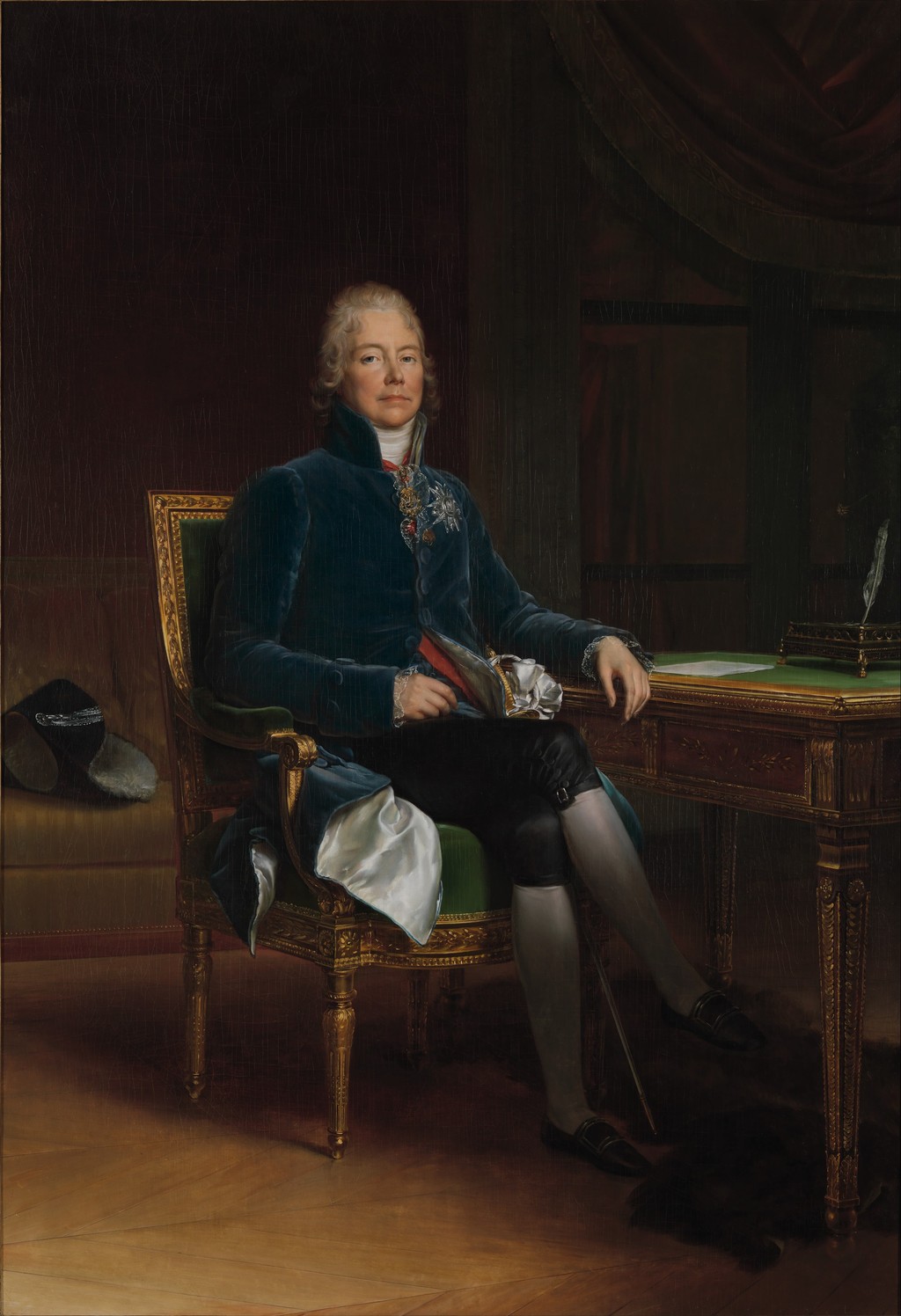
Francois Gerard, Charles Maurice de Talleyrand Perigord, 1808. Metropolitan Museum of Art, New York, public domain.
Who Was Talleyrand?
Charles Maurice de Talleyrand-Perigord was one of the most famous diplomats of modern Europe. His career crossed the final years of the French monarchy, the Revolution, Napoleon's Empire, the Bourbon Restoration and the post-Napoleonic settlement. He became a symbol of political survival, admired for diplomatic skill and distrusted for the same reason.
Gerard's portrait does not need to narrate that whole career. Its power comes from suggesting it. Talleyrand appears as a man whose authority lies in poise rather than force. The viewer is invited to read dress, posture, face and honors, but not to expect confession. That controlled unreadability is central to the portrait.
The 1808 Moment
The date matters. The Met states that the portrait was commissioned after Talleyrand resigned as Napoleon's foreign minister [1]. That means the image belongs to a moment of transition rather than simple triumph. Talleyrand was no longer occupying the same official position, yet he remained a figure of immense consequence.
Gerard's task was therefore delicate. A portrait made at this moment could not present Talleyrand merely as a servant of Napoleon, nor could it detach him entirely from imperial power. The painting had to show standing, intelligence and rank while leaving room for political movement. Gerard's polished language was perfectly suited to that ambiguity.
Portraiture often fixes identity. This portrait does something subtler: it fixes flexibility. Talleyrand appears complete, but not trapped by a single office or regime.
Gerard And The Sitter
The Met notes that Gerard knew Talleyrand personally [1]. That relationship matters because the portrait is not only an official likeness arranged by distance. It comes from an artist familiar with the sitter's world. Gerard himself was moving among patrons, salons and political elites. He understood the codes by which status could be signaled without blunt declaration.
This shared social world helps explain the portrait's tone. Talleyrand is not dramatized as a villain, hero or martyr. He is presented as a consummate public man. Gerard gives him composure, refinement and the kind of authority that depends on being watched without seeming anxious about being watched.
The Met's account is especially sharp because it does not treat the painting as a simple record of Talleyrand's face. It notes the balance between the sitter's ease, imposing presence and unrevealing expression, as well as the contrast between the calm of Talleyrand's body and the more highly worked chair and desk [1]. That contrast gives the portrait much of its intelligence. The furniture is animated; the man remains cool.
Gerard uses that contrast to stage a political temperament. Talleyrand's body does not need to perform energy because the surrounding signs do part of the work. The gilt chair, desk and honors create a field of activity around a sitter who appears to reserve himself. The painting therefore makes stillness feel strategic rather than empty.
This is where personal knowledge of the sitter matters. A painter who knew Talleyrand could understand that too much expression would be a mistake. The public legend of Talleyrand depended on control, indirection and timing. Gerard's portrait protects that legend by refusing emotional overstatement.
Reading The Portrait
The portrait's first effect is calm. Talleyrand's body is arranged with ease, but that ease is carefully constructed. His clothing, setting and honors identify status, while his expression withholds more than it reveals. Gerard balances likeness and performance.
The sitter's political career makes every sign in the portrait feel charged. Honors are never only decoration in such an image. They mark affiliation, memory and rank. The Met record notes that the honors in the portrait were updated after the Congress of Vienna [1]. That detail is extraordinary because it shows the painting adapting to the sitter's changing political reality.
A portrait that can be updated in this way is not simply a snapshot of one year. It becomes a living political object. Gerard's painting had to accommodate Talleyrand's future as well as his past.
This is where the portrait becomes especially revealing. A military portrait often turns on action, victory or command. A royal portrait often turns on inheritance, ceremony or sacred legitimacy. Talleyrand's portrait turns on continuity through change. The sitter's achievement was not conquest in the battlefield sense, but the ability to remain necessary while governments rose and fell.
The Congress of Vienna detail gives the portrait a second date hidden inside the first. The painting was made in 1808, but its honors were adjusted after 1815, when Talleyrand played a major role in the post-Napoleonic settlement and received the Order of the Golden Fleece [1]. This makes the work unusually eloquent about political time. It carries the memory of the Empire and the evidence of the world after the Empire.
For Gerard, that kind of alteration was not merely technical. It was part of portraiture's function among elites. A public image had to remain accurate enough to be useful and elevated enough to survive changes in office, title and alliance. The honors update shows a painting being kept politically current while preserving the authority of the original likeness.
Talleyrand's career almost demanded such an object. He was not a figure who could be contained by one regime. The portrait's later adjustment confirms what the image already suggests: this is a sitter whose identity depends on continuity through transformation.
Gerard gives visual form to that kind of power by avoiding obvious drama. The face is controlled. The body is settled. The costume is refined. The honors are present, but they do not explode across the painting as mere ornament. The image suggests that Talleyrand's authority lies in being unhurried. He appears as someone who can wait, negotiate and survive.
Portraiture And Political Survival
Gerard's broader career helps explain why this portrait works. He was trained in David's circle, rose under the Revolution, worked for Napoleon and remained important under the Restoration [2]. He understood, perhaps better than many artists, that power could change costume while still needing images.
Talleyrand's portrait is therefore a meeting between sitter and painter with unusually compatible skills. Talleyrand survived politics by mastering presentation, timing and ambiguity. Gerard succeeded as a portraitist by turning those qualities into elegant visual form. The painting is not psychological in a modern confessional sense. It is psychological because it knows the value of concealment.
The result is a portrait that feels less like praise than recognition. Gerard recognizes that Talleyrand's public identity depends on control. The painting does not break that control; it displays it.
The portrait also belongs to a wider world of Napoleonic and post-Napoleonic image-making. David's Napoleon images often turn the ruler into a figure of action or ceremony. Ingres's Napoleonic portraits emphasize strange frontality, splendor and almost icon-like authority. Gerard's Talleyrand operates differently. It presents a man near power rather than the ruler himself. That difference makes the painting more subtle. It shows the kind of person who survives by shaping events from beside the throne.
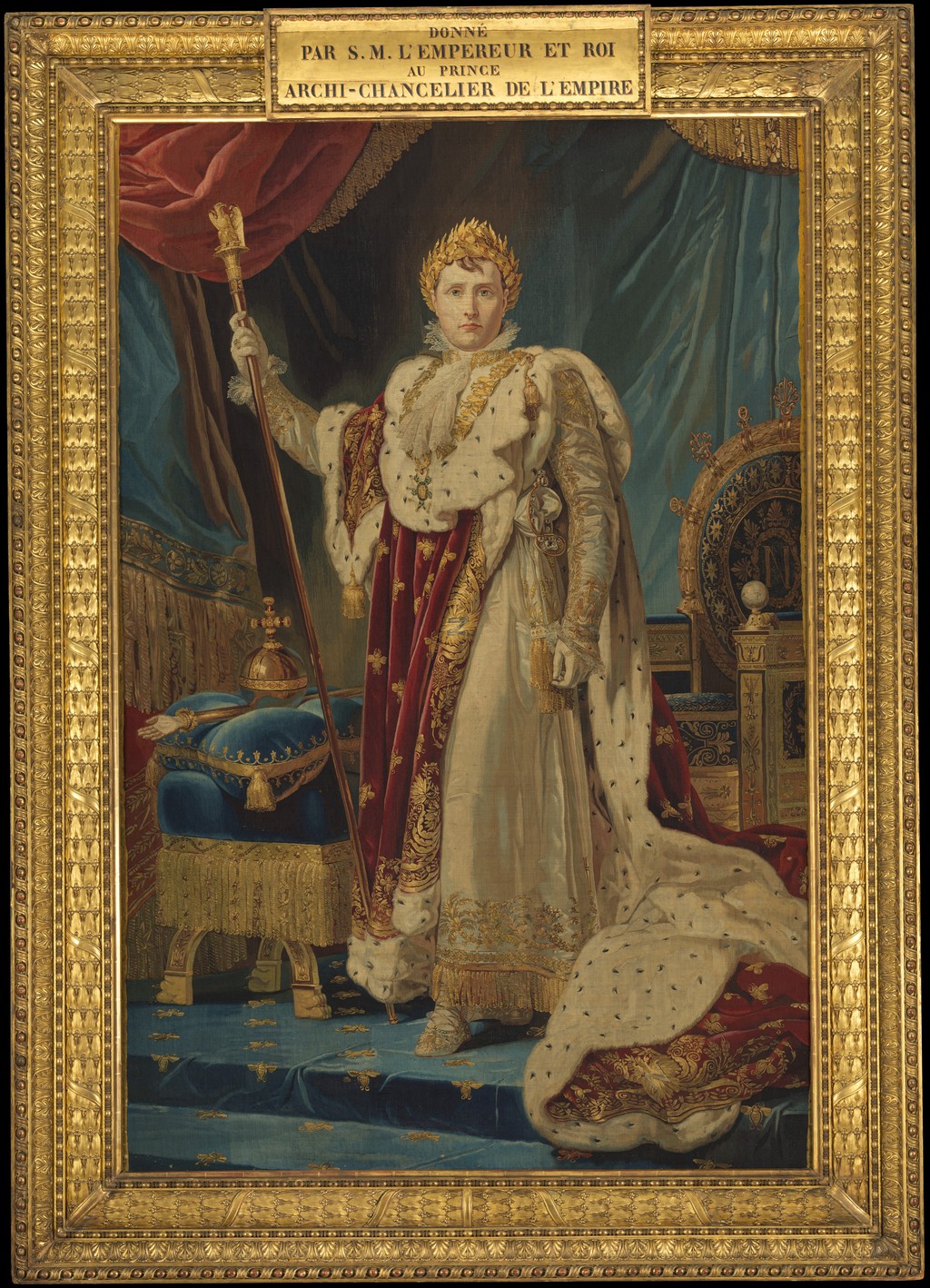
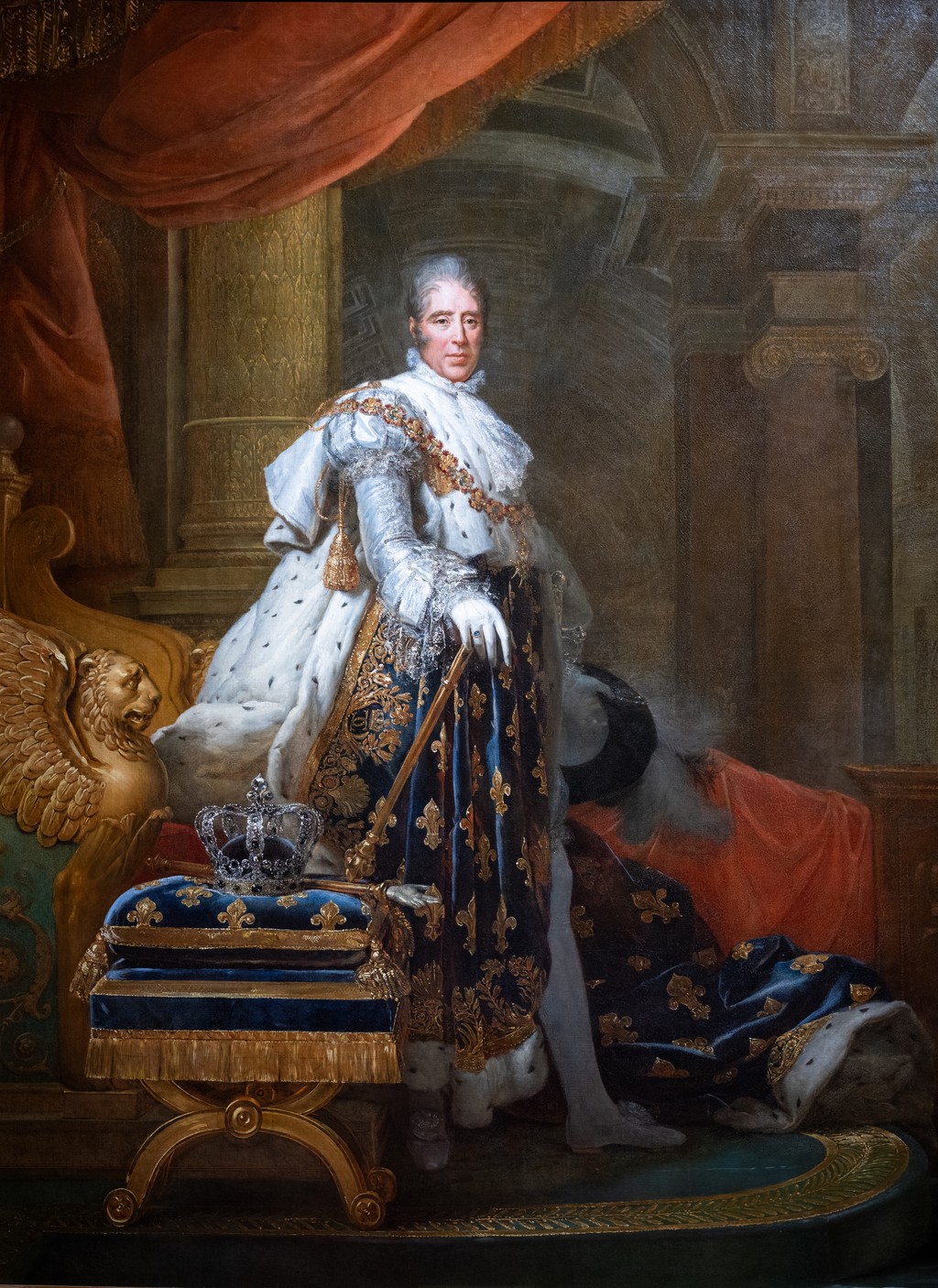
This is why the portrait is such a valuable counterpart to Gerard's official images of Napoleon and Charles X. Those works show sovereign display. Talleyrand shows the culture of counsel, negotiation and rank that surrounded sovereign power.
The Met And The Object Today
The Met's record gives the painting a clear modern collection identity. It is part of the museum's European Paintings collection, with object number 2012.348 [1]. That institutional setting changes the way the portrait is encountered. What began as an image of a living political actor is now studied as a historical object: a record of Gerard's art, Talleyrand's image and the visual culture of Napoleonic Europe.
As a result, Talleyrand is one of Gerard's strongest political portraits. It combines firm object information, a famous sitter, a clear historical moment and a painting that rewards close reading.
The Met's object number, 2012.348, also helps stabilize the work [1]. Talleyrand's image has a large historical aura, but the museum record keeps the discussion grounded in a specific object: one canvas, one date, one collection and one documented institutional history. That balance between famous sitter and concrete painting is essential. Without it, Talleyrand's biography could overwhelm Gerard's portrait.
The museum context also encourages a slower kind of looking. Talleyrand's name can easily overwhelm the painting because his political career is so famous. Gerard's canvas pulls the discussion back to visual choices: the calculated stillness, the measured display of rank and the coolness with which the sitter occupies space. The historical Talleyrand matters, but the portrait matters because Gerard found a pictorial language for that history.
The Met records the work as a large canvas, 83 7/8 by 57 7/8 inches, or 213 by 147 cm [1]. That scale is not incidental. Talleyrand is given the physical presence of a major public portrait, even though the painting's mood is quiet. The viewer confronts a body at near-official scale, not a small private likeness. Gerard's restraint therefore operates inside grandeur rather than instead of it.
The 2012 Met acquisition also gives the painting a modern chapter [1]. Its arrival in the European Paintings collection brought a major Gerard political portrait into a museum setting where it can be read alongside other images of power, diplomacy and post-Revolutionary Europe. That placement helps free the work from being only a French historical document. It becomes a case study in how portraiture can make political adaptation visible.
Kathryn Calley Galitz's Met Bulletin study frames Gerard through portraiture, scandal and power in Napoleonic France [3]. That framing is especially apt for Talleyrand. The painting is not scandalous in appearance; it is polished almost to silence. But the quiet surface belongs to a world of dangerous ambition, shifting loyalty and public reputation. Gerard's skill is to let the politics remain present without making the picture descend into anecdote.
This is why the portrait rewards repeated looking. At first, it may seem simply elegant. Then the resignation context, personal acquaintance, post-1815 honors and the sitter's larger career make the elegance feel loaded. The painting does not need to shout because its composure is the point.
It also clarifies Gerard's difference from more theatrical political painters. He does not stage Talleyrand as a decisive actor in a public crisis. He stages him as someone who has already absorbed crisis into manner. That is a subtler kind of drama, and it is exactly the kind Gerard could sustain across a long career of elite portraiture.
For Talleyrand, such drama could be more convincing than open display.
The portrait makes survival look like a cultivated discipline.
That is why the canvas belongs at the center of Gerard's political portraiture. It does not merely show a famous diplomat. It shows how a famous diplomat could be made durable in paint, ready to carry one past, one present and more than one future.
Why The Portrait Matters
Gerard's Talleyrand matters because it shows political portraiture at its most controlled. There is no battlefield, no coronation ceremony and no theatrical crisis. Instead, the painting offers a still image of a man whose importance lay in movement between systems.
The portrait asks viewers to think about power as performance. Talleyrand's clothing and honors matter, but so does his composure. Gerard makes political intelligence visible by refusing to overexplain it. The sitter's authority lies in the fact that he seems to know more than he says.
For Gerard, the painting demonstrates why he became so valued by elites. He could flatter without making flattery obvious. He could record rank without flattening personality. He could make survival look like elegance.
That last quality is what separates the portrait from a simple likeness. Gerard does not merely show what Talleyrand looked like in 1808. He shows how Talleyrand could be made to appear historically inevitable even in a moment after resignation. The portrait turns uncertainty into composure, and composure into authority.
The painting is also a reminder that portraits can be acts of timing. Had Talleyrand been painted only as a defeated minister, the image would have narrowed his future. Had he been painted only as Napoleon's servant, it would have aged badly as politics changed. Gerard's solution is more durable. He gives the sitter rank and distance, but keeps the image open enough to accommodate Talleyrand's next transformation.
That openness is the portrait's quiet brilliance. It shows a man of the Empire who could also belong to the world after the Empire. Few artists were better suited than Gerard to make that ambiguity look natural.
For that reason, the portrait is one of Gerard's sharpest political images. Its stillness is not passive. It is a strategy, both for the sitter and for the painter.
Gerard makes diplomacy visible without turning it into theater, which is why the portrait remains so controlled and unsettling.
It is elegance with political consequences.
Frequently Asked Questions
Talleyrand was a French diplomat and political figure whose career crossed the Revolution, Napoleon's Empire and the Bourbon Restoration. He is remembered for his diplomatic skill and political adaptability.
The Met records that the portrait was made after Talleyrand resigned as Napoleon's foreign minister. Gerard also knew Talleyrand personally, which helps explain the portrait's controlled social intelligence.
The Met notes that the honors in the portrait were updated after the Congress of Vienna. This shows how the painting adapted to Talleyrand's changing public position.
The painting is in the Metropolitan Museum of Art, European Paintings collection, object number 2012.348.
Discussion
Gerard's art often asks viewers to read public roles through small signs of pose, dress, surface and setting. Use the prompts below as starting points for looking closely.
Reader Insights
What detail most shapes your reading of Talleyrand: pose, setting, costume, expression or historical context?
How does Gerard balance public identity with a more personal or psychological presence?
Which comparison helps most: David's studio, Napoleonic portraiture, Restoration image-making or salon culture?
Join the Conversation
Share a thoughtful comment below about what you notice, question or compare when looking at this work.
References
- Metropolitan Museum of Art, Charles Maurice de Talleyrand Perigord (in English) https://www.metmuseum.org/art/collection/search/441969
- Chateau de Versailles, Francois Gerard (in English) https://en.chateauversailles.fr/discover/history/great-characters/francois-gerard
- Kathryn Calley Galitz, Francois Gerard: Portraiture, Scandal, and the Art of Power in Napoleonic France, Metropolitan Museum of Art Bulletin, 2013 https://www.metmuseum.org/met-publications/francois-gerard-the-metropolitan-museum-of-art-bulletin-v-71-no-1-summer-2013