by Tom Gurney
Tom Gurney BSc (Hons) is an art history expert with over 20 years experience
Published on July 18, 2026 / Updated on July 18, 2026
Email: tomgurney1@gmail.com / Phone: +44 7429 011000
Napoleon I in Coronation Robes by Francois Gerard: Introduction
Francois Gerard's image of Napoleon I in coronation robes is one of the clearest examples of portraiture becoming political machinery. The emperor stands in the costume of monarchy, but the portrait serves a new imperial regime. It borrows familiar signs of royal authority and turns them toward Napoleonic legitimacy. Gerard's task was not to show Napoleon in motion. It was to make him look inevitable.
The Louvre record for Portrait en pied de Napoleon Ier en costume du Sacre identifies a Gerard work in the Department of Paintings, inventory INV 4757 ; MR 1757 ; MV 5321, measuring 2.26 by 1.47 m [1]. The record states that the work was commissioned by Napoleon I for the Gobelins and is a replica of the painting commissioned for Talleyrand's hotel in 1805 [1]. The Metropolitan Museum of Art preserves a related tapestry after Gerard's painting, designed in 1805 and woven between 1808 and 1811 [2].
At a Glance
- ArtistFrancois Gerard
- SubjectNapoleon I in coronation robes
- Core painted objectLouvre record
INV 4757 ; MR 1757 ; MV 5321 - Louvre dimensions2.26 m high by 1.47 m wide
- Related objectMet tapestry after Gerard, designed 1805 and woven 1808-1811
- Contextofficial imperial portraiture, repetition, Gobelins production and Napoleonic state image-making
Contents
- Introduction
- An Official Image Of Empire
- Gerard, David And Imperial Taste
- The Talleyrand Connection
- Repetition And Versions
- The Gobelins And The Tapestry After Gerard
- Looking At The Image
- Tradition And Invention
- Why The Portrait Matters
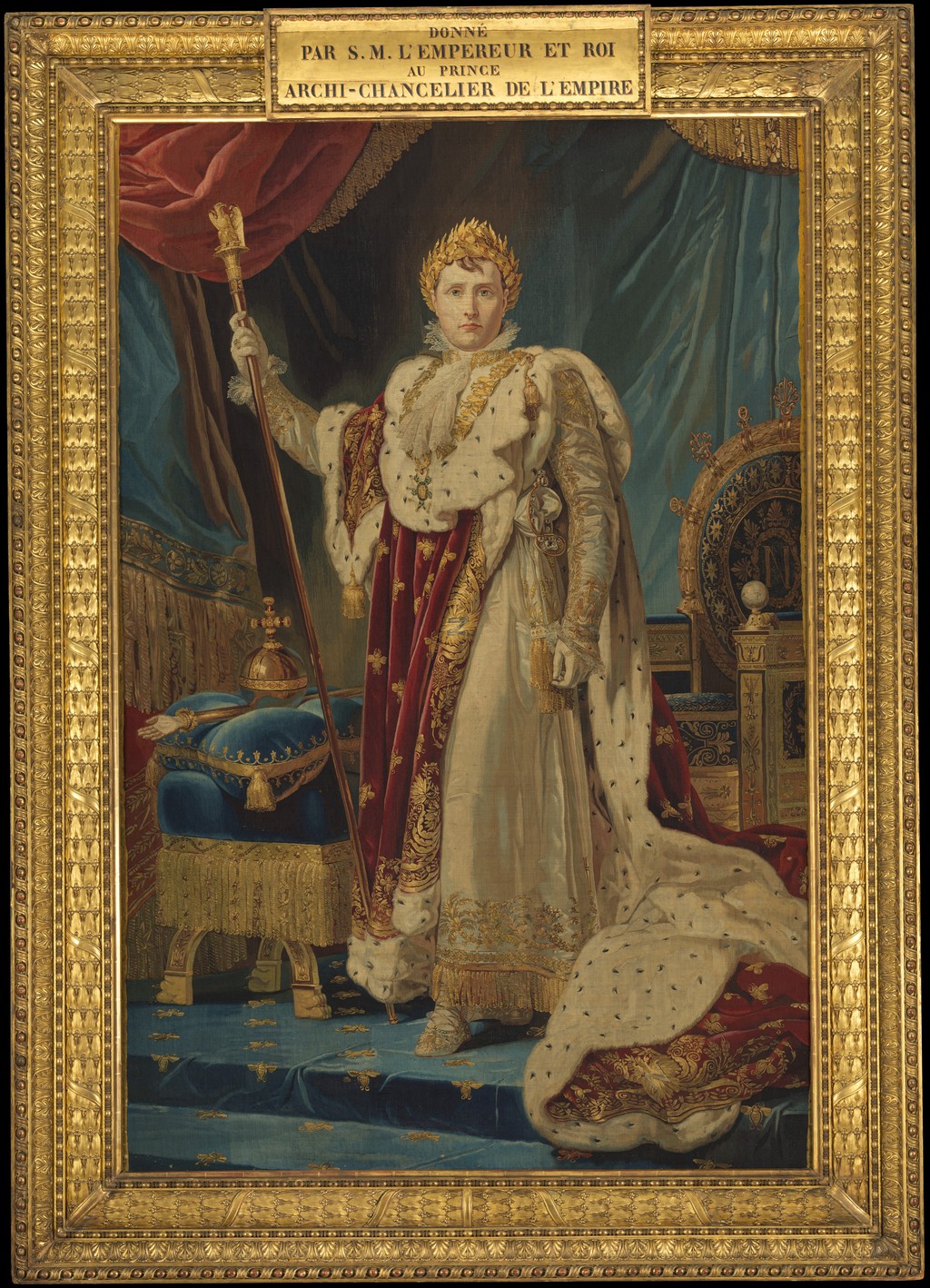
Portrait of Napoleon I, designed after Gerard's 1805 painted image and woven by the Gobelins in 1808-1811. Metropolitan Museum of Art, New York, public domain.
An Official Image Of Empire
Napoleon's power depended not only on armies and laws, but on images. After becoming emperor, he needed visual forms that could make the new regime appear legitimate. This was a delicate problem. The Revolution had attacked monarchy, yet the Empire borrowed many of monarchy's signs: throne, robes, regalia, ceremony and dynastic display.
Gerard's coronation-robes portrait belongs to that problem. Napoleon appears not as the young general of earlier campaigns, but as a ruler in ceremonial costume. The painting does not emphasize movement or battlefield energy. It emphasizes presence, order and continuity.
The Met's tapestry record explains the importance of Gerard's image in unusually direct terms. It notes that Jacques-Louis David was First Painter to the emperor, but that Napoleon did not like David's official coronation portrait painted in 1805. Instead, he preferred Gerard's portrait prepared for the Ministry of Foreign Affairs [2]. That preference tells much about Gerard's appeal. His image could make the emperor look authoritative without seeming awkwardly experimental.
The preference also shows that official art was judged by use, not only by artistic rank. David had enormous prestige, but Napoleon needed an image that could function smoothly in state spaces, diplomatic interiors and repeated versions. Gerard's portrait supplied a visual formula that was legible at once: emperor, throne room, robes, authority and continuity.
Gerard, David And Imperial Taste
David had given Napoleon some of his most famous images, especially the equestrian Napoleon Crossing the Alps and the vast Coronation of Napoleon. Yet Napoleon's preference for Gerard's coronation-robes portrait shows that imperial taste did not always reward the most famous artist. It rewarded the image that best served the regime's needs.
The Met notes that David and Ingres strove for novel imagery in their depictions of Napoleon in imperial robes, while Gerard's favored portrait relied on familiar conventions used to portray French kings since Louis XIV [2]. This is the key to the work. Gerard made novelty acceptable by clothing it in tradition.
Napoleon was a new emperor, but the portrait makes him legible through older royal visual language. That does not make the image backward-looking in a simple sense. It makes it strategic. The painting uses tradition as a tool for political invention.
The throne room setting described by the Met strengthens that effect [2]. Napoleon appears in the seat of imperial government, not in a battlefield or informal interior. The portrait therefore translates the energy of conquest into the language of rule. It tells the viewer that the general has become an institution.
The Talleyrand Connection
The Louvre states that its recorded work is a replica of the painting commissioned for Talleyrand's hotel in 1805 [1]. This detail links Napoleon's image directly to one of the most sophisticated political figures of the period. Talleyrand's residence became a setting for imperial representation, and Gerard's portrait of Napoleon entered that world of diplomacy, display and political theater.
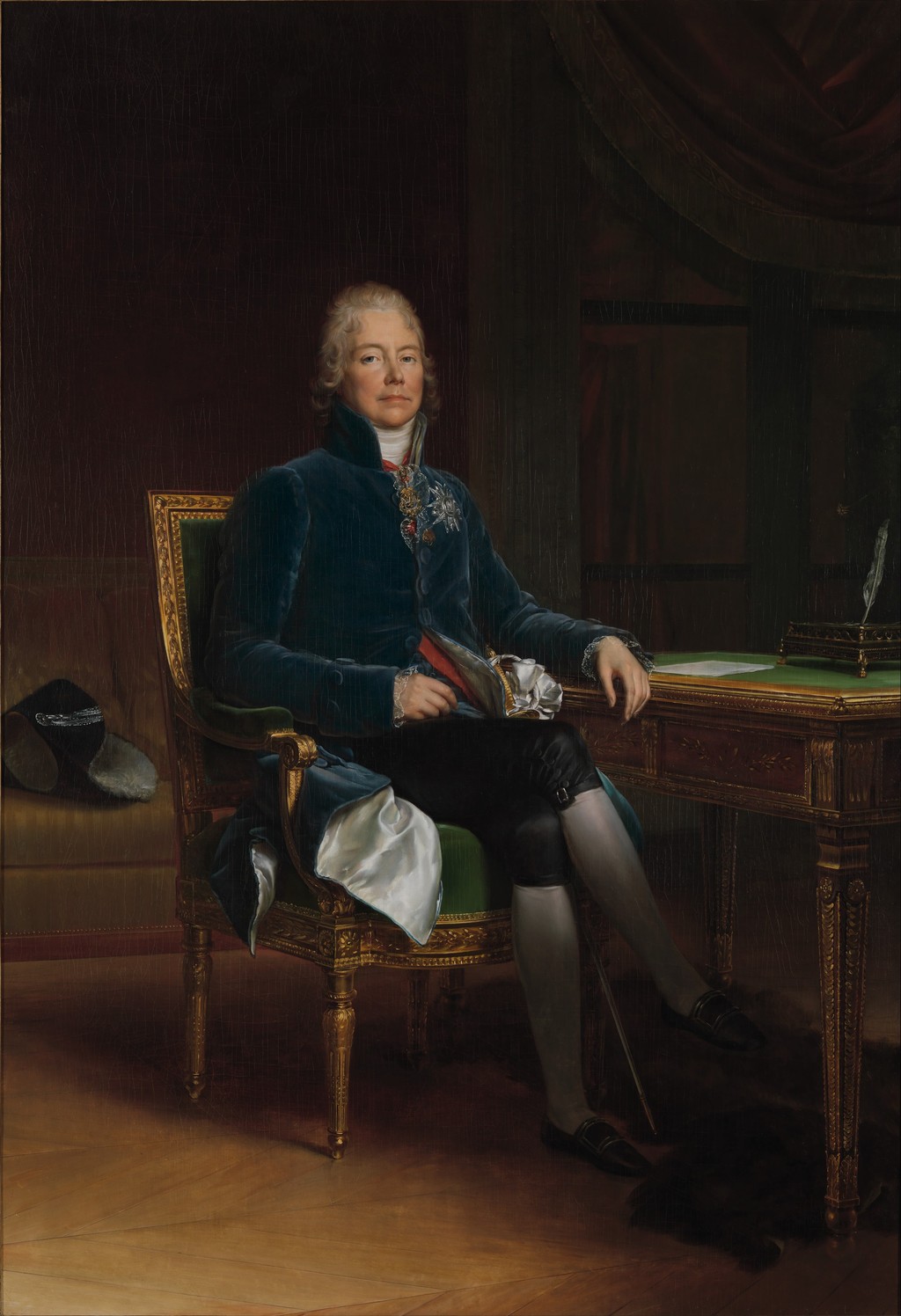
Talleyrand later commissioned Gerard's own portrait in 1808, after resigning as Napoleon's foreign minister [3]. The connection between these works is revealing. Gerard painted the emperor as ceremonial authority and Talleyrand as diplomatic composure. Together they show two faces of Napoleonic power: the ruler at the center and the political operator beside the throne.
The 1805 Talleyrand commission also helps explain why Gerard's Napoleon was designed for repetition. A successful official image could not remain isolated. It needed to appear in important interiors, circulate among officials and define how the emperor should be recognized.
This also makes the portrait a companion to Gerard's later Talleyrand. In one, Napoleon appears as ceremonial center; in the other, Talleyrand appears as controlled political intelligence. Gerard understood both forms of power and gave each a different visual temperature.
Repetition And Versions
The version history of Gerard's Napoleon is complicated, and that complexity must be part of the interpretation. The Louvre object is described as a replica, and the Met notes that Napoleon commissioned a number of repetitions for prominent officials, including the grand chamberlain, the duc de Talleyrand, and family members installed on thrones across western Europe [2].
The Met also cautions that it is no longer certain which of the many versions of Gerard's portrait was the first, although the first may be the canvas now at the Chateau de Versailles [2]. This uncertainty is not a weakness in the painting's importance. It is evidence of how official portraiture worked.
Gerard's image became a type. The more useful it was, the more it was repeated. Painted versions, replicas and related objects helped create a stable imperial likeness across multiple locations. The portrait's power lay partly in being reproducible.
That reproducibility also complicates modern viewing. A museum object connected to Gerard's Napoleon may be an autograph painting, a replica, a workshop version, a reduction, an engraving, or a work in another medium after his design. The visual idea remains Gerard's, but each object has its own status. The strongest interpretation keeps both things true: the image type is powerful, and the individual object's wording still matters.
The Gobelins And The Tapestry After Gerard
The Louvre records that its work was commissioned by Napoleon I for the Manufacture des Gobelins [1]. The Met tapestry shows what that connection could produce. The tapestry was designed in 1805 and woven between 1808 and 1811 after Gerard's painting [2]. It was made from wool, silk and silver-gilt thread, and eight weavers worked for three years on the object [2].
The decision to make a tapestry was politically meaningful. The Met notes that Napoleon ordered the imperial tapestry works to execute a woven version of his favored portrait in 1808, aligning himself with a royal tradition of tapestry patronage extending back to the Middle Ages [2]. A painted replica would have been faster and cheaper, but tapestry was slower, more costly and more precious.
That choice reveals how seriously Napoleon treated visual display. The woven version did not merely reproduce Gerard's image. It elevated it into a medium associated with royal magnificence and long traditions of court patronage.
The Met records that the tapestry was presented to Jean-Jacques Regis de Cambaceres, arch-chancellor of the Empire, four days after its completion on March 7, 1811 [2]. This destination matters. The object was not decorative in a neutral sense. It was a gift within the hierarchy of imperial power.
The labor of the tapestry also changed the nature of the image. The painted portrait already argued for imperial dignity; the woven version made that dignity materially expensive. Wool, silk and silver-gilt thread transformed Gerard's design into a luxury object whose manufacture itself testified to power.
Looking At The Image
The portrait type shows Napoleon in imperial robes, surrounded by the signs of rule. The costume is central. Coronation robes transform the body into an institution. Napoleon is not simply a man wearing rich fabric; he is a ruler made visible through ceremonial dress.
Gerard's strength is restraint. The image does not require theatrical movement. The emperor stands, faces the viewer and occupies space with controlled authority. The symbols around him do the work of political declaration, while the figure remains composed.
This is different from battlefield imagery, where Napoleon's authority often appears through command, danger or motion. In the coronation-robes image, power is settled. The portrait insists that Napoleon does not need to act in order to rule. His presence is enough.
The scale of the Louvre object, 2.26 m by 1.47 m, supports this effect [1]. It is a full public image, large enough to give Napoleon bodily presence while preserving the vertical dignity of a state portrait.
The portrait's vertical format also suits the logic of coronation robes. Fabric falls, regalia hangs and the body becomes a column of sovereignty. Gerard's composition turns costume into architecture. The emperor is built into the image rather than simply placed within it.
The robe also changes how Napoleon's body is understood. Earlier Napoleonic imagery often emphasizes mobility: crossing mountains, reviewing troops, commanding history. In Gerard's coronation-robes image, the emperor's body becomes ceremonial and almost immobile. That stillness is not weakness. It is the visual language of possession: possession of throne, palace, rank and historical legitimacy.
Tradition And Invention
The portrait's historical force comes from the tension between old forms and new power. Napoleon's Empire did not simply revive monarchy, but it borrowed the visual grammar of monarchy to naturalize itself. Gerard's image shows that process clearly.
The Met's comparison with David and Ingres is useful here [2]. David and Ingres attempted more novel solutions to Napoleonic imagery. Gerard's image found favor because it used familiar royal conventions. In political terms, familiarity was not a failure of imagination. It was a way to make the new regime easier to recognize.
Gerard's portrait therefore belongs to a wider history of visual legitimacy. When power changes, images help decide whether the change feels radical, lawful, sacred, military, hereditary or stable. Gerard chose stability.
That choice did not make the portrait politically neutral. Stability was itself an argument. The Empire wanted to appear as the rightful successor to French monarchy and as something newly created by Napoleon. Gerard's portrait holds those claims together by making old symbols obey a new ruler.
This is why the image continued to matter through repetitions and the Gobelins tapestry. It offered Napoleon a form of sovereignty that could be installed in different places and given to different people. The repeated portrait was not only an image of the emperor; it was a portable assertion that the Empire had a recognizable ceremonial face.
The image also reveals Gerard's special usefulness within Napoleonic art. He could absorb royal precedent without making Napoleon look like a borrowed king. The emperor appears newly installed and historically familiar at the same time. That balance explains why the portrait could compete successfully with more daring inventions by David or Ingres.
Gerard's solution was conservative in form but ambitious in function. It made the new imperial order look as if it already possessed the habits of old monarchy. For a regime obsessed with legitimacy, that visual calm was invaluable.
The portrait's success lies in that paradox: it is visually familiar enough to reassure, yet politically new enough to serve Napoleon's invented dynasty.
Gerard made that contradiction look effortless, which was precisely the point.
Why The Portrait Matters
Napoleon I in Coronation Robes matters because it shows Gerard operating at the center of imperial image-making. He was not simply recording Napoleon's appearance. He was helping create a form of imperial presence that could be repeated, woven, displayed and given.
The painting also explains why Gerard remained so useful to patrons across regimes. He understood how to make authority graceful and durable. That skill served Napoleon, but it could also serve the restored Bourbons after Napoleon's fall.
The version history makes the work especially important. A single painting might be admired; an image type repeated across paintings and tapestries becomes political infrastructure. Gerard's Napoleon entered that second category.
It also clarifies Gerard's relation to David. David may have been the greater revolutionary painter, but Gerard supplied an official imperial image Napoleon preferred. That preference should make the portrait impossible to dismiss as mere court polish.
Gerard's art is often quiet, but here quietness becomes command. The emperor is not charging forward, crossing mountains or reviewing troops. He is standing in robes. The image works because it makes standing still look like sovereignty.
Frequently Asked Questions
It shows Napoleon I in coronation robes, using ceremonial costume and royal visual conventions to present imperial authority.
The Met tapestry preserves a major work after Gerard's portrait, designed in 1805 and woven between 1808 and 1811. It shows how the painted image entered luxury production and imperial gift culture.
The Met records that Napoleon did not like David's official coronation portrait and preferred Gerard's 1805 portrait prepared for the Ministry of Foreign Affairs.
Official portraits needed to circulate among courts, officials and institutions. Gerard's image was repeated because it became an authoritative visual form for Napoleon's rule.
Discussion
Gerard's art often asks viewers to read public roles through small signs of pose, dress, surface and setting. Use the prompts below as starting points for looking closely.
Reader Insights
What detail most shapes your reading of Napoleon I in Coronation Robes: pose, setting, costume, expression or historical context?
How does Gerard balance public identity with a more personal or psychological presence?
Which comparison helps most: David's studio, Napoleonic portraiture, Restoration image-making or salon culture?
Join the Conversation
Share a thoughtful comment below about what you notice, question or compare when looking at this work.
References
- Louvre Collections, Portrait en pied de Napoleon Ier en costume du Sacre https://collections.louvre.fr/en/ark:/53355/cl010057769
- Metropolitan Museum of Art, Portrait of Napoleon I, tapestry after Gerard https://www.metmuseum.org/art/collection/search/199313
- Metropolitan Museum of Art, Charles Maurice de Talleyrand Perigord https://www.metmuseum.org/art/collection/search/441969