


 by Tom Gurney
Tom Gurney BSc (Hons) is an art history expert with over 20 years experience
Updated on October 23, 2026
Email: tomgurney1@gmail.com / Phone: +44 7429 011000
Choosing a book about Gustav Klimt
The most useful Klimt book is the one that answers the question you actually want to pursue. A substantial painting catalogue helps identify works and compare compositions. A drawing study follows the changes of pose and line that a finished canvas can conceal. An exhibition catalogue places Klimt beside other artists, while an illustrated story can introduce a child to his patterns without pretending to explain his whole career.
As an Amazon Associate I earn from qualifying purchases.
The four selections below offer those different approaches. Start with one rather than buying several overlapping surveys. For a broad introduction alongside your reading, explore the biography; for individual works, use the paintings index. A book becomes more rewarding when you can move between its argument, its illustrations and a particular picture that interests you.
A substantial reference for the paintings
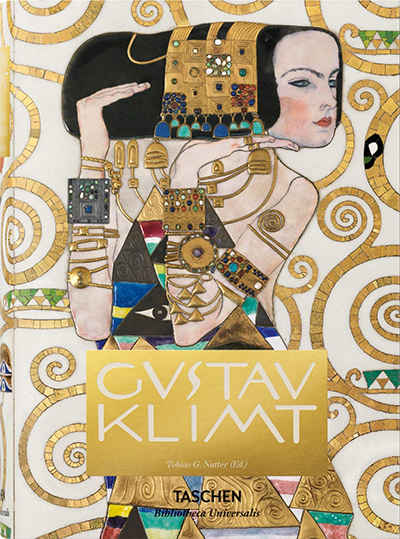
Tobias G. Natter's Gustav Klimt. The Complete Paintings, published by TASCHEN, is the choice for readers who want a substantial illustrated reference rather than a brief introduction. The publisher describes a complete painting catalogue covering the early career, the Secession, portraits, landscapes and major decorative projects, including photography of the Stoclet Frieze. Its listed English XL edition has 604 pages and ISBN 978-3-8365-6661-2.[1]
That breadth makes it a sensible starting point if your interest extends beyond the familiar golden pictures. Use it to compare a portrait with a landscape or to see where a decorative commission sits within the larger body of work. Follow a painting through the commentary and catalogue rather than treating the reproductions as a sequence of unrelated favourites.
Check the edition carefully. A title can appear in more than one physical format, and a smaller book with a similar cover is not necessarily the same reading experience. Match the seller's ISBN, language and pagination to the edition you intend to buy. The cover reproduced here belongs to the existing Natter-edited TASCHEN volume; cover design alone should not determine your choice.
Drawing and the development of a figure
Marian Bisanz-Prakken's Gustav Klimt: The Magic of Line accompanied the 2012 exhibition organised by the ALBERTINA and the J. Paul Getty Museum. Getty's English publication is a 304-page hardcover, ISBN 978-1-60606-111-4. Its focus is the variety of Klimt's drawings and the importance of drawing throughout his artistic development.[2]
Choose this direction if a pose, a hand or an unfinished passage holds your attention longer than a finished decorative surface. The useful question is not simply whether a sheet resembles a painting. Look at the decisions made within the drawing: the weight of an outline, an altered limb, the space left around a body, or the relation between a quickly recorded head and a more sustained contour.
Our drawings guide provides a companion route through individual works. Keep the book's caption beside the image as you read. A study, a finished independent drawing and a printed reproduction have different purposes, even when their subjects appear similar. This is the selection to pair with a painting reference when you want to understand more than the completed image.
Klimt alongside his contemporaries
Klimt. Inspired by Van Gogh, Rodin, Matisse offers a comparative approach. The Belvedere's 2023 catalogue record names Stella Rollig, Markus Fellinger, Emilie E. S. Gordenker and Edwin Becker as editors. Published by Hirmer, the 240-page catalogue was available in English, German and Dutch; the English ISBN is 978-94-93070-42-4.[3]
The accompanying museum project investigated which works Klimt could have encountered through exhibitions, collections, travel and reproductions. That question is more useful than assuming that two similar-looking pictures prove a direct borrowing. The catalogue is therefore a good next step for readers interested in artistic exchange rather than an isolated account of a single painter.[3]
Read the comparisons in pairs. Ask what actually changes between the works: their viewpoint, colour, treatment of a figure or organisation of the surface. Then return to a Klimt picture you know. The landscapes are a particularly useful place to practise that kind of comparison without reducing every connection to the use of gold.
A picture book for younger readers
Myriam Ouyessad's The Magical Tree is a story inspired by Klimt, not an illustrated biography. Prestel Junior's 32-page book, published in 2016, develops a tale around a life-saving tree and includes a reproduction of The Tree of Life. The publisher lists an age range of four to eight and ISBN 978-3-7913-7214-3.[4]
Its place on this list is deliberately different. A shared story can encourage a child to notice branching shapes, repeating patterns and the relationship between a small detail and a larger image. An adult can then distinguish the fictional tale from the actual Tree of Life within Klimt's decorative work. Choose it for that imaginative introduction, rather than as a substitute for a factual study of the artist.
What to check before buying
Look beyond the front cover. Confirm the language of the text, the edition and whether the listing describes a complete book. When buying a used copy, ask about loose pages, damaged bindings, annotations and missing fold-outs where the edition includes them. A modestly priced copy is less useful if the illustration or passage you need has been removed.
Think about how you will read it. A large reference volume can be rewarding at a table but inconvenient for travel. A compact survey may be easier to carry, yet less comfortable for comparing tiny details. If possible, examine a sample spread: captions, image size, the position of the binding and the legibility of the text all affect sustained use.
For a first purchase, choose breadth. For a second, choose a different question rather than another cover of the same famous painting. A painting catalogue and a drawing study complement one another more clearly than two similar image-led introductions. If your interest is concentrated on a particular exhibition, collection or theme, a specialist catalogue may be more useful than a general survey.
Library copies can help you make that decision before purchasing. Use the ISBN to distinguish editions and ask whether a reference volume can be consulted or borrowed. Treat price and stock as details to check with the current seller; an old publication announcement does not establish today's availability. For decorative copies rather than books, see the separate guide to Klimt prints and posters.
References
- TASCHEN, Gustav Klimt. The Complete Paintings, edited by Tobias G. Natter, English XL edition, 604 pages, ISBN 978-3-8365-6661-2; publisher description and edition record. . Accessed 23 October 2026. View source.
- J. Paul Getty Trust, “New Book Argues That to Understand Klimt's Art, One Must Consider His Drawings,” 16 May 2012; publication record for Marian Bisanz-Prakken, Gustav Klimt: The Magic of Line. . Accessed 23 October 2026. View source.
- Belvedere, Klimt. Inspired by Van Gogh, Rodin, Matisse, 2023 exhibition press kit, exhibition research on PDF pages 2–3 and catalogue metadata on PDF page 11. . Accessed 23 October 2026. View source.
- Penguin Random House / Prestel Junior, Myriam Ouyessad, The Magical Tree, publisher description and edition record, ISBN 978-3-7913-7214-3. . Accessed 23 October 2026. View source.