


Flowers can occupy almost every scale of a painting. They may form a carpet beneath mythological figures, rise as a carefully arranged bouquet, spread across a field or dissolve into light on water. Their colours are immediately attractive, but colour alone does not explain their importance. Painters have used flowers to organise space, test powers of observation, mark cultivated places and transform a familiar subject through new kinds of handling.
This guide follows ten flower paintings in chronological order, from Botticelli’s Primavera to Monet’s late water garden. It concentrates on what flowers do within each composition. Some are the principal object of attention; others connect people to a setting or turn landscape into rhythm. The selection is therefore neither a ranking nor an exhaustive catalogue. It offers a route through changing pictorial decisions, grounded in individual works.
The page belongs within the wider Paintings hub, while the directory of Famous Paintings serves a broader masterpiece search. Readers looking for the history and conventions of Still Life or Landscape Painting can follow those dedicated guides. The meanings attached to floral motifs belong with Flowers in Art, and practical studies in another medium belong with Flower Drawings. Here, the focus remains on how ten painters made flowers pictorially active.
Flowers across allegory and close observation
The first three works establish an unusually wide range. Botticelli scatters identifiable plants through a mythological grove. Rachel Ruysch builds a lavish bouquet from precisely differentiated specimens. Chardin reduces the scale and the visual drama, asking viewers to notice the balance of a quieter arrangement. Flowers move from environment to principal subject, then from abundance to restraint.
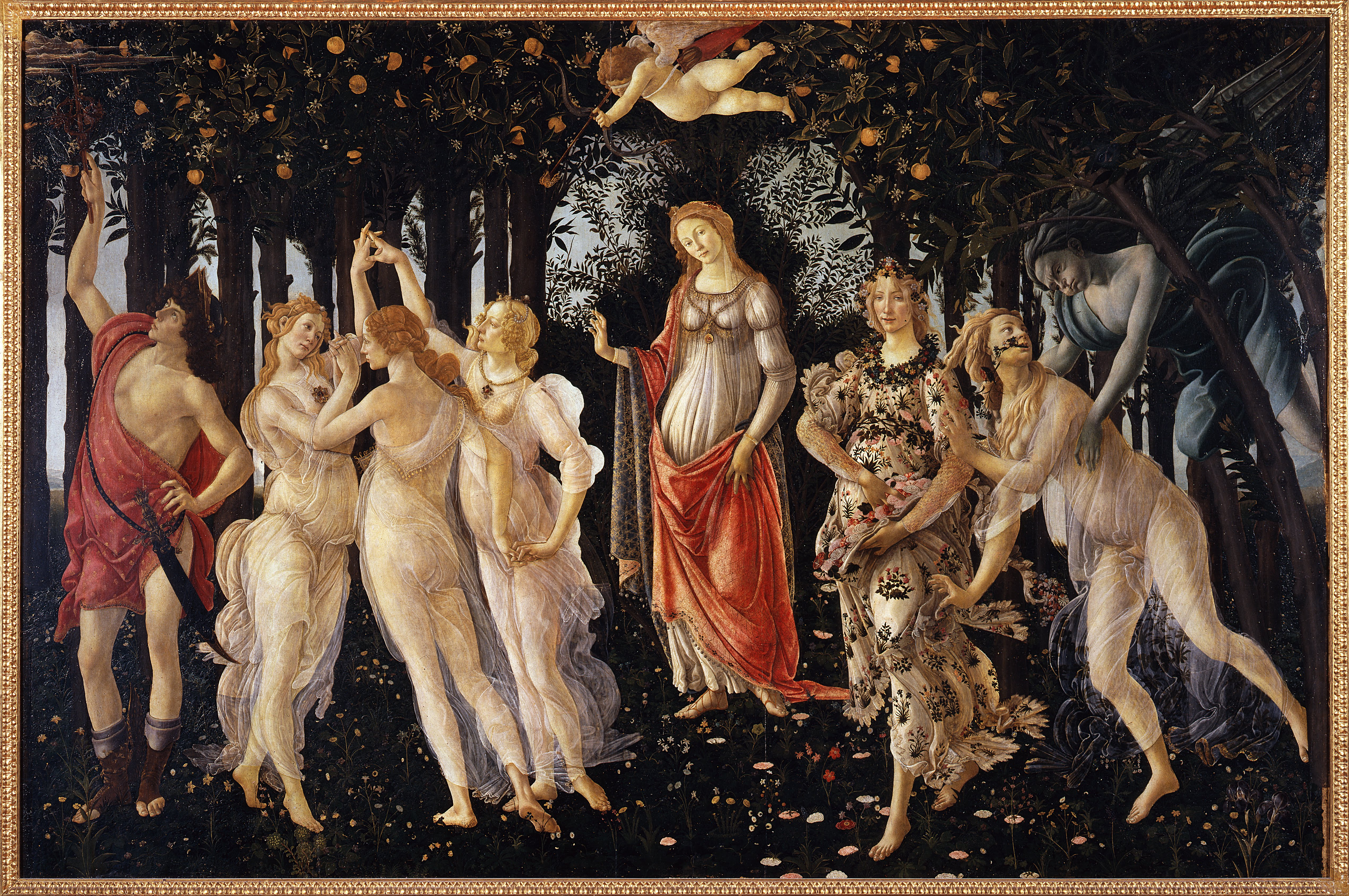
1. Spring (Primavera) — Sandro Botticelli, c. 1480
In Spring (Primavera), flowers do more than decorate the foreground. They make the grove feel dense, cultivated and extraordinarily particular. Mythological figures stand and move across a dark strip of vegetation, while pale blossoms interrupt the ground like points of light. The setting holds the procession together: bodies are spaced across the width, but the continuous flowering field makes them inhabitants of one imagined place.
The Uffizi dates the work to about 1480, describes its medium as tempera grassa on wood, and records the large panel as inventory 1890 no. 8360, measuring 207 by 319 centimetres. Its account also notes that at least 138 plant species have been identified in the picture, including 42 different species of flowers.[1] That botanical richness should not turn the painting into a plant chart. Botticelli varies scale and clarity so that close description contributes to an encompassing poetic effect. Individual blossoms reward inspection, yet collectively they establish the ground on which the allegorical action unfolds. Explore Sandro Botticelli for the artist’s wider use of linear movement, patterned surfaces and mythological subjects.
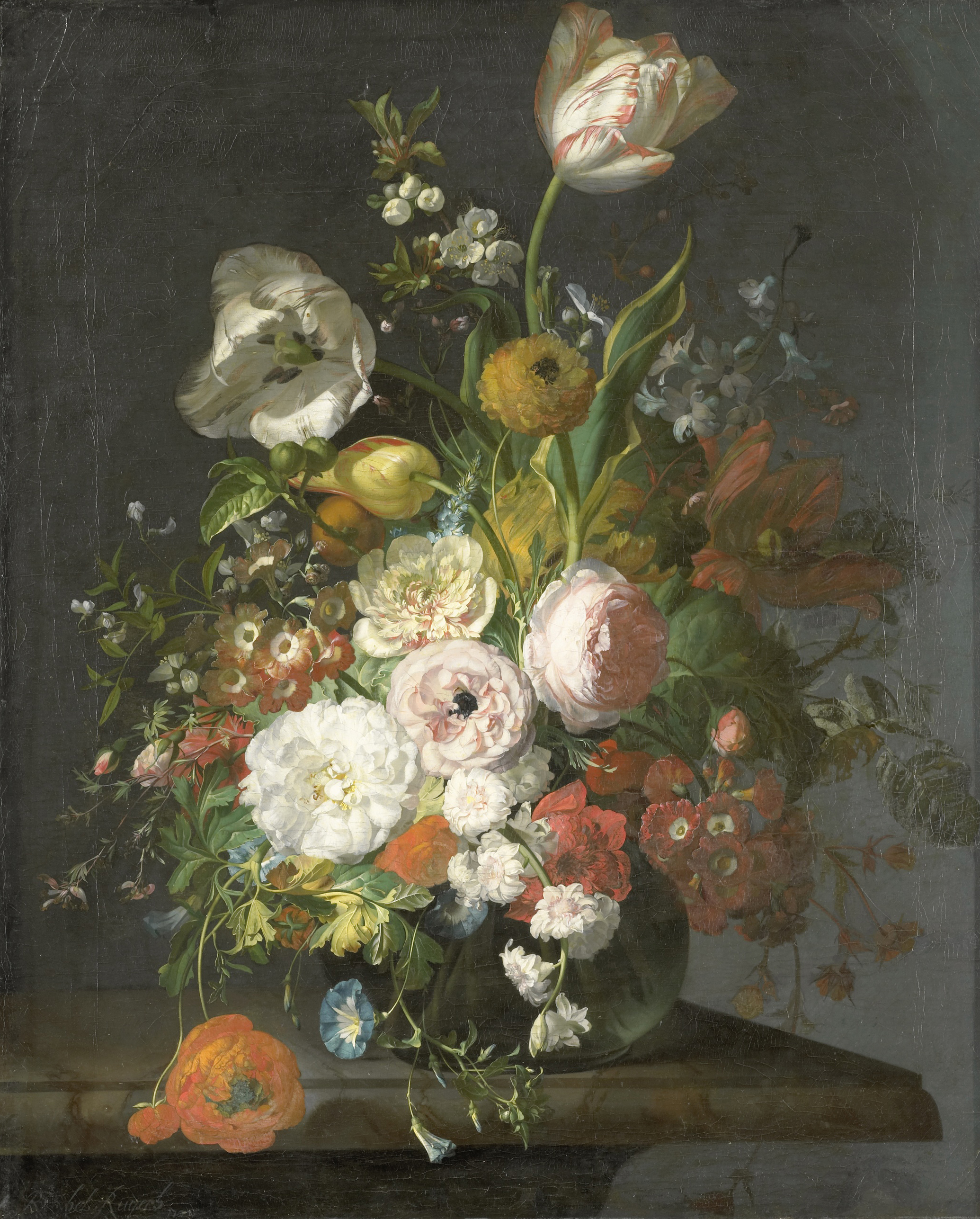
2. Still Life with Flowers in a Glass Vase — Rachel Ruysch, c. 1690–c. 1720
Still Life with Flowers in a Glass Vase brings the bouquet forward against a dark background. Tall stems rise above heavier blossoms, leaves turn at different angles, and smaller flowers occupy the intervals between larger forms. The transparent vase reveals stems below the waterline, extending the act of looking from the bright crown of the arrangement to its supporting structure.
The Rijksmuseum records the work as an oil on canvas made between about 1690 and about 1720, accession SK-A-354, measuring 65 by 53.5 centimetres.[2] The extended date range cautions against forcing the painting into a single moment, while the composition itself encourages sustained comparison. Ruysch differentiates petals by edge, weight and direction. Some flowers open fully; others bend or recede. The bouquet is abundant without becoming shapeless because light and overlapping contours guide the eye through it. Visit Rachel Ruysch to place this concentrated flower piece within the career of a painter who made botanical variety serve ambitious still-life design.
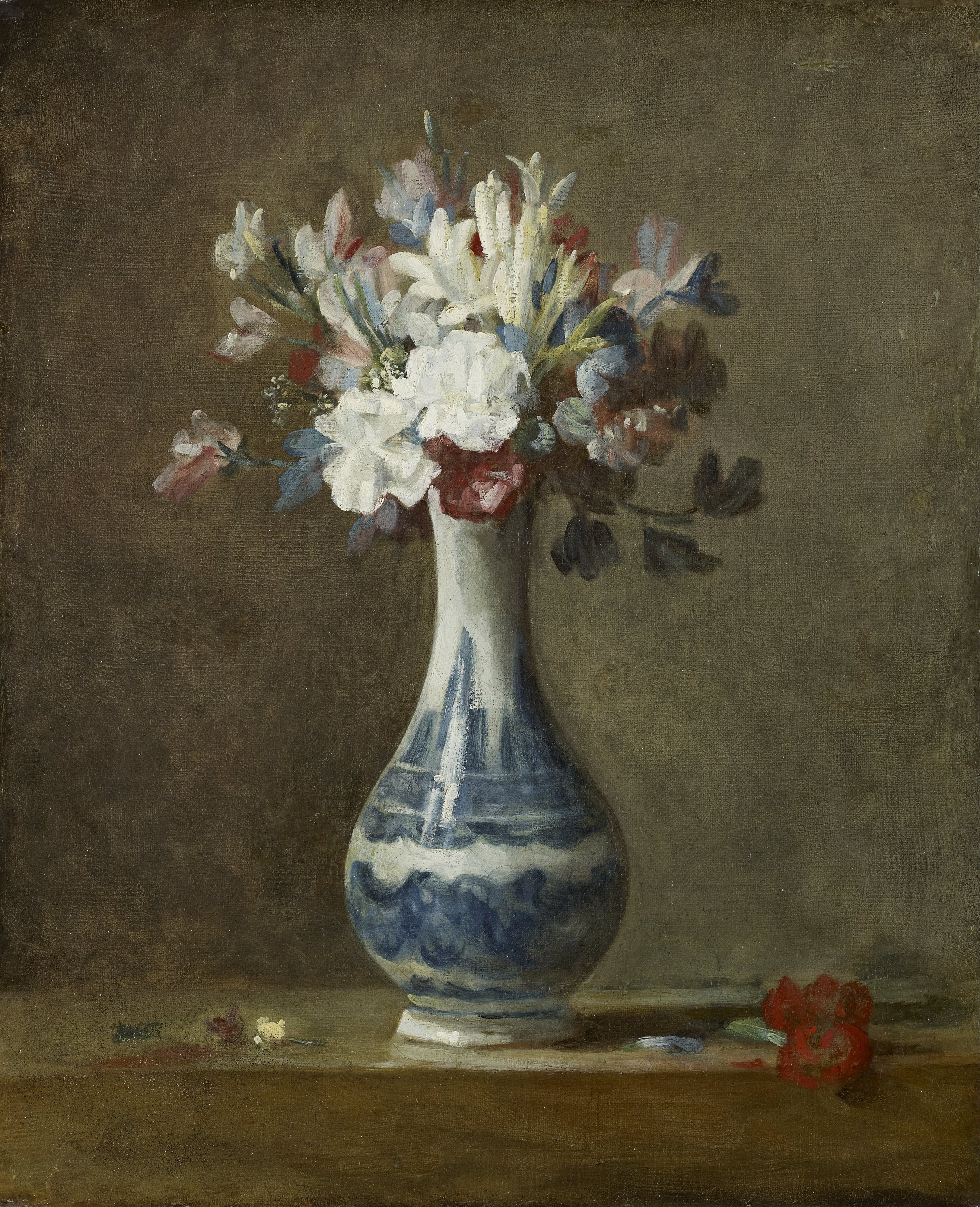
3. A Vase of Flowers — Jean-Baptiste-Siméon Chardin, about 1750–1760
Chardin’s A Vase of Flowers is smaller and less crowded. A compact cluster of carnations, tuberoses and sweet peas occupies a plain earthenware vase. The flowers lean unevenly rather than forming a symmetrical crown. Loose petals and subtle shifts of light keep the arrangement alive, while the muted setting prevents any single colour from dominating.
National Galleries of Scotland dates the oil on canvas to about 1750–1760 and records it as NG 1883, measuring 45.2 by 37.1 centimetres.[3] Those modest dimensions suit the intimacy of the encounter. Chardin does not compete with Ruysch through a greater number of species or a more intricate vessel. He makes differences of texture and tonal weight carry the picture. Petals seem soft against the rougher pot, and the dark background lets pale blossoms emerge gradually. Browse Chardin for other paintings in which ordinary objects gain presence through measured relationships rather than spectacle.
The bouquet opens into modern colour
The next three paintings loosen the flower piece without abandoning observation. Bazille enlarges a vase of blooms into a tall, forceful colour arrangement. Monet releases red poppies across a sunlit hillside. Manet returns to the vase at a smaller scale, making transparent glass, stems and a few flowers sufficient for a complete picture. Together they show that modernity did not require one format: abundance, landscape and intimacy could each become a field for direct colour.
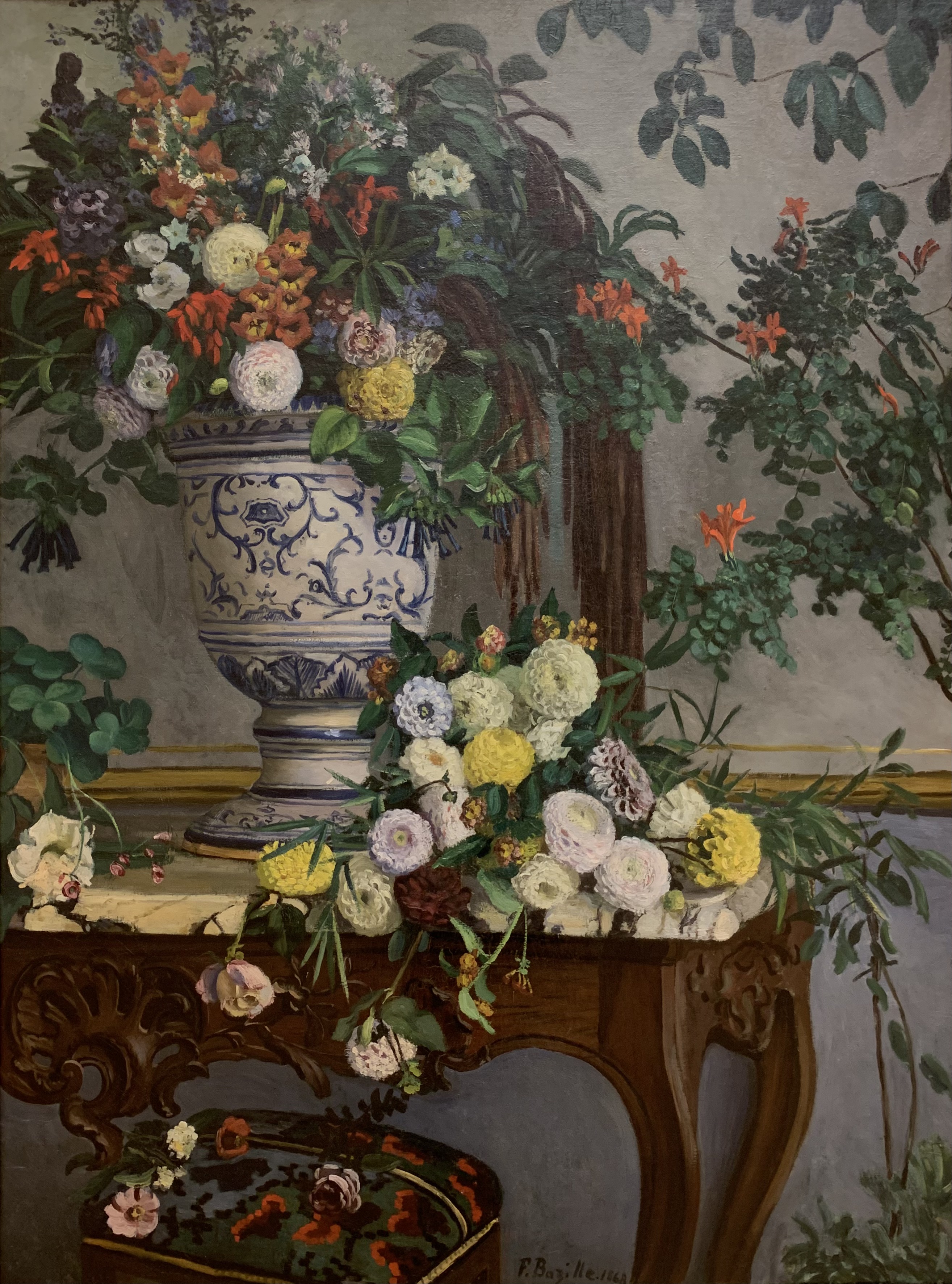
4. Flowers — Frédéric Bazille, 1868
In Flowers, a tall bouquet presses upward through a vertical canvas. Bright blossoms gather at several heights instead of forming one rounded mass. Dark foliage and background intensify their reds, whites and yellows, while the broad arrangement gives the flower piece a physical scale rarely associated with a tabletop study.
The Musée de Grenoble identifies the work as an oil on canvas painted by Frédéric Bazille in 1868 and measuring 130 by 97 centimetres.[4] The French Ministry of Culture’s collection record corroborates the museum custody, dimensions and inventory MG 2911.[5] These facts distinguish the canvas from a preparatory study and help explain its imposing presence. Bazille’s painting forms a useful bridge in this sequence: its flowers remain gathered in a vessel, yet their scale and separated colour accents anticipate the greater freedom with which colour will structure the following landscapes and bouquets. Read more about Frédéric Bazille and his place among the painters working around the beginnings of Impressionism.
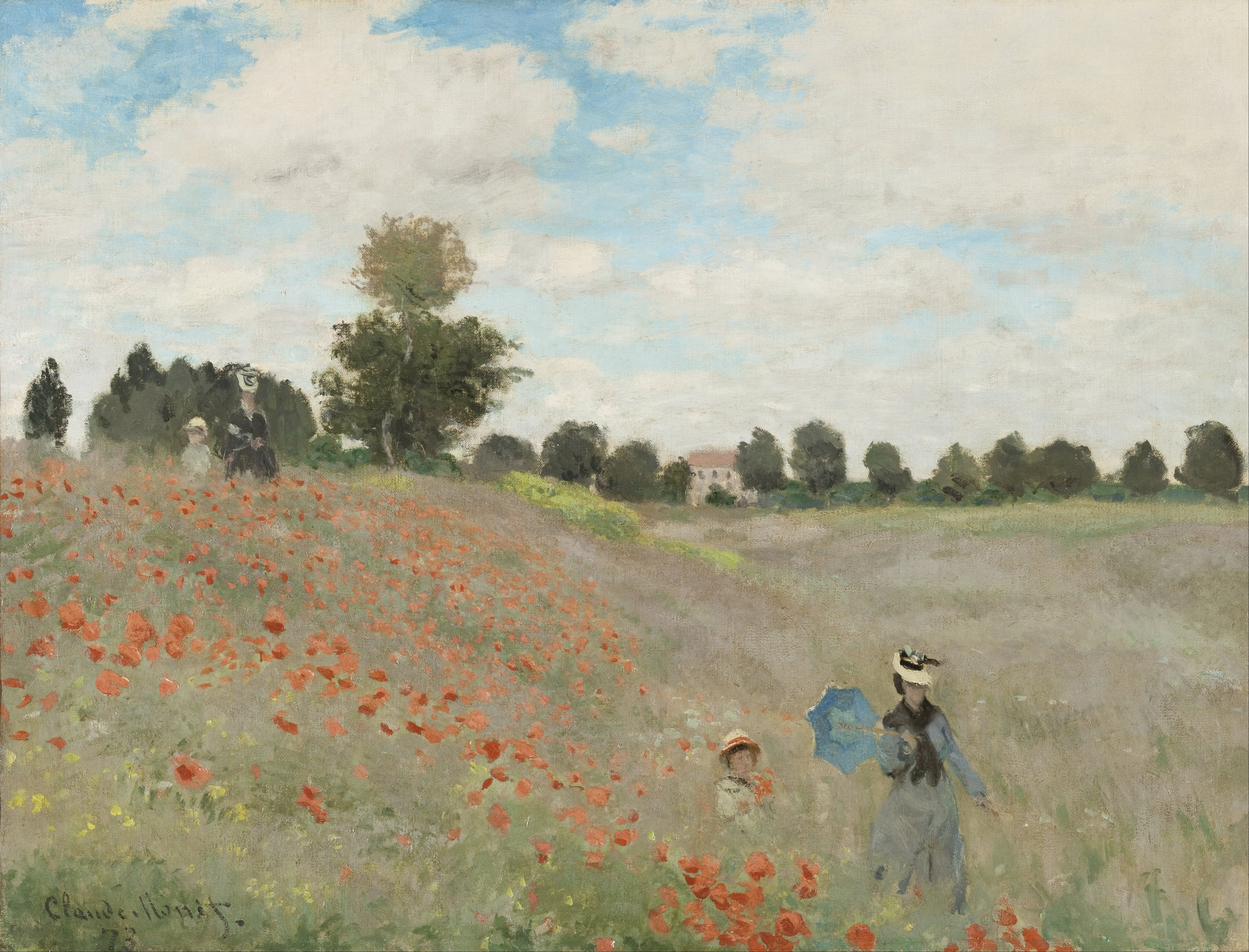
5. Poppy Field (Coquelicots) — Claude Monet, 1873
Poppy Field (Coquelicots) disperses flowers through open air. Red poppies recur across a green slope as two figures descend in the foreground and two more appear near the horizon. The repeated spots do not describe every bloom separately. Instead, they establish a visual beat that carries the eye through the field and links near and distant ground.
The Musée d’Orsay records the 1873 oil on canvas as RF 1676, measuring 50 by 65.3 centimetres, and also gives La promenade as an alternate title.[6] That title draws attention to movement through the landscape, but the poppies are essential to how movement becomes visible. Their distribution stops the hillside from reading as a single undivided plane. Dense marks near the foreground grow smaller and less distinct farther away, helping colour articulate depth. The human figures provide scale and direction without turning the flowers into scenery for a portrait. See Claude Monet for the artist’s continuing experiments with repeated motifs, changing conditions and painted sensation.
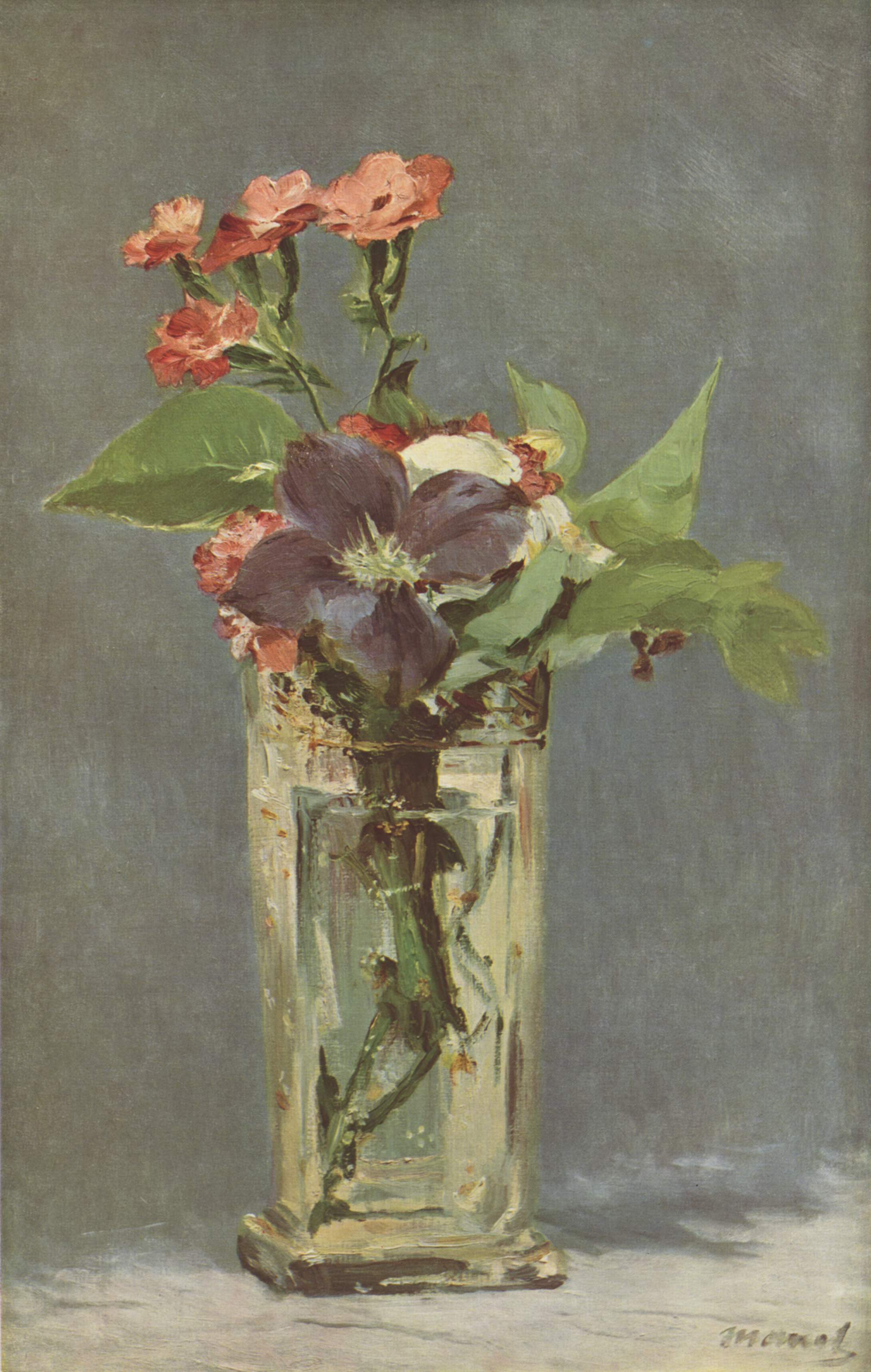
6. Flowers in a Crystal Vase — Édouard Manet, 1882
Manet’s Flowers in a Crystal Vase contracts the subject again. White carnations and purple clematis lean from a clear container, their stems visible through the water. The small group has no need of elaborate accessories. A few crossings of stem and leaf make the lower half active, while blossoms spread into the darker space above.
The Musée d’Orsay records the painting as an 1882 oil on canvas, inventory RF 2000 19, measuring 54.5 by 35 centimetres.[7] The museum title is deliberately broader than the longer descriptive name often attached to the work. Looking closely explains why the crystal vase matters as much as the flowers. Reflections, water and stems create compressed layers within a narrow area, and the vessel’s transparency prevents the bouquet from ending at its rim. The directness of the arrangement does not mean simplicity of observation. Explore Édouard Manet for portraits, scenes of modern life and still lifes united by alert handling and carefully judged tonal contrasts.
Flowers shared with figures, light and expression
Sargent, Van Gogh and Redon make flowers vehicles for three sharply different experiences. Sargent places cultivated blooms around children at twilight. Van Gogh constructs a bouquet through emphatic yellow paint. Redon lets colour and atmosphere loosen the boundary between observed flower and imagined presence. In each case, flowers remain recognisable while participating in a larger expressive order.
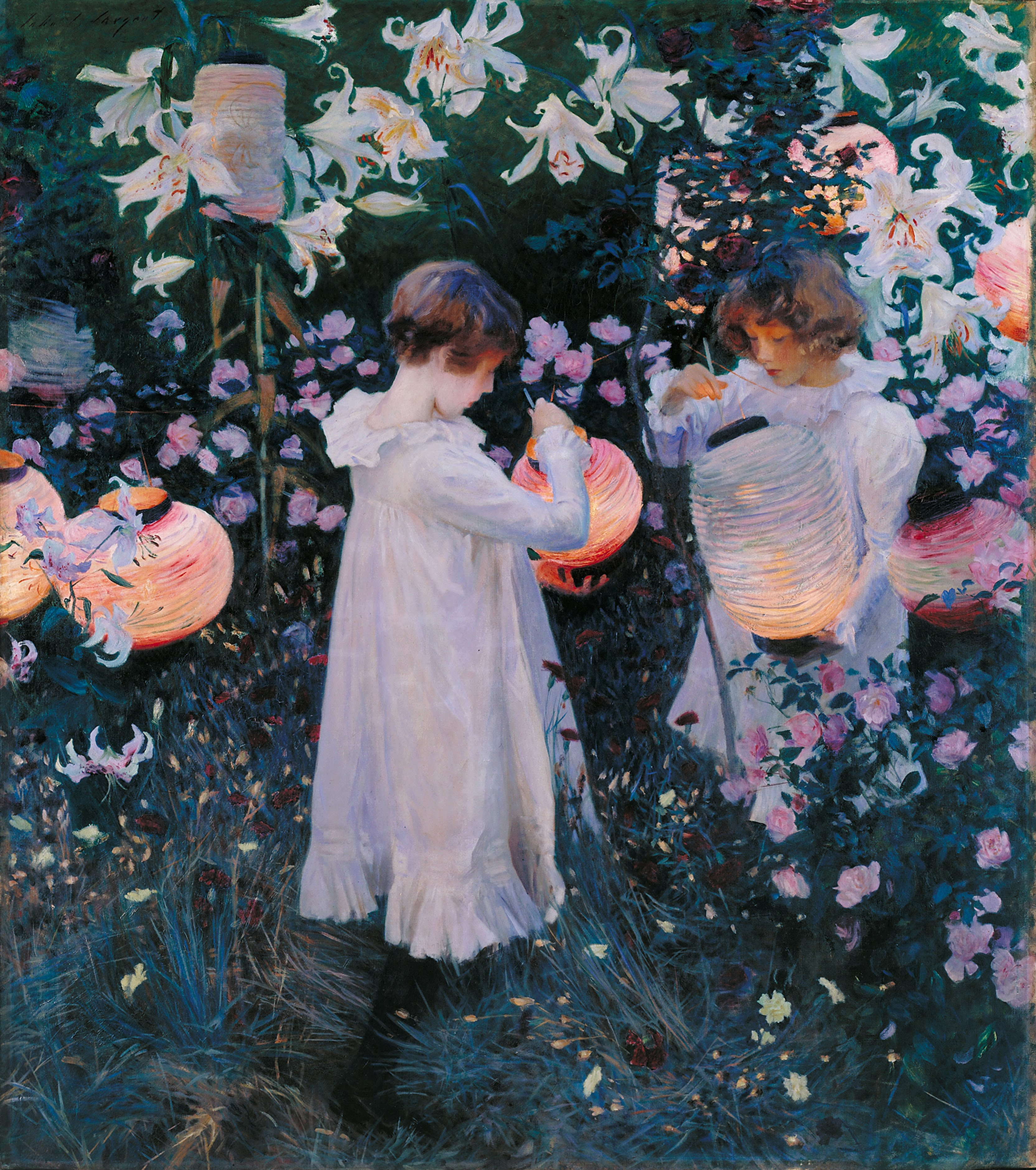
7. Carnation, Lily, Lily, Rose — John Singer Sargent, 1885–1886
In Carnation, Lily, Lily, Rose, two girls light paper lanterns among tall white lilies and scattered pink flowers. The blossoms are nearly level with the children, so the garden does not function as a distant backdrop. Stems divide the foreground, flower heads catch the fading light, and lanterns introduce warmer points of illumination among them.
The Smithsonian registry identifies the work as an oil on canvas of 1885–1886, measuring 174 by 153.7 centimetres, and records Tate as its owner under N01615.[8] Tate’s collection record confirms that identity and title.[9] Conservation study of the canvas has examined Sargent’s prolonged outdoor working process and the material changes associated with it.[10] That history helps account for the picture’s specificity without reducing it to a technical demonstration. The scene depends on a narrow meeting of natural and artificial light. Flowers, white dresses and paper lanterns receive related but not identical tones, allowing the garden to feel both observed and deliberately composed. Visit John Singer Sargent for the artist’s portraits and outdoor subjects.
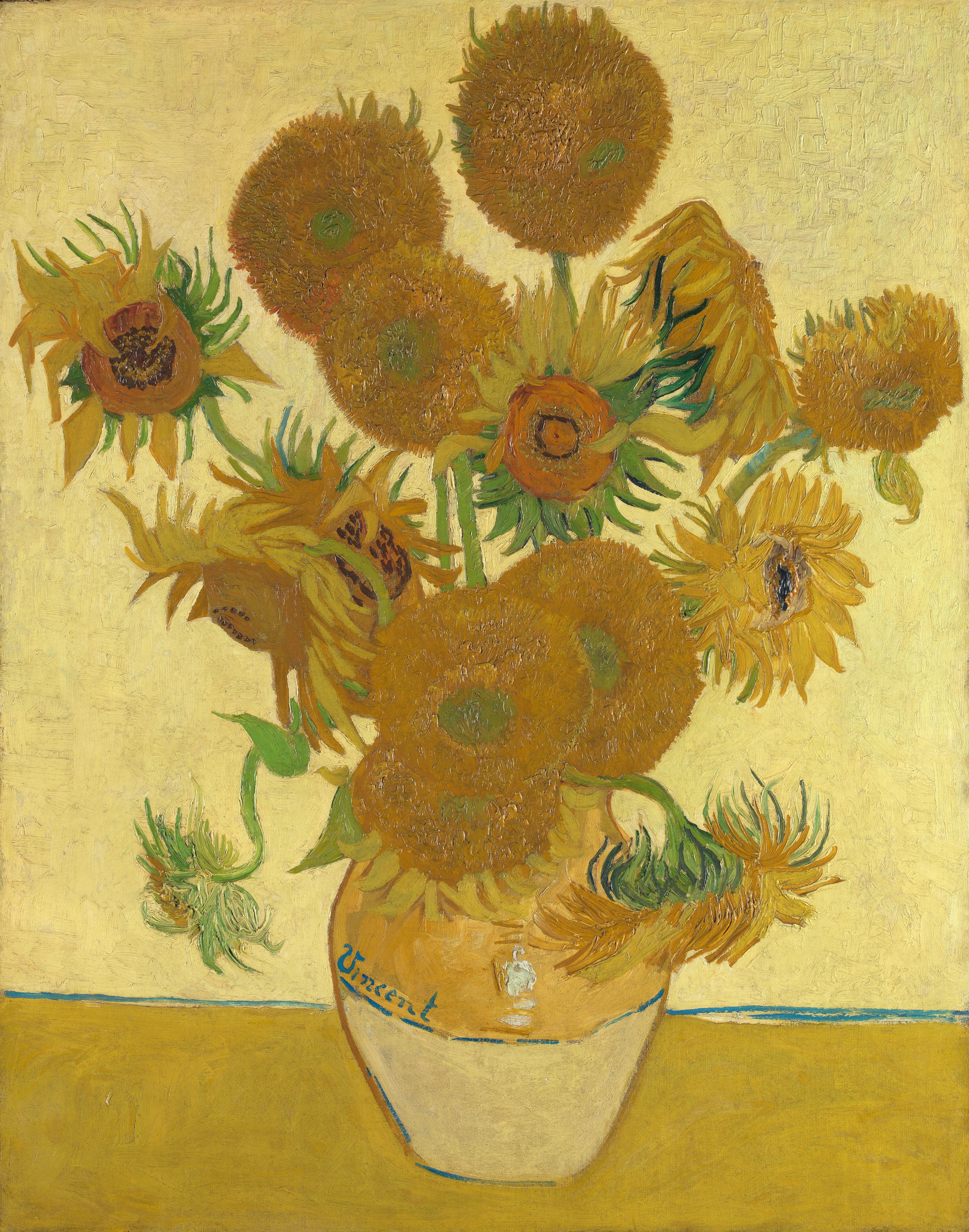
8. Sunflowers — Vincent van Gogh, 1888
Sunflowers makes yellow both subject and environment. A cluster of flower heads fills a simple vase against a yellow wall and tabletop. Differences within that restricted range become unusually vivid: greenish centres, ochre petals, pale highlights and darker outlines separate one bloom from another. Some flowers face outward; others turn aside, droop or lose petals.
The National Gallery identifies its painting as an 1888 oil on canvas, NG3863, measuring 92.1 by 73 centimetres.[11] The bouquet contains flowers at different stages, from full disks to more depleted heads, so its unity does not depend on uniform freshness. Van Gogh gives each bloom a distinct silhouette while binding the group through recurring curves and dense touches of paint. The plain vessel and compressed setting direct attention back to those surfaces. The work demonstrates how a familiar bouquet can become a sustained study of variation inside one dominant colour. Explore Vincent van Gogh for related experiments with colour, contour and rhythmic brushwork.
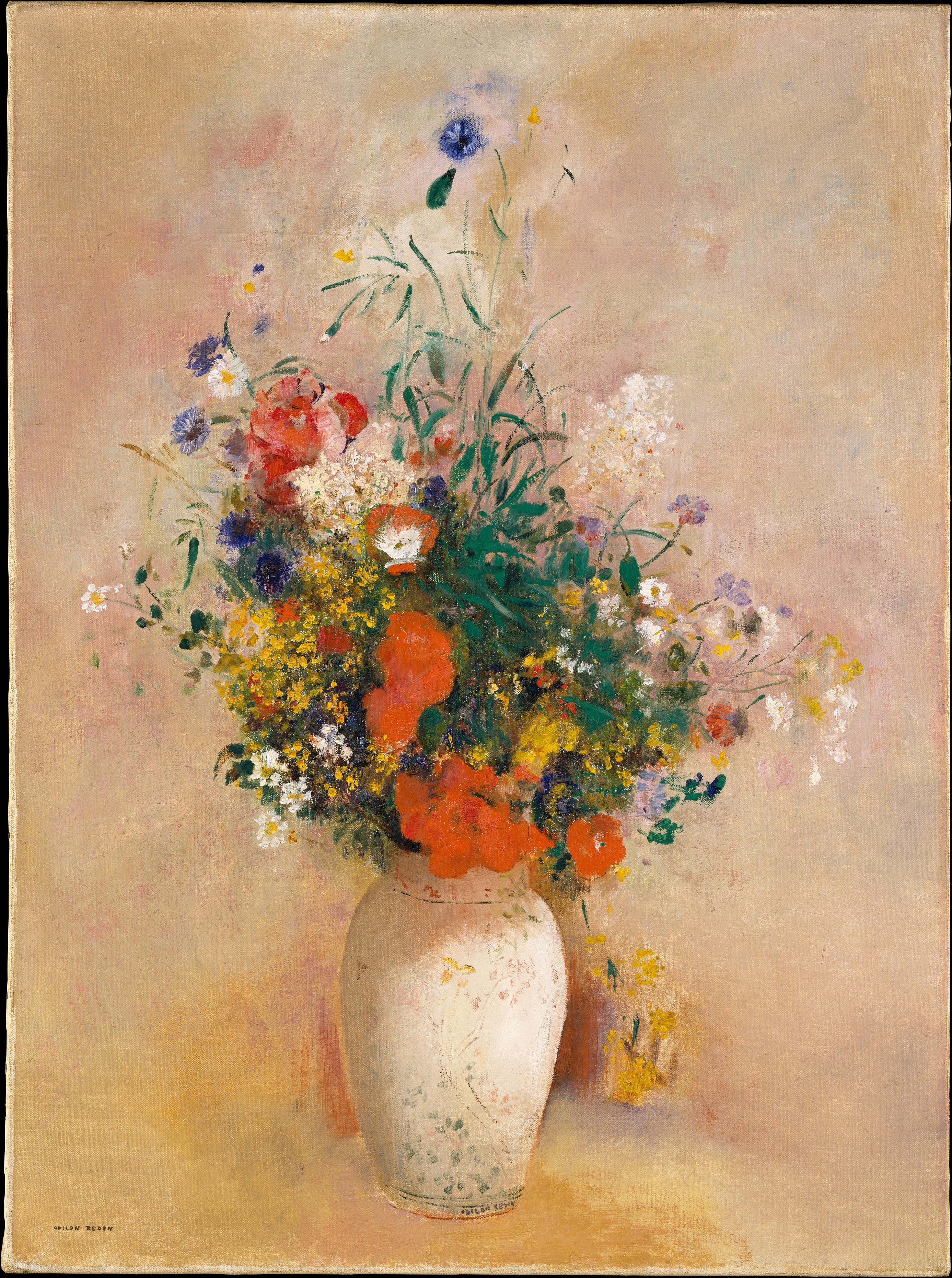
9. Vase of Flowers (Pink Background) — Odilon Redon, c. 1906
Redon’s Vase of Flowers (Pink Background) allows the bouquet to hover between description and reverie. Small coloured blossoms gather above a dark vessel, but their edges soften into the surrounding pink. Rather than isolating every stem, Redon creates an atmosphere in which blue, orange, white and red notes appear to glow.
The Metropolitan Museum of Art dates the oil on canvas to about 1906 and records it as accession 59.16.3, measuring 72.7 by 54 centimetres.[12] The vertical format and central vase preserve the basic structure of a flower piece, yet colour weakens the sense of solid, measurable space. Some blooms can be followed individually; others register first as luminous marks. Redon uses that uncertainty positively. The viewer recognises a bouquet while experiencing it as a changing field of sensations. See Odilon Redon for works in which natural forms, dreamlike association and unusual colour relationships repeatedly meet.
The garden becomes the whole field
Monet’s final canvas changes the relation between flower and setting. Earlier works place blooms on the ground, in vessels or around figures. In Water Lilies, the water garden occupies the entire wide surface. There is no horizon and no container. Flowers punctuate reflections and submerged colour, inviting the eye to move laterally without settling on a single centre.
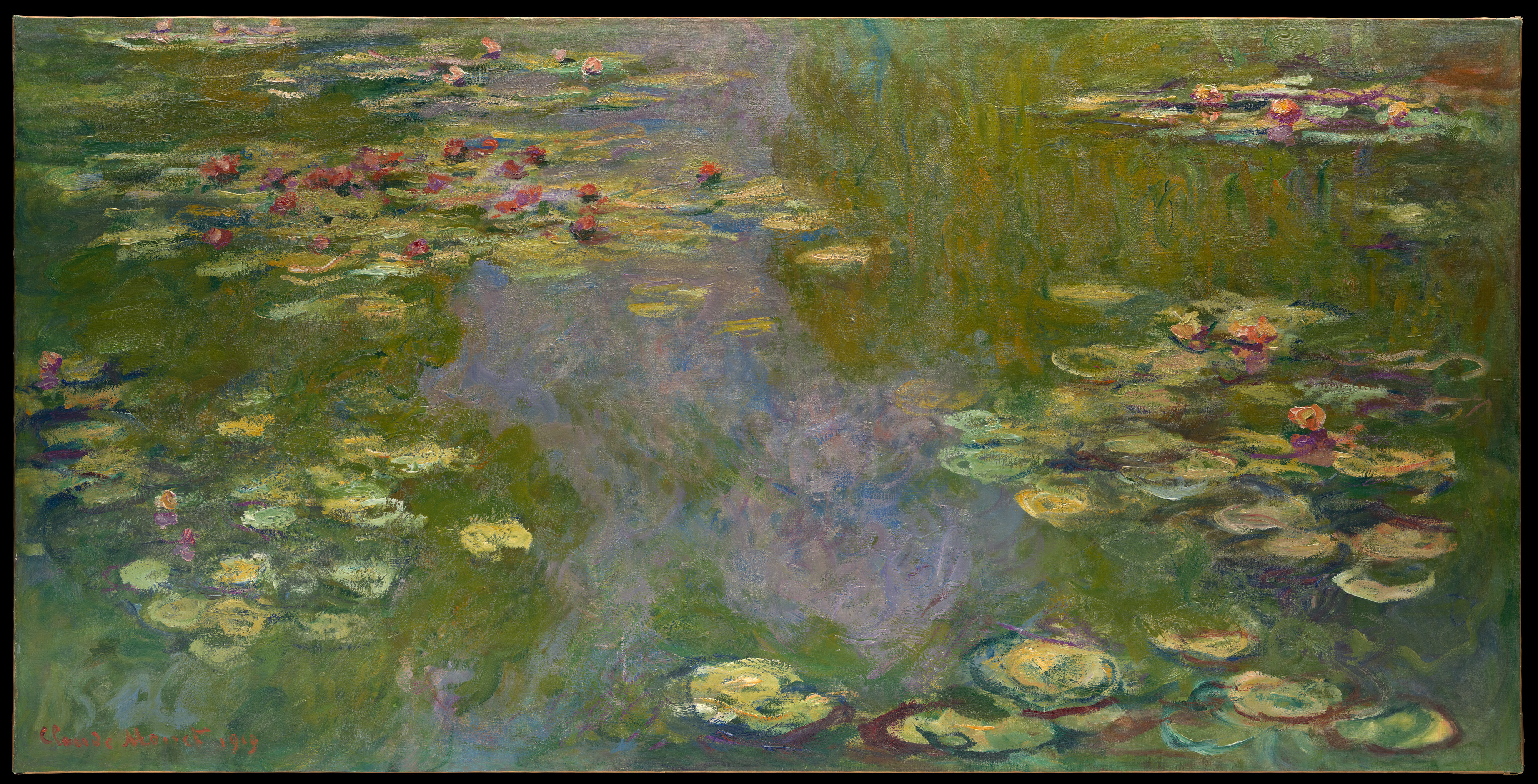
10. Water Lilies — Claude Monet, 1919
The 1919 Water Lilies spreads blue and violet blooms across green, turquoise and darker passages. Leaves and reflections interrupt one another, making it difficult to separate the surface of the pond from the depth it appears to hold. This uncertainty is central to the experience. Flowers identify the water garden, but they also serve as anchors within a broad network of colour.
The Metropolitan Museum of Art records the work as a 1919 oil on canvas, accession 1998.325.2, measuring 101 by 200 centimetres.[13] Its width encourages scanning rather than a quick reading from central subject to background. Compared with the poppy field of 1873, the later canvas offers fewer cues to conventional distance: no figures cross it, and no skyline closes the view. Yet the flowers still organise attention. Their intervals give rhythm to an environment that might otherwise seem boundless. Monet transforms a specific cultivated pond into a painting whose relationships of surface, reflection and colour remain active across nearly every part.
How to look at flower paintings
These works suggest a practical way to look beyond subject labels. First ask where the flowers are located: underfoot, inside a vessel, across a landscape, around figures or floating on water. Then notice how their scale relates to the painting. Botticelli’s many small blossoms accumulate into a setting, while Bazille’s large canvas grants a bouquet bodily presence. Monet’s late lilies extend across a field wider than any single flower can command.
Next consider whether the painter differentiates specimens or uses them as repeated marks. Ruysch and Chardin reward comparison of edges, stems and textures, though their arrangements pursue very different kinds of abundance. The poppies at Argenteuil describe depth through recurrence. Redon lets separate blooms partially dissolve into coloured atmosphere. No single balance between botanical clarity and pictorial freedom defines success.
Finally, look at the flower’s relationship with time. A bouquet gathers plants temporarily; a garden offers changing light; cut sunflowers reveal different stages within one arrangement. Paintings cannot preserve living flowers, but they can make transience visible through drooping heads, fallen petals, brief illumination and unstable reflections. That tension helps explain why the subject has remained useful across such different periods and formats.
Flower paintings are not a minor category held together only by prettiness. They can stage allegory, demonstrate exacting observation, reorganise landscape or push colour toward an immersive experience. Beginning with individual works protects those differences. Comparison then shows the enduring challenge: how to give fragile, changing forms enough structure to hold a painting together without losing the sensations that made them worth observing.
Frequently Asked Questions
Sandro Botticelli’s Spring, usually called Primavera, dates to about 1480 and begins the sequence with flowers spread through a mythological grove. [1]
Ruysch made the flower bouquet an ambitious principal subject, differentiating many blooms while organising them into a coherent composition. [2]
No. Monet’s Poppy Field uses repeated flowers to organise a landscape, while Sargent places flowers around figures in a garden. [6]
The pond fills the wide canvas without a horizon or container, so flowers punctuate an immersive field of reflections and colour. [13]
Discussion
Use this work-led guide as a starting point for close looking rather than a universal key to what flowers mean.
Share an observation about how placement, scale or colour changes the role of flowers in one of these paintings.
Reader Insights
Which painting makes individual blossoms most distinct, and how does that precision shape the whole composition?
How does a flower’s role change when it moves from a vase to a field, garden or pond?
Where should interpretation stop when a visible detail supports more than one plausible reading?
Join the Conversation
Add your reading below, keeping observations specific and evidence clear.
References
- Uffizi Galleries, “Spring (Primavera)”.
- Rijksmuseum, “Still Life with Flowers in a Glass Vase”.
- National Galleries of Scotland, “A Vase of Flowers”.
- Musée de Grenoble, “Fleurs”.
- French Ministry of Culture POP, “Fleurs”.
- Musée d’Orsay, “Coquelicots”.
- Musée d’Orsay, “Fleurs dans un vase de cristal”.
- Smithsonian National Portrait Gallery, “Carnation, Lily, Lily, Rose”.
- Tate, “Carnation, Lily, Lily, Rose”.
- British Art Studies, Sargent conservation study.
- The National Gallery, “Sunflowers”.
- The Metropolitan Museum of Art, “Vase of Flowers (Pink Background)”.
- The Metropolitan Museum of Art, “Water Lilies”.