Buy Art Prints Now
from Amazon
* As an Amazon Associate I earn from qualifying purchases.
Image reference [1]
 by Tom Gurney
Tom Gurney BSc (Hons) is an art history expert with over 20 years experience
Published on August 25, 2026 / Updated on September 6, 2026
Email: tomgurney1@gmail.com / Phone: +44 7429 011000
Still Life with Flowers in a Glass Vase: Introduction
Rachel Ruysch's Still Life with Flowers in a Glass Vase is a compact lesson in abundance. The Rijksmuseum records the painting as an oil on canvas measuring 65 by 53.5 cm, made around 1690 to around 1720 and now identified by object number SK-A-354.[1] Its title is simple, almost generic: flowers, glass, vase. Yet that simplicity is deceptive. In Ruysch's hands, a vase on a marble tabletop becomes a small theatre of light, transparency, pressure and botanical invention.
The painting belongs to the part of Ruysch's career that made her one of Europe's most admired flower still-life painters. The Rijksmuseum describes her as one of the most successful artists of her day and highlights the lifelike quality of her roses, poppies, carnations and irises.[2] This work shows why such praise attached to her name. The bouquet is not just a display of flower forms. It is a carefully organised encounter between living softness and hard surfaces: petals against darkness, stems inside glass, blossoms above polished stone.
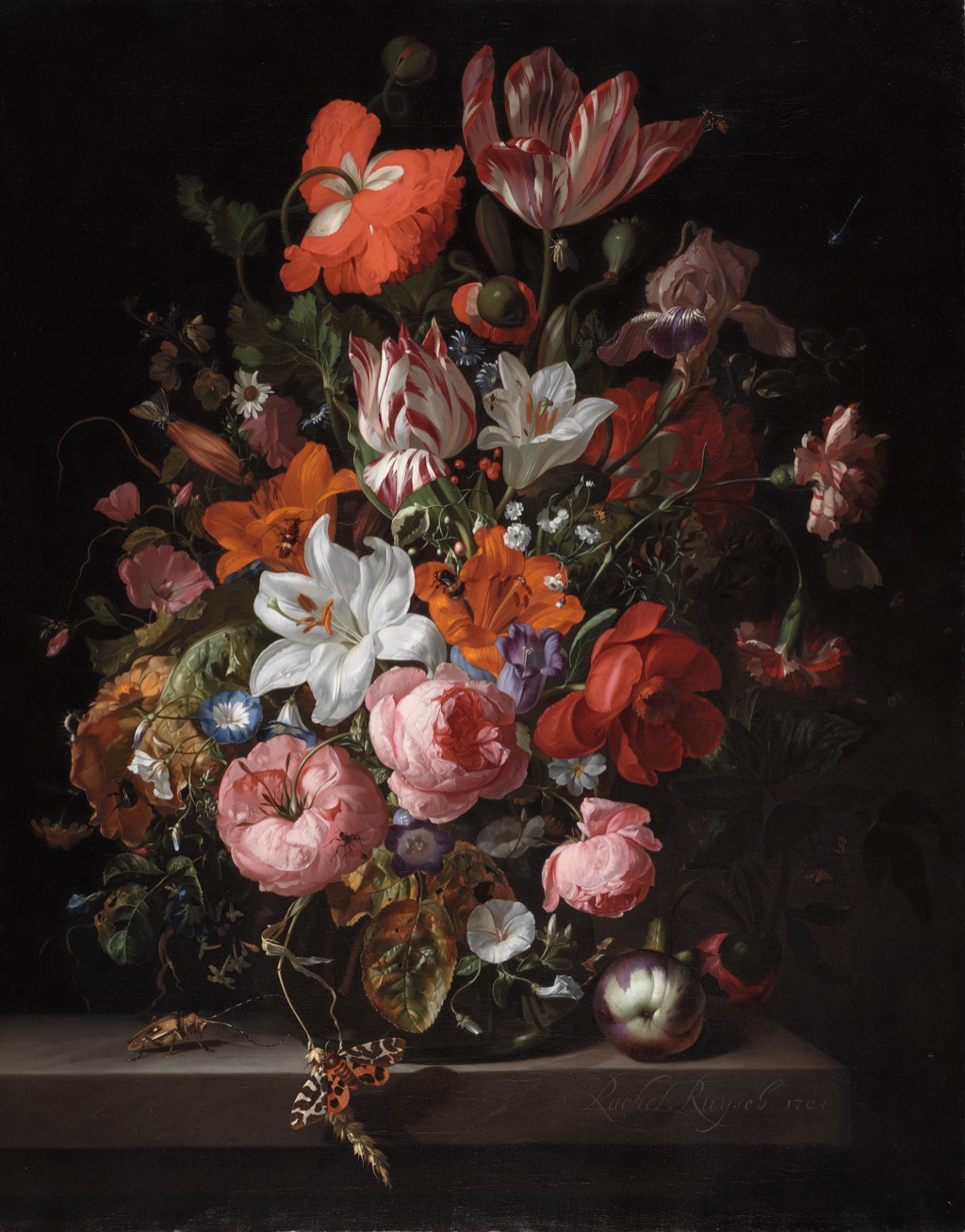
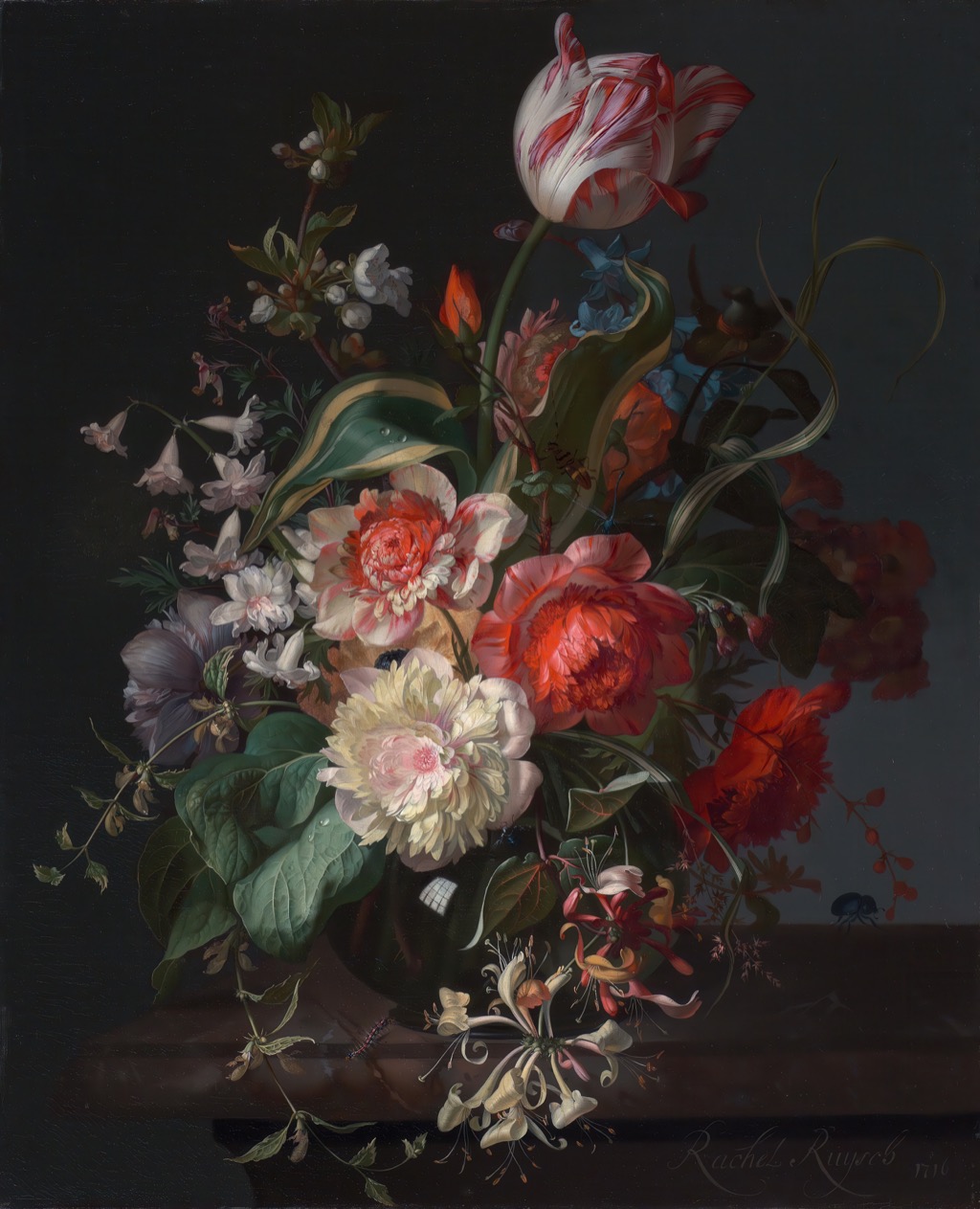
It is also a painting that needs careful identification. Ruysch made several flower pieces with related titles, and museums often use similar English wording for different objects. This page is about the Rijksmuseum Still Life with Flowers in a Glass Vase, not the Mauritshuis Vase with Flowers of 1700, not the Detroit Institute of Arts Flowers in a Glass Vase of 1704, and not the National Gallery's Flowers in a Glass Vase with a Tulip of 1716.[3][4][5] Keeping those works distinct is not a pedantic exercise. It helps us see how Ruysch returned to the glass-vase formula without repeating herself.
At a Glance
- ArtistRachel Ruysch (1664-1750)
- TitleStill Life with Flowers in a Glass Vase
- Datec. 1690-c. 1720
- MediumOil on canvas
- Dimensions65 cm high x 53.5 cm wide
- CollectionRijksmuseum, Amsterdam
- Object numberSK-A-354
- DisplayGallery of Honour, Rijksmuseum
- AcquisitionPurchased in 1814
- SignatureThe Rijksmuseum records the signature as "Rachel Ruysch f."
- SubjectA bouquet in a glass vase on a marble tabletop
- Floral identificationsThe Rijksmuseum description names, among other flowers, tulips, roses, carnations, irises, poppies, hyacinths and bindweed.[1]
Contents
- Introduction
- Identifying the Rijksmuseum Painting
- A Bouquet Built Around Glass
- Marble, Shadow and the Arrangement of Space
- Flowers Named With Care
- Invention, Study and the Impossible Bouquet
- How It Differs From Similar Ruysch Titles
- Why the Painting Matters
Identifying the Rijksmuseum Painting
The Rijksmuseum title, object number and object facts are the best starting point for this painting. The work is Still Life with Flowers in a Glass Vase, object number SK-A-354, painted by Rachel Ruysch and dated by the museum to around 1690 to around 1720.[1] That wide date range matters. It places the painting within Ruysch's long mature development rather than tying it to one exact year.
The Rijksmuseum's description is in Dutch, but its core information is clear: the painting shows a still life with flowers in a glass vase on a marble tabletop. The bouquet includes, among other flowers, tulips, roses, carnations, irises, poppies, hyacinths and bindweed.[1] The phrase "among other flowers" is important because it keeps the description open. The record gives enough identification to guide the eye, but it does not pretend that every bloom has been definitively named for a casual viewer.
The object entered the Rijksmuseum by purchase in 1814, and the museum lists it as public domain.[1] Its place in the Gallery of Honour also gives it a particular public role. It is not hidden as a minor specialist object; it appears within the museum's central presentation of Dutch painting. That location encourages viewers to see Ruysch not as a decorative aside to the better-known male painters of the Dutch Golden Age, but as a major artist working at the highest level of still-life ambition.
The painting's scale is also worth noticing. At 65 cm high, it is larger than some of Ruysch's more intimate flower pieces, but still small enough to reward close inspection. It has the compression that flower still life often demands: a whole imagined season of growth, bloom and visual pleasure held within a format that a viewer can study from nearby.
A Bouquet Built Around Glass
The glass vase is the painting's quiet engine. A flower still life can easily become all blossom, but Ruysch makes the container part of the drama. Glass gives her a way to paint transparency, reflection and depth without opening the composition into a landscape. It also gives the bouquet a visible structure. The flowers may spread outward in profusion, but the vase insists that the arrangement has weight, water, stems and a centre of gravity.
The title directs attention to that material challenge. Glass is difficult because it is both present and almost absent. It catches light only at its edges, curves and reflections. It can show the darkened mass of stems inside while still remaining translucent. A painter has to make the viewer believe in a solid object that is partly invisible.
Ruysch's glass vessels often serve this double purpose. They display virtuosity, but they also organise the bouquet. The viewer sees the flowers above, then looks down into the darker interior where stems cross and disappear. The vase turns a mass of flowers into a constructed object. It makes abundance plausible.
In this Rijksmuseum painting, the glass vase also helps distinguish the work from other Ruysch flower pieces that place bouquets in baskets, on forest floors, in stone niches or in other kinds of containers. The glass-vase format asks for a particular kind of looking. The top of the painting offers bloom and colour; the lower part asks us to think about support, shadow and the mechanics of illusion.
That contrast is one reason Ruysch's flower paintings do not feel merely ornamental. A casual glance registers the bouquet. A slower glance starts to notice how much work is being done by the objects beneath it: the vessel, the tabletop, the water-darkened stems, and the dark ground that throws the flowers into relief.
Marble, Shadow and the Arrangement of Space
The Rijksmuseum description places the glass vase on a marble tabletop.[1] That small fact gives the composition a great deal of force. Marble is cool, hard and polished; flowers are soft, temporary and vulnerable. By setting the bouquet on stone, Ruysch makes the arrangement feel staged and precious. The tabletop becomes a ledge between the viewer's world and the painted world.
Dutch still-life painters often used ledges to sharpen illusion. A ledge gives the viewer a stable front edge. It creates a measurable plane, so that petals, stems and vessels can appear to project into space. In Ruysch's case, the ledge also intensifies the contrast between permanence and change. Marble seems durable. Cut flowers do not. The whole painting is balanced between those two sensations.
The dark surrounding space matters just as much. Ruysch's flowers do not appear under flat, even illumination. They emerge from shadow. Darkness simplifies the setting while making each highlighted petal more vivid. It also lets the bouquet open and close in stages. Some blossoms present themselves boldly; others turn away, fall back or become partly hidden by leaves and stems.
The result is not a tidy botanical chart. It is a spatial arrangement. The eye moves upward and outward, then returns to the glass vessel and the tabletop. The bouquet appears generous, but it is not shapeless. Ruysch learned from a still-life tradition that valued diagonal movement, varied flower sizes and carefully managed asymmetry. The Rijksmuseum's Dutch account of Ruysch connects the influence of her teacher Willem van Aelst with precisely these qualities: diagonal compositions and arrangements of flowers differing in size and type.[6]
That structure gives the painting its authority. It allows Ruysch to present many flowers without letting the painting become a flat inventory. The forms overlap, lean, cluster and separate. The bouquet seems natural because it avoids mechanical order, yet it feels controlled because every major movement has been composed.
Flowers Named With Care
Ruysch's flowers invite naming, but they also reward restraint. The Rijksmuseum identifies tulips, roses, carnations, irises, poppies, hyacinths and bindweed among the bouquet in SK-A-354.[1] Those names are enough to suggest the painting's range: upright and drooping forms, broad and narrow petals, dense heads, curling stems and strong contrasts of colour and texture.
Tulips matter because they carried special prestige in Dutch flower painting. By Ruysch's lifetime, the tulip had long been associated with horticultural desire, collecting and visual rarity. Roses offer another kind of richness: layered petals, soft transitions and the sense of a bloom opening from within. Carnations bring fringed edges and compact rhythms. Irises cut through the bouquet with sharper forms. Poppies can introduce delicate petals and a suggestion of fragility. Hyacinths add clustered density, while bindweed gives the composition a climbing, curling motion.
Yet the safest way to speak about these flowers is to stay close to the museum record. Ruysch's art is so persuasive that a viewer may want to name more than the evidence supports. That temptation is part of the painting's power. It feels botanically knowable. But common names, historical varieties and painted resemblance do not always line up neatly. A flower in a seventeenth- or eighteenth-century painting may resemble a modern species without being one that can be identified confidently from reproduction or memory.
This caution does not make the painting less exciting. It makes looking more honest. Ruysch was not making a modern field guide. She was making a still life for viewers who could enjoy botanical specificity, rarity, decorative harmony and painterly invention at the same time. The point is not to turn every petal into a label. The point is to notice how convincingly the bouquet persuades us that such labels might exist.
The Rijksmuseum's artist page helps explain why this mattered to her reputation. It describes Ruysch's highly detailed floral still lifes as lifelike, singling out roses, poppies, carnations and irises as examples of flowers that seem almost indistinguishable from real ones.[2] That statement is not just praise for accuracy. It points to the core illusion of Ruysch's art: the painted flower appears fresh, present and touchable, while the painting itself preserves what nature cannot.
Invention, Study and the Impossible Bouquet
The bouquet in Still Life with Flowers in a Glass Vase looks as though it has been gathered from life, but Ruysch's flower paintings are best understood as constructed images. Dutch flower painters did not always paint one bouquet that sat in front of them at one moment. Museum commentary on Ruysch repeatedly stresses the role of studies, preserved specimens and planned composition.
The National Gallery's account of Flowers in a Glass Vase with a Tulip is especially useful here. It explains that the older idea of flower painters adding each bloom as it came into season has been reconsidered. Instead, painters used collections of flower studies to fill a planned composition. The same discussion describes a method in which the shapes of flowers and leaves were sketched on the prepared surface, the background was painted around them, and the blooms were built in layers from dark tones to lighter ones before final highlights were added.[5]
That method helps us look at the Rijksmuseum painting. Even without an exact year, SK-A-354 belongs to a practice in which close observation and pictorial invention work together. The bouquet is credible because the parts are studied. It is compelling because the whole has been arranged. Ruysch gives the viewer the sensation of immediate nature while quietly compressing many moments of observation into one image.
Her background made such work possible. Frederik Ruysch, her father, was a prominent anatomist and botanist in Amsterdam, associated with scientific collections and the Hortus Botanicus. The Mauritshuis links Rachel Ruysch's love of flowers and plants to that environment, and the broader modern exhibition literature has emphasized the meeting of art and natural history in her work.[3][7][8] The point is not that her father's science explains everything. It is that Ruysch grew up in a culture where looking closely at natural forms had intellectual value.
The recent Rachel Ruysch: Nature into Art exhibition, organised by the Alte Pinakothek, Toledo Museum of Art and Museum of Fine Arts, Boston, has made that connection newly visible. The exhibition framed Ruysch's floral still lifes through plants, fruits, butterflies, insects, global collecting, botanical gardens and the scientific environment of the seventeenth and eighteenth centuries.[8][9] That frame is helpful for this painting because it reminds us that a bouquet could be more than a bouquet. It could be an image of cultivated attention.
How It Differs From Similar Ruysch Titles
The title Still Life with Flowers in a Glass Vase sounds clear until it is placed beside other Ruysch works. Several important paintings use similar vase-and-flowers wording, and the differences matter.
The Rijksmuseum painting discussed here is SK-A-354. It is dated around 1690 to around 1720, painted in oil on canvas, measures 65 by 53.5 cm, and shows a bouquet in a glass vase on a marble tabletop.[1] Its title begins with "Still Life," and its collection is the Rijksmuseum in Amsterdam.
The Mauritshuis painting is Vase with Flowers, dated 1700, oil on canvas, 79.5 by 60.2 cm, inventory number 151.[3] The Mauritshuis emphasises its bouquet as past its freshest moment: flowers droop, an overblown flower has apparently been cut away, and the resulting gap creates depth. That is a very specific dramatic effect. It should not be folded into the Rijksmuseum painting simply because both works involve a vase and flowers.
The Detroit Institute of Arts painting is Flowers in a Glass Vase, dated 1704 and signed and dated at the bottom right on the ledge.[4] Detroit describes it as a large flower still life with white and orange lilies, peonies, cabbage roses and striated tulips, with dewdrops and hovering insects. The museum also stresses that the selected flowers do not bloom at the same time and that the arrangement could only have existed in the artist's imagination.[4] Again, those details belong to the Detroit work, not automatically to the Rijksmuseum one.
The National Gallery painting is Flowers in a Glass Vase with a Tulip, dated 1716, oil on canvas, 46.5 by 36 cm, on loan from the collection of Janice and Brian Capstick.[5] The National Gallery identifies the Semper Augustus striped tulip, roses, honeysuckle and pear blossom, and provides unusually detailed commentary on technique, insects, water drops and Ruysch's flower-study process.[5] Its title overlaps most closely with the Detroit and Rijksmuseum works, but its object facts make it distinct.
These distinctions improve the viewing experience. They show that Ruysch did not have one generic formula for flower paintings. The glass vase could become a different problem each time: a vehicle for scale, elegance, darkness, seasonal impossibility, surface brilliance, courtly refinement or signs of fading. The shared vocabulary makes comparison possible; the object facts keep the paintings from blurring into one another.
Why the Painting Matters
The Rijksmuseum Still Life with Flowers in a Glass Vase matters because it condenses many of Ruysch's strengths into a single readable object. It shows her command of flowers, but also her command of relations: soft to hard, opaque to transparent, light to darkness, variety to order, immediacy to invention.
It also helps correct a narrow idea of Dutch painting. For many readers, the Dutch Golden Age is first associated with portraits, domestic interiors, landscapes and genre scenes. Ruysch's flower still lifes show that still life could be just as ambitious. A bouquet could demonstrate knowledge of botany, access to rare plants, control of illusion, elite taste and serious artistic intelligence.
Her success was not an afterthought. The Rijksmuseum identifies her as one of the most successful artists of her day.[2] The Mauritshuis calls her one of the most successful Dutch still-life painters of the seventeenth and eighteenth centuries and notes her fame at home and abroad.[3] The Pinakothek's exhibition text describes her floral still lifes as sought-after and expensive collector's items during her lifetime.[9] These statements are important because they place Ruysch's achievement in public, professional and market terms, not merely in modern recovery language.
The painting also belongs inside the larger story of Rachel Ruysch's flower paintings and her relationship to art and science. Its flowers are beautiful, but beauty is only the beginning. The bouquet is a record of looking, selecting, comparing and composing. Its glass vase asks the viewer to notice transparency and support. Its marble tabletop turns a natural arrangement into a staged object. Its title seems ordinary, but the painting is anything but ordinary.
For readers exploring Ruysch's works, SK-A-354 is especially useful because it sits between intimacy and display. It is not as tightly dated as the Rijksmuseum's 1716 Still Life with Flowers on a Marble Tabletop, nor does it carry the strongly documented wilted drama of the Mauritshuis Vase with Flowers. Its power is quieter. It presents the flower still life as an art of disciplined abundance: many blooms, many textures, many visual claims, all held together by the logic of a glass vessel on stone.
That is why it remains a rewarding painting to look at slowly. The title tells us what is there. Ruysch shows us how much can happen inside that simple phrase.
Frequently Asked Questions
Discussion
In Ruysch's Rijksmuseum painting, do you find yourself looking first at the flowers as individual blooms, or at the glass vase and marble tabletop that make the whole arrangement feel staged?
Reader Insights
Compare the Rijksmuseum painting with the Mauritshuis Vase with Flowers. How does a fresh-looking arrangement differ in mood from one described by the museum as past its peak?
Look only at the glass vase for a moment. What does it add besides holding the flowers?
Use the Rijksmuseum's flower names as a guide, then stop naming and look for movement: curled stems, drooping petals, changes of light and shifts between shadow and colour.
Join the Conversation
Share a thoughtful observation about Rachel Ruysch, the painting, or the wider still-life tradition that would help another reader look more carefully.
References
- Rijksmuseum, Rachel Ruysch, Still Life with Flowers in a Glass Vase, c. 1690-c. 1720, object number SK-A-354. https://www.rijksmuseum.nl/en/collection/SK-A-354
- Rijksmuseum, "Rachel Ruysch," artist page. https://www.rijksmuseum.nl/en/collection/node/Rachel-Ruysch--3eaff215275e2ebd47d02cfba2044cc8
- Mauritshuis, Rachel Ruysch, Vase with Flowers, 1700, object page. https://www.mauritshuis.nl/en/our-collection/artworks/151-vase-with-flowers
- Detroit Institute of Arts, Rachel Ruysch, Flowers in a Glass Vase, 1704, object page. https://dia.org/collection/flowers-glass-vase/66064
- National Gallery, London, Rachel Ruysch, Flowers in a Glass Vase with a Tulip, 1716, object page. https://www.nationalgallery.org.uk/paintings/rachel-ruysch-flowers-in-a-glass-vase-with-a-tulip
- Rijksmuseum, "Rachel Ruysch," Nederlandse meesters story. https://www.rijksmuseum.nl/nl/stories/nederlandse-meesters/story/rachel-ruysch
- Mauritshuis, "Rachel Ruysch (1664-1750)," artist page. https://www.mauritshuis.nl/en/our-collection/our-masters/rachel-ruysch/
- Museum of Fine Arts, Boston, "Rachel Ruysch: Artist, Naturalist, and Pioneer." https://www.mfa.org/exhibition/rachel-ruysch-artist-naturalist-and-pioneer
- Alte Pinakothek, "Rachel Ruysch: Nature into Art," exhibition page. https://www.pinakothek.de/en/exhibition/nature-into-art
- RKD Studies, "Court Paintings for Johann Wilhelm II, Elector Palatine (1708-1716)," in Masters of Mobility. https://masters-of-mobility.rkdstudies.nl/6-still-life-painter-rachel-ruysch-1664-1750-and-her-connections-to-germany/62-court-paintings-for-johann-wilhelm-ii-elector-palatine-1708-1716/
- Robert Schindler, Bernd Ebert, and Anna C. Knaap, eds., Rachel Ruysch: Nature into Art. MFA Publications, 2024.
- Marianne Berardi, Science into Art: Rachel Ruysch's Early Development as a Still-Life Painter. Ph.D. diss., University of Pittsburgh, 1998.
- Marianne Berardi, Rachel Ruysch: The Hague 1664-1750 Amsterdam. Richard Green, 2012.
- Main image reference: Rachel Ruysch, Still Life with Flowers in a Glass Vase, Rijksmuseum. Public-domain image via Wikimedia Commons / Rijksmuseum. https://commons.wikimedia.org/wiki/Category:Still_Life_with_Flowers_in_a_Glass_Vase_(Rachel_Ruysch,_Rijksmuseum)