Buy Art Prints Now
from Amazon
* As an Amazon Associate I earn from qualifying purchases.
Image reference [1]
 by Tom Gurney
Tom Gurney BSc (Hons) is an art history expert with over 20 years experience
Published on August 25, 2026 / Updated on September 6, 2026
Email: tomgurney1@gmail.com / Phone: +44 7429 011000
Rachel Ruysch and Women Artists of the Dutch Golden Age: Introduction
Rachel Ruysch belongs in the history of Dutch flower painting, but she also belongs in a wider history of women artists in the Dutch Republic. Her career was unusually long, visible and successful. Born in The Hague in 1664, trained in Amsterdam, active as a still-life painter for elite patrons, and appointed court painter to Johann Wilhelm, Elector Palatine, she gives modern readers a rare chance to see a woman artist whose reputation was not built only after death.[1]
That does not mean her story should be turned into a simple tale of triumph over disappearance. The stronger point is more exact. Ruysch worked in a world where women could make art, teach, draw, collect, paint, publish, study nature and participate in family workshops, but where professional access and later art-historical language were uneven. Her life sits between visibility and restriction. She was admired in her own time, but modern scholarship and museums are still clarifying the broader network of women around her: Judith Leyster, Anna Ruysch, Maria Sibylla Merian, Alida Withoos, Clara Peeters and others whose work complicates any idea that Dutch and Flemish women artists were rare exceptions.[2]
For Ruysch, the important question is not simply "Was she a woman artist?" It is: what did gender change, what did skill make possible, and how did a painter of flowers build authority in a market that valued knowledge, finish and invention?
At a Glance
- Rachel Ruysch was one of the most successful Dutch still-life painters of the late seventeenth and early eighteenth centuries.
- She trained with Willem van Aelst and became known for highly detailed flower paintings, fruit pictures and forest-floor still lifes.
- Sources identify her as the first woman member of The Hague's Confrerie Pictura.
- From 1708 to 1716 she served as court painter to Johann Wilhelm, Elector Palatine, while maintaining her Amsterdam base.
- Her career can be compared carefully with Judith Leyster, Anna Ruysch, Maria Sibylla Merian, Alida Withoos and Clara Peeters, but not as though all women artists had the same training, market or reception.
- Recent exhibitions and research projects have brought Ruysch into larger conversations about women artists, natural history and collecting in the Low Countries.
Contents
- Introduction
- Why Ruysch Matters Here
- A Professional Career, Not a Footnote
- Judith Leyster and a Different Dutch Path
- Sisters, Naturalists and Flower Painters
- Gender, Training and Reception
- Why Modern Museums Are Returning to Ruysch
Why Ruysch Matters Here
Ruysch matters in histories of women artists because her career resists two easy habits. One habit is to treat women painters as isolated anomalies. The other is to turn them into a single category, as if gender alone explains their art. Ruysch needs a better frame than either one.
She was exceptional, but she was not alone. The National Museum of Women in the Arts has placed Ruysch within exhibitions on women artists of the Dutch Golden Age and, more recently, women artists from Antwerp to Amsterdam. The museum's artist profile emphasises her family connections, early apprenticeship, professional activity, court service and late career.[3] The Museum of Fine Arts, Boston, has also framed Ruysch through a major exhibition that brings her flower paintings together with specimens and work by other women artists, including Anna Ruysch, Maria Sibylla Merian and Alida Withoos.[4]
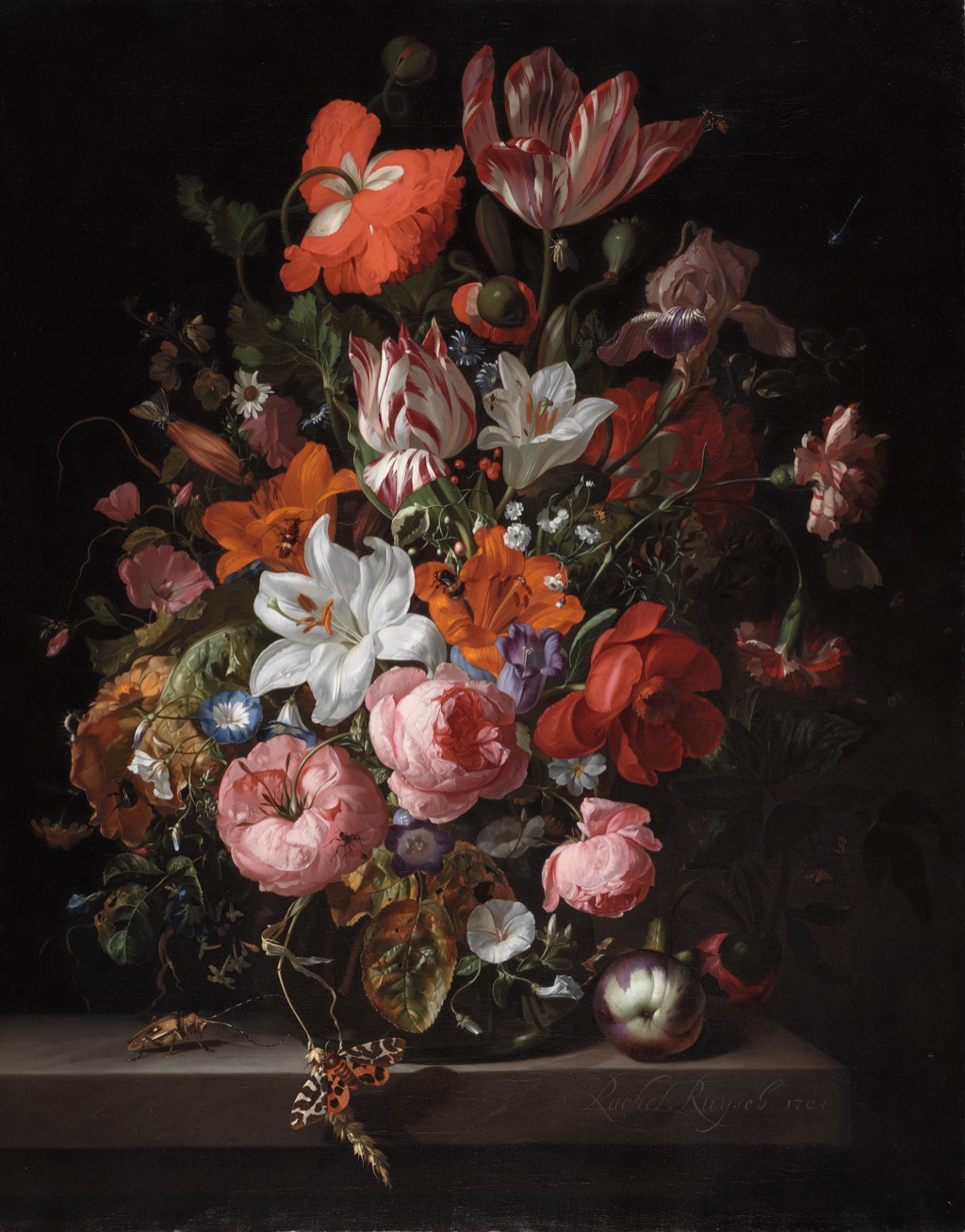
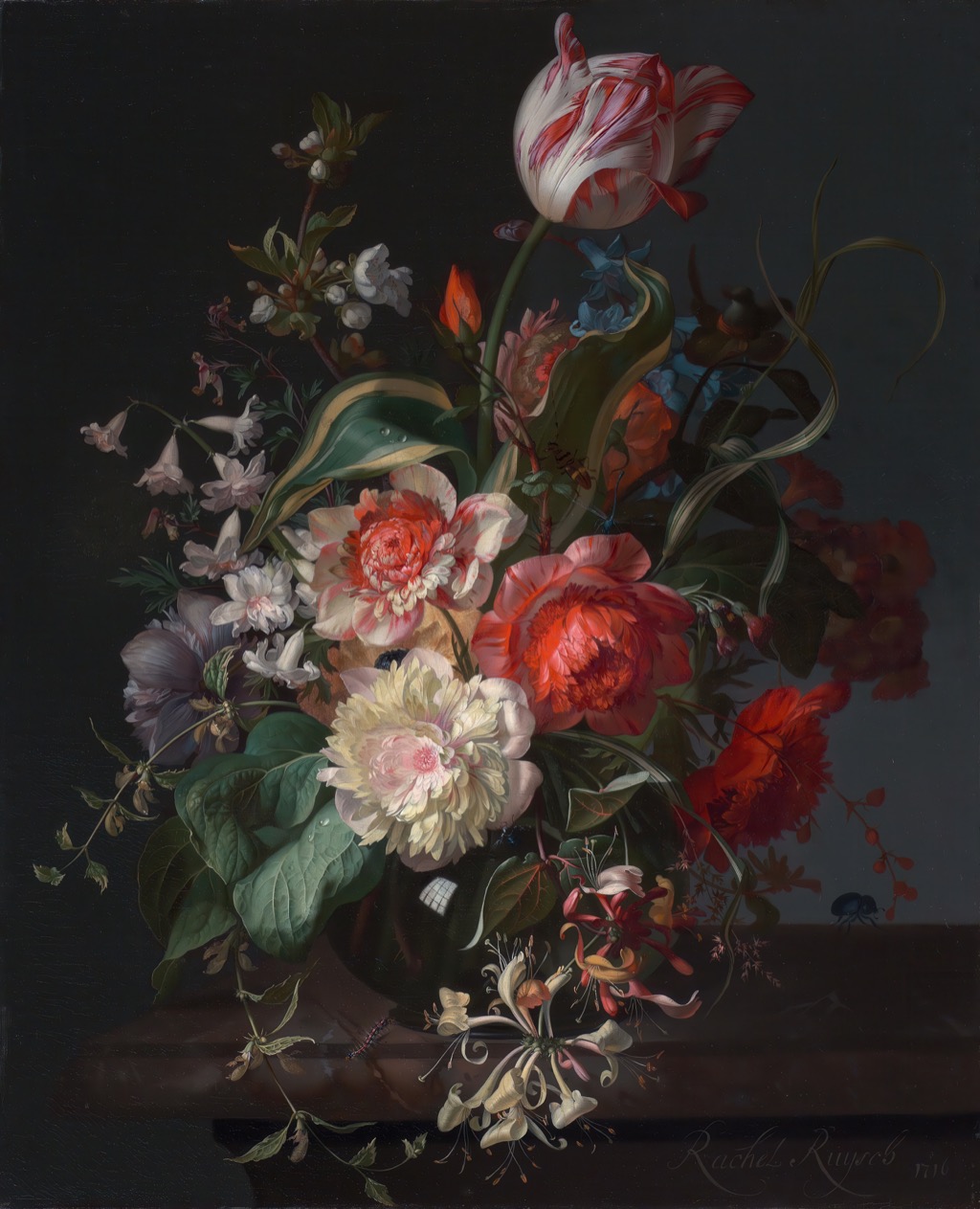
That context changes how we see the paintings. A Ruysch bouquet is not only a beautiful arrangement of roses, poppies, tulips, insects and leaves. It is also the result of professional training, access to scientific and botanical culture, market knowledge and a public identity as a painter. Her gender shaped the conditions of that identity, but it did not reduce the work to biography.
The same balance is useful for reading other Dutch and Flemish women artists. Judith Leyster was a Haarlem painter of lively genre scenes, musicians and portraits; Clara Peeters made refined still lifes in the early seventeenth century; Maria Sibylla Merian joined natural-history observation with images of insects and plants; Alida Withoos came from a family of artists associated with botanical and natural-history imagery. These artists did not have identical careers. Their value lies partly in their difference.
A Professional Career, Not a Footnote
Ruysch's career was public, profitable and long. Rijksmuseum describes her as one of the most successful artists of her day, known for floral still lifes of extraordinary lifelike detail.[5] Mauritshuis similarly presents her as famous at home and abroad, a court painter and a leading still-life specialist.[6] The Metropolitan Museum of Art, discussing the 1692 portrait she made in collaboration with Michiel van Musscher, notes that across more than six decades she attracted royal patronage, high prices and strong praise for her still-life paintings.[7]
Those facts matter because women artists are often introduced through family roles: daughter of, wife of, sister of. Ruysch did have important relationships. Her father, Frederik Ruysch, was an anatomist, botanist and collector. Her teacher, Willem van Aelst, was a leading still-life painter. Her husband, Juriaen Pool, was a portrait painter. Her sister Anna Ruysch also painted flower still lifes. But Rachel Ruysch's achievement cannot be explained away by proximity to others.
She entered a specialist field and became one of its major names. She painted for wealthy collectors and European patrons. She joined a professional artistic society in The Hague. She continued to work after marriage and into old age. The point is not that every detail of her life was easy or typical. It is that she should be discussed first as a painter with a serious career.
This is where Ruysch differs from the common idea of the "hidden" woman artist. She was not unknown in her lifetime. Her work was collected, praised and valued. The harder question is how later histories categorized that success, and how often admiration for her skill came wrapped in surprise that a woman could possess it.
Judith Leyster and a Different Dutch Path
Judith Leyster makes a useful comparison because she shows a very different route through Dutch art. Leyster worked earlier in the seventeenth century, mainly in Haarlem, and is best known for genre scenes, musicians and portraits rather than flower still lifes. Her paintings belong close to the world of Frans Hals and Haarlem figure painting, while Ruysch's belong to Amsterdam still life, natural history and elite collecting.
The comparison should not flatten them into one story. Leyster's art often depends on social animation: a musician turns toward us, a figure laughs, a sitter performs identity. Ruysch's art depends on another kind of life: petals open and fade, insects move, stems arc, drops catch the light, and imagined bouquets gather many seasons into one composition. Both artists had to make skill visible, but they did so through different subjects, markets and pictorial languages.
Placed together, they help widen the map of Dutch Golden Age art. The period is often introduced through Rembrandt, Vermeer, Hals, landscapes, city views, portraits and domestic interiors. Ruysch and Leyster remind us that women artists were not outside that world looking in. They worked within its genres and markets, though with different levels of access, support and later recognition.
The safest way to use the comparison is specific: Leyster helps readers see one form of women's professional painting in the Dutch Republic; Ruysch helps readers see another. Their careers do not prove a single rule. They open a larger field.
Sisters, Naturalists and Flower Painters
Ruysch's closest women-artist context begins at home. The Alte Pinakothek's Rachel Ruysch: Nature into Art exhibition devotes attention to her sister Anna Ruysch, describing her as a talented painter of floral still lifes whose surviving work is much less researched and far smaller in number.[8] That comparison is revealing. Two sisters could share access, environment and early promise, yet only one built the professional success that later made her name widely recoverable.
Maria Sibylla Merian and Alida Withoos add another kind of context. The MFA Boston exhibition places their work near Ruysch's because all three connect art with the study of natural forms.[4] Merian is especially important for the visual culture of insects and plants, while Withoos belongs to a family workshop environment associated with botanical and natural-history subjects. Mentioning them alongside Ruysch should not imply they all did the same work. It shows that the visual study of nature created opportunities for women in several media and settings.
Clara Peeters broadens the still-life frame. Active in the early seventeenth century, she is often discussed as one of the important women still-life painters of the Low Countries. Her polished objects, reflected surfaces and carefully arranged foods belong to a different generation from Ruysch, but they help show that women artists were present in still life before Ruysch's great flower pieces.
Together, these names make a stronger argument than a long unsourced list would. Ruysch was part of a wider landscape of women's artistic work in the Low Countries and neighboring European networks. Some women were famous. Some were recorded unevenly. Some worked in family settings. Some entered markets more visibly than others. The pattern is not absence. It is uneven evidence, uneven opportunity and uneven memory.
Gender, Training and Reception
Gender mattered to Ruysch's career, but it should be handled with care. Mauritshuis emphasises that she continued a successful career after marriage and motherhood, an unusual path for a woman in her period.[6] NMWA records her apprenticeship, Pictura membership and work for international patrons.[3] National Gallery material also notes her formal career in The Hague and Düsseldorf.[9]
Those facts support a clear claim: Ruysch navigated expectations that made sustained professional art-making more difficult for women. They do not support every broad claim sometimes attached to women artists. It would be too simple to say she was "forgotten" in the same way as every other woman painter, or that all women artists were excluded from all professional spaces. Her case is more interesting because she was both constrained and celebrated.
Modern research also asks how records themselves shape reputation. An RKD story on eighteenth-century women artists describes work to update and refine database records, including attention to gendered language and family-role labels that can narrow how women artists are understood.[2] That matters for Ruysch because labels can quietly decide whether a woman appears as an artist, a wife, a daughter, a pupil or an exception.
Older praise needs the same caution. Admiration for Ruysch could be genuine and still gendered. A viewer might praise her flowers while marveling that a woman painted them. A later writer might value her diligence while reducing her to domestic virtue. Modern readers can keep the evidence without inheriting the assumptions.
The best approach is to return to the paintings. Ruysch's flower still lifes are not important because they were made by a woman instead of a man. They are important because they are brilliant paintings, made by an artist whose gender affected the conditions under which that brilliance was trained, marketed, praised and remembered.
Why Modern Museums Are Returning to Ruysch
Recent attention to Ruysch has grown because her art connects several questions that matter now: women artists, natural history, collecting, scientific imagery, Dutch still life and the global movement of plants and specimens. The international Nature into Art project, organised across Munich, Toledo and Boston, presents Ruysch not as a decorative specialist but as an artist whose flowers belong between art and science.[4][8]
That renewed attention also changes how a reader might move through the rest of Ruysch's work. Her biography shows the long arc of her training, marriage, patrons and late career. Her flower paintings show how she built imaginary bouquets from observation and invention. Her art-and-science context shows how Frederik Ruysch, the Hortus Botanicus and natural-history culture shaped the world around her without taking the achievement away from her.
The women-artist context adds one more layer. Ruysch's success was not proof that early modern women faced no barriers. It was proof that, under particular conditions, a woman artist could become a leading painter in a demanding and prestigious field. The task for modern viewers is to see both the individual and the network: Rachel Ruysch as a singular painter, and Rachel Ruysch among the many women whose work made the art of the Low Countries richer than the old shorthand allowed.
Frequently Asked Questions
Discussion Prompt
Rachel Ruysch was celebrated in her own lifetime, yet modern museums are still rebuilding the wider context around her and other women artists. How should we balance admiration for her exceptional career with attention to the less visible women who worked around her?
Discussion
Rachel Ruysch was celebrated in her own lifetime, yet modern museums are still rebuilding the wider context around her and other women artists. How should we balance admiration for her exceptional career with attention to the less visible women who worked around her?
Reader Insights
Compare Ruysch with [Judith Leyster](/judith-leyster/) to see how two Dutch women artists built authority through very different subjects.
Look at Ruysch beside Maria Sibylla Merian or Alida Withoos to explore how women contributed to the visual study of plants and insects.
For a broader European comparison, place Ruysch near [Artemisia Gentileschi](/artemisia-gentileschi/) and [Élisabeth Vigée Le Brun](/elisabeth-vigee-le-brun/) as artists whose reputations were shaped by talent, market conditions, patronage and gendered reception.
Join the Conversation
Share a thoughtful observation about Rachel Ruysch, the painting, or the wider still-life tradition that would help another reader look more carefully.
References
- Rijksmuseum, "Rachel Ruysch," https://www.rijksmuseum.nl/en/collection/node/Rachel-Ruysch--3eaff215275e2ebd47d02cfba2044cc8; Mauritshuis, "Rachel Ruysch (1664-1750)," https://www.mauritshuis.nl/en/our-collection/our-masters/rachel-ruysch
- RKD, Romy Kerkhof, "Unwavering legacy: 18th-century women artists in the RKD database," 2 December 2024, https://www.rkd.nl/en/knowledge-publications/rkd-stories/unwavering-legacy-18th-century-women-artists-in-the-rkd-database
- National Museum of Women in the Arts, "Rachel Ruysch," https://nmwa.org/art/artists/rachel-ruysch/
- Museum of Fine Arts, Boston, "Rachel Ruysch: Artist, Naturalist, and Pioneer," https://www.mfa.org/exhibition/rachel-ruysch-artist-naturalist-and-pioneer
- Rijksmuseum, "Rachel Ruysch," https://www.rijksmuseum.nl/en/collection/node/Rachel-Ruysch--3eaff215275e2ebd47d02cfba2044cc8
- Mauritshuis, "Rachel Ruysch (1664-1750)," https://www.mauritshuis.nl/en/our-collection/our-masters/rachel-ruysch
- The Metropolitan Museum of Art, "Rachel Ruysch (1664-1750)," https://www.metmuseum.org/art/collection/search/875634
- Pinakothek, "Rachel Ruysch: Nature into Art," https://www.pinakothek.de/en/exhibition/nature-into-art
- National Gallery, London, "Rachel Ruysch," https://www.nationalgallery.org.uk/artists/rachel-ruysch
- Robert Schindler, Bernd Ebert and Anna C. Knaap, eds., Rachel Ruysch: Nature into Art, Boston: MFA Publications, 2024.
- Main image reference: Rachel Ruysch and Michiel van Musscher, Rachel Ruysch in her studio, 1692. Public-domain image via Wikimedia Commons / The Metropolitan Museum of Art. https://commons.wikimedia.org/wiki/File:Rachel_Ruysch_and_Michiel_van_Musscher_-_Rachel_Ruysch_in_her_studio.jpg