


 Buy Art Prints Now
from Amazon
* As an Amazon Associate I earn from qualifying purchases.
Image reference [1]
 by Tom Gurney
Tom Gurney BSc (Hons) is an art history expert with over 20 years experience
Published on August 25, 2026 / Updated on September 6, 2026
Email: tomgurney1@gmail.com / Phone: +44 7429 011000
Rachel Ruysch Paintings: Introduction
Rachel Ruysch's paintings turn still life into an art of concentration. A vase of flowers becomes a world of glass, darkness, insects, cut stems, polished ledges, botanical knowledge and painterly ambition. Her best-known works are floral still lifes, but her achievement is broader than one repeated bouquet. Across a long career, Ruysch painted flower pieces, fruit pieces, forest-floor scenes and richly staged arrangements that carried her reputation from Amsterdam and The Hague to the court of Johann Wilhelm, Elector Palatine, in Dusseldorf.
This overview is a guide to Ruysch's paintings rather than a complete catalogue. It gathers the main types of work, the museums that anchor her reputation today, and the individual paintings that deserve close attention. Because many of her titles sound similar, object details matter. Still Life with Flowers in a Glass Vase, Flowers in a Glass Vase, Flowers in a Glass Vase with a Tulip and Vase with Flowers are not interchangeable labels. Each points to a specific work, collection and moment in Ruysch's career.
Ruysch (1664-1750) trained with Willem van Aelst, grew up in the scientific household of Frederik Ruysch, and became one of the most successful still-life painters of her age.[1][2][3] Her paintings remain compelling because they hold opposites in balance: exact observation and impossible bouquets, luxury and decay, scientific curiosity and decorative brilliance, close detail and confident design.
At a Glance
- Main painting typeflower still life, often in a glass vase or on a stone or marble ledge.
- Other important subjectsfruit pieces, forest-floor still lifes, insects, specimens, cut stems and combinations of flowers with fruit.
- Working charactermany bouquets are carefully composed inventions rather than one bouquet copied from nature at a single moment.
- Key visual featuresdark backgrounds, diagonal movement, transparent glass, marble or stone ledges, dewdrops, insects, damaged leaves and selective light.
- Major collection anchorsRijksmuseum, Mauritshuis, National Gallery, Detroit Institute of Arts, Toledo Museum of Art, Alte Pinakothek / Bayerische Staatsgemaldesammlungen and National Museum of Women in the Arts.
- Title cautionRuysch's works often have similar English titles, so date, collection, dimensions and inventory number help distinguish them.
- Best first routebegin with the flower paintings, then follow the individual pages for Still Life with Flowers on a Marble Tabletop, Still Life with Flowers in a Glass Vase, Vase with Flowers and Flowers in a Glass Vase.
Contents
- Introduction
- A Selective Map of Ruysch's Paintings
- Flower Paintings and Impossible Bouquets
- Fruit Pieces and Forest-Floor Worlds
- Major Paintings by Collection
- How to Tell Similar Titles Apart
- Style, Technique and Looking Closely
- Court, Collectors and Reputation
- How to Keep Exploring
All Rachel Ruysch Paintings in This Cluster




A Selective Map of Ruysch's Paintings
Ruysch is usually introduced as a flower painter, and that is fair as long as the phrase is not made too small. In seventeenth- and eighteenth-century Dutch art, a flower painting could be a display of costly flowers, a demonstration of technical finish, a response to horticulture and natural history, a meditation on transience, and a collector's object all at once. Ruysch's paintings move through all of those registers.
Her works are easiest to approach through types. The first group is the large or medium-sized bouquet in a vase, often set before a dark background. These are the paintings that most visitors associate with her name: abundant flower heads, curling stems, tiny insects, moisture, shadow and the sense that the bouquet has been arranged for the eye rather than for a room.
A second group joins flowers with fruit. These works connect botanical display to abundance, ripeness and appetite. The Pinakothek's holdings, including Fruchtestuck of 1709 and several flower pieces, are useful reminders that Ruysch's range did not stop at the vertical vase bouquet.[4]
A third group turns downward toward the forest floor. Here the subject may include plants, insects, reptiles, mushrooms or damp undergrowth. The National Gallery notes the influence of Otto Marseus van Schrieck on Ruysch's early work, especially in dark forest subjects with flora, insects and lizards.[2] These paintings connect Ruysch to a tradition of sottobosco, or forest-floor still life, where nature is studied near the ground rather than arranged on a tabletop.
What joins these types is Ruysch's ability to make close looking feel dramatic. The paintings are not quiet inventories. They are built around movement: a stem curves into light, a tulip leans outward, a beetle interrupts the polished ledge, a wilted bloom opens a gap in the bouquet. Her still lifes have stillness, but not inertia.
Flower Paintings and Impossible Bouquets
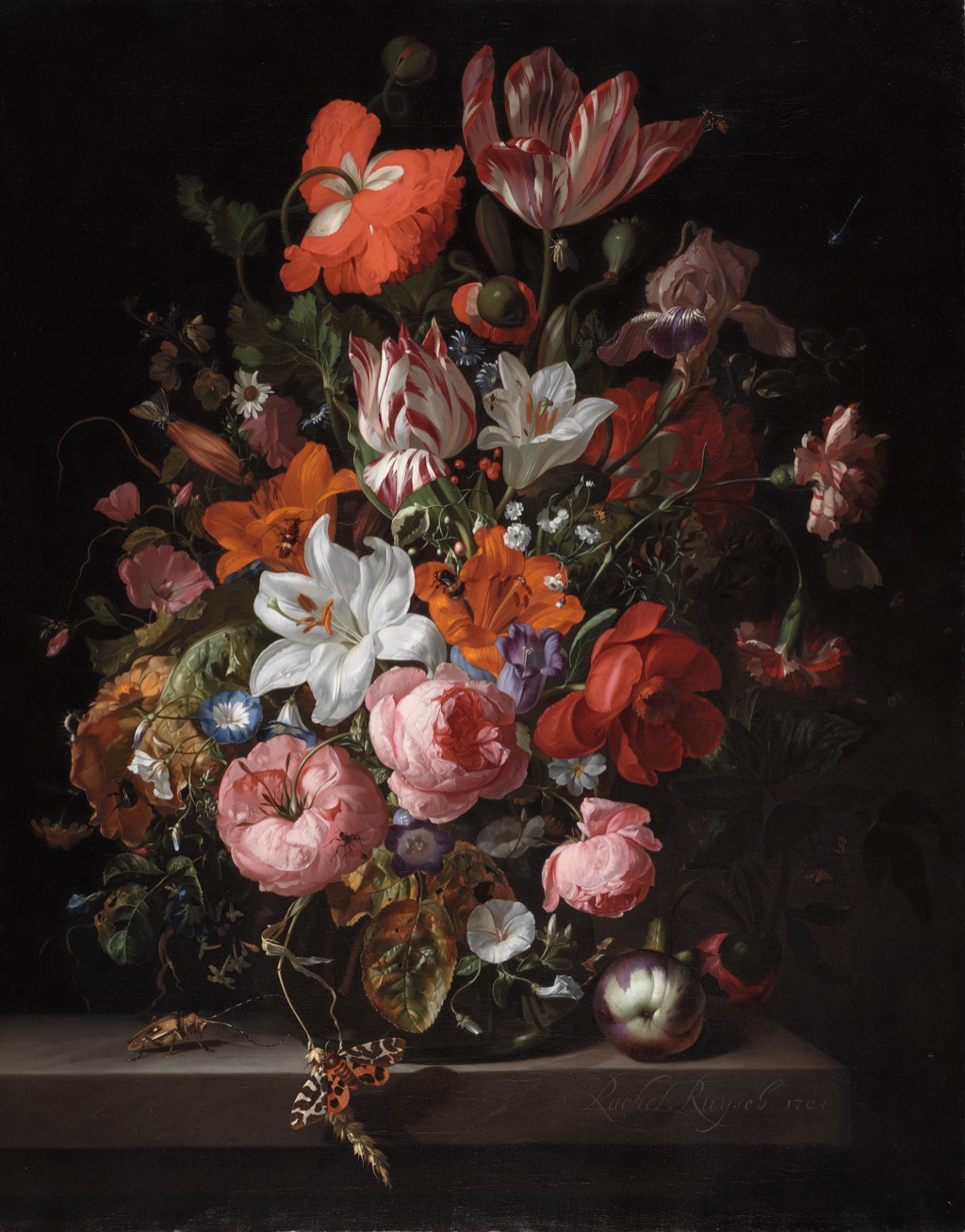
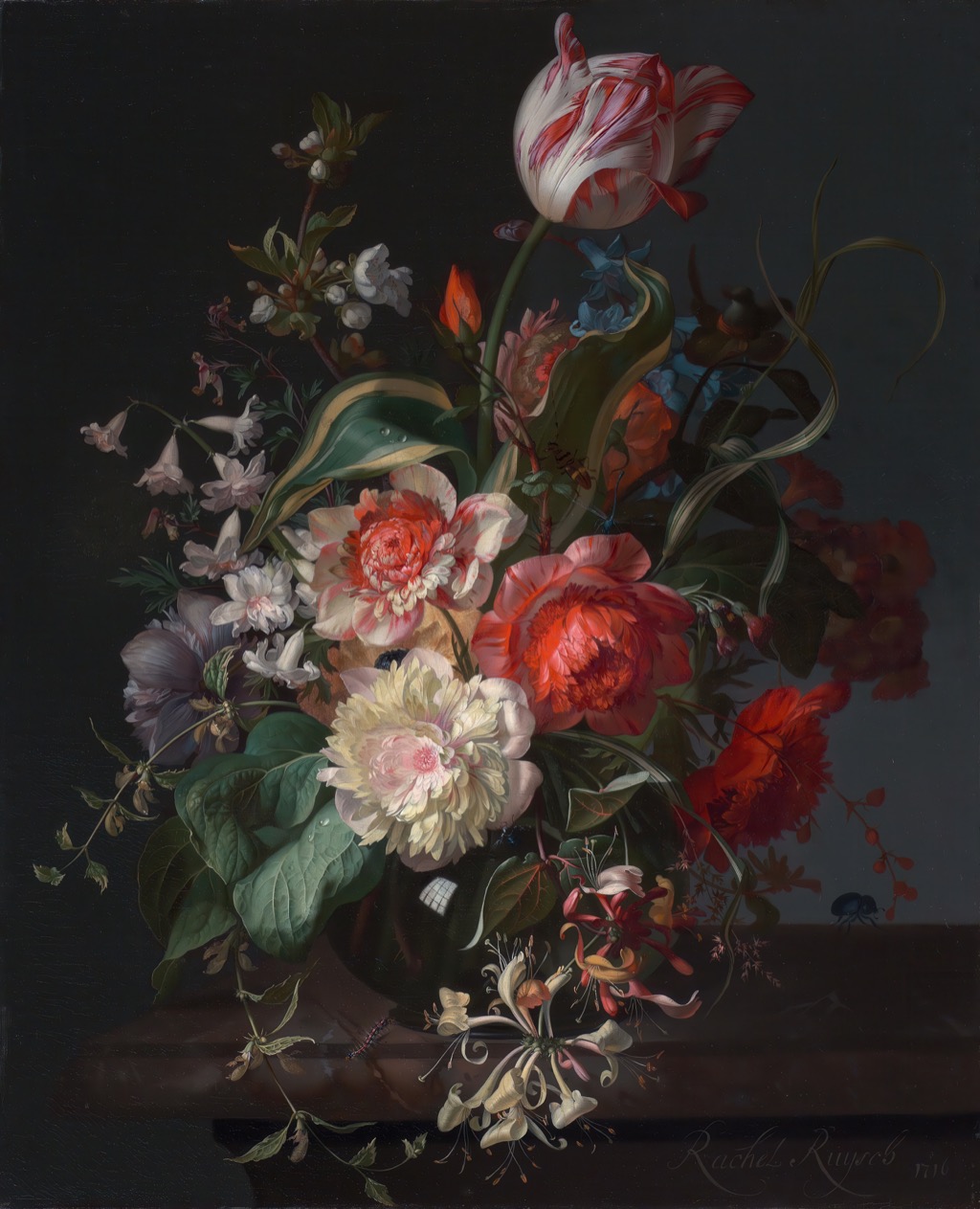
Ruysch's flower paintings often look freshly gathered, yet many of them are deliberately impossible as real arrangements. The Rijksmuseum says this clearly of Still Life with Flowers on a Marble Tabletop of 1716: the bouquet contains more than ten species and would be difficult to assemble because the blossoms flower at different times.[5] The Detroit Institute of Arts makes the same point about its Flowers in a Glass Vase of 1704, where the selected blooms do not belong to one shared season.[6]
This seasonal impossibility is not a failure of realism. It is part of the painting's intelligence. Ruysch used studies, memory and natural observation to create bouquets that could bring together rarity, beauty and timing in a single composition. A real vase fades quickly. A painted bouquet can hold spring, summer and autumn under one light.
The most reliable floral names come from museum records. In the Rijksmuseum's Still Life with Flowers on a Marble Tabletop, the description names flowers including roses, poppies, irises, carnations and bindweed.[5] The National Gallery identifies roses, honeysuckle, pear blossom and the Semper Augustus striped tulip in Flowers in a Glass Vase with a Tulip.[7] The Detroit Institute of Arts identifies lilies, peonies, cabbage roses and striated tulips in Flowers in a Glass Vase.[6] The Mauritshuis describes a blue iris, tulip, white roses, calendula and a likely red opium poppy in Vase with Flowers.[8]
Those names are useful, but Ruysch's paintings are not only botanical puzzles. The bouquet matters as a designed whole. Flowers are arranged by size, direction, colour, texture and depth. A dark background pushes pale petals forward. A ledge makes the composition feel almost reachable. A glass vase tests transparency and reflection. Small insects keep the eye moving after the main blossoms have been seen.
For a fuller reading of this side of her work, continue to Rachel Ruysch Flower Paintings and Rachel Ruysch Art and Science.
Fruit Pieces and Forest-Floor Worlds
Flower paintings dominate Ruysch's modern reputation, but fruit and forest-floor subjects are important to the shape of her work. They widen the meaning of "nature" in her paintings. A flower bouquet is arranged nature: chosen, elevated, placed in a vessel and lit. A fruit piece stresses ripeness, abundance and the pleasures of surface. A forest-floor scene brings the viewer into a lower, stranger space of growth, dampness, insects and hidden movement.
The Pinakothek's collection record for Fruchtestuck dates the fruit piece to 1709, gives its medium as canvas and records a picture size of 91 by 70 cm.[9] In the same broader collection group, Ruysch's Blumenstrauss of 1715 is described as a painting that unites naturalistic rendering with the artificiality of a staged presentation.[10] That phrase captures much of her art, whether the subject is fruit, flowers or both together.
Forest-floor works also connect Ruysch to the scientific and collecting culture around her family. Her father Frederik Ruysch was a scholar of botany and medicine, and modern museum accounts repeatedly connect Rachel's precision to access to specimens, plants and natural-history knowledge.[1][3][11] But these paintings should still be understood as artworks rather than scientific diagrams. Ruysch's natural details are selected and staged. They carry curiosity, but also mood.
Modern scholarship has helped restore this range. The MFA Boston exhibition Rachel Ruysch: Artist, Naturalist, and Pioneer brought together 35 paintings with plant and insect specimens and works by other women artists, including Anna Ruysch, Maria Sibylla Merian and Alida Withoos.[11] The Pinakothek's Nature into Art exhibition was organised in sections that included early work, the two Ruysch sisters, art and science, fame and fortune, and changing perspectives.[12] That exhibition structure is a useful reminder: Ruysch's paintings are not a row of isolated bouquets. They belong to a larger world of training, family, science, market, gender, patronage and changing taste.
Major Paintings by Collection
The following selected works help orient Ruysch's painting career. They are not a complete list, but they give readers firm collection anchors and distinguish several easily confused titles.
| Painting | Date | Collection | What to Notice |
|---|---|---|---|
| Still Life with Flowers in a Glass Vase | c. 1690-c. 1720 | Rijksmuseum, SK-A-354 | A monumental flower still life in oil on canvas, 65 by 53.5 cm, with flowers in a glass vase on a marble tabletop.[13] |
| Vase with Flowers | 1700 | Mauritshuis, inv. 151 | A wilted bouquet, oil on canvas, 79.5 by 60.2 cm, signed and dated on the lower left edge of the table.[8] |
| Flowers in a Glass Vase | 1704 | Detroit Institute of Arts, 1995.67 | A large imagined arrangement with dewdrops, insects and flowers that do not bloom at the same time.[6] |
| Blumenstrauss | 1715 | Alte Pinakothek / Bayerische Staatsgemaldesammlungen, inv. 878 | A court-period bouquet, canvas, 75 by 60.3 cm, acquired from the Mannheim Gallery in 1799.[10] |
| Still Life with Flowers on a Marble Tabletop | 1716 | Rijksmuseum, SK-A-2338 | A compact, dense bouquet with more than ten species, insects and a seasonally impossible arrangement.[5] |
| Flowers in a Glass Vase with a Tulip | 1716 | National Gallery, L1208 | A refined bouquet culminating in the Semper Augustus tulip, oil on canvas, 46.5 by 36 cm, on loan from the Capstick collection.[7] |
| Flower Still Life | about 1716-1720 | Toledo Museum of Art, 1956.57 | A dark-ground bouquet with damaged leaves, caterpillars and signs of fragile beauty.[14] |
| Roses, Convolvulus, Poppies, and Other Flowers in an Urn on a Stone Ledge | ca. late 1680s | National Museum of Women in the Arts | A dynamic, pyramid-shaped flower arrangement in oil on canvas, 42 1/2 by 33 inches.[3] |
Several patterns emerge from this group. First, Ruysch's paintings exist across major public collections rather than in one single museum story. Amsterdam, The Hague, London, Detroit, Toledo, Munich and Washington all preserve different routes into her art. Second, the works often share compositional language without becoming duplicates. Vases, ledges, dark grounds and insects recur, but each painting stages those elements differently. Third, the date range matters. The late 1680s NMWA painting, the 1700 Mauritshuis work, the 1704 Detroit picture and the 1715-1716 court-period works show a career adapting across decades.
For readers coming from Dutch art or Baroque art, these paintings also correct a narrow view of the period. Ruysch's still lifes belong beside better-known Dutch achievements in portraiture, genre painting and landscape, from The Night Watch to Girl with a Pearl Earring. They show that a flower painting could be intellectually dense, commercially successful and internationally admired.
How to Tell Similar Titles Apart
Ruysch's titles can be confusing because many are descriptive rather than unique. A title such as Flowers in a Glass Vase tells you the subject, not necessarily the exact object unless the collection is named. That is why a reader should pay attention to date, museum, dimensions and inventory number.
For example, the Rijksmuseum's Still Life with Flowers in a Glass Vase is a painting dated about 1690 to about 1720, object number SK-A-354, 65 by 53.5 cm.[13] The Detroit Institute of Arts work called Flowers in a Glass Vase is dated 1704, much larger at 33 by 26 3/8 inches unframed, and carries the accession number 1995.67.[6] The National Gallery's Flowers in a Glass Vase with a Tulip is a 1716 painting, 46.5 by 36 cm, inventory number L1208.[7] The Mauritshuis Vase with Flowers is dated 1700, 79.5 by 60.2 cm, inventory number 151.[8]
Those distinctions are not pedantic. They affect interpretation. The Mauritshuis painting is notable for wilted flowers and a cut-off poppy that opens space in the bouquet. The National Gallery work is especially important for the Semper Augustus tulip and for a late, refined style. The Detroit painting stresses an imaginary, seasonally impossible display. The Rijksmuseum's SK-A-354 represents Ruysch in the Gallery of Honour as a grand flower still-life painter whose work attracted elite patrons.
When looking at Ruysch online, use the collection name as part of the title in your mind: the Rijksmuseum glass-vase painting, the Detroit glass-vase painting, the National Gallery tulip painting, the Mauritshuis vase painting. This simple habit prevents the common mistake of blending several works into one generalized bouquet.
Style, Technique and Looking Closely
Ruysch's paintings are built for slow looking. The first impression is usually abundance: flowers pushing forward, colour against dark ground, a glass vessel or stone ledge anchoring the whole. Then the painting starts to break into discoveries. A beetle crawls along a ledge. A caterpillar bends toward a leaf. A bloom droops. A petal curls. A damaged leaf interrupts the polish of the arrangement.
The National Gallery's account of Flowers in a Glass Vase with a Tulip is especially helpful for technique. It describes a process in which the artist likely sketched the shapes of flowers and leaves on the prepared surface, painted the background around them, built the blossoms in layers from dark tones toward lighter ones, and finished with highlights.[7] That sequence explains why Ruysch's paintings can feel both planned and fresh. The structure is careful; the surface is animated.
Her use of darkness is equally important. A dark ground gives pale flowers force, but it also creates pockets of uncertainty. Not every stem is equally visible. Some leaves disappear into the background before returning to light. This makes the bouquet feel deep rather than flat. The Toledo Museum of Art places its Flower Still Life against the dark-background tradition of late seventeenth-century flower painting.[14] The National Gallery notes that Ruysch retained that older dark ground in the 1716 tulip picture even as her touch moved toward a more decorative style.[7]
Light organises the paintings. In the Mauritshuis Vase with Flowers, bright lower flowers contrast with upper blooms that recede into shade.[8] In the Rijksmuseum's Still Life with Flowers on a Marble Tabletop, a small canvas of 48.5 by 39.5 cm contains more than ten species and many insects.[5] The scale is modest; the visual density is high.
For a fuller technical route, continue to Rachel Ruysch Style and Technique.
Court, Collectors and Reputation
Ruysch's paintings were admired during her lifetime. The Rijksmuseum describes her as one of the most successful artists of her day.[1] The National Gallery says her paintings often sold for more in her lifetime than Rembrandt's did in his.[15] NMWA notes that she produced large flower works for an international circle of patrons after joining the painters' guild in The Hague in 1701.[3]
Her court role is central to that reputation. From 1708 until 1716, she served as court painter to Johann Wilhelm, Elector Palatine, while remaining closely tied to Amsterdam.[2][3] RKD Studies describes her court arrangement as unusually flexible: she received a fixed salary, was not expected to work exclusively for the elector, and could send work from Amsterdam rather than relocating permanently.[16] The Pinakothek's exhibition account places this period in a broader phase of fame and fortune, when her brilliant bouquets with fruit and insects helped establish her international name.[12]
Collectors valued these paintings because they combined several forms of prestige. They showed rare flowers and horticultural knowledge. They demonstrated the artist's ability to paint fragile textures with extraordinary finish. They turned seasonal and perishable things into durable objects. They also allowed owners to display cultivated taste: not just wealth, but attention.
Ruysch's modern reputation has grown through museum research and major exhibitions, but it is not a simple story of sudden rediscovery. NMWA notes that her reputation never fully disappeared, even as the popularity of flower painting changed after her death.[3] What has changed is the intensity of recent attention: exhibitions and scholarship now frame her not only as a successful woman artist, but as a painter whose work reshapes how we understand still life, natural history and artistic ambition around 1700.
How to Keep Exploring
If you are new to Ruysch, start with Rachel Ruysch Flower Paintings. That route explains the impossible bouquet, the dark ground, the glass vase, and the small details that make her flower paintings so absorbing.
Then move to individual works. Still Life with Flowers on a Marble Tabletop is a strong first object because the Rijksmuseum record gives clear facts and the painting condenses many of her strengths. Still Life with Flowers in a Glass Vase helps distinguish the Rijksmuseum glass-vase work from similarly titled paintings. Vase with Flowers at the Mauritshuis is the best route into wilting, interruption and light. Flowers in a Glass Vase at the Detroit Institute of Arts is excellent for understanding imaginary seasonal abundance. Flowers in a Glass Vase with a Tulip is especially useful for the Semper Augustus tulip and Ruysch's refined late court-period style.
For wider context, read Rachel Ruysch Art and Science for her relationship to specimens, botany and natural-history culture. Use Rachel Ruysch Women Artists of the Dutch Golden Age to place her beside other women artists without turning her into an isolated exception. Rachel Ruysch Biography gives the career arc: The Hague birth, Amsterdam training, Willem van Aelst, marriage to Juriaen Pool, Pictura, Dusseldorf patronage and late work.
Above all, keep looking at the individual paintings. Ruysch's art rewards patience. The title gives you the subject. The collection record gives you the facts. The painting itself gives you the drama: light, insects, glass, petals, damage, abundance and time held still.
Frequently Asked Questions
Discussion Prompt
Ruysch's paintings often combine botanical precision with arrangements that could not exist as one real bouquet. Does that make them feel more natural, more artificial, or more powerful because they are both at once?
Discussion
Ruysch's paintings often combine botanical precision with arrangements that could not exist as one real bouquet. Does that make them feel more natural, more artificial, or more powerful because they are both at once?
Reader Insights
Compare two similarly titled Ruysch vase paintings by collection, date and dimensions before comparing their flowers.
Look for insects, damaged leaves or wilting blooms before reading the museum label; then decide whether those details change the mood of the painting.
Choose one bouquet and name only the flowers identified by the holding museum. Notice how much of the painting still works beyond exact botanical naming.
Join the Conversation
Share a thoughtful observation about Rachel Ruysch, the painting, or the wider still-life tradition that would help another reader look more carefully.
References
- Rijksmuseum, "Rachel Ruysch," artist page. https://www.rijksmuseum.nl/en/collection/node/Rachel-Ruysch--3eaff215275e2ebd47d02cfba2044cc8
- National Gallery, London, "Rachel Ruysch," artist page. https://www.nationalgallery.org.uk/artists/rachel-ruysch
- National Museum of Women in the Arts, "Rachel Ruysch," artist profile. https://nmwa.org/art/artists/rachel-ruysch/
- Pinakothek / Bayerische Staatsgemaldesammlungen, "Rachel Ruysch," artist page. https://www.sammlung.pinakothek.de/en/artist/apG9OgmxZn
- Rijksmuseum, Rachel Ruysch, Still Life with Flowers on a Marble Tabletop, 1716, object page. https://www.rijksmuseum.nl/en/collection/object/---570d1419506e38cb3916f640fe5a2328
- Detroit Institute of Arts, Rachel Ruysch, Flowers in a Glass Vase, 1704, object page. https://dia.org/collection/flowers-glass-vase/66064
- National Gallery, London, Rachel Ruysch, Flowers in a Glass Vase with a Tulip, 1716, object page. https://www.nationalgallery.org.uk/paintings/rachel-ruysch-flowers-in-a-glass-vase-with-a-tulip
- Mauritshuis, Rachel Ruysch, Vase with Flowers, 1700, object page. https://www.mauritshuis.nl/en/our-collection/artworks/151-vase-with-flowers
- Pinakothek / Bayerische Staatsgemaldesammlungen, Rachel Ruysch, Fruchtestuck, 1709, object record. https://www.sammlung.pinakothek.de/en/artwork/ZMLJyooxJv
- Pinakothek / Bayerische Staatsgemaldesammlungen, Rachel Ruysch, Blumenstrauss, 1715, object record. https://www.sammlung.pinakothek.de/en/artwork/A9xlnQAGWv
- Museum of Fine Arts, Boston, "Rachel Ruysch: Artist, Naturalist, and Pioneer," exhibition page. https://www.mfa.org/exhibition/rachel-ruysch-artist-naturalist-and-pioneer
- Alte Pinakothek, "Rachel Ruysch: Nature into Art," exhibition page. https://www.pinakothek.de/en/exhibition/nature-into-art
- Rijksmuseum, Rachel Ruysch, Still Life with Flowers in a Glass Vase, c. 1690-c. 1720, object page. https://www.rijksmuseum.nl/en/collection/object/Still-Life-with-Flowers-in-a-Glass-Vase--210e3fc99bb8b3a875fcd7b57fce1a83
- Toledo Museum of Art, Rachel Ruysch, Flower Still Life, about 1716-1720, object page. https://emuseum.toledomuseum.org/objects/54880/flower-still-life
- National Gallery, London, "Rachel Ruysch," paintings page. https://www.nationalgallery.org.uk/paintings/rachel-ruysch
- RKD Studies, "Court paintings for Johann Wilhelm II, Elector Palatine, 1708-1716." https://masters-of-mobility.rkdstudies.nl/6-still-life-painter-rachel-ruysch-1664-1750-and-her-connections-to-germany/62-court-paintings-for-johann-wilhelm-ii-elector-palatine-1708-1716/
- Main image reference: Rachel Ruysch, Still Life with Flowers on a Marble Tabletop, 1716. Public-domain image via Wikimedia Commons / Rijksmuseum. https://commons.wikimedia.org/wiki/File:Rachel_Ruysch_-_Still_life_with_flowers_on_a_marble_tabletop.jpg