Buy Art Prints Now
from Amazon
* As an Amazon Associate I earn from qualifying purchases.
Image reference [1]
 by Tom Gurney
Tom Gurney BSc (Hons) is an art history expert with over 20 years experience
Published on August 25, 2026 / Updated on September 6, 2026
Email: tomgurney1@gmail.com / Phone: +44 7429 011000
Rachel Ruysch: Art and Science: Introduction
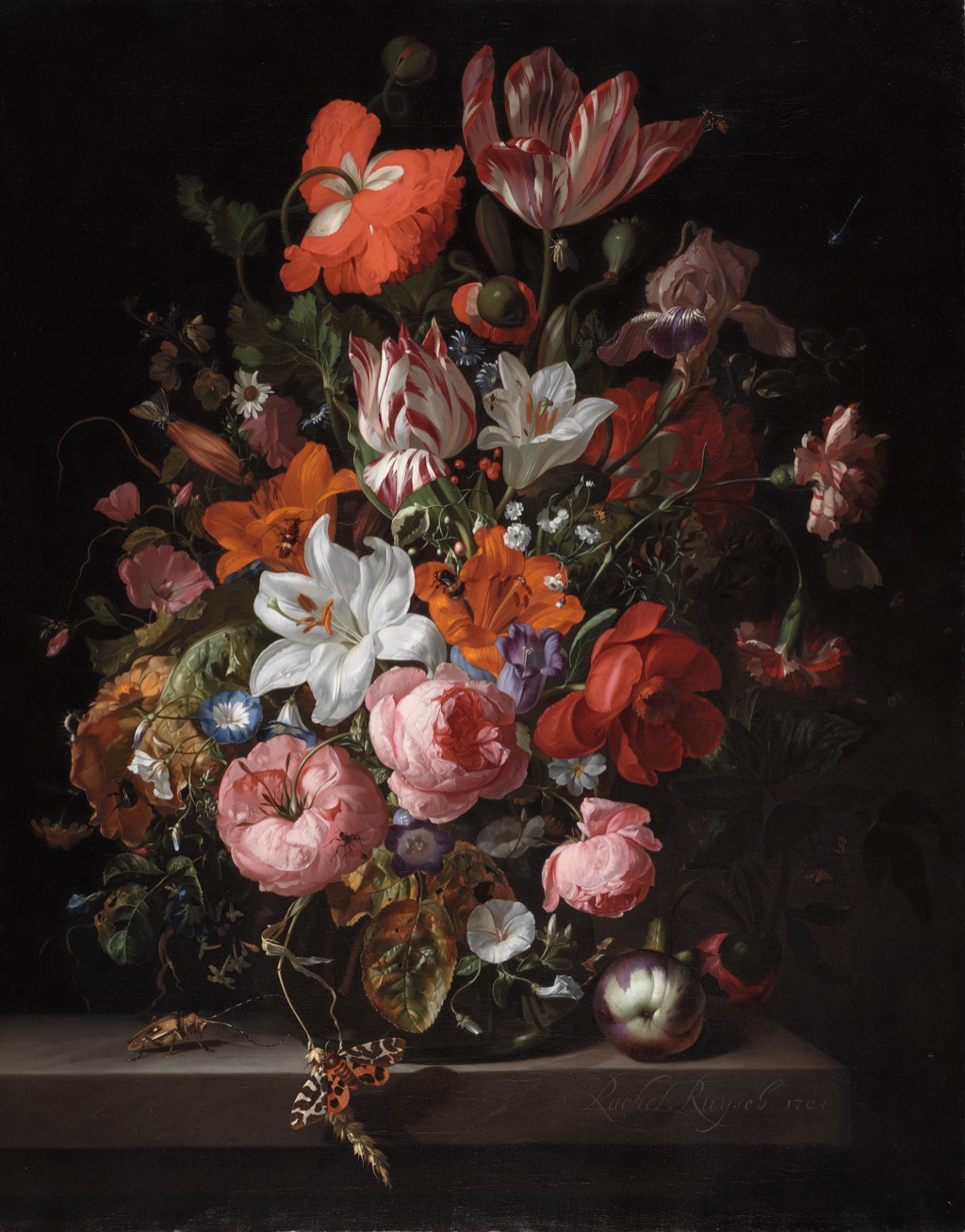
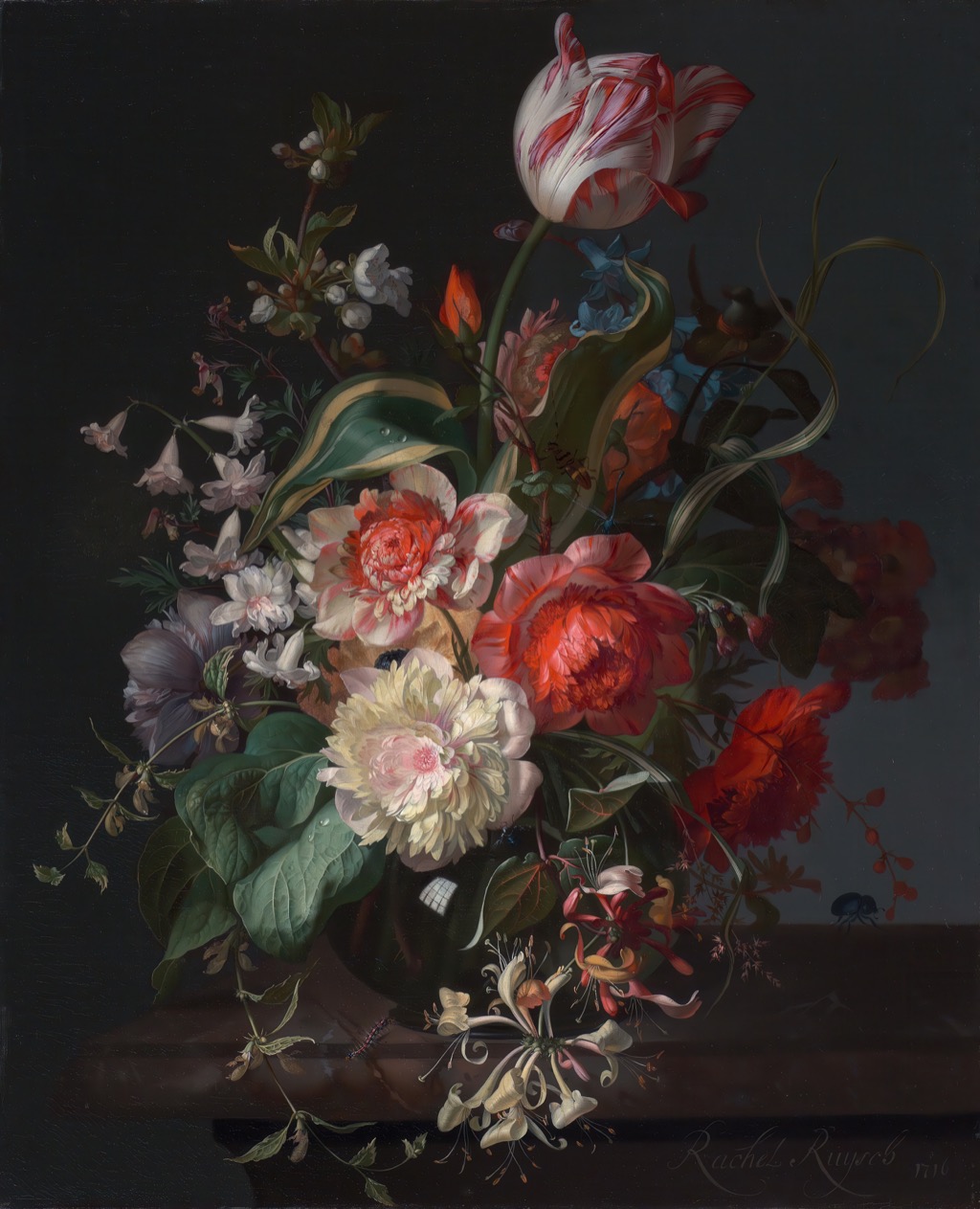
Rachel Ruysch painted flowers as if looking were a form of knowledge. Her bouquets glitter with drops of water, torn leaves, insects, moss, fruit, stems and petals observed with such discipline that they can seem almost botanical. Yet they are not dry illustrations. They are staged works of art: impossible seasonal gatherings, dark theatrical spaces, sweeping diagonals and flashes of colour that bring the natural world into motion.
That combination is why Ruysch belongs in any serious account of art and science in the Dutch Republic. Born in The Hague in 1664 and raised in Amsterdam, she grew up close to one of Europe's most remarkable natural-history environments. Her father, Frederik Ruysch, was an anatomist, botanist and collector whose preserved specimens and anatomical preparations were famous across Europe. Amsterdam also offered botanical gardens, trade networks, horticultural collectors, illustrated books and a culture of close observation. Rachel Ruysch absorbed that world, but she did not merely borrow its subject matter. She transformed it into paintings that made knowledge sensuous, exact and alive.
Her achievement is easy to understate if her science is treated as an inherited family atmosphere or if her flowers are treated as decorative luxury goods. Ruysch's art is stronger than either explanation. She turned the study of plants, insects and surfaces into pictorial invention. She knew how to make an imaginary bouquet feel more convincing than a literal one. She kept working through a long professional career, became associated with elite patrons and court culture, and built a reputation that connected virtuoso painting with natural knowledge.[1][2][3]
At a Glance
- Rachel Ruysch was a Dutch flower and still-life painter whose work joined artistic invention with close natural observation.
- Her father, Frederik Ruysch, was an anatomist, botanist and collector, but Rachel's paintings are not simply extensions of his career.
- Amsterdam's Hortus Botanicus, scientific collections, botanical books and horticultural culture helped shape the world in which she learned to see.
- Ruysch's bouquets often combine flowers that did not bloom at the same time, making them carefully constructed compositions rather than records of one live arrangement.
- Insects, dewdrops, damaged leaves, moss and fruit matter because they show nature as active, fragile and full of change.
- Her work belongs beside the histories of women artists, scientific labour and natural-history culture in the Dutch Republic.
Contents
- Introduction
- Art and Science in Rachel Ruysch's Amsterdam
- Frederik Ruysch and the Limits of Family Influence
- The Hortus Botanicus and the Culture of Plants
- Flower Studies and Imagined Bouquets
- Native and Exotic Nature on the Same Ledge
- Insects, Dewdrops and the Drama of Observation
- Women Artists and Scientific Labor
- Why Ruysch Still Feels Modern
Art and Science in Rachel Ruysch's Amsterdam
Ruysch's Amsterdam was a city where art, medicine, trade, gardening and collecting met one another constantly. The Dutch Republic's commercial networks brought plants, shells, insects, spices, bulbs and other natural specimens into private collections and public institutions. Physicians and botanists studied plants for medical and scientific reasons. Wealthy collectors cultivated rare flowers as signs of curiosity and status. Artists turned those forms of knowledge into images that could travel farther than the specimens themselves.
Flower painting already had a strong Dutch and Flemish tradition before Ruysch. Earlier artists such as Ambrosius Bosschaert and later specialists in still life helped make the bouquet a prestige subject. A painted vase of flowers could show wealth, refinement and the pleasure of looking. But Ruysch pushed the genre toward a particularly intense union of artifice and observation. Her bouquets are not botanical plates, because their purpose is not to isolate a specimen against a neutral ground. Nor are they casual studio arrangements. They are composed worlds, built from studied fragments and arranged so the eye moves through living detail.
The modern exhibition and catalogue project Rachel Ruysch: Nature into Art has helped renew attention to this side of her work. Its framing of Ruysch as artist, naturalist and pioneer is useful because it refuses to separate the beauty of her paintings from the knowledge that made them possible.[4][5] The best way to understand her art is to see those forces working together: scientific culture sharpened her attention, while painting gave that attention rhythm, depth, colour and feeling.
This does not mean Ruysch should be called a scientist in the modern professional sense. The categories were different in her lifetime, and women were often excluded from formal institutions even when they contributed to knowledge through drawing, collecting, teaching, workshop practice or domestic intellectual labour. Ruysch's place is more precise and more interesting. She worked at the border where natural knowledge became visual form.
Frederik Ruysch and the Limits of Family Influence
Any account of Rachel Ruysch and science has to begin with Frederik Ruysch, but it should not end there. Frederik was a prominent anatomist, botanist and collector. His anatomical preparations, preserved specimens and natural-history materials were internationally known, and the scientific collection associated with his name became a point of fascination for visitors and rulers. Detroit's account of Ruysch's Flowers in a Glass Vase, for example, connects Rachel's access to natural specimens with Frederik's celebrated collection and notes its later sale to Peter the Great.[6]
For Rachel, this environment mattered. It placed her near unusual objects, disciplined methods of looking and a household culture in which nature was not merely admired but examined, classified and preserved. The anatomical collection also reminds us that seventeenth-century and early eighteenth-century natural history was tactile and visual. Specimens were handled, arranged, displayed and interpreted. Knowledge was made through the eye as well as through text.
But Rachel Ruysch's paintings are not illustrations of Frederik's work. Her art does not simply translate anatomy into flowers or turn her father's reputation into a career. She trained as a painter, most importantly with Willem van Aelst, a leading still-life specialist whose refined surfaces, dark grounds and elegant compositions helped shape her artistic language.[2][3] She entered a competitive art market, developed her own pictorial intelligence and sustained a career over decades.
The distinction matters because women artists are too often explained through proximity to men: father, teacher, husband, patron. In Ruysch's case those relationships are historically important, but they are not the achievement. The achievement lies in what she did with the materials and opportunities available to her. She made paintings in which natural knowledge became composition. A petal is never only a petal; it is also a note of colour, a curve in a larger rhythm, a surface catching light, a fragile thing threatened by time.
Frederik Ruysch gave Rachel proximity to scientific culture. Rachel Ruysch gave that culture one of its most compelling artistic forms.
The Hortus Botanicus and the Culture of Plants
Amsterdam's Hortus Botanicus was part of the environment that made Ruysch's flower painting possible. Founded for medical and botanical study, the garden became a place where plants could be cultivated, examined and compared. It connected local learning with wider networks of trade and collecting. Rare and unfamiliar species could move from ships and private gardens into scientific and artistic awareness.
For a painter of flowers, this mattered not just because it supplied subjects, but because it changed what a subject could mean. A flower in Ruysch's world could be a garden treasure, a medical plant, a collector's prize, a product of global exchange, a seasonal event, a symbol of transience and a painterly challenge all at once. The same stem might belong to science, commerce and art.
The Rijksmuseum's Dutch-language story on Ruysch emphasises the importance of the botanical world around her, including rare native and exotic species and the scientific setting shaped by her father and Amsterdam's plant culture.[1] That context helps explain the extraordinary range of natural forms in her paintings. Her bouquets often bring together flowers, insects and small living details with a specificity that feels studied rather than generic.
Still, Ruysch was not making garden inventories. She was making paintings for viewers who valued both knowledge and delight. A rare species could demonstrate access to a wider world, but in the painting it also had to work as shape, brightness and contrast. A pale flower could open a dark composition. A red or striped blossom could anchor a diagonal movement. A curling leaf could guide the eye from the rim of a vase toward the deeper space behind it.
The Hortus and related botanical culture gave Ruysch a language of variety. Painting gave her a grammar for arranging that variety into drama.
Flower Studies and Imagined Bouquets
One of the most important facts about Ruysch's flower paintings is that many of her bouquets could not have existed as single live arrangements. Museums repeatedly note that the flowers shown together often did not bloom at the same time.[1][2][6][7] That seasonal impossibility is not a flaw or a trick. It is central to the art.
Ruysch's bouquets were assembled from flower studies, memory, workshop practice and botanical knowledge. This allowed her to gather different moments of the year into one image. A spring bloom could appear beside a summer flower; a perfect petal could sit near a leaf already curling or browning. The result is not an exact record of one hour in a room. It is a heightened vision of nature over time.
This is where her art and science meet most visibly. Observation gave her the parts: the structure of stems, the translucency of petals, the weight of fruit, the movement of insects, the shine of water. Composition gave those parts a shared life. Ruysch's flower paintings often seem spontaneous because they are so carefully planned. The eye moves from bloom to bloom, yet the arrangement rarely feels static. Stems tilt, petals turn, leaves cross, insects interrupt and shadows deepen.
The National Gallery's account of Flowers in a Glass Vase with a Tulip is especially useful for seeing this process. It identifies the famous striped Semper Augustus tulip as one of the flowers in the picture and discusses the work's dark ground, insects and flower-study method.[8] Such details remind us that Ruysch's naturalism depended on both close looking and pictorial construction. She could make a rare tulip recognizable, but she also knew how to make it perform inside the painting.
The imagined bouquet also complicates a simple idea of realism. Ruysch is realistic in detail but inventive in total design. Each form persuades the eye, while the whole arrangement belongs to art rather than to ordinary experience. That tension is part of her brilliance. She creates nature as no one could have found it, and then paints it so convincingly that it feels discovered.
Native and Exotic Nature on the Same Ledge
Ruysch's paintings belong to a culture fascinated by the movement of natural things across distance. The Dutch Republic's trade networks helped bring exotic plants, bulbs and specimens into European collections. At the same time, native flowers, common insects and familiar garden forms remained central to the language of still life. Ruysch's art often holds these worlds together.
This does not mean every flower in every painting should be treated as a coded symbol of empire or trade. Care is needed. Some species can be identified by museum records; others should be discussed more generally. But the larger context is clear. Ruysch's viewers lived in a world where rare plants could signal curiosity, cost and connection to distant places. A painting that gathered native and exotic forms together could make that world visible on a tabletop or stone ledge.
Her still lifes also resist the idea that exotic nature was only spectacle. In Ruysch's hands, unusual plants do not merely announce novelty. They enter a visual system governed by balance, light and touch. A striking bloom may catch attention first, but the painting soon asks the viewer to notice less obvious forms: the bend of a stem, the underside of a leaf, the small insect near the edge, the difference between fresh and fading surfaces.
The Toledo Museum of Art's account of Ruysch's Flower Still Life stresses the relationship between seasonal impossibility, insects, damaged leaves, botany and anatomy.[7] That cluster of ideas is useful beyond one object. It shows how Ruysch's flower painting could bring together cultivated beauty and biological process. Nature is never just arranged; it is active. Leaves decay, insects feed, petals open and close, water gathers and evaporates.
The same attention appears in works across major collections, from the Rijksmuseum and Mauritshuis to Detroit, Toledo, London and Munich.[1][2][6][7][8][9] The consistency of this evidence across institutions helps explain why Ruysch has become such a strong subject for renewed scholarship. Her paintings are not isolated displays of technical skill. They are sophisticated images of a world enlarged by collecting, travel, study and desire.
Insects, Dewdrops and the Drama of Observation
Small details carry large force in Ruysch's art. Dewdrops glisten on petals. Insects crawl, hover or settle. Leaves show holes, tears and browning edges. Fruit and flowers share the same ledges and vases. These details can be easy to admire as feats of skill, but they do more than prove that Ruysch could paint finely.
They make the still life unstable. A bouquet might seem arranged for permanent beauty, yet every detail says otherwise. Water suggests freshness, but also passing time. Insects bring movement, appetite and vulnerability. A damaged leaf interrupts perfection. A heavy flower bends under its own weight. Ruysch's naturalism is never merely glossy. It is alert to change.
This gives her work a different emotional register from simple abundance. The paintings are lush, but they are not complacent. They invite slow looking, and slow looking reveals that beauty is inseparable from fragility. The scientific eye and the poetic eye are not opposed. They work together.
Ruysch's dark backgrounds intensify this effect. Against shadow, pale petals and reflective drops seem to emerge into visibility. The viewer feels the act of seeing as an event. A flower is not just there; it appears. That appearance depends on contrast, touch and timing. The more closely Ruysch studies nature, the more theatrical her paintings become.
This is one reason her work still feels fresh. She does not ask the viewer to choose between accuracy and drama. The drama comes from accuracy made visible. A dewdrop is convincing because it is observed; it is beautiful because it is placed exactly where the painting needs a point of light.
Women Artists and Scientific Labor
Ruysch's art also belongs to the history of women's work in art and science. The modern Nature into Art project places her in conversation with figures such as her sister Anna Ruysch, Maria Sibylla Merian and Alida Withoos, women whose work connected drawing, painting, collecting and the study of natural forms.[4] That context matters because scientific culture was not made only in universities, academies or official posts. It was also made in households, workshops, gardens, collections and studios.
Women often entered these worlds through family training, artisanal practice or access to private networks. Their labour could be visible in images while remaining less visible in institutions. Botanical illustration, flower painting and natural-history drawing required sustained expertise: the ability to observe structure, record difference, manage materials and understand living forms. Those skills were intellectual as well as manual.
Ruysch's career shows how powerful that expertise could become in the art market. She was not simply a gifted amateur working near scientific men. She trained professionally, married the painter Juriaen Pool, continued to work after marriage and built a reputation that reached elite patrons. Sources connect her with The Hague's Pictura and with service as court painter to Johann Wilhelm, Elector Palatine, while museums emphasise her long career and high standing.[2][3][9][10]
The gender history is important, but it should be handled without turning Ruysch into a sentimental exception. Her life was unusual, but her success was not accidental. She worked in a genre where technical brilliance, natural knowledge and market demand could meet. She also worked in a society where women artists faced limits on training, access and recognition. Holding both facts together gives a clearer picture than either triumphal praise or simple constraint.
Ruysch's art makes women's scientific labour visible because it shows knowledge embodied in practice. Every stem, petal and insect implies time spent looking. Every impossible bouquet implies a store of studies and decisions. The paintings are beautiful because they are learned.
Why Ruysch Still Feels Modern
Ruysch's renewed visibility today is not only a matter of recovering an overlooked woman artist, though that recovery is essential. Her paintings speak strongly to current readers because they refuse the split between art and knowledge. They show that beauty can be analytical, that observation can be imaginative and that the natural world can be studied without being made lifeless.
They also ask timely questions about collection and display. What happens when living things are gathered, named, preserved, traded and arranged? How does a painting turn nature into culture? When does close looking become possession, and when does it become care? Ruysch's world was very different from ours, but her art remains alive because it sits inside those questions rather than outside them.
Her paintings do not give simple answers. They offer a way of looking. A blossom may be rare or familiar, native or exotic, fresh or fading. An insect may be decorative at first glance and unsettling at the next. A bouquet may seem natural until we realize it is an invention built from many seasons. Ruysch's intelligence lies in keeping these possibilities active.
That is why the phrase "art and science" fits her so well, as long as it is not used loosely. In Ruysch's paintings, science is not a set of labels pasted onto flowers. Art is not a pleasant surface added after knowledge has done its work. The two are bound together in the act of seeing. Her flowers persuade us because she knew them, and they move us because she knew how to make knowledge bloom.
Frequently Asked Questions
Discussion Prompt
Rachel Ruysch often painted bouquets that could never have existed in one vase at one moment. Does that make her paintings less realistic, or does it reveal a deeper kind of truth about how artists and scientists assemble knowledge from observation?
Discussion
Rachel Ruysch often painted bouquets that could never have existed in one vase at one moment. Does that make her paintings less realistic, or does it reveal a deeper kind of truth about how artists and scientists assemble knowledge from observation?
Reader Insights
A close-looking note on one Ruysch painting, focused on a single insect, petal or dewdrop and what it changes in the composition.
A comparison between Ruysch and Maria Sibylla Merian on women, natural history and the visual study of insects and plants.
A short reflection on whether imaginary bouquets feel more truthful than literal arrangements because they gather multiple seasons into one image.
Join the Conversation
Share a thoughtful observation about Rachel Ruysch, the painting, or the wider still-life tradition that would help another reader look more carefully.
References
- Rijksmuseum, Rachel Ruysch artist page and Dutch masters story: https://www.rijksmuseum.nl/en/collection/node/Rachel-Ruysch--3eaff215275e2ebd47d02cfba2044cc8 and https://www.rijksmuseum.nl/nl/stories/nederlandse-meesters/story/rachel-ruysch
- Mauritshuis, Rachel Ruysch artist page and Vase with Flowers: https://www.mauritshuis.nl/en/our-collection/our-masters/rachel-ruysch/ and https://www.mauritshuis.nl/en/our-collection/artworks/151-vase-with-flowers
- National Museum of Women in the Arts, Rachel Ruysch artist profile: https://nmwa.org/art/artists/rachel-ruysch/
- Museum of Fine Arts, Boston, Rachel Ruysch: Artist, Naturalist, and Pioneer: https://www.mfa.org/exhibition/rachel-ruysch-artist-naturalist-and-pioneer
- Robert Schindler, Bernd Ebert and Anna C. Knaap, eds., Rachel Ruysch: Nature into Art, Boston: MFA Publications, 2024.
- Detroit Institute of Arts, Flowers in a Glass Vase: https://dia.org/collection/flowers-glass-vase/66064
- Toledo Museum of Art, Flower Still Life and Art Minute: https://emuseum.toledomuseum.org/objects/54880/flower-still-life and https://toledomuseum.org/collection/art-minute/art-minute-rachel-ruysch-flower-still-life
- National Gallery, London, Rachel Ruysch and Flowers in a Glass Vase with a Tulip: https://www.nationalgallery.org.uk/artists/rachel-ruysch and https://www.nationalgallery.org.uk/paintings/rachel-ruysch-flowers-in-a-glass-vase-with-a-tulip
- Pinakothek, Rachel Ruysch: Nature into Art and Blumenstrauss: https://www.pinakothek.de/en/exhibition/nature-into-art and https://www.sammlung.pinakothek.de/en/artwork/A9xlnQAGWv/rachel-ruysch/blumenstrauss
- RKD Studies, Court Paintings for Johann Wilhelm II: https://masters-of-mobility.rkdstudies.nl/6-still-life-painter-rachel-ruysch-1664-1750-and-her-connections-to-germany/62-court-paintings-for-johann-wilhelm-ii-elector-palatine-1708-1716/
- Marianne Berardi, Science into Art: Rachel Ruysch's Early Development as a Still-Life Painter, Ph.D. diss., University of Pittsburgh, 1998.
- Marianne Berardi, Rachel Ruysch: The Hague 1664-1750 Amsterdam, London: Richard Green, 2012.
- Main image reference: Rachel Ruysch, Still Life with Flowers on a Marble Tabletop, 1716. Public-domain image via Wikimedia Commons / Rijksmuseum. https://commons.wikimedia.org/wiki/File:Rachel_Ruysch_-_Still_life_with_flowers_on_a_marble_tabletop.jpg