Buy Art Prints Now
from Amazon
* As an Amazon Associate I earn from qualifying purchases.
Image reference [1]
 by Tom Gurney
Tom Gurney BSc (Hons) is an art history expert with over 20 years experience
Published on August 25, 2026 / Updated on September 6, 2026
Email: tomgurney1@gmail.com / Phone: +44 7429 011000
Flower Still Life: Introduction
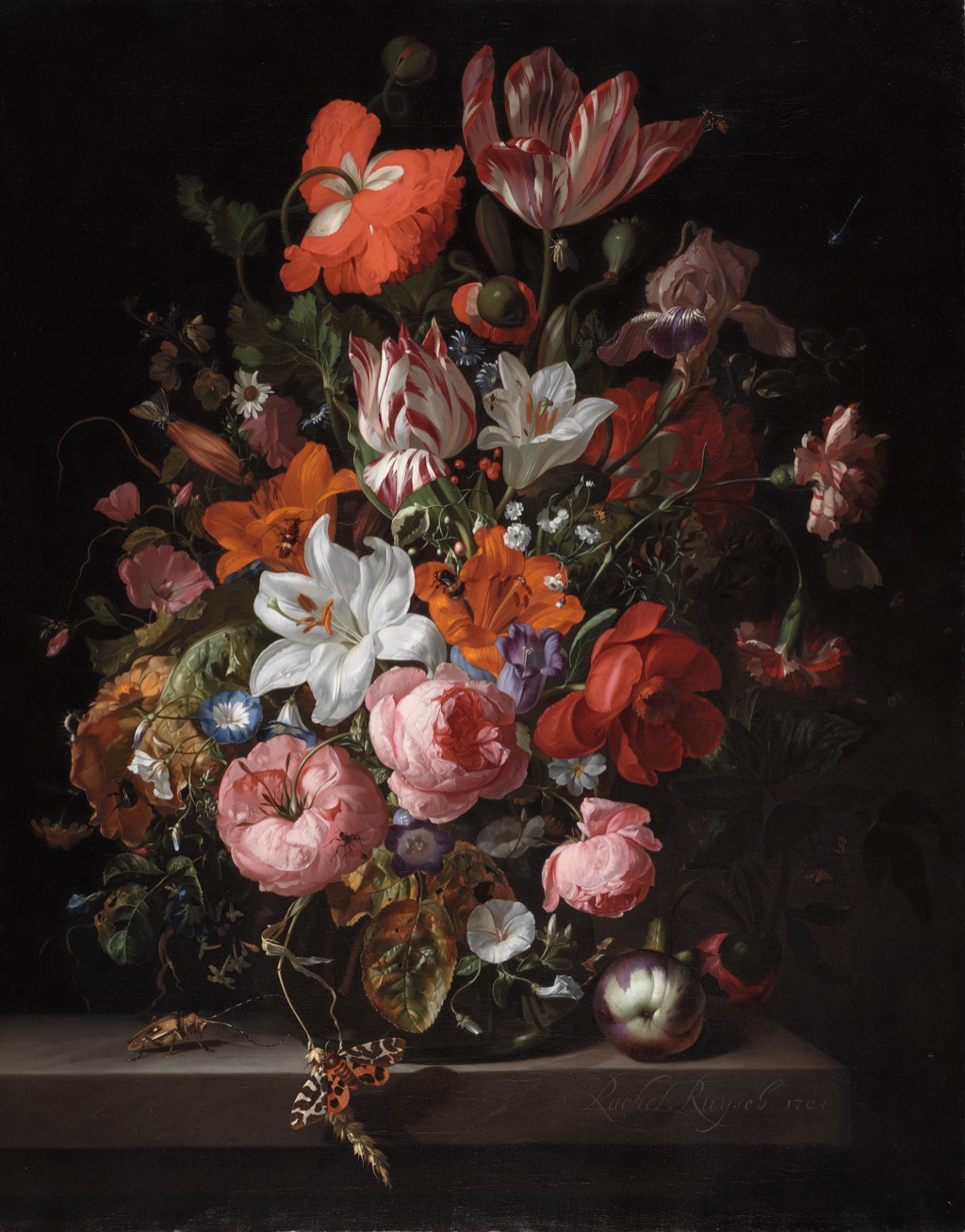
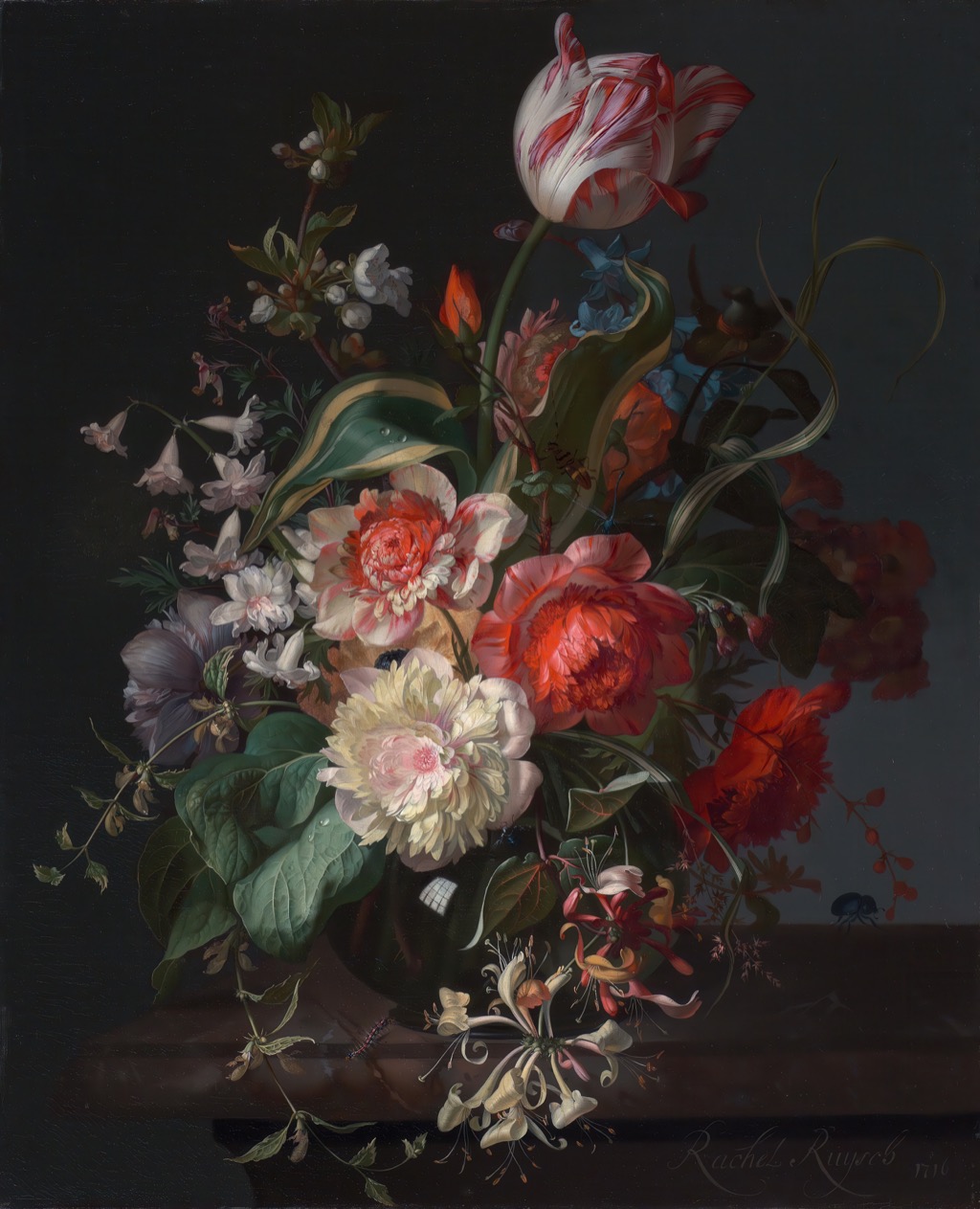
Rachel Ruysch's Flower Still Life at the Toledo Museum of Art is a painting of abundance under pressure. A dense bouquet rises from a shadowed vase, its reds, pinks, whites, blues and violets appearing against a dark background. Flowers spill outward rather than standing obediently upright. Leaves curl and brown. Small creatures move through the arrangement. Near the base, the Toledo Museum of Art's Art Minute description notes two seashells beside the vase, quiet reminders that this painted world is not only botanical but also collected, arranged and staged.[1]
The object record dates the painting to about 1716-1720, when Ruysch was in the mature phase of a career that had already brought international admiration.[2] It is an oil on canvas from Amsterdam, now in Toledo, purchased with funds from the Libbey Endowment, Gift of Edward Drummond Libbey. Those facts matter because this is not an anonymous example of Dutch flower painting. It is a specific late-career work by one of the most accomplished still-life painters in Europe, made when Ruysch had long since mastered the delicate balance between exact observation and pictorial invention.
The painting looks lush at first glance, but its beauty is not simple prettiness. Toledo's account draws attention to caterpillars, hungry insect damage and browning leaves among the blossoms.[2] The bouquet contains flowers that would not all have bloomed at the same time, so its unity is a painterly fiction rather than a record of one real vase.[2] Ruysch makes that fiction persuasive through closely studied detail. She gives the viewer a bouquet that could not easily exist in one season, then fills it with enough evidence of nature's fragility to make it feel convincingly alive.
At a Glance
- ArtistRachel Ruysch (1664-1750)
- TitleFlower Still Life
- DateAbout 1716-1720
- Place of originAmsterdam, The Netherlands
- MediumOil on canvas
- Dimensions29 3/4 x 23 7/8 in. (75.6 x 60.6 cm)
- CollectionToledo Museum of Art
- Object number1956.57
- Credit linePurchased with funds from the Libbey Endowment, Gift of Edward Drummond Libbey
- SubjectA floral still life with blossoming and wilting plants, insects, a vase, marble table and shells
Contents
- Introduction
- What the Toledo Painting Shows
- A Bouquet Made Across Time
- Close Looking: Insects, Damage and Decay
- The Dark Ground and the Tabletop Stage
- Ruysch's Natural-History Eye
- A Mature Work from About 1716-1720
- Why Toledo's *Flower Still Life* Matters
What the Toledo Painting Shows
The Toledo Flower Still Life is a vertical painting built around a crowded bouquet set against darkness. The museum's Art Minute image description describes a mass of flowers in reds, pinks, whites, blues and violets, with an asymmetrical arrangement that spills toward the lower left and a bright red flower visible near the upper right.[1] The vase rests on a marble table, partly lost in shadow, with two seashells beside it.[1]
That description gives a useful map for looking. The painting is not arranged as a neat, front-facing display. Its energy comes from imbalance. The bouquet leans and expands. Stems arc outward. Blossoms face different directions, some open to the viewer and others partially hidden by leaves or petals. The flowers do not simply fill the middle of the canvas; they push against its edges and test the boundary between controlled composition and natural growth.
Ruysch's dark background is essential to that effect. It does not behave like empty space. It acts as a visual pressure that makes the flowers appear to emerge into light. Pale petals become brighter because they are set against shadow. Reds and violets deepen. Thin stems become more visible where they catch a highlight, then disappear again where they turn inward. The darkness also slows the viewer down. Instead of seeing everything at once, the eye has to move through the bouquet by following changes of light, colour and texture.
The marble table gives the arrangement a human stage. Flowers belong to nature, but a marble tabletop belongs to a room, a collector's interior and a culture of display. The seashells reinforce that sense of collection. They sit at the base like small, precious objects placed near the vase. Without turning the painting into a simple inventory of luxury goods, Ruysch lets shells, stone, glass, leaves, insects and petals meet in one controlled visual field. The result is a still life about nature, but nature already studied, selected and brought indoors.
It is important not to overname the flowers. Toledo's public text speaks broadly of a lush floral arrangement and gives more certainty to the visual and thematic details than to a full botanical list.[1][2] That caution suits Ruysch's art. Her paintings often invite botanical curiosity, but this particular page is strongest when it stays close to what the museum identifies and what the eye can responsibly observe: blossoming and wilting plants, insect life, damaged leaves, an asymmetrical bouquet, a marble support and a dark field.
A Bouquet Made Across Time
Toledo's label notes that Ruysch included many flowers that would never bloom at the same time.[2] This is one of the central facts of the painting. The bouquet looks immediate, as though freshly placed before us, yet it is made from different botanical moments. It gathers more than one season into a single display.
That does not make the painting false. It makes it a particular kind of truth. Ruysch was not trying to document one bouquet as it happened to stand before her on one afternoon. She was composing an ideal flower piece from knowledge, studies and memory. The viewer experiences a persuasive whole, but that whole depends on the artist's ability to make separate observations belong together.
The same principle appears across Ruysch's flower paintings. The Mauritshuis explains that she combined flowers, plants and animals that would not appear together in the real world, drawing on living and preserved models, rare plants and botanical knowledge.[3] The National Gallery likewise describes her practice in terms of studied flowers and planned compositions rather than simple seasonal transcription.[4] In Flower Still Life, this method becomes visible through the bouquet's layered density. It is not a casual bunch. It is an arrangement of chosen effects: open bloom, fading petal, curling stem, small creature, damaged leaf, polished table and dark air.
The impossibility of the bouquet also changes the way we read time in the painting. A real bouquet fades because time passes. Ruysch's bouquet already contains several kinds of time: the different blooming seasons of the flowers, the present moment of display, and the hints of decay visible in wilting plants and insect-bitten leaves. The painting compresses time rather than stopping it.
That compression is part of its emotional charge. The viewer is offered a vision of abundance that cannot last and, in one sense, could not have existed naturally at all. Ruysch makes the work attractive enough to delight the eye, then precise enough to trouble the idea of simple permanence. It is a bouquet made from mastery, not from convenience.
Close Looking: Insects, Damage and Decay
Toledo's account is especially valuable because it directs the viewer toward the small disturbances inside the beauty. It mentions caterpillars crawling along a flower stem and browning leaves marked by holes made by insects.[2] The Art Minute description adds a butterfly, a bee and a caterpillar among petals, leaves, buds and curving stems.[1] These details should not be treated as decorative extras. They are part of how the painting thinks.
Insects change the scale of the still life. From across the room, the bouquet reads as a large shape of colour and shadow. Up close, it becomes a small habitat. Petals become surfaces to land on. Stems become paths. Leaves become food, shelter and evidence of touch. The viewer's attention shifts from the theatrical whole to tiny episodes within it.
That shift is one of Ruysch's strengths. She could organise a complex bouquet so that it remained legible, but she could also reward patient looking with minute incidents. The insects do not break the composition apart. They animate it. They make the bouquet feel inhabited rather than simply displayed.
They also complicate beauty. A flower still life can be read as an image of cultivated pleasure: costly flowers, polished surfaces, rare specimens and refined technique. Ruysch includes that pleasure, but she does not leave it untouched. Browning leaves and insect damage remind us that the arrangement is fragile. The same natural life that produces blossoms also produces appetite, decay and disappearance.
The Toledo label connects these vivid details with the fading of beauty and the mortality of living things.[2] That interpretation fits the broader still-life tradition, but it is not heavy-handed here. Ruysch does not need a skull, extinguished candle or overt moral emblem. The argument is carried by the leaves themselves. A hole in a leaf can do quiet philosophical work. A caterpillar on a stem can make the whole bouquet feel temporary.
This is why the painting benefits from slow viewing. Its first pleasure is colour and abundance. Its deeper pleasure is the way those sensations become unstable. The flowers seem to bloom in splendour, yet every small sign of damage says that splendour belongs to a world of change.
The Dark Ground and the Tabletop Stage
The Toledo painting belongs to a tradition of flower pieces set against dark grounds. Toledo's label places it in the style of flower painting from the second half of the seventeenth century.[2] Ruysch uses that inheritance with confidence. The dark background gives the bouquet intensity, but it also gives the painting discipline. Without it, the profusion of petals, leaves and stems might become diffuse. Against darkness, each lit form has consequence.
The composition depends on asymmetry. The Art Minute description notes flowers spilling toward the lower-left corner and a bright red flower near the upper right.[1] Those two points create a diagonal rhythm. The eye moves from the lower reach of the arrangement up through the bouquet toward the high red accent, then back down through stems, leaves and shadow. This diagonal movement keeps the painting from becoming static.
Ruysch had trained with Willem van Aelst, a still-life painter associated with elegant compositions, fine surfaces and sophisticated arrangements. The National Gallery records that she trained with him in Amsterdam from 1679, and other museum sources emphasise his importance for her formation.[4][5] In Flower Still Life, the inheritance is visible not as imitation but as command. The bouquet is highly finished, but it is not stiff. It has poise and movement at the same time.
The marble tabletop is a second kind of discipline. It gives the image a boundary and a base. The viewer can imagine the vase's weight, the coolness of the stone and the slight distance between the painted objects and our own space. The table also gives Ruysch a place for secondary details, including the shells described by Toledo's Art Minute.[1] These small objects widen the painting's world. They suggest collecting, travel, rarity and the habit of placing natural things into arrangements for study or pleasure.
The result is a painting in which every part has a role. The dark ground intensifies the flowers. The diagonal arrangement creates movement. The marble surface grounds the scene. The shells add a collecting note. The insects animate and unsettle. The vase holds the bouquet together, even when much of it is obscured by shadow and floral abundance.
Ruysch's Natural-History Eye
Ruysch's ability to make the Toledo bouquet convincing is tied to her unusual formation. She was the daughter of Frederik Ruysch, a professor of anatomy and botany, and Toledo notes that she likely became familiar with plants through him.[2] The National Museum of Women in the Arts describes Frederik Ruysch as an eminent scientist and says Rachel learned from him how to observe and record nature with accuracy.[5] The Mauritshuis adds that his collection included unusual objects, dried plants and preserved specimens, and that Rachel drew and painted from this environment.[3]
That background should be handled carefully. Rachel Ruysch was not important merely because she had access to her father's collection. Many people saw collections. Few transformed close observation into paintings of this authority. The natural-history environment gave her material and habits of looking; her achievement was to turn them into art.
At fifteen, she began training with Willem van Aelst.[2][4] This combination of scientific surroundings and professional still-life instruction shaped the distinctive tension in her work. Her flowers look closely observed, but they are not botanical plates. Her insects and leaves can be studied as natural details, but they also serve composition, mood and meaning. She does not simply record nature. She arranges it so that observation becomes drama.
The modern exhibition Rachel Ruysch: Artist, Naturalist, and Pioneer has helped bring this doubleness back into focus. The Museum of Fine Arts, Boston presents the exhibition and its related publication under the larger idea of Ruysch turning nature into art, with attention to rare species, insects and the small creatures hidden in her compositions.[6] Toledo's own Art Minute for Flower Still Life makes the same object-specific point: this painting asks the viewer to look for small living details inside a grand bouquet.[1]
The natural-history context also helps explain why the bouquet can be both impossible and convincing. Ruysch knew how flowers, leaves and insects behaved well enough to combine them inventively. She could paint a fiction that feels observed because the fiction is built from many acts of observation. That is one of the painting's central pleasures.
A Mature Work from About 1716-1720
The Toledo Museum of Art dates Flower Still Life to about 1716-1720.[2] This date range places it near a significant moment in Ruysch's career. From 1708 until 1716, she served as court painter to Johann Wilhelm, Elector Palatine, in Dusseldorf, according to the National Gallery and other museum accounts.[4][5] The National Museum of Women in the Arts notes that after returning to Holland she continued painting fruit and flower pictures for a prominent clientele.[5]
Whether one reads the Toledo painting as just after that court period or in its immediate wake, it belongs to a phase of professional authority. Ruysch was no longer a prodigy or promising specialist. She had already built an international reputation. Toledo's label describes her as the most famous female painter in the Dutch Golden Age and notes that her career lasted almost seven decades.[2] The wording is striking, but the painting itself supports the broader point: it shows an artist who could manage abundance without losing control.
The date also matters because flower painting was a competitive field with a long history by the early eighteenth century. Ruysch inherited conventions from earlier Dutch and Flemish flower painters: dark grounds, ledges, vases, carefully staged blossoms, insects and signs of decay. Her originality lies in the vitality she brings to those conventions. Flower Still Life is traditional in format, but not tired in effect. Its forms press outward. Its insects move. Its surface seems full of small events.
The painting's later history also tells us something about its reception. Toledo records a substantial bibliography, including older catalogues, art-history surveys and studies of women artists.[2] The work was shown in the 1976 Los Angeles County Museum of Art exhibition Women Artists: 1550-1950, and it appears in the 2024-2025 exhibition Rachel Ruysch: Nature into Art across Munich, Toledo and Boston.[2] These appearances show the painting's double importance: it is a major example of Dutch flower painting and a touchstone in the recovery and reassessment of women artists' historical careers.
The Art Minute adds a particularly evocative reception detail. In 1750, the year Ruysch died, a collection of poems written about her between 1685 and 1750 was published; Toledo notes that the authors, including several Dutch women poets, celebrated her as a master of science and art in depictions of flowers, fruit and animals.[1] That does not turn the Toledo painting into an illustration of the poems, but it helps us understand the kind of admiration Ruysch's art invited. Viewers saw not only beauty, but learned artistry.
Why Toledo's Flower Still Life Matters
Toledo's Flower Still Life matters because it gives a compact, object-specific view of Ruysch's mature art. It contains many of the qualities associated with her flower paintings: an impossible bouquet, a dark ground, asymmetrical movement, minute insect life, polished surfaces, botanical attention and signs of decay. Yet it is not merely an example of a type. Its particular details make it memorable.
The seashells at the base distinguish the Toledo painting from many discussions that focus only on flowers and insects.[1] They shift the scene toward the culture of collecting and display. The insect-bitten leaves give the painting a sharp vanitas edge without making it grim.[2] The asymmetrical fall of flowers toward the lower left and the bright accent near the upper right create a compositional rhythm that feels active rather than ceremonial.[1] These are not generic traits pasted onto a still-life formula. They are the painting's specific way of holding abundance together.
It also matters within the larger Rachel Ruysch cluster because it can speak to several routes at once. Readers interested in Ruysch's flower paintings can use it as a close case study. Readers interested in Rachel Ruysch: Art and Science can see how botanical knowledge, insects and collecting culture become pictorial drama. Readers comparing mature works can place it beside the Rijksmuseum's Still Life with Flowers on a Marble Tabletop without confusing the two paintings.
That last distinction is important. The Toledo painting is not the Rijksmuseum painting under another title. It has its own date range, object number, dimensions, provenance, exhibition history and visual emphasis. The Toledo record and Art Minute give the reader enough material to approach it as a particular work: a bouquet on a marble table, with shells at the base, insects moving through its surfaces and a carefully staged drama of bloom and decline.
The painting's appeal is therefore both immediate and slow-burning. It catches the eye through colour and density. It holds the eye through detail. It deepens through context: Ruysch's training, her natural-history world, her courtly reputation, the culture of Dutch still life and the later recognition of her career. A viewer can enjoy the bouquet first and still find more to notice after several minutes of looking.
That is the strength of Ruysch's art. She does not ask us to choose between beauty and knowledge. In Flower Still Life, beauty is one way knowledge appears. The more closely the viewer looks, the less still the still life becomes.
Frequently Asked Questions
Discussion
In Ruysch's Flower Still Life, do the insects and damaged leaves make the bouquet feel more fragile, more realistic, or more unsettling?
Reader Insights
Compare the painting's first impression with its close details. Does the bouquet become less decorative the longer you look?
Notice the shells beside the vase. How do they change the painting from a flower arrangement into a display of collected natural things?
Think about the impossible bouquet. What does Ruysch gain by combining flowers that would not bloom together in real life?
Join the Conversation
Share a thoughtful observation about Rachel Ruysch, the painting, or the wider still-life tradition that would help another reader look more carefully.
References
- Toledo Museum of Art, "Art Minute: Rachel Ruysch, Flower Still Life," April 21, 2025. https://toledomuseum.org/collection/art-minute/art-minute-rachel-ruysch-flower-still-life
- Toledo Museum of Art, Flower Still Life, Rachel Ruysch, about 1716-1720, object number 1956.57. https://emuseum.toledomuseum.org/objects/54880/flower-still-life
- Mauritshuis, "Rachel Ruysch (1664-1750)." https://www.mauritshuis.nl/en/our-collection/our-masters/rachel-ruysch
- National Gallery, London, "Rachel Ruysch (1664-1750)." https://www.nationalgallery.org.uk/artists/rachel-ruysch
- National Museum of Women in the Arts, "Rachel Ruysch." https://nmwa.org/art/artists/rachel-ruysch/
- Museum of Fine Arts, Boston, "Rachel Ruysch: Artist, Naturalist, and Pioneer," and related publication Rachel Ruysch: Nature into Art. https://www.mfa.org/exhibition/rachel-ruysch-artist-naturalist-and-pioneer
- Rijksmuseum, "Rachel Ruysch." https://www.rijksmuseum.nl/en/collection/node/Rachel-Ruysch--3eaff215275e2ebd47d02cfba2044cc8
- Main image reference: Rachel Ruysch, Flower Still Life, Toledo Museum of Art. Public-domain image via Wikimedia Commons / Toledo Museum of Art. https://commons.wikimedia.org/wiki/File:Rachel_Ruysch_-_Flower_Still_Life,_Toledo.jpg