 Buy Art Prints Now
from Amazon
* As an Amazon Associate I earn from qualifying purchases.
Image reference [1]
 by Tom Gurney
Tom Gurney BSc (Hons) is an art history expert with over 20 years experience
Published on August 25, 2026 / Updated on September 6, 2026
Email: tomgurney1@gmail.com / Phone: +44 7429 011000
Flowers in a Glass Vase: Introduction
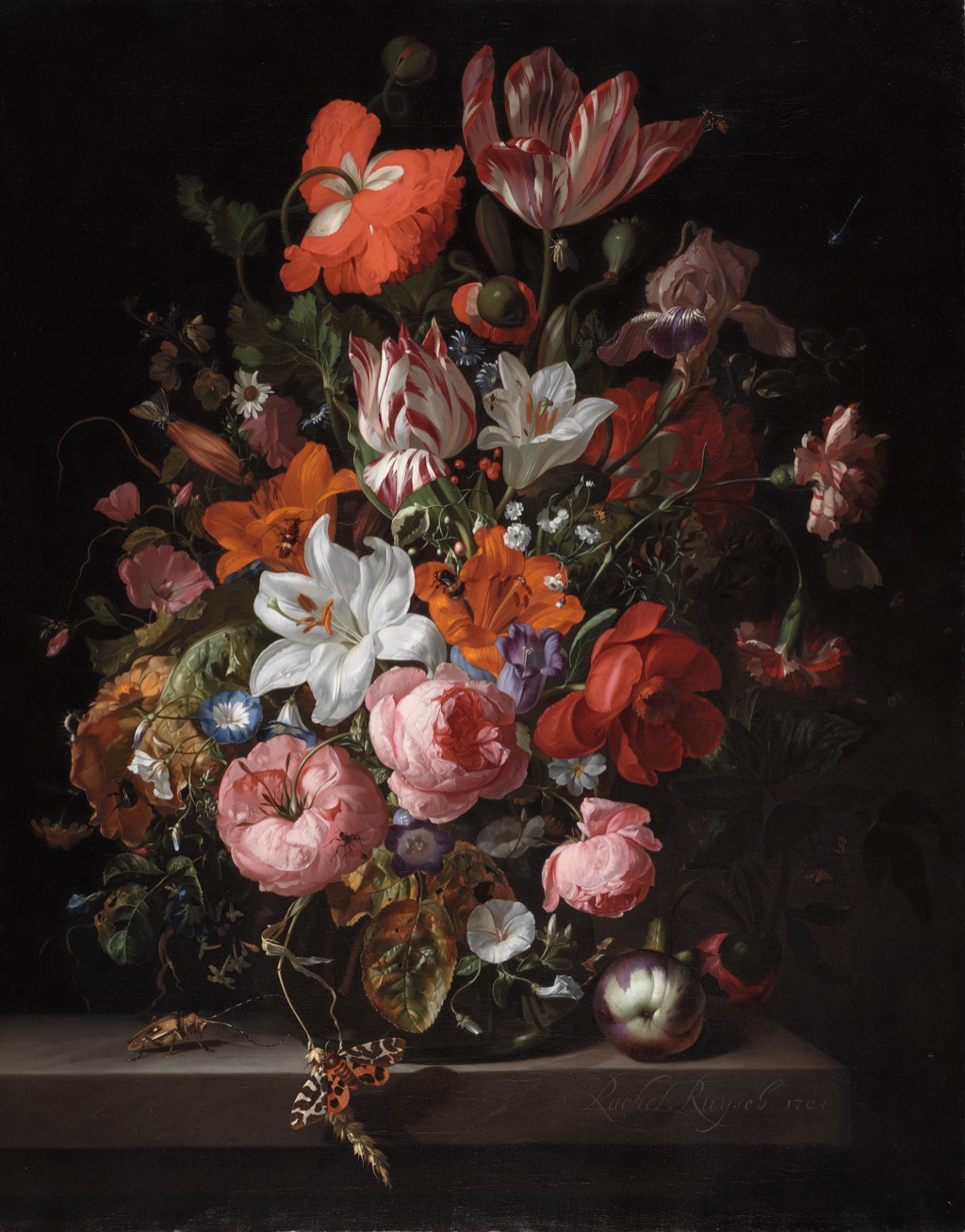
Rachel Ruysch's Flowers in a Glass Vase is a painting of abundance held under exquisite control. Painted in 1704 and now in the Detroit Institute of Arts, it presents a lavish bouquet in a glass vessel, set against darkness and crowded with lilies, peonies, roses, tulips, dewdrops, and insects. At first it seems to celebrate flowers at their freshest. Look longer, and it becomes a carefully made fiction: the Detroit Institute of Arts notes that the selected blooms do not flower at the same time of year, so the arrangement could only have existed in the artist's imagination.[1]
That phrase should not make the painting feel less precise. Ruysch's achievement lies in making an impossible bouquet feel observed. Each petal, insect, shine of moisture, and shift of light suggests patient study, yet the whole composition is more artful than any single vase placed before the painter. The picture gathers different seasons into one dramatic display and asks the viewer to enjoy the tension between natural knowledge and painterly invention.
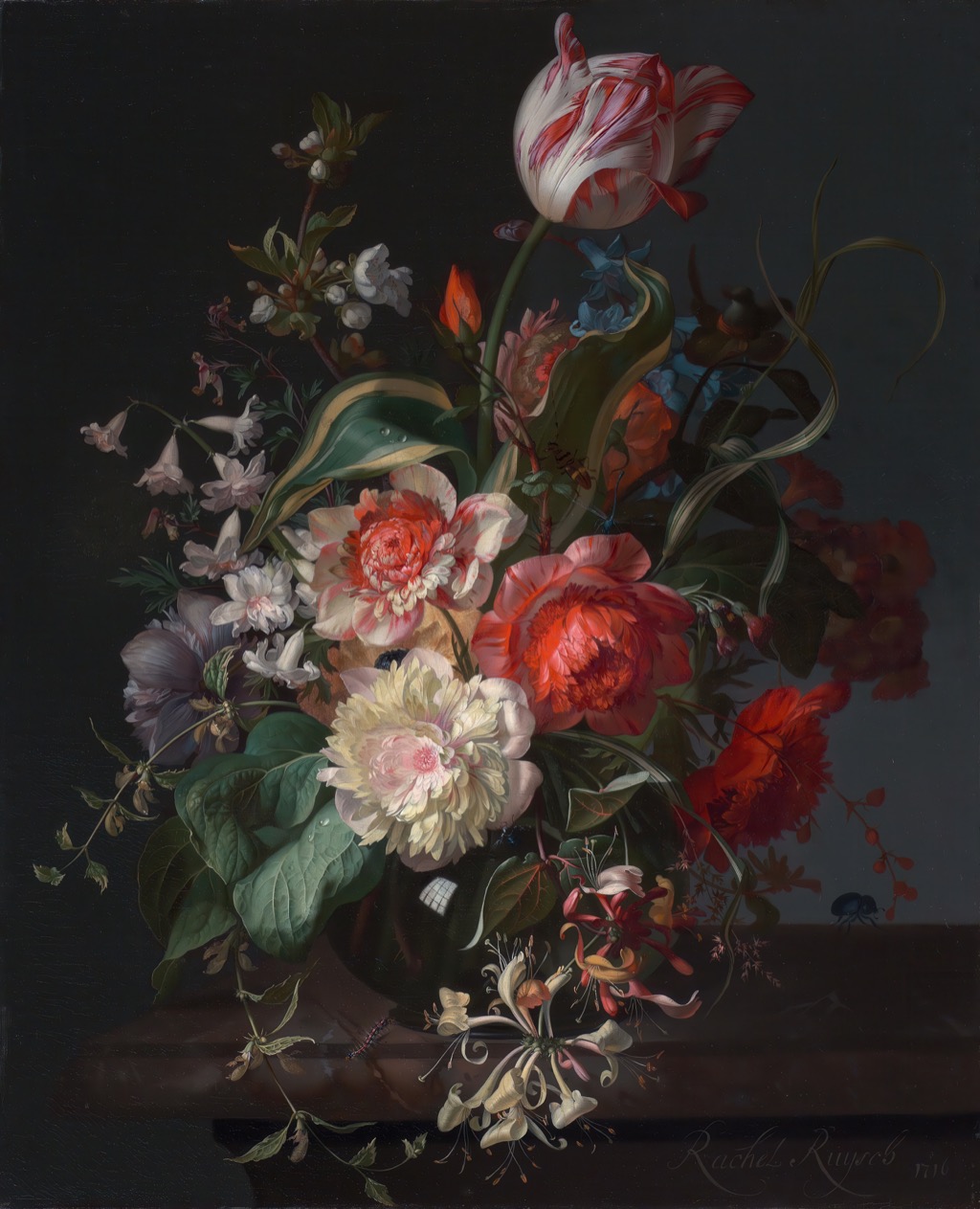
This article is about the Detroit Institute of Arts painting titled Flowers in a Glass Vase, dated 1704 and accessioned as 1995.67. Ruysch painted several similarly titled flower pieces, and museums use closely related titles for different objects. This Detroit work should be distinguished from the Rijksmuseum's Still Life with Flowers in a Glass Vase, the Mauritshuis Vase with Flowers, and the National Gallery's Flowers in a Glass Vase with a Tulip.[2][3][4]
At a Glance
- ArtistRachel Ruysch (1664-1750)
- TitleFlowers in a Glass Vase
- Date1704
- MediumOil on canvas
- Dimensions83.8 x 67 cm, unframed
- CollectionDetroit Institute of Arts
- DepartmentEuropean Painting
- Accession number1995.67
- Signature and dateSigned and dated at bottom right on the ledge, "Rachel Ruysch 1704"
- SubjectA large flower still life in a glass vase with dewdrops and insects
- Key cautionThis is the Detroit painting, not the Rijksmuseum, Mauritshuis, or National Gallery vase-and-flower works with similar titles
Contents
- Introduction
- The Detroit Painting
- An Impossible Bouquet
- Glass, Dewdrops, and the Work of Illusion
- Insects and the Small Drama of Nature
- Ruysch in 1704
- Provenance and Collection History
- Similar Titles, Different Paintings
- Why the Painting Matters
The Detroit Painting
The Detroit Institute of Arts records Flowers in a Glass Vase as an oil painting on canvas made by Rachel Ruysch in 1704.[1] Its unframed dimensions, 83.8 x 67 cm, make it a substantial flower piece rather than a tiny cabinet curiosity. The painting is large enough for the bouquet to feel commanding, but still intimate enough to reward close looking.
The work belongs to the DIA's European Painting department and is listed under the accession number 1995.67.[1] The museum's credit line records the painting as a Founders Society purchase supported by numerous funds and donors. Its long list of contributing funds is more than administrative detail. It hints at the institutional importance of acquiring a major Ruysch painting in the late twentieth century, when museums and scholars were giving renewed attention to women artists and to the intellectual complexity of still life.
The DIA's own description calls the painting a "large flower still life" and places emphasis on its vivid flowers, glistening water drops, and insect life.[1] The museum identifies white and orange lilies, peonies, cabbage roses, and striated tulips among the display. Those identifications are useful, but they also set a boundary. Ruysch's painting invites botanical curiosity, yet not every bloom needs to be named for the picture to be understood. The safest approach is to use the flowers named by the museum record and treat additional identifications with caution.
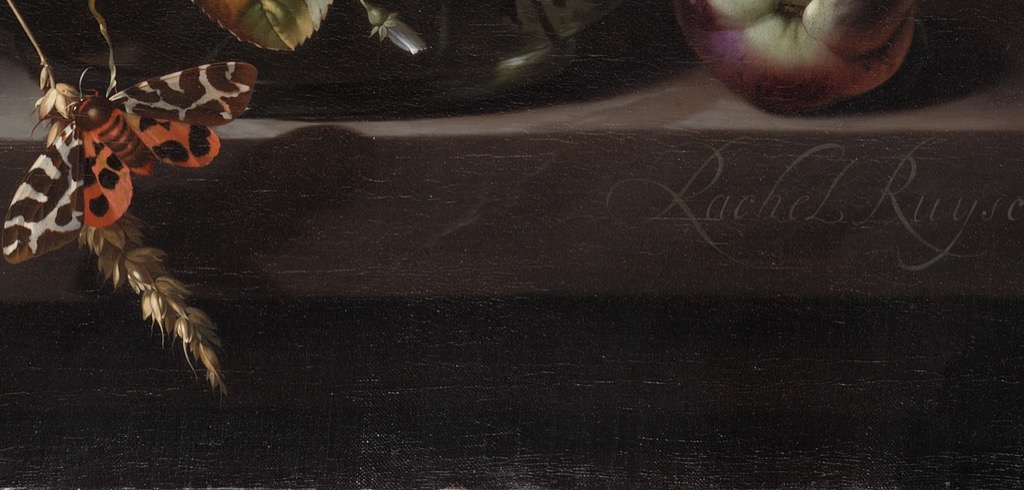
The signature and date appear at the bottom right on the ledge.[1] That detail matters because Ruysch's name was a mark of professional prestige. By 1704 she was already a highly accomplished still-life painter, trained in Amsterdam and admired by patrons for the refined naturalism of her flower pieces. The signed ledge makes the painting's illusion slightly double: it serves as the stone support for the bouquet and as the place where the painter asserts authorship.
The DIA object record lists the painting as on view in the Dutch Golden Age area of the museum.[1] That setting is appropriate, but the work also complicates the familiar idea of Dutch Golden Age painting. Ruysch is not presenting a tavern scene, a church interior, a portrait, or a household anecdote. She is using flowers to stage knowledge, luxury, seasonality, beauty, and decay.
An Impossible Bouquet
The central idea of Flowers in a Glass Vase is simple to see and difficult to accomplish: many flowers appear to bloom together in one sumptuous arrangement. Ruysch gives the bouquet the force of a natural event. It seems freshly cut, luminous, and fragrant. Dewdrops glisten on petals, and insects hover as if drawn by scent.[1]
Yet the bouquet is not a record of one moment in a garden or studio. The DIA notes that the selected flowers do not bloom at the same time of year.[1] This is one of the most important facts about the painting. The arrangement is imaginary, but it is not careless fantasy. It is an invention built from observation.
Dutch flower painters often worked from studies rather than from one complete bouquet. The National Gallery's discussion of Ruysch's Flowers in a Glass Vase with a Tulip explains that the older idea of painters adding each bloom gradually as it came into season has been reconsidered. Instead, painters used collections of flower studies within planned compositions.[4] That process helps explain the Detroit painting. Ruysch could bring together flowers associated with different seasons because she was composing with visual knowledge accumulated over time.
This working method changes how the viewer reads the painting. If the bouquet is impossible, its truth is not literal. It is artistic, botanical, and temporal. Ruysch condenses many moments of looking into one image. The result is a bouquet more durable than any real arrangement and more complex than a simple display of flowers.
The painting's abundance also has a social dimension. In the Dutch Republic and across early modern Europe, rare flowers, imported plants, gardens, botanical books, and specimens belonged to cultures of collecting and knowledge. Ruysch grew up in a household unusually close to that world. Her father, Frederik Ruysch, was a noted anatomist, botanist, and collector. The DIA connects her interest in the natural world to his scientific reputation and to his extensive collection of preserved zoological specimens, later purchased by Peter the Great of Russia.[1]
That background should not reduce Rachel Ruysch to an extension of her father. The painting is hers: designed, balanced, signed, and executed by an artist with her own career. But the scientific environment around her helps explain why the flowers feel so exact. Ruysch knew how to look at nature as structure, surface, and living matter.
Annotated Details from Flowers in a Glass Vase
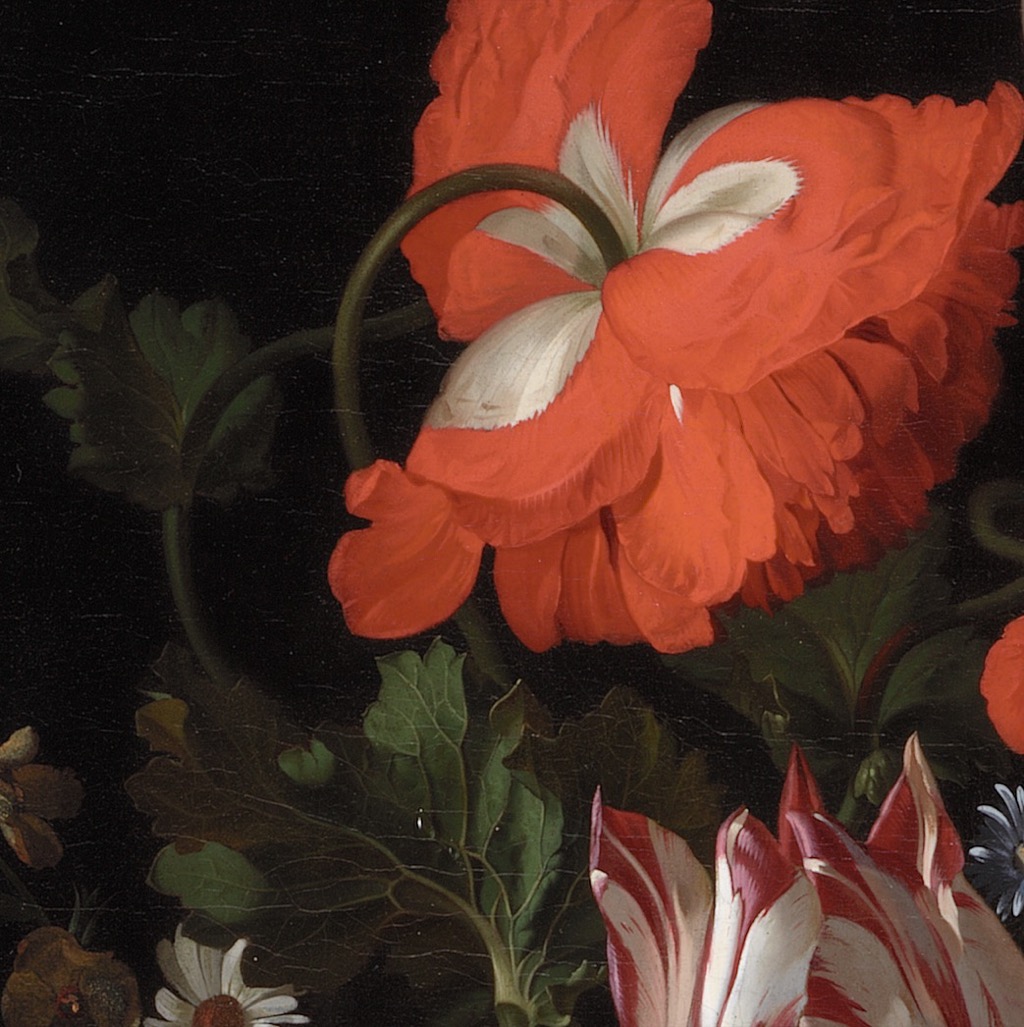
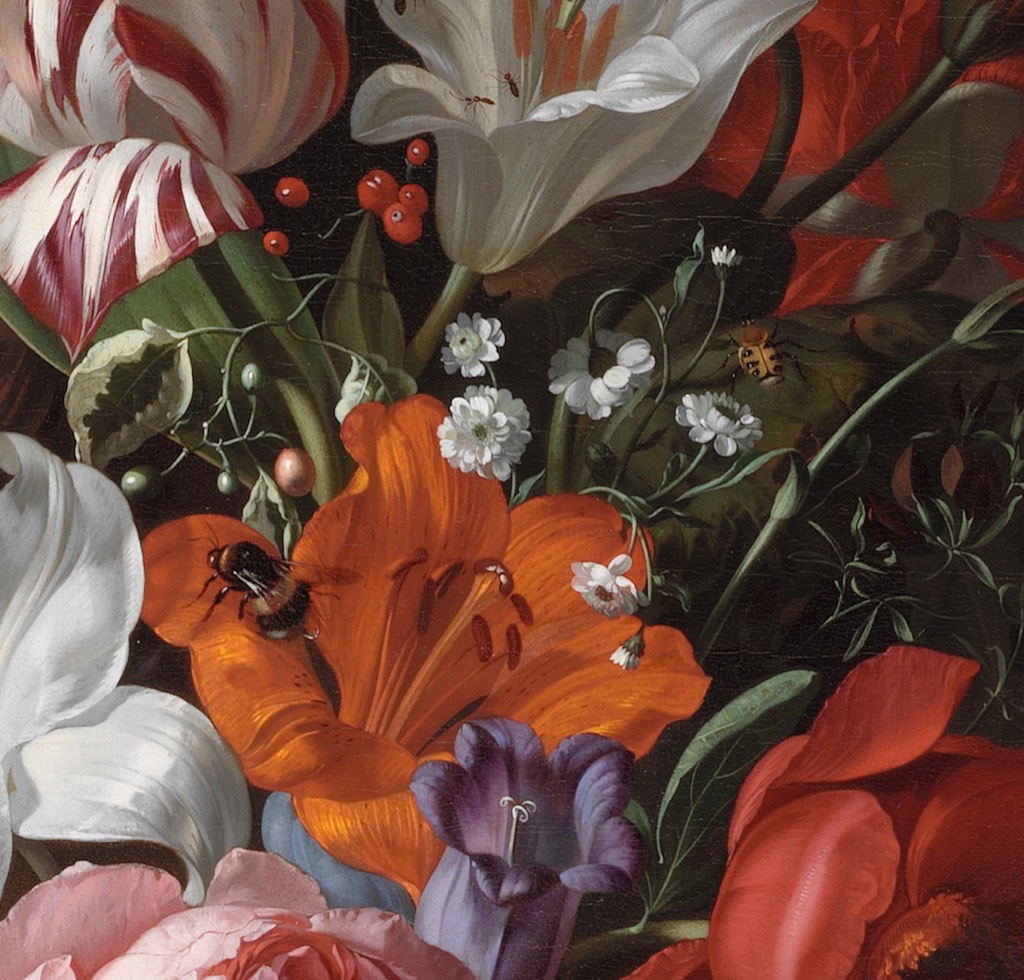
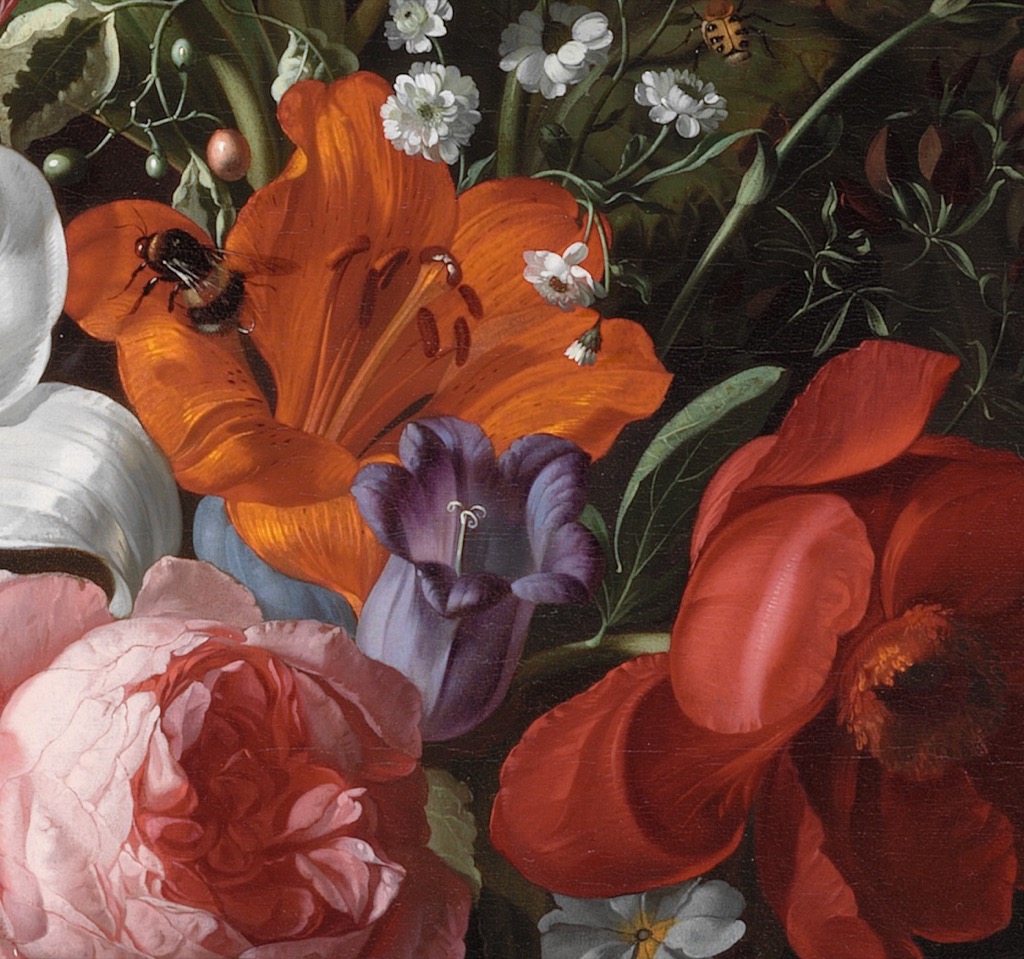
This annotated close reading uses the Detroit painting to isolate six passages where Ruysch turns a large flower still life into a concentrated exercise in seasonal invention, surface brilliance and small-scale natural drama. The labels stay with visible features and with the DIA-supported account of flowers, dewdrops, insects and an imaginary bouquet.[1]
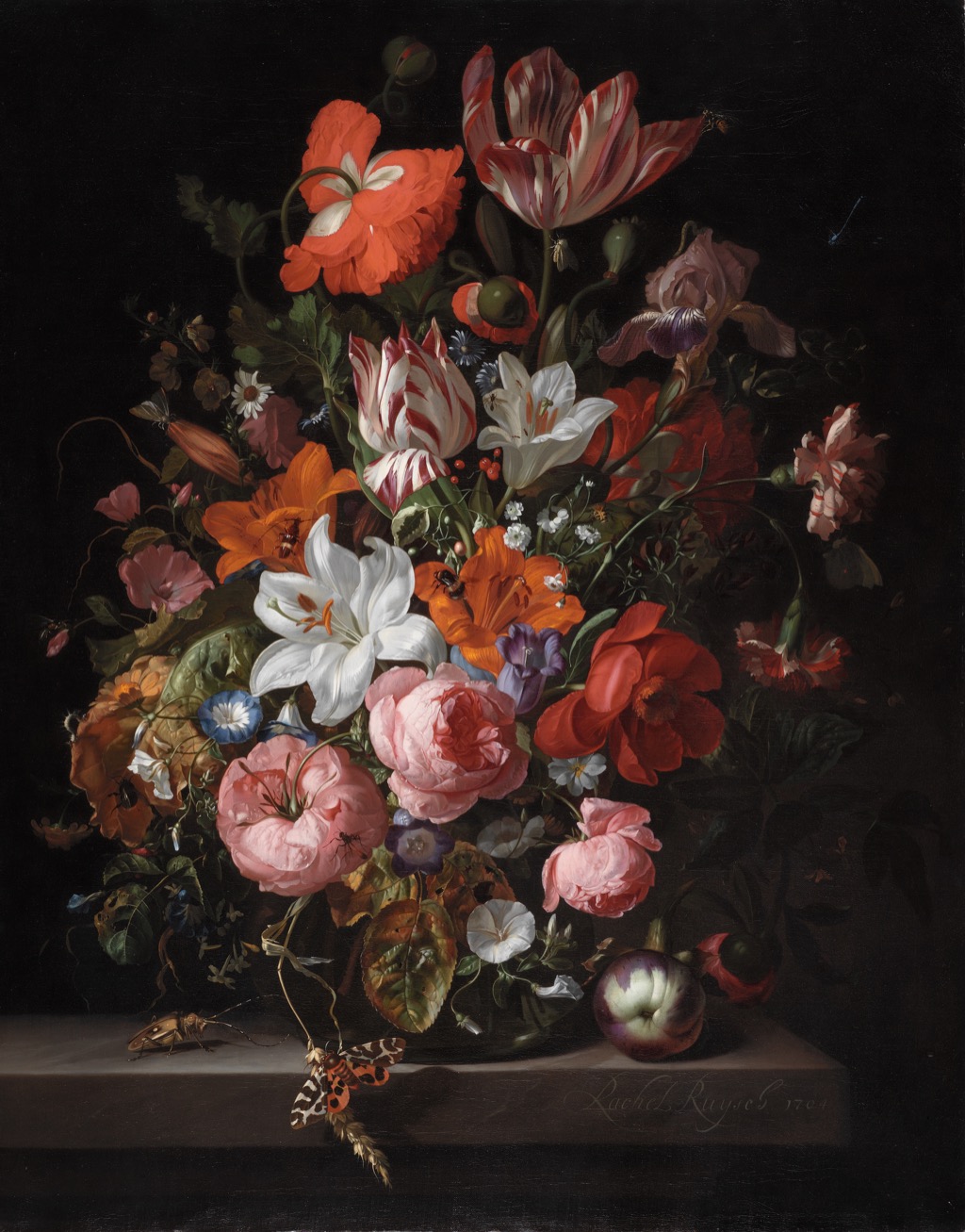
Details from FLOWERS IN A GLASS VASE
This annotated close reading uses the Detroit painting to isolate six passages where Ruysch turns a large flower still life into a concentrated exercise in seasonal invention, surface brilliance and small-scale natural drama. The labels stay with visible features and with the DIA-supported account of flowers, dewdrops, insects and an imaginary bouquet.
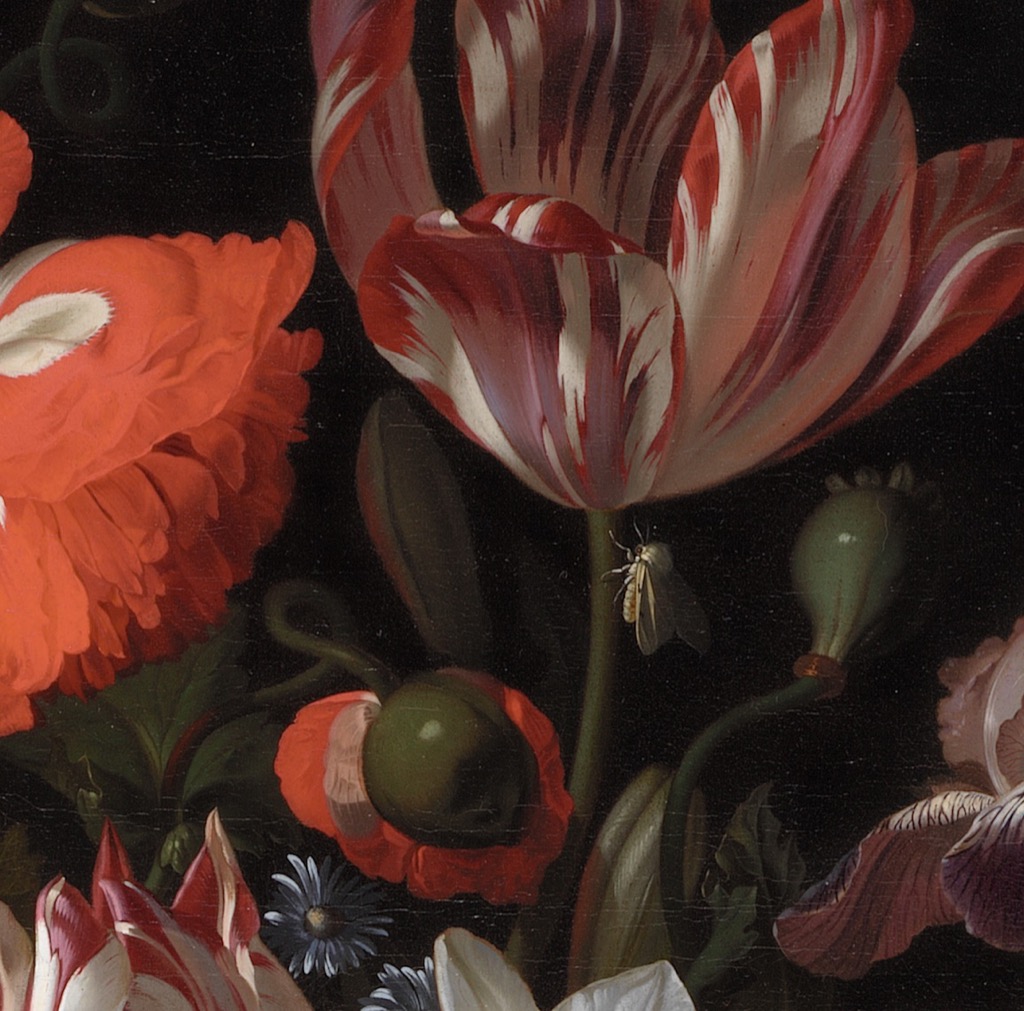
Striped Upper Tulip
The striped tulip near the top gives the bouquet a dramatic high point. It draws the eye upward and helps explain why Ruysch's imaginary arrangements feel designed rather than merely abundant.
Orange Flower and Bud
The large orange flower and nearby bud show how Ruysch balances open bloom with potential growth. The contrast gives the arrangement movement without needing a narrative scene.
White Lily and Central Light
The white lily catches light in a crowded centre of stems, petals and shadow. It helps the bouquet read clearly even though the surrounding forms are dense.
Dewdrops and Small Blossoms
Small blossoms, berries and points of moisture slow the viewer down. They turn freshness into a painted effect made from tiny highlights rather than broad colour alone.
Lower Rose and Insect Life
The lower rose is beautiful but not isolated from nature. Insects and nearby leaves keep the painted bouquet alive as a small environment rather than a polished inventory.
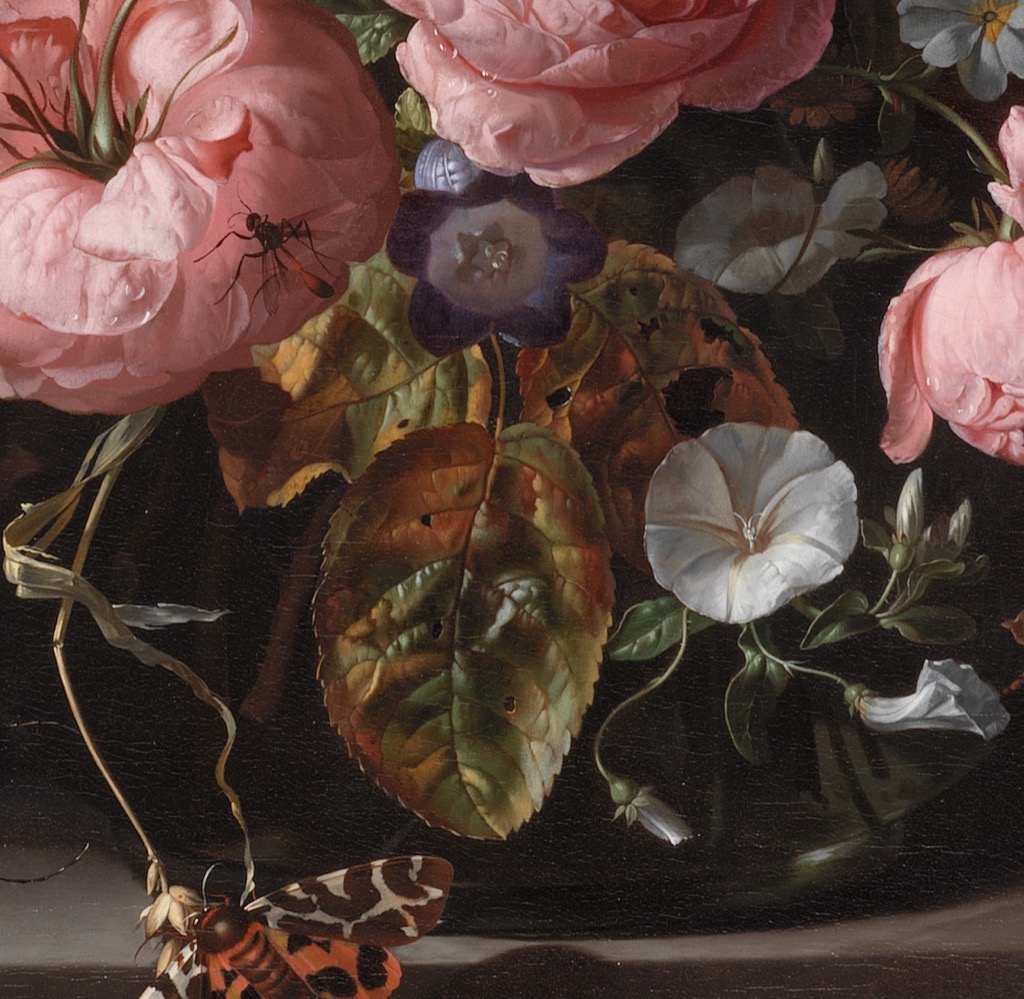
Signed Ledge and Butterfly
The ledge grounds the vase and carries Ruysch's signature and date. The butterfly nearby keeps the threshold lively, turning the bottom edge into part of the painting's drama.
Glass, Dewdrops, and the Work of Illusion
The title directs attention to the vase, and rightly so. A glass vase is a demanding object for a painter because it is both container and optical puzzle. It must be transparent enough to suggest depth, reflective enough to catch light, and solid enough to hold the bouquet. In Ruysch's flower pieces, the vessel is rarely a neutral support. It gathers stems, water, reflections, and shadows into a compact centre of illusion.
In the Detroit painting, the glass vase participates in the same tension as the bouquet. It seems to offer visual evidence: the stems are gathered, the flowers have been arranged, the vessel stands before us. Yet the painting's larger fiction remains. This bouquet could not simply have been cut and placed there at one time. The vase becomes the convincing stage for an impossible gathering.
Dewdrops intensify that illusion. The DIA points to glistening drops on petals, which suggest that the blossoms have only recently been cut.[1] Water on petals is a small detail, but it has a large effect. It makes the flowers feel temporary, tactile, and close. It invites the viewer to imagine freshness, coolness, and scent.
At the same time, those droplets are performances of paint. A dewdrop is a tiny test of highlight, contour, and transparency. It must sit on the petal, not merely on the surface of the canvas. Ruysch uses such details to pull the viewer into a slower form of looking. The more convincing the drop appears, the more aware one becomes of the painter's precision.
The dark ground is equally important. Ruysch's flowers emerge from shadow rather than from a bright, neutral setting. This contrast gives the bouquet depth and theatricality. Pale petals push forward; darker leaves recede; bright accents catch the eye and then send it elsewhere. The darkness is not empty. It is the condition that makes the bouquet sparkle.
The ledge at the bottom of the painting anchors the illusion. It gives the vase a place to stand and the viewer a threshold. Still-life painters often used ledges to make objects seem close to the viewer's space. Ruysch adds her signature and date there, turning the ledge into both a physical support within the picture and a record of authorship.
Insects and the Small Drama of Nature
The DIA describes insects drawn to the flowers' scent and notes their presence as part of the painting's meticulous realism.[1] Insects are small, but they are not minor. They shift the still life from arrangement to environment. A bouquet without insects might remain a display. A bouquet with insects becomes a place where life continues to move.
In Ruysch's flower paintings, insects often make the viewer change scale. From a distance, the painting is a vertical mass of colour and light. Up close, it becomes a sequence of discoveries. An insect can lead the eye along a petal, pause attention near a stem, or make a shadowed area suddenly active. These details reward repeated viewing.
They also complicate the idea of beauty. Flowers attract because they are vivid, fragrant, and delicate. Insects arrive because flowers are part of a living system: places of food, shelter, reproduction, and decay. Ruysch does not need to turn the painting into a moral lesson for that truth to register. The insects remind us that the bouquet is not only a luxury object. It belongs to nature's cycles.
This is where Ruysch's art differs from simple decoration. The picture is undeniably beautiful, and it was made for viewers who valued beauty. But its beauty is active and unstable. Dewdrops will dry. Petals will wilt. Insects will feed, hover, crawl, and disappear. The painting fixes these effects in oil while keeping their temporariness visible.
Modern viewers often approach Dutch still life through ideas of symbolism, especially vanitas themes of transience and mortality. Those ideas can be useful, but they should not flatten the painting into a code. In Flowers in a Glass Vase, the DIA emphasises realism, imagination, flower seasonality, dewdrops, insects, and Frederik Ruysch's natural-history context.[1] That evidence supports a reading of beauty joined to time and natural process. It does not require every petal to stand for a single fixed meaning.
The best way to read the insects is to let them do several things at once. They animate the surface, show Ruysch's skill, connect the bouquet to scent and freshness, and introduce fragility into abundance. They are tiny agents of realism and tiny disturbances of perfection.
Ruysch in 1704
Ruysch painted the Detroit Flowers in a Glass Vase in 1704, four years after the Mauritshuis Vase with Flowers and before her formal period as court painter to Johann Wilhelm, Elector Palatine, in Dusseldorf.[1][3][5] It belongs to a moment when her reputation was already strong and becoming international.
NMWA notes that Ruysch became a member of the painters' guild in The Hague in 1701 and began producing large flower works for an international circle of patrons around that time.[6] That context is useful for the Detroit painting. The work's scale, finish, and luxury fit a painter serving demanding collectors. It is not a modest study of garden flowers. It is a professional statement.
Ruysch had trained with Willem van Aelst, a leading Dutch flower painter, beginning when she was fifteen.[6] Van Aelst's influence is often connected with diagonal movement, elegant asymmetry, and refined still-life effects. In the Detroit painting, the bouquet does not read as a rigid botanical chart. It rises, presses outward, and competes for attention, as the DIA puts it, through large white and orange lilies, peonies, cabbage roses, and striated tulips.[1]
Her biography has sometimes been told through the apparent improbability of professional success: a woman artist, married, with children, sustaining a long career in a specialist field. Those facts matter, but they should not overshadow the work. Ruysch succeeded because her paintings answered a real market for virtuoso flower pieces and because her technical command was exceptional. The Detroit painting makes that success visible without needing to turn her life into a simplified moral story.
The date 1704 is also important because it places the painting before the 1716 works now at the Rijksmuseum and National Gallery. Comparing these paintings shows continuity rather than repetition. Ruysch returned to the glass-vase bouquet format because it gave her a powerful structure: flowers gathered into a vessel, set against darkness, enlivened by moisture and insects, and made more intriguing by seasonal impossibility. Within that structure, each painting has its own size, collection history, title, flower emphasis, and mood.
Provenance and Collection History
The Detroit painting has a well-documented ownership history in the DIA record. The museum traces it, with cautious wording at the start, to James West of Alscot House in Warwickshire, then through several generations of the West and Alston-Roberts West family.[1] In 1994 it was sold at Sotheby's in London to the dealer Johnny van Haeften, and in 1995 it was purchased by the Detroit Institute of Arts.[1]
This provenance matters because flower paintings by Ruysch were luxury objects from the beginning. They were not anonymous household decorations. They were signed works by a celebrated painter, collected, inherited, catalogued, sold, and acquired by major institutions. The Detroit painting's passage through a British country-house collection and then the Old Master market is part of its modern story.
The DIA also lists published references, including Hofstede de Groot's 1928 catalogue, M. H. Grant's 1956 study of Ruysch, the 1985 Treasure Houses of Great Britain exhibition catalogue, the 1994 Sotheby's sale catalogue, and George S. Keyes and colleagues' Masters of Dutch Painting: The Detroit Institute of Arts.[1] These references show that the painting has not been merely a beautiful object in storage. It has been part of the scholarly and collecting record around Ruysch for decades.
The acquisition date, 1995, is worth noticing. Modern scholarship on Ruysch has expanded substantially since the late twentieth century, with particular attention to her position as a woman artist, her natural-history context, and the intellectual force of her still lifes. The 2024-2025 exhibition Rachel Ruysch: Artist, Naturalist, and Pioneer at the Museum of Fine Arts, Boston, and the related publication Rachel Ruysch: Nature into Art present her as a major artist whose flower paintings speak across art, science, gender, collecting, and global exchange.[7]
The Detroit painting fits that renewed understanding very well. It is not only a fine flower piece. It is a major example of how Ruysch transformed natural observation into pictorial invention.
Similar Titles, Different Paintings
Ruysch's flower paintings can be confusing because their titles often sound alike. Museums use variations on flowers, vases, glass vases, marble ledges, and tulips. Those titles describe real features, but they can blur distinct objects if the collection, date, and object number are ignored.
The Detroit Institute of Arts painting discussed here is Flowers in a Glass Vase, dated 1704, oil on canvas, accession number 1995.67.[1] Its museum record identifies the picture with white and orange lilies, peonies, cabbage roses, striated tulips, dewdrops, insects, and a bouquet that could only have existed in imagination because the blooms do not share a season.[1]
The Rijksmuseum's Still Life with Flowers in a Glass Vase is a different painting. It is dated about 1690 to about 1720, measures 65 x 53.5 cm, and has the object number SK-A-354.[2] The Rijksmuseum identifies flowers including tulips, roses, carnations, irises, poppies, hyacinths, and bindweed. It is in the Rijksmuseum collection, not Detroit.
The Mauritshuis Vase with Flowers is also separate. It is dated 1700 and is known for a bouquet that the Mauritshuis describes as past its best, with drooping flowers and a cut-off opium poppy creating a central space.[3] Its title does not include "glass," but it belongs to the same broader world of Ruysch's vase flower pieces.
The National Gallery's Flowers in a Glass Vase with a Tulip is another distinct work. It is dated 1716, oil on canvas, 46.5 x 36 cm, and is on loan from the collection of Janice and Brian Capstick.[4] The National Gallery identifies a prominent Semper Augustus tulip and provides especially useful discussion of Ruysch's painting technique and flower-study practice.[4]
Keeping these works separate is not pedantry. It protects the paintings from becoming interchangeable bouquets. Ruysch reused formats because they were rich artistic problems, not because she was repeating herself mechanically. Each painting has a different date, scale, collection, object history, and visual emphasis.
Why the Painting Matters
Flowers in a Glass Vase matters because it shows Ruysch at the centre of her powers before her court-painter years. The painting joins the qualities that made her famous: luxurious abundance, botanical credibility, dark-ground drama, tiny insect life, convincing moisture, and an arrangement that appears natural while quietly defying nature.
It also helps modern readers understand why flower painting was a serious artistic field. A bouquet could display technical skill as demanding as portraiture. It could advertise knowledge of rare and seasonal plants. It could connect domestic interiors to global trade, gardens, scientific collecting, and elite taste. It could ask viewers to think about beauty, time, and artifice without giving up visual pleasure.
Ruysch's painting is especially compelling because it does not choose between delight and intelligence. The flowers are gorgeous. The insects are playful and unsettling. The dewdrops are dazzling. The seasonal impossibility is intellectually satisfying once noticed. The glass vase makes the fiction persuasive. The signature on the ledge reminds us that this abundance is authored, not accidental.
For readers exploring Ruysch's wider work, the Detroit painting belongs beside her flower paintings, the Rijksmuseum Still Life with Flowers in a Glass Vase, the Mauritshuis Vase with Flowers, and the National Gallery Flowers in a Glass Vase with a Tulip. It also connects strongly to Ruysch's style and technique and to the scientific culture explored in Rachel Ruysch: Art and Science.
The painting's deepest achievement may be its poise. It gathers flowers that could not bloom together, insects that suggest motion, droplets that imply recent freshness, and a glass vase that insists on physical presence. It turns contradiction into harmony. That is why the bouquet still feels convincing, even after we know it could not have existed as a single arrangement.
Frequently Asked Questions
Discussion
Ruysch's Detroit bouquet looks freshly gathered but brings together flowers from different seasons. Does knowing that the bouquet is impossible make the painting feel more artificial, more impressive, or more true to the experience of memory?
Reader Insights
Compare the Detroit painting with the Rijksmuseum Still Life with Flowers in a Glass Vase and note how similar titles can hide different visual choices.
Look only at the insects and dewdrops for a few minutes. How do these tiny details change the mood of the bouquet?
Notice the role of the glass vase and ledge. Do they make the arrangement feel stable, staged, fragile, or theatrical?
Join the Conversation
Share a thoughtful observation about Rachel Ruysch, the painting, or the wider still-life tradition that would help another reader look more carefully.
References
- Detroit Institute of Arts, Rachel Ruysch, Flowers in a Glass Vase, 1704, oil on canvas, accession number 1995.67. https://dia.org/collection/flowers-glass-vase/66064
- Rijksmuseum, Rachel Ruysch, Still Life with Flowers in a Glass Vase, c. 1690-c. 1720, object number SK-A-354. https://www.rijksmuseum.nl/en/collection/SK-A-354
- Mauritshuis, Rachel Ruysch, Vase with Flowers, 1700. https://www.mauritshuis.nl/en/our-collection/artworks/151-vase-with-flowers
- National Gallery, London, Rachel Ruysch, Flowers in a Glass Vase with a Tulip, 1716, inventory number L1208. https://www.nationalgallery.org.uk/paintings/rachel-ruysch-flowers-in-a-glass-vase-with-a-tulip
- RKD Studies, "Court Paintings for Johann Wilhelm II, Elector Palatine (1708-1716)," in Masters of Mobility. https://masters-of-mobility.rkdstudies.nl/6-still-life-painter-rachel-ruysch-1664-1750-and-her-connections-to-germany/62-court-paintings-for-johann-wilhelm-ii-elector-palatine-1708-1716/
- National Museum of Women in the Arts, "Rachel Ruysch," artist profile. https://nmwa.org/art/artists/rachel-ruysch/
- Museum of Fine Arts, Boston, Rachel Ruysch: Artist, Naturalist, and Pioneer, exhibition page and publication information for Rachel Ruysch: Nature into Art. https://www.mfa.org/exhibition/rachel-ruysch-artist-naturalist-and-pioneer
- Robert Schindler, Bernd Ebert, and Anna C. Knaap, eds., Rachel Ruysch: Nature into Art. MFA Publications, 2024.
- Marianne Berardi, Rachel Ruysch: The Hague 1664-1750 Amsterdam. Richard Green, 2012.
- Main image reference: Rachel Ruysch, Flowers in a Glass Vase, 1704. Image supplied for local manual-test build; object record via Detroit Institute of Arts. https://dia.org/collection/flowers-glass-vase/66064