Buy Art Prints Now
from Amazon
* As an Amazon Associate I earn from qualifying purchases.
Image reference [1]
 by Tom Gurney
Tom Gurney BSc (Hons) is an art history expert with over 20 years experience
Published on August 25, 2026 / Updated on September 6, 2026
Email: tomgurney1@gmail.com / Phone: +44 7429 011000
Bouquet of Flowers: Introduction
Rachel Ruysch's Bouquet of Flowers in Munich is a painting about splendour under control. A flower arrangement rises against a dark ground, full of colour, surface, and tiny movements of life. The bouquet looks persuasive enough to seem freshly present, but it is also unmistakably staged. The flowers, leaves, insects, and vessel have been arranged for pictorial force, not simply copied from one vase at one moment.
The Pinakothek / Bayerische Staatsgemaldesammlungen records the work under the German title Blumenstrauss. It is dated 1715, painted on canvas, and measures 75 x 60.3 cm in image size. The painting belongs to the Bayerische Staatsgemaldesammlungen - Alte Pinakothek Munich, carries inventory number 878, and was acquired in 1799 from the Mannheim Gallery.[1] Those facts place the work firmly within the Bavarian collection, but its story reaches back to Ruysch's international reputation and to the courtly world around Johann Wilhelm, Elector Palatine.
The painting is especially useful because it sits near the centre of Ruysch's most successful period. In 1708 she was appointed court painter to Johann Wilhelm in Dusseldorf, and she remained in his service until his death in 1716.[2][3] The Pinakothek's own recent exhibition, Rachel Ruysch: Nature into Art, frames these years as a period of fame and fortune, when Ruysch produced brilliant flower and fruit arrangements that helped establish her reputation far beyond Amsterdam.[3] Bouquet of Flowers, dated 1715, belongs to that mature court-period world without needing to be reduced to a document of patronage. It remains first of all a painting: a richly invented still life in which natural detail and artifice become inseparable.
At a Glance
- ArtistRachel Ruysch (1664-1750)
- TitleBouquet of Flowers
- Original recorded titleBlumenstrauss
- Date1715
- MediumCanvas, recorded by the Pinakothek collection; commonly described as oil on canvas in exhibition and image records
- Dimensions75 x 60.3 cm image size; 72 x 59 cm sight size
- CollectionBayerische Staatsgemaldesammlungen - Alte Pinakothek Munich
- Inventory number878
- AcquisitionAcquired in 1799 from the Mannheim Gallery
- DisplayRecorded by the Pinakothek as displayed in the Alte Pinakothek, upper floor, Cabinet 23
- Why it mattersThe painting brings Ruysch's flower-painting virtuosity into the German court and collection context that shaped her mature international reputation.
Contents
- Introduction
- A Munich Flower Piece
- What the Painting Shows
- Natural Detail and Staged Presentation
- Ruysch in 1715
- Court Patronage and the Mannheim Route
- How It Compares with Other Ruysch Bouquets
- Why the Painting Matters Now
A Munich Flower Piece
The first step with Ruysch's Bouquet of Flowers is to identify it carefully. Several of her paintings have similar titles in English: bouquets, flower pieces, flowers in vases, glass-vase arrangements, and still lifes with flowers. This page is about the Munich painting dated 1715, recorded by the Pinakothek as Blumenstrauss, inventory number 878.[1]
That German title matters because it reminds us that Ruysch's reputation was not confined to the Dutch Republic. She was born in The Hague, trained in Amsterdam, and built much of her working life around Dutch artistic and scientific culture. Yet her flower paintings moved through international networks of patrons and collections. The Munich painting entered the Bavarian collections from the Mannheim Gallery in 1799, and RKD Studies connects this work to the private-cabinet history of the Elector Palatine's collection.[1][4]
The Pinakothek record describes Ruysch as the daughter of Frederik Ruysch, the Amsterdam professor of botany, and places her among the fine painters active at Johann Wilhelm's Dusseldorf residence.[1] The same record makes a concise but important point about the painting itself: its composition combines naturalistic rendering with the artificiality of staging.[1] That is one of the best ways into Ruysch's art. Her flower paintings look intensely observed, but they are not plain botanical transcriptions. They are constructed worlds.
For a viewer, this means the Munich painting should be read on two levels at once. On one level, it offers the pleasure of surface: petals, leaves, colour, shadow, delicate edges, and small living details. On another, it asks us to notice how nature has been arranged. The bouquet is not a casual bunch of flowers. It is a composition, designed to lead the eye upward and inward, to balance brightness against darkness, and to turn individual blooms into a larger pictorial performance.
That double identity is central to Ruysch's achievement. Her best flower paintings convince because they seem animate. They endure because they never pretend that vitality is simple. The Munich Bouquet of Flowers is both natural and theatrical, botanical and courtly, intimate in detail and grand in effect.
What the Painting Shows
The Munich painting presents a dense floral arrangement set against darkness. The bouquet rises vertically, with blossoms, leaves, stems, and small details creating a varied surface rather than a simple symmetrical display. The viewer's attention moves between larger flower heads and smaller interruptions: curls of foliage, shifts of colour, and insects or tiny creatures that animate the still life.
The Pinakothek's public record does not provide a full botanical inventory of the bouquet, so the safest reading is descriptive rather than over-specific. The painting can be discussed as a flower piece rich in natural detail, but individual species should be named only when supported by reliable museum or scholarly evidence. This caution is not a weakness. Ruysch's art invites slow looking even when every bloom is not labelled.
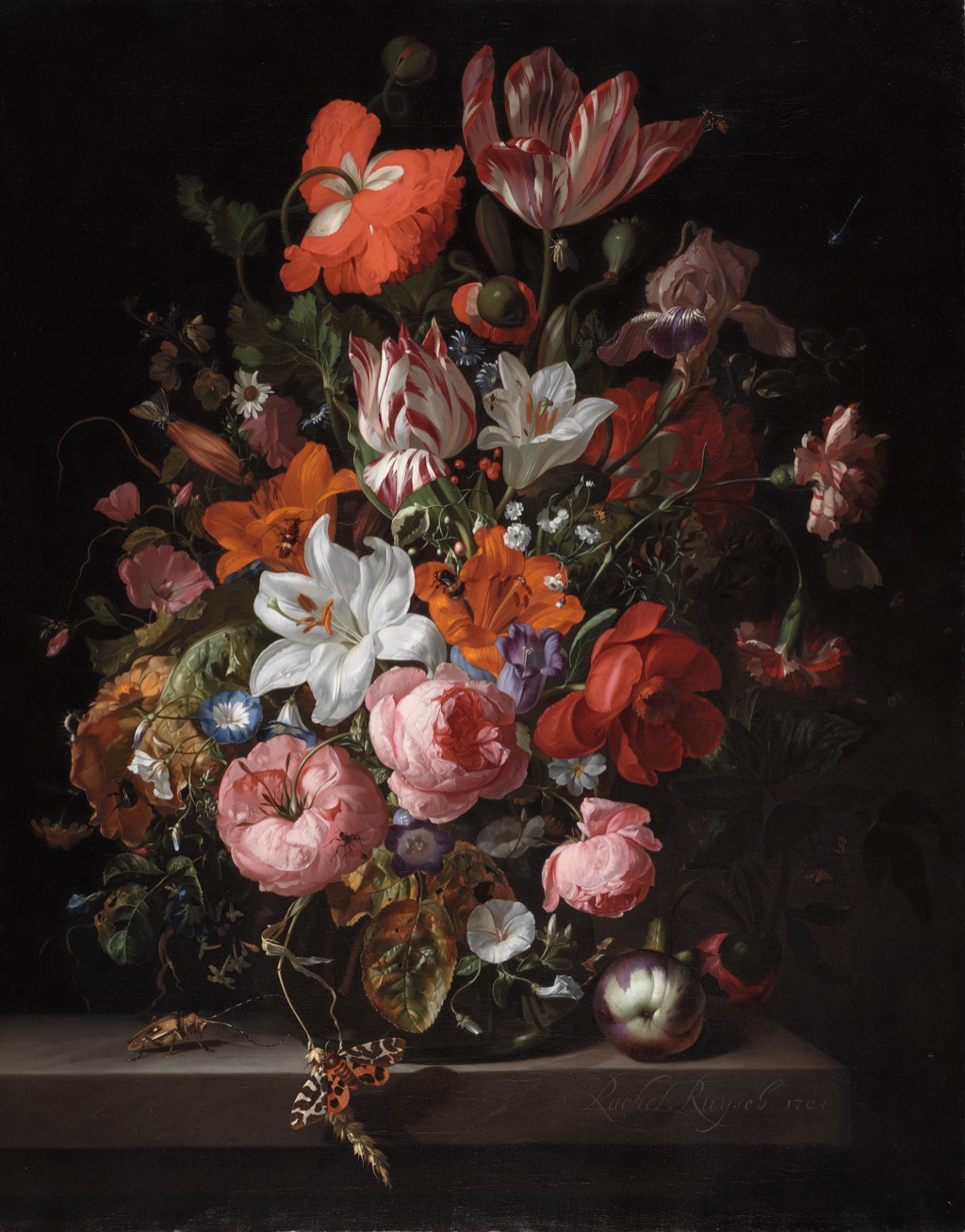
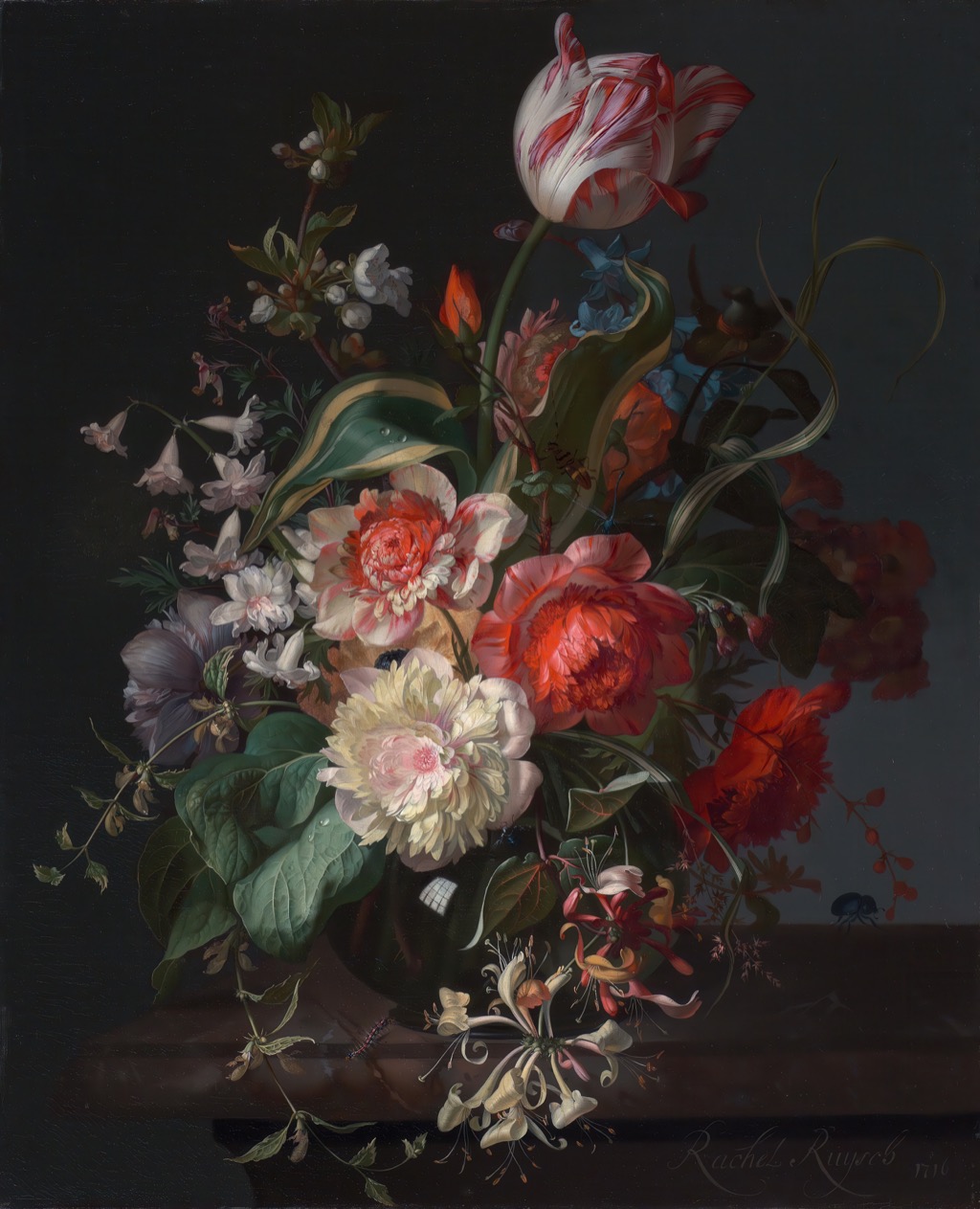
Her flower paintings often include plants that could not easily have bloomed together in one real arrangement. Museum records for other Ruysch works make this point clearly. The Rijksmuseum notes that the bouquet in her 1716 Still Life with Flowers on a Marble Tabletop includes more than ten species and would have been difficult to assemble in reality because the flowers bloom at different times.[5] The Detroit Institute of Arts makes a similar observation about its 1704 Flowers in a Glass Vase, where the flowers form an imagined arrangement rather than a same-season bouquet.[6]
The Munich painting belongs to that larger practice of invention. A flower still life by Ruysch is not simply a record of what stood in front of her. It is a durable arrangement made from observation, memory, studies, and artistic judgment. The painting holds nature still, but not passively. It edits, heightens, gathers, and stages.
The dark ground is part of this effect. Against darkness, pale flowers can flare forward while other forms recede. This creates depth without needing a complex setting. The bouquet becomes a lit event, a theatre of petals and leaves. Ruysch's skill lies in making that event feel both abundant and controlled.
The ledge or vessel also matters. Ruysch's bouquets are rarely just floating masses. They usually depend on some architectural or domestic anchor: a vase, a stone or marble ledge, a table edge, or a shadowed base. These supports place the natural world inside a cultivated setting. The viewer is not in a garden. The viewer is looking at nature collected, arranged, and made available for contemplation.
Natural Detail and Staged Presentation
The phrase "naturalistic rendering" can sound straightforward, but in Ruysch's work it is complicated. A petal may be painted with astonishing attention. A leaf may curl as if it has weight. An insect may be small enough to miss at first and precise enough to reward close inspection. Yet the whole arrangement is artificial, not because it is false, but because it has been composed.
This is where Ruysch differs from a merely decorative flower painter. She uses natural detail to build credibility, then uses staging to build meaning. The viewer believes in the flowers because their surfaces have been closely observed. The viewer remains engaged because the composition does more than display them. It creates movement, contrast, suspense, and hierarchy.
The recent Nature into Art exhibition made this point across the artist's career. At the Alte Pinakothek, the exhibition was organised around sections that included early work, the two Ruysch sisters, art and science, fame and fortune, and changing perspectives.[3] The "art, nature and science" section placed special emphasis on Ruysch's link to botanical and zoological research, including the role of her father Frederik Ruysch, whose natural-specimen collection was widely known.[3]
That context helps explain why her flowers carry such authority. Rachel Ruysch grew up close to a world of specimens, observation, medicine, botany, and collecting. The National Museum of Women in the Arts notes that her father helped teach her to observe and record nature with great accuracy, and that she was apprenticed at about fifteen to Willem van Aelst, a leading Dutch flower painter.[2] Her art emerged from these two forms of training: scientific attention and painterly discipline.
But Bouquet of Flowers is not scientific illustration. It is a courtly and collectible still life, made to be seen as art. The difference matters. Scientific illustration tends to isolate, clarify, and identify. Ruysch's painting gathers, overlaps, dazzles, and withholds. It lets a flower be recognisable while also becoming part of a larger design.
This is why the painting can feel modern to viewers today. It does not force us to choose between accuracy and imagination. It shows how observation can become invention. It asks a question that runs through much of Ruysch's work: what happens when nature is not merely copied, but arranged into a more intense form of attention?
Ruysch in 1715
The date 1715 is important. Ruysch was in her early fifties and had decades of artistic experience behind her. She had trained with Willem van Aelst, married the portrait painter Juriaen Pool, continued a long professional career, and established herself as one of the most admired still-life painters of her time.[2][7]
By then, she was also near the end of her formal period as court painter to Johann Wilhelm, Elector Palatine. NMWA states that she served in Dusseldorf from 1708 until the prince's death in 1716.[2] RKD Studies gives a more detailed account of the arrangement: Ruysch had a fixed salary, was not expected to work exclusively for the elector, and was allowed to complete work for him in her own Amsterdam workshop.[4] That last point is crucial. Her court role did not simply remove her from her Dutch artistic world. It extended her reach while allowing her to remain connected to Amsterdam.
The Pinakothek's Nature into Art exhibition describes the years beginning around 1700 as Ruysch's most successful and productive period.[3] In 1701 she became the first female member of the Confrerie Pictura in The Hague, and in 1708 she was appointed court painter in Dusseldorf.[3] The exhibition account links this phase to brilliant, colourful, deceptively realistic bouquets with fruit and insects that established her international reputation.[3]
Bouquet of Flowers belongs exactly there. It is not an early experiment, and it is not a late-career reduction. It is a mature work from a period in which Ruysch's floral still lifes were associated with elite demand, international circulation, and exceptional technical finish.
This context should deepen, rather than flatten, the painting. It would be too easy to treat the court appointment as the only interesting fact. The better reading is that the appointment helps explain the level at which the painting operated. A Ruysch bouquet could be a luxury object, a display of cultivated knowledge, an artistic performance, and a sign of status. Its beauty was not separate from its social life.
At the same time, the painting does not need biography to justify it. Even without knowing the court context, the viewer can sense the command of the work: the orchestration of colour, the dark ground, the staged naturalism, and the tiny details that ask the eye to keep moving.
Court Patronage and the Mannheim Route
The court and collection history of Bouquet of Flowers needs careful wording. The Pinakothek record states that the painting was acquired in 1799 from the Mannheim Gallery.[1] RKD Studies identifies a flower piece dated 1715, now in Munich and carrying Alte Pinakothek inventory number 878, in the context of Johann Wilhelm's private cabinet and its later movement to Mannheim.[4] That makes the painting especially valuable for understanding how Ruysch's work moved through German court collections.
RKD Studies explains that Johann Wilhelm built both a public gallery in Dusseldorf and an extensive private collection. After his death in 1716, his brother Karl Philipp inherited the collections and later took the private cabinet to Mannheim in 1730.[4] Drawings made in Mannheim in 1731 feature paintings by Rachel Ruysch, including a flower piece dated 1715 now in Munich.[4]
This does not mean every detail of the painting's first display can be stated with certainty. RKD is careful about the appearance of the Dusseldorf private rooms, noting that their exact look is uncertain.[4] But the broader route is meaningful: Dusseldorf, Mannheim, and Munich form a collection history through which Ruysch's court-period paintings entered the Bavarian holdings.
The court relationship itself was unusually flexible. According to RKD Studies, Ruysch worked for Johann Wilhelm while maintaining her Amsterdam workshop, was not bound exclusively to him, and visited Dusseldorf at least twice during the period.[4] This arrangement says a great deal about her status. She was valuable enough to serve a powerful patron without giving up her wider practice.
The relationship also appears to have had a personal dimension. RKD Studies notes that Ruysch and Juriaen Pool named their youngest son Jan Willem after the elector, and that the elector and Anna Maria Luisa de' Medici were apparently present at the child's baptism in Amsterdam in 1711.[4] Those details should not be turned into sentimental decoration, but they do show that patronage here was more than a distant purchase order.
For Bouquet of Flowers, this court context helps explain the painting's scale of ambition. A bouquet could carry international prestige. A still life could belong in a princely cabinet. Flowers, fruit, insects, and polished surfaces could speak to taste, rarity, knowledge, and power.
How It Compares with Other Ruysch Bouquets
Ruysch's flower paintings are best understood by comparing them carefully, not by blending them into one generalised floral style. The Munich Bouquet of Flowers is a 1715 court-period painting in the Alte Pinakothek.[1] It differs from her other major works by date, collection, scale, and historical setting.
The Mauritshuis Vase with Flowers of 1700 is especially concerned with a bouquet past its peak. The museum identifies wilting flowers, a tulip about to lose a petal, and a likely red opium poppy that has been cut off, opening a gap near the centre of the bouquet.[8] That painting turns decline into its central drama.
The Detroit Institute of Arts' Flowers in a Glass Vase of 1704 is larger and stresses the imagined abundance of a bouquet whose flowers do not bloom in the same season.[6] It is a strong comparison for the way Ruysch made artificial arrangements feel persuasive.
The Rijksmuseum's Still Life with Flowers on a Marble Tabletop of 1716 is smaller, measuring 48.5 x 39.5 cm, but dense with flowers and insects.[5] The museum emphasises that the bouquet contains more than ten species and could not easily have existed as a single real arrangement.[5] It is a close companion for understanding Ruysch's mature handling of compact abundance.
The National Gallery's Flowers in a Glass Vase with a Tulip, also dated 1716, is important for its Semper Augustus tulip and its account of Ruysch's late court-period style.[9] The National Gallery explains how Dutch flower painters worked from studies rather than waiting for each flower to bloom, and describes Ruysch's technique as moving from dark tones towards lighter colour and highlights.[9]
Compared with these works, the Munich Bouquet of Flowers stands out for its Bavarian court and collection route. Its value is not only visual, although the visual achievement is substantial. It also shows how Ruysch's bouquets could travel through systems of patronage, display, and collecting. It is a flower painting with a German afterlife built into its public identity.
That makes it an important stop after reading the broader pages on Rachel Ruysch flower paintings, Rachel Ruysch paintings, and Rachel Ruysch style and technique. It also belongs naturally with Rachel Ruysch court painter, where the Dusseldorf and Johann Wilhelm context can be followed in fuller detail.
Why the Painting Matters Now
Modern attention to Ruysch has changed the way her paintings are seen. For a long time, flower painting could be treated as decorative, minor, or merely pleasing. Ruysch makes that view difficult to sustain. Her bouquets are technical performances, intellectual constructions, luxury objects, and meditations on the living world.
The Nature into Art project has been central to this renewed attention. The Alte Pinakothek exhibition in Munich, followed by presentations at the Toledo Museum of Art and the Museum of Fine Arts, Boston, was presented as the first major monographic exhibition of Ruysch's work.[3] The MFA Boston exhibition brought together 35 paintings with plant and insect specimens and works by other women artists, including Anna Ruysch, Maria Sibylla Merian, and Alida Withoos.[10] That approach places Ruysch at the intersection of art, natural history, gender, collecting, and global exchange.
The Munich painting benefits from that frame. Bouquet of Flowers is not just a pretty vase of blooms. It is a work from an artist whose father moved through medical and botanical knowledge, whose training placed her inside elite still-life practice, whose career continued across marriage and motherhood, and whose paintings were desired by international patrons.[2][3][4]
It also asks contemporary viewers to think about what "nature" means in art. The bouquet looks natural because the details persuade us. It is artificial because the arrangement is staged. It is truthful because Ruysch understands flowers as living forms. It is fictional because the painting gathers them into an idealised and durable display. That tension is the point.
The painting's collection history adds another layer. The 1799 acquisition from the Mannheim Gallery, the RKD account of Johann Wilhelm's cabinet, and the present home in the Alte Pinakothek all show that Ruysch's art has long belonged beyond a single national story.[1][4] A Dutch flower painting became part of a German courtly and Bavarian museum history. The bouquet itself becomes a traveller.
That is why Bouquet of Flowers deserves its own close article. It gives readers a way to look closely at a single Ruysch painting while also understanding the wider forces around it: Amsterdam training, botanical observation, court patronage, international collecting, and the modern recovery of her ambition.
Frequently Asked Questions
Discussion
Ruysch's Bouquet of Flowers looks naturalistic and carefully staged at the same time. Does that tension make the painting feel more lifelike, more artificial, or more powerful because it is both?
Reader Insights
Compare the Munich Bouquet of Flowers with a Ruysch bouquet in another collection. Which difference stands out first: date, composition, mood, or collection history?
Look for places where darkness does visual work. How does the dark ground make certain flowers or details feel nearer?
Read the painting as a courtly object rather than a domestic bouquet. What changes when the flowers are imagined as part of an elite collection?
Join the Conversation
Share a thoughtful observation about Rachel Ruysch, the painting, or the wider still-life tradition that would help another reader look more carefully.
References
- Pinakothek / Bayerische Staatsgemaldesammlungen, Rachel Ruysch, Blumenstrauss, 1715, object record. https://www.sammlung.pinakothek.de/en/artwork/A9xlnQAGWv/rachel-ruysch/blumenstrauss
- National Museum of Women in the Arts, "Rachel Ruysch," artist profile. https://nmwa.org/art/artists/rachel-ruysch/
- Alte Pinakothek, "Rachel Ruysch: Nature into Art," exhibition page. https://www.pinakothek.de/en/exhibition/nature-into-art
- RKD Studies, "Court Paintings for Johann Wilhelm II, Elector Palatine (1708-1716)," in Masters of Mobility. https://masters-of-mobility.rkdstudies.nl/6-still-life-painter-rachel-ruysch-1664-1750-and-her-connections-to-germany/62-court-paintings-for-johann-wilhelm-ii-elector-palatine-1708-1716/
- Rijksmuseum, Rachel Ruysch, Still Life with Flowers on a Marble Tabletop, 1716, object page. https://www.rijksmuseum.nl/en/collection/object/---570d1419506e38cb3916f640fe5a2328
- Detroit Institute of Arts, Rachel Ruysch, Flowers in a Glass Vase, 1704, object page. https://dia.org/collection/flowers-glass-vase/66064
- Rijksmuseum, "Rachel Ruysch," artist page. https://www.rijksmuseum.nl/en/collection/node/Rachel-Ruysch--3eaff215275e2ebd47d02cfba2044cc8
- Mauritshuis, Rachel Ruysch, Vase with Flowers, 1700, object page. https://www.mauritshuis.nl/en/our-collection/artworks/151-vase-with-flowers
- National Gallery, London, Rachel Ruysch, Flowers in a Glass Vase with a Tulip, 1716, object page. https://www.nationalgallery.org.uk/paintings/rachel-ruysch-flowers-in-a-glass-vase-with-a-tulip
- Museum of Fine Arts, Boston, "Rachel Ruysch: Artist, Naturalist, and Pioneer," exhibition page. https://www.mfa.org/exhibition/rachel-ruysch-artist-naturalist-and-pioneer
- Robert Schindler, Bernd Ebert, and Anna C. Knaap, eds., Rachel Ruysch: Nature into Art. MFA Publications, 2024.
- Marianne Berardi, Science into Art: Rachel Ruysch's Early Development as a Still-Life Painter. Ph.D. diss., University of Pittsburgh, 1998.
- Marianne Berardi, Rachel Ruysch: The Hague 1664-1750 Amsterdam. Richard Green, 2012.
- Main image reference: Rachel Ruysch, Bouquet of Flowers, 1715. Public-domain image via Wikimedia Commons / Bayerische Staatsgemäldesammlungen. https://commons.wikimedia.org/wiki/File:Rachel_Ruysch_-_Bouquet_of_Flowers_-_1715_-_Pinakothek_878.jpg