Buy Art Prints Now
from Amazon
* As an Amazon Associate I earn from qualifying purchases.
Image reference [1]
 by Tom Gurney
Tom Gurney BSc (Hons) is an art history expert with over 20 years experience
Published on August 25, 2026 / Updated on September 6, 2026
Email: tomgurney1@gmail.com / Phone: +44 7429 011000
Rachel Ruysch Biography: Introduction
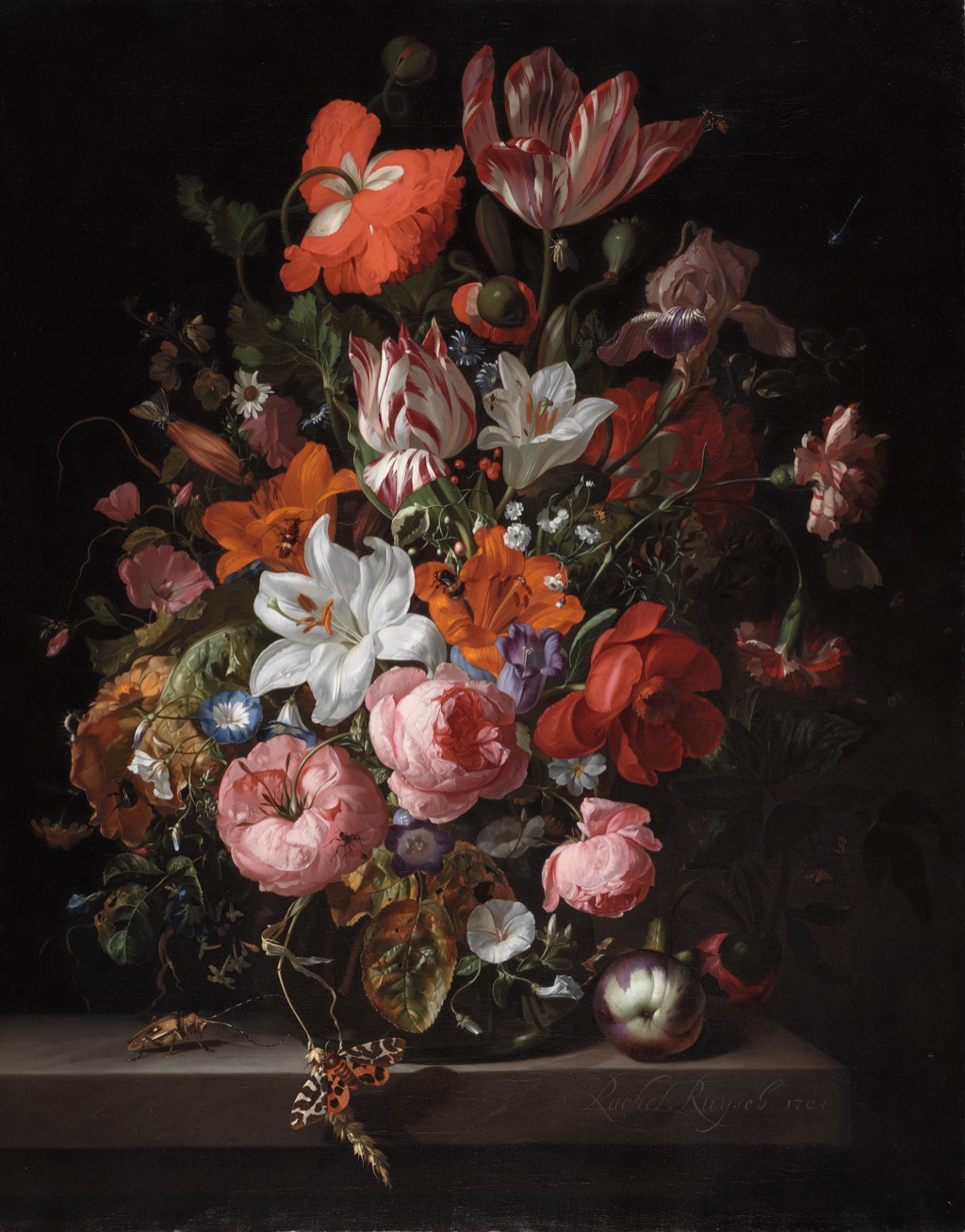
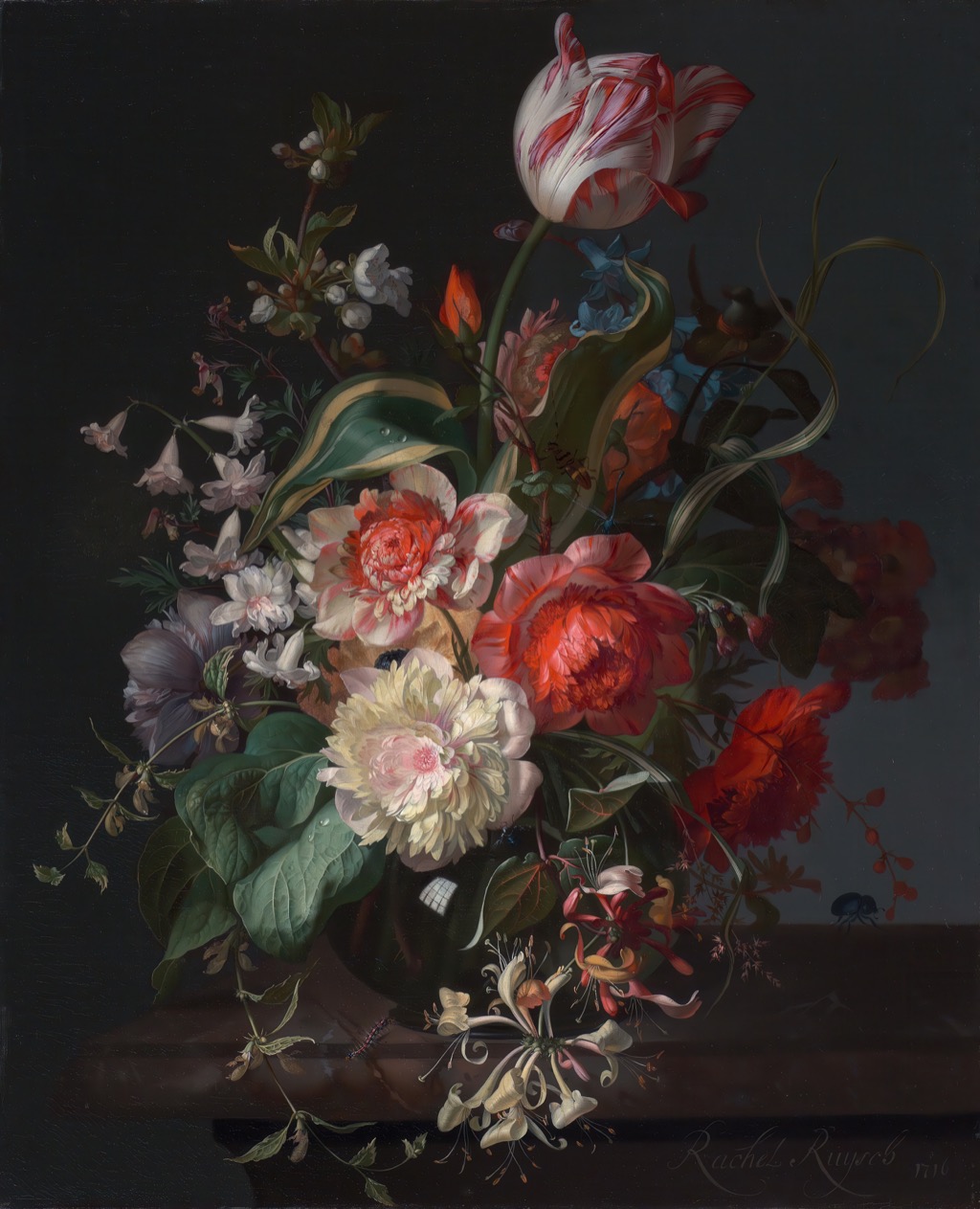
Rachel Ruysch built one of the longest and most admired careers in Dutch still-life painting. Born in The Hague in 1664 and raised in Amsterdam, she became famous for flower paintings that seem at first to be simple marvels of natural detail: roses, tulips, poppies, insects, drops of moisture, curling stems and fading petals arranged with brilliant precision. Look longer, and the paintings become something more complex. Ruysch was not merely copying bouquets from life. She was composing impossible gardens from observation, memory, preserved specimens and a sophisticated knowledge of nature.
Her biography crosses several worlds that usually appear separately in art history. She belonged to the culture of Dutch flower painting, trained with the still-life specialist Willem van Aelst, and developed a professional career with elite collectors. She also grew up in the household of Frederik Ruysch, the anatomist, botanist and collector whose Amsterdam cabinet of natural and anatomical specimens attracted visitors from across Europe. She married the painter Juriaen Pool, had a large family, joined the artists' society Pictura in The Hague, and worked as court painter to Johann Wilhelm, Elector Palatine, in Düsseldorf. By the time she died in Amsterdam on 12 August 1750, her reputation had already been shaped by collectors, poets and biographers as something exceptional.[1]
At a Glance
- Full nameRachel Ruysch
- BornThe Hague, 1664
- RaisedAmsterdam
- DiedAmsterdam, 12 August 1750
- Known forFlower still lifes, forest-floor still lifes, fruit and flower pictures
- TeacherWillem van Aelst
- SpouseJuriaen Pool, portrait painter
- Family contextDaughter of Frederik Ruysch, anatomist, botanist and collector
- Professional affiliationsPictura in The Hague; court painter to Johann Wilhelm in Düsseldorf
- Career spanFrom the late seventeenth century into the 1740s
Contents
- Introduction
- Early Life in The Hague and Amsterdam
- Frederik Ruysch and the Study of Nature
- Training with Willem van Aelst
- Marriage to Juriaen Pool and Professional Work
- Pictura and Public Recognition
- Court Painter to Johann Wilhelm
- Motherhood, Work and Reputation
- Late Career and Legacy
Early Life in The Hague and Amsterdam
Rachel Ruysch was born in The Hague in 1664, into a family with strong artistic, scientific and civic connections. Her maternal grandfather, Pieter Post, was an important architect, and her father, Frederik Ruysch, became one of the most famous anatomists and natural-history collectors in the Dutch Republic.[2] The family moved to Amsterdam while Rachel was young, and that city became the main setting of her artistic life.
Amsterdam mattered. It was a commercial capital, a publishing centre, a collecting city and a place where knowledge about distant plants, animals and luxury goods circulated with unusual intensity. For a painter of flowers and natural specimens, that environment offered more than subject matter. It offered a visual culture in which precision, rarity and display were highly valued.
Ruysch's early advantages should be described carefully. She was not a typical girl with easy access to professional training; the art world of the seventeenth-century Dutch Republic was still structured by family networks, workshops, guilds and expectations about gender. Yet she did grow up close to the kinds of materials that could make a still-life painter unusually alert: preserved plants, anatomical specimens, shells, insects, drawings, books and scientific conversations. Her later art cannot be reduced to her father's collection, but the household helped form the habits of looking that made her work distinctive.
The move from The Hague to Amsterdam also placed Ruysch near one of the greatest urban markets for still-life painting. Dutch collectors had long admired pictures of flowers, fruit, glass, silver, insects and other carefully rendered objects. By the time Ruysch entered the field, flower painting already had a rich history, from earlier specialists such as Ambrosius Bosschaert to the elegant still-life language of painters active in Amsterdam. Ruysch entered that tradition as a young woman, then reshaped it across an exceptionally long career.
Frederik Ruysch and the Study of Nature
Frederik Ruysch is often mentioned in his daughter's biography because his work helps explain the unusual scientific density around her art. He was a professor of anatomy and botany, associated with Amsterdam's medical and botanical culture, and became renowned for methods of preserving anatomical material. His collection included natural and anatomical specimens that could be studied, displayed and admired.[3]
For Rachel Ruysch, this environment offered a practical education in close observation. Sources do not need to turn her into a scientific assistant in order to recognize the importance of the setting. She learned to look at surfaces, textures, growth, decay, structure and variety. Her flower paintings often place fresh blossoms beside drooping petals, glistening drops, insects, curling leaves and dark cavities within the bouquet. These details are not incidental decoration. They make the flowers feel living, temporary and physically present.
The scientific context also helps explain why Ruysch's bouquets are not simply records of one vase placed before the painter. Museums regularly note that her paintings bring together flowers and small creatures that would not necessarily appear at the same place or season. The flowers may have been studied from life at different moments, copied from drawings, remembered from observation, or informed by preserved and cultivated specimens.[4] The result is not botanical illustration in the narrow sense. It is art built from botanical knowledge.
Frederik Ruysch's access to the Amsterdam Hortus Botanicus also matters for the wider story. The garden and related collections exposed Amsterdam artists and scholars to native and exotic plants. Rachel Ruysch's paintings repeatedly suggest that she knew how much viewers valued rarity. Yet her strongest works are not inventories of rare species. They are composed images in which detail serves rhythm, light and dramatic structure.
Training with Willem van Aelst
At about fifteen, Ruysch began training with Willem van Aelst, one of the leading still-life painters in Amsterdam.[5] Van Aelst was known for refined compositions, luxurious surfaces and a polished style that made flowers, fruit, glass and metal appear highly finished. For Ruysch, his studio offered professional discipline as well as a route into the market for still-life painting.
Her early work included forest-floor subjects: close views of plants, moss, insects, reptiles and small creatures near the ground. Mauritshuis material connects these early interests with Van Aelst's guidance and with Ruysch's own ability to render minute natural detail.[6] These pictures helped train the skills that would later animate her flower pieces. A bouquet by Ruysch is rarely still in the ordinary sense. Even when the vase is steady, the composition turns and breathes through small disturbances: a stem breaks the outline, a moth hovers, an insect crawls, a petal bends, a tendril arcs into the dark.
Van Aelst's influence can also be felt in Ruysch's taste for diagonals, recessive shadows and carefully staged abundance. But she did not simply inherit a formula. Her mature flower paintings often combine botanical specificity with a theatrical sense of emergence, as if the bouquet has grown out of darkness into a spotlight. The viewer sees individual petals and grains of pollen, yet also feels the composition as a whole: a tower, cascade, spiral or leaning mass of colour.
Ruysch's training is especially important because it places her inside a professional lineage. She was not an amateur who happened to paint flowers well. She was trained for the market, entered public artistic institutions, worked for powerful patrons and maintained a career for decades.
Marriage to Juriaen Pool and Professional Work
In 1693, Rachel Ruysch married Juriaen Pool, a portrait painter. Sources spell his first name in different forms, including Juriaen and Jurriaan; the same artist is meant. Their marriage joined two painters, though their reputations did not develop equally. Pool's name remains important in Ruysch's biography, but it is Rachel Ruysch's work that became internationally prized.
The marriage did not end her career. This point is often repeated because it was unusual enough to draw attention, but it should not be framed as a sentimental miracle. Ruysch continued to paint because she had training, patrons, skill, a market and a professional identity. She also lived in a household where art was part of family work. Her career after marriage included some of the paintings for which she is now best known.
The Metropolitan Museum of Art's portrait of Rachel Ruysch, painted in 1692 by Ruysch and Michiel van Musscher, offers a useful glimpse of that professional identity before her marriage.[7] Rather than presenting her only as a wife or mother, the portrait tradition around Ruysch helped shape her public image as an artist of consequence. Later family portraits connected her to Pool and their children, but the most striking feature of her reception is how firmly contemporaries identified her with her paintings.
Ruysch's domestic life and professional life are sometimes treated as competing stories. A better approach is to see them as intertwined without pretending that we can reconstruct every practical detail. She had a large family; many sources give the number of children as ten, while some modern exhibition material varies. Several children died young. These facts belong in her biography, but they should not crowd out the career itself. Ruysch's paintings were not footnotes to domestic endurance. They were the basis of her public standing.
Pictura and Public Recognition
In 1701, Ruysch became associated with the artists' society Pictura in The Hague, often described as the Confrerie Pictura. Mauritshuis identifies her as the first woman to be a member of that society.[8] The point is significant because it places Ruysch in a formal artistic community rather than only in a private household or studio.
Pictura had been founded after painters in The Hague separated from the older guild structure. It represented a public professional setting for artists, exhibitions and artistic exchange. For Ruysch, membership also fit a broader pattern: by the beginning of the eighteenth century she was producing large flower works for an international circle of patrons.[9]
The Mauritshuis provenance for her 1700 Vase with Flowers even notes a possible early connection between the painting and the Confrerie Pictura.[10] Whether or not every detail of that route can be pressed too hard, the painting itself demonstrates why Ruysch's work attracted attention. It is not a simple bouquet at full freshness. Flowers droop, petals loosen, and an empty space near the centre gives the composition depth. The painting's drama lies in the tension between abundance and decline.
That tension became one of Ruysch's strengths. She could paint flowers as if they were almost touchable, but she also understood that still life depends on time. A blossom is never just a blossom. It is a stage in a short life. Ruysch's art made that fact visible without turning every painting into a moral lesson.
Court Painter to Johann Wilhelm
Ruysch's international reputation reached one of its clearest forms in 1708, when she became court painter to Johann Wilhelm II, Elector Palatine, in Düsseldorf. RKD Studies describes this appointment as a strong sign of the appreciation of her work in Germany.[11] The arrangement was also unusually flexible. Ruysch received a fixed salary, but she was not required to work exclusively for Johann Wilhelm and could complete paintings for him in her own Amsterdam workshop.[12]
This flexibility matters. Court appointments often imply relocation and direct service, but Ruysch's case shows a different model of elite patronage. She served the Düsseldorf court while maintaining her Amsterdam base and wider clientele. During the period from 1708 until Johann Wilhelm's death in 1716, she visited Düsseldorf at least twice, while commissioned works traveled into German and Italian collections.[13]
The court connection also involved Juriaen Pool. Around the end of Johann Wilhelm's life, Pool received a commission for a family portrait including himself, Rachel Ruysch and their son Jan Willem. RKD Studies notes that Rachel is central in the composition, seated near a bouquet of flowers, while Pool directs attention toward one of her paintings.[14] The image makes visible what the documents also suggest: Ruysch's artistic identity was the family's strongest public asset.
Johann Wilhelm and his wife, Anna Maria Luisa de' Medici, belonged to a network of elite collectors. Some of Ruysch's works connected the Amsterdam studio to Düsseldorf, Munich and Florence. Paintings now associated with the Alte Pinakothek and Uffizi collections help show the international movement of her art.[15] Ruysch's career was therefore not only Dutch in location and training. It was European in patronage and reputation.
Motherhood, Work and Reputation
Ruysch's biography is often told through the remarkable fact that she continued painting while raising a large family. That fact deserves attention, but it also needs restraint. Older accounts sometimes treat her as a curiosity: a woman praised for producing paintings and children in the same breath. Modern readers can acknowledge the difficulty and rarity of her position without making motherhood the explanation for her art.
The more important point is that Ruysch sustained a public, professional career across changing life stages. She married, had children, worked for patrons, joined artistic institutions, served a court, and continued to paint into old age. NMWA notes that after her Düsseldorf period she kept producing fruit and flower pictures for prominent clients, and that her reputation endured even as fashion shifted.[16]
Her success was partly market-based. Ruysch's paintings commanded attention because collectors valued their finish, rarity and illusionism. They also belonged to a still-life tradition that appealed to viewers interested in luxury, nature and time. A costly flower painting could offer the pleasure of a garden that never wilted, while still reminding the viewer that real flowers do.
Her reputation was also literary. In 1750, the year of her death, a collection of poems about her paintings was published. The Toledo Museum of Art notes that the collection gathered fourteen poems written between 1685 and 1750, including works by several Dutch women poets.[17] Rijksmuseum and Mauritshuis both present the publication as an unusual honor. It should be treated as reception rather than as Ruysch's own voice, but it confirms that her contemporaries saw her paintings as worthy of public praise.
The gendered nature of that praise should not be ignored. Admiration for Ruysch often came wrapped in surprise that a woman could paint with such authority. A biography today can read past that surprise. Ruysch's importance does not depend on astonishment. It rests on the quality, ambition and duration of the work.
Late Career and Legacy
Ruysch's late career is one of the most impressive parts of her story. She continued painting into her eighties. NMWA highlights a canvas completed in 1747, when she was eighty-three, on which she inscribed her age.[18] Mauritshuis material similarly emphasises that she worked until very late in life.[19] These details matter because they show not only longevity, but professional continuity.
By the 1740s, the world in which Ruysch had begun painting had changed. The Dutch Republic's seventeenth-century art market was no longer the same, and flower painting itself had moved through different fashions. Yet Ruysch's art did not simply belong to one moment. Her paintings could satisfy older Dutch interests in natural detail and newer tastes for elegance, movement and refinement.
She died in Amsterdam on 12 August 1750. Some older or derivative references give conflicting dates, including a DBNL author entry that lists 12 October 1750, but modern museum and authority sources generally support 12 August.[20] For a public biography, 12 August 1750 is the clearest date to use.
Ruysch's legacy has grown in recent years because museums and scholars have returned to the relationship between art, science and women's professional labour in the early modern Netherlands. The 2024-2025 exhibition project Rachel Ruysch: Nature into Art, organised across Munich, Toledo and Boston, helped reposition her not as a marginal exception but as a major artist whose paintings bring together observation, invention and international patronage.[21]
Her biography is therefore not only the story of a gifted flower painter. It is the story of an artist who turned the study of nature into a public career. She worked within the Dutch still-life tradition, but her paintings also belong to the history of collecting, botany, court culture and women's artistic achievement. The flowers remain dazzling. The career behind them is just as remarkable.
Frequently Asked Questions
Discussion Prompt
Rachel Ruysch's paintings combine lifelike detail with bouquets that could not have existed as single natural arrangements. How does knowing that they were carefully invented change the way you look at them?
Discussion
Rachel Ruysch's paintings combine lifelike detail with bouquets that could not have existed as single natural arrangements. How does knowing that they were carefully invented change the way you look at them?
Reader Insights
Compare Ruysch's flower paintings with those of Willem van Aelst to see how she adapted a refined still-life language into something more dynamic and botanically charged.
Look at Ruysch alongside [Judith Leyster](/judith-leyster/) as two different examples of women's professional art-making in the Dutch Republic.
Trace one Ruysch painting through its collection history to understand how Dutch still lifes moved through court, museum and private collections.
Join the Conversation
Share a thoughtful observation about Rachel Ruysch, the painting, or the wider still-life tradition that would help another reader look more carefully.
References
- National Museum of Women in the Arts, "Rachel Ruysch," https://nmwa.org/art/artists/rachel-ruysch/; Mauritshuis, "Rachel Ruysch (1664-1750)," https://www.mauritshuis.nl/en/our-collection/our-masters/rachel-ruysch
- National Museum of Women in the Arts, "Rachel Ruysch," https://nmwa.org/art/artists/rachel-ruysch/
- Mauritshuis, "Rachel Ruysch (1664-1750)," https://www.mauritshuis.nl/en/our-collection/our-masters/rachel-ruysch; Mauritshuis, "Vase with Flowers," https://www.mauritshuis.nl/en/our-collection/artworks/151-vase-with-flowers
- Mauritshuis, "Rachel Ruysch (1664-1750)," https://www.mauritshuis.nl/en/our-collection/our-masters/rachel-ruysch; Detroit Institute of Arts, "Flowers in a Glass Vase," https://dia.org/collection/flowers-glass-vase/66064; Rijksmuseum, "Rachel Ruysch," https://www.rijksmuseum.nl/nl/stories/nederlandse-meesters/story/rachel-ruysch
- National Museum of Women in the Arts, "Rachel Ruysch," https://nmwa.org/art/artists/rachel-ruysch/; National Gallery, London, "Rachel Ruysch," https://www.nationalgallery.org.uk/artists/rachel-ruysch
- Mauritshuis, "Rachel Ruysch (1664-1750)," https://www.mauritshuis.nl/en/our-collection/our-masters/rachel-ruysch
- The Metropolitan Museum of Art, "Rachel Ruysch (1664-1750)," https://www.metmuseum.org/art/collection/search/875634
- Mauritshuis, "Rachel Ruysch (1664-1750)," https://www.mauritshuis.nl/en/our-collection/our-masters/rachel-ruysch
- National Museum of Women in the Arts, "Rachel Ruysch," https://nmwa.org/art/artists/rachel-ruysch/
- Mauritshuis, "Vase with Flowers," https://www.mauritshuis.nl/en/our-collection/artworks/151-vase-with-flowers
- RKD Studies, "Court Paintings for Johann Wilhelm II, Elector Palatine (1708-1716)," https://masters-of-mobility.rkdstudies.nl/6-still-life-painter-rachel-ruysch-1664-1750-and-her-connections-to-germany/62-court-paintings-for-johann-wilhelm-ii-elector-palatine-1708-1716/
- RKD Studies, "Court Paintings for Johann Wilhelm II, Elector Palatine (1708-1716)," https://masters-of-mobility.rkdstudies.nl/6-still-life-painter-rachel-ruysch-1664-1750-and-her-connections-to-germany/62-court-paintings-for-johann-wilhelm-ii-elector-palatine-1708-1716/
- RKD Studies, "Court Paintings for Johann Wilhelm II, Elector Palatine (1708-1716)," https://masters-of-mobility.rkdstudies.nl/6-still-life-painter-rachel-ruysch-1664-1750-and-her-connections-to-germany/62-court-paintings-for-johann-wilhelm-ii-elector-palatine-1708-1716/
- RKD Studies, "Court Paintings for Johann Wilhelm II, Elector Palatine (1708-1716)," https://masters-of-mobility.rkdstudies.nl/6-still-life-painter-rachel-ruysch-1664-1750-and-her-connections-to-germany/62-court-paintings-for-johann-wilhelm-ii-elector-palatine-1708-1716/
- Pinakothek, "Blumenstrauss," https://www.sammlung.pinakothek.de/en/artwork/A9xlnQAGWv; RKD Studies, "Court Paintings for Johann Wilhelm II, Elector Palatine (1708-1716)," https://masters-of-mobility.rkdstudies.nl/6-still-life-painter-rachel-ruysch-1664-1750-and-her-connections-to-germany/62-court-paintings-for-johann-wilhelm-ii-elector-palatine-1708-1716/
- National Museum of Women in the Arts, "Rachel Ruysch," https://nmwa.org/art/artists/rachel-ruysch/
- Toledo Museum of Art, "Art Minute: Rachel Ruysch, Flower Still Life," https://toledomuseum.org/collection/art-minute/art-minute-rachel-ruysch-flower-still-life; Rijksmuseum, "Rachel Ruysch," https://www.rijksmuseum.nl/nl/stories/nederlandse-meesters/story/rachel-ruysch
- National Museum of Women in the Arts, "Rachel Ruysch," https://nmwa.org/art/artists/rachel-ruysch/
- Mauritshuis, "Rachel Ruysch (1664-1750)," https://www.mauritshuis.nl/en/our-collection/our-masters/rachel-ruysch
- DBNL, "Rachel Ruysch - auteur," https://www.dbnl.org/auteurs/auteur.php?id=ruys012; Deutsche Biographie, "Ruysch, Rachel," https://www.deutsche-biographie.de/pnd124707777.html; Vlaamse Kunstcollectie, "Rachel Ruysch," https://vlaamsekunstcollectie.be/makers/rachel-ruysch
- Museum of Fine Arts, Boston, "Rachel Ruysch: Artist, Naturalist, and Pioneer," https://www.mfa.org/exhibition/rachel-ruysch-artist-naturalist-and-pioneer; Pinakothek, "Rachel Ruysch: Nature into Art," https://www.pinakothek.de/en/exhibition/nature-into-art; Robert Schindler, Bernd Ebert and Anna C. Knaap, eds., Rachel Ruysch: Nature into Art, Boston: MFA Publications, 2024.
- Main image reference: Rachel Ruysch and Michiel van Musscher, Rachel Ruysch in her studio, 1692. Public-domain image via Wikimedia Commons / The Metropolitan Museum of Art. https://commons.wikimedia.org/wiki/File:Rachel_Ruysch_and_Michiel_van_Musscher_-_Rachel_Ruysch_in_her_studio.jpg