Buy Art Prints Now
from Amazon
* As an Amazon Associate I earn from qualifying purchases.
Image reference [1]
 by Tom Gurney
Tom Gurney BSc (Hons) is an art history expert with over 20 years experience
Published on August 25, 2026 / Updated on September 6, 2026
Email: tomgurney1@gmail.com / Phone: +44 7429 011000
Rachel Ruysch as Court Painter to Johann Wilhelm in Düsseldorf: Introduction
Rachel Ruysch's appointment as court painter to Johann Wilhelm, Elector Palatine, is one of the clearest signs of how highly her flower paintings were valued during her lifetime. It was not a decorative honour added to an otherwise private career. It was a paid court relationship with one of Europe's major collectors, linking an Amsterdam still-life specialist to Düsseldorf, Florence, Mannheim and Munich.
The details matter because the phrase "court painter" can be misleading if it is imagined too literally. Ruysch did not simply leave Amsterdam and become a resident painter in Düsseldorf. According to RKD Studies, she was employed by Johann Wilhelm from 1708 until his death in 1716, had a fixed salary, was not required to work exclusively for him, and was allowed to complete paintings for the elector in her own Amsterdam workshop.[1] She visited Düsseldorf at least twice, but her career remained rooted in the Dutch Republic.
That arrangement makes her court role more interesting, not less. It shows a painter whose reputation travelled. Her pictures moved through elite collections, diplomatic gifts and princely galleries, while Ruysch herself continued to work within Amsterdam's artistic and scientific culture. Her service to Johann Wilhelm was a mark of status, but it also tells us how still-life painting could operate across borders in the early eighteenth century.
At a Glance
- Rachel Ruysch became court painter to Johann Wilhelm, Elector Palatine, in 1708.
- She worked for him until his death in 1716, a period of about eight years.
- RKD Studies records that she had a fixed salary, did not work exclusively for the elector and could paint for him from her Amsterdam workshop.
- She visited Düsseldorf at least twice, but the evidence does not support treating Düsseldorf as a full relocation.
- Six commissioned paintings connected with Johann Wilhelm's patronage survive, including works now associated with Munich, Augsburg and Florence.
- The court connection links Ruysch to the Düsseldorfer Galerie, the elector's private cabinet, the Medici court in Florence and the later Bavarian collections.
- Her court appointment reinforces her standing as one of the most successful Dutch still-life painters of her period.
Contents
- Introduction
- Why the Court Appointment Matters
- Johann Wilhelm and the Düsseldorf Setting
- A Court Painter with an Amsterdam Workshop
- The Paintings for Johann Wilhelm
- Düsseldorf, Mannheim and Munich
- Florence and the Medici Gift
- Court Patronage and Ruysch's Reputation
Why the Court Appointment Matters
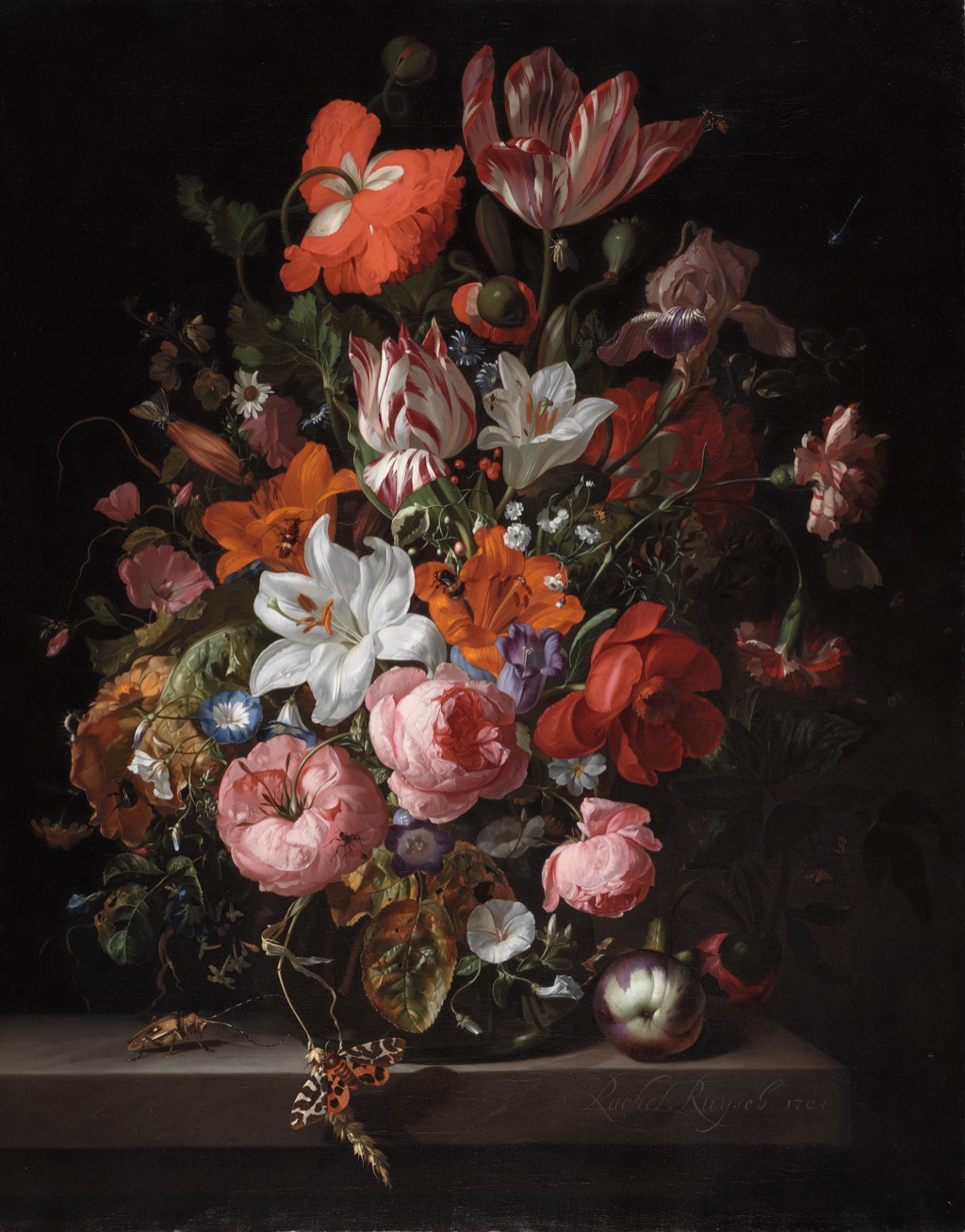
Ruysch is often introduced through flowers: roses, poppies, tulips, irises, insects, glass vases, dark grounds and impossible bouquets assembled from observation and invention. That is the right visual doorway into her art, but it can make her career sound smaller than it was. Her paintings were not only intimate displays of botanical skill. They were expensive, internationally admired works sought by elite collectors.
The court appointment gives that success a date and a patron. In 1708, Johann Wilhelm II, Elector Palatine, appointed Ruysch as court painter.[1] National Gallery and Mauritshuis both place this appointment within the larger arc of her career, after her training in Amsterdam and her association with The Hague's Confrerie Pictura.[2][3] The National Museum of Women in the Arts similarly presents the Düsseldorf role as a major sign of her international patronage.[4]
For modern readers, the appointment helps correct two common misunderstandings. First, still-life painting in the Dutch Republic was not merely a minor domestic genre. A flower painting by Ruysch could carry the value, difficulty and collector prestige of a luxury object. Second, Ruysch was not an artist whose reputation had to wait for modern recovery. She was admired and well paid in her own time, even though later art history has often treated women painters and still-life specialists as secondary to male history painters, portraitists and landscape painters.
Her court role also matters because it did not isolate her from the rest of her career. The same painter who worked for Johann Wilhelm also painted for other patrons, maintained a family and workshop life in Amsterdam, and continued producing flower and fruit pictures for decades. The court appointment was a high-status connection within a broader professional network.
Johann Wilhelm and the Düsseldorf Setting
Johann Wilhelm was a major collector as well as a political ruler. His court in Düsseldorf was tied to a larger culture of collecting, travel and display. RKD Studies notes that he had visited the Netherlands in 1695 and may have encountered Ruysch's world through Frederik Ruysch's celebrated anatomical museum or through The Hague's Confrerie Pictura, where Rachel Ruysch was a member.[1]
Those possible paths make sense. Frederik Ruysch, Rachel's father, was a famous anatomist, botanist and collector whose cabinet drew visitors from across Europe. Rachel Ruysch grew up close to that culture of scientific display and close looking. By the time Johann Wilhelm appointed her, she was not an unknown daughter of a learned father. She was a mature painter whose skill in flowers, insects and carefully staged natural forms had already made her a desirable artist for collectors.
Düsseldorf itself was becoming an important collection centre. Johann Wilhelm built the Düsseldorfer Galerie, a large gallery that displayed hundreds of paintings and opened to visitors in 1714.[1] RKD Studies describes it as the largest accessible gallery in the Holy Roman Empire at that time. It was not simply a private room of favourite pictures; it was a princely statement about taste, power and cultural ambition.
Still life had a place in that world. The 1778 catalogue and gallery illustrations discussed by RKD Studies show two still lifes by Ruysch displayed as pendants in the Düsseldorf gallery.[1] Their inclusion in such a setting is significant. Ruysch's flower and fruit pictures were not treated as background decoration. They belonged within a princely gallery that organised European painting by genre and prestige.
That setting also helps explain why the court appointment should be understood internationally. Düsseldorf was the first centre of the relationship, but Ruysch's paintings did not remain in a single palace context. Some moved through later Palatine and Bavarian collection histories; others were connected with Florence through Johann Wilhelm's Medici family ties. The court role gives one patron's name to a much wider movement of pictures.
A Court Painter with an Amsterdam Workshop
The safest way to describe Ruysch's court position is also the most revealing: she was a court painter who kept working from Amsterdam. RKD Studies is explicit that she had a fixed salary, was not expected to work only for Johann Wilhelm, and was allowed to complete the elector's paintings in her own workshop.[1] That was unusual enough to be worth stressing, but it should not be turned into a claim that she never travelled.
She did travel to Düsseldorf. RKD Studies cites the artist-biographer Jan van Gool for two trips to Germany, in 1710 and 1713.[1] Those visits matter, but they do not equal permanent residence. Mauritshuis also states that Johann Wilhelm did not make her move to Düsseldorf, allowing her to reside in Amsterdam while providing one painting a year.[3] The result was a flexible court relationship built around reputation, delivery and trust.
This matters for how we read her paintings. Ruysch's court works were not made in isolation from Amsterdam. They were produced by an artist formed by Amsterdam training, access to botanical culture, and the tradition of Dutch flower painting. Her father Frederik's world of anatomy, botany, preserved specimens and the Hortus Botanicus remained part of the intellectual setting around her art.[3] Her teacher Willem van Aelst had given her a specialist still-life language of polish, surface and dramatic arrangement.[2][4]
The court appointment did not replace that foundation. It exported it. Johann Wilhelm was paying for the excellence of an Amsterdam-based painter whose images could stand in a German princely collection alongside other prized European works.
The arrangement also complicates the idea of court art as a purely on-site service. Many court painters made portraits, decorations or dynastic imagery within a ruler's immediate environment. Ruysch's role was different. She supplied highly finished still lifes, apparently at a measured pace, to a collector who valued her specialised skill. A report by Zacharias Conrad von Uffenbach, who visited Ruysch and Juriaen Pool in Amsterdam in May 1711, records that she was expected to deliver one painting a year to the Elector Palatine in Düsseldorf.[1]
That rhythm fits what modern museum sources say about the demand for her work. The Pinakothek's Nature into Art exhibition text notes that Ruysch's still lifes were already sought-after and expensive during her lifetime, and that demand was great enough for her to produce only a few paintings a year.[5] Her court employment should therefore be seen as part of a carefully controlled professional output, not as the whole of her production.
The Paintings for Johann Wilhelm
RKD Studies identifies six surviving commissioned paintings connected with Johann Wilhelm's patronage: two counterparts and a flower piece now in the Alte Pinakothek in Munich, a large painting now in the Städtische Kunstsammlungen Augsburg, and two pendant paintings in the Uffizi in Florence.[1] It also cautions that they were not all commissioned for the same purpose and were not all created during the exact years of her court appointment.
That caution is important. A court role creates a relationship, but not every related picture has the same function. Some works entered the elector's Düsseldorf gallery. Some belonged to his private cabinet. Some were intended as gifts in a wider network of princely exchange. The safest reading is not "Ruysch made a uniform set for one room", but "Ruysch's court patronage produced several important works that moved through different elite collection contexts."
Two still lifes by Ruysch appeared in Johann Wilhelm's Düsseldorfer Galerie and are now in the Munich collections: a 1708 flower painting and a 1709 still life of fruit and animals at the foot of a tree before a grotto.[1] RKD Studies links the display history of these works to the gallery catalogues and later illustrations that recorded the arrangement of the Düsseldorf collection. Their pairing suggests that Ruysch's flower and fruit subjects could function together as elegant counterparts within a princely gallery.
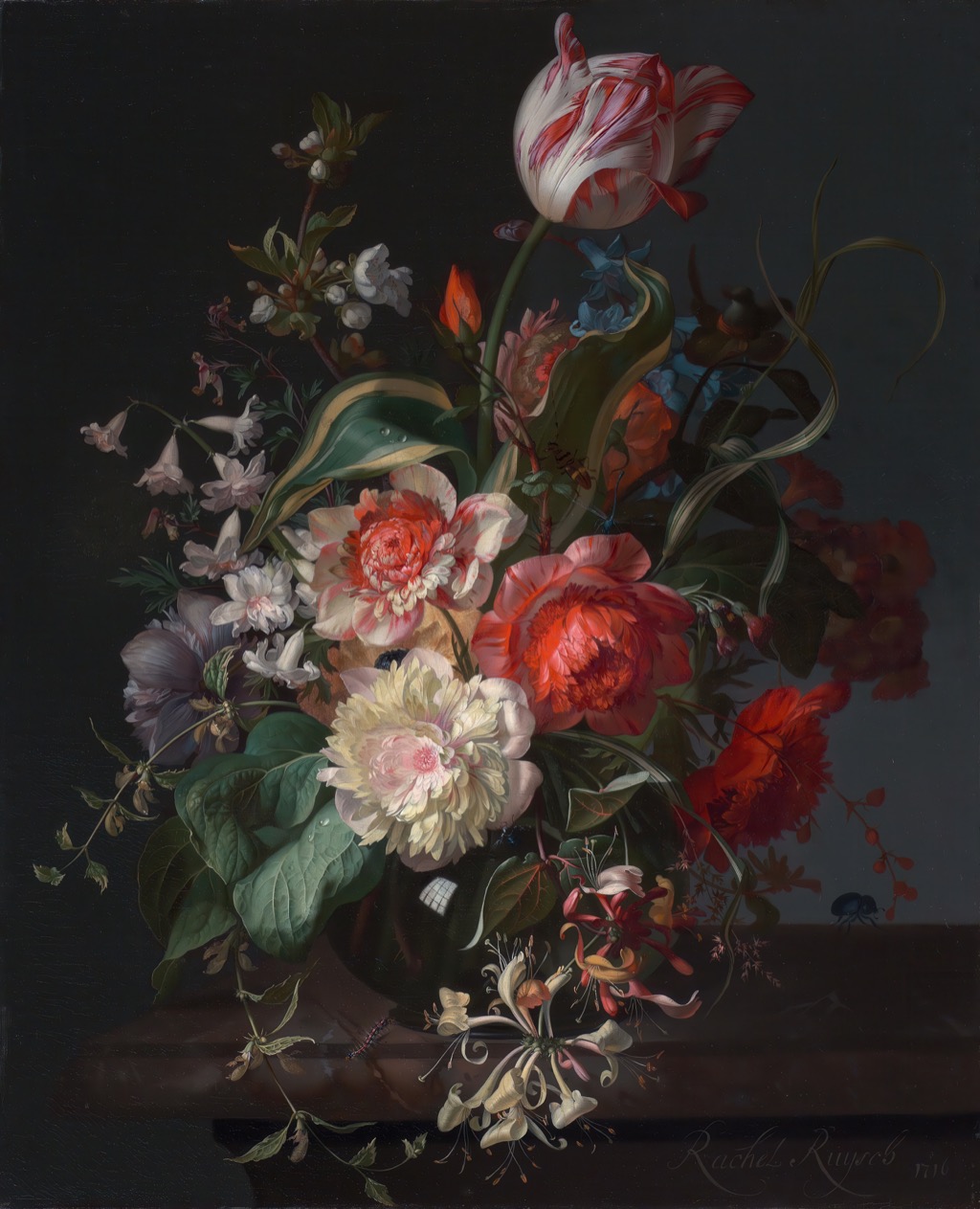
Another work, a flower piece dated 1715 and now in the Alte Pinakothek, belongs to the later part of the Johann Wilhelm connection.[1] The Pinakothek collection entry for Blumenstrauss gives the date as 1715, the support as canvas, the dimensions as about 75 by 60.3 cm, and the inventory number 878.[6] It also states that the painting was acquired in 1799 from the Mannheim Gallery, a detail that places the work on the path from Palatine collecting into the Bavarian State Painting Collections.[6]
The Pinakothek's short account of the 1715 Blumenstrauss connects Ruysch to the circle of fine painters active at Johann Wilhelm's Düsseldorf residence and describes the composition as joining naturalistic rendering with staged artifice.[6] That balance is essential to Ruysch. Her bouquets persuade the eye with precise petals, insects and leaves, but they are not simple copies of one arrangement placed before her. They are constructed images of abundance, designed for viewers who valued both natural knowledge and painterly invention.
The large 1714 painting now in Augsburg belonged to Johann Wilhelm's private collection context rather than the main gallery display.[1] RKD Studies notes that drawings made in Mannheim in 1731 show Ruysch paintings in the new display after the private cabinet had moved there. One drawing suggests that the large flower-and-fruit still life occupied a prominent place in Mannheim, which may reflect its status in Düsseldorf as well.[1]
Together, these works show the range of Ruysch's court production. Flower pieces, fruit-and-animal still lifes, pendants, gallery pictures and cabinet works all belonged to the same network of patronage. They also show how still life could move between intimacy and grandeur. A Ruysch painting rewards close looking, but it could also help a ruler shape the identity of a collection.
Düsseldorf, Mannheim and Munich
The court-painter story does not end in 1716. Johann Wilhelm's death changed the fate of his collections and gave Ruysch's paintings a longer German and Bavarian afterlife.
RKD Studies explains that the Düsseldorfer Galerie remained in place until 1806, when works were transferred to Bavaria, later entering the Alte Pinakothek in Munich in 1836.[1] The elector's private cabinet followed a different path. After Johann Wilhelm died, his younger brother Karl Philipp inherited both the gallery and the private collection. In 1730 he took the private cabinet to Mannheim, while the Düsseldorf gallery stayed behind.[1]
That history helps explain why Ruysch's paintings are now attached to several institutional locations. Munich's Alte Pinakothek and the wider Bayerische Staatsgemäldesammlungen hold major works connected with the Palatine and Bavarian collection histories. The 1715 Blumenstrauss in Munich, acquired from the Mannheim Gallery in 1799, is one part of that history.[6] The 1708 flower painting, now in the Bavarian State Painting Collections and associated with Bayreuth in the Pinakothek database, represents another work tied to the Düsseldorf gallery's later movement.[1][7]
For readers, the important point is not to memorise every transfer. It is to see that Ruysch's reputation travelled with collections. Her pictures were made by an Amsterdam painter, commissioned by a ruler in Düsseldorf, recorded in princely catalogues and displays, moved through Mannheim or Bavaria, and are now studied through museum and RKD records. Court patronage turned still-life painting into a mobile object of status.
The Bavarian collection path also gives modern viewers a practical way to understand the 2024-2025 Nature into Art exhibition at the Alte Pinakothek. Munich is not a random host for Ruysch. It is one of the places where her court-connected works and their collection histories remain especially important. The Pinakothek exhibition presented Ruysch between Amsterdam, Düsseldorf and Florence, with curators from Munich, Toledo and Boston bringing together art, science and patronage.[5]
That exhibition frame is useful because it resists reducing Ruysch to a single city or single identity. She was Dutch, Amsterdam-based and deeply connected to the flower-still-life tradition of the Netherlands. She was also part of a cross-border culture in which rulers, collectors, scientists and artists exchanged pictures, knowledge and prestige.
Florence and the Medici Gift
Johann Wilhelm's court connection also reached Florence. He was married to Anna Maria Luisa de' Medici, daughter of Cosimo III de' Medici, Grand Duke of Tuscany. RKD Studies records that when Zacharias Conrad von Uffenbach visited Ruysch and Juriaen Pool in Amsterdam in 1711, Ruysch was working on two panel paintings for Cosimo III.[1]
Those works were not simply part of her regular obligation to Johann Wilhelm. RKD Studies describes them as a special commission ordered by the elector as a present for his father-in-law.[1] The two landscape-format pendants, one with fruit, animals and insects on a mossy ground and the other with flowers in a wicker basket, remain in Florence at the Uffizi.[1]
This episode is especially revealing because it shows court patronage as relationship-making. A painting could be a gift, a diplomatic gesture, a collector's pleasure and a demonstration of taste. Johann Wilhelm and Cosimo III both owned major collections and exchanged works and ideas.[1] By commissioning Ruysch for a Medici gift, Johann Wilhelm used her flower and fruit still lifes as objects worthy of elite international exchange.
The Florence commission also shows why Ruysch's Amsterdam base matters. Von Uffenbach encountered the works in progress at the home of Ruysch and Pool in Amsterdam, not in Düsseldorf or Florence.[1] The paintings' destination was international, but their making belonged to her own working environment. That distinction helps keep the geography honest: Amsterdam was the centre from which her court and collector networks extended.
It also enriches the way we read her flowers. A basket of flowers or a forest-floor still life might seem apolitical compared with a royal portrait or battle scene. Yet in this context, still life carried prestige between courts. Ruysch's precision, rarity and invention made her work suitable for a ruler's gift to another ruler. The subject was flowers; the function could be dynastic courtesy and cultural display.
Court Patronage and Ruysch's Reputation
Ruysch's Düsseldorf appointment belongs beside other signs of her success. Rijksmuseum describes her as one of the most successful artists of her day.[8] Mauritshuis says she was famous both at home and abroad and sold to wealthy collectors and European royalty for high prices.[3] The Metropolitan Museum of Art, discussing the 1692 portrait made with Michiel van Musscher, emphasises the long career, royal patronage and high prices attached to her still lifes.[9]
The court role sharpens that picture. It shows that Ruysch's reputation was not confined to the Dutch art market. It also shows that still life could bring a woman painter into elite circuits usually described through male artists, dynastic portraiture or grand history painting. Her achievement was not that she escaped her genre. It was that she made the genre powerful.
Her family portrait with Juriaen Pool and their son Jan Willem adds one more layer. RKD Studies explains that Pool received a commission from Johann Wilhelm in or shortly before 1716 to paint a family portrait including himself, Ruysch and their youngest son, Jan Willem, who had been named after the elector.[1] In the portrait, Ruysch sits centrally near a bouquet, while Pool directs attention to one of her flower paintings on an easel. The work never reached Düsseldorf because news of Johann Wilhelm's death arrived as it was to be transported.[1]
That portrait is not simply a family document. It visualises the court relationship around Ruysch's professional identity. The child carries the elector's name and medal; the husband presents the painter's work; Ruysch sits near the flowers that made her famous. The image confirms what the documents already suggest: in this household, the court connection was built around Rachel Ruysch's art.
It is worth keeping the claim precise. Ruysch's appointment did not make her the only still-life painter of importance in Europe, nor does it mean she abandoned Amsterdam for Düsseldorf. It means that a leading Dutch flower painter secured a rare and flexible court position with one of the period's great collectors, and that her pictures entered a network of princely display and exchange.
That is why the court-painter story should sit near the centre of any account of Ruysch. Her flower paintings are beautiful, but beauty was only part of their power. They were learned, costly, mobile, admired and collectible. Johann Wilhelm's patronage makes that visible.
Frequently Asked Questions
Discussion Prompt
Ruysch's court appointment shows a flower painter working in the same elite collecting world as rulers, diplomats and princely galleries. Does knowing that change how you read her still lifes, or do the paintings already announce their own status through skill and invention?
Discussion
Ruysch's court appointment shows a flower painter working in the same elite collecting world as rulers, diplomats and princely galleries. Does knowing that change how you read her still lifes, or do the paintings already announce their own status through skill and invention?
Reader Insights
Follow the court story back to Ruysch's [biography](/rachel-ruysch/biography/) to see how Amsterdam training, family life and international patronage overlapped.
Compare the Düsseldorf-connected paintings with Ruysch's wider [flower paintings](/rachel-ruysch/flower-paintings/) to see how courtly prestige and close natural observation worked together.
Look next at [Bouquet of Flowers](/rachel-ruysch/bouquet-of-flowers/) for a Munich example that carries the Bavarian collection history into a single artwork.
Join the Conversation
Share a thoughtful observation about Rachel Ruysch, the painting, or the wider still-life tradition that would help another reader look more carefully.
References
- RKD Studies, "Court Paintings for Johann Wilhelm II, Elector Palatine (1708-1716)," in Masters of Mobility, https://masters-of-mobility.rkdstudies.nl/6-still-life-painter-rachel-ruysch-1664-1750-and-her-connections-to-germany/62-court-paintings-for-johann-wilhelm-ii-elector-palatine-1708-1716/
- National Gallery, London, "Rachel Ruysch (1664-1750)," https://www.nationalgallery.org.uk/artists/rachel-ruysch
- Mauritshuis, "Rachel Ruysch (1664-1750)," https://www.mauritshuis.nl/en/our-collection/our-masters/rachel-ruysch
- National Museum of Women in the Arts, "Rachel Ruysch," https://nmwa.org/art/artists/rachel-ruysch/
- Pinakothek, "Rachel Ruysch: Nature into Art," https://www.pinakothek.de/en/exhibition/nature-into-art
- Bayerische Staatsgemäldesammlungen, Alte Pinakothek, "Rachel Ruysch, Blumenstrauss, 1715," https://www.sammlung.pinakothek.de/en/artwork/A9xlnQAGWv/rachel-ruysch/blumenstrauss
- Bayerische Staatsgemäldesammlungen, "Rachel Ruysch, Blumenstrauss, 1708," https://www.sammlung.pinakothek.de/en/artwork/PdxzEXE4w5/rachel-ruysch/blumenstrauss
- Rijksmuseum, "Rachel Ruysch," https://www.rijksmuseum.nl/en/collection/node/Rachel-Ruysch--3eaff215275e2ebd47d02cfba2044cc8
- The Metropolitan Museum of Art, "Rachel Ruysch (1664-1750)," https://www.metmuseum.org/art/collection/search/875634
- Robert Schindler, Bernd Ebert and Anna C. Knaap, eds., Rachel Ruysch: Nature into Art, Boston: MFA Publications, 2024.
- Marianne Berardi, Science into Art: Rachel Ruysch's Early Development as a Still-Life Painter, Ph.D. diss., University of Pittsburgh, 1998.
- Marianne Berardi, Rachel Ruysch: The Hague 1664-1750 Amsterdam, Richard Green, 2012.
- Main image reference: Rachel Ruysch, Bouquet of Flowers, 1715. Public-domain image via Wikimedia Commons / Bayerische Staatsgemäldesammlungen. https://commons.wikimedia.org/wiki/File:Rachel_Ruysch_-_Bouquet_of_Flowers_-_1715_-_Pinakothek_878.jpg