Buy Art Prints Now
from Amazon
* As an Amazon Associate I earn from qualifying purchases.
Image reference [1]
 by Tom Gurney
Tom Gurney BSc (Hons) is an art history expert with over 20 years experience
Published on August 25, 2026 / Updated on September 6, 2026
Email: tomgurney1@gmail.com / Phone: +44 7429 011000
Rachel Ruysch Flower Paintings: Introduction
Rachel Ruysch's flower paintings look immediate at first: blossoms push forward from darkness, petals catch points of light, insects move through leaves, and glass vases seem to hold stems freshly cut from a garden. Look longer, however, and the paintings become more intellectually charged. These bouquets were not simple records of flowers placed before the artist. They were carefully composed inventions, assembled from study, memory, botanical knowledge, and the visual traditions of Dutch flower painting.
That tension is central to Ruysch's art. Her flowers feel alive, yet they often could not have bloomed together in a single season. Her details invite identification, yet the safest way to name them is usually through museum records rather than guesswork. Her bouquets are decorative, but not merely decorative. They belong to a world of collectors, natural-history cabinets, horticultural exchange, luxury objects, and close looking.
Ruysch (1664-1750) became one of the most admired flower still-life painters in Europe. She trained with Willem van Aelst, grew up in the household of the anatomist and botanist Frederik Ruysch, and built a career that reached from Amsterdam and The Hague to the court of Johann Wilhelm, Elector Palatine, in Düsseldorf.[1][2][3] Her flower paintings remain compelling because they join beauty and difficulty: abundance with decay, scientific attention with artistic invention, and intimate detail with public reputation.
At a Glance
- Rachel Ruysch specialized in flower still lifes, fruit pieces, and related nature subjects across a career of nearly seven decades.
- Her bouquets were often imagined arrangements, not literal bouquets painted from one vase at one moment.
- Museum records repeatedly note that her flowers could bloom in different seasons, making the arrangements deliberately impossible in real life.
- She used dark grounds, marble ledges, glass vases, diagonal movement, and carefully staged light to give depth and drama to small-scale flower paintings.
- Insects, dewdrops, damaged leaves, cut stems, and wilting blooms are not incidental decoration; they help animate the painted bouquet.
- Floral identifications should be handled cautiously. When specificity matters, rely on museum descriptions, such as roses, poppies, irises, carnations, bindweed, honeysuckle, pear blossom, lilies, peonies, and tulips where those are named by collection records.[4][5][6]
- Ruysch's botanical precision was supported by study, drawings, access to natural-history knowledge, and the scientific environment of her father's collections and the Amsterdam Hortus Botanicus.[7]
- Her flower paintings appealed to elite collectors because they combined rarity, virtuoso technique, learned natural observation, and refined decorative power.
Contents
- Introduction
- The Art of the Impossible Bouquet
- Dark Grounds, Glass Vases, and Marble Ledges
- How Ruysch Studied Flowers
- Insects, Dewdrops, and the Life Around the Bouquet
- Botanical Precision Without Over-Identification
- Courtly and Collector Appeal
- Ruysch and the Dutch Flower Still-Life Tradition
- Key Flower Paintings to Look At
The Art of the Impossible Bouquet
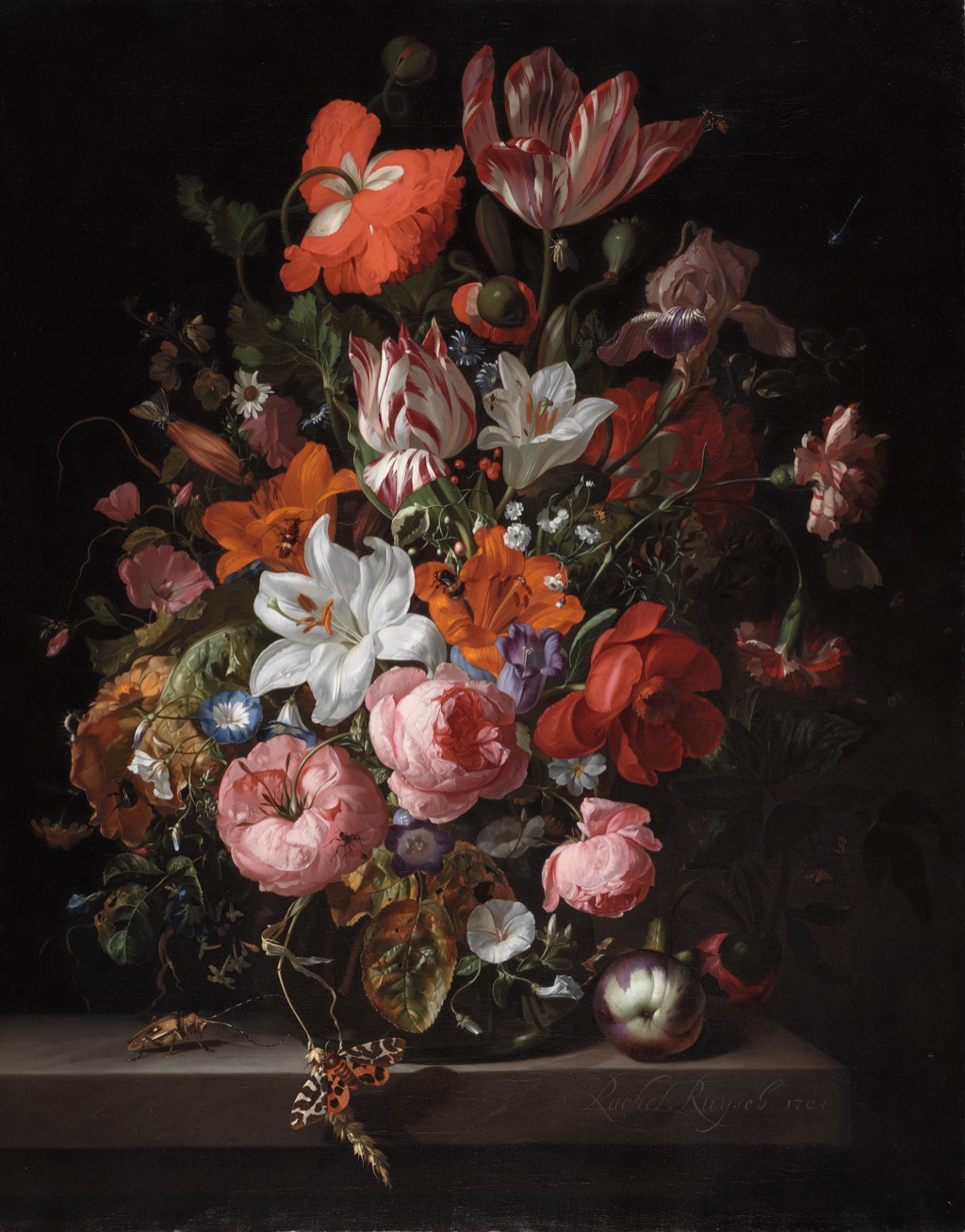
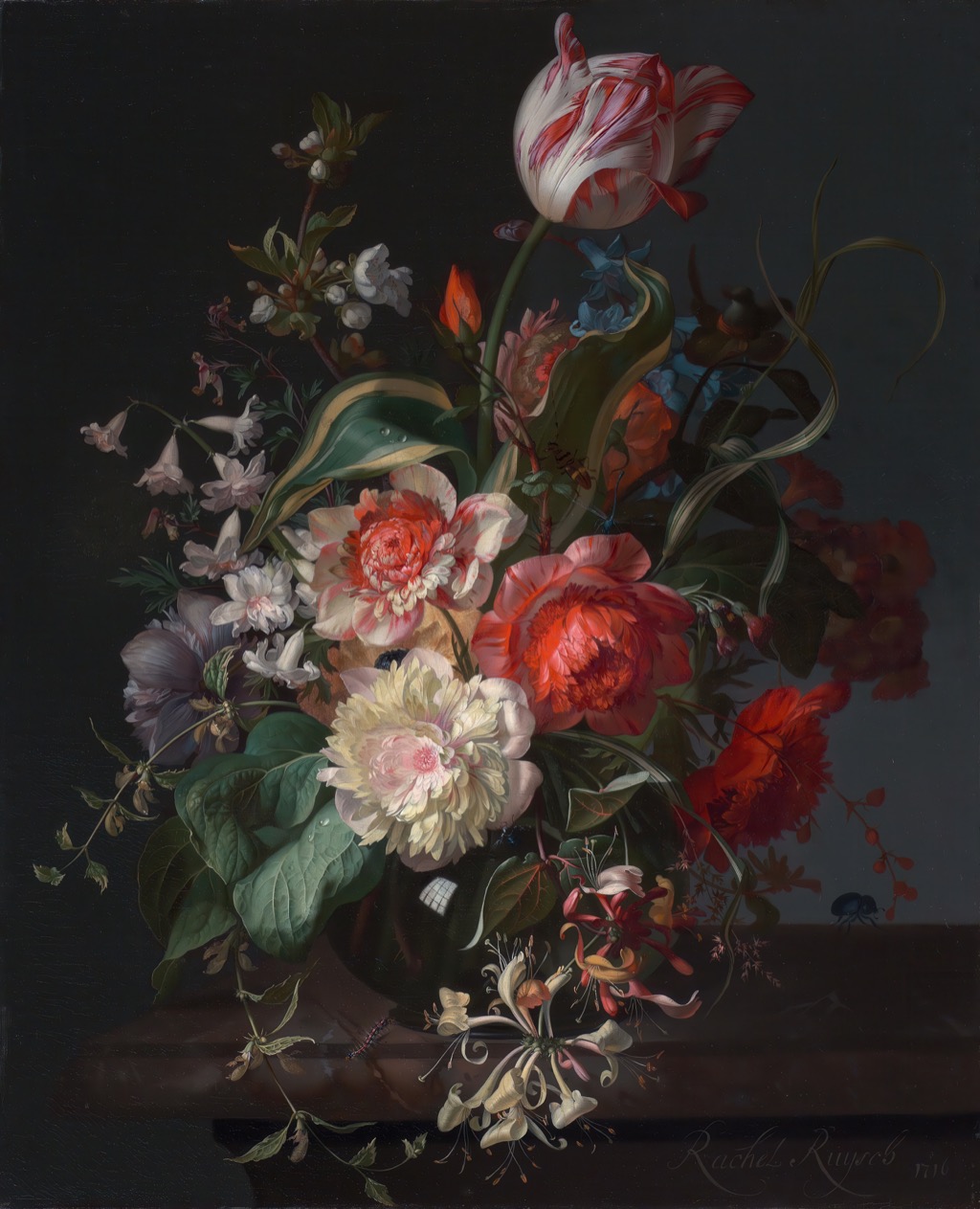
Many of Ruysch's most famous flower paintings are built around a paradox. They seem fresh, almost newly gathered, yet they present flowers that could not all have been available at the same time. The Rijksmuseum says this plainly of Still Life with Flowers on a Marble Tabletop of 1716: the bouquet includes more than ten species and would have been difficult to assemble in real life because the blossoms flower at different times.[4] The Detroit Institute of Arts makes a similar point about Flowers in a Glass Vase of 1704, noting that the selected flowers do not bloom in the same season and that the arrangement could only have existed in Ruysch's imagination.[6]
This does not make the paintings less naturalistic. It makes them more ambitious. Ruysch was not simply showing what happened to be on a table. She was composing an ideal bouquet, one that condensed rarity, beauty, seasonal change, and botanical variety into a single visual event. A Ruysch flower painting can feel like spring, summer, and autumn meeting under controlled light.
The effect depends on credibility. The flowers must be convincing individually before the viewer notices that the bouquet is impossible collectively. Ruysch's petals fold, droop, curl, and fray with such precision that the larger fiction becomes persuasive. Her paintings work because they ask the viewer to believe two things at once: that every part has been observed closely, and that the whole arrangement is an invention.
This is why the word "imagined" is more useful than "fantasy." Ruysch's bouquets are not arbitrary dreams. They are disciplined constructions made from accumulated knowledge. The National Gallery describes a process in which Dutch flower painters used collections of flower studies to fill preplanned compositions, rather than gradually adding each bloom when it came into season.[5] In Ruysch's case, this working method helps explain the extraordinary mixture of apparent immediacy and long preparation.
Her floral still lifes also reward attention to timing. A flower at full bloom may sit beside one that is fading. A cut stem may suggest recent intervention. A browning leaf or insect-chewed surface may interrupt the polished luxury of the bouquet. At the Mauritshuis, Vase with Flowers of 1700 is described as an unusually wilted arrangement, with drooping flowers, a conspicuous gap near the centre, and a stem that appears to have just been cut.[8] Ruysch's flower paintings are not just displays of abundance; they are dramas of timing.
Dark Grounds, Glass Vases, and Marble Ledges
Ruysch often sets her flowers against dark grounds. This darkness is not empty background. It gives the bouquet a stage. Pale blossoms flash forward; leaves vanish and reappear; stems are sorted into layers; insects emerge as discoveries rather than labels. The Toledo Museum of Art describes its Flower Still Life as a lush arrangement set against a dark background in the style of flower painting from the second half of the seventeenth century.[9] The National Gallery also notes that Ruysch retained the dark background associated with seventeenth-century Baroque flower painting in Flowers in a Glass Vase with a Tulip, even while her handling there moves toward a more delicate decorative style.[5]
The dark ground helps create depth. Ruysch's bouquets rarely sit flatly in front of the viewer. They turn, climb, lean, and open. Flowers of different sizes are staggered across the surface, often with a strong diagonal energy associated in the Rijksmuseum's account with the influence of Willem van Aelst.[7] A large bloom may anchor the lower area, while smaller flowers, curled stems, or a prized tulip lead the eye upward. The result is controlled asymmetry: nothing feels accidental, but nothing feels stiff.
Glass vases and marble ledges intensify the illusion. They introduce reflections, edges, and surfaces that test the painter's skill. A transparent vessel allows the viewer to see stems descending into water or shadow. A marble tabletop gives the bouquet a cool, polished support. In Still Life with Flowers on a Marble Tabletop, the Rijksmuseum records the support as oil on canvas and identifies the setting as a glass vase on a marble tabletop.[4] The ledge also creates a border between the viewer's space and the painted world. When an insect crawls along it or a leaf overlaps it, the painting seems to break its own boundary.
Ruysch's lighting is selective. It does not illuminate everything equally. The Mauritshuis account of Vase with Flowers emphasises how bright white roses and calendula at the bottom contrast with flowers above that recede into partial shade.[8] This makes the bouquet feel spatially complex. Light is not only a way to show colour; it is a way to organise attention.
Darkness also suits the intellectual mood of the paintings. These are luxury objects, but they are full of fragile life. A blossom may be dazzling because it is temporary. A dewdrop may sparkle because it will vanish. Ruysch's dark backgrounds give that temporary brightness a setting intense enough to hold it.
How Ruysch Studied Flowers
Ruysch's flower paintings are often discussed through the meeting of art and science, and for good reason. Her father, Frederik Ruysch, was a professor of anatomy and botany in Amsterdam, associated with the Hortus Botanicus and known for collections of anatomical, botanical, and zoological specimens.[7][8] The Rijksmuseum notes that Rachel Ruysch studied flora and fauna in her father's collection, visited the Amsterdam Hortus Botanicus, consulted botanical books and prints, and recorded observations in drawings that served as studies for her paintings.[7]
That environment matters, but it should not reduce her art to family biography. Ruysch's flower paintings are not scientific illustrations disguised as still lifes. They are paintings designed for collectors and viewers, full of compositional wit and pictorial theater. Her botanical knowledge gave her a richer vocabulary. Her artistic judgment determined what to do with it.
Training also mattered. NMWA states that Ruysch was apprenticed at fifteen to Willem van Aelst, a prominent Dutch flower painter.[3] The National Gallery identifies Van Aelst as her teacher from 1679.[2] The Rijksmuseum connects Van Aelst's influence especially with her diagonal compositions and varied arrangements of flowers in different sizes.[7] Through this training, Ruysch entered a specialist tradition that prized finish, refinement, and convincing surfaces.
The flower-study process explains why her paintings can be both exact and seasonally impossible. A painter with a stock of studies could design a bouquet before painting it, choosing blooms for colour, shape, rarity, symbolic association, or compositional balance. The National Gallery's account of Flowers in a Glass Vase with a Tulip describes a staged method: sketching flower and leaf shapes onto the prepared surface, painting the background around those reserves, building the flowers in layers from darker tones to lighter ones, and adding final highlights.[5]
This kind of process helps viewers understand the patience behind the dazzle. Ruysch's flowers appear spontaneous because the final surface is so alive. Underneath that life is planning. The bouquet has been thought through before it blooms on the canvas.
Insects, Dewdrops, and the Life Around the Bouquet
Ruysch's flower paintings are crowded with small lives. Insects crawl over leaves, hover near scent, or settle at the edge of a ledge. Dewdrops cling to petals. Leaves brown, curl, or show holes. These details make the bouquet more than an arrangement of cut flowers. They turn it into a small ecosystem.
The Rijksmuseum says Still Life with Flowers on a Marble Tabletop "teems with insects" and records insects as one of the work's subjects.[4] The Detroit Institute of Arts notes glistening dewdrops on petals and hovering insects in Flowers in a Glass Vase.[6] The National Gallery describes hidden winged creatures, flies, beetles, a damsel fly, a caterpillar, a reflected high window in the glass vase, and sparkling drops of water.[5] Toledo's Flower Still Life includes caterpillars on a flower stem and browning leaves riddled with holes made by insects.[9]
These motifs have several effects at once. First, they sharpen realism. A painted insect is a tiny test of observation, proportion, and finish. Second, they animate the still life. The flowers have been cut, but the painting is not still in the ordinary sense. Life moves through it. Third, they complicate beauty. Insect damage, wilting, and browning remind the viewer that natural abundance includes consumption and decay.
It is tempting to flatten all of this into a single moral message about transience. Some flower paintings of the period do invite vanitas readings, and Ruysch certainly includes signs of fragility. But the best response is more flexible. Her details can suggest fading beauty without making every bloom a sermon. The Toledo label says the damaged leaves and insects suggest fragility and allude to beauty fading and mortality.[9] That is a useful reading, especially because it stays close to the visible evidence.
The smallest elements also slow the viewer down. Ruysch's paintings are not absorbed in one glance. They ask for inspection: a beetle here, a droplet there, a torn leaf, a stem disappearing into shadow, a butterfly or fly almost hidden in the dark. This kind of looking connects her work to collectors' habits as much as to devotional or moral habits. A Ruysch painting rewards the owner or visitor who returns to it repeatedly.
Botanical Precision Without Over-Identification
Ruysch's paintings invite botanical naming, but they also require restraint. Museum records identify certain flowers in specific works, and those identifications are the safest guide. The Rijksmuseum description of Still Life with Flowers on a Marble Tabletop names roses, poppies, irises, carnations, and bindweed among the bouquet.[4] The National Gallery identifies roses, honeysuckle, pear blossom, and the Semper Augustus striped tulip in Flowers in a Glass Vase with a Tulip.[5] The Detroit Institute of Arts names white and orange lilies, peonies, cabbage roses, and striated tulips in Flowers in a Glass Vase.[6] The Mauritshuis describes a blue iris, a tulip, white roses, calendula, and a likely red opium poppy in Vase with Flowers.[8]
Beyond such source-backed names, caution is part of good looking. A painted flower may resemble a familiar species, but resemblance is not proof. Varieties have changed, historic names do not always map neatly onto modern taxonomy, and museum labels may use accessible common names rather than scientific classifications. Ruysch's own art also complicates identification because she may combine observed details, stored studies, exotic plants, and decorative invention.
That said, botanical precision is unmistakably central to her appeal. NMWA emphasises that her attention to detail could extend to individual grains of pollen.[3] The Rijksmuseum describes her floral still lifes as lifelike and notes roses, poppies, carnations, and irises as almost indistinguishable from real flowers.[1] The modern Nature into Art exhibition framing goes further, placing her work among plant and insect specimens and emphasising her role in bringing new species, including passionflowers and cacti, into flower still lifes as global trade expanded the range of plants cultivated in Dutch gardens and greenhouses.[10]
The important point is not that every flower can be named by the casual viewer. It is that Ruysch created paintings in which naming feels possible. The viewer senses that the natural world has been studied, sorted, and recomposed with exceptional care.
Courtly and Collector Appeal
Ruysch's flower paintings appealed to a highly cultivated audience. They were beautiful objects, but beauty alone does not explain their prestige. They displayed technical virtuosity, knowledge of rare plants and insects, control of illusion, and the ability to transform the temporary into something durable.
The Rijksmuseum's Dutch account describes Ruysch's flower still lifes as sought-after collector's objects, ranging from large sumptuous bouquets to small elegant posies.[7] The same account links her success to carefully judged colour, refined technique, and faithful rendering of detail.[7] NMWA notes that in 1701 she joined the painters' guild in The Hague and began producing large flower works for an international circle of patrons.[3] The Mauritshuis calls her one of the most successful Dutch still-life painters of the seventeenth and eighteenth centuries and notes that she was famous both at home and abroad.[8]
Her court appointment strengthened that reputation. From 1708 until 1716, she served as court painter to Johann Wilhelm, Elector Palatine, while continuing to work from Amsterdam.[2][3] RKD Studies describes the arrangement as unusual: Ruysch had a fixed salary, was not expected to work exclusively for the elector, and could complete work for him in her own Amsterdam workshop.[11] That arrangement suggests both demand and status. A flower painter did not need to be physically present at court to serve courtly taste.
Why would elite collectors prize these works? Partly because a Ruysch bouquet compressed forms of possession that mattered in the period: rare flowers, global horticulture, refined craft, natural knowledge, and painterly brilliance. A collector could not keep all seasons in bloom, but a painting could offer the illusion of doing so. A real bouquet wilted; a painted bouquet displayed control over time.
This does not make Ruysch's art cold or merely acquisitive. Her paintings are sensuous. Their pleasures are immediate: colour, texture, sparkle, shadow, and the small thrill of discovery. But those pleasures were embedded in a culture that valued rarity, expertise, and cultivated attention. A Ruysch painting was something to enjoy, inspect, discuss, and own.
Ruysch and the Dutch Flower Still-Life Tradition
Ruysch belongs to the Dutch flower still-life tradition, but she should not be treated as a footnote to it. She trained inside a specialist field shaped by earlier painters and market expectations, then developed a recognizable approach of her own.
The National Gallery places her in relation to Dutch flower painters of her time and compares the dark Baroque background of her 1716 Flowers in a Glass Vase with a Tulip with Jan van Huysum's later use of a lighter backdrop.[5] The Rijksmuseum emphasises Van Aelst's influence on her diagonal composition and varied arrangement.[7] The National Gallery's artist page also notes the influence of Otto Marseus van Schrieck on her early work, especially dark forest flora with insects and lizards.[2] These comparisons help position her without reducing her to imitation.
In earlier Dutch flower still lifes, painters often presented carefully ordered bouquets in vases or niches, with individual blooms offered for close inspection. Ruysch inherited that concern for rarity and finish, but her mature works often feel more mobile. Stems arc and twist. Flowers spill outward. Insects create small points of disturbance. Even when the bouquet is staged, it resists perfect symmetry.
Her career also runs across changing tastes. The National Gallery sees Flowers in a Glass Vase with a Tulip as retaining a seventeenth-century dark ground while moving toward a more delicate decorative style beginning to spread across Europe.[5] The Rijksmuseum likewise notes that Ruysch responded to changing taste in later work, with more evenly lit flowers and lighter backgrounds.[7] This ability to adapt helps explain her unusually long success.
For readers exploring Dutch artists or Baroque artists, Ruysch offers a crucial reminder: Dutch Golden Age painting was not only portraiture, genre scenes, landscapes, or the familiar names of Rembrandt, Vermeer, and Frans Hals. Still life could be a field of innovation, ambition, and international reputation. Ruysch's flower paintings show that a vase of blooms could carry as much artistic intelligence as a human figure.
Key Flower Paintings to Look At
Still Life with Flowers on a Marble Tabletop (1716, Rijksmuseum) is one of the clearest works for understanding Ruysch's impossible bouquets. The Rijksmuseum identifies more than ten species, insects, and a seasonally implausible arrangement made credible through her study of live and prepared flowers.[4] The painting is also compact: at 48.5 by 39.5 cm, it demonstrates how much visual density Ruysch could compress into a relatively small canvas.
Flowers in a Glass Vase with a Tulip (1716, National Gallery, London) is especially useful for studying technique and style. The National Gallery identifies roses, honeysuckle, pear blossom, and the Semper Augustus striped tulip, while also explaining the dark ground, insect details, reflected window, water drops, and likely working method.[5] The painting shows Ruysch in the final year of her Düsseldorf court appointment, balancing Baroque darkness with a lighter, more decorative touch.
Vase with Flowers (1700, Mauritshuis) is a remarkable example of Ruysch's interest in flowers past their peak. The Mauritshuis points to drooping blooms, a cut-off poppy, a central gap that deepens the bouquet, and strong effects of light and texture.[8] It is a flower painting about display, but also about interruption.
Flowers in a Glass Vase (1704, Detroit Institute of Arts) makes the imagined nature of Ruysch's bouquets easy to grasp. The DIA identifies lilies, peonies, cabbage roses, and striated tulips, notes dewdrops and insects, and stresses that the selected flowers do not bloom at the same time.[6]
Flower Still Life (about 1716-1720, Toledo Museum of Art) emphasises the darker side of abundance. Toledo highlights flowers that would not bloom together, caterpillars, insect-damaged leaves, and the fragility of beauty.[9] It is an excellent painting for readers who want to see how Ruysch's detail can move from delight to unease without losing elegance.
Together, these works show why Ruysch's flower paintings are not interchangeable bouquets. Some are dense and sparkling; some are grander and more courtly; some stress freshness; others dwell on wilting, cutting, or decay. Across them, the constant is her ability to make an invented arrangement feel alive.
Frequently Asked Questions
Discussion Prompt
Ruysch's flower paintings are both intensely naturalistic and deliberately artificial. When you look at one of her impossible bouquets, do you experience it first as a convincing piece of nature, a display of artistic skill, a meditation on time, or a luxury object made for collectors?
Discussion
Ruysch's flower paintings are both intensely naturalistic and deliberately artificial. When you look at one of her impossible bouquets, do you experience it first as a convincing piece of nature, a display of artistic skill, a meditation on time, or a luxury object made for collectors?
Reader Insights
Compare Ruysch's use of dark backgrounds with a lighter eighteenth-century flower still life and ask how the change affects mood, depth, and the sense of luxury.
Choose one Ruysch bouquet and list only the flowers that a museum source identifies; then note how many visual details remain powerful without exact botanical names.
Track the insects and damaged leaves in a single painting and consider whether they make the bouquet feel more alive, more fragile, or both.
Join the Conversation
Share a thoughtful observation about Rachel Ruysch, the painting, or the wider still-life tradition that would help another reader look more carefully.
References
- Rijksmuseum, "Rachel Ruysch," artist page. https://www.rijksmuseum.nl/en/collection/node/Rachel-Ruysch--3eaff215275e2ebd47d02cfba2044cc8
- National Gallery, London, "Rachel Ruysch," artist page. https://www.nationalgallery.org.uk/artists/rachel-ruysch
- National Museum of Women in the Arts, "Rachel Ruysch," artist profile. https://nmwa.org/art/artists/rachel-ruysch/
- Rijksmuseum, Rachel Ruysch, Still Life with Flowers on a Marble Tabletop, 1716, object page. https://www.rijksmuseum.nl/en/collection/object/---570d1419506e38cb3916f640fe5a2328
- National Gallery, London, Rachel Ruysch, Flowers in a Glass Vase with a Tulip, 1716, object page. https://www.nationalgallery.org.uk/paintings/rachel-ruysch-flowers-in-a-glass-vase-with-a-tulip
- Detroit Institute of Arts, Rachel Ruysch, Flowers in a Glass Vase, 1704, object page. https://dia.org/collection/flowers-glass-vase/66064
- Rijksmuseum, "Rachel Ruysch," Nederlandse meesters story. https://www.rijksmuseum.nl/nl/stories/nederlandse-meesters/story/rachel-ruysch
- Mauritshuis, Rachel Ruysch, Vase with Flowers, 1700, object page. https://www.mauritshuis.nl/en/our-collection/artworks/151-vase-with-flowers
- Toledo Museum of Art, Rachel Ruysch, Flower Still Life, about 1716-1720, object page. https://emuseum.toledomuseum.org/objects/54880/flower-still-life
- Museum of Fine Arts, Boston, "Rachel Ruysch: Artist, Naturalist, and Pioneer," exhibition page. https://www.mfa.org/exhibition/rachel-ruysch-artist-naturalist-and-pioneer
- RKD Studies, "Court Paintings for Johann Wilhelm II, Elector Palatine (1708-1716)," in Masters of Mobility. https://masters-of-mobility.rkdstudies.nl/6-still-life-painter-rachel-ruysch-1664-1750-and-her-connections-to-germany/62-court-paintings-for-johann-wilhelm-ii-elector-palatine-1708-1716/
- Robert Schindler, Bernd Ebert, and Anna C. Knaap, eds., Rachel Ruysch: Nature into Art. MFA Publications, 2024.
- Marianne Berardi, Science into Art: Rachel Ruysch's Early Development as a Still-Life Painter. Ph.D. diss., University of Pittsburgh, 1998.
- Marianne Berardi, Rachel Ruysch: The Hague 1664-1750 Amsterdam. Richard Green, 2012.
- Main image reference: Rachel Ruysch, Vase with Flowers, 1700. Public-domain image via Wikimedia Commons / Mauritshuis. https://commons.wikimedia.org/wiki/File:Rachel_Ruysch_-_Vase_with_Flowers_-_1700_-_Mauritshuis_151.jpg