Buy Art Prints Now
from Amazon
* As an Amazon Associate I earn from qualifying purchases.
Image reference [1]
 by Tom Gurney
Tom Gurney BSc (Hons) is an art history expert with over 20 years experience
Published on August 25, 2026 / Updated on September 6, 2026
Email: tomgurney1@gmail.com / Phone: +44 7429 011000
Rachel Ruysch Style and Technique: Introduction
Rachel Ruysch's style is easy to admire and harder to reduce to one phrase. Her flower paintings look precise, even dazzlingly natural, but they are not simple copies of bouquets set before the artist. They are staged inventions, built from studies, memory, botanical knowledge and a highly disciplined command of oil paint. Flowers from different seasons appear to bloom together. Insects enter the arrangement as if drawn by scent. Dewdrops sit on petals. Glass vessels catch reflections. Marble ledges make the painted world seem to press close to the viewer.
That mixture of precision and invention is the key to Ruysch's technique. She trained with Willem van Aelst, grew up in the scientific household of the anatomist and botanist Frederik Ruysch, and developed a flower-painting language that joined Dutch still-life refinement with natural-history attention.[1][2][3] Her works are not botanical illustrations, but they depend on the authority of close looking. They are not merely decorative, but they give deep pleasure through colour, polish, texture and surprise.
This guide explains how to recognise Ruysch's style across the major works in this cluster, including Still Life with Flowers on a Marble Tabletop, Still Life with Flowers in a Glass Vase, Vase with Flowers, Flowers in a Glass Vase, Flowers in a Glass Vase with a Tulip, Flower Still Life and Bouquet of Flowers. The more these paintings are compared, the clearer her method becomes: she makes abundance feel organised, darkness feel active, and tiny details carry the weight of a whole natural world.
At a Glance
- Ruysch's mature flower paintings often use dark grounds, diagonal movement, glass vases, stone or marble ledges, and carefully staged light.
- Her bouquets frequently combine flowers that would not bloom at the same time, so they should be understood as studied inventions rather than direct records of one arrangement.
- Willem van Aelst's influence appears in elegant diagonals, polished surfaces and asymmetrical still-life design.
- Ruysch's father, Frederik Ruysch, gave her unusual access to botanical, zoological and anatomical specimens, but her paintings remain artistic compositions rather than scientific diagrams.
- Insects, caterpillars, butterflies, beetles, damaged leaves and dewdrops are central to her visual language, not small afterthoughts.
- Glass vessels and ledges create illusionthey organise stems, reflect light, mark the front edge of the picture and make the bouquet feel physically present.
- Ruysch balances botanical detail with pictorial freedom. Good looking means noticing both, while avoiding unsupported flower identifications.
- Her later works can show lighter, airier and more decorative tendencies, but her strongest paintings still depend on exact placement, surface control and visual tension.
Contents
- Introduction
- How to Recognise Ruysch's Style
- Composition: Diagonals, Pyramids and Controlled Asymmetry
- Dark Grounds and Selective Light
- Glass, Ledges and the Edge of Illusion
- Flower Studies, Invention and the Impossible Bouquet
- Insects, Dewdrops and Minute Detail
- Surface, Finish and the Painter's Hand
- How Her Technique Changes Across Key Works
How to Recognise Ruysch's Style
Ruysch's paintings often announce themselves through contrast. A bouquet appears from deep shadow, its brightest flowers gathered near the centre or lower foreground, while leaves and stems sink into darkness. The viewer sees a dense floral mass, but it does not sit like a flat pattern. It climbs, leans, twists and opens. Large blossoms set the rhythm; smaller flowers, curling tendrils and insects keep the eye moving.
The Rijksmuseum describes Ruysch's floral still lifes as highly detailed and lifelike, with flowers that can appear almost indistinguishable from real specimens.[4] That quality is real, but it is only one part of the effect. Ruysch's style is not just accuracy. It is accuracy placed under pressure by composition. Her flowers are convincing because they have been studied, yet the bouquet as a whole is a pictorial fiction.
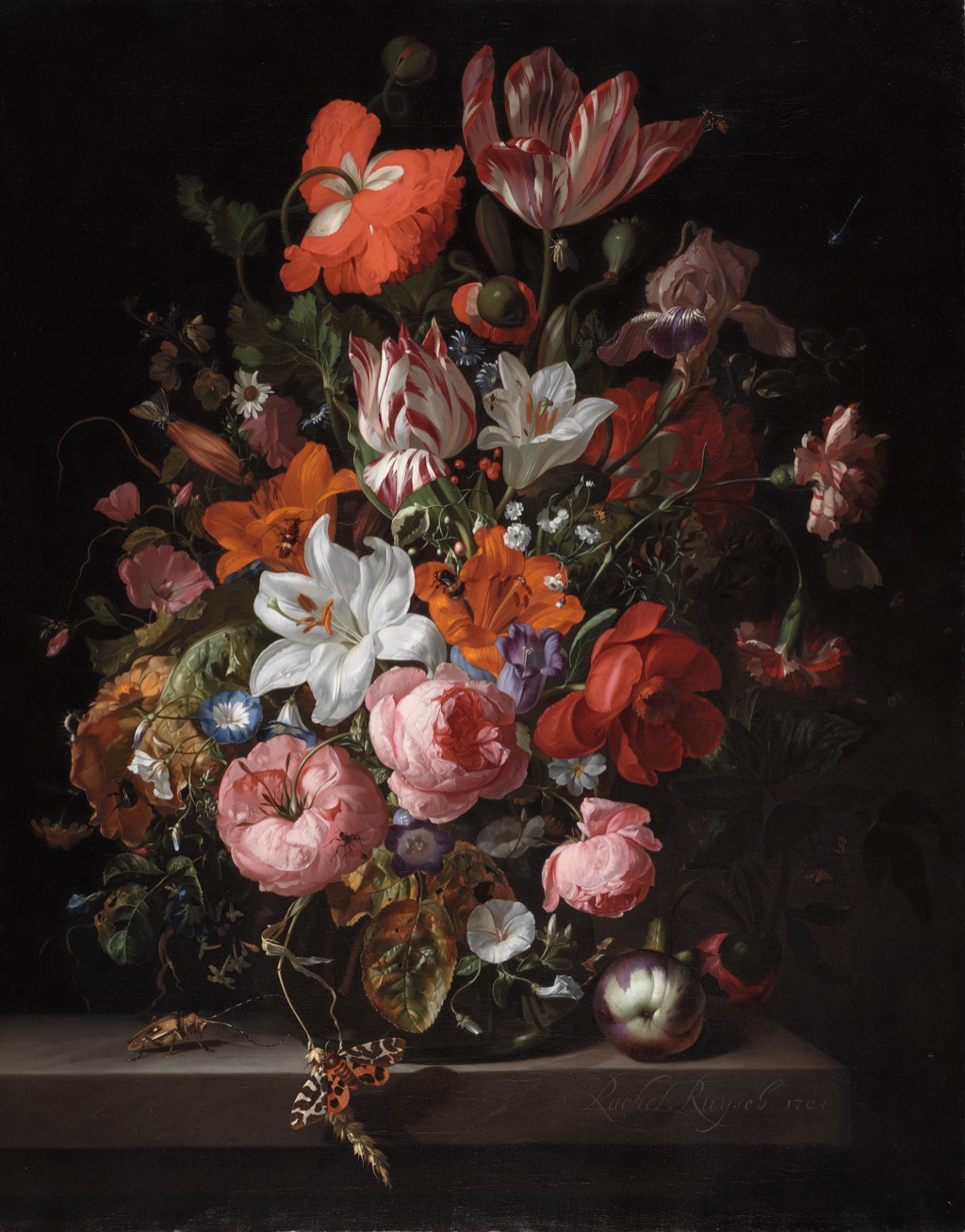
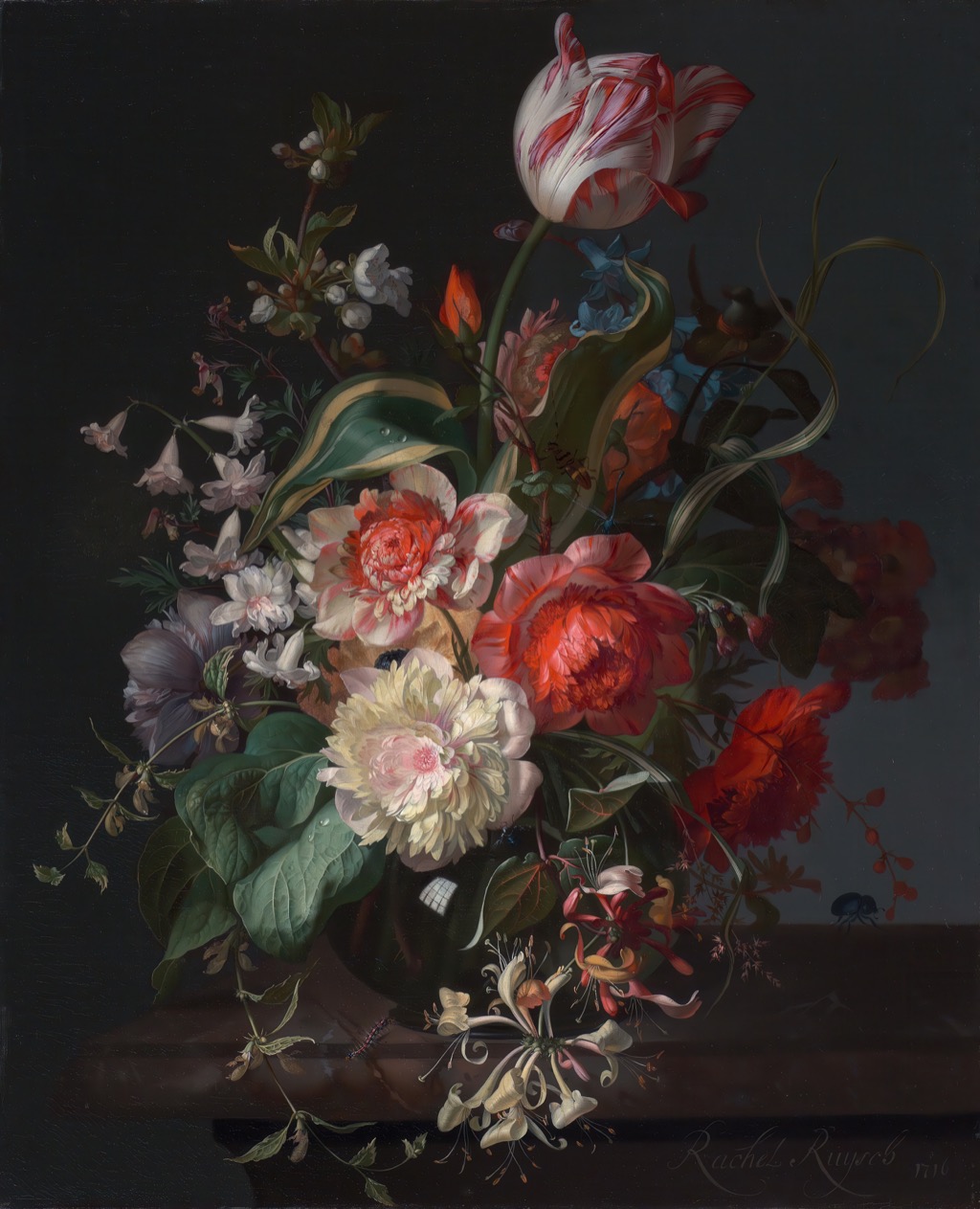
Her technique depends on the viewer accepting that paradox. In the Rijksmuseum's Still Life with Flowers on a Marble Tabletop, the bouquet contains more than ten flower species and teems with insects, but the museum notes that such a bouquet would have been difficult to assemble in reality because the blossoms flower at different times.[5] The Detroit Institute of Arts makes the same point about its 1704 Flowers in a Glass Vase: the selected blooms do not share one season, so the arrangement could only have existed in the artist's imagination.[6]
This does not make the paintings less truthful. Ruysch's art creates another kind of truth, based on repeated observation rather than a single moment. She gives the viewer flowers known over time, recomposed into one concentrated display. That is why her work can feel both natural and artificial, both intimate and courtly.
Ruysch's style is also recognisable in its appetite for small life. Insects do not merely decorate her bouquets. They bring movement, scale and tension. A caterpillar on a stem, a beetle on a ledge, a hovering fly or a butterfly near a bloom turns the still life into a small environment. The painting becomes a place where beauty is touched by hunger, time and decay.
Composition: Diagonals, Pyramids and Controlled Asymmetry
Ruysch learned from Willem van Aelst, one of Amsterdam's leading still-life painters, and museum accounts regularly connect his influence with her diagonal arrangements and elegant asymmetry.[1][2] That training matters because her bouquets rarely rise in simple symmetry. They feel balanced, but not static. They are built from slants, counter-slants, arcs and interruptions.
In a Ruysch flower painting, the largest blooms often act like anchors. They hold the lower or central area, while smaller flowers climb outward, lean sideways or turn into shadow. The arrangement may suggest a pyramid, but it is usually a lively, unstable pyramid rather than a rigid triangle. NMWA's Roses, Convolvulus, Poppies, and Other Flowers in an Urn on a Stone Ledge is a strong example: the museum describes its dynamic pyramid-shaped composition, asymmetrical blossoms, curving stems and dramatically lit centre.[7]
The diagonal is one of Ruysch's great tools for avoiding stiffness. It makes the bouquet feel as if it is growing, slipping, swelling or turning. In the Rijksmuseum's Still Life with Flowers on a Marble Tabletop, the flowers rise from a blue glass vase and spread across a compact canvas, but the eye is not trapped in one central column. It moves from broad blossoms to small leaves, from the vase to the insects, from the ledge into the dark interior of the bouquet.[5]
At the Mauritshuis, Vase with Flowers shows another kind of compositional intelligence. The bouquet is past its peak: a blue iris droops, a tulip is close to losing a petal, and a central flower has been cut away.[8] The gap left by that cut bloom creates depth. Ruysch turns absence into structure. Instead of filling every space, she lets the viewer look through the bouquet, using the interruption to make the arrangement feel layered.
Her compositions therefore work through managed abundance. There is a lot to see, but it is not random. Each cluster of flowers answers another. Each dark recess makes a bright edge stronger. Each insect or droplet slows the eye at a particular point. Ruysch's bouquets feel lavish because they are full; they feel sophisticated because that fullness has been organised.
Dark Grounds and Selective Light
Dark backgrounds are one of Ruysch's signature effects. They connect her to seventeenth-century Dutch and Baroque flower painting, but they also serve a practical pictorial purpose. Darkness lets the flowers project forward. Pale petals, glass highlights and water drops become luminous because the space around them is withheld.
The National Gallery notes that Flowers in a Glass Vase with a Tulip keeps the dark background typical of seventeenth-century Baroque painting, even as Ruysch's touch in that work becomes more delicate and decorative.[9] This is a useful description of her position between traditions. She did not abandon the drama of the dark ground, but she could soften, refine and lighten the handling within it.
Darkness in Ruysch is not an empty curtain. It is a working space. Leaves recede into it. Stems disappear and reappear. Flowers turn from visibility into shadow. This makes the bouquet feel deep and staged rather than pasted onto the surface. In Toledo's Flower Still Life, the museum describes a lush floral arrangement set against a dark background, with flowers that would not bloom together and details of caterpillars, browning leaves and insect damage.[10] The darkness there heightens both abundance and fragility.
Light is equally selective. Ruysch rarely bathes the whole bouquet evenly. She uses illumination to rank forms and make space. In the Mauritshuis Vase with Flowers, the lower white roses and calendula are brightly lit, while upper flowers receive less intense light and recede into partial shade.[8] That modulation gives the painting much of its depth. The viewer does not simply see flowers; the viewer sees flowers coming forward and withdrawing.
Selective light also shapes mood. A flower at the edge of darkness seems more precious than one under broad daylight. A dewdrop is more convincing when it catches a tiny highlight against a muted petal. A glass vase becomes a small theatre of reflection when the background around it is dark enough to make the shine legible.
This is one reason Ruysch's paintings still feel vivid in reproduction and in galleries. Their compositions are dense, but their light is disciplined. The eye always has a path.
Glass, Ledges and the Edge of Illusion
Glass vases are among Ruysch's most demanding recurring motifs. A glass vessel has to do several things at once: hold the bouquet, reveal stems, reflect light, suggest water and remain believable as a solid object. It is transparent and reflective, present and elusive. For a painter of illusion, it is an ideal test.
The Rijksmuseum's Still Life with Flowers in a Glass Vase makes the vessel central to the whole display. The museum records tulips, roses, carnations, irises, poppies, hyacinths and bindweed in a bouquet placed in a glass vase on a marble tabletop.[11] The vase gathers the composition. It gives the flowers a physical base and a visual centre, even when the blossoms spread beyond it in every direction.
In the Detroit Flowers in a Glass Vase, the vessel again stabilises an impossible bouquet. The flowers do not belong to one season, yet the glass container persuades the eye that they have been arranged together.[6] This is a beautiful kind of deception. The vase makes the fiction feel practical. It says: here are stems, water, weight and support.
Ledges play a related role. A stone or marble ledge marks the front of the painted world. It creates a boundary between the viewer and the arrangement, then lets details test that boundary. A leaf may hang over it. A beetle may crawl along it. A signature may sit on it. In Ruysch's paintings, the ledge is not just furniture. It is where illusion meets authorship and where nature comes closest to the viewer.
The National Gallery's Flowers in a Glass Vase with a Tulip includes a reflected high window in the glass vase, as well as droplets of water on leaves.[9] Such details pull the viewer into the mechanics of looking. A reflection implies a room outside the bouquet. A droplet implies recent moisture. A ledge implies touchable stone. The painting grows convincing through these small optical promises.
Glass and ledges also prevent the bouquet from becoming pure fantasy. However impossible the seasonal combination, the staging feels material. The flowers have a place to stand. The viewer has a threshold from which to look. Ruysch's art depends on that double effect: imaginative construction made physically persuasive.
Flower Studies, Invention and the Impossible Bouquet
One of the most important facts about Ruysch's technique is that her bouquets were planned. The old idea that Dutch flower painters simply added each bloom to a canvas as it came into season has been reconsidered. The National Gallery explains that artists used collections of flower studies to fill preplanned compositions, and describes Ruysch beginning with sketched flower and leaf shapes, painting the background around them, building forms in layers from darker tones toward lighter ones, and finishing with delicate highlights.[9]
This process explains the peculiar freshness of her art. The paintings look spontaneous because the final surface is so responsive. In reality, their energy depends on preparation. Ruysch had to decide where the major flowers would sit, how the dark spaces would open, where stems would cross, and which small details would animate the arrangement.
Her scientific environment supported this practice. The Mauritshuis describes Frederik Ruysch's collections of curiosities, including dried plants, preserved specimens and natural rarities, and notes that Rachel drew and painted from this world.[3] It also explains that her paintings combine flowers, plants and animals that would not be seen together in the real world, using living and preserved models.[3] NMWA similarly emphasises that Ruysch learned to observe and record nature accurately through her father, then trained with Van Aelst from the age of fifteen.[2]
Yet the result is not science alone. Ruysch's paintings are not pages from a botanical book. They are works of artistic judgement. A study might preserve the form of a flower, but a painting must decide how that flower behaves among others. Should it face outward or turn away? Should it catch light or disappear into shade? Should it dominate, support, interrupt or surprise?
The impossible bouquet is therefore Ruysch's central act of invention. In the Rijksmuseum's Still Life with Flowers on a Marble Tabletop, different seasons are brought together in a blue vase on stone.[5] In Detroit's Flowers in a Glass Vase, lilies, peonies, roses and tulips compete for attention beneath droplets and insects.[6] In the National Gallery's Flowers in a Glass Vase with a Tulip, a prized Semper Augustus tulip crowns a refined late arrangement.[9] These bouquets are not lies. They are visual arguments: nature can be studied across time and recomposed by art.
Insects, Dewdrops and Minute Detail
Ruysch's smallest details are some of her strongest statements of technique. Insects, dewdrops, damaged leaves, curled petals and reflected light make the paintings feel inhabited. They also prove her control at multiple scales. A large rose and a tiny beetle require different kinds of touch, but both must belong to the same world.
The Detroit Institute of Arts points to glistening dewdrops and insects in Flowers in a Glass Vase, noting that the drops suggest freshly cut blossoms and that insects remain attracted to the flowers.[6] The National Gallery identifies hidden winged creatures, flies, beetles, a damsel fly, a caterpillar, a reflected window and sparkling water drops in Flowers in a Glass Vase with a Tulip.[9] Toledo's Flower Still Life includes caterpillars, browning leaves and holes made by hungry insects.[10]
These details are not only feats of realism. They change the meaning of the bouquet. Dewdrops suggest freshness, but also passing time. Insects suggest scent and life, but also appetite and damage. Browning leaves make abundance less perfect and more moving. A cut stem or fading petal brings the viewer closer to the brief life of the flowers.
Ruysch's details should be read flexibly. Dutch still life often invites moral reflection on transience, and some of her motifs certainly point toward fragility. But her paintings are richer than simple symbols. NMWA's discussion of Roses, Convolvulus, Poppies, and Other Flowers in an Urn on a Stone Ledge notes that although vanitas elements are present, scholars doubt that a fully moralising vanitas intention is the main point there.[7] The insects and browning leaves can be straightforward observations of life as well as reminders of decay.
Minute detail also affects the viewer's behaviour. Ruysch makes people look slowly. From a distance, the bouquet reads as a whole. Up close, it becomes a sequence of discoveries. The painting rewards repeated attention, which helps explain why such works appealed to collectors. A Ruysch flower painting could be enjoyed as colour and luxury, then inspected as a world of small decisions.
Surface, Finish and the Painter's Hand
Ruysch's finish is refined, but it is not mechanical. Her best paintings are polished enough to persuade the eye, while varied enough to make the surfaces feel distinct. Petals are thin, folded, curled, frilled or heavy. Leaves can be glossy, dull, torn or spotted. Glass is cool and reflective. Stone is smooth. Insects have hard bodies, fine legs or fragile wings.
The National Gallery's account of Ruysch's working method is especially useful here because it describes a layered process: forms laid out first, background painted around them, flowers built from dark to light, highlights added last.[9] That order matters. It helps explain why her flowers seem to emerge from darkness rather than sit on top of it. The highlights are not random sparkle; they are the last, decisive touches that bring the illusion into focus.
Rijksmuseum documentation for Still Life with Flowers on a Marble Tabletop lists the technical study by M. van Eikema Hommes and A. Wallert titled "Een evenwichtige wemeling. Over de schildertechniek van Rachel Ruysch".[5] The Dutch phrase has often been understood as capturing the paradox of Ruysch's art: a balanced swarm. That is exactly what her surface offers. The painting may appear crowded, but the crowding is controlled.
Her surface also resists the idea that botanical accuracy and artistic freedom are opposites. A flower can be precise and placed in an impossible bouquet. A dewdrop can be convincing and theatrically staged. An insect can be carefully observed and positioned to guide the eye. Ruysch's finish lets her combine close fact with pictorial fiction.
This is where her technique differs from mere display. A lesser flower painting can overwhelm the viewer with decorative abundance. Ruysch keeps the viewer moving through distinct textures and intervals. She knows when to sharpen an edge, when to soften a petal, when to bury a stem in shadow and when to place one tiny highlight where it will make the whole arrangement breathe.
How Her Technique Changes Across Key Works
Comparing Ruysch's paintings shows continuity without sameness. The format may repeat: flowers, vase, ledge, dark ground, insects, careful light. But each work solves a different problem.
In Still Life with Flowers on a Marble Tabletop, the problem is compression. A relatively small canvas contains more than ten flower species, insects, a blue glass vase and a marble support.[5] The bouquet is abundant, yet the painting never loses its compact order. It is an excellent work for seeing Ruysch's ability to make density legible.
In Still Life with Flowers in a Glass Vase at the Rijksmuseum, the problem is monumentality. The museum describes a large, opulent floral still life that attracted the kind of wealthy patrons willing to pay high prices for such paintings.[11] The scale, glass vessel and luxury of the display show why Ruysch's flower pieces could operate as collector objects of serious prestige.
In the Mauritshuis Vase with Flowers, the problem is decline. The bouquet is past its best, and the cut flower near the centre creates depth.[8] Ruysch's technique here is not just about making flowers fresh. It is about making fading, cutting and partial shade pictorially compelling.
In Detroit's Flowers in a Glass Vase, the problem is persuasive impossibility. Dewdrops suggest freshness, insects suggest scent, and the flowers feel newly gathered, even though the museum notes that they do not bloom together.[6] The painting succeeds because observation and invention are perfectly interlocked.
In the National Gallery's Flowers in a Glass Vase with a Tulip, the problem is refinement. The Semper Augustus tulip crowns the arrangement, while the dark Baroque background remains. The National Gallery sees a subtle shift toward more decorative handling, with frilled petals, graceful leaves and tiny sculptural florets.[9] Ruysch keeps the old drama of darkness while moving toward a more delicate eighteenth-century elegance.
In Toledo's Flower Still Life, the problem is fragility. The dark ground, impossible seasonal mixture, caterpillars and damaged leaves make beauty feel vulnerable.[10] The work is lush, but it is not complacent. It turns close detail into a meditation on change.
In Pinakothek's Bouquet of Flowers, the problem is staged naturalism. The collection describes Ruysch as uniting naturalistic rendering with the artificiality of staged presentation.[12] That phrase could stand for much of her technique. Her flowers persuade as nature and then reveal themselves as art.
Together, these works show why Ruysch's style remains so compelling. She did not simply paint flowers well. She built worlds in which flowers, insects, glass, stone, darkness and light became instruments of thought.
Frequently Asked Questions
Discussion
Ruysch's bouquets are intensely naturalistic and deliberately artificial at the same time. When you look at one of her flower paintings, do you trust the botanical detail first, or do you notice the staged illusion first?
Reader Insights
Compare the glass vase in one Ruysch painting with the marble or stone ledge below it. Which surface feels more convincing, and why?
Choose one bouquet and trace the diagonal movement from the lowest bright flower to the highest or most distant bloom.
Look for insects, droplets and damaged leaves before naming any flowers. Notice how much of Ruysch's technique depends on small signs of motion and time.
Join the Conversation
Share a thoughtful observation about Rachel Ruysch, the painting, or the wider still-life tradition that would help another reader look more carefully.
References
- National Gallery, London, "Rachel Ruysch." https://www.nationalgallery.org.uk/artists/rachel-ruysch
- National Museum of Women in the Arts, "Rachel Ruysch," artist profile. https://nmwa.org/art/artists/rachel-ruysch/
- Mauritshuis, "Rachel Ruysch (1664-1750)." https://www.mauritshuis.nl/en/our-collection/our-masters/rachel-ruysch
- Rijksmuseum, "Rachel Ruysch," artist page. https://www.rijksmuseum.nl/en/collection/node/Rachel-Ruysch--3eaff215275e2ebd47d02cfba2044cc8
- Rijksmuseum, Rachel Ruysch, Still Life with Flowers on a Marble Tabletop, 1716, object number SK-A-2338. https://www.rijksmuseum.nl/en/collection/object/---570d1419506e38cb3916f640fe5a2328
- Detroit Institute of Arts, Rachel Ruysch, Flowers in a Glass Vase, 1704, accession number 1995.67. https://dia.org/collection/flowers-glass-vase/66064
- National Museum of Women in the Arts, Rachel Ruysch, Roses, Convolvulus, Poppies, and Other Flowers in an Urn on a Stone Ledge, ca. 1680s. https://nmwa.org/art/collection/roses-convolvulus-poppies-and-other-flowers-urn-stone-ledge/
- Mauritshuis, Rachel Ruysch, Vase with Flowers, 1700, inventory number 151. https://www.mauritshuis.nl/en/our-collection/artworks/151-vase-with-flowers
- National Gallery, London, Rachel Ruysch, Flowers in a Glass Vase with a Tulip, 1716, inventory number L1208. https://www.nationalgallery.org.uk/paintings/rachel-ruysch-flowers-in-a-glass-vase-with-a-tulip
- Toledo Museum of Art, Rachel Ruysch, Flower Still Life, about 1716-1720, object number 1956.57. https://emuseum.toledomuseum.org/objects/54880/flower-still-life
- Rijksmuseum, Rachel Ruysch, Still Life with Flowers in a Glass Vase, c. 1690-c. 1720, object number SK-A-354. https://www.rijksmuseum.nl/en/collection/object/Still-Life-with-Flowers-in-a-Glass-Vase--210e3fc99bb8b3a875fcd7b57fce1a83
- Pinakothek, Rachel Ruysch, Blumenstrauss / Bouquet of Flowers, 1715. https://www.sammlung.pinakothek.de/en/artwork/A9xlnQAGWv/rachel-ruysch/blumenstrauss
- Museum of Fine Arts, Boston, "Rachel Ruysch: Artist, Naturalist, and Pioneer." https://www.mfa.org/exhibition/rachel-ruysch-artist-naturalist-and-pioneer
- Robert Schindler, Bernd Ebert and Anna C. Knaap, eds., Rachel Ruysch: Nature into Art. MFA Publications, 2024.
- Marianne Berardi, Science into Art: Rachel Ruysch's Early Development as a Still-Life Painter. Ph.D. diss., University of Pittsburgh, 1998.
- Marianne Berardi, Rachel Ruysch: The Hague 1664-1750 Amsterdam. Richard Green, 2012.
- Main image reference: Rachel Ruysch, Still Life with Flowers in a Glass Vase, Rijksmuseum. Public-domain image via Wikimedia Commons / Rijksmuseum. https://commons.wikimedia.org/wiki/Category:Still_Life_with_Flowers_in_a_Glass_Vase_(Rachel_Ruysch,_Rijksmuseum)