Buy Art Prints Now
from Amazon
* As an Amazon Associate I earn from qualifying purchases.
Image reference [1]
 by Tom Gurney
Tom Gurney BSc (Hons) is an art history expert with over 20 years experience
Published on August 25, 2026 / Updated on September 6, 2026
Email: tomgurney1@gmail.com / Phone: +44 7429 011000
Vase with Flowers: Introduction
Rachel Ruysch's Vase with Flowers at the Mauritshuis is not a simple celebration of freshness. Painted in 1700, the work shows a bouquet that has begun to pass its peak: flowers droop, petals threaten to fall, and an empty space near the centre of the arrangement changes the whole rhythm of the picture. In a genre often associated with perfect abundance, Ruysch gives the viewer something more unsettled and more interesting. The bouquet is still beautiful, but it is no longer untouched.
The Mauritshuis identifies the painting as an oil on canvas by Rachel Ruysch, dated 1700, measuring 79.5 x 60.2 cm, and now in The Hague with inventory number 151.[1] The museum's account of the painting is especially valuable because it does not treat the flowers as generic decoration. It points to the blue iris hanging at the upper right, the tulip at the left beginning to lose a petal, white roses and calendula brightened by light near the lower part of the bouquet, and a likely red opium poppy that appears to have been cut away.[1]
That makes this Mauritshuis painting a distinctive entry point into Ruysch's art. It belongs with her wider group of flower still lifes, but it should not be confused with the Rijksmuseum's Still Life with Flowers in a Glass Vase, the Detroit Institute of Arts' Flowers in a Glass Vase, or the National Gallery's Flowers in a Glass Vase with a Tulip. This page is about the Mauritshuis Vase with Flowers: a 1700 painting in which depth, light, texture, and decay are held in tense balance.
At a Glance
- ArtistRachel Ruysch (1664-1750)
- TitleVase with Flowers
- Date1700
- MediumOil on canvas
- Dimensions79.5 x 60.2 cm
- CollectionMauritshuis, The Hague
- Inventory number151
- Display noteRecorded by the Mauritshuis as on view in Room 11
- Signature and dateSigned and dated lower left, on the edge of the table, "Rachel Ruysch F: 1700"
- Provenance summaryProbably given by the painter to Pictura in The Hague; later with H.D. Loeff Gallery, The Hague; purchased in 1826
- Why it mattersThe painting is an unusually direct example of Ruysch making a flower still life out of beauty in decline, not just beauty at full bloom.
Contents
- Introduction
- A Mauritshuis Flower Piece
- A Bouquet Past Its Peak
- Light, Depth, and Texture
- What the Flowers Can Safely Tell Us
- Ruysch in 1700
- How This Painting Differs from Other Vase Paintings
- Why the Painting Still Holds Attention
A Mauritshuis Flower Piece
The first thing to know about Vase with Flowers is its identity. Ruysch painted many flower pieces, and several important works have similar vase or glass-vase titles. This one is the Mauritshuis painting dated 1700, an oil on canvas in The Hague.[1] The title is plain, almost modest, but the painting is anything but generic.
The work presents a bouquet arranged in a vase, set against darkness and organised by shifts of light. The flowers are not displayed as a neutral botanical sample. They are staged as a visual event, with some blooms catching sharp illumination while others withdraw into shade. The lower part of the bouquet comes forward with particular force. The upper flowers recede, bend, and lose intensity. The eye moves not only from flower to flower, but from fresh display toward visible decline.
That sense of timing makes the painting stand apart. Many Dutch flower still lifes show flowers from different seasons gathered into a single impossible bouquet. Ruysch often participated in that tradition, using study, memory, and botanical knowledge to create arrangements that could not simply have sat before her at one moment.[2][3] In the Mauritshuis painting, however, the impossibility is joined to another kind of fiction: the bouquet is shown after its perfect moment has passed.
The museum notes that the painting is one of relatively few flower pieces in which the bouquet is clearly past its peak.[1] This is a crucial point. Ruysch does not merely add one fading leaf as a symbolic hint. She builds the composition around wilted movement, a central interruption, and flowers that no longer stand as a seamless display. The result is not less refined than her more sumptuous bouquets. It is refined in a different way.
The Mauritshuis also connects the painting to Ruysch's wider achievement. Its artist page describes her as one of the most successful Dutch still-life painters of the seventeenth and eighteenth centuries, celebrated for refined, colorful flower paintings, famous both in the Dutch Republic and abroad.[4] Seen in that context, Vase with Flowers is not an eccentric aside. It shows how Ruysch could use the conventions of a prestigious flower piece while sharpening their emotional and visual stakes.
For readers arriving from the broader Rachel Ruysch cluster, this painting is best understood as a major close-looking object. For readers exploring her flower paintings, it demonstrates how her bouquets could transform beauty into a study of time.
A Bouquet Past Its Peak
The Mauritshuis description gives the painting its central drama: the bouquet is fading.[1] Flowers droop. The blue iris at the upper right hangs downward. A tulip at the left is close to shedding a petal. In the middle of the bouquet, an overblown flower has been cut off. The museum suggests that this missing flower was probably a large red opium poppy, a bloom known for its short duration.[1]
That cut matters. It is not only an anecdotal detail. The removal of the flower creates a visible gap, and the gap changes the structure of the bouquet. Instead of forming one full, closed mass, the arrangement opens into depth. The viewer is invited to look into the bouquet, not just at its surface.
The cut stem also makes time feel immediate. A faded flower might tell us that beauty passes. A stem that seems freshly cut tells us that someone has intervened. The bouquet has been tended, edited, or corrected, but the correction leaves its own evidence. Ruysch turns absence into composition.
This is a bold choice within flower painting. A conventional bouquet might depend on plenitude: more blooms, richer colour, fuller display. Ruysch gives us abundance with a wound in it. The missing flower does not weaken the painting. It gives the bouquet a hinge around which space, shadow, and narrative all turn.
The effect is not melodramatic. Ruysch's art rarely needs theatrical exaggeration. The painting remains controlled, polished, and visually pleasurable. But the pleasure is sharpened by the knowledge that some flowers are declining, one has been removed, and the arrangement is no longer at the moment a collector might normally choose to display it.
This handling suits a painter who understood both botanical observation and pictorial invention. The flower is not a fixed emblem; it is a living form passing through stages. Ruysch's bouquet has reached a stage in which beauty and loss are inseparable. That is why the Mauritshuis picture can feel more psychologically vivid than a perfectly fresh arrangement. It shows flowers not as ideal specimens, but as time-bound bodies.
Light, Depth, and Texture
The Mauritshuis emphasises the painting's strong sense of depth, created partly by the gap left near the middle of the bouquet.[1] Depth is one of the painting's quiet triumphs. Flower still lifes can easily become decorative surfaces, especially when the blossoms are dense. Ruysch avoids that flatness by making the bouquet open and recede.
Light performs much of this work. The museum notes that the white roses and calendula near the bottom are brightly illuminated, while the flowers above receive less intense light and seem to move back into partial shade.[1] The contrast makes the bouquet feel layered. Some forms press toward the viewer; others sink into the dark interior.
The lower flowers also create a foundation. Their brightness holds the painting steady, while the drooping and fading forms above introduce instability. This combination is one of Ruysch's strengths: the composition can be carefully arranged and yet full of movement. The viewer senses both design and natural change.
Texture is equally important. The Mauritshuis singles out Ruysch's ability to suggest light and texture with great skill.[1] In a flower painting, texture is not just finish. It is meaning. The smoothness of a petal differs from the stiffness of a leaf, the dampness of a drop, the cut edge of a stem, the soft openness of a rose, the papery vulnerability of a tulip petal, or the heavier presence of a vase.
Ruysch's training helps explain this range. She studied with Willem van Aelst, one of Amsterdam's leading still-life painters, and museum accounts regularly connect his influence with her highly controlled arrangements and polished surfaces.[3][4] She also grew up in the household of Frederik Ruysch, an anatomist and botanist whose collections of natural specimens helped form her access to close observation.[4][5] Those two contexts - artistic training and natural-historical attention - meet in paintings like this.
The work is not a scientific illustration. It is a painting made for looking, collecting, and admiration. But Ruysch's flower pieces depend on the viewer believing that these surfaces have been studied. The illusion is not broad. It is granular. A petal carries weight because its edge has been understood. A wilting bloom convinces because decline has been observed as carefully as freshness.
What the Flowers Can Safely Tell Us
Ruysch's flower paintings invite identification, but this is a place where caution improves the article rather than limits it. The safest flower names for Vase with Flowers are the ones given by the Mauritshuis: a blue iris, a tulip, white roses, calendula, and a likely red opium poppy that has been cut off.[1] Beyond that, the painting can be discussed as a bouquet without turning every visible bloom into a claim.
This matters because Ruysch's art encourages close botanical curiosity. Her flowers are painted with such precision that viewers naturally want to name them. The Rijksmuseum describes her floral still lifes as highly detailed and lifelike, with roses, poppies, carnations, and irises that appear almost indistinguishable from real flowers.[6] The National Museum of Women in the Arts similarly stresses her striking attention to detail, shaped by botanical study and by the intellectual world around her father's collections.[5]
But resemblance is not proof. Historic flower varieties, artistic conventions, partly hidden blooms, and changing names make over-identification risky. A painting can be botanically intelligent without every flower being confidently identified by a modern viewer. In Ruysch's case, restraint is especially important because the bouquet may combine study, memory, preserved specimens, and pictorial invention.
The broader principle is clear from several Ruysch works. The Detroit Institute of Arts notes that the flowers in its 1704 Flowers in a Glass Vase do not bloom at the same time of year and therefore form an imagined arrangement.[7] The Rijksmuseum makes a similar point about her 1716 Still Life with Flowers on a Marble Tabletop, whose flowers would have been difficult to gather together in reality.[8] The National Gallery's 1716 Flowers in a Glass Vase with a Tulip also explains that Dutch flower painters worked from flower studies rather than simply adding each bloom when it appeared in season.[9]
The Mauritshuis Vase with Flowers belongs to this world of artful construction, even though its central interest is not only seasonal impossibility. The bouquet is imagined and observed, composed and fading. The flowers tell us that Ruysch knew the forms of nature intimately. The cut and wilting details tell us that she also knew how to make nature's instability part of the picture.
Ruysch in 1700
The date 1700 places Vase with Flowers at an important point in Ruysch's career. She was born in The Hague in 1664 and grew up in Amsterdam, where her father Frederik Ruysch worked as a noted anatomist and botanist.[4][5] At about fifteen she trained with Willem van Aelst, entering a specialist still-life tradition at a high level.[4][5] By 1700, she was no longer a precocious young painter but an established artist in her mid-thirties.
Her public reputation would continue to grow. In 1701 she became associated with The Hague's painters' society Pictura, and from 1708 to 1716 she worked for Johann Wilhelm, Elector Palatine.[4][5][10] RKD Studies describes her court appointment in 1708 as a clear sign of appreciation for her work in Germany and notes that she delivered paintings for the Elector while remaining tied to Amsterdam.[10]
The Mauritshuis provenance for Vase with Flowers is also suggestive. The museum records that the painting was probably given by Ruysch to Pictura in The Hague before passing through H.D. Loeff Gallery and being purchased in 1826.[1] The initial provenance is marked with uncertainty, so it should not be overstated. Still, the connection is meaningful because Pictura was an important artistic institution in The Hague and part of the public framework around Ruysch's professional identity.
Ruysch's biography is often told through exception: a woman painter who sustained a long career, married the painter Juriaen Pool, raised a large family, worked for elite patrons, and remained productive into old age.[4][5] Those facts are important, but Vase with Flowers asks us not to treat biography as the whole story. The painting's authority rests in its visual intelligence. It shows what made Ruysch worth collecting and praising: not novelty alone, but command.
In 1700 she could take a familiar still-life format and make it unusually charged. Instead of offering a perfect bouquet, she presented a bouquet in visible transition. Instead of hiding the instability of flowers, she used it to open the composition. The painting shows an artist confident enough to let beauty falter, because the faltering itself becomes beautiful.
How This Painting Differs from Other Vase Paintings
Ruysch's titles can be confusing because several major works use similar formulas: vase, flowers, glass vase, tulip. Good object identification is essential.
The Mauritshuis painting is Vase with Flowers, dated 1700, oil on canvas, 79.5 x 60.2 cm, inventory number 151.[1] Its distinguishing feature is the bouquet past its peak, especially the drooping flowers and the cut-off central bloom that creates depth.
The Rijksmuseum's Still Life with Flowers in a Glass Vase is a different painting. It is dated broadly to about 1690-1720, measures 65 x 53.5 cm, and carries the object number SK-A-354.[11] It is important for Ruysch's monumental flower-vase formula, but it is not the Mauritshuis picture.
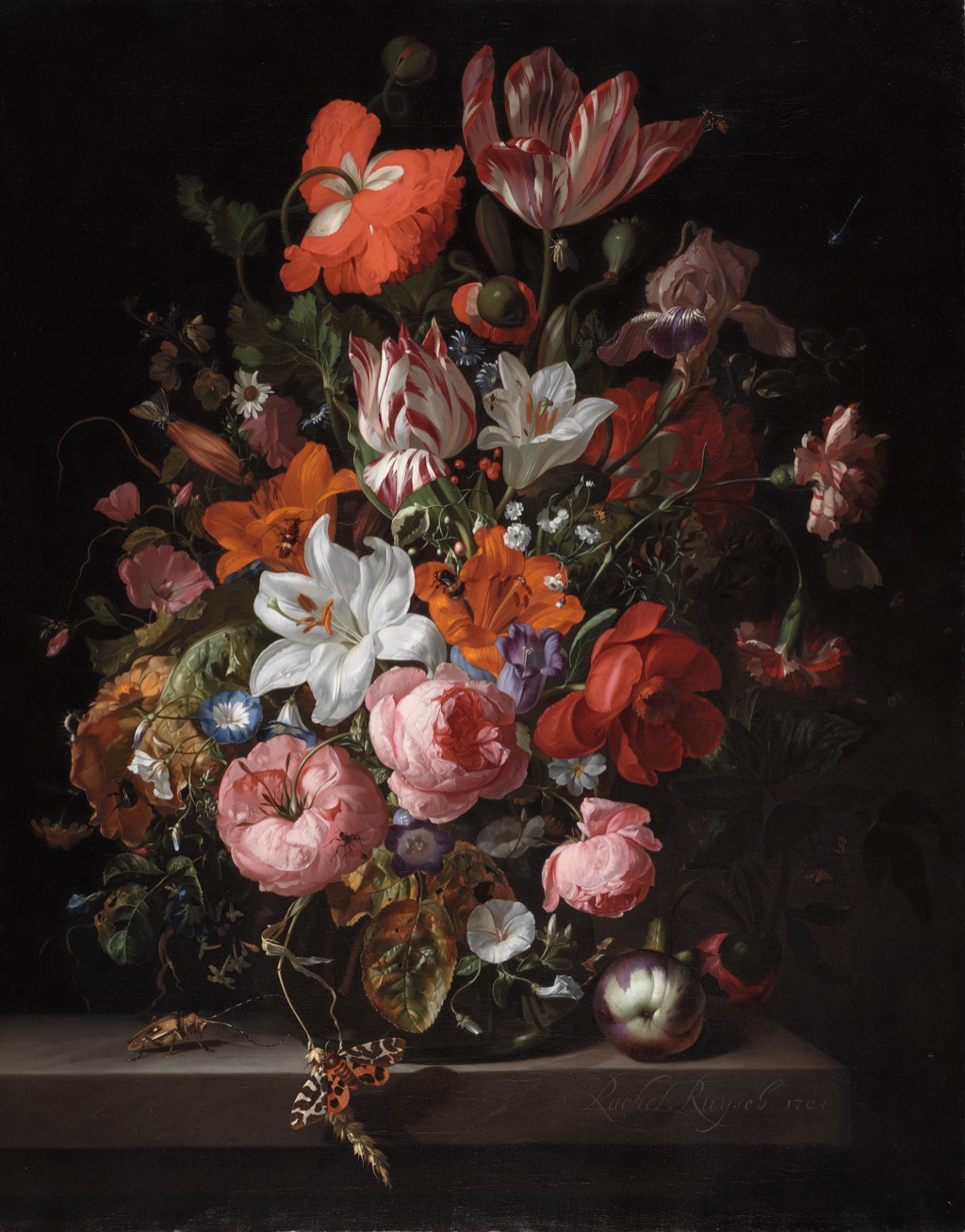
The Detroit Institute of Arts' Flowers in a Glass Vase is also a different work, dated 1704, with accession number 1995.67.[7] The DIA emphasises its dewdrops, insects, large floral display, and imaginary arrangement of flowers that do not bloom at the same time.[7] It is a useful comparison for Ruysch's handling of glass, freshness, and abundance, but its mood differs from the Mauritshuis bouquet's explicit decline.
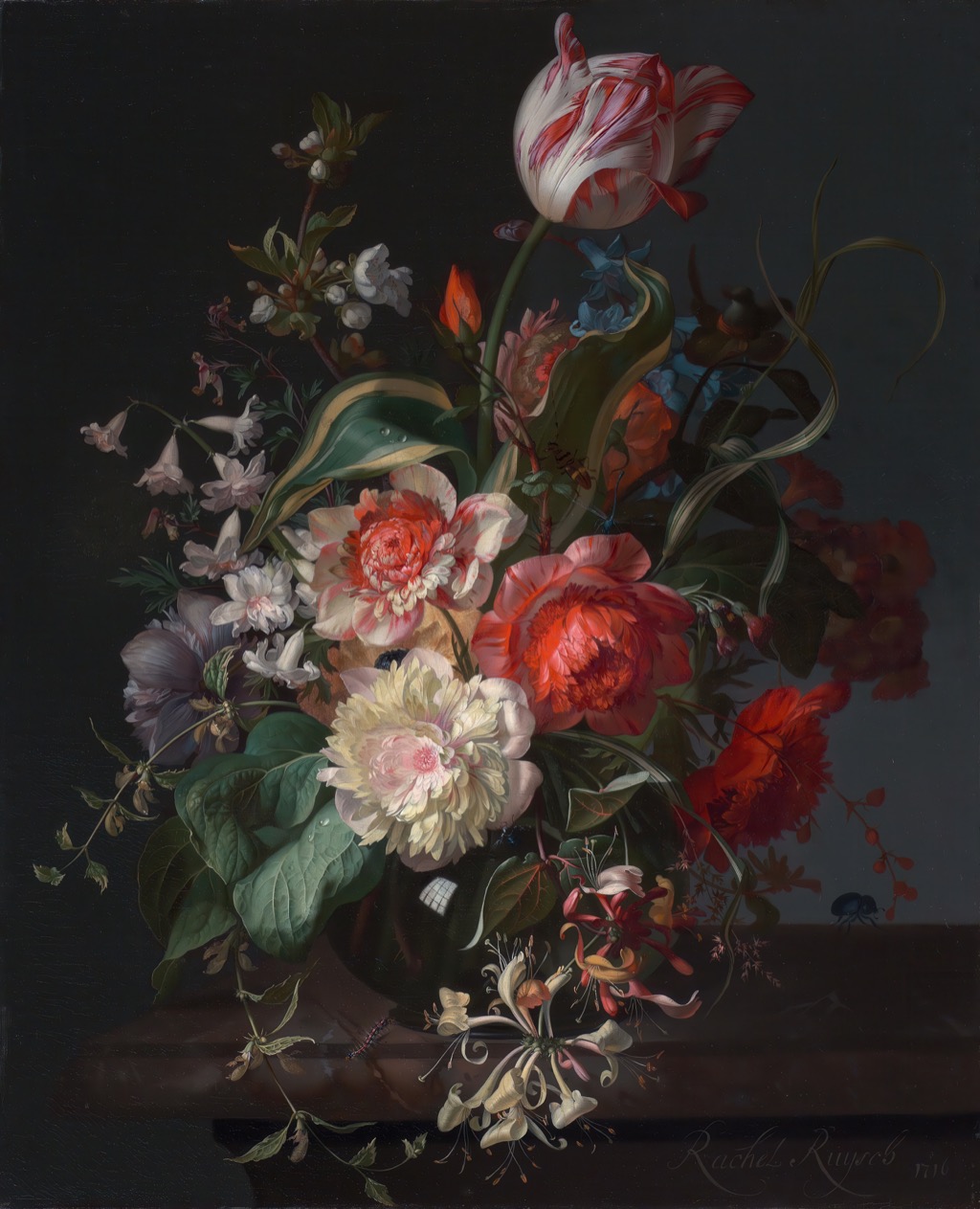
The National Gallery's Flowers in a Glass Vase with a Tulip is dated 1716 and is on loan from the collection of Janice and Brian Capstick.[9] That painting is especially associated with the Semper Augustus striped tulip and a late-career shift toward a more decorative style.[9] Again, it belongs to the same larger field, but not to the same object history or compositional problem.
The Rijksmuseum's Still Life with Flowers on a Marble Tabletop, also dated 1716, is another key comparison. It is smaller than the Mauritshuis painting, measuring 48.5 x 39.5 cm, and it centres on a blue glass vase placed on a marble tabletop.[8] Its impossible bouquet and insects make it essential for understanding Ruysch's mature flower painting, but the Mauritshuis work has its own identity through wilting and interruption.
These distinctions are not pedantic. They help readers look better. When similar titles are treated as interchangeable, Ruysch's range disappears. The Mauritshuis Vase with Flowers is not simply one more pretty bouquet. It is the painting in which the bouquet's fading condition becomes the structural and emotional centre.
Why the Painting Still Holds Attention
The power of Vase with Flowers lies in its mix of control and vulnerability. Ruysch controls the arrangement, the light, the textures, and the viewer's route through the bouquet. Yet the flowers themselves are vulnerable. They bend, fade, lose petals, and leave gaps. The painting's intelligence comes from the tension between artistic command and natural decline.
That tension also keeps the work from becoming a flat moral lesson. It would be easy to call the picture a reminder that beauty fades and stop there. Ruysch gives us something richer. The fading bouquet is not only a symbol; it is an optical problem, a compositional device, and a test of painterly sympathy. How do you paint a flower when it is no longer at its most photogenic moment? How do you make absence visible? How do you turn a cut stem into depth?
Modern interest in Ruysch has grown partly because her work sits at the meeting point of art, science, collecting, and gendered professional history. The Museum of Fine Arts, Boston, describes the 2025 exhibition Rachel Ruysch: Artist, Naturalist, and Pioneer as the first comprehensive solo exhibition devoted to the artist, bringing together her paintings with plant and insect specimens and works by other women artists.[12] That context helps contemporary viewers see her flower pieces not as decorative leftovers from Dutch art, but as ambitious works about knowledge, rarity, life, and transformation.
The Mauritshuis painting is especially useful within that renewed attention because it resists the easiest kind of admiration. It is beautiful, but its beauty is not smooth. It asks the viewer to notice aging, cutting, loss, and shade alongside brilliance. It shows that Ruysch could turn a bouquet's imperfection into a deeper kind of pictorial order.
The painting also belongs naturally with the rest of her cluster. It deepens the overview of Rachel Ruysch's paintings, sharpens the discussion of Rachel Ruysch flower paintings, and supports the broader story of Rachel Ruysch and art and science. But its central lesson is contained in the object itself: a flower piece can be most alive as art when its flowers have already begun to fail.
Frequently Asked Questions
Discussion
Ruysch makes a fading bouquet feel visually compelling rather than merely damaged. When you look at Vase with Flowers, does the sense of decline make the painting more beautiful, more uneasy, or both?
Reader Insights
Compare the central gap in the Mauritshuis bouquet with a fuller Ruysch flower painting. How does empty space change the way you experience abundance?
Look only at the areas of strongest light: the white roses, calendula, and lower forms. How does Ruysch use brightness to organise the bouquet?
Notice the difference between naming flowers and reading the painting. Which details matter even when you do not know the exact botanical identity of every bloom?
Join the Conversation
Share a thoughtful observation about Rachel Ruysch, the painting, or the wider still-life tradition that would help another reader look more carefully.
References
- Mauritshuis, Rachel Ruysch, Vase with Flowers, 1700, object page. https://www.mauritshuis.nl/en/our-collection/artworks/151-vase-with-flowers
- Rijksmuseum, "Rachel Ruysch," Dutch Masters story. https://www.rijksmuseum.nl/nl/stories/nederlandse-meesters/story/rachel-ruysch
- National Gallery, London, Rachel Ruysch, Flowers in a Glass Vase with a Tulip, 1716, object page. https://www.nationalgallery.org.uk/paintings/rachel-ruysch-flowers-in-a-glass-vase-with-a-tulip
- Mauritshuis, "Rachel Ruysch (1664-1750)." https://www.mauritshuis.nl/en/our-collection/our-masters/rachel-ruysch
- National Museum of Women in the Arts, "Rachel Ruysch," artist profile. https://nmwa.org/art/artists/rachel-ruysch/
- Rijksmuseum, "Rachel Ruysch," artist page. https://www.rijksmuseum.nl/en/collection/node/Rachel-Ruysch--3eaff215275e2ebd47d02cfba2044cc8
- Detroit Institute of Arts, Rachel Ruysch, Flowers in a Glass Vase, 1704, object page. https://dia.org/collection/flowers-glass-vase/66064
- Rijksmuseum, Rachel Ruysch, Still Life with Flowers on a Marble Tabletop, 1716, object page. https://www.rijksmuseum.nl/en/collection/object/---570d1419506e38cb3916f640fe5a2328
- National Gallery, London, Rachel Ruysch, Flowers in a Glass Vase with a Tulip, 1716, details and overview. https://www.nationalgallery.org.uk/paintings/rachel-ruysch-flowers-in-a-glass-vase-with-a-tulip
- RKD Studies, "Court Paintings for Johann Wilhelm II, Elector Palatine (1708-1716)," in Masters of Mobility. https://masters-of-mobility.rkdstudies.nl/6-still-life-painter-rachel-ruysch-1664-1750-and-her-connections-to-germany/62-court-paintings-for-johann-wilhelm-ii-elector-palatine-1708-1716/
- Rijksmuseum, Rachel Ruysch, Still Life with Flowers in a Glass Vase, c. 1690-c. 1720, object number SK-A-354. https://www.rijksmuseum.nl/en/collection/object/Still-Life-with-Flowers-in-a-Glass-Vase--210e3fc99bb8b3a875fcd7b57fce1a83
- Museum of Fine Arts, Boston, "Rachel Ruysch: Artist, Naturalist, and Pioneer," exhibition page. https://www.mfa.org/exhibition/rachel-ruysch-artist-naturalist-and-pioneer
- Robert Schindler, Bernd Ebert, and Anna C. Knaap, eds., Rachel Ruysch: Nature into Art. MFA Publications, 2024.
- Marianne Berardi, Science into Art: Rachel Ruysch's Early Development as a Still-Life Painter. Ph.D. diss., University of Pittsburgh, 1998.
- Marianne Berardi, Rachel Ruysch: The Hague 1664-1750 Amsterdam. Richard Green, 2012.
- Main image reference: Rachel Ruysch, Vase with Flowers, 1700. Public-domain image via Wikimedia Commons / Mauritshuis. https://commons.wikimedia.org/wiki/File:Rachel_Ruysch_-_Vase_with_Flowers_-_1700_-_Mauritshuis_151.jpg