 Buy Art Prints Now
from Amazon
* As an Amazon Associate I earn from qualifying purchases.
Image reference [1]
 by Tom Gurney
Tom Gurney BSc (Hons) is an art history expert with over 20 years experience
Published on August 25, 2026 / Updated on September 6, 2026
Email: tomgurney1@gmail.com / Phone: +44 7429 011000
Flowers in a Glass Vase with a Tulip: Introduction
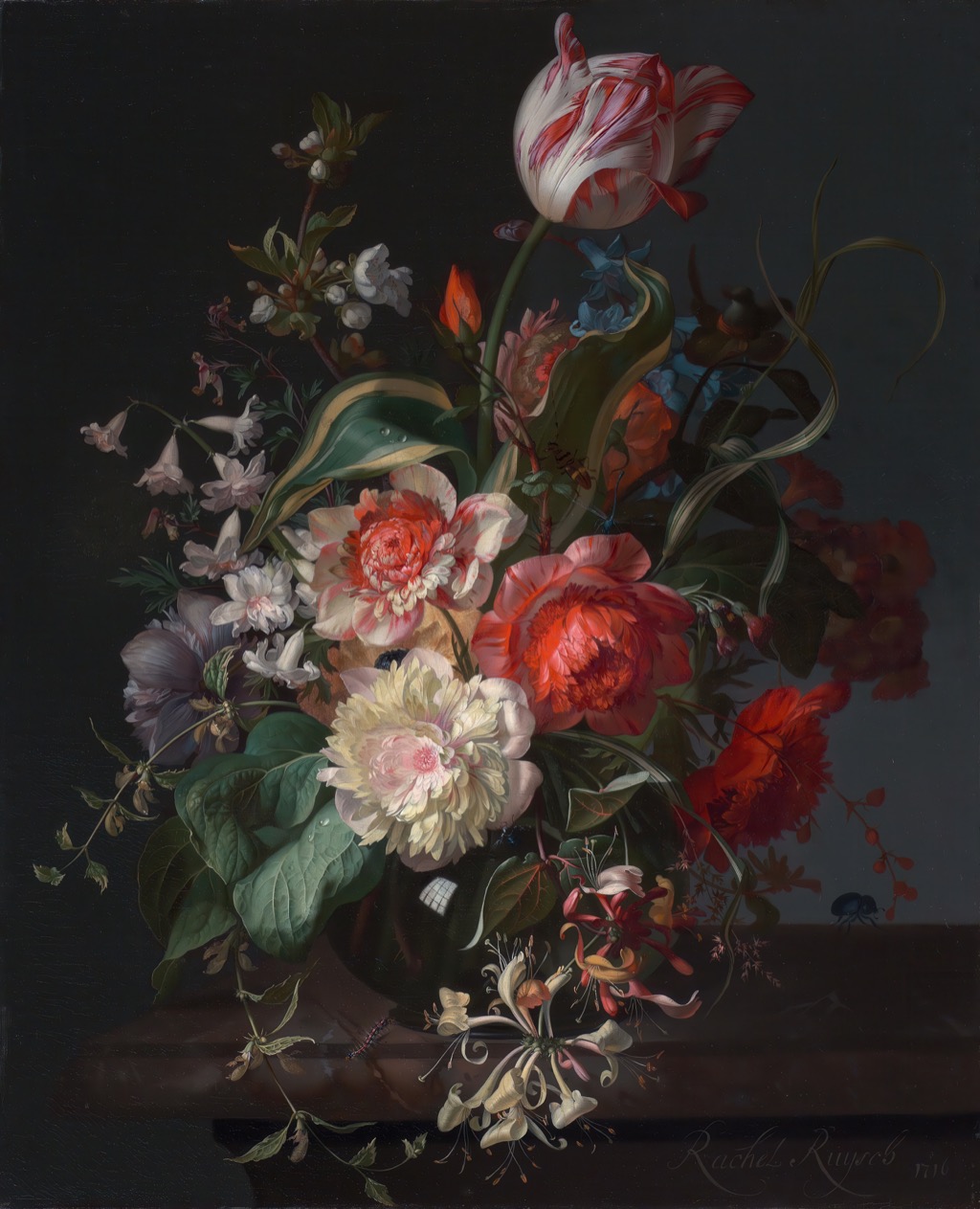
Rachel Ruysch's Flowers in a Glass Vase with a Tulip is a small painting with a highly deliberate centre of attention. The National Gallery records it as an oil on canvas made in 1716, measuring 46.5 x 36 cm, signed and dated, and on loan from the collection of Janice and Brian Capstick.[1] Its title tells the viewer to expect flowers, glass and a tulip, but the painting is richer than that plain description suggests. Ruysch uses a dark ground, a clear vessel, insects, water drops and a celebrated striped tulip to turn a compact bouquet into a display of precision, elegance and invention.
This page is about the National Gallery painting titled Flowers in a Glass Vase with a Tulip. That identification matters because Ruysch made several flower pieces with similar English titles. The Rijksmuseum has Still Life with Flowers in a Glass Vase, the Detroit Institute of Arts has Flowers in a Glass Vase, and the Mauritshuis has Vase with Flowers.[2][3][4] These works belong to the same broad world of Dutch flower still life, but they are not interchangeable. The National Gallery painting is the 1716 work whose composition culminates in the Semper Augustus striped tulip identified in the museum's commentary.[1]
At a Glance
- ArtistRachel Ruysch (1664-1750)
- TitleFlowers in a Glass Vase with a Tulip
- Date1716
- MediumOil on canvas
- Dimensions46.5 x 36 cm
- Collection contextNational Gallery, London
- Inventory numberL1208
- DisplayRoom 28, according to the National Gallery record
- CreditOn loan from the collection of Janice and Brian Capstick
- InscriptionSigned and dated
- Key flower named by the museumSemper Augustus striped tulip
- Key cautionThis is the National Gallery painting, not the Rijksmuseum, Detroit or Mauritshuis flower-vase works with related titles
Contents
- Introduction
- Identifying the National Gallery Painting
- The Tulip and the Shape of Attention
- Glass, Darkness and Surface Brilliance
- Flowers, Insects and Cautious Looking
- Ruysch in 1716
- Similar Titles, Different Paintings
- Why the Painting Matters
Identifying the National Gallery Painting
The National Gallery's object facts give the safest starting point. Flowers in a Glass Vase with a Tulip is listed as a 1716 oil painting on canvas by Rachel Ruysch, with the inventory number L1208.[1] It is smaller than some of her more imposing flower pieces, but the scale suits the painting's refined character. At 46.5 x 36 cm, it asks for close looking rather than broad theatrical distance.
The painting is also a loan, not a National Gallery-owned work. The record credits it to the collection of Janice and Brian Capstick and gives the image copyright as courtesy of the owner.[1] For readers, the important point is not legal detail but object clarity. This is a particular painting with a particular status, date and collection history, not a generic example of Ruysch's vase paintings.
The National Gallery title is especially useful because it names the tulip. Many flower still lifes are titled after a vase, ledge or general floral arrangement. Here, the title draws attention to one bloom inside the abundance. The museum's commentary identifies that bloom as the Semper Augustus striped tulip, a rare and famous tulip variety associated with Dutch horticultural prestige.[1] The tulip becomes a visual summit. The bouquet rises toward it, and the title makes sure the viewer notices.
The painting belongs to Ruysch's mature career. By 1716 she was one of the most admired flower painters in Europe. The National Gallery's artist page notes that she trained in Amsterdam with Willem van Aelst from 1679, worked in The Hague in the early eighteenth century, and served as court painter to Johan Willem, Elector Palatine, from 1708 until 1716.[5] The painting therefore sits at a moment when Ruysch's professional reputation, technical authority and elite patronage were firmly established.
The Tulip and the Shape of Attention
The tulip in the title does more than identify a flower. It shapes the whole experience of the painting. The National Gallery describes the bouquet as including roses, honeysuckle, pear blossom and other flowers, with the striped tulip at the culminating point.[1] That wording is a useful guide for looking: the painting is not a flat botanical assortment. It has a direction, an ascent and a climax.
The Semper Augustus matters because tulips had a special place in Dutch visual and horticultural culture. By Ruysch's lifetime, striped tulips could evoke rarity, collecting and cultivated taste. The National Gallery goes further, identifying the Semper Augustus as especially treasured and noting that it is now extinct.[1] That does not mean the painting should be reduced to a history lesson about tulip mania. Ruysch is not simply illustrating a famous flower. She is placing a prized bloom within a carefully orchestrated still life.
The tulip also clarifies the painting's mood. Many earlier Dutch flower pieces are built around abundance, scientific attention and market luxury. Ruysch keeps those qualities, but the National Gallery notices a subtle shift in style in this painting. It points to frilled rose petals, curling tulip leaves and honeysuckle florets that feel almost ornamental, moving the work toward the decorative taste spreading through Europe in the early eighteenth century.[1] The painting remains dark-ground and Baroque in structure, but its delicacy has a lighter, more playful edge.
That balance is one of the painting's pleasures. Ruysch does not abandon precision. She changes its emotional temperature. The flowers still feel studied, layered and exact, but they are also graceful. The tulip's leaves curl like lines drawn for elegance as much as for botanical description. The roses and honeysuckle offer a softer rhythm around the more spectacular striped bloom.
Readers should be cautious with flower identification beyond what the museum provides. The National Gallery names roses, honeysuckle, pear blossom and the Semper Augustus tulip.[1] Those names are enough to anchor the painting. Additional identifications may be tempting, especially because Ruysch's flowers look so persuasive, but a public reading should not turn resemblance into certainty.
Annotated Details from Flowers in a Glass Vase with a Tulip
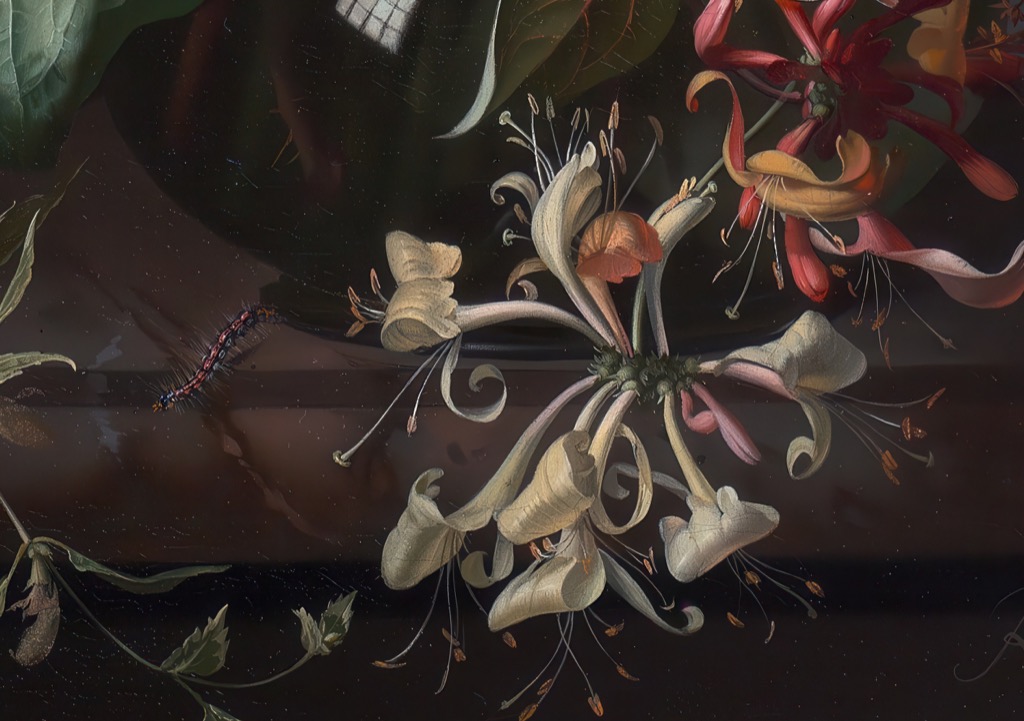
This annotated close reading follows the National Gallery painting through six visible passages: the striped tulip, the left-hand blossoms, the glass vessel, surface highlights, insects and the lower flowers. The labels keep the Semper Augustus and other flower names tied to the museum record.[1]
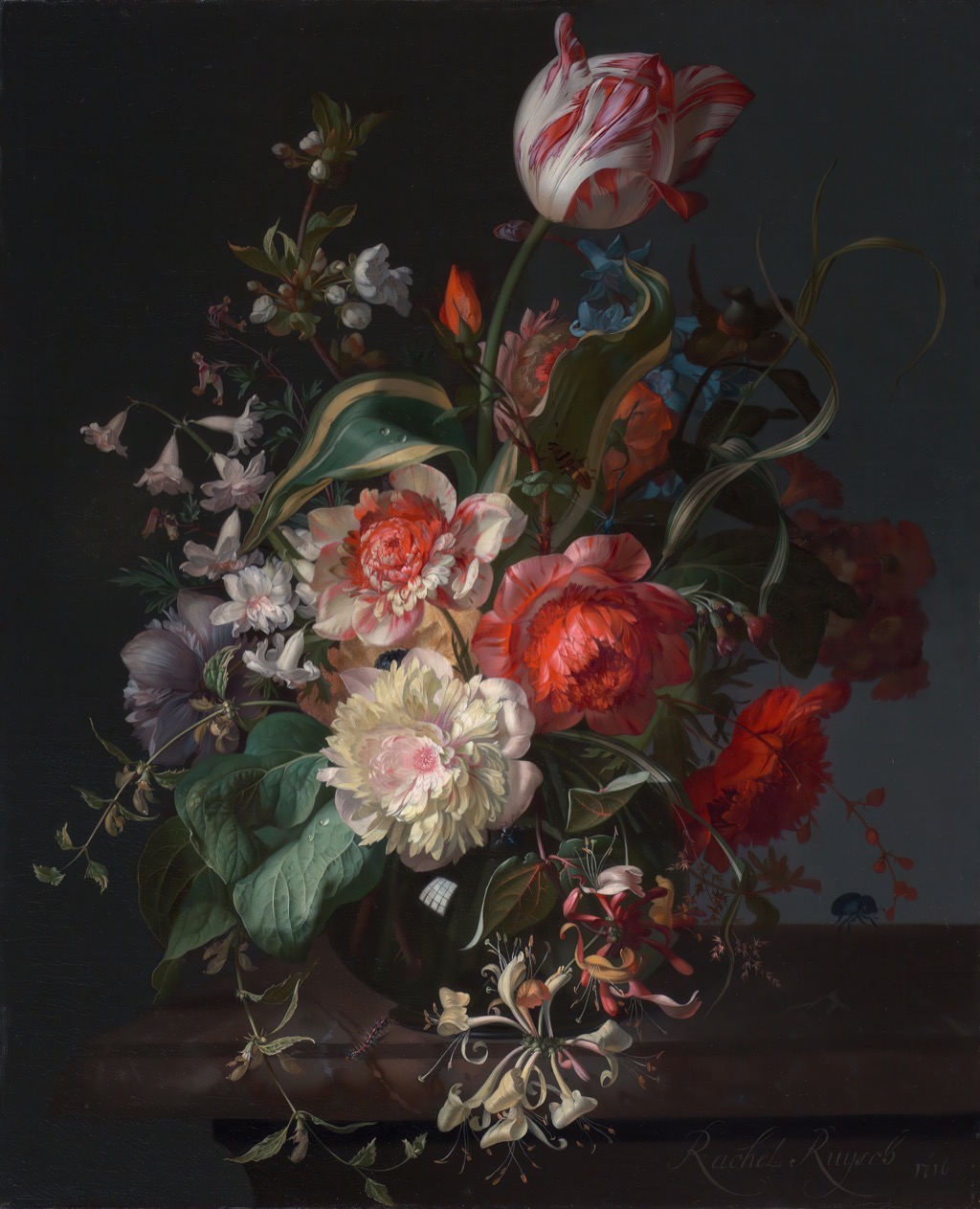
Details from FLOWERS IN A GLASS VASE WITH A TULIP
This annotated close reading follows the National Gallery painting through six visible passages: the striped tulip, the left-hand blossoms, the glass vessel, surface highlights, insects and the lower flowers. The labels keep the Semper Augustus and other flower names tied to the museum record.
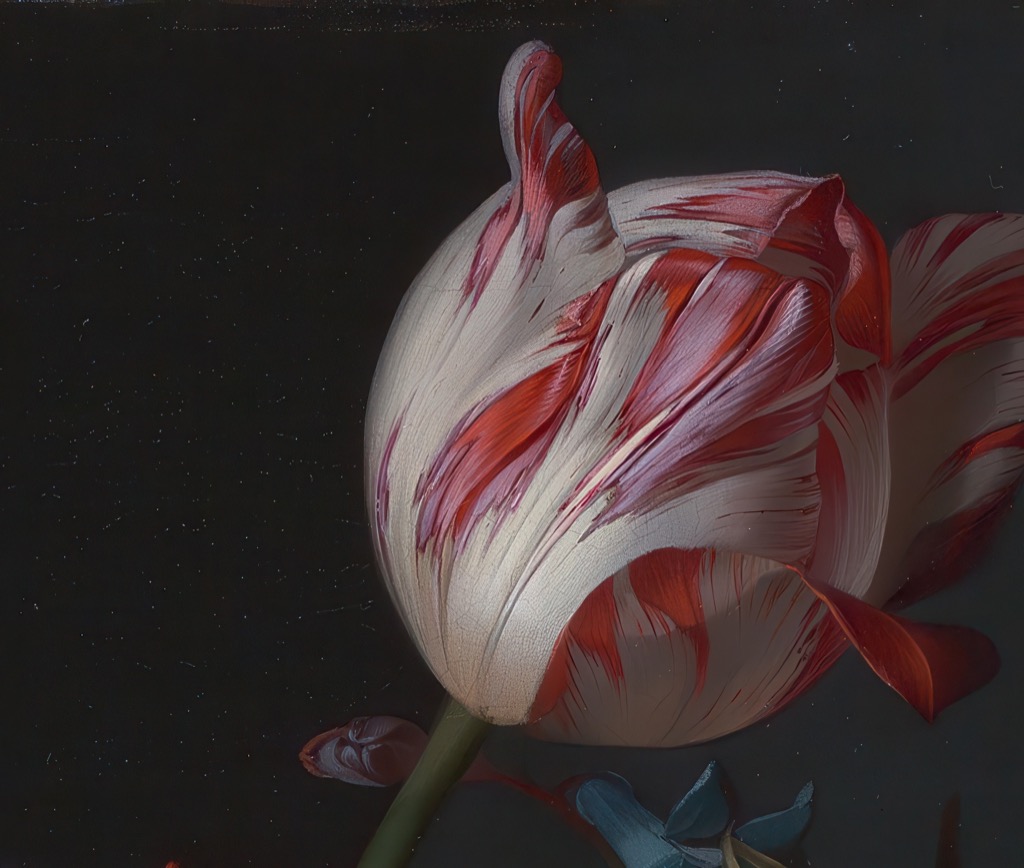
Semper Augustus Tulip
The striped tulip named by the National Gallery sits at the summit of the bouquet. Its height and strong pattern turn a single flower into the painting's visual climax.
Pear Blossom and Left Stems
The left side carries smaller pale flowers and angled stems. These quieter forms keep the tulip from standing alone and help the composition climb diagonally.
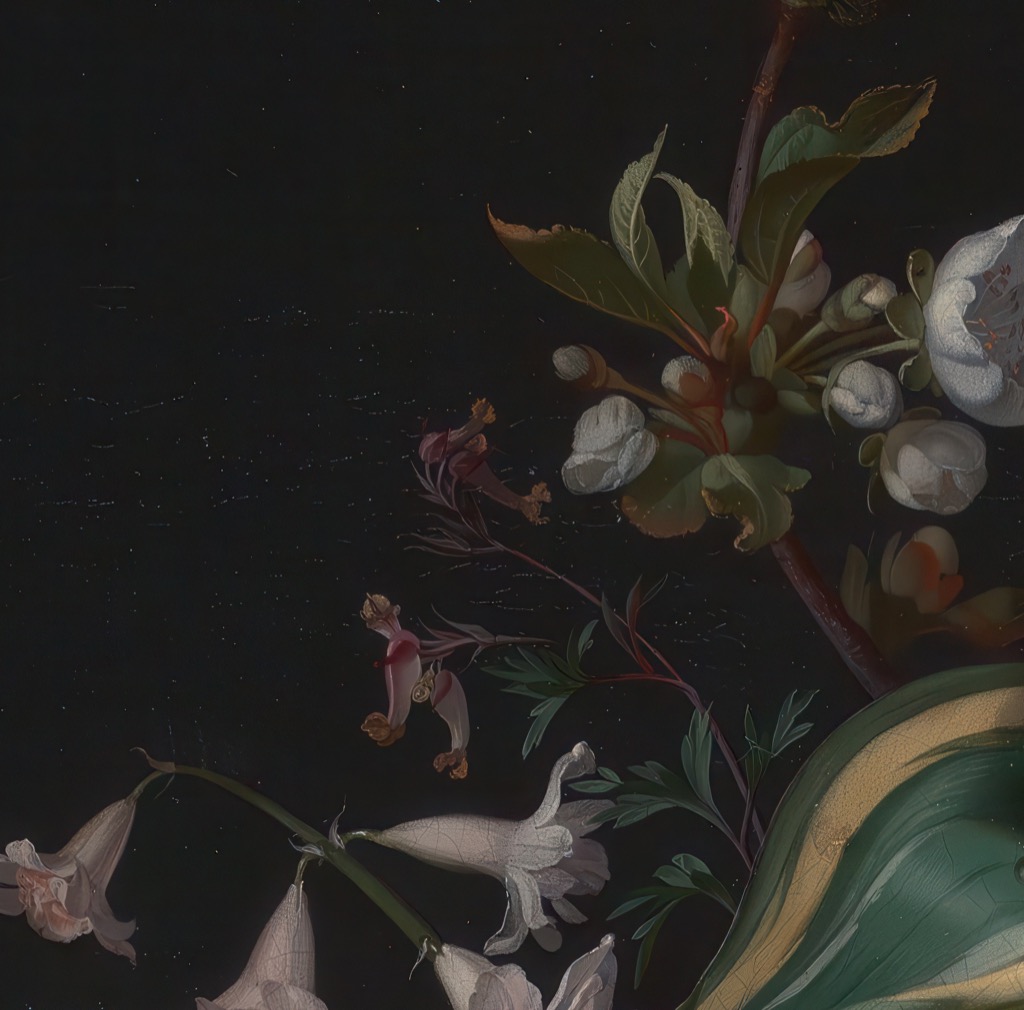
Glass Vase Reflection
The glass vase is both support and optical challenge. Reflections, water and stems have to remain legible without making the vessel feel heavy.
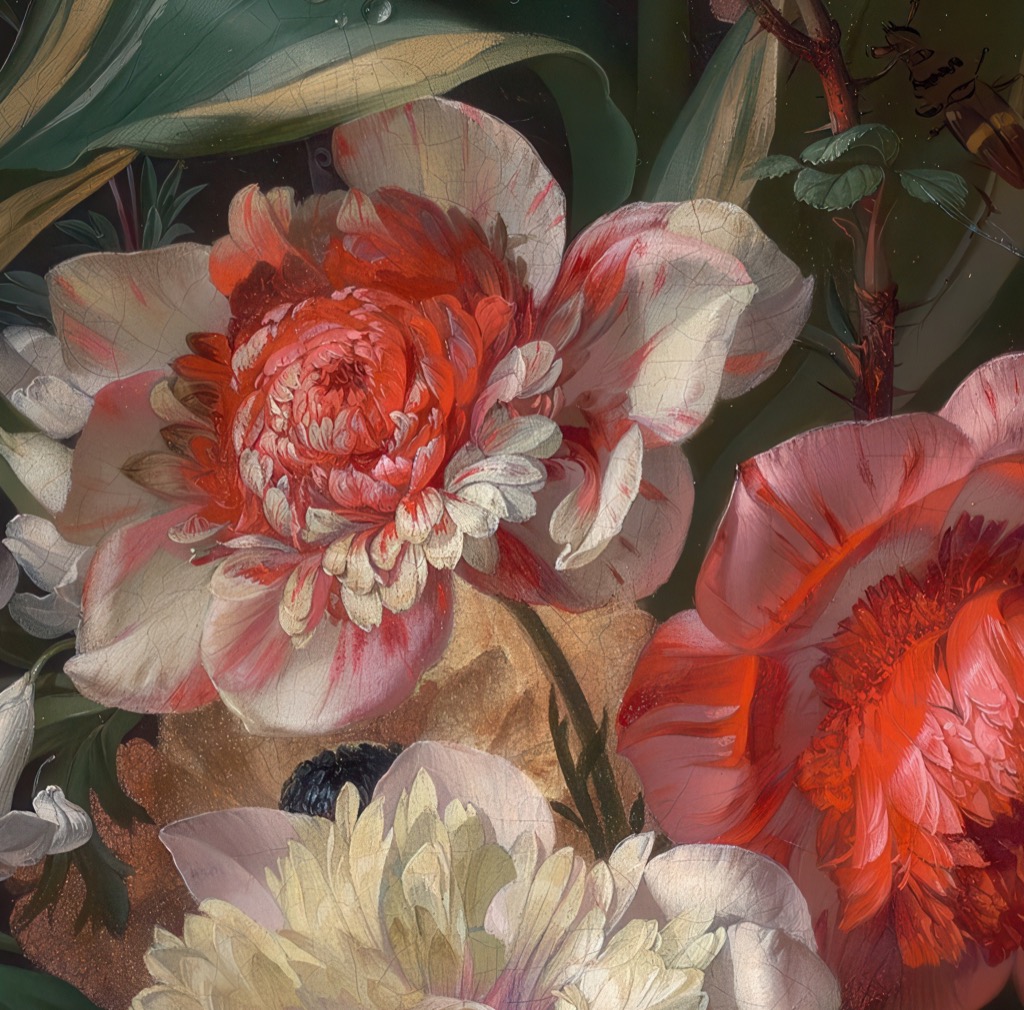
Red Flower and Surface Brilliance
The vivid red flower shows Ruysch's control of layered light. Strong colour is held against the dark ground without flattening the surrounding petals and leaves.
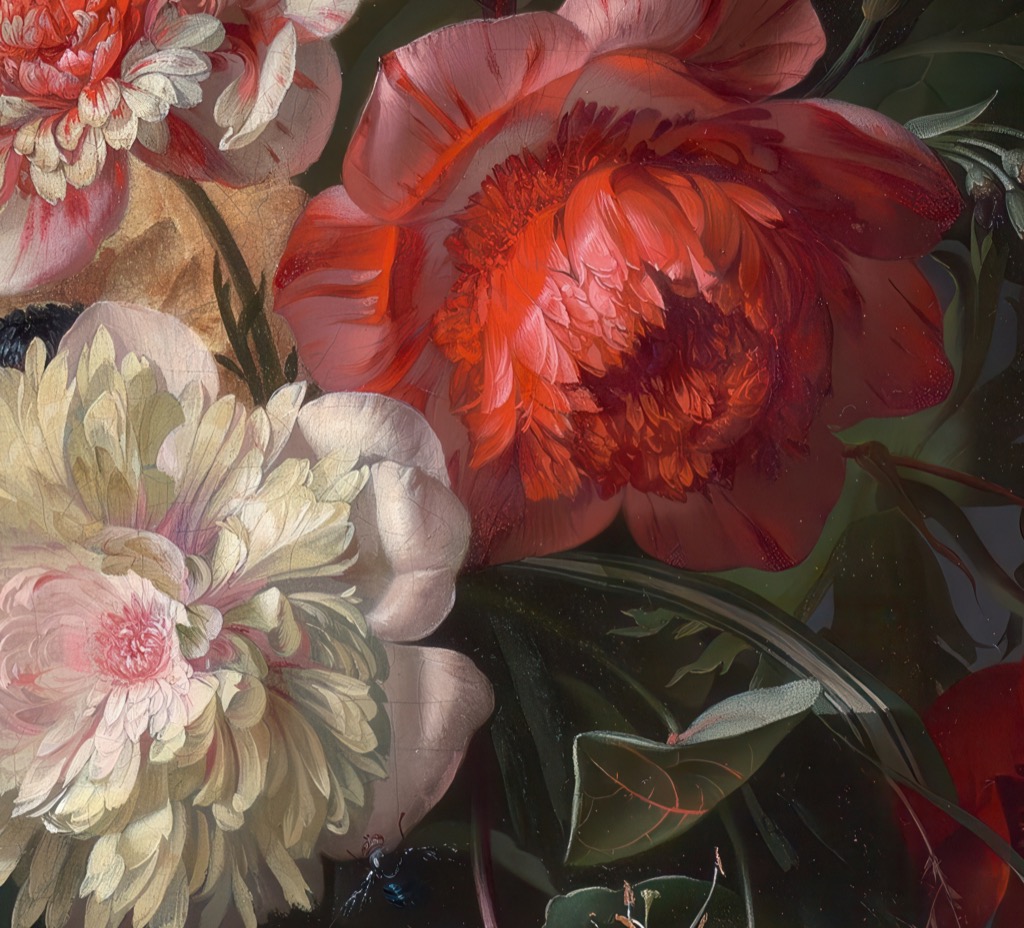
Insects and Curving Leaves
The insects and curling leaves make the bouquet active at a smaller scale. Ruysch asks the viewer to move between spectacular flowers and tiny living details.
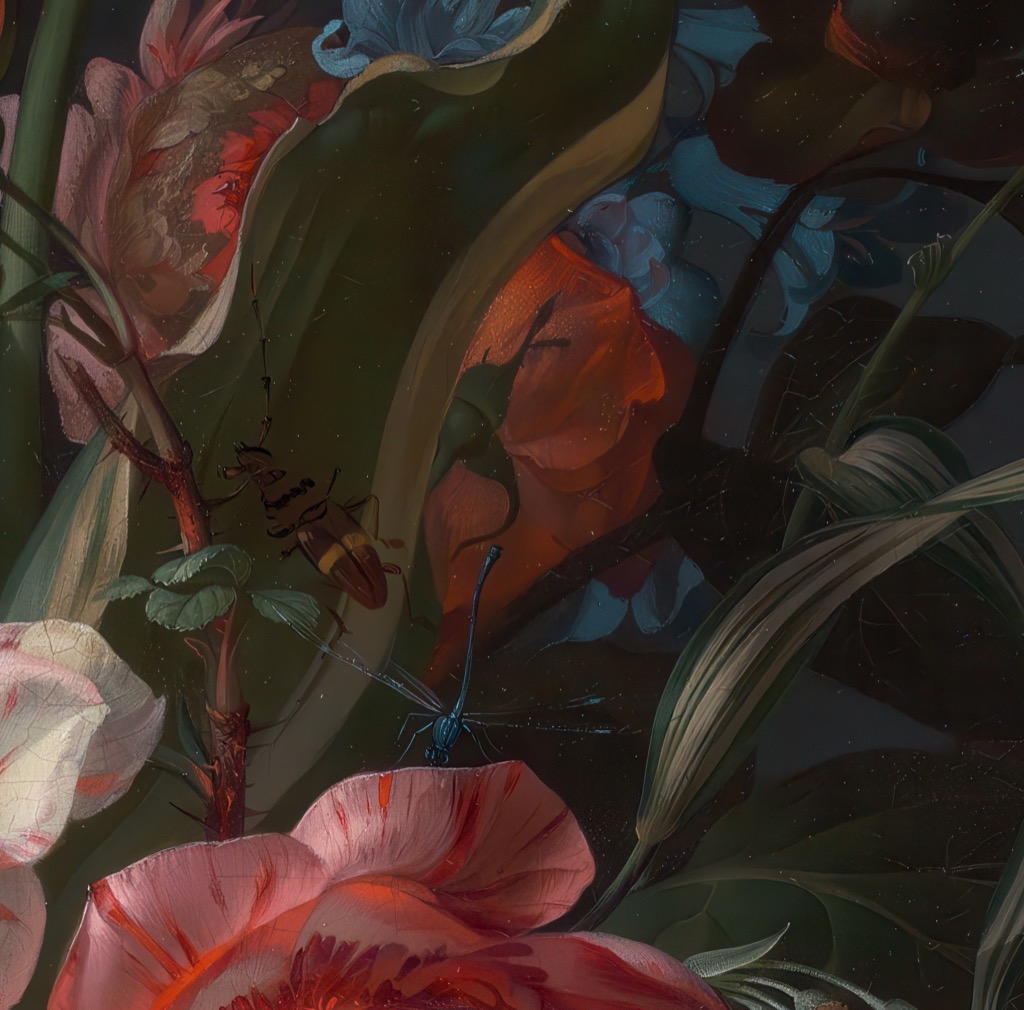
Lower Flowers and Caterpillar
The lower flowers and caterpillar turn the bottom of the image into more than a base. They carry the painting's close-looking rhythm all the way down to the ledge.
Glass, Darkness and Surface Brilliance
The glass vase is the quiet technical challenge at the heart of the painting. A clear vessel must be visible and almost invisible at once. It has to hold stems and water, catch light, reflect surrounding space and still remain transparent. Ruysch uses the vase as a centre of illusion: the bouquet seems physically gathered, yet the painting also asks the viewer to enjoy the artifice of that gathering.
The National Gallery describes a high window reflected in the glass vase and water drops sparkling on leaves.[1] These details matter because they reveal how Ruysch makes the surface come alive. A reflected window turns the vase into an optical object. Water drops make the leaves feel fresh, cool and temporary. Both details are tiny performances of paint, but they persuade the eye that the bouquet is present before us.
The dark ground intensifies that effect. The National Gallery notes that Ruysch kept the dark background associated with seventeenth-century Baroque painting, even as her handling in this work suggests a more delicate early eighteenth-century refinement.[1] Darkness makes the pale flowers brighter, the glass harder to pin down and the insects easier to discover slowly. It also gives the composition depth. Blossoms come forward, leaves twist back, and small highlights flash against shadow.
The painting's technique, as described by the National Gallery, helps explain why the bouquet feels both natural and planned. The museum rejects the old assumption that Dutch flower painters simply added blooms one by one as each came into season. Instead, it explains that artists used flower studies within a preplanned composition.[1] In Ruysch's case, the process likely began with sketched flower and leaf forms on the prepared surface, followed by the background and then layered paint for the blooms, moving from darker tones toward lighter ones and final highlights.[1]
That method is crucial to the painting's meaning. The bouquet looks like a single arrangement, but it is really a composed fiction built from study, memory and design. The glass vase helps make the fiction believable. It gathers the imaginary bouquet into a convincing object.
Flowers, Insects and Cautious Looking
Ruysch's flower paintings often reward a double kind of attention. From a distance, the viewer sees an elegant bouquet. Up close, the painting becomes a field of small discoveries. The National Gallery points to winged creatures, flies, beetles, a damselfly, a hump-backed beetle and a striped caterpillar.[1] These creatures are not decorative extras. They bring movement into still life.
Insects help the bouquet feel like part of nature rather than a static display. They suggest scent, texture, appetite and the passing of time. A flower attracts because it is beautiful, but also because it is alive, vulnerable and useful within a larger natural system. Ruysch's insects make that system visible in miniature.
They also show her patience as a painter. A beetle on a ledge or a caterpillar moving toward the flowers requires a different kind of attention from a large rose or tulip. The viewer must slow down and change scale. That change of scale is part of Ruysch's intelligence. She gives the eye a spectacular tulip, then rewards it for noticing the smallest living details around the bouquet.
Modern viewers often want Dutch still lifes to carry fixed symbolic messages. A tulip may seem to signify rarity, a fading flower may seem to signify mortality, an insect may seem to signal decay. Those readings can be useful when they are tied to evidence, but this painting does not need to become a rigid code. The National Gallery's commentary supports a more flexible reading: the work joins rarity, grief held outside the picture, courtly refinement, scientific knowledge, flower-study practice and decorative grace.[1]
That flexibility is valuable. Flowers in a Glass Vase with a Tulip is not merely a botanical record. It is also not merely a moral lesson. It is a work in which natural detail, painterly brilliance and social prestige occupy the same small canvas.
Ruysch in 1716
The date 1716 places the painting at a significant point in Ruysch's career. The National Gallery notes that this was her final year as court painter to Johan Willem II, Elector Palatine, in Dusseldorf.[1] Its artist page gives the broader chronology: Ruysch worked in The Hague from 1701 to 1708, became the first female member of the artists' society Confrerie Pictura, and then served the Elector Palatine from 1708 to 1716.[5]
Court patronage matters because it shows how highly Ruysch's flower paintings were valued. Her work was not a private pastime or a minor domestic art. It circulated among wealthy and powerful clients who paid for virtuoso still lifes. The Mauritshuis similarly describes her as famous at home and abroad, a court painter for a German prince, and one of the most successful Dutch still-life painters of the seventeenth and eighteenth centuries.[6]
At the same time, Ruysch's achievement should not be swallowed by biography. The National Gallery mentions her children, wealth, bereavement and the paintings she left to her daughters.[1] These details are moving, but the painting itself is not a confession of private grief. The museum is careful to note that grief did not spill into her pictures.[1] The canvas presents refinement, control and professional mastery.
Ruysch's scientific environment also matters, but here again balance is important. She was the daughter of Frederik Ruysch, a botanist, physician and anatomist, and grew up close to Amsterdam's culture of natural knowledge.[5][6] The Museum of Fine Arts, Boston's exhibition Rachel Ruysch: Artist, Naturalist, and Pioneer frames her paintings in relation to plants, insects, specimens, women and scientific knowledge in early modern Europe.[7] That context helps modern viewers understand why her flowers feel so closely observed. It should not make the painting seem like a laboratory illustration. Ruysch turns knowledge into art.
Similar Titles, Different Paintings
Ruysch's glass-vase paintings need careful separation because their titles can sound deceptively alike. The National Gallery work discussed here is Flowers in a Glass Vase with a Tulip, dated 1716, oil on canvas, 46.5 x 36 cm, inventory number L1208.[1] Its title singles out a tulip, and the museum commentary identifies the Semper Augustus as the key bloom.[1]
The Rijksmuseum's Still Life with Flowers in a Glass Vase is a different work. It is dated broadly to about 1690 to about 1720, measures 65 x 53.5 cm, and has the object number SK-A-354.[2] The Rijksmuseum describes a bouquet in a glass vase on a marble tabletop, with flowers including tulips, roses, carnations, irises, poppies, hyacinths and bindweed.[2] It is the Amsterdam object, not the London loan painting.
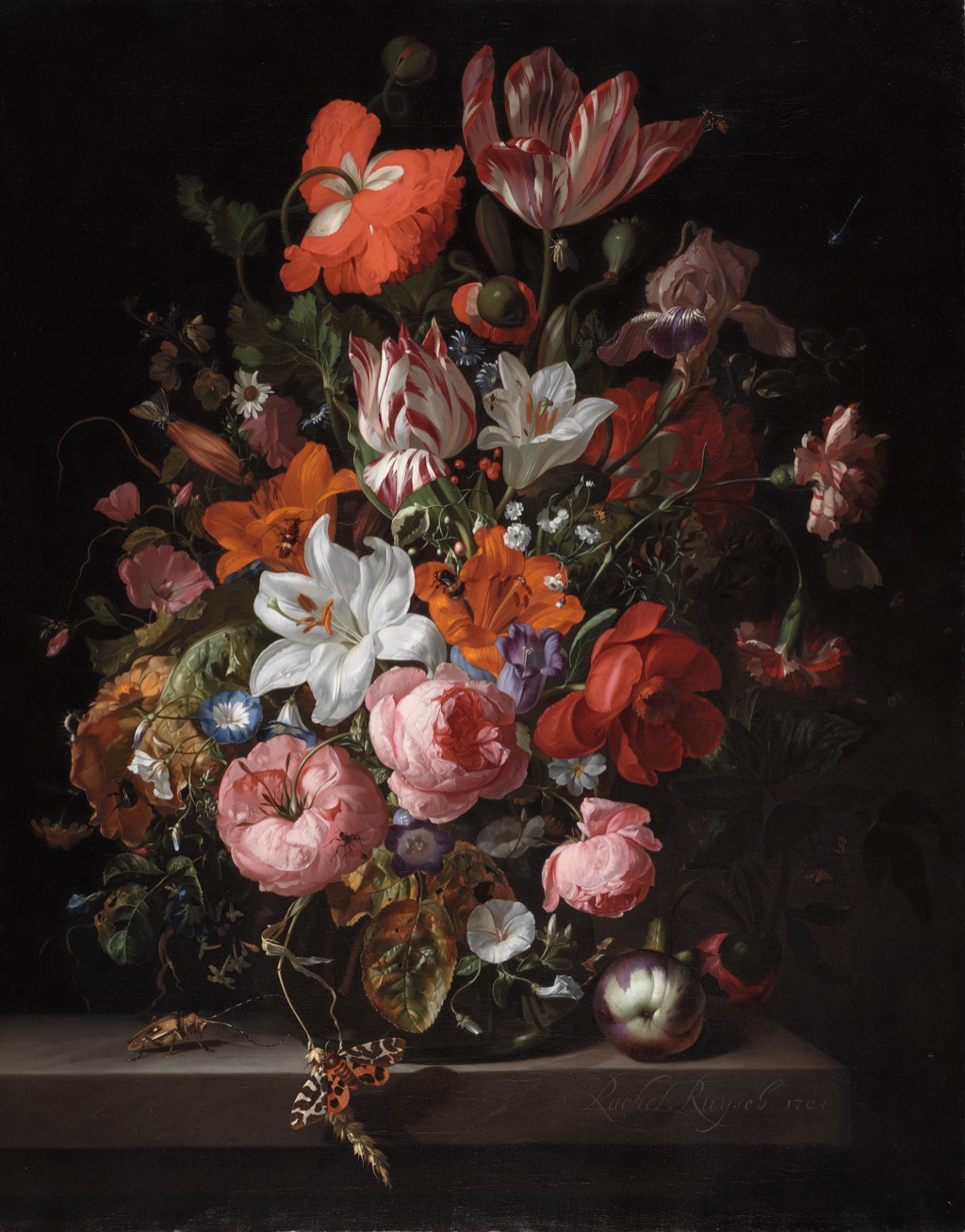
The Detroit Institute of Arts painting titled Flowers in a Glass Vase is also separate. It is dated 1704, measures 83.8 x 67 cm unframed, and belongs to the DIA's European Painting department as accession number 1995.67.[3] The DIA emphasises its large scale, dewdrops, insects and flowers that do not bloom at the same time.[3] That 1704 painting has its own provenance and collection history.
The Mauritshuis Vase with Flowers is dated 1700, measures 79.5 x 60.2 cm, and has the inventory number 151.[4] It is especially known for a bouquet that the Mauritshuis describes as past its peak, with drooping flowers and a cut-off opium poppy creating depth.[4] Its title does not include "glass," and its visual drama is different from the National Gallery painting's tulip-centred refinement.
The differences are worth spelling out because Ruysch returned to vase-and-flower formats throughout her career. Repetition of a format did not mean repetition of a painting. Each version changed the balance of scale, surface, season, mood and display. The National Gallery work stands out for its compact size, late date, signed and dated status, dark-ground delicacy and emphasis on the Semper Augustus tulip.
Why the Painting Matters
Flowers in a Glass Vase with a Tulip matters because it shows Ruysch refining a famous still-life formula without emptying it of seriousness. The painting has the elements viewers expect from a Dutch flower piece: a vase, a dark ground, brilliant blooms, insects and meticulous finish. Yet it also has a distinctive late-career elegance. The tulip is spectacular, but the painting is not loud. Its drama is concentrated.
The work is also a useful entry point into Rachel Ruysch's flower paintings because it makes several of her central habits easy to see. She builds an arrangement that looks natural but depends on planning. She uses flowers named by the museum record while keeping the total bouquet richer than any short list. She brings insects into the scene so the still life feels alive. She uses glass and water drops to make paint behave like light.
For comparison, the painting sits naturally beside the Rijksmuseum Still Life with Flowers in a Glass Vase, the DIA Flowers in a Glass Vase, and the Mauritshuis Vase with Flowers. It also connects to Ruysch's style and technique, especially her use of dark grounds, layered highlights, glass, insects and carefully controlled asymmetry.
Most of all, the painting helps explain why Ruysch cannot be treated as a marginal flower specialist. Her still lifes join pleasure and intellect. They require botanical looking, painterly looking and historical looking at once. In this 1716 work, the prized tulip draws the eye upward, but the painting's achievement lies in the whole arrangement: the glass that holds it, the darkness that frames it, the insects that animate it and the painterly discipline that makes a fiction feel freshly alive.
Frequently Asked Questions
Discussion
In Flowers in a Glass Vase with a Tulip, does the most powerful impression come from the rare tulip, the glass-vase illusion, or the small insects and water drops that make the bouquet feel alive?
Reader Insights
Notice how the title directs your eye to one flower, even though the painting is full of competing details.
Compare the National Gallery painting with Ruysch's other glass-vase works before assuming similar titles describe the same object.
Look for the tension between natural observation and artistic invention: the bouquet feels real, but it is carefully composed.
Join the Conversation
Share a thoughtful observation about Rachel Ruysch, the painting, or the wider still-life tradition that would help another reader look more carefully.
References
- National Gallery, London, "Rachel Ruysch, Flowers in a Glass Vase with a Tulip, 1716." https://www.nationalgallery.org.uk/paintings/rachel-ruysch-flowers-in-a-glass-vase-with-a-tulip
- Rijksmuseum, "Still Life with Flowers in a Glass Vase, Rachel Ruysch, c. 1690-c. 1720." https://www.rijksmuseum.nl/en/collection/object/Still-Life-with-Flowers-in-a-Glass-Vase--210e3fc99bb8b3a875fcd7b57fce1a83
- Detroit Institute of Arts, "Flowers in a Glass Vase." https://dia.org/collection/flowers-glass-vase/66064
- Mauritshuis, "Vase with Flowers." https://www.mauritshuis.nl/en/our-collection/artworks/151-vase-with-flowers
- National Gallery, London, "Rachel Ruysch." https://www.nationalgallery.org.uk/artists/rachel-ruysch
- Mauritshuis, "Rachel Ruysch (1664-1750)." https://www.mauritshuis.nl/en/our-collection/our-masters/rachel-ruysch/
- Museum of Fine Arts, Boston, "Rachel Ruysch: Artist, Naturalist, and Pioneer." https://www.mfa.org/exhibition/rachel-ruysch-artist-naturalist-and-pioneer
- Main image reference: Rachel Ruysch, Flowers in a Glass Vase with a Tulip, 1716. Image supplied for local manual-test build; object record via National Gallery, London. https://www.nationalgallery.org.uk/paintings/rachel-ruysch-flowers-in-a-glass-vase-with-a-tulip