Buy Art Prints Now
from Amazon
* As an Amazon Associate I earn from qualifying purchases.
Image reference [1]
 by Tom Gurney
Tom Gurney BSc (Hons) is an art history expert with over 20 years experience
Published on August 25, 2026 / Updated on September 6, 2026
Email: tomgurney1@gmail.com / Phone: +44 7429 011000
Still Life with Flowers on a Marble Tabletop: Introduction
Rachel Ruysch's Still Life with Flowers on a Marble Tabletop is a small painting with a startling amount of life inside it. Painted in 1716 and now in the Rijksmuseum, the work shows a blue glass vase crowded with flowers on a marble ledge. The bouquet seems at first to be a triumph of simple observation: petals open, stems twist, insects move among leaves, and the tabletop gives the whole arrangement a cool, polished stage. Yet the painting is not a record of one vase placed before the artist. It is an artful construction, built from close study, professional memory, and the flower painter's ability to make many moments of nature appear to bloom at once.
The Rijksmuseum describes the bouquet as containing more than ten flower species and "teeming" with insects.[1] Its own object data identifies roses, poppies, irises, carnations, and bindweed among the flowers.[2] That limit matters. Ruysch's art invites botanical curiosity, but one of the strengths of this painting is that it keeps precision and wonder in balance. It gives the impression of abundance without making every plant into a label. The viewer is asked to look closely, not merely to name.
Made when Ruysch was already one of Europe's most celebrated painters of floral still lifes, Still Life with Flowers on a Marble Tabletop is also a mature-career statement. By 1716 she had decades of experience behind her, a reputation among elite collectors, and recent service as court painter to Johann Wilhelm, Elector Palatine, in Dusseldorf.[3] The painting belongs to a world in which flower pieces could be luxury objects, scientific performances, feats of brushwork, and meditations on the living world all at once.
At a Glance
- ArtistRachel Ruysch (1664-1750)
- TitleStill Life with Flowers on a Marble Tabletop
- Date1716
- MediumOil on canvas
- Dimensions48.5 cm high x 39.5 cm wide
- CollectionRijksmuseum, Amsterdam
- Object numberSK-A-2338
- Signature and date"Rachel Ruysch 1716"
- AcquisitionPurchased in 1908 with support from the Vereniging Rembrandt
- SubjectA flower piece with flowers in a vase and insects
Contents
- Introduction
- A Bouquet That Could Not Simply Exist
- Composition: A Small Stage With Deep Space
- Flowers, Insects, and the Living Surface
- Study, Memory, and Flower-Painting Technique
- Ruysch in 1716: A Mature Painter at Full Command
- Why This Painting Still Feels Fresh
A Bouquet That Could Not Simply Exist
The first surprise of Still Life with Flowers on a Marble Tabletop is not its illusionism, but its improbability. The painting persuades the eye before the mind begins to object. A blue glass vase supports a bouquet in which spring and summer seem to have negotiated a private truce. The flowers are gathered into a single display, yet they do not all belong to one natural moment.
The Rijksmuseum makes the point directly: because the blossoms flower at different times, assembling such a bouquet in real life would have been difficult.[1] That observation is central to understanding Ruysch's art. Dutch flower still lifes are often admired as records of observation, and Ruysch certainly deserves that admiration. But her flower pieces are not botanical snapshots. They are planned compositions made from many acts of looking.
The museum's object description identifies a bouquet in a blue glass vase with, among other flowers, roses, poppies, irises, carnations, and bindweed.[2] Those names give us a useful foothold without exhausting the painting. Roses bring layered softness. Poppies can suggest thin, mobile petals. Irises introduce blade-like forms and sharper accents. Carnations add fringed textures. Bindweed contributes curling, climbing movement. Together they allow Ruysch to vary surface, silhouette, colour, and direction.
The point is not that Ruysch assembled a florist's fantasy in defiance of nature. It is subtler than that. She knew the life cycles of flowers well enough to combine them convincingly across time. The impossible bouquet is possible as painting because its parts are studied with care. The work proposes a special kind of truth: not the truth of one hour in one room, but the truth of repeated attention.
This is why the painting feels both natural and composed. Each flower has its own weight and direction, yet the bouquet also reads as a whole. It is a fiction made from disciplined observation. The fiction is not a weakness. It is the engine of the painting.
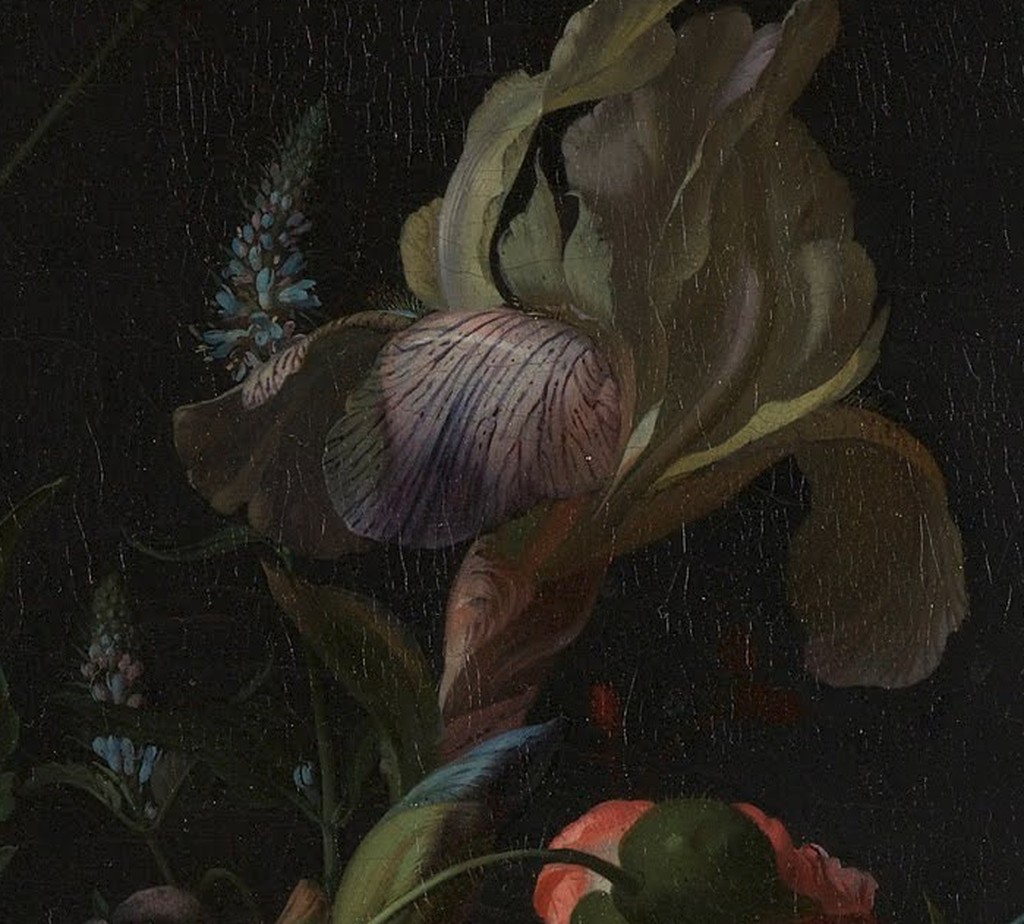
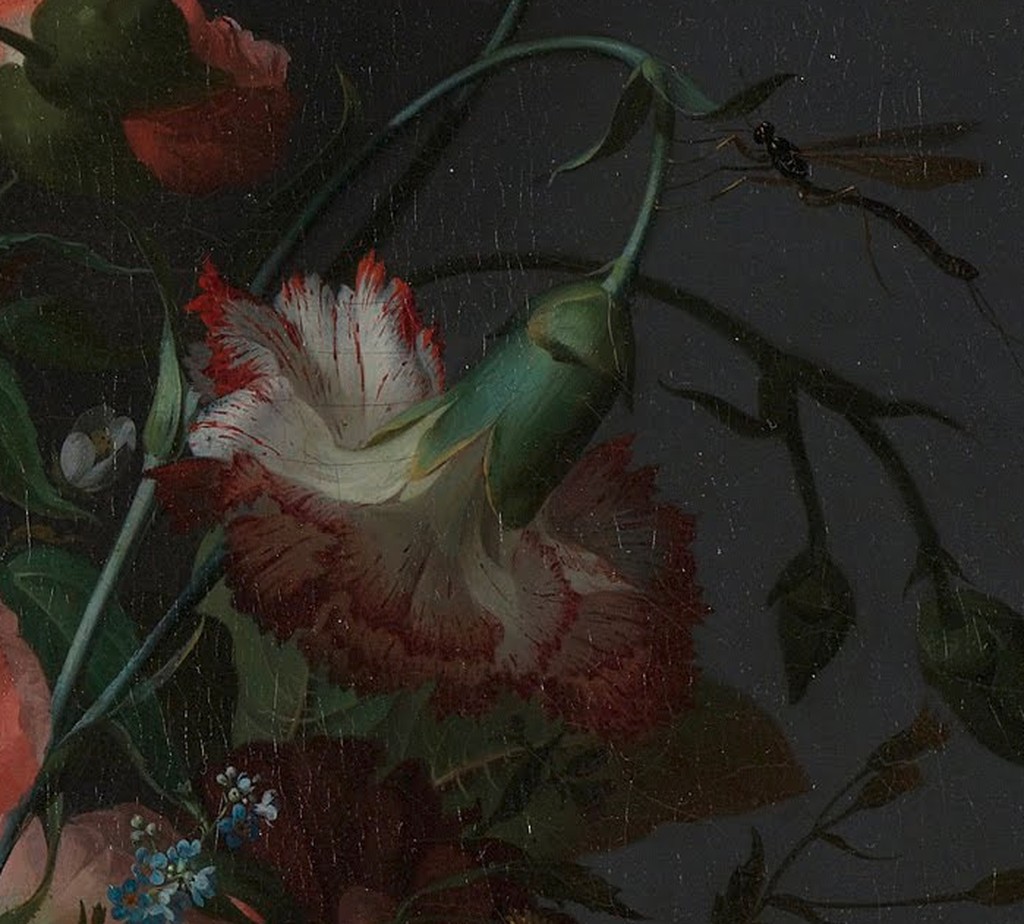
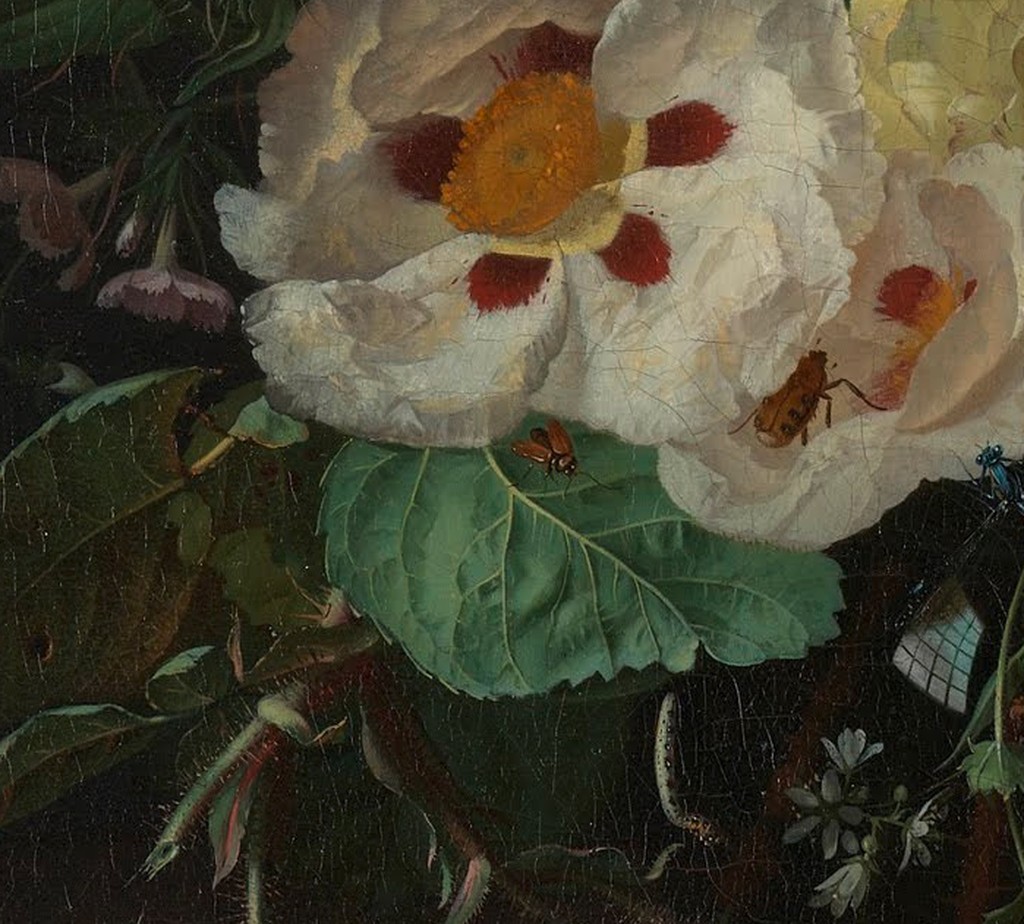
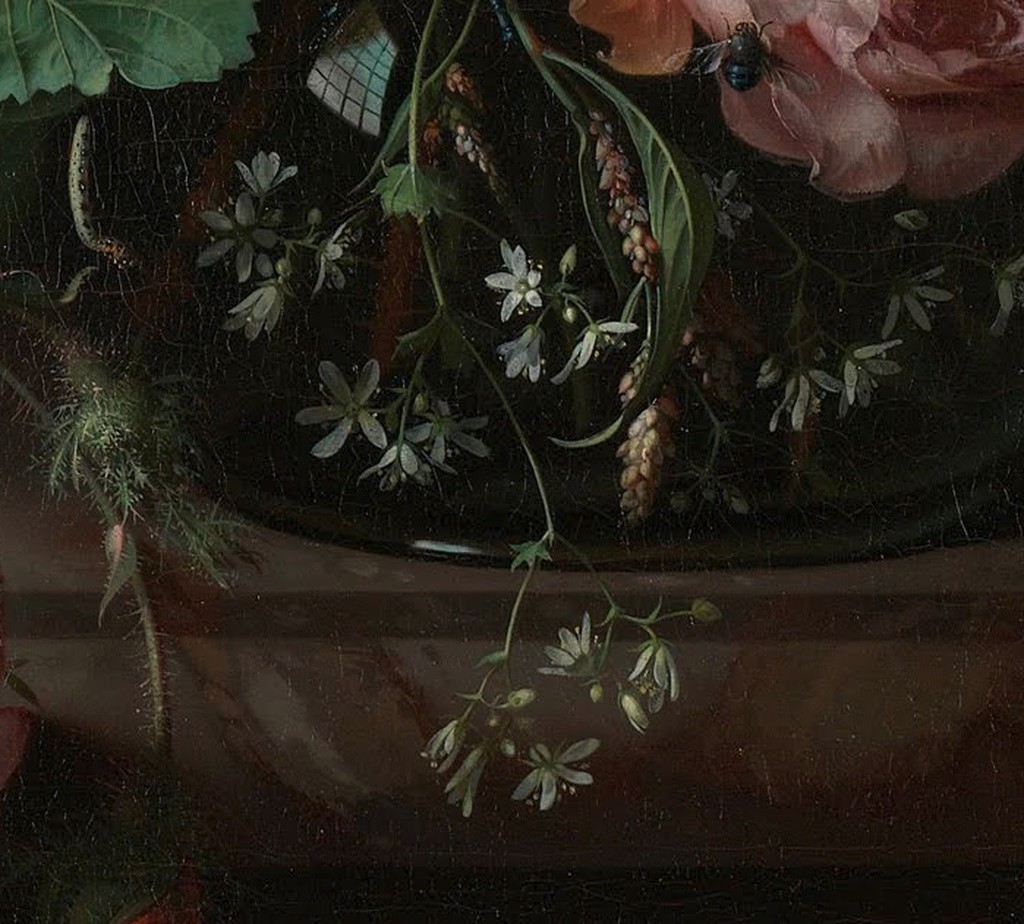
Annotated Details from Still Life with Flowers on a Marble Tabletop
This annotated close reading isolates six passages where Ruysch turns a flower still life into a study of structure, light and minute observation. The labels avoid speculative botanical identification and focus instead on visible pictorial decisions: how the bouquet rises from a dark ground, how insects and petals animate the surface, and how the marble ledge keeps the abundance physically convincing.
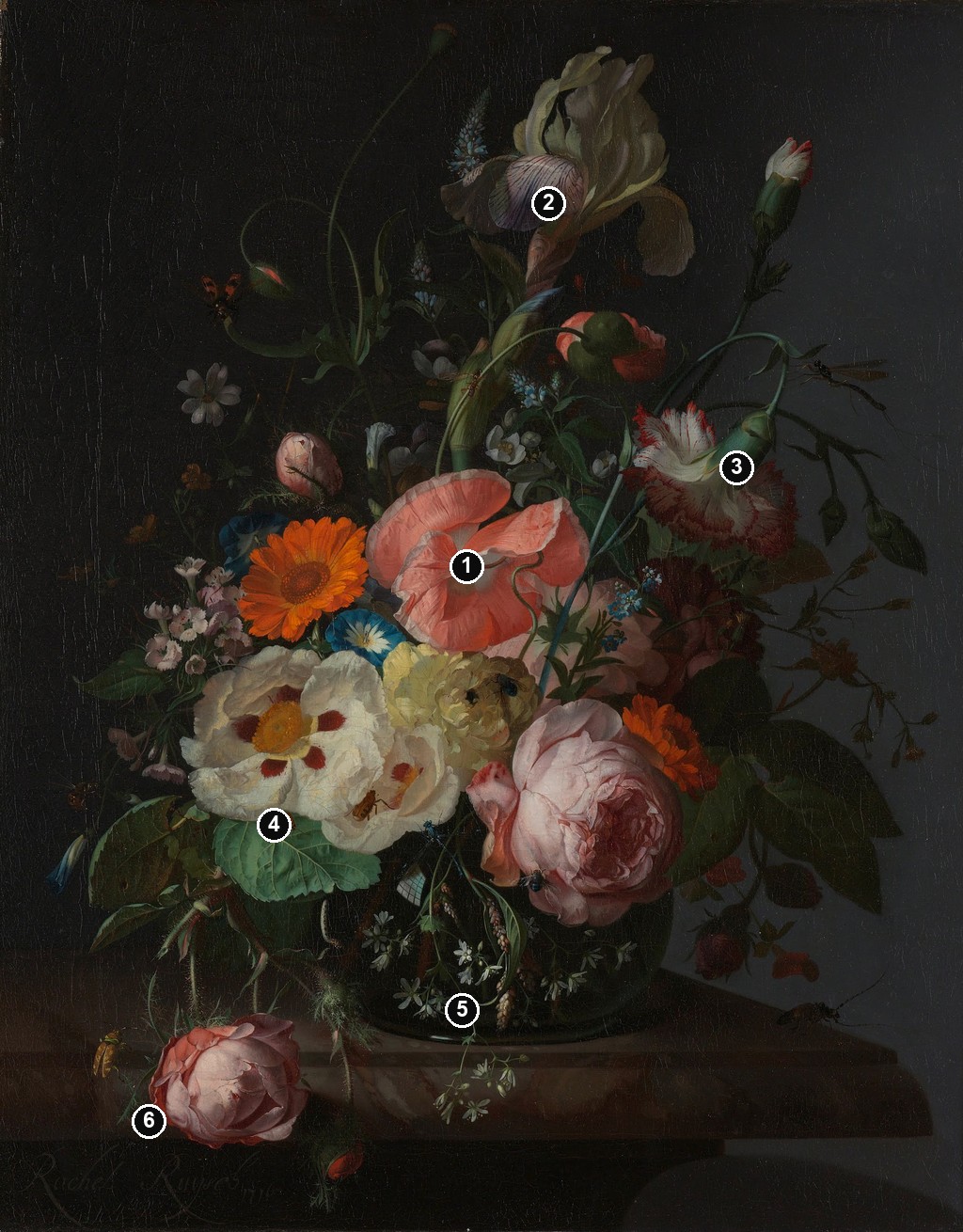
Details from STILL LIFE WITH FLOWERS ON A MARBLE TABLETOP
The selected details move from the brightest flower masses to the darker upper stems and the marble ledge, showing how Ruysch balances botanical precision with a carefully staged visual rhythm.
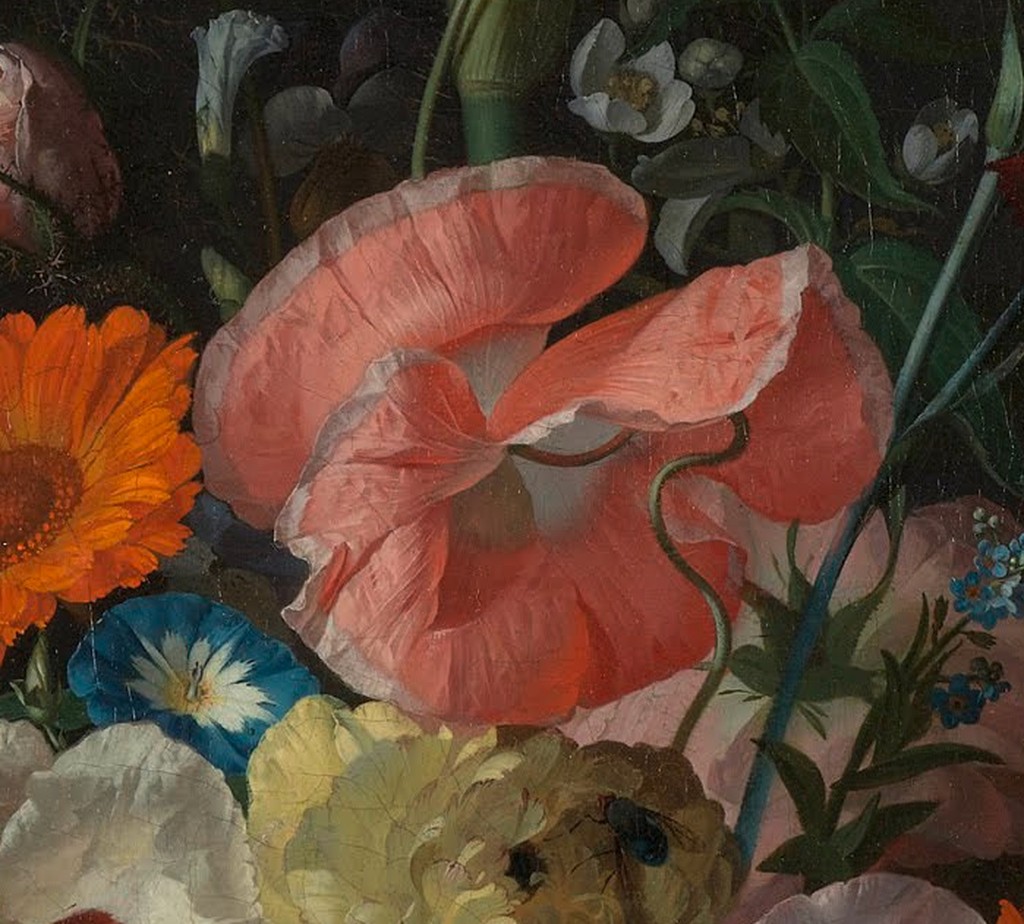
Central Pink Bloom
The large pink bloom sits near the centre of the bouquet, but it does not flatten the composition. Its folded petals, curling stem and neighbouring leaves create a turning movement that links the dense lower flowers to the taller stems above.
Striped Upper Flower
Near the top, a striped flower opens against the dark background. Ruysch uses cooler colour, fine veining and shadowed petals to make this upper passage feel both delicate and structurally important within the bouquet.
Right-Hand White Flower
The white and red-edged flower on the right interrupts the darker side of the arrangement. Its lit petals pull attention outward while the curved stem behind it keeps the eye moving back into the centre.
White Petals and Insect
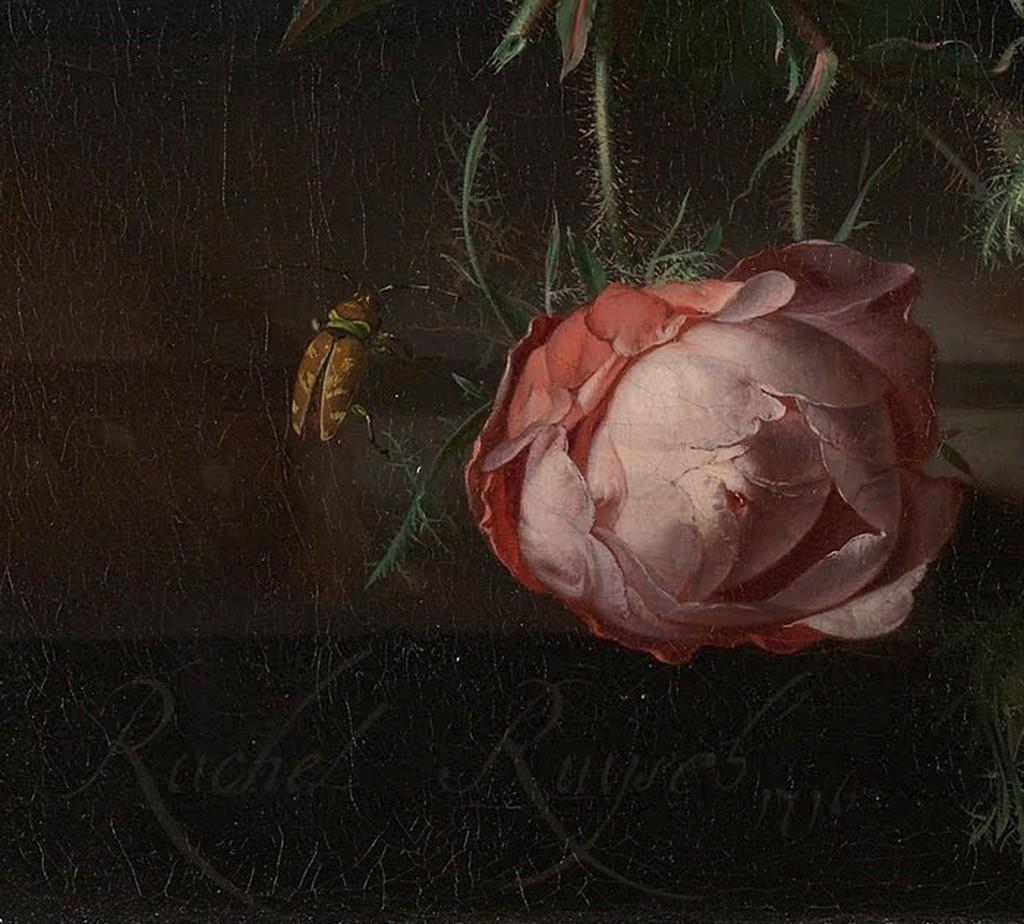
In the lower cluster, pale petals and small insects demonstrate Ruysch's taste for close looking. The insects are not treated as casual decoration; they sharpen the sense that the flowers are living, fragile things placed in a temporary arrangement.
Glass, Stems and Table Edge
The lower vase and table edge anchor the bouquet. Dark glass, trailing stems and the horizontal ledge prevent the flowers from becoming a floating display, giving the still life its physical weight and illusionistic base.
Fallen Rose on the Marble
The fallen rose extends the arrangement beyond the vase. Its placement on the marble ledge turns the bottom of the painting into an active threshold between display, touch and transience.
Composition: A Small Stage With Deep Space
The painting is modest in scale: 48.5 cm high and 39.5 cm wide.[1] That size matters because the bouquet feels larger in experience than it is in measurement. Ruysch compresses a great deal into a vertical format. The marble tabletop gives the flowers a horizontal base, while the vase and stems drive the eye upward into a rising mass of petals and leaves. The dark surrounding space sharpens the edges of the forms and makes the flowers appear to emerge from shadow.
Ruysch had trained with Willem van Aelst, one of the leading still-life painters in Amsterdam. The Rijksmuseum's Dutch story on Ruysch notes Van Aelst's influence especially in diagonal compositions and varied arrangements of flowers of different kinds and sizes.[4] That training is visible in the way this bouquet avoids stiff symmetry. The arrangement does not rise like a formal cone. It leans, opens, curls, and turns.
The eye moves through the painting along changes in pressure. Some flowers face outward as bright declarations. Others are partly hidden, turned sideways, or tucked behind leaves. The larger blossoms create visual anchors, while smaller stems and tendrils keep the surface active. This balance between display and concealment is one of Ruysch's great pleasures. She gives enough order for the bouquet to read clearly, then fills that order with small surprises.
The marble tabletop is more than a convenient ledge. It gives the picture a material contrast: cool stone below, living forms above. The tabletop also separates the viewer's space from the painted world. Its front edge implies nearness, as though the bouquet has been placed just beyond reach. Still-life painters often used ledges in this way, but Ruysch turns the device into a test of attention. The painting invites a viewer to scan the border between object and illusion: the vase, the stems, the insects, the leaves that edge toward the open air.
The blue glass vase is equally important. Glass lets Ruysch show depth without opening a landscape. It is a compact optical world: reflective, translucent, and darkened by water and stems. Even where the viewer cannot fully disentangle the interior, the vase tells us that this bouquet has a structure. It is not merely a cloud of flowers. It has weight, support, and a hidden architecture.
Flowers, Insects, and the Living Surface
One reason Ruysch's flower pieces hold attention is that they are never only about flowers. The Rijksmuseum classifies the work's subjects as flowers in a vase, insects, and a flower piece.[1] Insects are not secondary decoration here. They animate the bouquet, shift the scale of looking, and remind the viewer that floral beauty belongs to a living ecosystem.
The painting asks for two kinds of viewing. From a distance, the bouquet appears as an elegant arrangement. Up close, it becomes a small world of encounters. Leaves overlap. Stems disappear. Petals turn into shelters and landing places. Insects make the painting feel inhabited rather than arranged. They also complicate the idea of perfection. A flower still life can present ideal blooms, but insects bring movement, appetite, and vulnerability into the display.
The Rijksmuseum's broader account of Ruysch describes her still lifes as microcosms in which life seems to swarm among leaves. It also notes that her flowers, snakes, snails, and insects were painted with such accuracy that they can still be recognized today.[5] The Marble Tabletop painting fits that larger habit of mind. Its insects sharpen the viewer's sense that the bouquet is not frozen. Even in stillness, the forms imply time.
That sense of time is important because flower paintings can easily become pure spectacle. Ruysch avoids that. The blossoms may be carefully selected and arranged, but the insects draw attention to the fragile conditions of beauty. A petal is also a surface that can be touched, eaten, entered, or passed over. A stem is also a path. A leaf is also a hiding place. The painting's refinement does not cancel nature's restlessness.
The insects also show Ruysch's technical range. Petals require one kind of touch: transitions of colour, soft edges, thin veils, and curled surfaces. Insects demand another: tiny legs, hard bodies, wings, and points of reflected light. The shift in scale displays a painter capable of moving from broad composition to minute detail without losing coherence. The bouquet never dissolves into a catalogue of details, yet each detail feels available.
Study, Memory, and Flower-Painting Technique
The Rijksmuseum explains that Ruysch's extensive study of live and prepared flowers allowed her to paint vivid bouquets with great precision.[1] That sentence is the key to the painting's method. Ruysch did not need all the flowers to be fresh in front of her at once. She could draw on studies, preserved specimens, botanical knowledge, and workshop practice.
Her upbringing gave her unusual access to the natural world as a field of study. Her father, Frederik Ruysch, was a professor of anatomy and botany in Amsterdam and taught at the Hortus Botanicus. He collected botanical, zoological, and anatomical specimens and developed methods of preservation that helped specimens retain a lifelike appearance.[4] The Mauritshuis likewise emphasises that Rachel Ruysch drew and painted from her father's collection and that her flower paintings combined living and preserved models.[6]
This background should not reduce Rachel Ruysch to her father's daughter. It matters because it helps explain the environment in which her eye was trained. She grew up near collections where looking closely was not a casual activity but a disciplined practice. Plants, insects, shells, animals, and preserved anatomical specimens were studied, displayed, classified, and admired. Ruysch turned that culture of observation into a painterly language of her own.
The National Gallery's discussion of another Ruysch flower painting from 1716 helps clarify how such bouquets were made. It notes that the old idea of Dutch flower painters adding each bloom as it came into season has been reconsidered. Instead, artists used collections of flower studies to fill a planned composition. The same account describes Ruysch beginning with sketched forms on the prepared surface, painting the background around reserved flowers and leaves, building the forms in layers from darker tones toward lighter ones, and finishing with delicate highlights.[7]
That technical sequence is useful when looking at Still Life with Flowers on a Marble Tabletop. The painting's abundance does not mean improvisation. Its liveliness depends on planning. Ruysch had to know where the major flowers would sit, how much dark ground would remain between them, where stems would cross, and how the smaller forms would keep the eye moving. A successful flower piece of this kind needs both botanical credibility and pictorial control.
The title of a technical study listed in the Rijksmuseum documentation, "Een evenwichtige wemeling" - roughly, "a balanced swarm" - captures the paradox of Ruysch's art.[8] Her paintings can feel crowded, but they are not chaotic. The viewer senses profusion because so much is happening; the viewer senses harmony because Ruysch manages that activity through placement, contrast, and finish.
Ruysch in 1716: A Mature Painter at Full Command
By 1716, Ruysch was not an emerging painter testing a formula. She was a mature artist with an established European reputation. The Rijksmuseum describes her as one of the most successful artists of her day and notes that her highly detailed floral still lifes were admired for lifelike roses, poppies, carnations, and irises.[9] The Mauritshuis calls her one of the most successful Dutch still-life painters of the seventeenth and eighteenth centuries, famous at home and abroad.[6]
Her career also reached into elite patronage. From 1708 to 1716, Ruysch worked for Johann Wilhelm, Elector Palatine, while remaining in Amsterdam with her family.[6] RKD Studies records a contemporary visitor's report from 1711 that Ruysch was expected to deliver one painting a year to the Elector Palatine in Dusseldorf.[3] The arrangement says a great deal about her status. Ruysch's skill was valued highly enough that a court appointment did not require permanent relocation.
This context changes how we read the Rijksmuseum painting. Still Life with Flowers on a Marble Tabletop is not merely pretty or decorative. It belongs to a late Baroque and early eighteenth-century market in which flower paintings could circulate among wealthy citizens, courtly collectors, and international patrons. Such works displayed taste, knowledge, access, and money. Rare or out-of-season flowers could suggest connections to gardens, trade, collecting, and learned observation.
At the same time, Ruysch's success should not be turned into a simplified story of overcoming. She did work in a field where gender shaped expectations, and sources repeatedly note how unusual her professional continuity was after marriage. But the painting itself asks us to begin with artistic command. Ruysch's biography helps explain the conditions of her career; it should not replace the evidence of the canvas. In 1716 she was making paintings that condensed decades of looking, practice, reputation, and technical refinement.
The signature and date recorded by the Rijksmuseum - "Rachel Ruysch 1716" - are therefore more than archival details.[1] They mark authorship at a high point of professional confidence. Ruysch's name on the canvas belongs to a painter whose work was collected, praised, and studied during her lifetime.
Why This Painting Still Feels Fresh
The enduring appeal of Still Life with Flowers on a Marble Tabletop lies in its refusal to settle into one category. It is a botanical display, but not botanical illustration. It is a luxury still life, but not mere ornament. It is an impossible bouquet, but not a fantasy detached from observation. It is a technical performance, but its brilliance serves the sensation of life.
That layered identity is one reason recent scholarship has returned to Ruysch with such energy. The 2024-2025 Rachel Ruysch: Artist, Naturalist, and Pioneer exhibition and the accompanying Rachel Ruysch: Nature into Art publication frame her achievement across art, natural history, collecting, and gendered professional history.[10]
The painting also rewards modern viewers because it changes with distance. Seen quickly, it offers abundance: a bouquet against darkness, a blue vase, a stone ledge, a gathering of colour. Seen slowly, it becomes a choreography of particulars. The flowers do not simply fill space; they direct attention. The insects do not simply decorate; they animate. The marble does not simply support; it cools and stabilizes the scene.
Ruysch's art can seem, at first glance, to belong to a vanished culture of collectors, court patrons, and botanical cabinets. But the painting's basic questions remain immediate. How do we make sense of nature when we arrange it? What happens when observation becomes artifice? Can a painting be truthful when it shows something that could not have existed in one moment?
Ruysch's answer is visual rather than theoretical. She builds a bouquet that could not easily be gathered and makes it feel persuasive through close study. She fills a modest canvas with flowers that bloom across time and insects that pull the scene back into time. She turns a tabletop into a world.
That is why the painting still feels alive. Its illusion is not a trick played on the viewer. It is an invitation to look with the same patience that made the painting possible.
The painting is also a compact way into Ruysch's wider career. It belongs beside the broader story of Rachel Ruysch, her flower paintings, and the scientific culture explored in Rachel Ruysch: Art and Science.
Frequently Asked Questions
Discussion
When you look at Ruysch's bouquet, do you notice the overall arrangement first, or do the small insects and hidden details pull you into the painting before the composition does?
Reader Insights
Notice how the marble tabletop changes the mood of the bouquet. Does it make the flowers feel more precious, more fragile, or more staged?
Compare the painting's "impossible" bouquet with a real seasonal bouquet. What kind of truth does Ruysch gain by combining flowers that would not naturally bloom together?
Look for the places where the painting shifts scale: large blossoms, small petals, thin stems, tiny insects. How does Ruysch keep all those levels from becoming disorderly?
Join the Conversation
Share a thoughtful observation about Rachel Ruysch, the painting, or the wider still-life tradition that would help another reader look more carefully.
References
- Rijksmuseum, Still Life with Flowers on a Marble Tabletop, Rachel Ruysch, 1716, object number SK-A-2338. https://www.rijksmuseum.nl/en/collection/object/---570d1419506e38cb3916f640fe5a2328
- Rijksmuseum object data for Still Life with Flowers on a Marble Tabletop, description identifying roses, poppies, irises, carnations, bindweed, a blue glass vase, a marble tabletop, and insects. https://www.rijksmuseum.nl/en/collection/object/---570d1419506e38cb3916f640fe5a2328
- RKD Studies, "Court Paintings for Johann Wilhelm II, Elector Palatine (1708-1716)," in Masters of Mobility. https://masters-of-mobility.rkdstudies.nl/6-still-life-painter-rachel-ruysch-1664-1750-and-her-connections-to-germany/62-court-paintings-for-johann-wilhelm-ii-elector-palatine-1708-1716/
- Rijksmuseum, "Rachel Ruysch," Dutch Masters story, sections on artistic and scientific milieu, Willem van Aelst, flower compositions, flower science, and microcosms. https://www.rijksmuseum.nl/nl/stories/nederlandse-meesters/story/rachel-ruysch
- Rijksmuseum, "Rachel Ruysch," Dutch Masters story, "Microcosmos" section. https://www.rijksmuseum.nl/nl/stories/nederlandse-meesters/story/rachel-ruysch
- Mauritshuis, "Rachel Ruysch (1664-1750)." https://www.mauritshuis.nl/en/our-collection/our-masters/rachel-ruysch
- National Gallery, London, Rachel Ruysch, Flowers in a Glass Vase with a Tulip, 1716, in-depth discussion of flower-study practice and painting technique. https://www.nationalgallery.org.uk/paintings/rachel-ruysch-flowers-in-a-glass-vase-with-a-tulip
- Rijksmuseum documentation for SK-A-2338, listing M. van Eikema Hommes and A. Wallert, "Een evenwichtige wemeling. Over de schildertechniek van Rachel Ruysch," Kunstschrift 44, no. 1 (2000), pp. 39-44. https://www.rijksmuseum.nl/en/collection/object/---570d1419506e38cb3916f640fe5a2328
- Rijksmuseum, Rachel Ruysch artist page. https://www.rijksmuseum.nl/en/collection/node/Rachel-Ruysch--3eaff215275e2ebd47d02cfba2044cc8
- Robert Schindler, Bernd Ebert, and Anna C. Knaap, eds., Rachel Ruysch: Nature into Art. MFA Publications, 2024. Exhibition/publication page: https://www.mfa.org/exhibition/rachel-ruysch-artist-naturalist-and-pioneer
- Main image reference: Rachel Ruysch, Still Life with Flowers on a Marble Tabletop, 1716. Public-domain image via Wikimedia Commons / Rijksmuseum. https://commons.wikimedia.org/wiki/File:Rachel_Ruysch_-_Still_life_with_flowers_on_a_marble_tabletop.jpg