Buy Art Prints Now
from Amazon
* As an Amazon Associate I earn from qualifying purchases.
Image reference [1]
 by Tom Gurney
Tom Gurney BSc (Hons) is an art history expert with over 20 years experience
Published on August 25, 2026 / Updated on September 6, 2026
Email: tomgurney1@gmail.com / Phone: +44 7429 011000
Introduction
Rachel Ruysch was one of the most accomplished flower painters of the Dutch Golden Age. Born in The Hague in 1664 and active for much of her life in Amsterdam, she built a career around paintings that look at once delicate and intensely constructed: blossoms tilt across dark grounds, insects test the edges of petals, drops of water catch the light, and bouquets bring together flowers that could not have bloomed in the same season.[1][2]
Her art belongs to the Dutch Baroque world of still life, but it is also inseparable from natural history. Ruysch grew up in a household shaped by the scientific work of her father, Frederik Ruysch, an anatomist, botanist and collector whose specimens were famous in Amsterdam and beyond.[3] She trained with the still-life painter Willem van Aelst, developed a distinctive command of flower painting, married the portrait painter Juriaen Pool, and continued to work across a long professional life.[4]
Ruysch's reputation was not a modern invention. She joined the artist society Pictura in The Hague, served as court painter to Johann Wilhelm, Elector Palatine, in Düsseldorf, and saw her paintings collected by elite patrons during her lifetime.[2][5] Today, museums and scholars place her at the centre of renewed attention to women artists, natural history and the international culture of Dutch still life.[6][7]
At a Glance
- Full nameRachel Ruysch
- Born1664, The Hague
- Died12 August 1750, Amsterdam
- NationalityDutch
- Main fieldflower still life
- Trainingapprentice of Willem van Aelst
- Family contextdaughter of Frederik Ruysch; married to Juriaen Pool
- Key associationsAmsterdam, The Hague, Pictura, Düsseldorf court
- Known forelaborate flower paintings, imagined bouquets, botanical detail and long professional success
- Related pagesRachel Ruysch Biography, Rachel Ruysch Paintings, Rachel Ruysch Flower Paintings, Rachel Ruysch: Art and Science
Contents
- Introduction
- Why Rachel Ruysch Matters
- Early Life and Training
- Flower Painting and the Imagined Bouquet
- Art, Science and Natural History
- Career, Patronage and Reputation
- Famous Paintings by Rachel Ruysch
- Rachel Ruysch and Women Artists
- Where to Go Next
Why Rachel Ruysch Matters
Rachel Ruysch matters because she turned flower painting into a field of intellectual and visual ambition. The subject may seem modest at first: vases, ledges, blossoms, insects and fruit. In Ruysch's hands, however, the flower piece became a place where painterly invention, natural observation and the culture of collecting met with unusual force.
Her best-known works do not simply record flowers. They assemble them. A Ruysch bouquet can contain species that bloom in different months, arranged as if nature had briefly suspended the calendar. Museums frequently note this seasonal impossibility because it is central to understanding her method: the paintings were composed from close study, memory and artistic design rather than copied from a single living arrangement.[3][8][9] That distinction matters. It moves Ruysch away from the idea of decorative transcription and toward the more demanding work of invention.
Ruysch also matters because her career was unusually long and visible. She was born in 1664 and died in 1750, living through major changes in taste, patronage and the European art market.[1][4] While many Dutch artists of the seventeenth century are remembered for a narrow period of production, Ruysch's working life extended across decades. Her paintings continued to attract attention beyond the Republic, including at the Düsseldorf court of Johann Wilhelm.[5]
For modern readers, Ruysch brings several histories together. She belongs beside Dutch still-life specialists such as Willem van Aelst and Jan van Huysum, but she also speaks to the history of women artists, the art of scientific looking, and the collecting culture that connected Amsterdam to princely courts. She is a vital figure for anyone exploring Dutch artists, 17th-century artists or the wider story of women who sustained professional artistic careers before the modern academy system.
Early Life and Training
Ruysch was born in The Hague in 1664. Her family moved within a world of learning, medicine, collecting and art. Her father, Frederik Ruysch, was a celebrated anatomist and botanist whose collections included anatomical preparations, natural specimens and botanical material.[3][6] This did not make Rachel Ruysch a scientific illustrator in a narrow sense, but it gave her unusual access to forms of looking that mattered deeply to her mature paintings: preserved specimens, rare plants, anatomical precision and the careful handling of visual evidence.
Amsterdam was one of the great centres of Dutch art and natural history. The city's gardens, collections, trade networks and print culture widened the range of objects available to artists and collectors. Ruysch's flower paintings reflect that environment. They often combine familiar European flowers with more unusual plants, and they give tiny living things, from insects to damaged leaves, the attention usually reserved for principal figures in a history painting.
Her formal artistic training came through Willem van Aelst, a refined still-life painter known for elegant arrangements, polished surfaces and sophisticated composition.[4] Van Aelst's influence can be felt in Ruysch's command of dark grounds, glancing highlights and diagonal movement. Yet Ruysch's mature work is not merely an extension of her teacher's style. She developed a more animated, organic sense of growth. Stems bend, blooms lean, and small creatures make the bouquet feel like a living ecosystem rather than a display case.
Ruysch married Juriaen Pool in 1693. Pool was a painter too, and the pair are connected in a notable 1692 portrait now in The Metropolitan Museum of Art, made by Ruysch and Michiel van Musscher.[10] Ruysch continued to paint after marriage and through family life. Modern accounts sometimes linger on the number of her children as if it were the central fact of her career. It is more useful to say that she sustained a large household and an ambitious professional practice at the same time, a combination that shaped her historical reception but should not reduce the art itself.
Flower Painting and the Imagined Bouquet
Flower painting had a deep tradition in the Netherlands before Ruysch. Seventeenth-century collectors valued tulips, roses, carnations, poppies, irises and other blossoms not only for beauty but also for rarity, cost and learned association. Earlier artists had already made the flower piece a prestigious still-life form. Ruysch inherited that tradition and intensified it.
Her bouquets often rise from glass vases, stone ledges or dark recesses. The structure may look spontaneous, but the composition is carefully staged. A main diagonal usually gives the bouquet energy. Larger blossoms anchor the design, while smaller flowers, curling tendrils, insects and pale highlights pull the eye across the surface. The result is a controlled instability: the bouquet feels lush and alive, yet every form has been placed with painterly purpose.
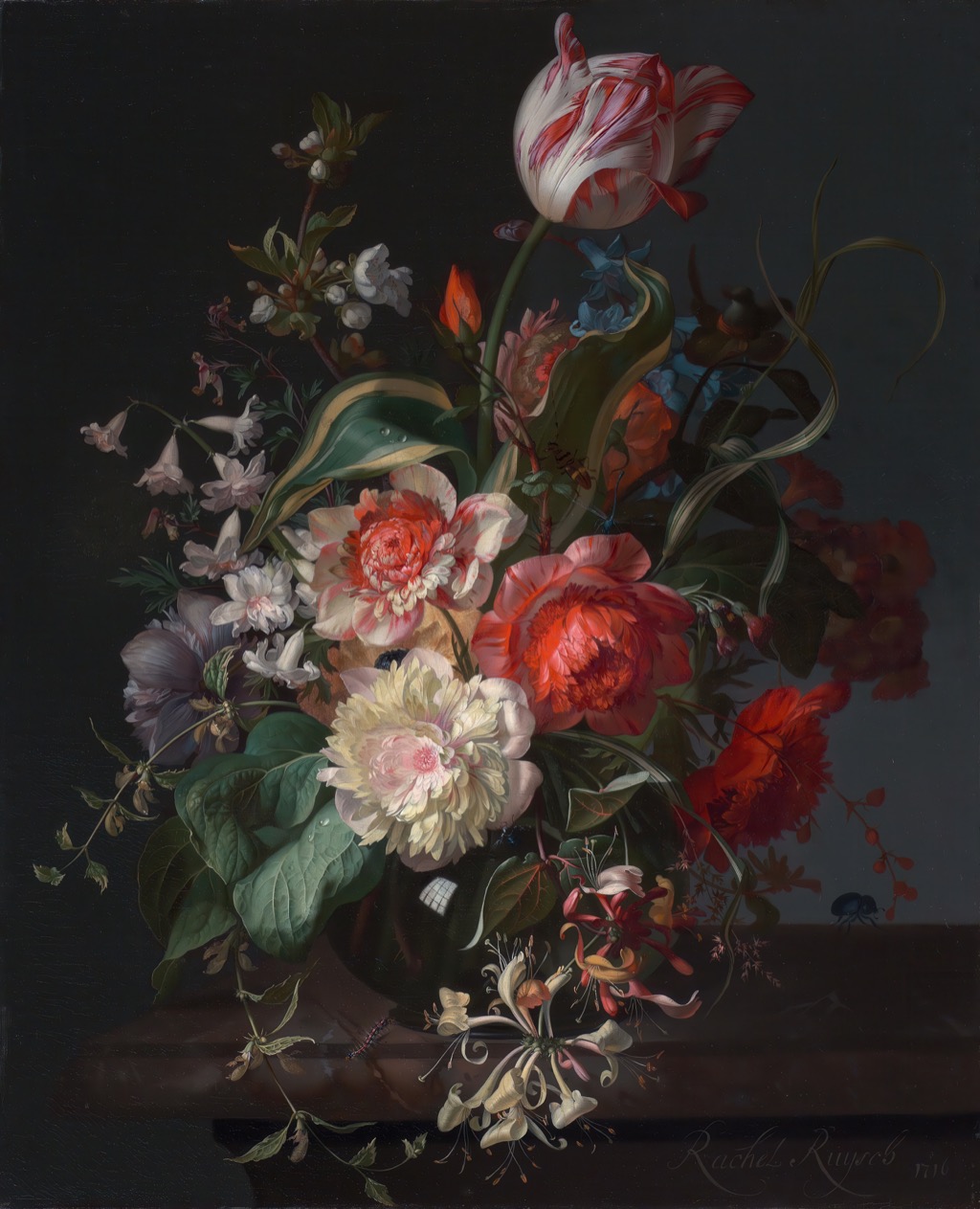
The imagined bouquet is one of Ruysch's most important devices. Paintings such as the Rijksmuseum's Still Life with Flowers on a Marble Tabletop show more than a plausible cut-flower arrangement. The museum identifies the work as a 1716 painting and notes the combination of many species, insects and studied detail.[8] The interest lies partly in artifice. Ruysch could gather flowers across seasons, compress time, and offer the viewer a heightened version of nature.
That heightened nature is not abstract. It depends on exact observation. Dewdrops cling to petals. Caterpillars and beetles make their way through the image. Some leaves are bitten, blemished or curling. A fallen petal or drooping stem can remind the viewer that the bouquet's brilliance is temporary. These details sometimes invite symbolic readings, especially in relation to transience, but they also belong to a culture of close looking. Ruysch's paintings reward viewers who move between the whole arrangement and the smallest incident.
Her flower paintings are also technical achievements. Pale petals set against dark grounds require control of tone; transparent glass requires precision in reflected light; the layering of stems inside a vase demands spatial clarity. National Gallery commentary on Flowers in a Glass Vase with a Tulip emphasises Ruysch's dramatic lighting, botanical detail, insects and flower-study process.[11] The painting's famous tulip becomes part of a larger orchestration of surface, depth and movement.
Art, Science and Natural History
Ruysch's art is often discussed through the phrase "nature into art," a fitting shorthand for the current scholarly interest around her work.[6][7] It does not mean that she simply transferred nature onto canvas. Rather, she transformed natural knowledge into pictorial experience.
Her father's world is important here, but it should be kept in proportion. Frederik Ruysch's anatomical and botanical collections were widely known, and his work exposed Rachel Ruysch to scientific cultures of preservation, classification and display.[3] Yet the paintings are not illustrations for his career. They are autonomous works of art that use natural observation in the service of composition, colour and illusion.
The Amsterdam environment gave Ruysch access to plants, specimens and images circulating through gardens, collectors and books. The Hortus Botanicus and the city's trade networks helped make rare flora part of urban visual culture.[3] A flower painting could therefore signal much more than prettiness. It could point toward commerce, collecting, horticulture, medicine, empire, scientific curiosity and the pleasures of cultivated knowledge.
Ruysch's insects and small creatures are especially important. They activate the bouquet. A beetle is not merely an accessory, and a caterpillar is not merely a sign of decay. Such details bring the natural world into motion and remind the viewer that flowers are part of living systems. Toledo's discussion of Flower Still Life connects seasonal impossibility, insects, plant damage and Ruysch's familiarity with botany and anatomy.[12] Detroit's Flowers in a Glass Vase likewise stresses dewdrops, insects and the imaginative gathering of blooms.[9]
This fusion of art and science gives Ruysch's work a particular modern force. Her paintings appeal to viewers interested in Dutch still life, but they also open onto the history of natural history, women's access to knowledge, and the relationship between beauty and evidence. For a deeper look at these questions, see Rachel Ruysch: Art and Science.
Career, Patronage and Reputation
Ruysch's career was remarkable not only for quality but for duration and status. She is recorded in connection with The Hague's Pictura, and the Mauritshuis identifies her as the first woman member of that artists' society.[2] Her association with Pictura places her within a professional world that was not always easy for women to enter, but her career should not be framed only as an exception to exclusion. She operated successfully within real artistic and commercial networks.
Her court role was especially significant. Ruysch served as court painter to Johann Wilhelm, Elector Palatine, in Düsseldorf, a position commonly dated to the years around 1708 to 1716.[5] This appointment connected her to one of the major collecting courts of the period. It also helps explain the movement of her works across German and Italian princely collections, including contexts associated with Johann Wilhelm and Anna Maria Luisa de' Medici.[5][13]
Her paintings were valuable during her lifetime. Museum sources describe her as a celebrated and successful painter, and The Metropolitan Museum of Art's portrait entry connects her image to fame, royal patronage and high prices.[10] These points should be handled carefully. They do not mean that Ruysch moved through the art world without limits, nor that her reception was free from gendered assumptions. They do show that her achievement was recognized before later art histories narrowed the field around a smaller group of famous male painters.
By the eighteenth century, Ruysch's work belonged to an international taste for refined flower painting. Her late career overlapped with changing preferences for lighter, more decorative effects, while her own paintings retained the close structure and natural detail that had defined her success. She died in Amsterdam in 1750, leaving a body of work that remained visible in collections even when her broader historical profile faded.
Recent exhibitions and scholarship have restored her to a more accurate position. The exhibition Rachel Ruysch: Nature into Art, organised across Munich, Toledo and Boston, has helped present her as an artist whose work belongs to the central history of European still life, not its margins.[6][7] That renewed attention is not a correction made for novelty's sake. It is a response to the quality, ambition and documentary strength of the paintings themselves.
Famous Paintings by Rachel Ruysch
Ruysch's paintings are held in major museum collections across Europe and the United States. The following works are useful starting points for understanding her range.
Still Life with Flowers on a Marble Tabletop, painted in 1716 and now in the Rijksmuseum, is one of the strongest examples of her mature flower painting.[8] The work combines a dense bouquet, marble ledge, insects and sharply observed blooms. It is an ideal entry point for readers who want to study how Ruysch builds abundance through controlled design.
Still Life with Flowers in a Glass Vase, also in the Rijksmuseum, shows the importance of the glass vessel in her art.[14] Stems, reflections and shadows become part of the painting's visual intelligence. The vase is not just a container; it is a test of transparency, spatial order and painterly discipline.
Vase with Flowers, painted in 1700 and now in the Mauritshuis, is central to Ruysch's public reputation.[15] The museum's discussion emphasises the fictional nature of the bouquet and the way flowers from different seasons are gathered into one composition. It is a particularly clear example of how Ruysch's art balances naturalism and invention.
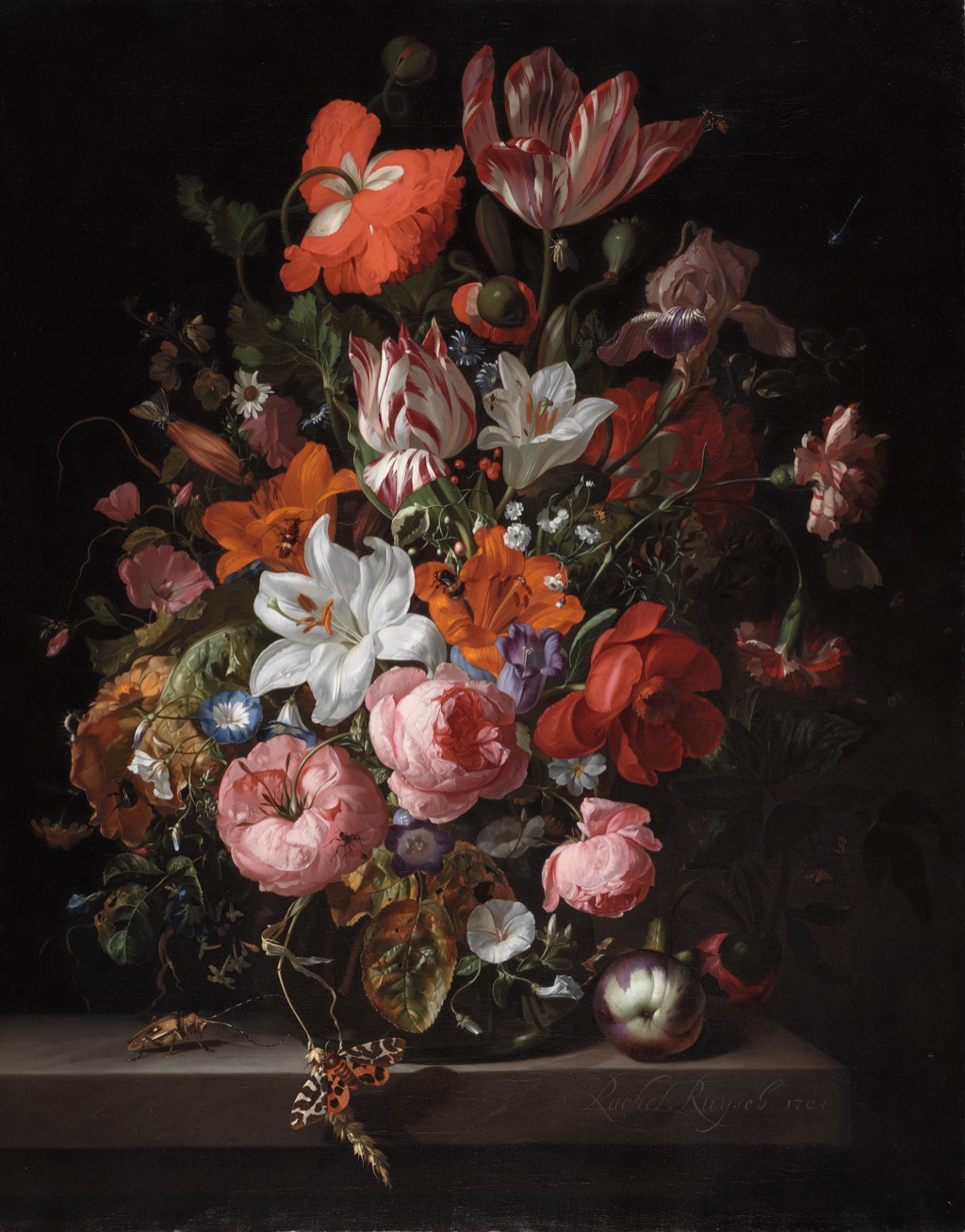
Flowers in a Glass Vase, painted in 1704 and now at the Detroit Institute of Arts, offers another major view of her flower painting at scale.[9] Detroit highlights the dewdrops, insects and non-contemporaneous blooms that help define the picture. The painting shows how Ruysch could make a still life feel both meticulously studied and freshly alive.
Flowers in a Glass Vase with a Tulip, dated 1716 and associated with the National Gallery in London, is especially valuable for close looking.[11] The museum identifies the tulip and discusses the painting's lighting, insects and flower-study process. It is a compact lesson in Ruysch's ability to turn botanical specificity into drama.
Flower Still Life, dated around 1716-1720 and held by the Toledo Museum of Art, connects Ruysch's art to the themes of botany, insects and natural transformation.[12] Toledo's account is particularly helpful for understanding how apparently decorative flower paintings can carry learned and observational weight.
Blumenstrauss, painted in 1715 and held by the Alte Pinakothek, brings Ruysch's work into the German court and collection context.[16] It is also useful for seeing how her paintings travelled beyond the Dutch Republic and entered major princely holdings.
Roses, Convolvulus, Poppies and Other Flowers in an Urn on a Stone Ledge, in the National Museum of Women in the Arts, broadens the view of Ruysch's early and mature reputation in American collections.[4] Its long descriptive title also reminds us how closely flower paintings were often catalogued through their botanical contents.
For a fuller guide to the paintings, see Rachel Ruysch Paintings and Rachel Ruysch Flower Paintings.
Rachel Ruysch and Women Artists
Ruysch's career is now central to the study of women artists in the Dutch Republic and eighteenth-century Europe. She should be discussed alongside figures such as Judith Leyster, Anna Ruysch, Maria Sibylla Merian, Alida Withoos and Clara Peeters, while keeping each artist's field distinct. Ruysch was not important because she was rare alone. She was important because she produced work of exceptional quality within a professional culture in which women artists were present, active and too often underrepresented in later histories.
The National Museum of Women in the Arts and the MFA's exhibition framing both help place Ruysch within a broader story of artistic and scientific labour by women.[4][6] This context is essential, but it should not flatten her into a symbol. Ruysch was a specialist, a professional, a court painter and a technical innovator. Her flower paintings are not merely evidence that women could paint; they are among the works through which Dutch flower painting itself must be understood.
Ruysch also helps widen the usual map of the Dutch Golden Age. Many readers arrive through Rembrandt and works such as The Night Watch, through Vermeer and Girl with a Pearl Earring, or through Frans Hals, whose art shaped the familiar story of Dutch painting. Ruysch asks us to keep that story open. Still life was not a minor sideline to portraiture, genre painting or history painting. It was a major field in which artists explored material value, trade, science, illusion, mortality and delight.
Where to Go Next
Begin with Rachel Ruysch Biography for a chronological account of her life, family, training, marriage, professional networks and late career.
Continue to Rachel Ruysch Paintings for a guide to major works, collection locations and recurring subjects.
For the heart of her reputation, read Rachel Ruysch Flower Paintings, which focuses on bouquets, insects, vessels, seasonal invention and the Dutch flower-piece tradition.
For the scientific context, read Rachel Ruysch: Art and Science, which explores Frederik Ruysch, natural-history collecting, botanical study and the culture of looking around her art.
Frequently Asked Questions
Discussion Prompt
Ruysch's flower paintings can look natural at first glance, but they are carefully invented. How does knowing that the bouquets are composed across seasons change the way you read their beauty, realism and sense of time?
Discussion
Ruysch's flower paintings can look natural at first glance, but they are carefully invented. How does knowing that the bouquets are composed across seasons change the way you read their beauty, realism and sense of time?
Reader Insights
Compare one Ruysch bouquet with a still life by Willem van Aelst or Jan van Huysum, focusing on movement rather than flower identification.
Choose one small detail, such as an insect, bitten leaf or droplet, and ask whether it feels decorative, scientific, symbolic or all three.
Trace how Ruysch's career connects Amsterdam, The Hague, Düsseldorf and later museum collections, then consider how patronage shaped what survived.
Join the Conversation
Share a thoughtful observation about Rachel Ruysch, the painting, or the wider still-life tradition that would help another reader look more carefully.
References
- Rijksmuseum, Rachel Ruysch artist page: https://www.rijksmuseum.nl/en/collection/node/Rachel-Ruysch--3eaff215275e2ebd47d02cfba2044cc8
- Mauritshuis, Rachel Ruysch artist page: https://www.mauritshuis.nl/en/our-collection/our-masters/rachel-ruysch/
- Rijksmuseum, Dutch Masters story on Rachel Ruysch: https://www.rijksmuseum.nl/nl/stories/nederlandse-meesters/story/rachel-ruysch
- National Museum of Women in the Arts, Rachel Ruysch artist profile: https://nmwa.org/art/artists/rachel-ruysch/
- RKD Studies, "Still-life painter Rachel Ruysch (1664-1750) and her connections to Germany": https://masters-of-mobility.rkdstudies.nl/6-still-life-painter-rachel-ruysch-1664-1750-and-her-connections-to-germany/62-court-paintings-for-johann-wilhelm-ii-elector-palatine-1708-1716/
- Museum of Fine Arts, Boston, Rachel Ruysch: Artist, Naturalist, and Pioneer: https://www.mfa.org/exhibition/rachel-ruysch-artist-naturalist-and-pioneer
- Pinakothek, Rachel Ruysch: Nature into Art: https://www.pinakothek.de/en/exhibition/nature-into-art
- Rijksmuseum, Still Life with Flowers on a Marble Tabletop: https://www.rijksmuseum.nl/en/collection/object/---570d1419506e38cb3916f640fe5a2328
- Detroit Institute of Arts, Flowers in a Glass Vase: https://dia.org/collection/flowers-glass-vase/66064
- The Metropolitan Museum of Art, Rachel Ruysch (1664-1750): https://www.metmuseum.org/art/collection/search/875634
- National Gallery, London, Flowers in a Glass Vase with a Tulip: https://www.nationalgallery.org.uk/paintings/rachel-ruysch-flowers-in-a-glass-vase-with-a-tulip
- Toledo Museum of Art, Flower Still Life: https://emuseum.toledomuseum.org/objects/54880/flower-still-life
- RKD, "Unwavering Legacy: 18th-Century Women Artists in the RKD Database": https://www.rkd.nl/en/knowledge-publications/rkd-stories/unwavering-legacy-18th-century-women-artists-in-the-rkd-database
- Rijksmuseum, Still Life with Flowers in a Glass Vase: https://www.rijksmuseum.nl/en/collection/SK-A-354
- Mauritshuis, Vase with Flowers: https://www.mauritshuis.nl/en/our-collection/artworks/151-vase-with-flowers
- Alte Pinakothek / Bayerische Staatsgemäldesammlungen, Blumenstrauss: https://www.sammlung.pinakothek.de/en/artwork/A9xlnQAGWv/rachel-ruysch/blumenstrauss
- Robert Schindler, Bernd Ebert and Anna C. Knaap, eds., Rachel Ruysch: Nature into Art. MFA Publications, 2024.
- Marianne Berardi, Science into Art: Rachel Ruysch's Early Development as a Still-Life Painter. Ph.D. dissertation, University of Pittsburgh, 1998.
- Marianne Berardi, Rachel Ruysch: The Hague 1664-1750 Amsterdam. Richard Green, 2012.
- Main image reference: Rachel Ruysch, Still Life with Flowers on a Marble Tabletop, 1716. Public-domain image via Wikimedia Commons / Rijksmuseum. https://commons.wikimedia.org/wiki/File:Rachel_Ruysch_-_Still_life_with_flowers_on_a_marble_tabletop.jpg