


 by
Tom Gurney
Tom Gurney BSc (Hons) is an art history expert with over 20 years experience
Published on October 6, 2016 / Updated on October 23, 2026
Email:
tomgurney1@gmail.com
/ Phone:
+44 7429 011000
Water Lilies, 1919
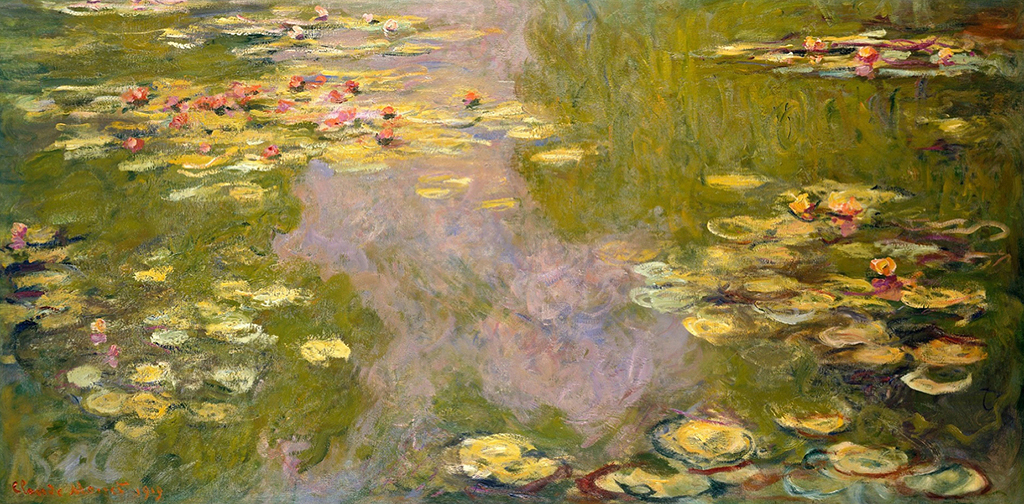
Claude Monet's Water Lilies of 1919 is a single, wide canvas in the Metropolitan Museum of Art's Annenberg collection. Its floating plants crowd around an open passage of reflected light, making the pond both a recognisable subject and an unstable painted space. [1]
At a Glance
Looking into the open centre
Lily pads and flowers gather near the edges, but the centre is not simply empty. A pale, irregular passage of water curves through the composition, carrying reflections that are more difficult to identify than the plants.
The upper left contains scattered pink blooms among horizontal marks. At the lower right, larger rounded pads create a more insistent presence. Their arrangement helps turn an apparently open space into a carefully balanced image.
There is no visible horizon to separate sky from earth. What might ordinarily belong above the scene appears within the pond instead.
The eye therefore moves between two experiences. It follows floating leaves across a surface, then seems to look through that surface into a reflected world.
The picture's interest lies in maintaining both. Recognising the flowers does not resolve every mark, and uncertainty does not make the scene subjectless. The Water Lilies overview places this individual solution within the wider range of Monet's pond imagery.
A wide painting with no distant viewpoint
The canvas is almost twice as wide as it is high. [1] That proportion gives the plant groups room to spread, while the absence of a clearly described bank makes it harder to locate the spectator.
A wide format can suggest a panorama, but this painting does not provide a conventional view across fields towards a distant horizon. Much of the interest is immediately before us.
Horizontal pads and more vertical reflected strokes create different directions within the same field. Their contrast helps distinguish the floating plants without enclosing every form in a firm outline.
Colour works through adjacency as much as through description. Pink, yellow and green passages change their effect according to the darker or paler marks beside them.
The colours guide considers that variability in detail. Here, the large central opening and the more crowded margins make colour part of the composition's movement, not simply a way to label different species.
What Monet told the dealers in 1919
The Met's 1999 acquisition bulletin gives the painting a specific documentary setting. In August 1919 Monet wrote to Bernheim-Jeune about a group of landscapes on which he was working intensely, describing them as a respite from the large Decorations. [2]
The bulletin identifies this painting as one of four signed and dated canvases sold to the firm that autumn. This was not a picture that necessarily remained in the studio until his death.
The evidence is useful because it distinguishes two simultaneous kinds of activity. Work for the market could proceed alongside the more ambitious decorative undertaking.
It also provides a more precise account than a general claim that an elderly Monet no longer sold paintings. Reluctance to part with work did not exclude particular transactions.
The letter does not reduce the canvas to a commercial exercise. It shows artistic concentration and a possible buyer occupying the same conversation, without telling us the exact sequence of every painted mark.
Not every late Water Lilies was a State panel
Monet's late water-garden paintings have related subjects but different destinations. The large ensemble donated to France became eight compositions installed in the Orangerie's two oval rooms in 1927. [3]
The 1919 Met painting belongs to the group sold through Bernheim-Jeune, rather than being a fragment removed from that installation. [2]
This distinction changes how scale and intention are understood. A long, independent canvas can explore decorative effects without having been assigned a position in a permanent room.
Similarly, MoMA's Water Lilies , dated 1914-26, is a three-panel composition approximately 12.76 metres wide. [7] It is neither this painting nor part of the Orangerie gift.
The MoMA triptych guide and Orangerie overview offer comparisons at different scales. Collection identifiers prevent a shared title from erasing these distinctions.
Why there is no universal painting recipe
The visible surface encourages close attention, but it cannot by itself establish every stage of making. A pale flower may appear to sit above darker water without proving that all flowers were added last.
The Art Institute's technical study of a different Water Lily Pond , dated 1917/19, gives a useful counterexample. Examination found flowers introduced both before and after reflected foliage, with some earlier forms partly hidden by later paint. [4]
That work also contains multiple applications over dried paint, while no underdrawing was observed by the methods used.
These findings belong to Chicago's object, 1982.825. They should not be presented as laboratory results for the Met's canvas.
Their broader value is to show how complicated a sequence can be. They caution against describing Monet's method as outlines first, dark colours next and highlights last. The technique discussion follows such distinctions between visible appearance, technical evidence and inference.
The living pond and the studio
The garden that supplied these motifs had been deliberately made and maintained. Monet acquired the first water-garden land in 1893 and used diverted water from a branch of the Epte to create the pond. [6]
The resulting environment supplied plants and reflections, but a painted arrangement need not reproduce their positions during one brief visit.
Temkin and Nora Lawrence's account of the late project describes Monet moving between canvases and developing large paintings in the studio after observation outside. [8]
This helps explain how transient imagery could become a sustained pictorial problem. Light changes quickly; a canvas can be reconsidered over time.
The 1919 painting should therefore not be imagined as a mechanically cropped photograph of a fixed instant. It is a constructed image based on a place in which Monet had spent years looking. The garden history explains the physical setting without claiming to reconstruct the weather or exact session that produced this canvas.
Another Water Lilies in the same museum
The Met also owns a separate Water Lilies dated 1916-19, accession 1983.532. At 130.2 by 200.7 centimetres, it is taller than the Annenberg canvas while having a similar width. [5]
The comparison shows why a title and approximate period are insufficient to identify a work. Dimensions, accession numbers and collection histories give the paintings separate identities.
The extra height changes the field available for the motif. A similarly wide canvas need not distribute plants and reflections in the same way.
It also follows that information about one work's ownership or technical examination cannot automatically explain the other. The catalogue guide provides a broader framework for keeping such examples distinct.
Within the 1919 picture, close looking remains the starting point. Its signature, open centre and clusters around the edges provide specific features to follow before making comparisons with another similarly named pond.
Later ownership and a painter's response
The Met's provenance traces the canvas through Bernheim-Jeune, a period of shared ownership with Durand-Ruel, and later collectors and dealers before the Annenbergs bought it in 1968. [1]
That history extends the documented 1919 transaction without turning the painting into a simple illustration of market success.
Ellsworth Kelly's museum audio offers a different kind of evidence: an artist's response. He attends to the near-abstract surface and to the space between painting and spectator. [1]
Such a response does not prove that Monet intended to become an abstract painter. It shows how another artist could find a continuing problem in the relationship between image and material.
The 1919 Water Lilies remains compelling because its plants never entirely settle the picture. Rounded leaves anchor the eye, while the clouded opening unsettles it again. The painting offers recognisable things and an active field of paint without asking the viewer to choose only one.
Frequently Asked Questions
The Met's Annenberg canvas, accession 1998.325.2. [1]
Yes. It was among four signed and dated canvases sold to Bernheim-Jeune in 1919. [2]
No. They are used as a clearly identified comparison, not as tests on the Met painting. [4]
Discussion
Look again at the images and ideas explored in Water Lilies, 1919. These editorial prompts invite your observations.
Reader Insights
Follow the pale central opening and the plant groups around its edges.
Compare what can be observed in a reproduction with what requires technical examination.
Consider how two paintings with the same title can differ in format and history.
Join the Conversation
Share a detail, comparison or question about Water Lilies, 1919 below.
References
- Metropolitan Museum of Art , Water Lilies, 1919, 1998.325.2; object record, provenance and Ellsworth Kelly audio. View source .
- Metropolitan Museum of Art Bulletin , volume 57, number 2, Fall 1999, page 60; the 1919 correspondence and sale. View source .
- Musee de l'Orangerie , History of the Water Lilies cycle; the separate French ensemble. View source .
- Art Institute of Chicago , Monet scholarly catalogue, entry 47, Water Lily Pond, 1917/19, 1982.825; comparative technical evidence. View source .
- Metropolitan Museum of Art , Water Lilies, 1916-19, 1983.532; a distinct canvas. View source .
- Maison et jardins de Claude Monet , Water lily pond; the cultivated setting. View source .
- MoMA , Water Lilies, 1914-26, 666.1959.a-c; the separate monumental triptych. View source .
- Ann Temkin and Nora Lawrence, MoMA , Claude Monet: Water Lilies, 2009; observation, studio work and extended revision. View source .







