by Tom Gurney
Tom Gurney BSc (Hons) is an art history expert with over 20 years experience
Published on May 6, 2026 / Updated on May 6, 2026
Email: tomgurney1@gmail.com / Phone: +44 7429 011000
Colours in Monet's Water Lilies
Colour is one of the great subjects of Claude Monet's Water Lilies. The paintings may begin with a garden pond, but their real drama lies in the shifting relationships between green, blue, pink, violet, yellow and red.
The main colours in the Water Lilies
| Colour | Typical role | Effect |
|---|---|---|
| Green | Lily pads, banks, trees and reflections | Unifies plant life and water. |
| Blue | Reflected sky and open water | Creates atmosphere and depth. |
| Pink | Water lily flowers and reflected light | Adds warmth and delicacy. |
| White | Flowers and highlights | Creates sparkle across the pond surface. |
| Violet | Shadow, evening light and late harmonies | Deepens the emotional tone of the paintings. |
| Orange and red | Late reflections and stronger contrasts | Gives some late works a dramatic intensity. |
Early colour harmonies
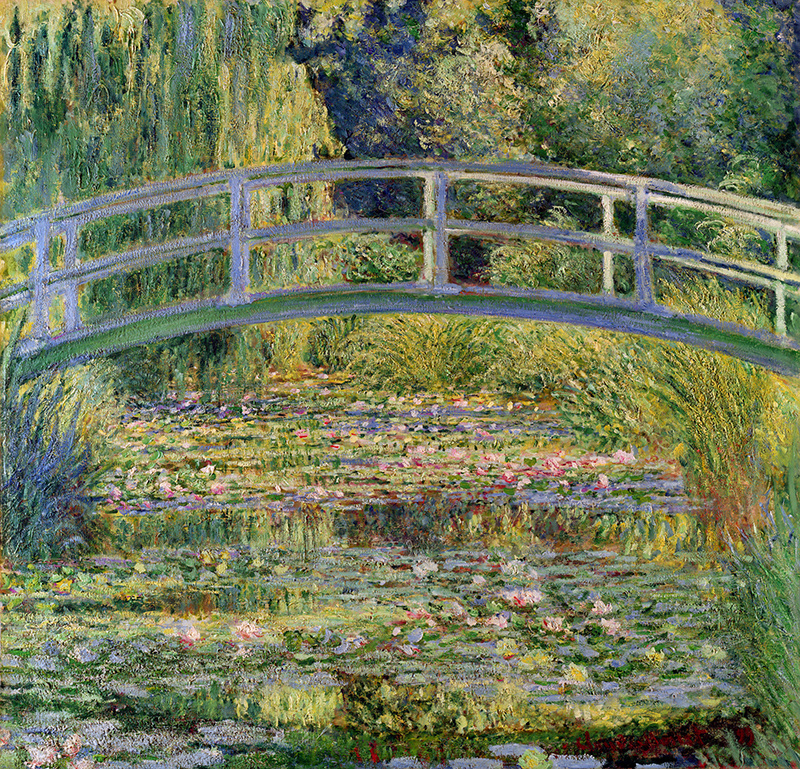
The early Water Lilies often use fresh greens, soft blues and delicate pinks. These colours still describe a garden that can be entered visually. The pond, bridge and vegetation remain part of a recognisable outdoor setting.
Late colour intensity
In the late Water Lilies, Monet's colour becomes broader and more daring. Violet, deep blue, red-orange and dense green can spread across large areas of the canvas. The result is less like a naturalistic view of a pond and more like an immersive field of sensation.
Colour and reflection
The special challenge of the Water Lilies was that colour did not belong to one object. Blue might be the sky reflected in the water. Green might be a lily pad, a tree, a bank or a reflection. Pink might be a flower or a flicker of light. Monet used this instability to make the pond feel alive.
Colour and cataracts
Monet's later eyesight problems are often discussed in relation to his changing palette. Cataracts may have affected how he perceived colour, but the late Water Lilies should not be reduced to medical explanation. The paintings also show deliberate artistic ambition: Monet was pushing colour, scale and brushwork toward a new kind of visual experience.
Colour as a bridge to abstraction
The more colour became independent, the closer Monet moved toward abstraction. The late Water Lilies still come from the real pond at Giverny, but their colour fields helped later artists understand painting as an environment of light, surface and emotion.
See also Monet's Water Lilies and Abstract Art.