by Tom Gurney
Tom Gurney BSc (Hons) is an art history expert with over 20 years experience
Published on May 6, 2026 / Updated on May 6, 2026
Email: tomgurney1@gmail.com / Phone: +44 7429 011000
Close-Up Details in Monet's Water Lilies
Claude Monet's Water Lilies reward slow looking. At first glance they may appear soft, decorative and atmospheric, but close details reveal how carefully Monet built the effects of water, reflection, flower, sky and movement.
Why close-ups matter
The Water Lilies are not simply pictures of flowers. They are paintings about the experience of seeing. A close-up can show how Monet placed a few pink or white touches among green lily pads, how blue reflections suggest the sky, or how broad strokes of violet and green dissolve the pond into pure colour.
Details to study
| Detail | What to look for | Why it matters |
|---|---|---|
| Lily pads | Flat green shapes floating across the surface | They anchor the eye and prevent the reflections from becoming completely abstract. |
| Water lily flowers | Small pink, white or yellow accents | They add points of light and rhythm across the pond. |
| Reflected sky | Blue, pale violet or grey passages | The sky appears beneath the flowers, reversing normal landscape space. |
| Tree reflections | Vertical green, brown or purple strokes | They create depth without traditional perspective. |
| Late brushwork | Loose, broad, layered marks | These passages show Monet moving toward a more abstract visual language. |
Suggested image close-ups


Early Water Lilies close-ups
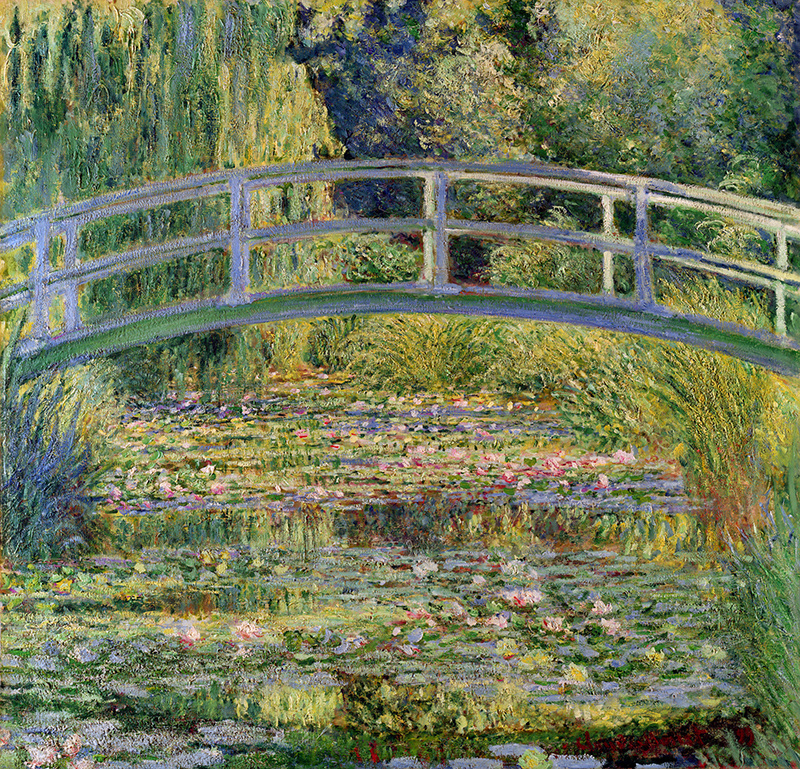
In the early works of 1899 and 1900, close-up details often reveal the structure of the garden. The Japanese bridge, banks, trees and flowers are still clearly visible. These paintings are useful for showing how Monet began with a recognisable place before gradually removing fixed perspective.
Late Water Lilies close-ups
In the late paintings, details become more difficult to separate. A patch of colour might be a flower, a reflection, a shadow or simply a painted mark. This uncertainty is central to the power of the late Water Lilies. Monet remains connected to nature, but the painting itself becomes increasingly independent.
Close looking checklist
- Can you identify where the water surface begins?
- Are you looking at real plants or reflected trees?
- Is there a horizon?
- Do the colours describe objects, light, or mood?
- Does the brushwork remain descriptive, or does it become abstract?
For more on the whole series, return to Monet's Water Lilies.