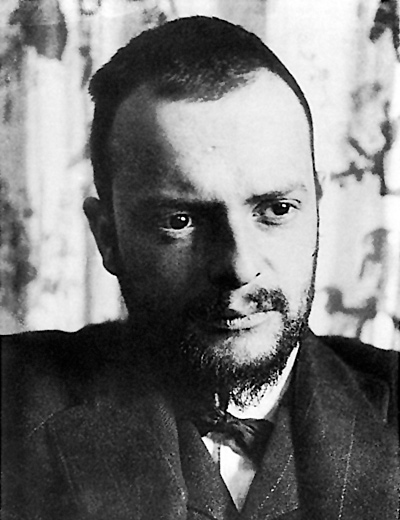
 by Tom Gurney
Tom Gurney BSc (Hons) is an art history expert with over 20 years experience
Published on June 19, 2020 / Updated on September 27, 2026
Email: tomgurney1@gmail.com / Phone: +44 7429 011000
Art, life and ways of looking
Paul Klee made pictures that seem to change while we look at them. A cluster of rectangles becomes a town; a thin line turns into a bird, a machine or a sign; a few marks on a dark surface suggest a whole night scene. His works can be playful and unsettling in the same breath. Their small scale often draws us near enough to notice how a line was transferred, a colour laid down or an image built from separate pieces.
Klee was born near Bern in 1879, studied art in Munich, taught at the Bauhaus and returned to Bern after the Nazis forced him from his Düsseldorf teaching post. He died in Switzerland in 1940. These events matter, but none is a master key to every picture. His art moved between drawing and painting, observation and invention, humour and gravity. This page offers a way into that variety, then points to the works and subjects that reward a closer look.[1][2]
At a Glance
- Born18 December 1879, Münchenbuchsee near Bern [1]
- Died29 June 1940, Locarno-Muralto [1]
- FamilyMarried the pianist Lily Stumpf; son Felix born 30 November 1907 [4]
- Principal placesBern, Munich, Weimar, Dessau and Düsseldorf [1]
- WorkDrawing, watercolour, prints and paintings on varied supports [3]
- TeachingBauhaus, 1921–1931; Düsseldorf Academy, 1931–1933 [1]
- ArchiveHandwritten work register and teaching papers in Bern [6]
Paul Klee in artistic context
Der Blaue Reiter circle
Klee's contact and exhibitions, 1911–1914Bauhaus
Klee's teaching, 1921–1931Düsseldorf Academy
Klee's professorship, 1931–1933Lyonel Feininger
Bauhaus master, 1919–1932Paul Klee
Bauhaus master, 1921–1931Wassily Kandinsky
Bauhaus master, 1922–1933Angelus Novus
1920Fish Magic
1925Castle and Sun
1928Death and Fire
1940The connections and timeline draw on the Zentrum Paul Klee chronology, Bauhaus teaching research and the object records cited below.
Contents
- What kind of artist was Klee?
- Lines that make a world
- Colour as a structure, not a signature
- Humour, titles and the double take
- The same subject can make a different picture
- From Munich to the Bauhaus
- Düsseldorf, Bern and late work
- Where to go next
Four stages of Paul Klee's career
Bern, Munich and the road to Tunisia
Music, formal drawing study, Italy, early graphic satire and new artistic contacts shaped Klee's first public exhibitions. The 1914 Tunisia journey entered an inquiry into colour already under way.
Work and exhibition during wartime
Klee continued making art during military service at aviation facilities. His exhibitions and Goltz retrospective helped bring his work to a wider public before his move to the Bauhaus.
The Bauhaus and Düsseldorf
At the Bauhaus Klee taught form, colour and ways of constructing images while developing his own work. He moved to the Düsseldorf Academy in 1931 and was suspended after the Nazi takeover in 1933.
Exile, illness and new production
After his forced departure from Düsseldorf, Klee worked in Bern through serious illness. His late output included spare graphic signs, constructed surfaces and works open to different political and biographical readings.
What kind of artist was Klee?
Calling Klee a painter describes only part of his work. The Zentrum Paul Klee estimates that about four fifths of his oeuvre consists of works on paper. Drawings and watercolours are therefore central, and even many of the celebrated images that we loosely call paintings are assembled on paper or cardboard. The museum also notes the sensitivity of Klee's papers, inks and colours, one reason that its holdings cannot all remain on view at once.[3] Begin with the material when you encounter a picture: is the line drawn directly, pressed from another sheet, scratched through paint or formed by the edge between two coloured fields?
The surviving oeuvre is large. A 2026 study by the Zentrum Paul Klee speaks of approximately 9,600 works, while older accounts often round the figure to 10,000. These are approximate counts of an oeuvre spanning many media, rather than totals of paintings alone. The same museum study found worked reverse sides in about 600 works. Some continue an idea rather than simply record a rejected attempt. Looking at the back of an object can therefore change the account of how it was made.[5]
Klee kept a handwritten register of his works. The later nine-volume Catalogue raisonné Paul Klee is a separate scholarly undertaking, and the Zentrum Paul Klee continues its research in a database accessible at the archive by appointment. Our paintings index is a way to browse selected images and articles, not a reproduction of either catalogue. The drawings, watercolours and prints pages give other routes through a career that resists one medium label.[6]
Lines that make a world
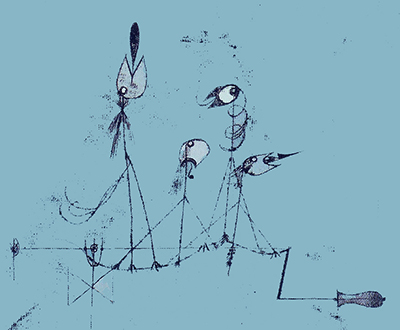
In Twittering Machine (1922), four birdlike creatures perch on a shaft joined to a hand crank. Their beaks open above a pale blue field and a pink surround. The handle offers the possibility of motion; the birds' calls seem almost imaginable, yet nothing tells us what turning the crank would actually do. MoMA identifies the work as an oil-transfer drawing with watercolour and ink on paper, with gouache and ink borders on board. Klee traced from one sheet through a layer of dried oil paint to transfer the line onto another, leaving pressure marks and smudges. The apparent ease of the bird shapes is the result of a deliberate, layered process.[7]
The picture can be read as comic contraption, anxious trap or an uneasy joining of nature and machinery. MoMA's interpretation emphasises the birds' restraint and the threat beneath them. That is a powerful reading, but the visible mechanism also leaves room for uncertainty: we are invited to imagine a sound that the image never literally plays. The work is a good introduction to Klee because its wit, drawing and physical method cannot be separated into neat categories. The fuller work article follows its making and later interpretations.
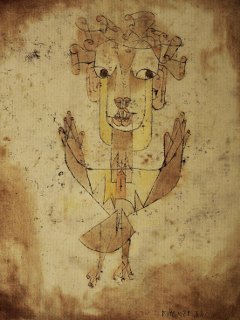
Another paper image acquired a life far beyond the moment it was made. Klee created Angelus Novus in 1920. Walter Benjamin later owned it and, in a 1940 reflection on history, described an “angel of history” looking toward catastrophe while being driven forward. Benjamin's prose has made the work famous in philosophy, but his angel is his reading of Klee's image, made two decades after the artwork. The visible drawing, its material construction, ownership and Benjamin's later text deserve separate accounts. Start with the artwork page if you want to see how a modest work on paper became an enduring image of historical thought.[8][9]
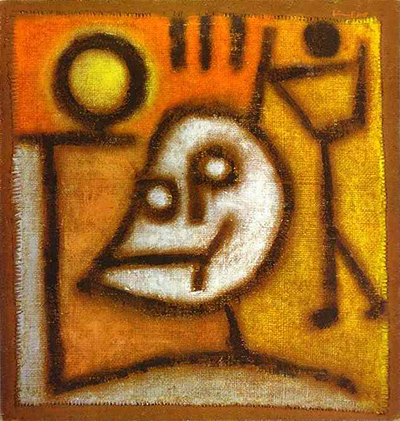
Line can behave differently in other works. In the late Death and Fire, broad marks form a face in which the German letters of Tod—death—can be discerned. It is tempting to treat every mark as a private symbol with a fixed translation. Klee's signs are not always that cooperative. Sometimes they are letters, sometimes outlines, sometimes forms that remain between the two. The late-work page examines this change of scale and mark without reducing the picture to a medical record.[10]
Colour as a structure, not a signature
Colour is one of the most inviting approaches to Klee, but it did not suddenly appear in his work in 1914, and it is not the subject of every drawing. His earlier graphic images can be nearly monochrome. In later works, colour may build an image, interrupt a grid, or set one form apart from everything around it. The relationship matters more than a general claim that Klee “used bright colours.”[2][3]
The 1914 journey through Tunisia with August Macke and Louis Moilliet became important to Klee's account of himself as an artist. In Hammamet with Its Mosque, watercolour and graphite on paper mounted on cardboard arrange architectural forms into transparent, overlapping colour areas. The Metropolitan Museum of Art sees in this work a move away from colour used only to describe an observed object. That is a useful way to look, though the journey should be understood as part of a longer development rather than an instantaneous discovery. Klee returned to motifs, structures and places long after he travelled.[2][11]
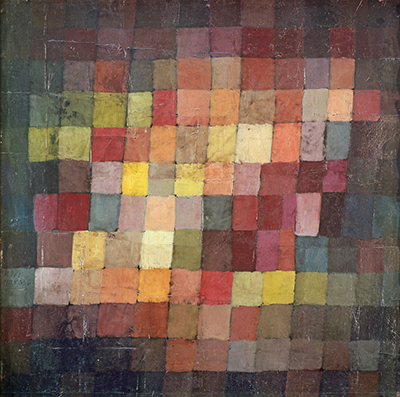
Some colour pictures make their logic especially visible. Ancient Harmony (Alter Klang, 1925) gathers irregular coloured rectangles inside a dark field. Light pinks and yellows emerge among blue-black, green and brown blocks. The rows change size and interval rather than repeating like a mechanical chessboard. Its translated title suggests sound or harmony, but looking closely need not mean assigning a particular note to each square. The work offers a rhythm of difference, with the dark outer field helping the centre appear luminous.[12]
Crystal Gradation (Kristall-Stufung, 1921) builds a different kind of order on a small sheet of watercolour paper. Its angular divisions seem to advance and recede as their colours change in steps. Curved edges interrupt any expectation that the image is a perfectly regular diagram. The German Stufung points to gradation by stages: the eye moves between adjoining values rather than across a single smooth digital gradient. Kunstmuseum Basel records it as watercolour on paper with a brush-and-pen border, mounted on card. These facts matter because the work's apparent crystalline solidity is made with a light, layered medium on a portable support. The work page follows the sheet's construction and its documented place in Klee's 1921 experiments.[13]
In Red Balloon (1922), a small, emphatic red circle hovers above a townlike arrangement of roofs, blocks and lines. The title turns the circle into a balloon; the geometry below remains less settled as a place. Look again at the surface: the Guggenheim describes oil on chalk-primed gauze mounted on board, while marking an oil-transfer drawing component as uncertain. The open textile weave visible across both sky and buildings joins them physically even where the red circle seems to float free. Klee's support and title thus do different jobs: one binds the picture together, while the other gives a name to its most distinct shape. It is a useful example of how a picture can be readable without becoming a literal landscape or a fixed allegory.[14]
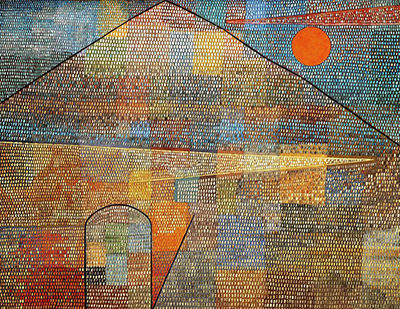
The much larger Ad Parnassum (1932) offers a different challenge: a broad surface constructed from innumerable small colour marks, with a triangular form, rising light and architectural associations. It cannot be summarised by saying Klee “painted with dots.” Scale, layering and the relation of near and distant viewing are central to the experience of this picture. The colour page and materials and techniques page take these questions further through verified individual objects.[15]
His later journey through Egypt, begun in December 1928, offers another way to see colour and geometry working together. In Highway and Byways (1929), a central rising route is flanked by branching paths and bands that divide into different widths. Scholarship relates the painting to the Nile valley and to Klee's study of pictorial rhythm, but the landscape association should not erase the painting's measured construction. Nor did every geometric experiment begin on the Egyptian journey: Klee had already been teaching and testing divisions of a field at the Bauhaus. The work's dedicated page separates the journey, the visible structure and later interpretations.[16]
Humour, titles and the double take
Klee's titles often change what a viewer sees. Before reading Cat and Bird, the face in the 1928 painting may be a set of broad shapes and curved marks. The small bird located on the cat's forehead then turns the image into a tense meeting of two creatures and perhaps a glimpse of thought. The title makes the relationship legible without settling exactly what the cat intends. In Around the Fish, a single fish lies among unrelated objects and signs; their placement can feel ceremonial, playful or ominous. Each painting asks for observation before an all-purpose symbolic translation.[17][18]
The Centre Pompidou organised its 2016 Klee retrospective around irony, drawing attention to satire, theatricality, mechanical creatures and the artist's habit of testing the rules of representation. This is a curatorial argument, not a label to attach to every image. It is especially helpful where a picture's title and visible form disagree or where an apparently simple creature becomes unsettling. Klee can let two readings coexist. A smile does not always make a work carefree; an abstract grid can retain traces of a town, garden or body.[19]
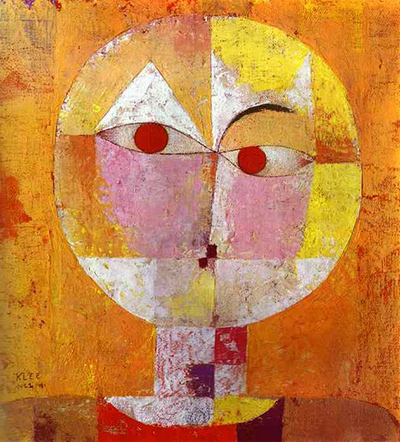
Senecio is one of the best places to test that double view. Its roughly square face uses coloured planes and unequal eyes. The Basel museum links the title to the botanical name Senecio vulgaris and records Klee's additional catalogue wording Baldgreis, referring to an aging, balding man. The face can suggest a mask or performance, but the familiar English gloss “Head of a Man Going Senile” is not a secure translation of that original wording. The dedicated page follows the object, title and later interpretations without forcing them into one story.[20]
The same subject can make a different picture
Fish recur in Klee's work, but The Goldfish, Fish Magic and Around the Fish are distinct objects and pictorial problems. Hamburg's Der Goldfisch (1925) suspends its bright central fish in a dark aquatic world; the smaller surrounding fish make a difference in scale and attention. The museum identifies oil and watercolour on paper mounted on cardboard and records the painting's passage through the Berlin Nationalgalerie, Nazi confiscation and its eventual arrival in Hamburg. That history belongs to this object, not automatically to every Klee fish.[21]
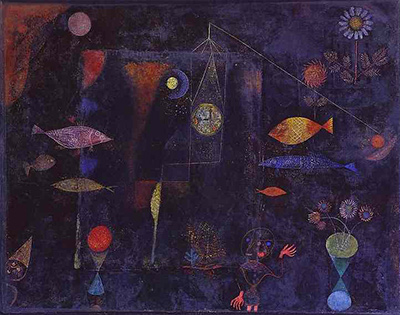
Philadelphia's Fish Magic (also 1925) offers another kind of darkness. Klee built layers, scratched through a black surface and attached a piece of fabric, allowing forms to appear and disappear across a constructed field. Its clock, plants, fish and other signs can evoke a staged performance as much as a view underwater. MoMA's Around the Fish (1926) sets a fish among objects that seem deliberately arranged around it. Its precise visual relationships are worth describing before deciding whether the image is a meal, a ritual, a joke or a meditation. Reading the three pictures together makes the point that a repeated motif does not require one fixed meaning or one technique.[18][22]
Titles can also carry a borrowed story into the picture. The work on this site called Sinbad the Sailor has a longer German title describing a battle scene from a comic-fantastic opera about a seafarer. The figures, sea creatures and action make narrative looking tempting, yet the original title needs to be read accurately before the scene is retold as an illustration of a familiar Arabian Nights episode. Klee could invite a story while inventing its stage. His opera-battle work page follows the original object and the translation question.[23]
From Munich to the Bauhaus
Klee grew up in a musical family and studied art in Munich at the turn of the century. Early drawings, satirical inventions and prints show that his imagination did not begin with the small coloured squares now associated with his name. In Munich he encountered the circle around Wassily Kandinsky and Franz Marc and took part in the second Blue Rider exhibition in 1912. Association with the circle was important, but it should not be stretched into a claim that he founded every movement in which his work was later exhibited. His 1912 Paris visit also brought him into direct contact with Robert and Sonia Delaunay's work.[1][2]
The 1914 Tunisia journey followed, then military service during the First World War. Klee was called up in 1916 and worked at aviation facilities after training; he continued making art. In 1920 the Munich dealer Hans Goltz held a retrospective of hundreds of works. Walter Gropius invited Klee to the Bauhaus later that year, and he began teaching in Weimar in 1921. The school moved to Dessau in 1925; Klee's family moved there in 1926. Keeping these dates separate helps connect a work to the right setting rather than assigning every picture from 1925 to Dessau.[1]
At the Bauhaus, Klee studied how points become lines, how colour relationships work, how forms grow and how motion can be pictured. His teaching papers survive in large numbers. He did publish the compact Pädagogisches Skizzenbuch (Pedagogical Sketchbook) in 1925. The much larger volumes often called the “Paul Klee Notebooks” were compiled after his death from his teaching legacy; they are not books he finished and published as a series. The notebooks page examines that difference, while the Bauhaus page looks at the school, its workshops and his exchange with other artists.[6][24]
His lessons also reached students making things in other media. Gunta Stölzl attended Klee's teaching before she led the Bauhaus weaving workshop; from 1927 he gave a form course for weaving students. The workshop artists used and changed what they learned as they designed textiles. Their woven works belong to them, even where a colour or compositional exercise can be traced to Klee's classroom. This is a reason to look at his teaching as a relationship between people and practices, not simply a set of diagrams to match against his own paintings.[25]
Music was another working language, rooted in his upbringing and continued life with Lily, a pianist and teacher. A painting's variations can invite comparisons with rhythm or polyphony, but a visual pattern is not automatically a transcription of sound. The music page looks at Klee's playing, listening, teaching and later composers' responses, with the evidence for each connection kept clear.[26]
Lily's work belongs in this story in her own right. She was a professionally trained musician and earned income by teaching piano while Paul developed his art and shared substantial care of their young son. Their household mixed music, paid work, childcare and artistic work. At Weimar, her paid teaching gave way to another musical role: she attended Gertrud Grunow's Bauhaus course for three years and took part in concerts and musical gatherings. The biography follows her role across the later move to Bern.[27]
Düsseldorf, Bern and late work
Klee left the Bauhaus for a professorship at the Düsseldorf Academy in 1931. After the Nazi seizure of power, the academy suspended him without notice on 21 April 1933, under an antisemitic allegation about his identity; formal dismissal followed later that year. He and Lily returned to Bern around Christmas. The Nazi regime's claim about him was a tool of persecution, not a fact about his ancestry. In 1937 the authorities confiscated 102 Klee works from German museums, according to the Zentrum Paul Klee.[1][28]
The art of these years cannot be treated as one mood. Klee made directly charged drawings and pictures that invite more open political questions; he also kept working through formal problems of colour, signs and construction. Fire at Full Moon (1933) is a useful example of the distinction. Its owning museum places it in the summer of that year probably, while presenting a political reading as a question. The red shape and yellow moon are visible and title-related; no source yet proves that each is a coded emblem of an event. The work article can set its colour structure beside the documented circumstances without claiming access to an unwritten intention.[29]
Klee became seriously ill in the mid-1930s. His output fell sharply in 1936, then recovered; the Zentrum Paul Klee records 1,253 works in 1939. A diagnosis of progressive scleroderma is retrospective, made after his death. It is sound to discuss illness as part of the chronology and to notice broader marks or different scales in particular late works. It is unsound to infer a clinical symptom from every change in line or to assume that all late works say the same thing.[1][10]
Death and Fire (1940) makes mortality hard to avoid: the title and the face's letter-like forms invite it. Yet the painting also has a particular jute support, coloured paste and graphic structure. Its material and visual choices deserve attention alongside its date. In other late works, including Struck from the List and Insula dulcamara, marks can suggest writing or figures without yielding one unambiguous sentence. The late-work page follows these distinctions and the evidence for political and biographical readings.[10][30]
Klee had been born in Switzerland to a German father and Swiss mother, but he held German citizenship during his life. His Swiss naturalisation was granted on 5 July 1940, six days after his death. “German artist, born in Switzerland” is often a useful short catalogue description; the full biography explains why the nationality question is more complicated.[1]
Where to go next
To follow the life in sequence, read the biography. The Tunisia, Bauhaus and late-work pages take up distinct chapters. Colours, music, notebooks and materials and techniques follow recurring ideas across objects. For works themselves, browse the paintings hub and its A–G, H–S and T–Z indexes, or choose a picture from the artwork directory below.
The Zentrum Paul Klee in Bern is the central archive and holds the world's largest collection of the artist's works. Its display changes and its research database is consulted on site by appointment. Our Zentrum Paul Klee guide explains the institution and points to its current information, while the articles here concentrate on what individual works, documents and histories can tell us.[3][6]
Eight works to begin with
Angelus Novus
1920 · An oil-transfer image with a later philosophical life.
Senecio
1922 · A face shaped by colour, title and unequal eyes.
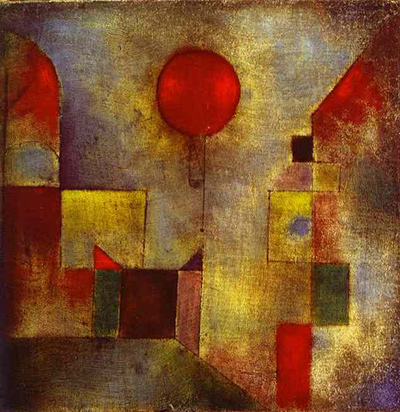
Red Balloon
1922 · A red focal form hovering over a constructed town.
Ancient Harmony
1925 · An irregular colour grid that suggests rhythm.
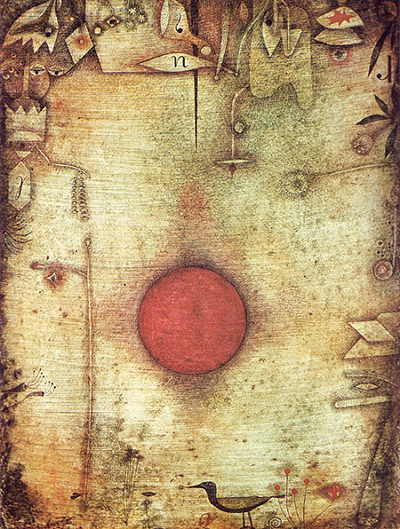
Ad marginem
1930 · Signs and forms gather around the margins.
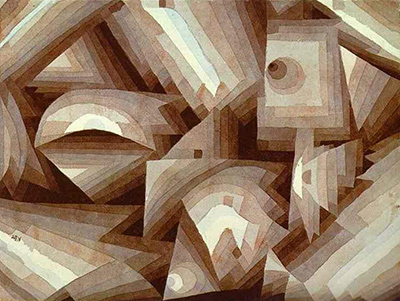
Crystal Gradation
1921 · Stepped watercolour makes crystal-like space.
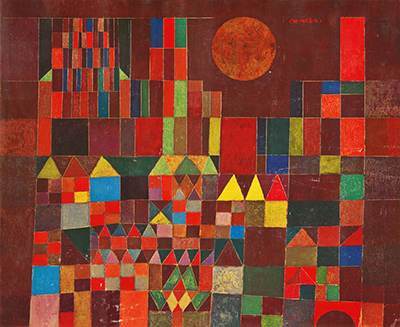
Castle and Sun
1928 · A townlike grid of rectangles and diagonals.
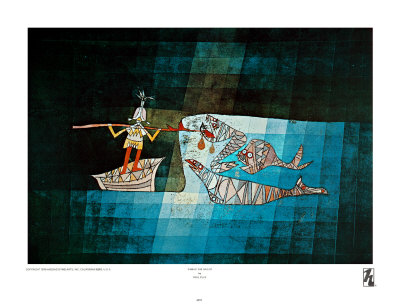
Opera Battle Scene
1923 · Klee’s comic-fantastic opera scene, often shortened to Sinbad the Sailor.
Explore selected works from Klee’s much larger oeuvre. Titles without a link have an authenticated catalogue identity but no reviewed article yet.
Artworks directory
| Name | Date | Medium |
|---|---|---|
| A Gate | 1939 | Painting and mixed media |
| A Woman for Gods | 1938 | Watercolour and mixed media |
| Ab Ovo | 1917 | Watercolour and mixed media |
| Above Mountain Summit | 1917 | Drawing and mixed media |
| Abstract Trio | 1923 | Drawing and mixed media |
| Acrobats | 1915 | Watercolour and mixed media |
| Actor's Mask | 1924 | Painting and mixed media |
| Ad Marginem | 1930 | Drawing and mixed media |
| Ad Parnassum | 1932 | Painting and mixed media |
| Adventurer Ship | 1927 | Drawing and mixed media |
| Affected Place | 1922 | Drawing and mixed media |
| After a Sketch from Zurich | 1914 | Watercolour and mixed media |
| After Drawing | 1919 | |
| After The Floods | 1936 | Watercolour and mixed media |
| All Souls' Picture | 1921 | |
| Ancient Harmony | 1925 | Painting and mixed media |
| Angel Applicant | 1939 | Drawing and mixed media |
| Angel Serves the Desired | 1920 | |
| Angel, Still Female | 1939 | Painting and mixed media |
| Angelus Novus | 1920 | Drawing and mixed media |
| Animal Terror | 1926 | Painting and mixed media |
| Arab Song | 1932 | Painting and mixed media |
| Archangel | 1938 | Painting and mixed media |
| Architecture | 1923 | Painting and mixed media |
| Architecture of the Plain | 1923 | Drawing and mixed media |
| Around the Fish | 1926 | Painting and mixed media |
| Arrival of the Air Steamer | 1921 | Drawing and mixed media |
| Asiatic God | 1924 | Painting and mixed media |
| Astrological Fantasy Portrait | 1924 | Drawing and mixed media |
| Athlete's Head | 1932 | Watercolour and mixed media |
| Aufgehender Stern | 1931 | Painting and mixed media |
| Autumn Flower | 1922 | Painting and mixed media |
| Bad Band | 1920 | Drawing and mixed media |
| Baroque Centaur | 1939 | Painting and mixed media |
| Before the Blitz | 1923 | Drawing and mixed media |
| Before the Snow | 1929 | Drawing and mixed media |
| Besessenes Madchen | 1924 | Watercolour and mixed media |
| Bird Garden | 1924 | |
| Bird Wandering Off | 1926 | Watercolour and mixed media |
| Blossoms in the Night | 1930 | Watercolour and mixed media |
| Blue-Bird-Pumpkin | 1939 | Painting and mixed media |
| Boats in the Flood | 1937 | Painting and mixed media |
| Botanical Theatre | 1934 | Drawing and mixed media |
| Boy in Fancy Dress | 1931 | Watercolour and mixed media |
| Broken Key | 1938 | |
| Brother and Sister | 1930 | Watercolour and mixed media |
| But the Red Roof | 1935 | Painting and mixed media |
| C - C = Fisch | 1931 | Watercolour and mixed media |
| Cacti | 1912 | Painting and mixed media |
| Camel (in Rhythmic Landscape with Trees) | 1920 | Drawing and mixed media |
| Captive Pierrot | 1923 | Drawing and mixed media |
| Castle and Sun | 1928 | Drawing and mixed media |
| Cat and Bird | 1928 | Drawing and mixed media |
| Cathedrals | 1925 | Watercolour and mixed media |
| Chalice of the Heart | 1937 | Painting and mixed media |
| Characters in Yellow | 1937 | Painting and mixed media |
| Chosen Site | 1927 | Mixed media |
| Christmas Picture | 1923 | Drawing and mixed media |
| City of Towers | 1916 | Painting and mixed media |
| Clarification | 1932 | Painting and mixed media |
| Collection of Figurines | 1926 | Painting and mixed media |
| Colorful Architecture | 1917 | Painting and mixed media |
| Comedians' Handbill | 1938 | |
| Comic Opera Singer | 1927 | Painting and mixed media |
| Composition | 1939 | Painting and mixed media |
| Composition with Figures | 1915 | Drawing and mixed media |
| Composition with the Yellow Half-Moon and the Y | 1918 | Watercolour and mixed media |
| Conch–Still Life II | 1939 | Watercolour and mixed media |
| Cosmic Composition | 1919 | Painting and mixed media |
| Crystal Gradation | 1921 | Drawing and mixed media |
| Dance of the Grieving Child | 1922 | Painting and mixed media |
| Dancing Girl | 1940 | Painting and mixed media |
| Das Licht und Etliches | 1931 | Mixed media |
| Death and Fire | 1940 | Painting and mixed media |
| Death for the Idea | 1915 | |
| Demon as Pirate | 1926 | Watercolour and mixed media |
| Diana | 1931 | Painting and mixed media |
| Diavolo Player | 1923 | Drawing and mixed media |
| Die Kapelle | 1917 | Watercolour and mixed media |
| Die Vase | 1938 | Painting and mixed media |
| Doctor | 1930 | Drawing and mixed media |
| Dredger and Sailboat | 1931 | Watercolour and mixed media |
| Ein Tor | 1939 | Painting and mixed media |
| Ein Weib fur Gotter | 1938 | Mixed media |
| Embrace | 1939 | Watercolour and mixed media |
| Episode before an Arab Town | 1923 | |
| Equals Infinity | 1932 | Painting and mixed media |
| Eros | 1923 | Drawing and mixed media |
| Error on Green | 1930 | Watercolour and mixed media |
| Evening Figure | 1935 | Drawing and mixed media |
| Falling Bird | 1919 | |
| Fermata | 1932 | Watercolour and mixed media |
| Fire Clown | 1921 | Watercolour and mixed media |
| Fire Full Moon | 1933 | Watercolour and mixed media |
| Fire in the Evening | 1929 | Painting and mixed media |
| Fish in the Harbour | 1916 | Watercolour and mixed media |
| Fish Magic | 1925 | Watercolour and mixed media |
| Flock of Birds | 1917 | Drawing and mixed media |
| Flora on Sand | 1927 | Watercolour and mixed media |
| Flower Myth | 1918 | |
| Flower Stand with Watering Can and Bucket | 1910 | Watercolour and mixed media |
| Flowering Tree (Abstraction with Reference to a Flowering Tree) | 1925 | Painting and mixed media |
| Flowers in Pots | 1923 | |
| Flowers in Stone | 1939 | Painting and mixed media |
| Forest Witch | 1938 | Painting and mixed media |
| Fright of a Girl | 1922 | Drawing and mixed media |
| Fruits on Red | 1930 | Drawing and mixed media |
| Full Moon | 1919 | Mixed media |
| Föhn Wind in Franz Marc's Garden | 1915 | Watercolour and mixed media |
| Garden in St Germain, The European Quarter near Tunis | 1914 | Watercolour and mixed media |
| Ghost Chamber with the Tall Door (New Version) | 1925 | |
| Ghost of a Genius | 1922 | Drawing and mixed media |
| Girl in Mourning | 1939 | Painting and mixed media |
| Glance of a Landscape | 1926 | Watercolour and mixed media |
| Gluht Nach | 1939 | Drawing and mixed media |
| Golden Fish | 1925 | Watercolour and mixed media |
| Goldfish Wife | 1921 | Watercolour and mixed media |
| Green Plant, Blood, Louse | 1924 | Drawing and mixed media |
| Hafenbild | 1918 | Mixed media |
| Hammamet with Mosque | 1914 | Watercolour and mixed media |
| Harbour with Sailing Ships | 1937 | Painting and mixed media |
| Hauptweg und Nebenwege | 1929 | Painting and mixed media |
| Heavenly and Earthly Time | 1927 | Drawing and mixed media |
| Heroic Fiddling | 1938 | Painting and mixed media |
| Heroic Roses | 1938 | Painting and mixed media |
| Heroic Strokes of the Bow | — | Mixed media |
| Highway and Byways | 1929 | Drawing and mixed media |
| Houses near the Gravel Pit | 1913 | Watercolour and mixed media |
| Howling Dog | 1928 | Painting and mixed media |
| In the Current Six Thresholds | 1929 | Painting and mixed media |
| In the Style of Kairouan | 1914 | Drawing and mixed media |
| Individualized Altimetry of Stripes | 1930 | Painting and mixed media |
| Insula Dulcamara | 1938 | |
| Interior with the Clock | 1913 | Watercolour and mixed media |
| Irma Rossa the Animal Tamer | 1918 | Drawing and mixed media |
| Journey in Corsica | 1927 | Drawing and mixed media |
| Landscape with Bluebirds | 1919 | Watercolour and mixed media |
| Legend of the Nile | 1937 | Painting and mixed media |
| Lemon Harvest | 1937 | Watercolour and mixed media |
| Likeness in the Bower | 1930 | Watercolour and mixed media |
| Limits of Reason | 1927 | Painting and mixed media |
| Little Hope | 1938 | Watercolour and mixed media |
| Magdalena before the Conversion | 1938 | Drawing and mixed media |
| Mask of Fear | 1932 | Painting and mixed media |
| May Picture | 1925 | Painting and mixed media |
| Monument in a Cemetery | 1922 | Watercolour and mixed media |
| Monuments at G | 1929 | Watercolour and mixed media |
| Municipal Jewel | 1917 | Watercolour and mixed media |
| Mural from the Temple of Longing Thither | 1922 | |
| Nach der Uberschwemmung | 1936 | Watercolour and mixed media |
| New Harmony | 1936 | Painting and mixed media |
| New House in the Suburbs | — | Mixed media |
| Old Steamboat | 1922 | Drawing and mixed media |
| On the Edge | 1930 | Drawing and mixed media |
| Once Emerged from the Gray of Night | 1918 | Drawing and mixed media |
| One Who Understands | 1934 | Painting and mixed media |
| Oriental Pleasure Garden | 1925 | Painting and mixed media |
| Park of Idols | 1939 | Watercolour and mixed media |
| Passing by Red Pillars | 1928 | Watercolour and mixed media |
| Persian Nightingales | 1917 | Drawing and mixed media |
| Popular Wall Painting | 1922 | Painting and mixed media |
| Prestidigitator | 1927 | Watercolour and mixed media |
| Rainy Day | 1931 | Watercolour and mixed media |
| Red and White Domes | 1914 | Watercolour and mixed media |
| Red Balloon | 1922 | Drawing and mixed media |
| Redgreen and Violet-Yellow Rhythms | 1920 | Drawing and mixed media |
| Refuge | 1930 | Watercolour and mixed media |
| Rhythmic Rythmical | 1930 | Painting and mixed media |
| Saint of the Inner Light | 1921 | |
| Scaffolding of a New Building | 1930 | Painting and mixed media |
| Scholar in Dealing with Stars | 1926 | Watercolour and mixed media |
| Seated Woman | 1930 | Drawing and mixed media |
| Senecio | 1922 | Painting and mixed media |
| Separation in the Evening | 1922 | Drawing and mixed media |
| Sinbad the Sailor | 1923 | Drawing and mixed media |
| Skeptically Smiling | — | Mixed media |
| Small House in the Garden City | 1928 | Watercolour and mixed media |
| Small Portrait of a Girl in Yellow | 1925 | Painting and mixed media |
| Southern Gardens | 1919 | Watercolour and mixed media |
| Static-Dynamic Gradation | 1923 | Drawing and mixed media |
| Still Life | 1927 | Painting and mixed media |
| Still Life with Gladioli | 1932 | Watercolour and mixed media |
| Strange Garden | 1923 | Drawing and mixed media |
| Stricken City | 1936 | Painting and mixed media |
| Strong Dream | 1929 | Watercolour and mixed media |
| Struck from the List | 1933 | Drawing and mixed media |
| Structural I | 1924 | Drawing and mixed media |
| Sumpflegende | 1919 | Painting and mixed media |
| Temple Gardens | 1920 | Drawing and mixed media |
| The Arrow before the Target | 1921 | Drawing and mixed media |
| The Barbed Noose with the Mice | 1923 | Watercolour and mixed media |
| The Flora of the Heath | 1925 | Watercolour and mixed media |
| The Goldfish | 1925 | Watercolour and mixed media |
| The Hour Before One Night | 1940 | Painting and mixed media |
| The Man in Love | 1923 | |
| The Mask with the Flag | 1925 | Mixed media |
| The Pathos of Fertility | 1921 | |
| The Rhine at Duisburg | 1937 | Painting and mixed media |
| The Way to the Citadel | 1937 | Painting and mixed media |
| Three Houses and a Bridge | 1922 | Watercolour and mixed media |
| Tightrope Walker | 1923 | |
| Tomb in Three Parts | 1923 | Watercolour and mixed media |
| Tomcat's Turf | 1919 | Watercolour and mixed media |
| Tower in Orange and Green | 1922 | Drawing and mixed media |
| Tree and Architecture - Rhythms I | 1920 | Watercolour and mixed media |
| Tree and Architecture - Rhythms II | 1920 | Painting and mixed media |
| Tropical Dawn with the Owl | 1921 | Mixed media |
| Tropische Dammerung | 1921 | Painting and mixed media |
| Twittering Machine | 1922 | Drawing and mixed media |
| Variations (Progressive Motif) | 1927 | Watercolour and mixed media |
| Ventriloquist and Crier in the Moor | 1923 | |
| Viaducts Break Ranks | 1937 | Drawing and mixed media |
| Villa R | 1919 | Painting and mixed media |
| Village Carnival | 1926 | Painting and mixed media |
| Vor dem Blitz | 1923 | Drawing and mixed media |
| Wald-Hexen | 1938 | Painting and mixed media |
| Young Forest | 1925 | Drawing and mixed media |
Discussion
Klee's art moves between observed things, invented signs, colour structure and a wide range of physical materials.
The work rewards close looking, and the documents help us separate what Klee made from later interpretations.
Reader Insights
Which Klee picture changes most when you know its materials or original title?
Where do you see a line, colour interval or repeated form taking on more than one meaning?
Which source or object would you use to test a familiar claim about Klee?
Join the Conversation
Share a Klee work or research question that changed how you look at his art. Explain what you see and which source helped.
References
- Zentrum Paul Klee, “Paul Klee,” institutional biography and chronology (English, checked against German), View source.
- Sabine Rewald, The Metropolitan Museum of Art, “Paul Klee (1879–1940),” Heilbrunn Timeline of Art History (2004), View source.
- Zentrum Paul Klee, “Collection,” especially the works-on-paper and conservation sections, View source.
- Zentrum Paul Klee, “Paul Klee” German biography, including family and Felix's birth date, View source.
- Zentrum Paul Klee, “Klee's versos,” 2026 exhibition and research summary, View source.
- Zentrum Paul Klee, “Archiv & Forschung,” handwritten register, published catalogue, work database and access conditions (German), View source.
- The Museum of Modern Art, “Twittering Machine (Die Zwitscher-Maschine),” object record and MoMA Highlights interpretation, View source.
- Israel Museum, Picasso to Kentridge exhibition publication, pp. 26–27, Angelus Novus object and ownership account, View source.
- Walter Benjamin, “Über den Begriff der Geschichte,” thesis IX, German text in a scan hosted by Zurich University of the Arts, View source.
- Zentrum Paul Klee, “Tod und Feuer” in the Cover Star Klee guide and late-work object material, View source.
- The Metropolitan Museum of Art, “Hammamet with Its Mosque,” object record, View source.
- Kunstmuseum Basel; Zentrum Paul Klee; Lenbachhaus, institutional identity, music and square-painting sources for Alter Klang, Basel accession list, ZPK guide, Lenbachhaus comparison.
- Kunstmuseum Basel, “Kristall-Stufung,” collection record, object no. 1968.407 (German), View source.
- Solomon R. Guggenheim Museum, Visionaries: Creating a Modern Guggenheim, teacher resource, pp. 11–12, Red Balloon caption and discussion (2017), View source.
- Kunstmuseum Bern, “Ad Parnassum,” collection guide, View source.
- Fundación Juan March and Zentrum Paul Klee, Paul Klee: maestro de la Bauhaus (2013), Marianne Keller Tschirren, “Ritmo,” pp. 127–28 (Spanish), View source.
- The Museum of Modern Art, “Cat and Bird,” collection record, View source.
- The Museum of Modern Art, “Around the Fish,” collection record, View source.
- Centre Pompidou, “Paul Klee: L'ironie à l'œuvre,” exhibition framework (French), View source.
- Kunstmuseum Basel, Senecio exhibition booklet and object research (German), View source.
- Hamburger Kunsthalle, “Der Goldfisch,” current collection record and provenance (German), View source.
- Philadelphia Museum of Art, “Fish Magic,” collection record and technical account, View source.
- Kunstmuseum Basel, “Kampfscene aus der komisch-phantastischen Oper ‘der Seefahrer’,” collection record (German), View source.
- Bauhaus-Archiv; Zentrum Paul Klee, Pedagogical Sketchbook publishing account and original teaching archive, Bauhaus-Archiv, ZPK archive.
- Bauhaus Kooperation, Gunta Stölzl biography and “Unterricht Paul Klee” (German), Stölzl biography, Klee teaching account.
- Zentrum Paul Klee, “Klee musically,” exhibition guide (German), View source.
- Bauhaus-Archiv, Musikerinnen und Musiker im Umfeld des Bauhauses, research publication (German, 2025), pp. 136–45 on Lily Klee's work and music making, View source.
- Zentrum Paul Klee, 1933 academy documentation in Paul Klee: I Want to Know Nothing, View source.
- Museum Folkwang, “Fire at Full Moon (Feuer bei Vollmond),” object record and interpretation, View source.
- Zentrum Paul Klee; Jewish Museum, late-work object and 2026 exhibition material, ZPK guide, Jewish Museum checklist.