by Tom Gurney
Tom Gurney BSc (Hons) is an art history expert with over 20 years experience
Page Created on August 31, 2026 / Page Updated on November 6, 2026
Email: tomgurney1@gmail.com / Phone: +44 7429 011000
Suzanne Valadon Drawings and Prints: Introduction
Drawing was not a preliminary chapter that Suzanne Valadon abandoned when she became known as a painter. It was the continuous grammar of her art. Pencil, crayon, pastel, drypoint, etching and monoprint inking gave her different ways to register pressure, balance and touch. The early works often focus on people engaged in ordinary bodily actions—washing, drying, combing hair, bending towards a child—where a shift of weight matters more than a polished finish. Their concentrated lines help explain the firmness of her later oil paintings without reducing the sheets to studies.[1][2]
At a Glance
- Early landmarkPastel Self-Portrait, 1883
- Public recognitionFive drawings shown at the 1894 Société Nationale des Beaux-Arts salon
- Print processesDrypoint, etching, softground etching and varied inking
- Important supporterEdgar Degas, who collected works and encouraged printmaking
- Recurring motifsBathing, dressing, hair, motherhood, rest and portraiture
- Key principleWorks on paper are finished objects, not merely preparation
Contents
- Introduction
- Learning Through Line
- Degas and Intaglio
- After the Bath
- Bathing Prints and Variable Impressions
- Family as a Drawing Subject
- From Paper to Painted Contour
- Late Drawing and Lasting Value
Learning Through Line
Valadon began drawing while she was still earning money as a model. That overlap matters because her knowledge of the posed body included both duration and physical strain. Instead of constructing ideal anatomy from an academy routine, she often recorded a particular turn of the torso or the way an arm reaches behind the head. The line may be spare, but it is rarely vague.
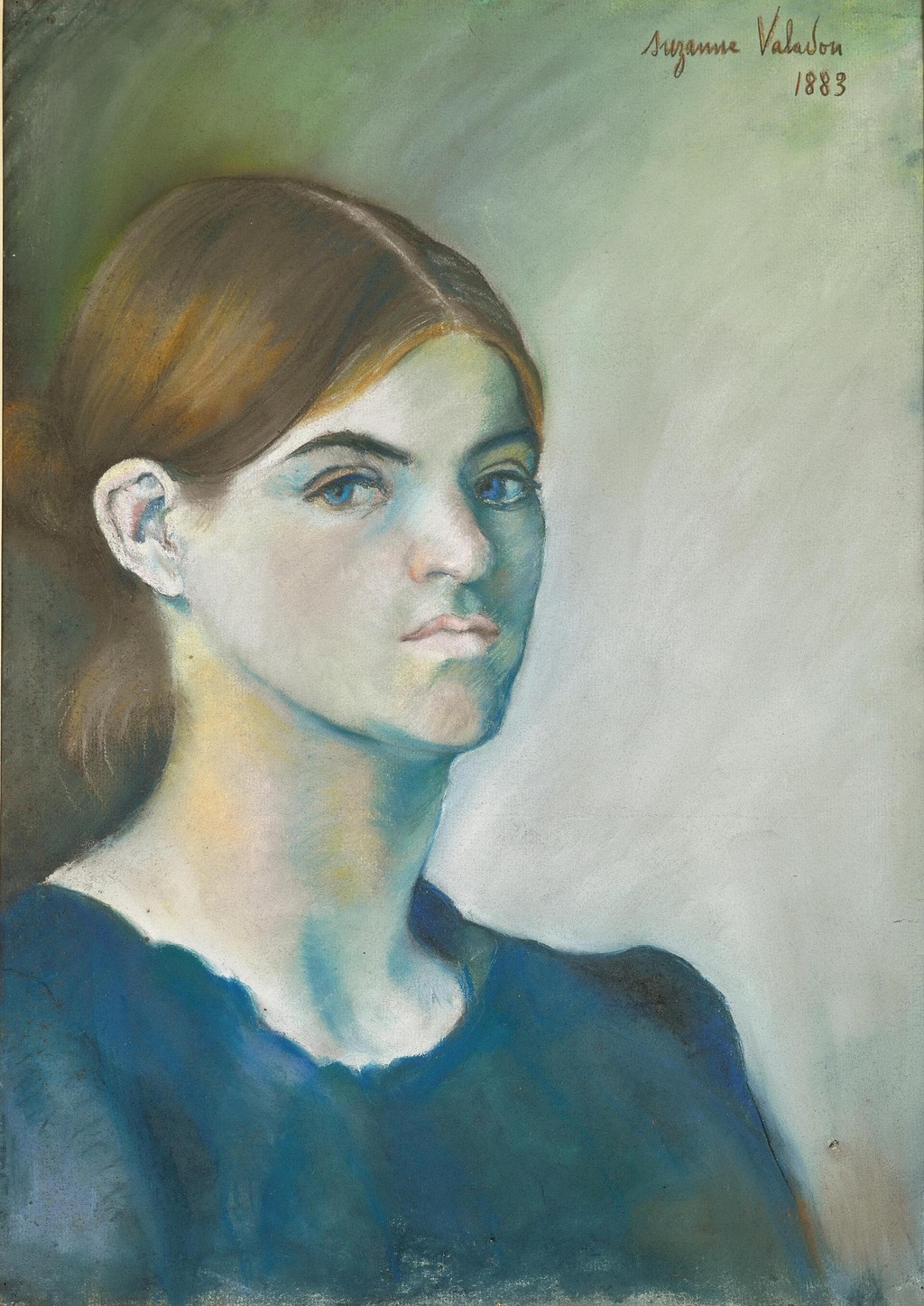
The 1883 self-portrait fixes the young artist’s head with economical pastel and charcoal. Its direct gaze and compressed bust format differ sharply from the social roles assigned to Valadon in other artists’ pictures. The portrait and self-portrait guide considers that distinction further. Here, the important point is material: colour and line already work together, long before her mature oils.[3]
Degas and Intaglio
Edgar Degas recognised Valadon’s ability as a draughtswoman, bought works and gave practical support with printmaking. MFA Houston’s scholarly catalogue reports that he assembled seventeen drawings and three prints by her. AWARE notes that she used his press. These facts place Valadon in a network of exchange while leaving the choices within each plate firmly hers.[3][4]
Intaglio reverses and transforms a drawing. Drypoint scratches directly into the plate, raising a burr that can hold velvety ink. Softground etching can preserve the touch of a drawing made through paper onto a coated plate. Printing introduces pressure, wiping and repetition; selective wiping can make one impression differ markedly from another. Valadon exploited those differences rather than treating the plate as a neutral copying device.
After the Bath
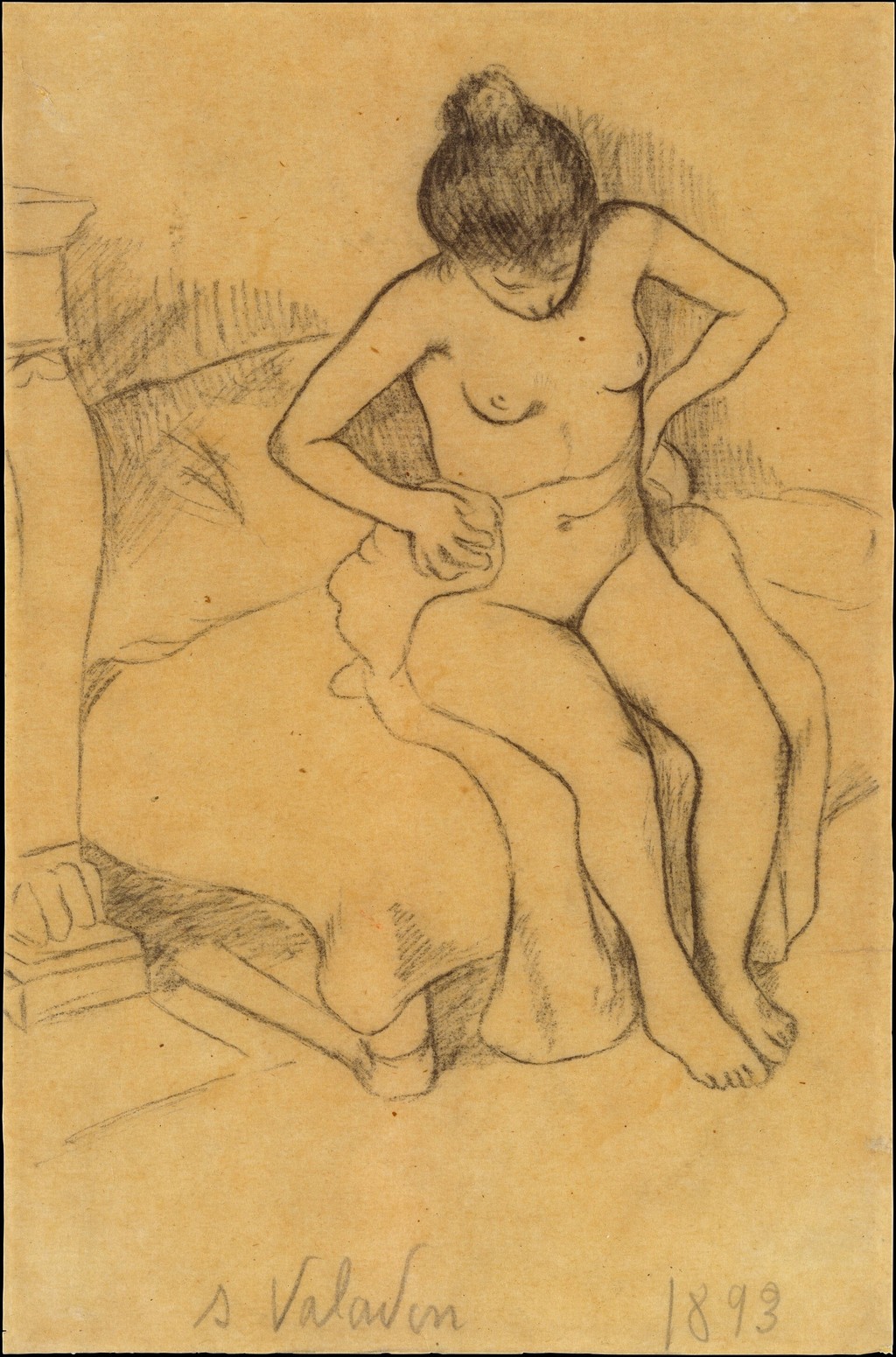
The Met’s After the Bath is dated 1893 and executed in black crayon on tan wove paper, later backed with rice paper for conservation. The sheet is small—20.6 by 13.5 centimetres—yet its seated figure feels grounded. Bent knees and downward head create a closed circuit of attention. The marks around the bed and body remain visible enough to show the act of construction.[5]
Nothing in the record requires the figure to represent a moral lesson or an erotic invitation. A close reading can establish posture, medium and spatial compression; it cannot recover private thoughts. This discipline also informs the nudes and female gaze essay, where a routine action is distinguished from a staged display.
Bathing Prints and Variable Impressions
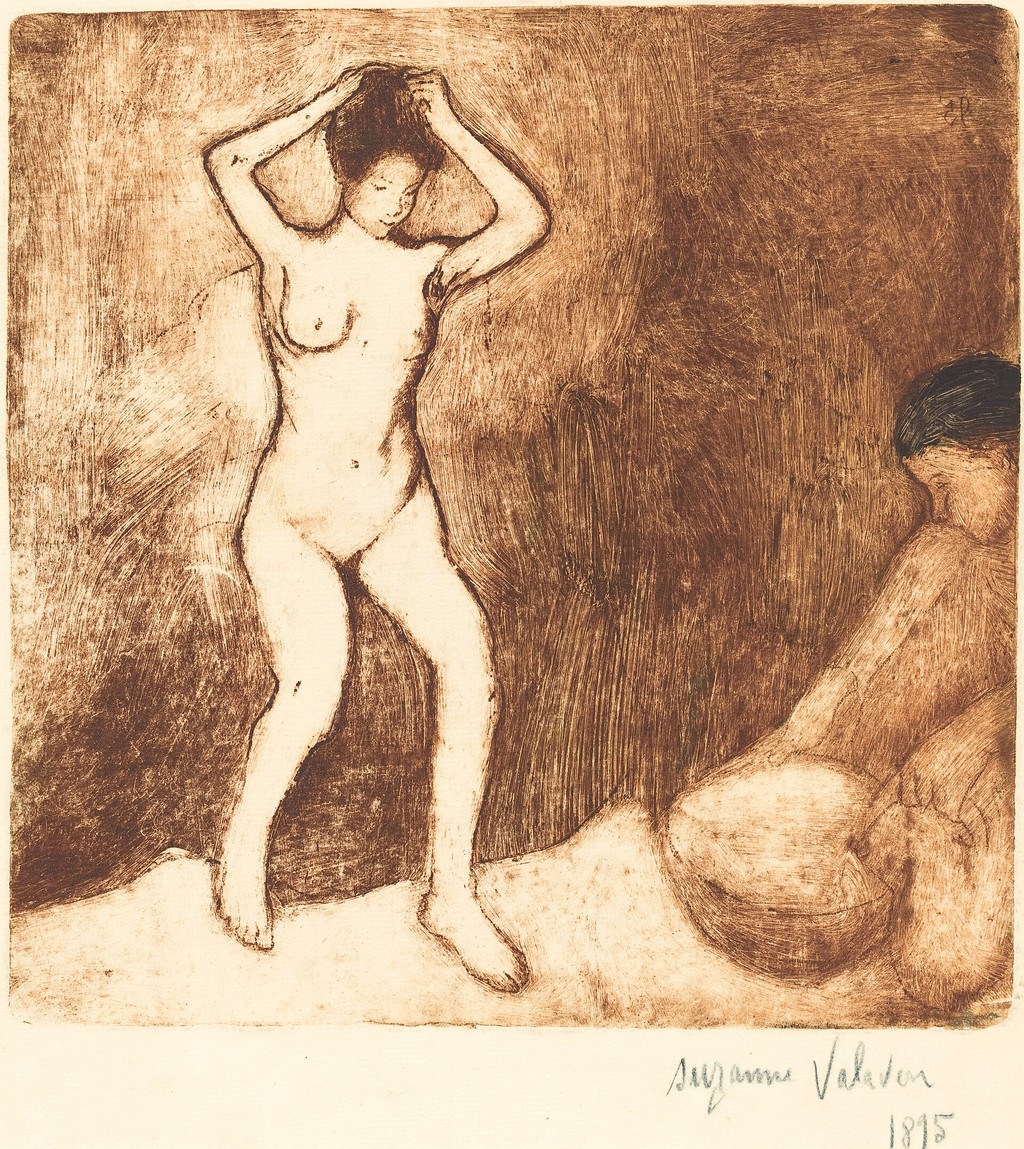
The National Gallery of Art holds several works that clarify Valadon’s print practice. Femmes s’essuyant (Women Drying Themselves) dates from 1893. Two impressions of Catherine prépare le tub et Louise nue se coiffe are dated 1895 but differ in technique: one combines softground etching and drypoint; another adds monoprint inking in brown and black. These are not interchangeable reproductions. Plate work provides a shared structure, while ink and wiping make the surface of each impression particular.[1][6]
The scenes are relational. One woman may prepare water while another arranges her hair; standing and crouching bodies divide the small field. Attention circulates within the image instead of pointing outwards towards an imagined spectator. That compositional fact supports, but does not by itself prove, modern interpretations centred on women’s experience.
Family as a Drawing Subject
Valadon frequently drew Maurice Utrillo and her mother. Domestic access allowed repeated observation over years, but it did not make every sheet a transparent family document. A child’s pose can become an experiment in proportion; an older face can become a study of accumulated line. The viewer must keep relationship and construction in view at the same time.[4]
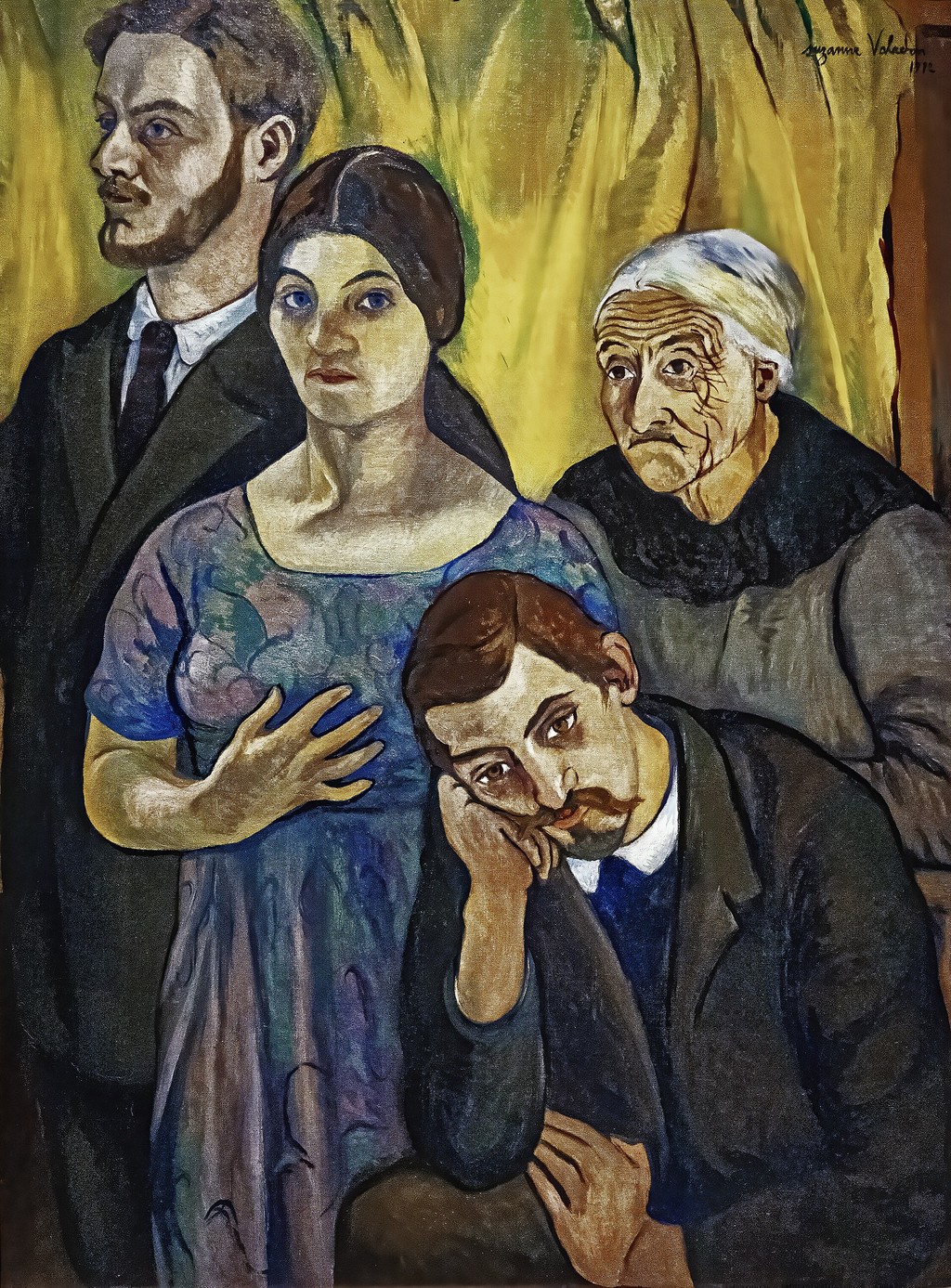
This habit of studying separate presences later feeds the group in Family Portrait. The painting’s figures do not dissolve into a single family identity. Likewise, early drawings preserve intervals between people—between a carer and a bather, a mother and child, an observer and a subject.
From Paper to Painted Contour
Valadon’s oils often use dark boundaries that recall the authority of drawn or incised line. The relation is not a simple transfer. In a print, a contour may be produced by ink held below or above the plate surface; in a painting, a line is itself a coloured stroke laid among other strokes. Yet both can determine how a body meets its environment.
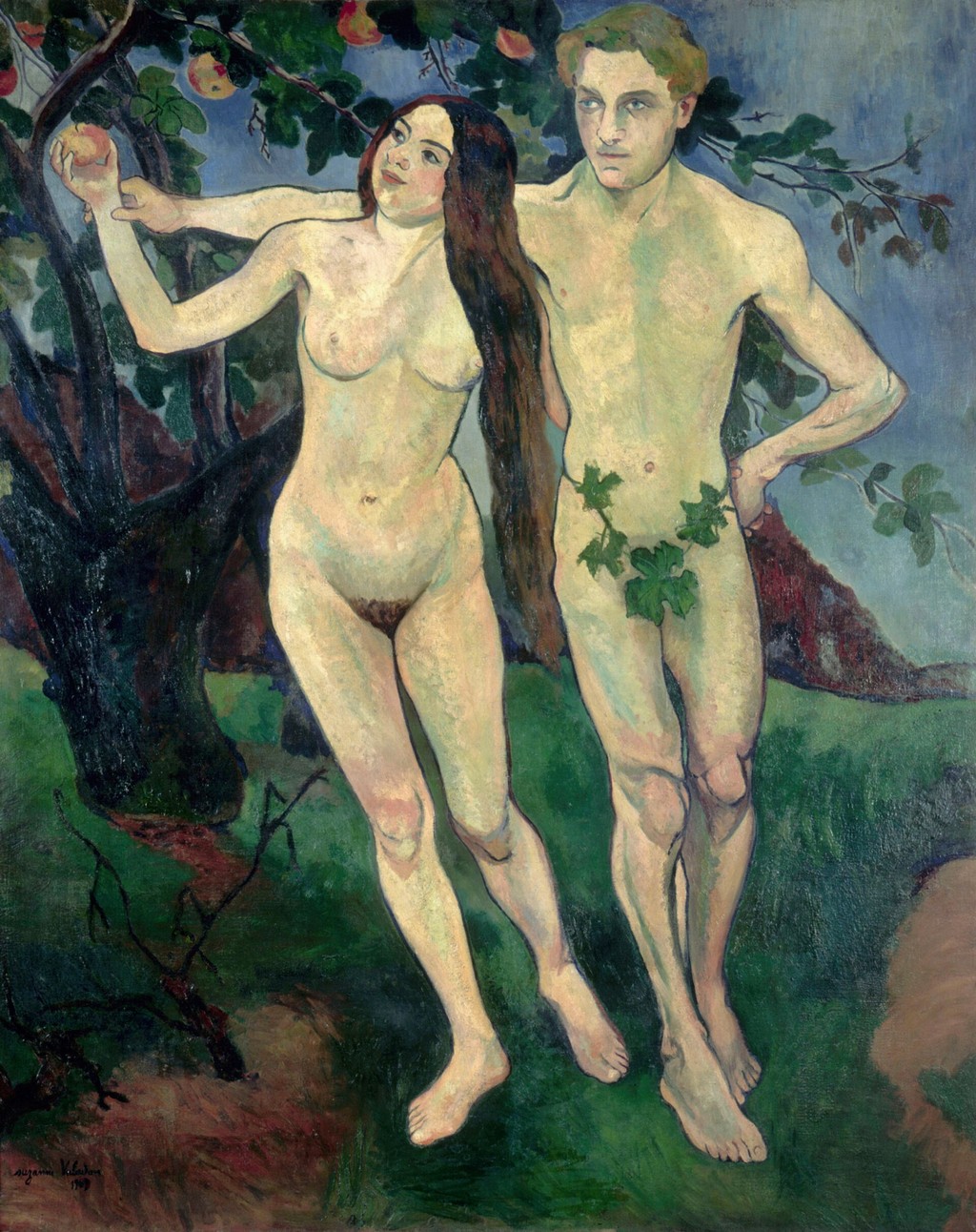
Compare the etched standing figure in La Toilette with the coupled bodies of Adam and Eve. In the large canvas, outlines contain expansive colour fields and help the figures compete with dense foliage. In the print, a few weighted edges and areas of plate tone are enough. The medium changes the means, not the seriousness of observation.
Late Drawing and Lasting Value
Health difficulties reduced Valadon’s capacity for sustained painting in the 1930s, and AWARE reports that she confined herself increasingly to drawing. This return was not a retreat to a lesser medium. It reactivated a practice that had carried her earliest self-definition and first public recognition.[4]
The paintings and artworks guide places works on paper beside oils rather than below them. The directory also identifies drawings and prints separately when public data provides a medium. Its numbers remain provisional, but even an incomplete census makes one conclusion secure: Valadon’s reputation cannot be understood through painting alone.
Researched works directory
This searchable evidence census contains 133 distinct records assembled from public collection data and a reproducible Wikidata snapshot. It is not a catalogue raisonné, not a claim of complete oeuvre coverage, and it keeps works with repeated titles as separate objects.
| Name | Date | Medium |
|---|---|---|
| زنان در حمام | 1909 | Painting |
| Adam and Eve | 1909 | Painting |
| After the bath | 1908 | Painting |
| André Utter and his dogs | 1932 | Painting |
| Anémones dans un verre blanc | 1920 | Painting |
| Black Venus | 1919 | Painting |
| Bouquet de fleurs dans un vase Empire | 1920 | Painting |
| Bouquet de fleurs sur un guéridon | 1925 | Painting |
| Bouquet de fleurs sur une petite table | 1932 | Painting |
| Bouquet de roses | 1936 | Painting |
| Bouquet of flowers | 1930 | Painting |
| Bouquet of flowers 1928 | 1928 | Painting |
| Casting the Net | 1914 | Painting |
| Catherine lying naked on a panther skin | 1923 | Painting |
| Catherine nue se coiffant | 1895 | |
| Châtillon-d'Azergues | 1927 | Painting |
| Chien endormi sur un coussin | 1923 | Painting |
| Deux figures | 1909 | Painting |
| Doctor Robert Le Masle | 1930 | Painting |
| Femme à la contrebasse | 1908 | Painting |
| Femmes au bain | 1893 | |
| Fleurs | 1930 | Painting |
| Fleurs et fougères dans un vase | 1929 | Painting |
| Flowers in front of a Window | 1930 | Painting |
| Fruit bowl | 1917 | Painting |
| Germaine Utter à sa fenêtre | 1926 | Painting |
| Germaine Utter devant sa fenêtre | Date unknown | Painting |
| Gilberte nue se coiffant | 1920 | Painting |
| Grandmother and Grandson | 1910 | Painting |
| Joy of Life | 1911 | Painting |
| Juliet sitting in a chair | 1909 | Painting |
| L'Acrobate, ou La Roue | 1916 | Painting |
| L'avenir dévoilé | 1912 | Painting |
| L'étable en Beaujolais | 1921 | Painting |
| La baigneuse nue | Date unknown | Painting |
| La boîte à violon | 1923 | Painting |
| La Cour du Château de Saint-Bernard | 1930 | Painting |
| La Couturière | 1914 | Painting |
| La Dame au petit chien | 1917 | Painting |
| La grenouille | 1910 | Drawing |
| La rue Cortot | Date unknown | Painting |
| La Toilette | 1895 | |
| La Vachère | 1922 | Painting |
| Landscape at Saint-Bernard (Ain) | 1932 | Painting |
| Le Canard | 1930 | Painting |
| Le Jardin de la rue Cortot | Date unknown | Painting |
| Les lilas et camélias | 1936 | Painting |
| Lilacs and Peonies | 1929 | Painting |
| Marie Coca et sa fille | 1913 | Painting |
| Mauricia Coquiot Portrait | 1915 | Painting |
| Mrs. Robert Rey and her daughter Sylvie | 1920 | Painting |
| Naked in the mirror | 1909–1916 | Painting |
| Nature morte | 1920 | Painting |
| Nature morte à la draperie et au bouquet | 1924 | Painting |
| Nature morte au lapin et à la perdrix | 1930 | Painting |
| Nature morte au poisson | 1926 | Painting |
| Nature morte aux fruits et aux fleurs | 1926 | Painting |
| Nu à la couverture rayée | 1922 | Painting |
| Nu à la draperie blanche | 1914 | Painting |
| Nu allongé sur un divan | 1926 | Painting |
| Nu assis | 1925 | Painting |
| Nu assis au bord d'un lit | 1929 | Painting |
| Nu assis sur un canapé | 1916 | Painting |
| Nu au châle bleu | 1930 | Painting |
| Nu, Suzanne Valadon | 1925 | Artwork |
| Nude Arranging Her Hair | 1916 | Painting |
| Nude on a Red Couch | 1920 | Painting |
| Nude Sitting on the Edge of a Bed | 1929 | Painting |
| Nude with drapery | 1921 | Painting |
| Nude with drapery and armchair | 1921 | Drawing |
| Nude woman with a cat and flowers | 1920 | Painting |
| Nudes | 1919 | Painting |
| Paysage de Bretagne ou Île d'Ouessant | 1912 | Painting |
| Plat d'étain | 1920 | Painting |
| Portrait d'enfant | Date unknown | Painting |
| Portrait de Lily Walton | 1923 | Painting |
| Portrait de Louis Moysés | 1924 | Painting |
| Portrait de Maurice Utrillo | 1921 | Painting |
| Portrait du sculpteur Gibault | 1895 | Painting |
| Portrait of a Woman | 1928 | Painting |
| Portrait of a Woman | 1929 | Painting |
| Portrait of a woman | 1934 | Painting |
| Portrait of Charles Wakefield-Mori | 1922 | Painting |
| Portrait of Erik Satie | 1892 | Painting |
| Portrait of Lily Walton | 1922 | Painting |
| Portrait of Madame Lévy | 1922 | Painting |
| Portrait of Madame Maurice Utrillo, Lucie Valore | 1937 | Painting |
| Portrait of Madame Petridès | 1937 | Painting |
| Portrait of Maurice Utrillo | 1928 | |
| Portrait of Mme Zamaron | 1922 | Painting |
| Portrait of Nora Kars | 1914 | Painting |
| Portraits of the Family | 1912 | Painting |
| Raminou cat study | 1917 | Painting |
| Raminou on his blue cushion | 1919 | Painting |
| Reclining Nude | 1928 | Painting |
| Route dans la forêt de Compiègne | 1914 | Painting |
| Seated Female Nude | 1916 | Painting |
| Seated Nude with Shawl Carpet | 1921 | Painting |
| Self-portrait | 1883 | Drawing |
| Self-Portrait | 1898 | Painting |
| Self-portrait in the mirror | 1927 | Painting |
| Self portrait with bare breasts | 1931 | Painting |
| Sitting nude | 1921 | Painting |
| Spring Flowers | 1928 | Painting |
| Still Life with Fruit | 1937 | Painting |
| Still Life with Fruit Basket | 1920 | Painting |
| Still life with white rose | 1936 | Painting |
| The Abandoned Doll | 1921 | Painting |
| The artist's mother | 1912 | Painting |
| The Bath | 1908 | Drawing |
| The bathers | 1923 | Painting |
| The Blue Room | 1923 | Painting |
| The Rising | 1920 | Painting |
| The two sisters | 1928 | Painting |
| The Woman in White Stockings | 1924 | Painting |
| Tree at Montmagny Quarry | Date unknown | Painting |
| Untitled (Still Life) | 1921 | Painting |
| Utrillo de face | 1925 | Drawing |
| Utrillo de trois-quarts | 1925 | Drawing |
| Utrillo devant son chevalet | 1919 | Painting |
| Utrillo pensif | 1911 | Drawing |
| Utter familly | 1921 | Painting |
| Vase de fleurs | 1917 | Painting |
| Vase de fleurs | 1927 | Painting |
| Vase de fleurs | 1934 | Painting |
| Vase de fleurs et tapis oriental | 1929 | Painting |
| Vase of flowers | 1922 | Painting |
| Woman in an armchair. Portrait of Madame G. | 1919 | Painting |
| Woman Seated | Date unknown | Painting |
| Woman with guitar | 1920 | Painting |
| Young Girl Bathing | 1919 | Painting |
| Young girl crocheting | 1892 | Painting |
| Young Girl in Front of a Window | 1930 | Painting |
Frequently Asked Questions
Her surviving works include pencil, crayon, pastel and mixed drawing media. Subjects range from self-portraits and family portraits to bathers, nudes, children and domestic gestures.[1][5]
Drypoint is an intaglio process in which a needle scratches a metal plate. The raised burr can retain ink and produce a soft, dark edge, though it wears with repeated printing.
No. He encouraged her, collected her work and helped her learn processes, but the plates and artistic decisions are Valadon’s. Ambroise Vollard later published prints from her work.[3][4]
Not necessarily. Plate condition, ink colour, paper and wiping can alter an impression. Valadon’s monoprint inking makes variation especially important in some bathing images.[6]
They allowed Valadon to study bodies in motion and relation without relying on heroic pose. Washing, drying and hair arranging produce complex bends, reaches and shifts of weight.
Discussion
Use this evidence-led guide as a starting point for close looking rather than a final verdict.
Share an observation about Suzanne Valadon Drawings and Prints or a source that adds useful context.
Reader Insights
Which work most clearly complicates the familiar label of American Impressionist?
Where do training, display, family, place or teaching most productively alter your reading?
Which source or surviving object would you investigate next?
Join the Conversation
Add your reading below, keeping observations specific and evidence clear.
References
- National Gallery of Art, Suzanne Valadon artist record, accessed 31 August 2026.
- Centre Pompidou, Suzanne Valadon resource dossier, accessed 31 August 2026.
- Museum of Fine Arts Houston, Self-Portrait, accessed 31 August 2026.
- AWARE, Suzanne Valadon, accessed 31 August 2026.
- Metropolitan Museum of Art, After the Bath, accessed 31 August 2026.
- National Gallery of Art, Catherine Prepares the Bath and Louise, Nude, Fixes Her Hair, accessed 31 August 2026.
- After the Bath, 1893 — Metropolitan Museum of Art, CC0.
More VALADON Artworks
Self-Portrait
After the Bath
La Toilette
The Abandoned Doll