 by Tom Gurney
Tom Gurney BSc (Hons) is an art history expert with over 20 years experience
Page Created on August 31, 2026 / Page Updated on November 6, 2026
Email: tomgurney1@gmail.com / Phone: +44 7429 011000
Suzanne Valadon Still Life and Landscape: Introduction
When the human figure disappears from a Suzanne Valadon painting, the surface does not become quiet. Flowers crowd a vase, stems strike against a window, trees divide a hillside and roofs lock into the contour of a street. Her still lifes and landscapes share the physical insistence of her portraits: objects occupy space rather than decorating it. Combining the two genres reveals a common method—strong boundaries, compressed depth and colour arranged in connected masses—while preserving the difference between a tabletop construction and a view shaped by weather, distance or place.[1][2]
At a Glance
- Still-life subjectsFlowers, fruit, fish, vessels and domestic objects
- Landscape subjectsMontmartre, gardens, rural roads, villages and Brittany
- Major late objectLilacs and Peonies, 1929, Metropolitan Museum of Art
- Important urban viewThe Sacré-Cœur Seen from the Rue Cortot Garden, 1916
- Characteristic structureCrowded foregrounds and shallow, interlocking planes
- Useful comparisonA bouquet before a window joins still life to landscape
Contents
- Introduction
- Still Life Beyond Decoration
- Lilacs and Peonies
- Flowers at a Window
- Rue Cortot and the Sacré-Cœur
- Rural Roads and Built Form
- Colour, Contour and Season
- Absence and Human Presence
- Reading Place Without Myth
Still Life Beyond Decoration
Flower painting could be dismissed as an acceptable “feminine” genre, especially when the wider career is framed around radical nudes. Valadon’s bouquets resist that hierarchy. Blossoms become dense coloured units, leaves interrupt one another, and the supporting vase is often only one part of a larger patterned field. The subject offers a demanding problem of balance: how to keep many small forms legible without losing the force of the whole.
The paintings and artworks overview situates these works beside figures and interiors. The comparison shows continuity rather than retreat. A flower head can be bounded as firmly as a cheek; a tabletop can tilt forward like the shallow bed in an interior.
Lilacs and Peonies
The Metropolitan Museum of Art dates Lilacs and Peonies to 1929. It is an oil on canvas measuring 100.6 by 81.6 centimetres, acquired through the 1967 bequest of Adelaide Milton de Groot.[3] The scale is substantial. It challenges the assumption that a still life must be a small domestic study.
The Met record does not offer an unrestricted downloadable image, so its data is used here without substituting another picture. That distinction preserves exact-object integrity. The dimensions and medium support one conclusion securely: Valadon treated the bouquet as a full-scale pictorial statement during a mature phase of her career.
Flowers at a Window
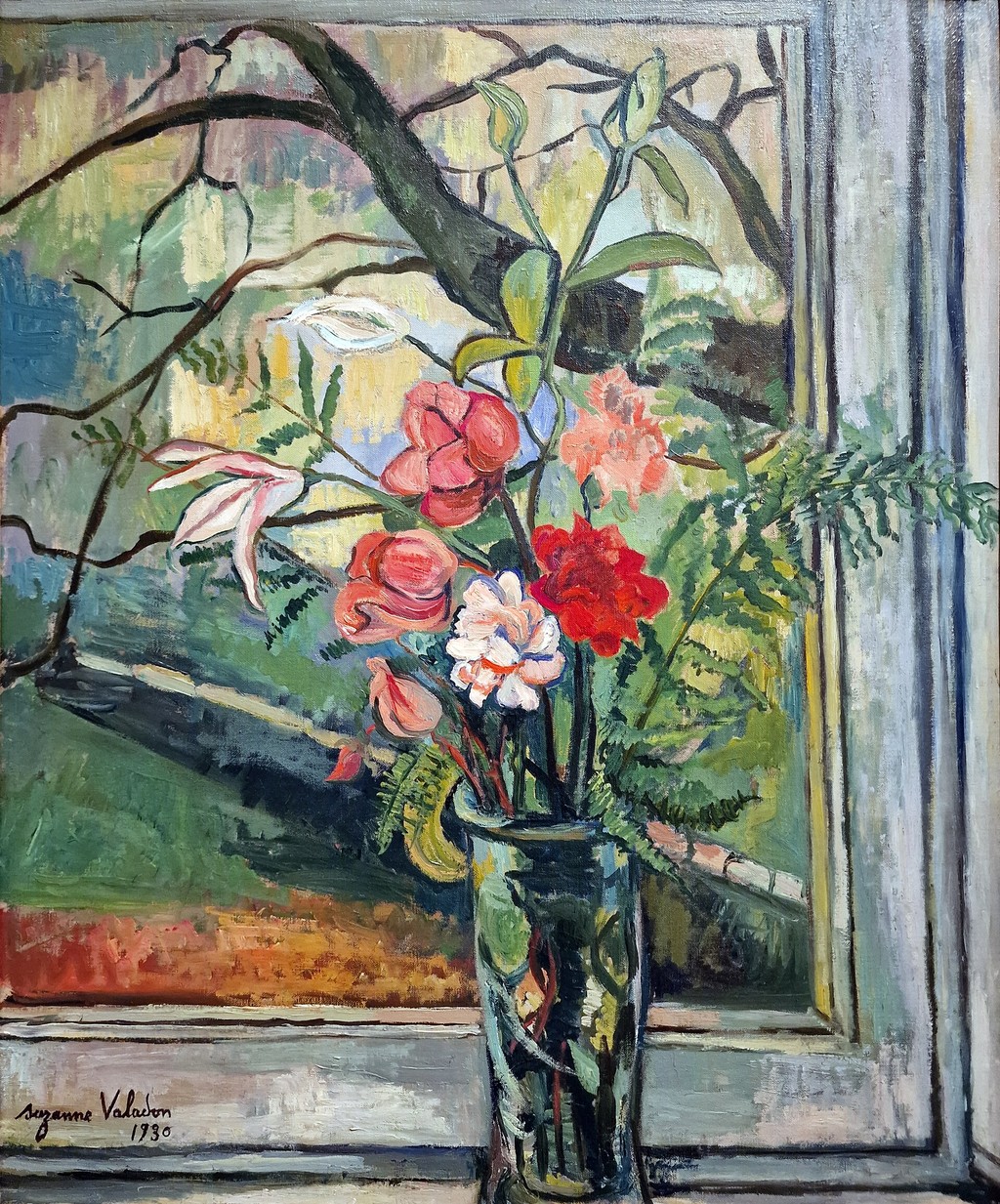
In paintings such as Flowers in Front of a Window (1930), a vase stands against an opening that reveals foliage or exterior space. The window is not a neutral backdrop. Its verticals frame the plant, while the view beyond breaks the boundary between cultivated interior object and living landscape. Reflections and overlapping stems make it difficult to decide where one spatial zone ends.[1]
This hybrid format is particularly revealing because it connects two kinds of looking. Still life depends on deliberate arrangement at close range; landscape usually implies a position before a larger environment. Valadon allows both scales to coexist. The viewer attends to a stem and a distant patch of colour within the same compressed field.
Rue Cortot and the Sacré-Cœur
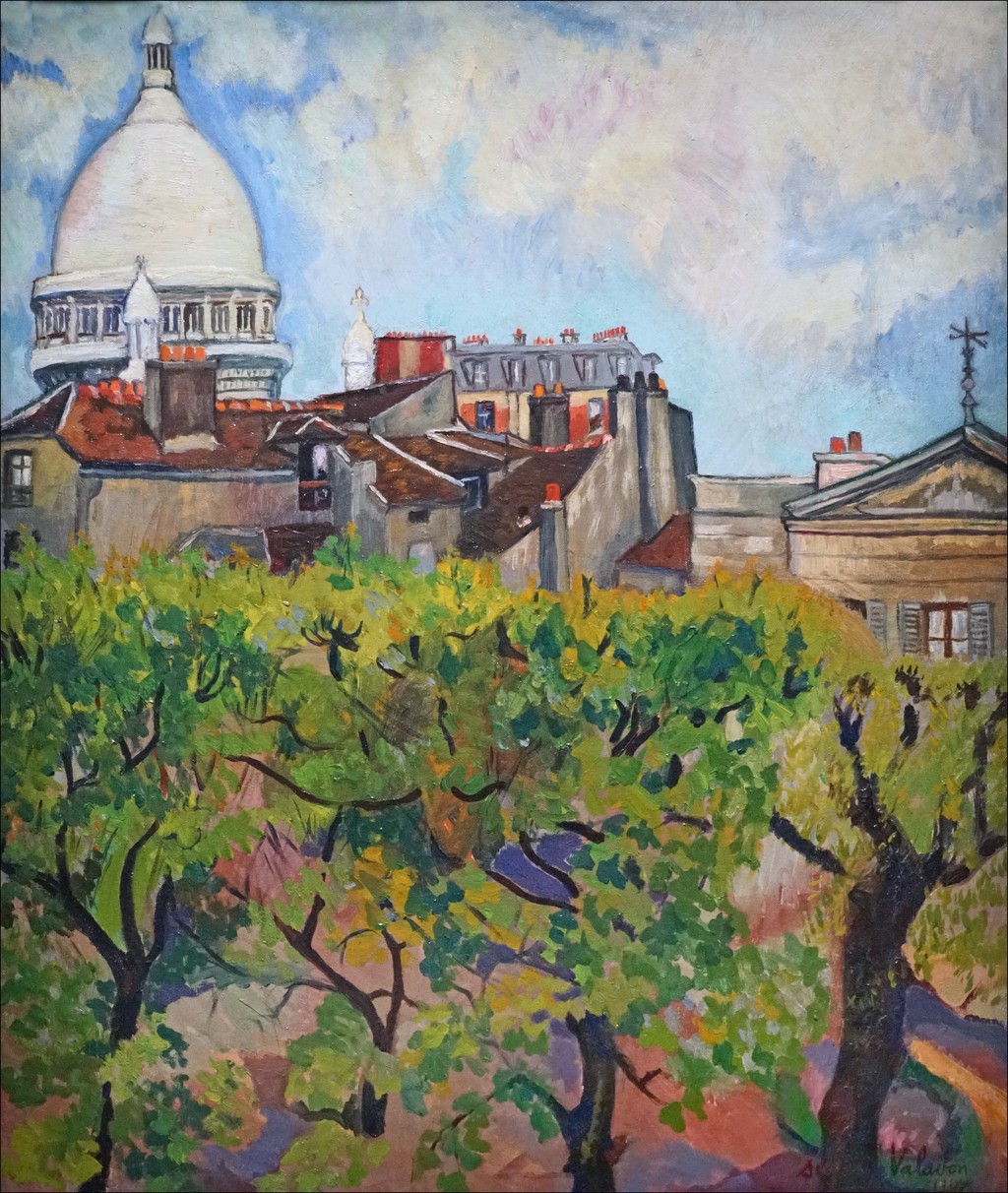
Valadon’s association with 12 rue Cortot gives her Montmartre views biographical resonance, but the paintings remain constructions. In The Sacré-Cœur Seen from the Rue Cortot Garden (1916), the white basilica rises beyond roofs and vegetation. Branches and leaves fill much of the foreground, so the monument is seen through lived garden space rather than isolated as a postcard emblem.[1]
Musée de Montmartre documents the studio household Valadon shared with Maurice Utrillo and André Utter at the address from 1912. Its present atelier-apartment was reconstructed from documents and photographs.[4] The Montmartre model-to-artist essay explains the site’s broader significance. The landscape itself should still be read from visible relations: foreground growth, rising roofs, pale dome and atmospheric blue.
Rural Roads and Built Form
Valadon also worked beyond Paris, painting locations in the Ain, Beaujolais, Brittany and other parts of France. Public structured records name roads, farm buildings, castle courtyards and village churches. These subjects bring architecture into direct contact with trees and sloping land. Walls do not recede through exact academic perspective; they become coloured planes stabilised by contour.[2]
The apparent simplicity can be deceptive. A path must conduct the eye without turning into an empty corridor. A roof can identify a place while remaining part of the surface rhythm. Valadon often resolves these problems through interlocking shapes rather than atmospheric dissolution.
Colour, Contour and Season
In both genres, colour is structural. A red flower can pull a cluster forward; a blue hill can separate layers; a dark branch can bind an otherwise dispersed view. Outlines vary in strength, sometimes surrounding individual objects and sometimes merging into shadow. This flexibility distinguishes contour from a mechanical signature.
The drawings and prints guide shows how years of graphic work prepared Valadon to make a line carry weight. In a landscape, that training helps a branch or roof edge organise large areas. In a still life, it keeps densely packed blossoms from collapsing into a single decorative patch.
Absence and Human Presence
A landscape without a figure is not necessarily empty of people. Gardens are cultivated, roads are travelled, houses are built and a bouquet has been gathered and arranged. Valadon’s still lifes and views often imply such activity without narrating it. They preserve evidence of handling and habitation in the placement of things.
This indirect presence offers a useful counterpoint to the portraits and self-portraits essay. Portraiture concentrates attention on a named or recognisable body; still life and landscape let acts of selection, movement and care remain visible through their results.
Reading Place Without Myth
Montmartre can easily become a romantic shorthand for bohemia, just as rural France can become a timeless refuge. Valadon’s pictures deserve more exact looking. Identify the buildings when a source can confirm them; distinguish a titled location from a presumed one; note what vegetation hides as well as what architecture reveals. A painting of rue Cortot is shaped by local history, but it is not a transparent record of daily life.
The researched directory below provides titles and dates for further discovery. Because its source is public structured data rather than a complete catalogue, it cannot establish the full proportion of Valadon’s landscapes or still lifes. It can, however, make their range visible and direct attention towards exact museum records.
Researched works directory
This searchable evidence census contains 133 distinct records assembled from public collection data and a reproducible Wikidata snapshot. It is not a catalogue raisonné, not a claim of complete oeuvre coverage, and it keeps works with repeated titles as separate objects.
| Name | Date | Medium |
|---|---|---|
| زنان در حمام | 1909 | Painting |
| Adam and Eve | 1909 | Painting |
| After the bath | 1908 | Painting |
| André Utter and his dogs | 1932 | Painting |
| Anémones dans un verre blanc | 1920 | Painting |
| Black Venus | 1919 | Painting |
| Bouquet de fleurs dans un vase Empire | 1920 | Painting |
| Bouquet de fleurs sur un guéridon | 1925 | Painting |
| Bouquet de fleurs sur une petite table | 1932 | Painting |
| Bouquet de roses | 1936 | Painting |
| Bouquet of flowers | 1930 | Painting |
| Bouquet of flowers 1928 | 1928 | Painting |
| Casting the Net | 1914 | Painting |
| Catherine lying naked on a panther skin | 1923 | Painting |
| Catherine nue se coiffant | 1895 | |
| Châtillon-d'Azergues | 1927 | Painting |
| Chien endormi sur un coussin | 1923 | Painting |
| Deux figures | 1909 | Painting |
| Doctor Robert Le Masle | 1930 | Painting |
| Femme à la contrebasse | 1908 | Painting |
| Femmes au bain | 1893 | |
| Fleurs | 1930 | Painting |
| Fleurs et fougères dans un vase | 1929 | Painting |
| Flowers in front of a Window | 1930 | Painting |
| Fruit bowl | 1917 | Painting |
| Germaine Utter à sa fenêtre | 1926 | Painting |
| Germaine Utter devant sa fenêtre | Date unknown | Painting |
| Gilberte nue se coiffant | 1920 | Painting |
| Grandmother and Grandson | 1910 | Painting |
| Joy of Life | 1911 | Painting |
| Juliet sitting in a chair | 1909 | Painting |
| L'Acrobate, ou La Roue | 1916 | Painting |
| L'avenir dévoilé | 1912 | Painting |
| L'étable en Beaujolais | 1921 | Painting |
| La baigneuse nue | Date unknown | Painting |
| La boîte à violon | 1923 | Painting |
| La Cour du Château de Saint-Bernard | 1930 | Painting |
| La Couturière | 1914 | Painting |
| La Dame au petit chien | 1917 | Painting |
| La grenouille | 1910 | Drawing |
| La rue Cortot | Date unknown | Painting |
| La Toilette | 1895 | |
| La Vachère | 1922 | Painting |
| Landscape at Saint-Bernard (Ain) | 1932 | Painting |
| Le Canard | 1930 | Painting |
| Le Jardin de la rue Cortot | Date unknown | Painting |
| Les lilas et camélias | 1936 | Painting |
| Lilacs and Peonies | 1929 | Painting |
| Marie Coca et sa fille | 1913 | Painting |
| Mauricia Coquiot Portrait | 1915 | Painting |
| Mrs. Robert Rey and her daughter Sylvie | 1920 | Painting |
| Naked in the mirror | 1909–1916 | Painting |
| Nature morte | 1920 | Painting |
| Nature morte à la draperie et au bouquet | 1924 | Painting |
| Nature morte au lapin et à la perdrix | 1930 | Painting |
| Nature morte au poisson | 1926 | Painting |
| Nature morte aux fruits et aux fleurs | 1926 | Painting |
| Nu à la couverture rayée | 1922 | Painting |
| Nu à la draperie blanche | 1914 | Painting |
| Nu allongé sur un divan | 1926 | Painting |
| Nu assis | 1925 | Painting |
| Nu assis au bord d'un lit | 1929 | Painting |
| Nu assis sur un canapé | 1916 | Painting |
| Nu au châle bleu | 1930 | Painting |
| Nu, Suzanne Valadon | 1925 | Artwork |
| Nude Arranging Her Hair | 1916 | Painting |
| Nude on a Red Couch | 1920 | Painting |
| Nude Sitting on the Edge of a Bed | 1929 | Painting |
| Nude with drapery | 1921 | Painting |
| Nude with drapery and armchair | 1921 | Drawing |
| Nude woman with a cat and flowers | 1920 | Painting |
| Nudes | 1919 | Painting |
| Paysage de Bretagne ou Île d'Ouessant | 1912 | Painting |
| Plat d'étain | 1920 | Painting |
| Portrait d'enfant | Date unknown | Painting |
| Portrait de Lily Walton | 1923 | Painting |
| Portrait de Louis Moysés | 1924 | Painting |
| Portrait de Maurice Utrillo | 1921 | Painting |
| Portrait du sculpteur Gibault | 1895 | Painting |
| Portrait of a Woman | 1928 | Painting |
| Portrait of a Woman | 1929 | Painting |
| Portrait of a woman | 1934 | Painting |
| Portrait of Charles Wakefield-Mori | 1922 | Painting |
| Portrait of Erik Satie | 1892 | Painting |
| Portrait of Lily Walton | 1922 | Painting |
| Portrait of Madame Lévy | 1922 | Painting |
| Portrait of Madame Maurice Utrillo, Lucie Valore | 1937 | Painting |
| Portrait of Madame Petridès | 1937 | Painting |
| Portrait of Maurice Utrillo | 1928 | |
| Portrait of Mme Zamaron | 1922 | Painting |
| Portrait of Nora Kars | 1914 | Painting |
| Portraits of the Family | 1912 | Painting |
| Raminou cat study | 1917 | Painting |
| Raminou on his blue cushion | 1919 | Painting |
| Reclining Nude | 1928 | Painting |
| Route dans la forêt de Compiègne | 1914 | Painting |
| Seated Female Nude | 1916 | Painting |
| Seated Nude with Shawl Carpet | 1921 | Painting |
| Self-portrait | 1883 | Drawing |
| Self-Portrait | 1898 | Painting |
| Self-portrait in the mirror | 1927 | Painting |
| Self portrait with bare breasts | 1931 | Painting |
| Sitting nude | 1921 | Painting |
| Spring Flowers | 1928 | Painting |
| Still Life with Fruit | 1937 | Painting |
| Still Life with Fruit Basket | 1920 | Painting |
| Still life with white rose | 1936 | Painting |
| The Abandoned Doll | 1921 | Painting |
| The artist's mother | 1912 | Painting |
| The Bath | 1908 | Drawing |
| The bathers | 1923 | Painting |
| The Blue Room | 1923 | Painting |
| The Rising | 1920 | Painting |
| The two sisters | 1928 | Painting |
| The Woman in White Stockings | 1924 | Painting |
| Tree at Montmagny Quarry | Date unknown | Painting |
| Untitled (Still Life) | 1921 | Painting |
| Utrillo de face | 1925 | Drawing |
| Utrillo de trois-quarts | 1925 | Drawing |
| Utrillo devant son chevalet | 1919 | Painting |
| Utrillo pensif | 1911 | Drawing |
| Utter familly | 1921 | Painting |
| Vase de fleurs | 1917 | Painting |
| Vase de fleurs | 1927 | Painting |
| Vase de fleurs | 1934 | Painting |
| Vase de fleurs et tapis oriental | 1929 | Painting |
| Vase of flowers | 1922 | Painting |
| Woman in an armchair. Portrait of Madame G. | 1919 | Painting |
| Woman Seated | Date unknown | Painting |
| Woman with guitar | 1920 | Painting |
| Young Girl Bathing | 1919 | Painting |
| Young girl crocheting | 1892 | Painting |
| Young Girl in Front of a Window | 1930 | Painting |
Frequently Asked Questions
Yes. Public records identify numerous bouquets and vases, especially from the 1920s and 1930s. Repeated generic titles refer to distinct objects and should not be merged without further evidence.[1][2]
The 1929 painting belongs to the Metropolitan Museum of Art in New York. The object page confirms its large scale and collection history but does not provide an unrestricted downloadable image.[3]
Yes. Views include the Sacré-Cœur, the rue Cortot garden and streets around the hill. The precise identity of a view should follow a collection record or securely transmitted title.[1][4]
Both rely on bounded forms, compressed depth and strongly organised colour. Trees, roofs and roads can perform structural roles comparable to bodies, furniture and patterned cloth.
No. The directory reproduces titles and basic data from a dated public snapshot. Exact location, dating and ownership require consultation of the linked item and a holding institution.
Discussion
Use this evidence-led guide as a starting point for close looking rather than a final verdict.
Share an observation about Suzanne Valadon Still Life and Landscape or a source that adds useful context.
Reader Insights
Which work most clearly complicates the familiar label of American Impressionist?
Where do training, display, family, place or teaching most productively alter your reading?
Which source or surviving object would you investigate next?
Join the Conversation
Add your reading below, keeping observations specific and evidence clear.
References
- Centre Pompidou, Suzanne Valadon resource dossier, accessed 31 August 2026.
- AWARE, Suzanne Valadon, accessed 31 August 2026.
- Metropolitan Museum of Art, Lilacs and Peonies, accessed 31 August 2026.
- Musée de Montmartre, permanent collections and atelier-apartment, accessed 31 August 2026.
- Flowers in Front of a Window, 1930 — National Gallery Prague, public domain.
More VALADON Artworks
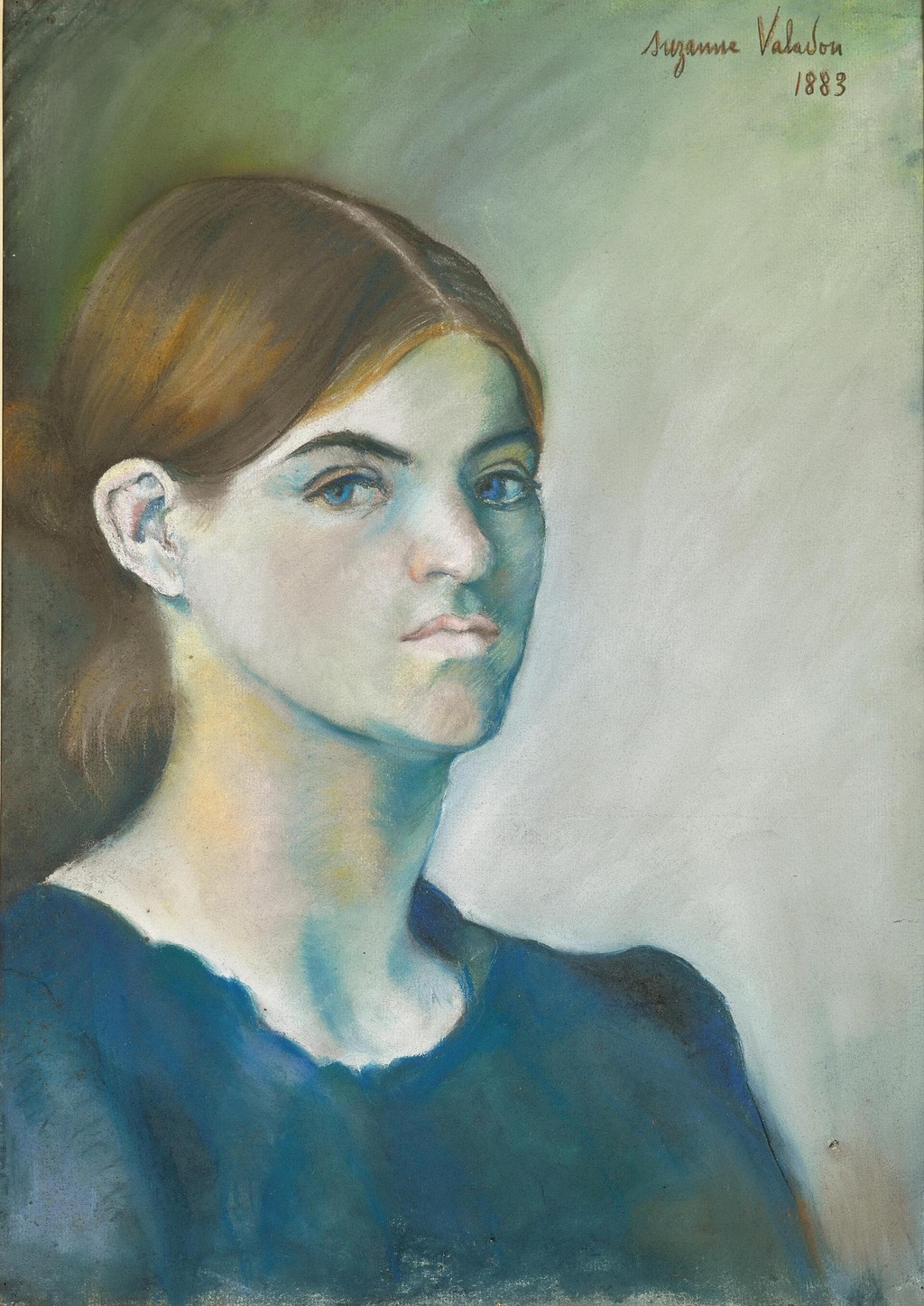
Self-Portrait
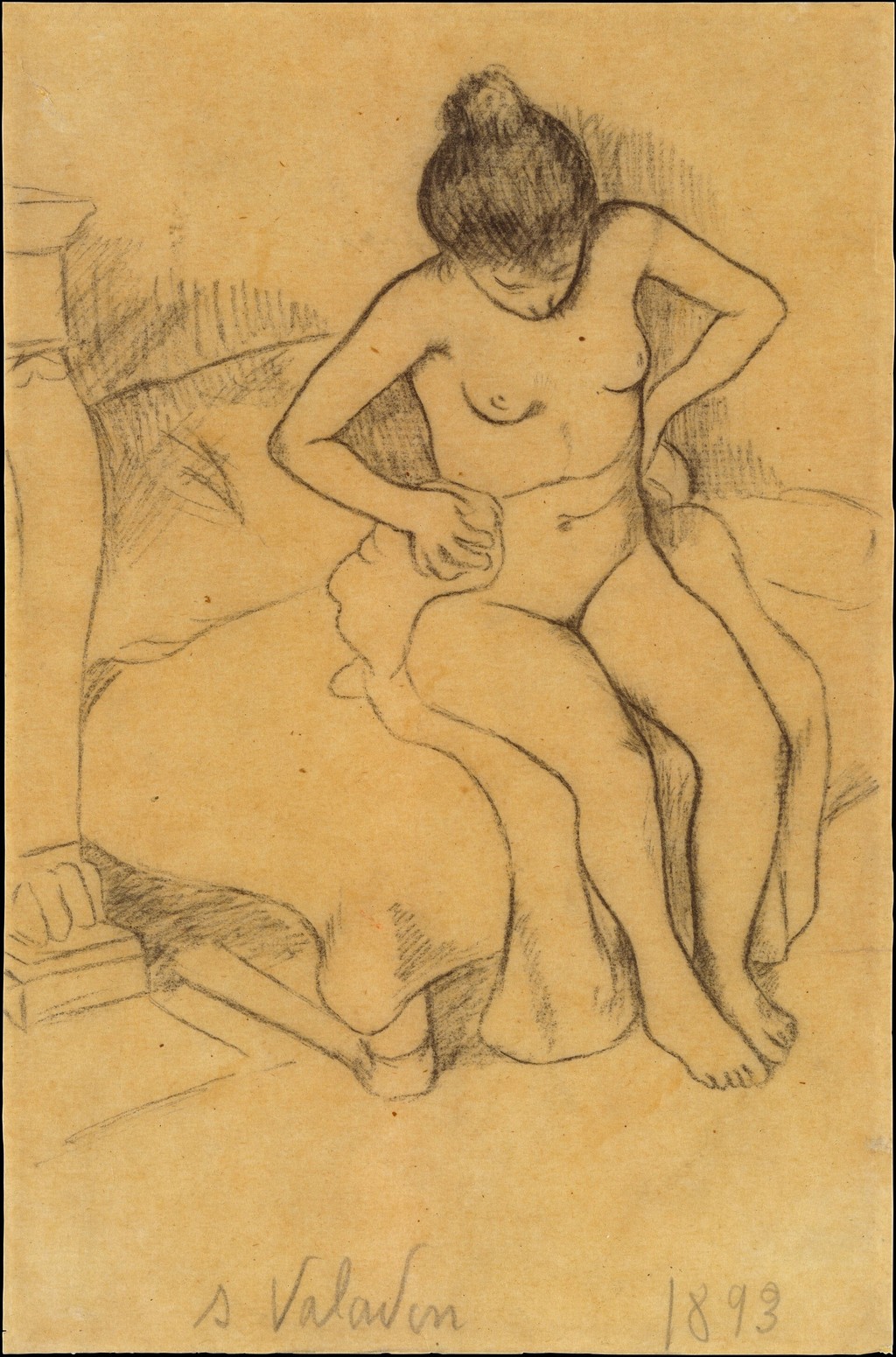
After the Bath
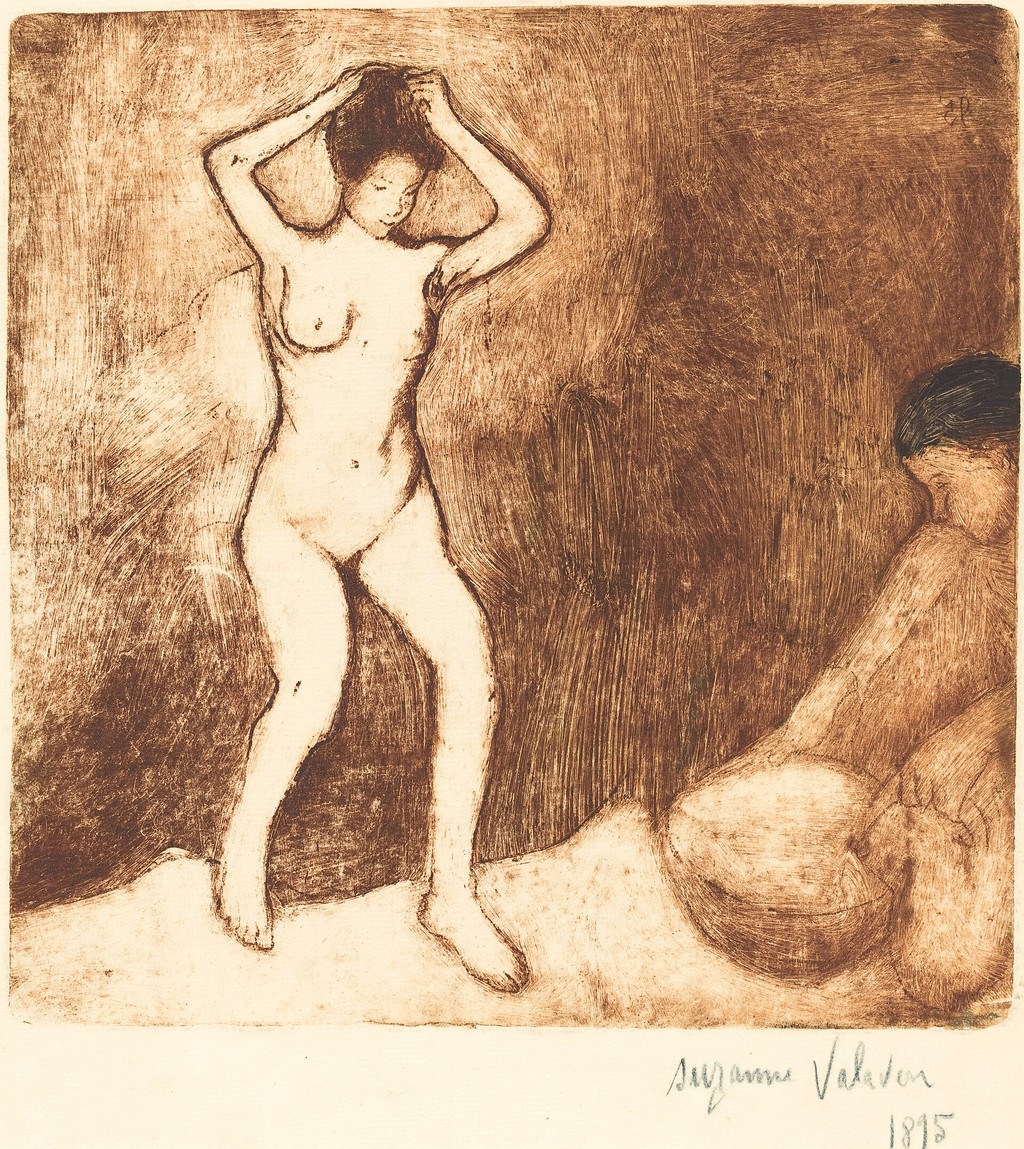
La Toilette
The Abandoned Doll