


 by Tom Gurney
Tom Gurney BSc (Hons) is an art history expert with over 20 years experience
Page Created on August 31, 2026 / Page Updated on November 6, 2026
Email: tomgurney1@gmail.com / Phone: +44 7429 011000
Suzanne Valadon: Introduction
Suzanne Valadon built a career by looking hard at the world that surrounded her. She knew Montmartre first as a working-class district and a place of employment, then as an artist’s model, and finally as a painter, draughtswoman and printmaker with an unmistakable visual language. Her pictures refuse the softening conventions often attached to women, domestic interiors and the nude. Strong contours hold forms in place; colour can be emphatic without becoming decorative; bodies retain weight, age and self-possession. That directness connects the early drawings of bathers to late self-portraits, landscapes, flower paintings and psychologically charged rooms.[1][2]
At a Glance
- Born23 September 1865, Bessines-sur-Gartempe, France
- Died7 April 1938, Paris, France
- Known forPainting, drawing, drypoint and etching
- Key subjectsPortraits, self-portraits, nudes, family, interiors, still life and landscape
- Important settingMontmartre, especially 12 rue Cortot
- Essential worksAdam and Eve, Family Portrait and The Blue Room
Suzanne Valadon in context
Impressionism
c. 1860–1886Post-Impressionism
c. 1886–1905Symbolism
c. 1880–1910Fauvism
c. 1905–1910School of Paris
c. 1900–1940Edgar Degas
1834–1917Pierre-Auguste Renoir
1841–1919Henri de Toulouse-Lautrec
1864–1901Suzanne Valadon
1865–1938Maurice Utrillo
1883–1955André Utter
1886–1948Self-Portrait
1883Portrait of Erik Satie
1892–93Adam and Eve
1909Family Portrait
1912The Casting of the Net
1914The Abandoned Doll
1921The Blue Room
1923Self-Portrait with Bare Breasts
1931Contents
- Introduction
- Why Suzanne Valadon Matters
- From Model to Author
- Drawing as a Foundation
- Portraits, Families and Self-Scrutiny
- Rethinking the Nude
- Rooms, Objects and Places
- How to Explore the Work
Why Suzanne Valadon Matters
Valadon’s importance does not rest on the novelty of an artist’s model taking up a brush. That familiar story can obscure the sustained discipline of her work. She drew from the early 1880s, exhibited drawings at the Société Nationale des Beaux-Arts in 1894, learned printmaking with encouragement from Edgar Degas, and developed a painting practice that became central after 1909. Institutional accounts trace solo and group exhibitions, support from dealers including Berthe Weill, and international recognition during her lifetime.[2][3]
Her distinction lies in how she converted close observation into structure. Lines around an arm, a cheek or a patterned cloth are rarely timid. They give bodies gravity and make the surrounding space press back. Even when a pose recalls an established genre—the bather, the odalisque, the family group—Valadon alters the social relation between viewer and subject. The result is neither simple naturalism nor a single manifesto. It is an art of physical presence, informed by long experience on both sides of the easel.
From Model to Author
Between roughly 1880 and 1893, Valadon modelled for artists including Pierre-Auguste Renoir and Henri de Toulouse-Lautrec. She could not afford a conventional academy training, but posing placed her inside studios where drawing, composition and the daily labour of art were visible at close range. Degas did not employ her as a model; he took her drawings seriously, collected examples and helped her understand print processes. That distinction matters. Her authorship emerged through sustained looking and making, not through a sudden transformation bestowed by a male mentor.[3][4]
The change of professional position is explored in Montmartre: Model to Artist. It also gives special force to her treatment of the nude. Valadon understood how a posed body can be arranged for another person’s gaze. In her own images, women bathe, dry themselves, rest or examine their reflection without being reduced to polished display. Male bodies, too, could become objects of the woman artist’s scrutiny.
Drawing as a Foundation
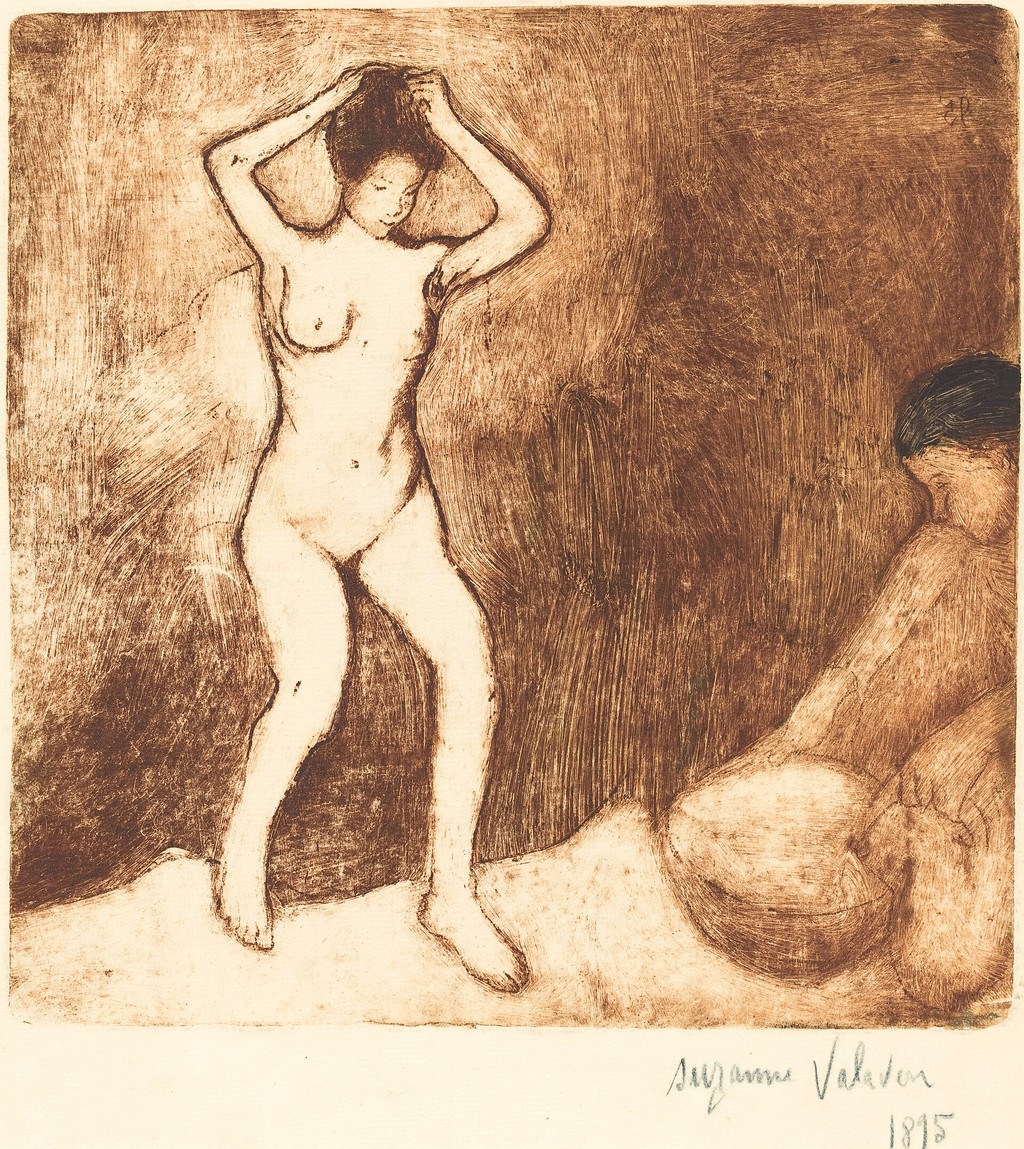
Valadon’s earliest surviving self-portrait is dated 1883. Her drawings and prints of the 1890s often concentrate on ordinary actions: washing, arranging hair, sitting on a bed, caring for a child. A black-crayon sheet such as After the Bath (1893) depends on economy rather than finish. The National Gallery of Art’s impressions of Catherine Prepares the Bath and Louise, Nude, Fixes Her Hair show how softground etching, drypoint and selective inking could turn drawn contours into richly varied printed lines.[5][6]
The drawings and prints guide follows this technical strand in detail. It also guards against treating works on paper as rehearsals for “finished” paintings. A drypoint’s burr, a crayon’s pressure and a monoprint’s unique wiping are active decisions. Valadon used those media to test how the body occupies space and how one figure attends to another.
Portraits, Families and Self-Scrutiny
Valadon repeatedly painted people whose lives intersected with hers: her mother, her son Maurice Utrillo, her partner André Utter, friends, patrons and herself. These relationships did not guarantee intimacy or ease. In Family Portrait (1912), four people are pressed into a shallow field, each with a distinct pose and direction of attention. The Centre Pompidou’s interpretation identifies references to Renaissance portrait types and to Dürer’s Melencolia I, while Musée d’Orsay confirms the object’s title, dimensions and collection history.[7][8]
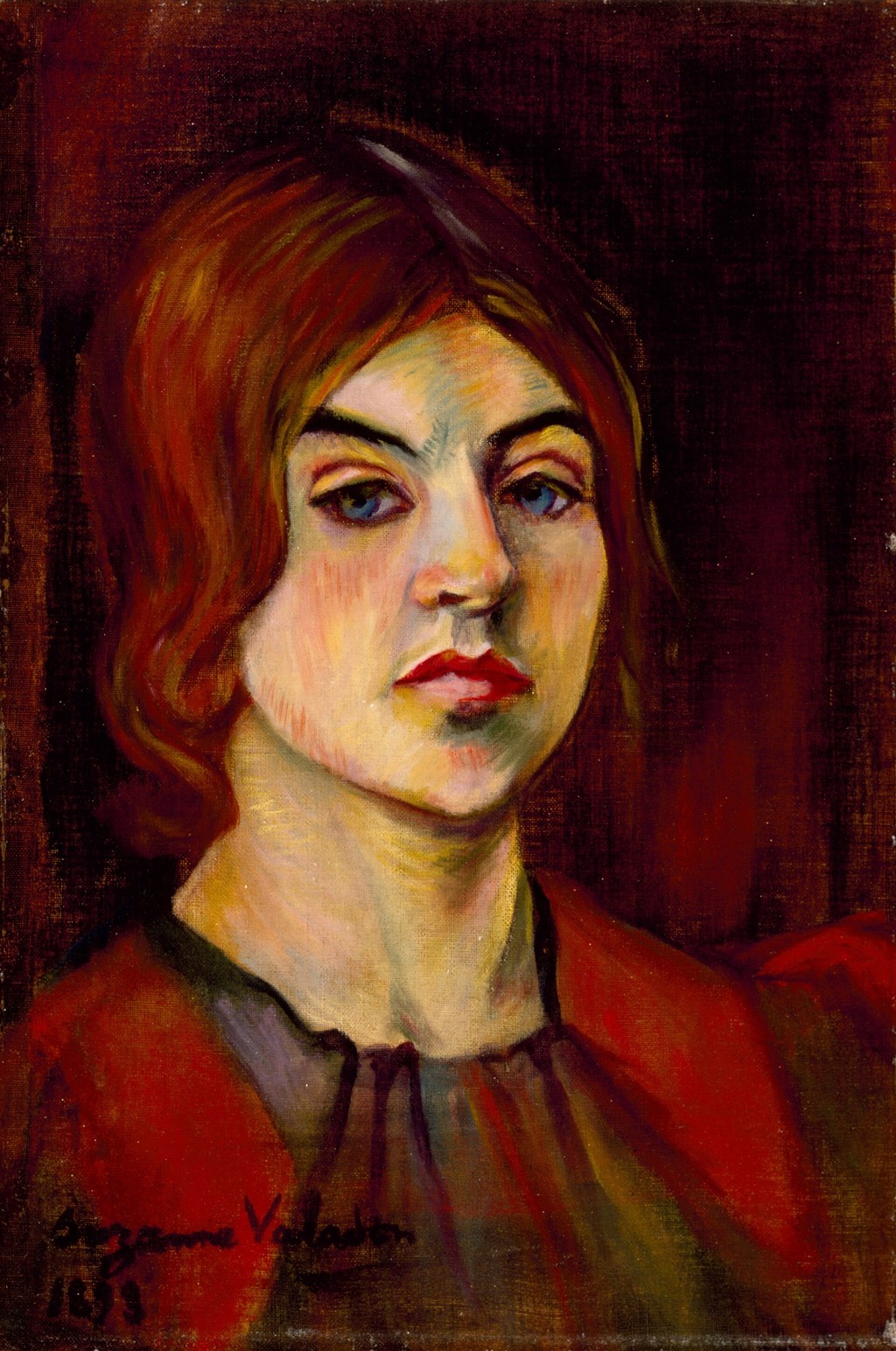
The picture is examined closely in Family Portrait. Across her self-portraits, Valadon’s scrutiny changes with age but rarely becomes flattering. The 1898 Self-Portrait in Houston is small, sharply coloured and direct. Later images make ageing part of artistic identity rather than something to conceal. The portrait and self-portrait guide brings these works together without assuming that every painted face reveals a private truth.
Rethinking the Nude
Current curators often use “female gaze” to describe Valadon’s reversal of inherited viewing relations. The phrase is useful if it remains an interpretive tool rather than a timeless label. Her nudes are varied: solitary women, paired bathers, adolescents in domestic settings, self-images and male figures. Their bodies tend to be bounded by dark contours, their poses specific rather than ideal, and their environments materially present.[1][2]
In Adam and Eve, Valadon represented herself with André Utter in a large biblical double nude. The Centre Pompidou record identifies both sitters and the work’s 1909 date. The linked dossier reads the painting as a triple reversal: the former model becomes painter, paints herself nude, and makes a male lover the object of her gaze.[9] The wider nudes and female gaze essay tests that claim across more than one image, including drawings where women’s routine actions matter as much as exposed skin.
Rooms, Objects and Places
Valadon’s strongest pictures do not isolate figures from their surroundings. Patterned covers, curtains, clothing and walls create competing fields of colour. The Blue Room (1923) places a clothed woman on a bed with books and a cigarette. Centre Pompidou interprets the scene as a modern revision of the odalisque: the woman occupies her private space without performing availability.[10] A dedicated close reading of The Blue Room separates visible evidence—the striped trousers, two books, floral textiles—from the larger curatorial argument.
Still lifes and landscapes broaden the same interest in pressure, pattern and place. Flowers push against the edges of vases and windows; the Sacré-Cœur rises beyond the vegetation of the rue Cortot garden; rural roads, buildings and trees are simplified into coloured masses. The still life and landscape guide shows that these subjects were not retreats from figure painting. They offered other ways to organise weight, contour and the tension between an object and its setting.
How to Explore the Work
Begin with the biography for the evidence behind key dates and relationships. Continue to paintings and artworks for a medium-wide view, then compare a work on paper with one of the three object studies. Notice where a museum record supplies a fact and where close looking begins. Dates, dimensions and collections can be verified; a figure’s inner state cannot.
The researched works directory below offers a broader discovery set. It is assembled from dated public collection data and creator-attributed Wikidata records, not from a complete catalogue raisonné. Repeated titles may refer to different objects, and an absent work is not evidence that Valadon never made it. Used with those limits in mind, the directory reveals the breadth of a career too often compressed into a colourful Montmartre anecdote.
Follow Suzanne Valadon's career through four stages
Work, modelling and a private drawing practice
After childhood in Bessines-sur-Gartempe and Paris, Valadon supported herself through varied work and modelled in Montmartre. Drawing overlapped with those sessions: the 1883 self-portrait is her earliest surviving work, and public recognition followed when she exhibited drawings in 1894.
Salon recognition, printmaking and early oils
Degas collected Valadon's drawings and encouraged her intaglio practice, while dealers circulated prints. Family, bathing and everyday bodily actions became persistent subjects; painting developed alongside rather than replacing work on paper.
Large figures, the studio household and public authority
A renewed concentration on painting brought Adam and Eve, Family Portrait and The Casting of the Net. From 1912, the household and studio at rue Cortot joined Valadon, Maurice Utrillo and André Utter during exceptionally productive years.
Modern interiors, flowers, landscapes and ageing
The Blue Room reworked an inherited reclining-woman format through modern clothing, books and smoking. Portraits, self-images, flower paintings and landscapes remained active subjects as exhibitions widened and drawing again became increasingly important late in life.
Essential works
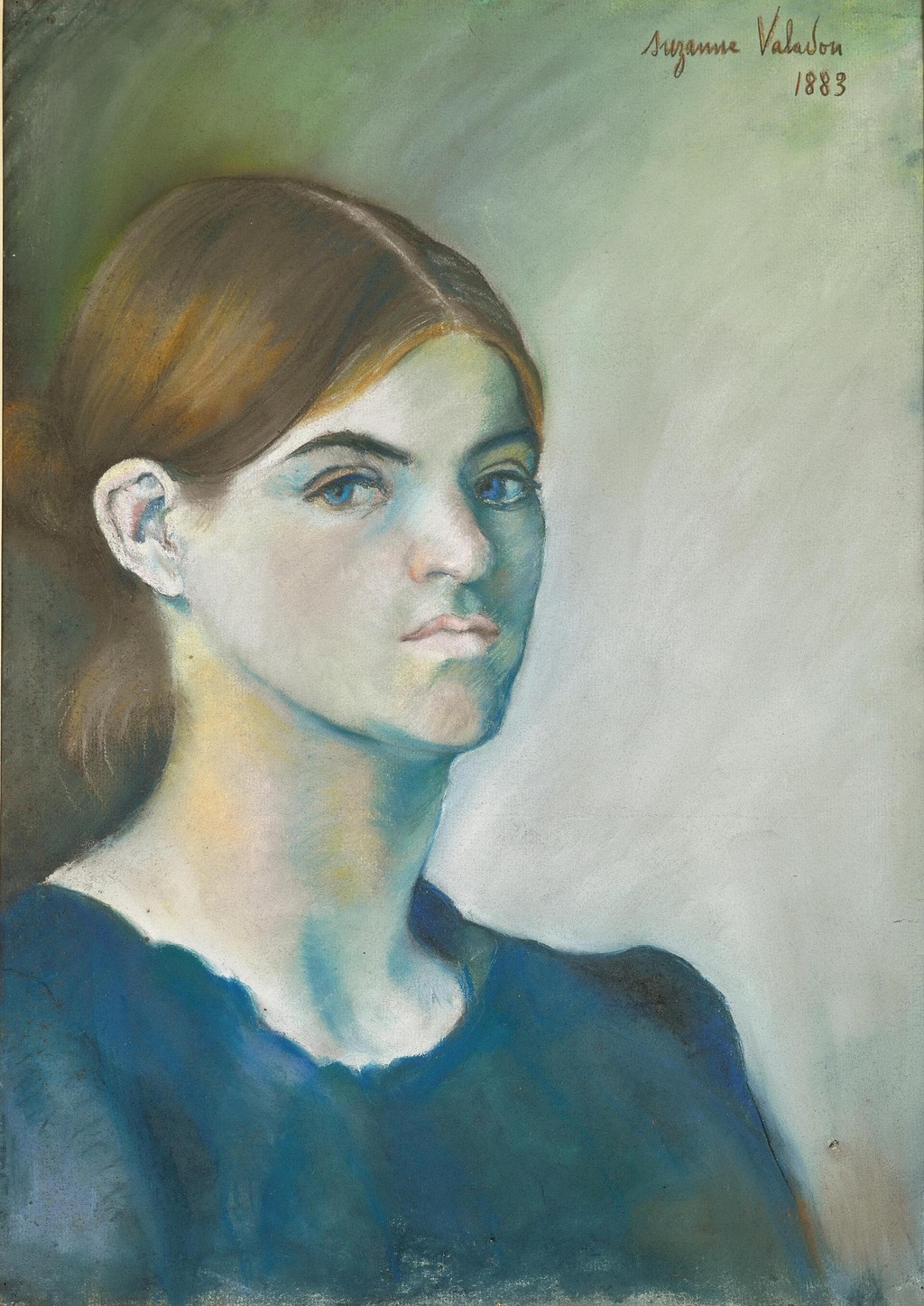
Self-Portrait
1883 · A tightly framed pastel establishes Valadon's authorship while she was still earning money as a model.
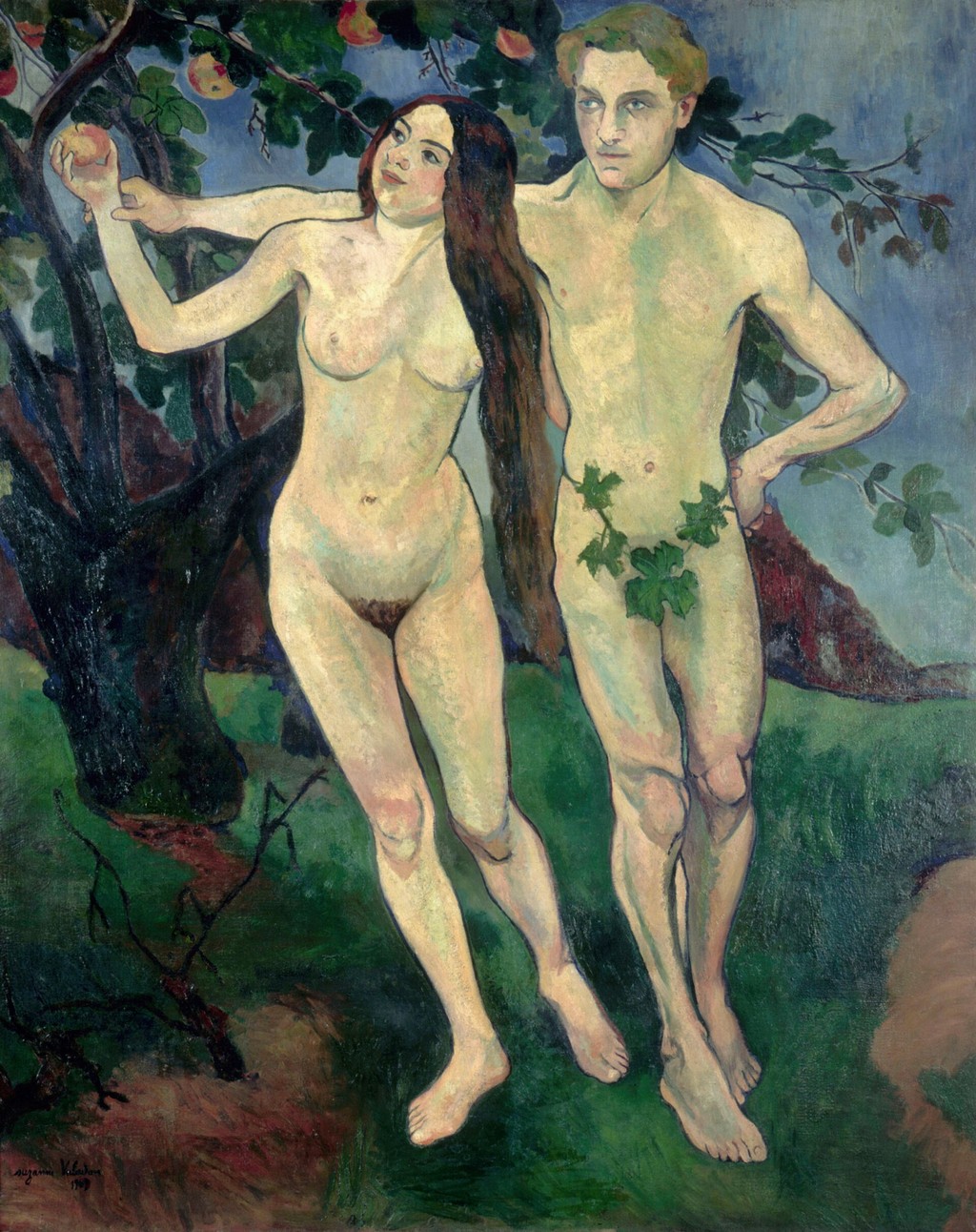
Adam and Eve
1909 · Valadon and André Utter become a monumental biblical couple in a reversal of established painter-model roles.
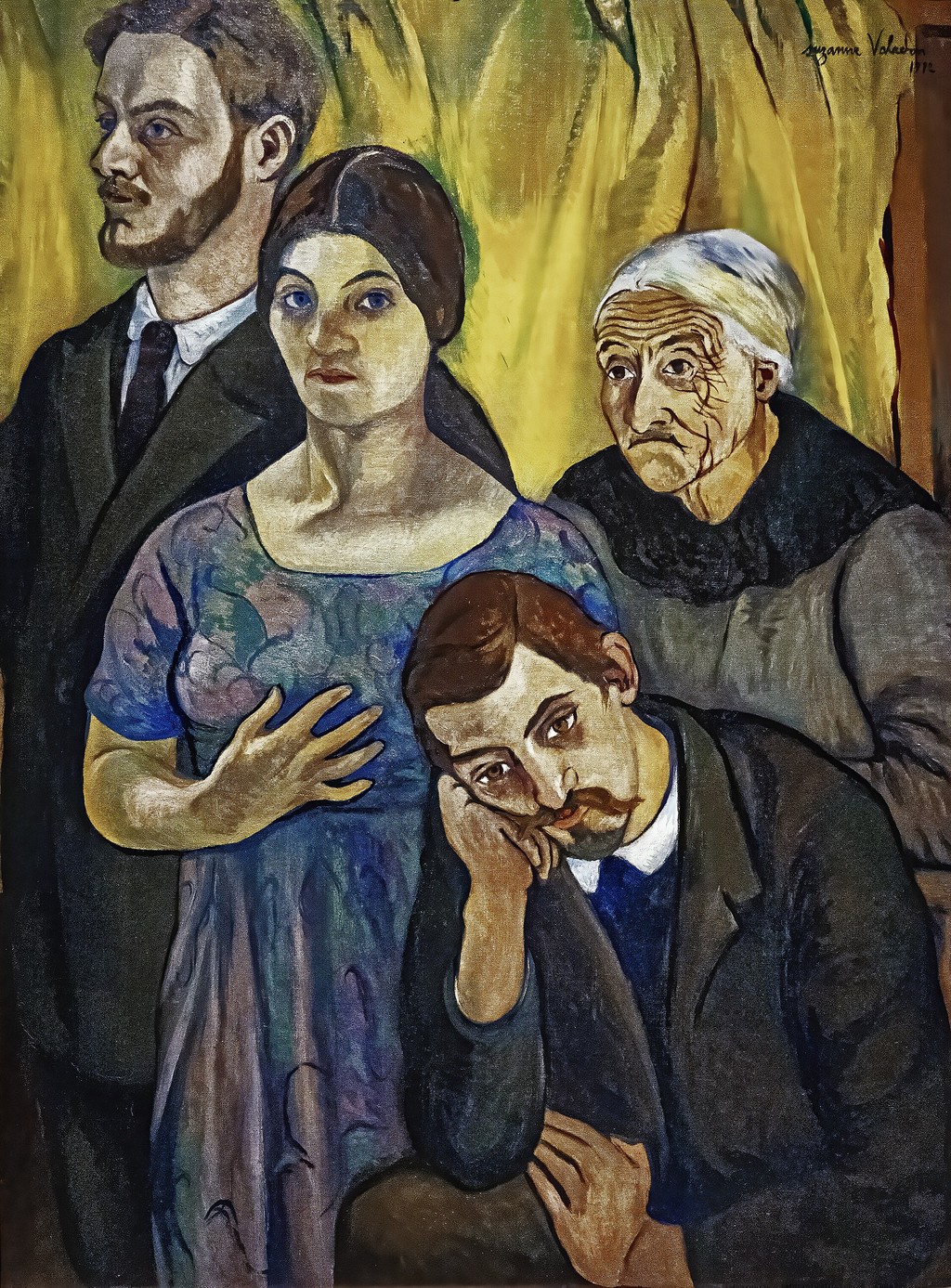
Family Portrait
1912 · Four related figures occupy one compressed field while learned poses keep their identities sharply separate.
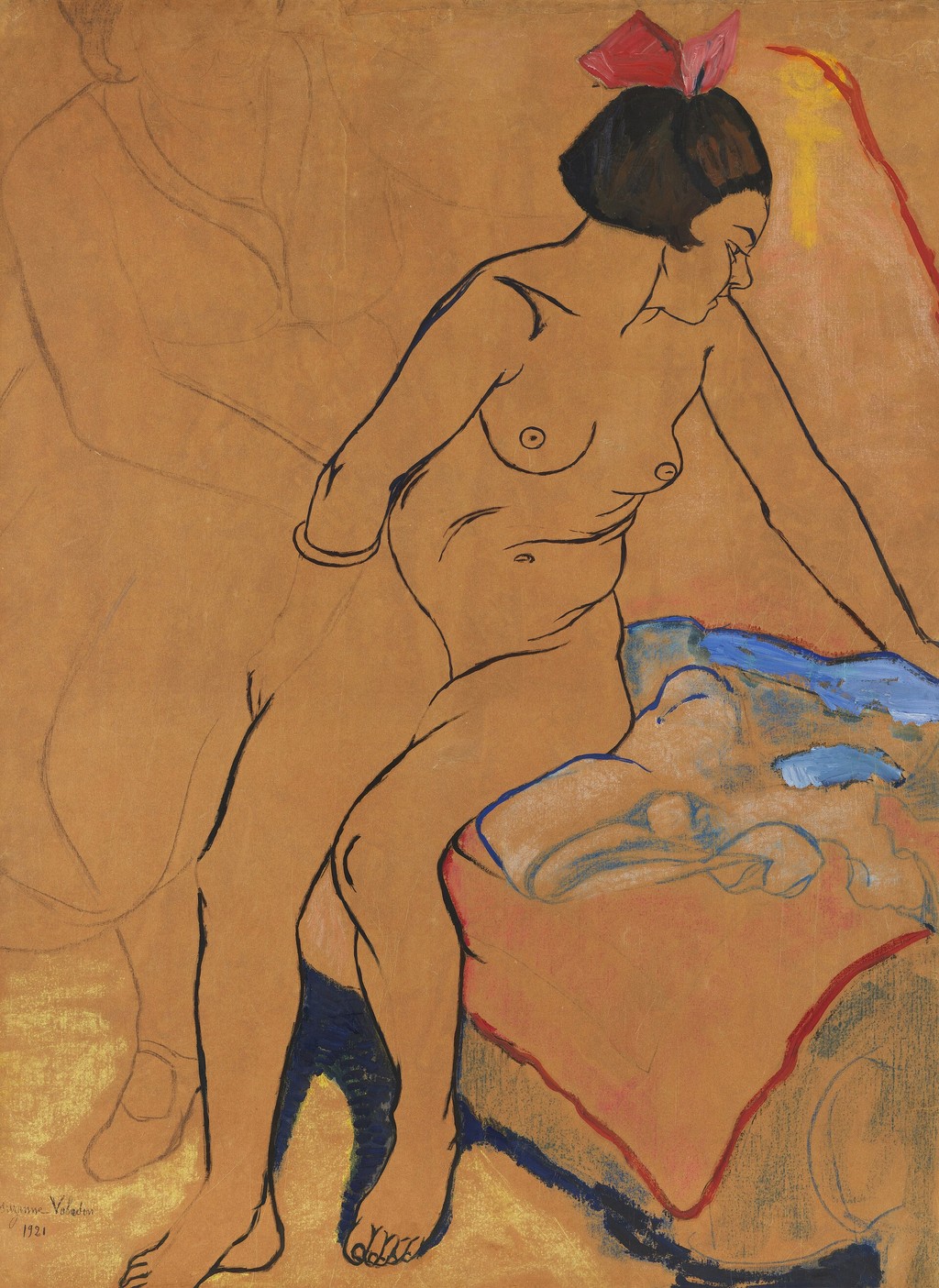
The Abandoned Doll
1921 · Bathing, a mirror and a discarded toy frame adolescence as embodied change rather than polished display.
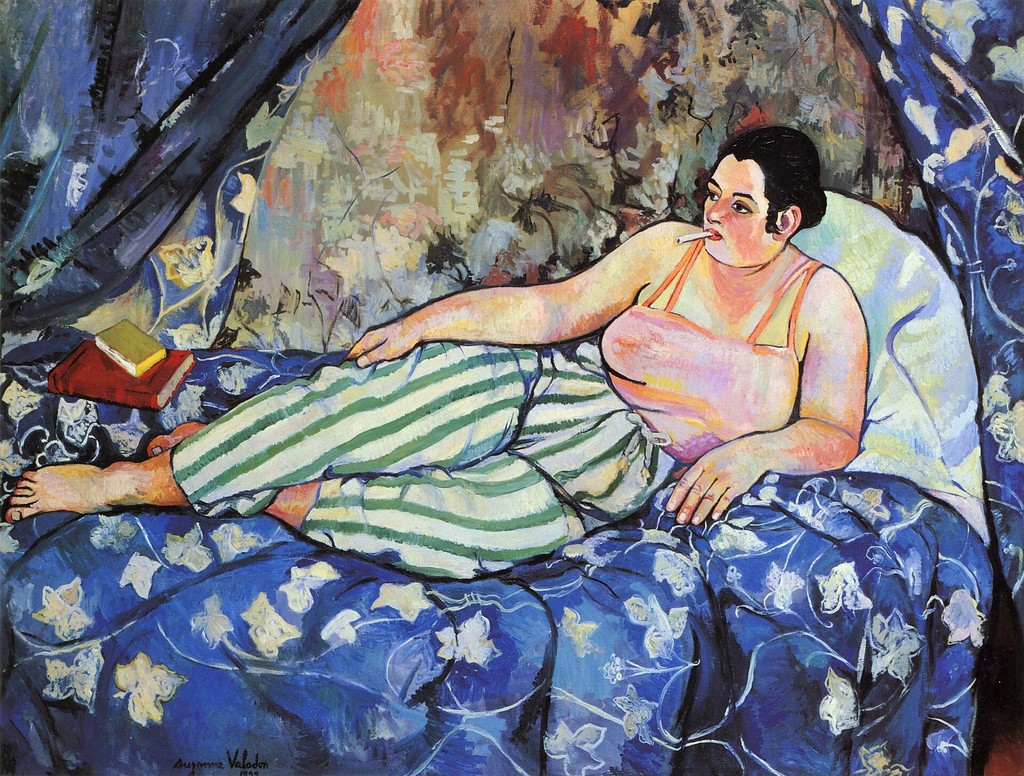
The Blue Room
1923 · Striped trousers, books and a cigarette transform the reclining-woman tradition into a modern private interior.
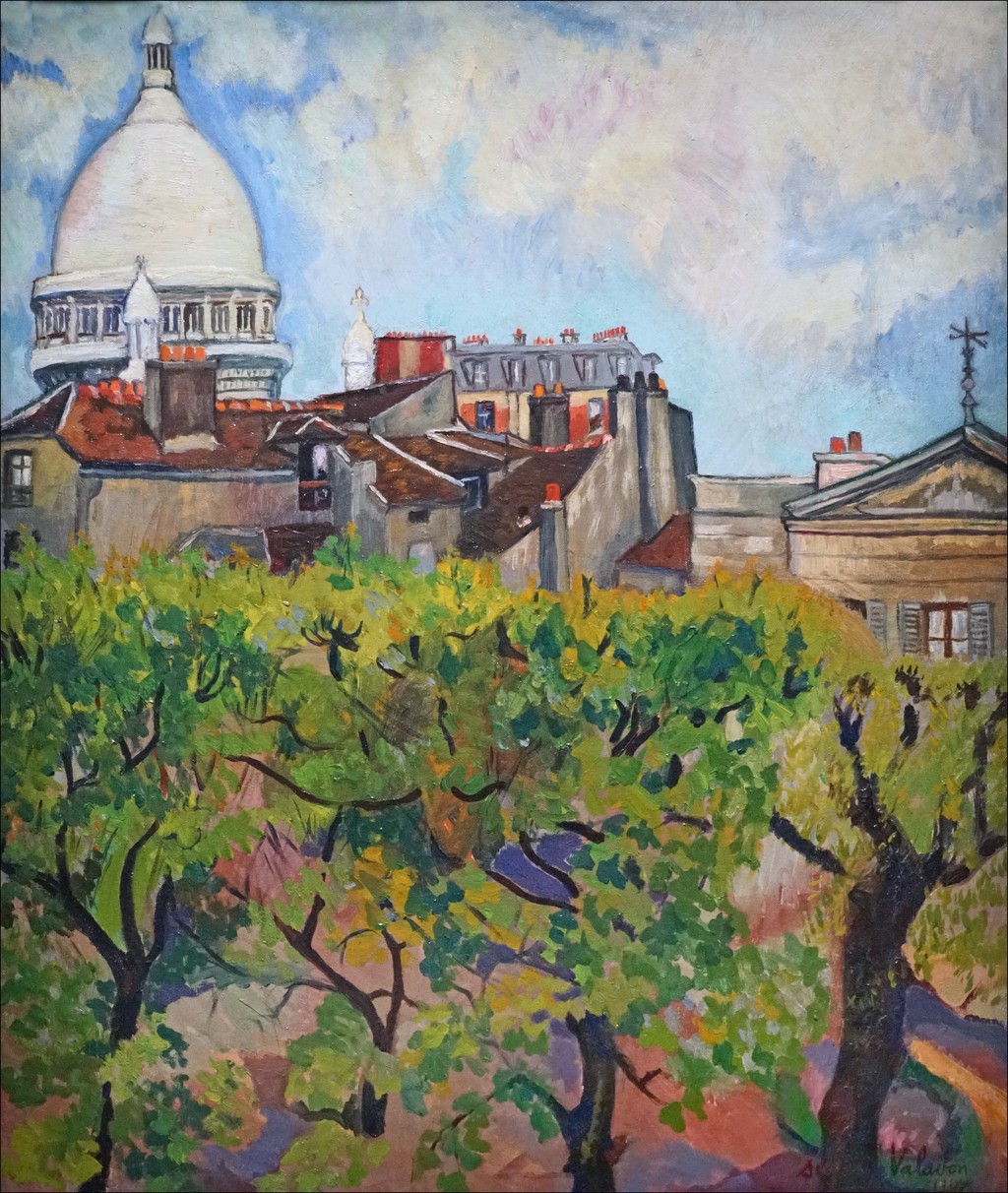
The Sacré-Cœur from Rue Cortot
1916 · Garden vegetation mediates the view towards the basilica, joining a working address to Montmartre's changing skyline.
Researched works directory
This searchable evidence census contains 133 distinct records assembled from public collection data and a reproducible Wikidata snapshot. It is not a catalogue raisonné, not a claim of complete oeuvre coverage, and it keeps works with repeated titles as separate objects.
| Name | Date | Medium |
|---|---|---|
| زنان در حمام | 1909 | Painting |
| Adam and Eve | 1909 | Painting |
| After the bath | 1908 | Painting |
| André Utter and his dogs | 1932 | Painting |
| Anémones dans un verre blanc | 1920 | Painting |
| Black Venus | 1919 | Painting |
| Bouquet de fleurs dans un vase Empire | 1920 | Painting |
| Bouquet de fleurs sur un guéridon | 1925 | Painting |
| Bouquet de fleurs sur une petite table | 1932 | Painting |
| Bouquet de roses | 1936 | Painting |
| Bouquet of flowers | 1930 | Painting |
| Bouquet of flowers 1928 | 1928 | Painting |
| Casting the Net | 1914 | Painting |
| Catherine lying naked on a panther skin | 1923 | Painting |
| Catherine nue se coiffant | 1895 | |
| Châtillon-d'Azergues | 1927 | Painting |
| Chien endormi sur un coussin | 1923 | Painting |
| Deux figures | 1909 | Painting |
| Doctor Robert Le Masle | 1930 | Painting |
| Femme à la contrebasse | 1908 | Painting |
| Femmes au bain | 1893 | |
| Fleurs | 1930 | Painting |
| Fleurs et fougères dans un vase | 1929 | Painting |
| Flowers in front of a Window | 1930 | Painting |
| Fruit bowl | 1917 | Painting |
| Germaine Utter à sa fenêtre | 1926 | Painting |
| Germaine Utter devant sa fenêtre | Date unknown | Painting |
| Gilberte nue se coiffant | 1920 | Painting |
| Grandmother and Grandson | 1910 | Painting |
| Joy of Life | 1911 | Painting |
| Juliet sitting in a chair | 1909 | Painting |
| L'Acrobate, ou La Roue | 1916 | Painting |
| L'avenir dévoilé | 1912 | Painting |
| L'étable en Beaujolais | 1921 | Painting |
| La baigneuse nue | Date unknown | Painting |
| La boîte à violon | 1923 | Painting |
| La Cour du Château de Saint-Bernard | 1930 | Painting |
| La Couturière | 1914 | Painting |
| La Dame au petit chien | 1917 | Painting |
| La grenouille | 1910 | Drawing |
| La rue Cortot | Date unknown | Painting |
| La Toilette | 1895 | |
| La Vachère | 1922 | Painting |
| Landscape at Saint-Bernard (Ain) | 1932 | Painting |
| Le Canard | 1930 | Painting |
| Le Jardin de la rue Cortot | Date unknown | Painting |
| Les lilas et camélias | 1936 | Painting |
| Lilacs and Peonies | 1929 | Painting |
| Marie Coca et sa fille | 1913 | Painting |
| Mauricia Coquiot Portrait | 1915 | Painting |
| Mrs. Robert Rey and her daughter Sylvie | 1920 | Painting |
| Naked in the mirror | 1909–1916 | Painting |
| Nature morte | 1920 | Painting |
| Nature morte à la draperie et au bouquet | 1924 | Painting |
| Nature morte au lapin et à la perdrix | 1930 | Painting |
| Nature morte au poisson | 1926 | Painting |
| Nature morte aux fruits et aux fleurs | 1926 | Painting |
| Nu à la couverture rayée | 1922 | Painting |
| Nu à la draperie blanche | 1914 | Painting |
| Nu allongé sur un divan | 1926 | Painting |
| Nu assis | 1925 | Painting |
| Nu assis au bord d'un lit | 1929 | Painting |
| Nu assis sur un canapé | 1916 | Painting |
| Nu au châle bleu | 1930 | Painting |
| Nu, Suzanne Valadon | 1925 | Artwork |
| Nude Arranging Her Hair | 1916 | Painting |
| Nude on a Red Couch | 1920 | Painting |
| Nude Sitting on the Edge of a Bed | 1929 | Painting |
| Nude with drapery | 1921 | Painting |
| Nude with drapery and armchair | 1921 | Drawing |
| Nude woman with a cat and flowers | 1920 | Painting |
| Nudes | 1919 | Painting |
| Paysage de Bretagne ou Île d'Ouessant | 1912 | Painting |
| Plat d'étain | 1920 | Painting |
| Portrait d'enfant | Date unknown | Painting |
| Portrait de Lily Walton | 1923 | Painting |
| Portrait de Louis Moysés | 1924 | Painting |
| Portrait de Maurice Utrillo | 1921 | Painting |
| Portrait du sculpteur Gibault | 1895 | Painting |
| Portrait of a Woman | 1928 | Painting |
| Portrait of a Woman | 1929 | Painting |
| Portrait of a woman | 1934 | Painting |
| Portrait of Charles Wakefield-Mori | 1922 | Painting |
| Portrait of Erik Satie | 1892 | Painting |
| Portrait of Lily Walton | 1922 | Painting |
| Portrait of Madame Lévy | 1922 | Painting |
| Portrait of Madame Maurice Utrillo, Lucie Valore | 1937 | Painting |
| Portrait of Madame Petridès | 1937 | Painting |
| Portrait of Maurice Utrillo | 1928 | |
| Portrait of Mme Zamaron | 1922 | Painting |
| Portrait of Nora Kars | 1914 | Painting |
| Portraits of the Family | 1912 | Painting |
| Raminou cat study | 1917 | Painting |
| Raminou on his blue cushion | 1919 | Painting |
| Reclining Nude | 1928 | Painting |
| Route dans la forêt de Compiègne | 1914 | Painting |
| Seated Female Nude | 1916 | Painting |
| Seated Nude with Shawl Carpet | 1921 | Painting |
| Self-portrait | 1883 | Drawing |
| Self-Portrait | 1898 | Painting |
| Self-portrait in the mirror | 1927 | Painting |
| Self portrait with bare breasts | 1931 | Painting |
| Sitting nude | 1921 | Painting |
| Spring Flowers | 1928 | Painting |
| Still Life with Fruit | 1937 | Painting |
| Still Life with Fruit Basket | 1920 | Painting |
| Still life with white rose | 1936 | Painting |
| The Abandoned Doll | 1921 | Painting |
| The artist's mother | 1912 | Painting |
| The Bath | 1908 | Drawing |
| The bathers | 1923 | Painting |
| The Blue Room | 1923 | Painting |
| The Rising | 1920 | Painting |
| The two sisters | 1928 | Painting |
| The Woman in White Stockings | 1924 | Painting |
| Tree at Montmagny Quarry | Date unknown | Painting |
| Untitled (Still Life) | 1921 | Painting |
| Utrillo de face | 1925 | Drawing |
| Utrillo de trois-quarts | 1925 | Drawing |
| Utrillo devant son chevalet | 1919 | Painting |
| Utrillo pensif | 1911 | Drawing |
| Utter familly | 1921 | Painting |
| Vase de fleurs | 1917 | Painting |
| Vase de fleurs | 1927 | Painting |
| Vase de fleurs | 1934 | Painting |
| Vase de fleurs et tapis oriental | 1929 | Painting |
| Vase of flowers | 1922 | Painting |
| Woman in an armchair. Portrait of Madame G. | 1919 | Painting |
| Woman Seated | Date unknown | Painting |
| Woman with guitar | 1920 | Painting |
| Young Girl Bathing | 1919 | Painting |
| Young girl crocheting | 1892 | Painting |
| Young Girl in Front of a Window | 1930 | Painting |
Frequently Asked Questions
She did not follow a conventional academy course, so “self-taught” is often used. It should not imply isolation. She learned by drawing continuously, observing studio practice while modelling, studying works around her and exchanging knowledge with artists, especially Degas in relation to printmaking.[3][4]
She worked among artists associated with Impressionism and Post-Impressionism, but her mature pictures resist a single label. Firm contours, flattened spaces and emphatic colour distinguish her from the broken touch and optical light usually associated with Impressionism.
No. Figures and portraits are central, but her output also includes flower still lifes, landscapes, gardens, street views, animals, domestic interiors, drawings and prints. The researched directory records this range.
Montmartre was where Valadon worked, modelled, developed artistic networks and later maintained a studio. The reconstructed apartment-studio at 12 rue Cortot recalls the household she shared with Maurice Utrillo and André Utter, though the museum clearly identifies the present interior as a reconstruction.[11]
Adam and Eve shows her reversal of the artist-model relation; Family Portrait brings self-image and household tension into a compressed group; The Blue Room turns an inherited reclining-woman format into a modern, materially specific interior.
Discussion
Use this evidence-led guide as a starting point for close looking rather than a final verdict.
Share an observation about Suzanne Valadon or a source that adds useful context.
Reader Insights
Which work most clearly complicates the familiar label of American Impressionist?
Where do training, display, family, place or teaching most productively alter your reading?
Which source or surviving object would you investigate next?
Join the Conversation
Add your reading below, keeping observations specific and evidence clear.
References
- Centre Pompidou, Suzanne Valadon resource dossier, accessed 31 August 2026.
- Centre Pompidou, Suzanne Valadon: A Female Gaze, accessed 31 August 2026.
- AWARE, Suzanne Valadon, accessed 31 August 2026.
- National Museum of Women in the Arts, Suzanne Valadon, accessed 31 August 2026.
- Metropolitan Museum of Art, After the Bath, accessed 31 August 2026.
- National Gallery of Art, Suzanne Valadon artist record, accessed 31 August 2026.
- Centre Pompidou, Family Portrait, accessed 31 August 2026.
- Musée d’Orsay, Family Portrait, accessed 31 August 2026.
- Centre Pompidou, Adam and Eve, accessed 31 August 2026.
- Centre Pompidou, Focus on The Blue Room, accessed 31 August 2026.
- Musée de Montmartre, permanent collections and Valadon atelier-apartment, accessed 31 August 2026.
- Self-Portrait, 1898 — Museum of Fine Arts, Houston, public domain.
More VALADON Artworks
Self-Portrait
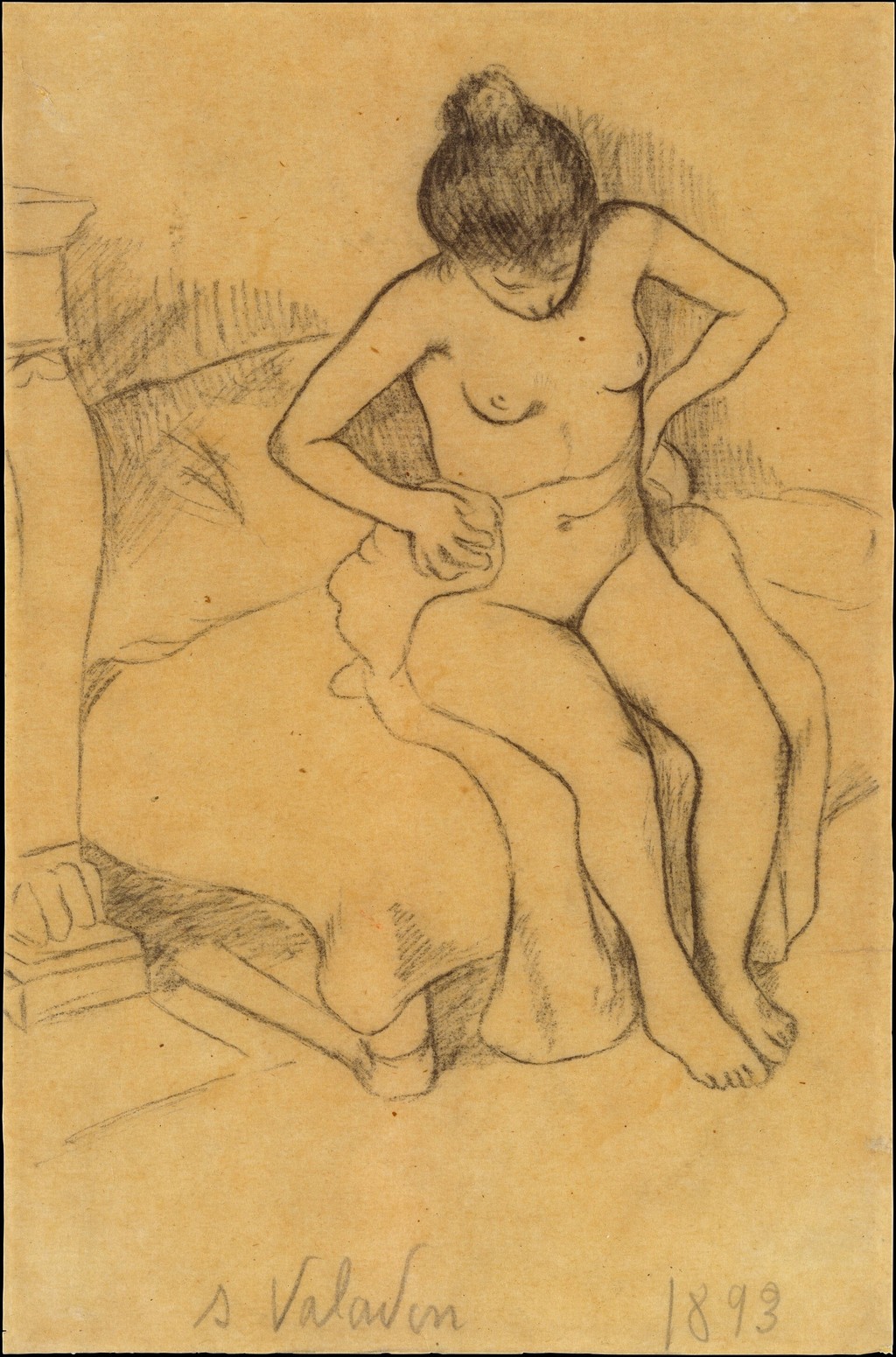
After the Bath
La Toilette
The Abandoned Doll