


 by Tom Gurney
Tom Gurney BSc (Hons) is an art history expert with over 20 years experience
Page Created on August 31, 2026 / Page Updated on November 6, 2026
Email: tomgurney1@gmail.com / Phone: +44 7429 011000
Suzanne Valadon Paintings and Artworks: Introduction
Suzanne Valadon’s art is often introduced through a handful of large nudes, yet her working range is broader: portraits, self-portraits, family groups, bathing scenes, domestic interiors, still lifes, landscapes, drawings, pastels, drypoints and etchings. What unites these subjects is not a fixed style formula. It is a preference for definite structure. Contour makes bodies and objects hold their ground; saturated areas of colour compete across shallow spaces; patterned fabrics or foliage can be as active as a face. Looking across media reveals how patiently Valadon built that language.[1][2]
At a Glance
- Main mediaOil, pastel, crayon, pencil, drypoint and etching
- Recurring subjectsPeople at rest, bathing, dressing, working or posing
- Portrait sittersSelf, family, friends, artists and patrons
- Other subjectsFlowers, fruit, animals, streets, gardens and rural landscapes
- Formal signaturesDark contour, compressed depth, emphatic colour and pattern
- Directory scope133 dated online discovery records, not a catalogue raisonné
Contents
- Introduction
- A Practice Built on Drawing
- Painting the Figure
- Portraiture and the Self
- Patterned Interiors
- Still Life and Landscape
- Three Essential Object Studies
- How to Read the Directory
A Practice Built on Drawing
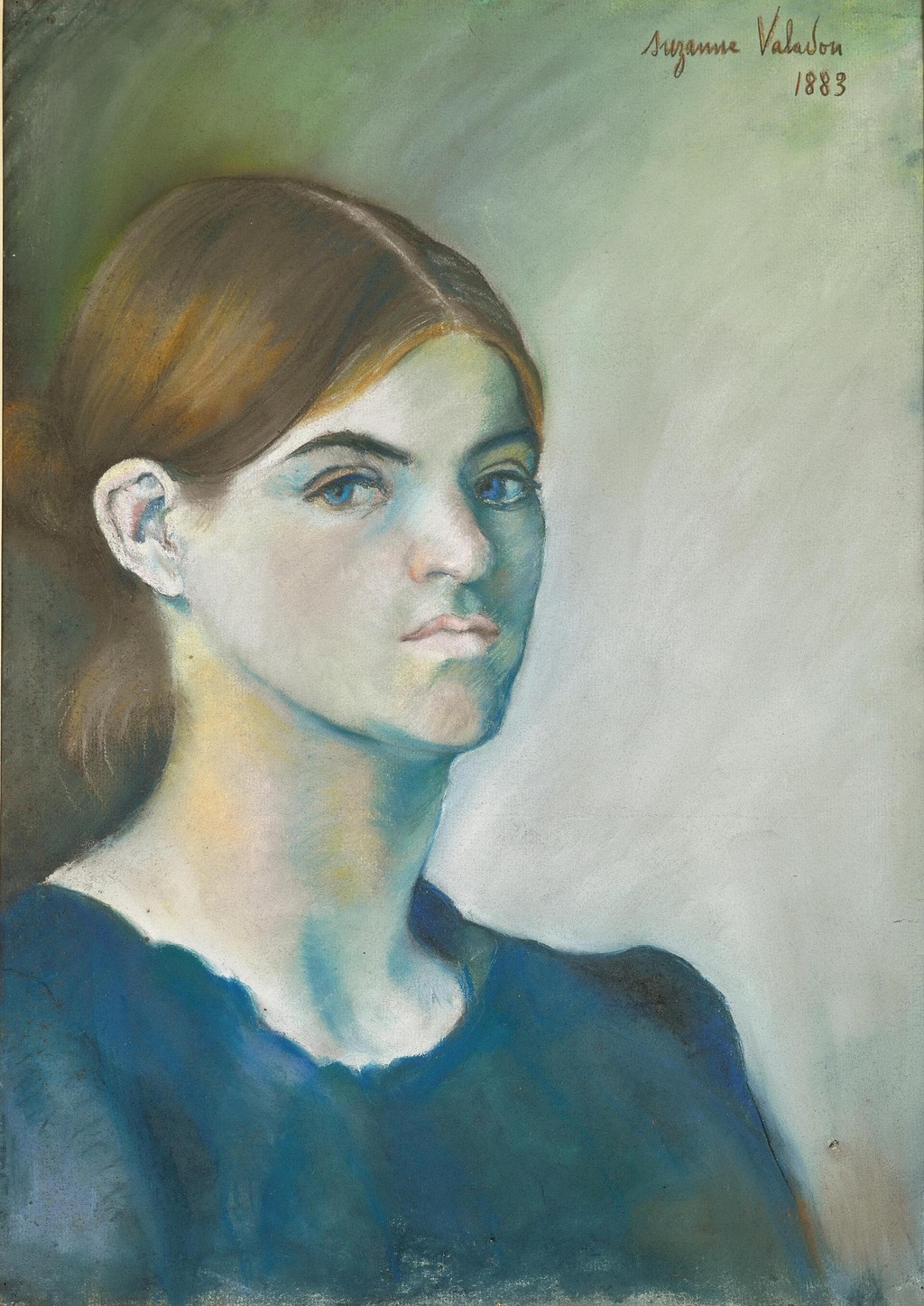
Valadon’s painting grew from a long engagement with line. Her earliest surviving self-portrait, dated 1883, is a work on paper. During the 1890s she exhibited drawings and developed intaglio printmaking. The Met’s After the Bath records the pressure and direction of black crayon on tan paper. At the NGA, related bathing prints demonstrate how she combined a softground matrix with drypoint or distinctive monoprint inking.[3][4]
Those media trained attention on boundaries, weight and gesture. In later oils, a dark line often surrounds a coloured shape without simply flattening it. The line may tighten a shoulder, separate a body from patterned upholstery or make a vase push forward. The drawings and prints essay compares the material effects directly.
Selected Suzanne Valadon works
Self-Portrait
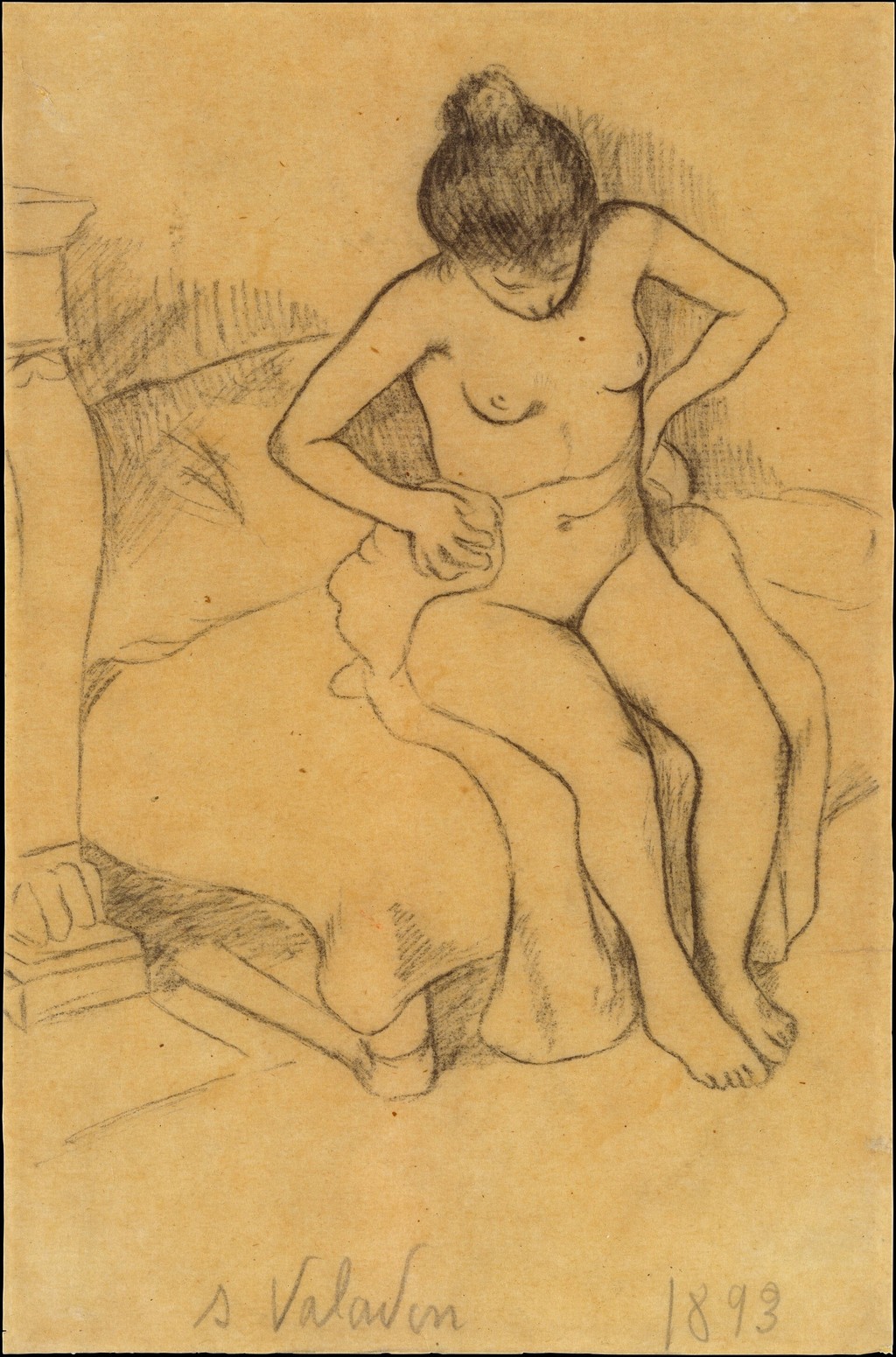
After the Bath
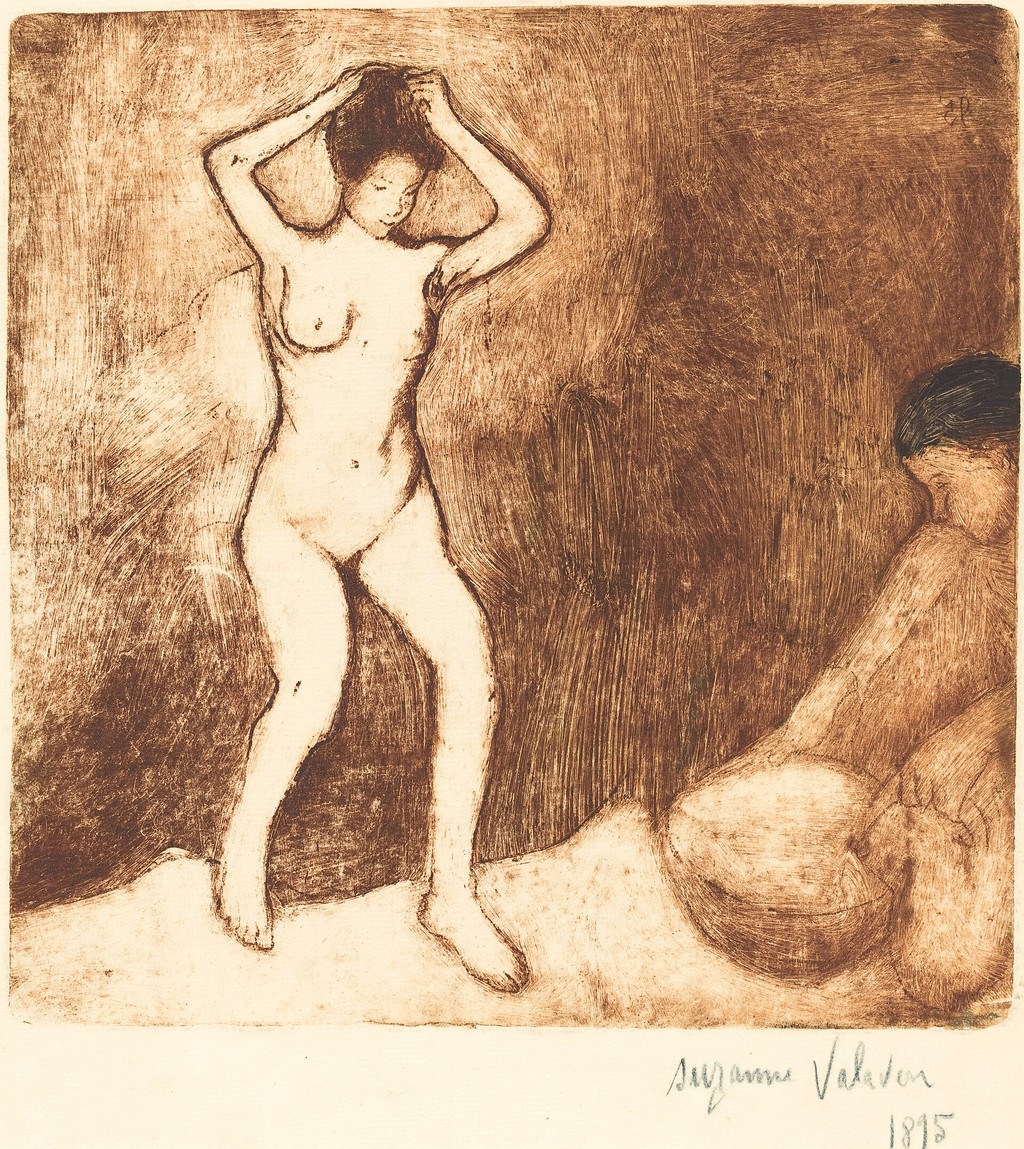
La Toilette
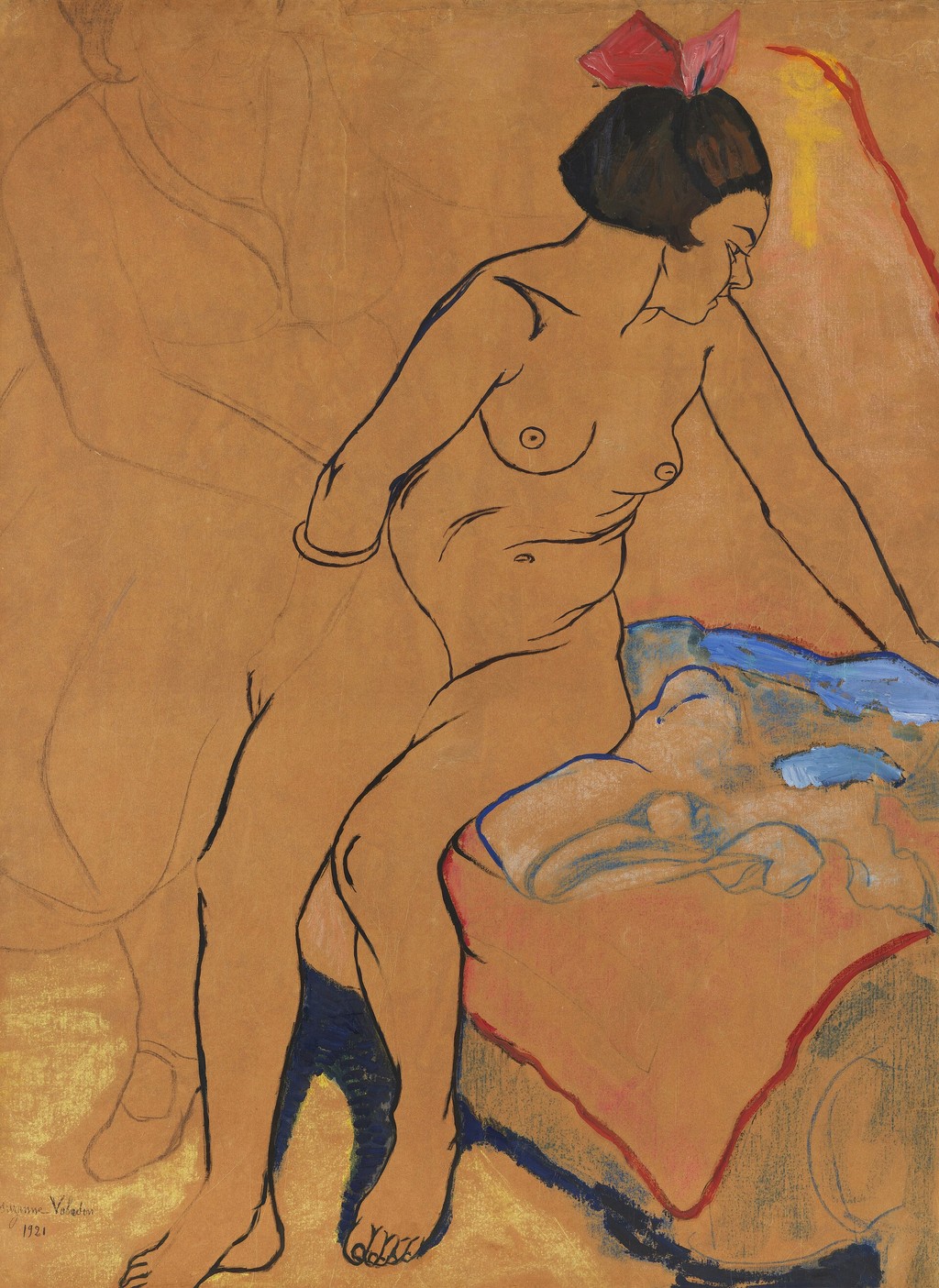
The Abandoned Doll
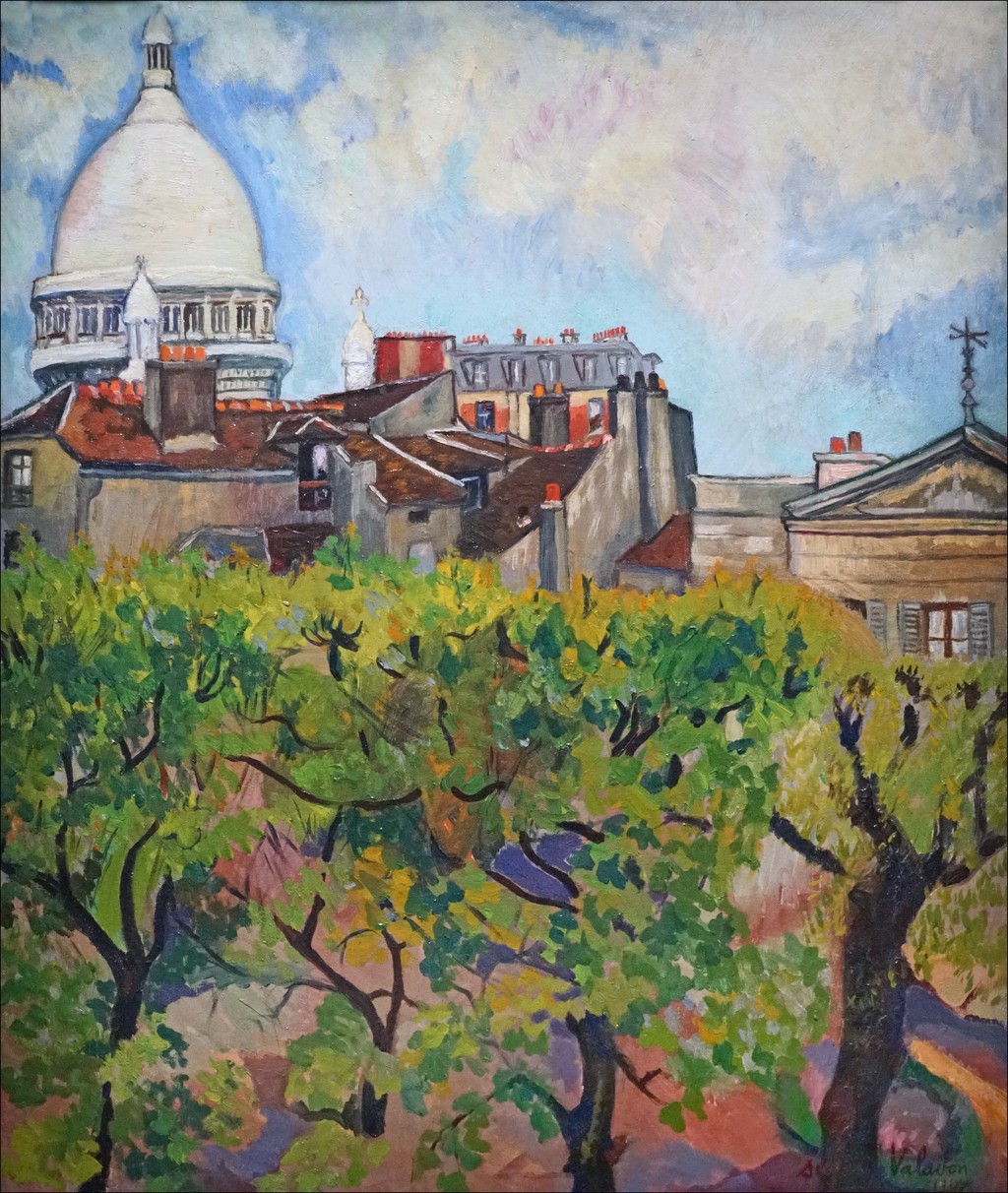
The Sacré-Cœur from Rue Cortot
Painting the Figure
The human figure gave Valadon her most persistent field of experiment. She painted solitary nudes, pairs, family groups, bathers and clothed sitters. NMWA characterises her bodies as frank and unidealised, particularly in Nude Arranging Her Hair and The Abandoned Doll. The latter turns bathing and dressing into a scene of adolescence, reflection and changing relations between child and adult.[5][6]
The nudes and female gaze guide treats “female gaze” as a current interpretive lens. It does not make every female sitter a symbol of liberation. Some pictures remain awkward, private or ambiguous. Their resistance to polished availability comes from pose, setting and the artist’s handling, not from the artist’s gender alone.
Portraiture and the Self
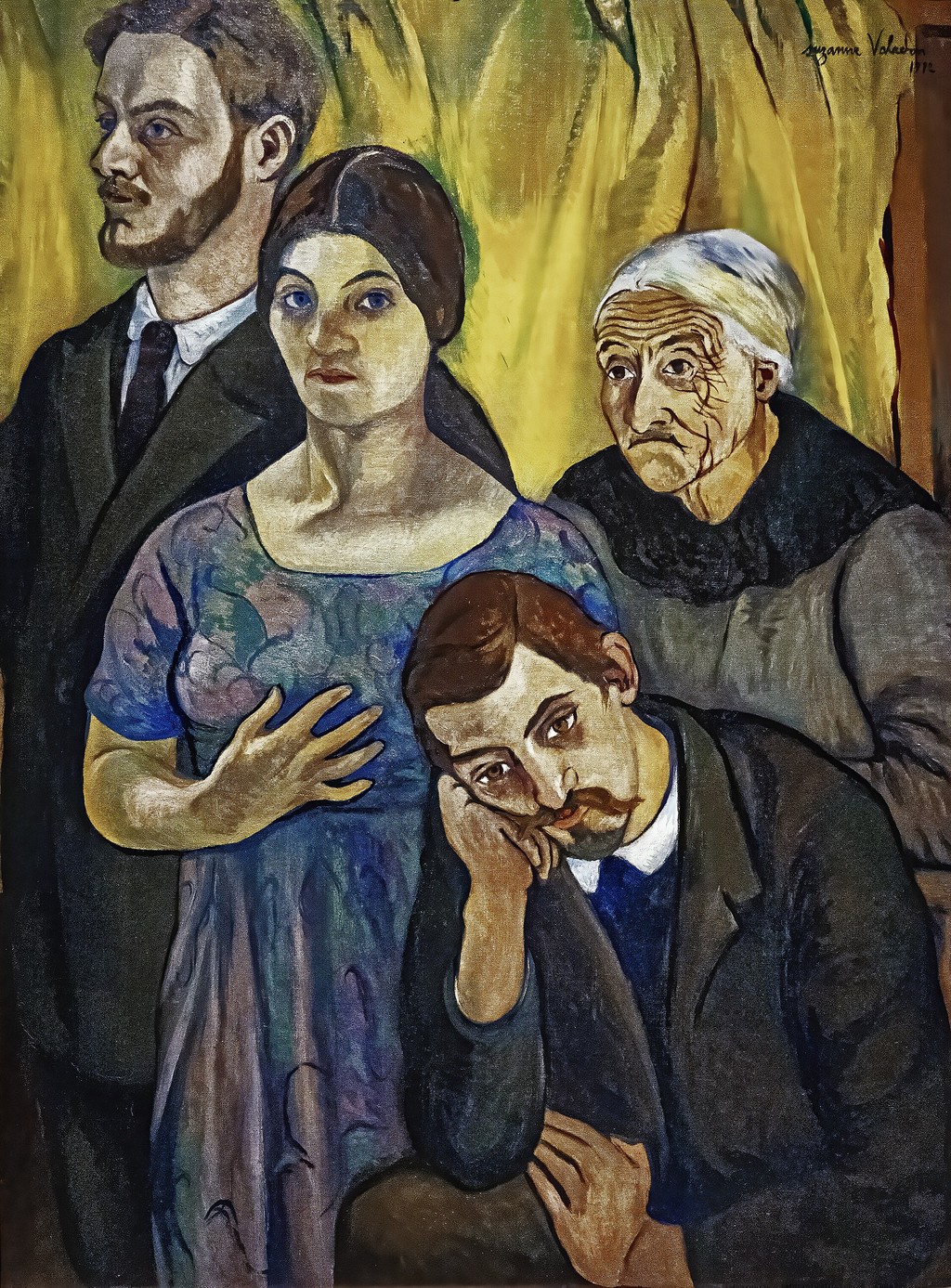
Valadon’s portraits range from the compact intensity of the 1898 Self-Portrait to group constructions such as Family Portrait. MFA Houston describes the self-portrait’s oil medium, small dimensions and provenance, while its catalogue essay sets it against the very different images Renoir made of Valadon as a model.[7] This comparison is useful because it shows that self-representation is an authored construction, not a neutral correction of someone else’s view.
Family and friends recur without becoming a stable iconography. Maurice Utrillo appears as child, young man and troubled adult; André Utter appears as partner, model and member of a household; Valadon’s mother brings another generation into the frame. The portraits and self-portraits essay follows these changing positions.
Patterned Interiors
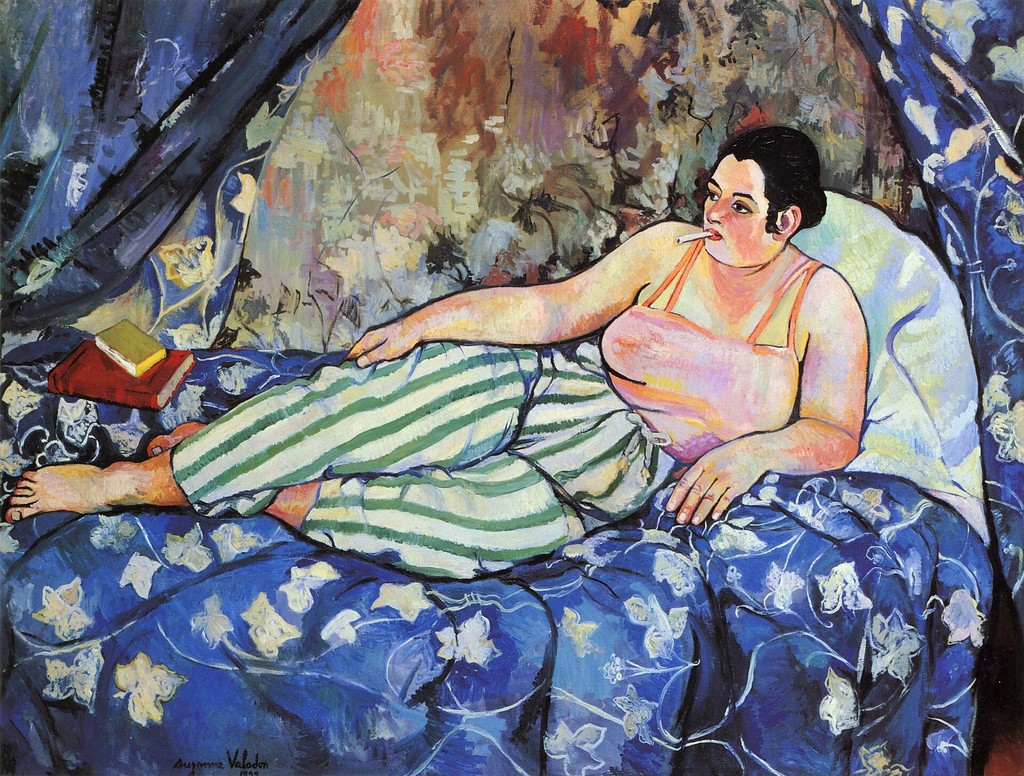
Pattern is structural in Valadon’s interiors. Bedcovers, striped trousers, floral cloth and damaged walls create fields that surround and sometimes threaten to absorb the figure. In The Blue Room (1923), the woman’s pale top and striped trousers organise the centre while blue fabrics extend across most of the surface. Two books and a cigarette add specific actions and choices without turning the scene into a coded puzzle.[8]
Centre Pompidou reads the picture as a revision of the odalisque tradition: a clothed, modern woman occupies the reclining pose without awaiting a male viewer. The Blue Room close reading tests that argument against the painting’s visible details. It is one instance of a wider practice in which an interior does more than contain a body; it helps define the body’s autonomy and pressure.
Still Life and Landscape
Flowers became a substantial late subject. The Met’s Lilacs and Peonies is dated 1929 and measures just over one metre high, confirming that “still life” did not necessarily mean minor scale.[9] Valadon also painted fruit, fish, cats, garden views and rural buildings. A window can turn a bouquet into a meeting point between interior and landscape; a street or hillside can be simplified into blocks of colour bound by branches and roofs.
The combined still life and landscape guide avoids inventing a false divide. Both genres involve arranging pressure across a surface: blossoms crowd a vessel, while trees and architecture lock a view together. They also show the persistence of Valadon’s colour and contour when no human figure is present.
Three Essential Object Studies
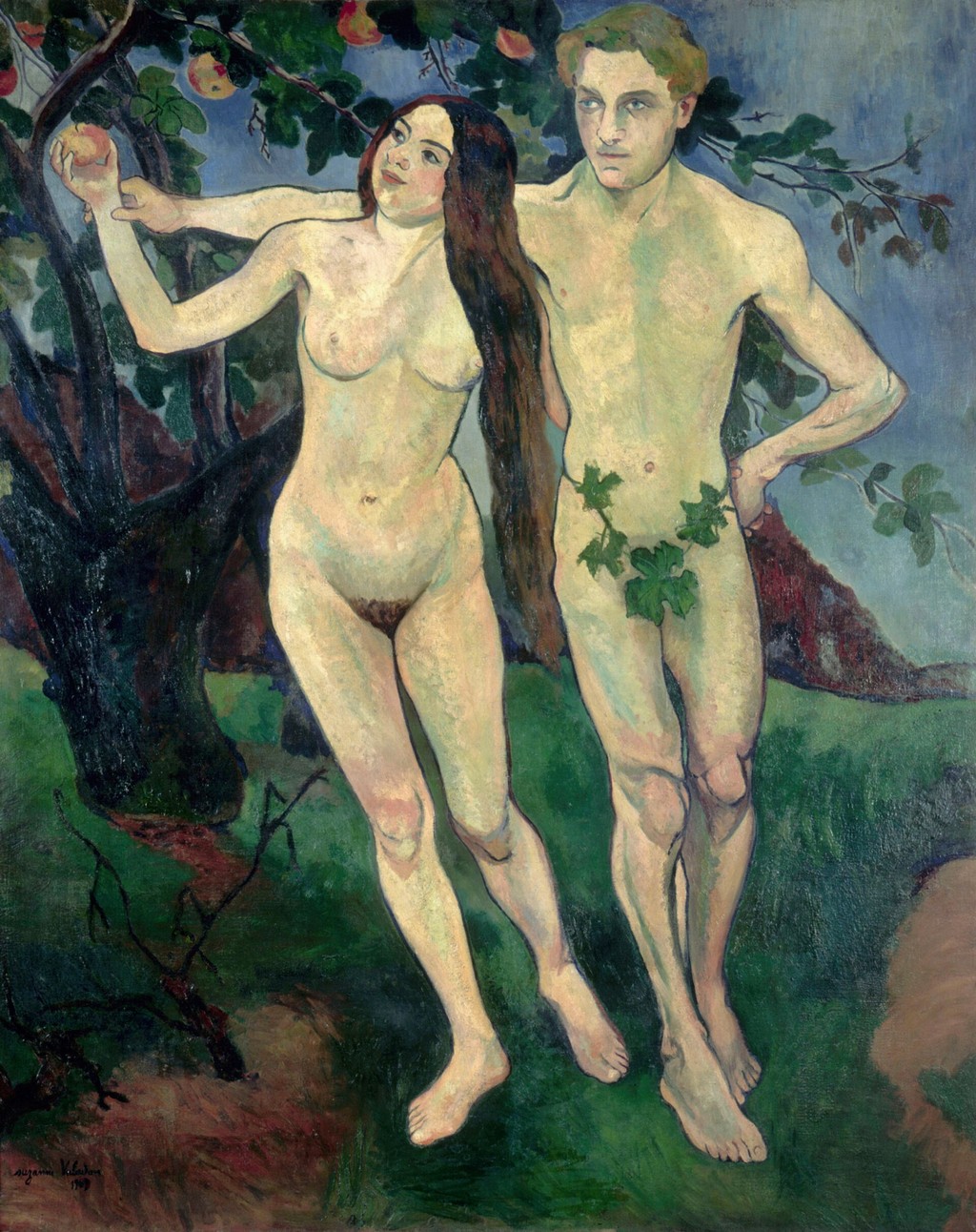
Three paintings offer a productive route through the career. Adam and Eve (1909) is an ambitious large double nude in which Valadon represented herself and André Utter within biblical narrative.[10] Family Portrait (1912) compresses four related people and several art-historical pose types into a single charged group.[11] The Blue Room (1923) revises the reclining-woman format with modern clothes, books and a smoking subject.
Each work has a dedicated guide: Adam and Eve, Family Portrait and The Blue Room. Reading them in date order shows a shift from overtly ambitious figure construction, through household portraiture, to a mature interior where modern life and inherited genre meet.
How to Read the Directory
The researched directory below collects 133 distinct creator-attributed records from a dated Wikidata snapshot. It retains repeated generic titles such as Nude, Self-Portrait and Vase of Flowers as separate entries when they have different identifiers. One object, the Cleveland Circus, is excluded because the holding museum records an active attribution dispute.[12]
This resource is a discovery census, not Paul Pétridès’s catalogue raisonné and not proof of complete oeuvre coverage. Some titles are translations, some dates are broad, and public structured data changes. The directory works best as a map towards museum records, not as an endpoint. Its unevenness is evidence about digital visibility as much as about Valadon’s production.
Researched works directory
This searchable evidence census contains 133 distinct records assembled from public collection data and a reproducible Wikidata snapshot. It is not a catalogue raisonné, not a claim of complete oeuvre coverage, and it keeps works with repeated titles as separate objects.
| Name | Date | Medium |
|---|---|---|
| زنان در حمام | 1909 | Painting |
| Adam and Eve | 1909 | Painting |
| After the bath | 1908 | Painting |
| André Utter and his dogs | 1932 | Painting |
| Anémones dans un verre blanc | 1920 | Painting |
| Black Venus | 1919 | Painting |
| Bouquet de fleurs dans un vase Empire | 1920 | Painting |
| Bouquet de fleurs sur un guéridon | 1925 | Painting |
| Bouquet de fleurs sur une petite table | 1932 | Painting |
| Bouquet de roses | 1936 | Painting |
| Bouquet of flowers | 1930 | Painting |
| Bouquet of flowers 1928 | 1928 | Painting |
| Casting the Net | 1914 | Painting |
| Catherine lying naked on a panther skin | 1923 | Painting |
| Catherine nue se coiffant | 1895 | |
| Châtillon-d'Azergues | 1927 | Painting |
| Chien endormi sur un coussin | 1923 | Painting |
| Deux figures | 1909 | Painting |
| Doctor Robert Le Masle | 1930 | Painting |
| Femme à la contrebasse | 1908 | Painting |
| Femmes au bain | 1893 | |
| Fleurs | 1930 | Painting |
| Fleurs et fougères dans un vase | 1929 | Painting |
| Flowers in front of a Window | 1930 | Painting |
| Fruit bowl | 1917 | Painting |
| Germaine Utter à sa fenêtre | 1926 | Painting |
| Germaine Utter devant sa fenêtre | Date unknown | Painting |
| Gilberte nue se coiffant | 1920 | Painting |
| Grandmother and Grandson | 1910 | Painting |
| Joy of Life | 1911 | Painting |
| Juliet sitting in a chair | 1909 | Painting |
| L'Acrobate, ou La Roue | 1916 | Painting |
| L'avenir dévoilé | 1912 | Painting |
| L'étable en Beaujolais | 1921 | Painting |
| La baigneuse nue | Date unknown | Painting |
| La boîte à violon | 1923 | Painting |
| La Cour du Château de Saint-Bernard | 1930 | Painting |
| La Couturière | 1914 | Painting |
| La Dame au petit chien | 1917 | Painting |
| La grenouille | 1910 | Drawing |
| La rue Cortot | Date unknown | Painting |
| La Toilette | 1895 | |
| La Vachère | 1922 | Painting |
| Landscape at Saint-Bernard (Ain) | 1932 | Painting |
| Le Canard | 1930 | Painting |
| Le Jardin de la rue Cortot | Date unknown | Painting |
| Les lilas et camélias | 1936 | Painting |
| Lilacs and Peonies | 1929 | Painting |
| Marie Coca et sa fille | 1913 | Painting |
| Mauricia Coquiot Portrait | 1915 | Painting |
| Mrs. Robert Rey and her daughter Sylvie | 1920 | Painting |
| Naked in the mirror | 1909–1916 | Painting |
| Nature morte | 1920 | Painting |
| Nature morte à la draperie et au bouquet | 1924 | Painting |
| Nature morte au lapin et à la perdrix | 1930 | Painting |
| Nature morte au poisson | 1926 | Painting |
| Nature morte aux fruits et aux fleurs | 1926 | Painting |
| Nu à la couverture rayée | 1922 | Painting |
| Nu à la draperie blanche | 1914 | Painting |
| Nu allongé sur un divan | 1926 | Painting |
| Nu assis | 1925 | Painting |
| Nu assis au bord d'un lit | 1929 | Painting |
| Nu assis sur un canapé | 1916 | Painting |
| Nu au châle bleu | 1930 | Painting |
| Nu, Suzanne Valadon | 1925 | Artwork |
| Nude Arranging Her Hair | 1916 | Painting |
| Nude on a Red Couch | 1920 | Painting |
| Nude Sitting on the Edge of a Bed | 1929 | Painting |
| Nude with drapery | 1921 | Painting |
| Nude with drapery and armchair | 1921 | Drawing |
| Nude woman with a cat and flowers | 1920 | Painting |
| Nudes | 1919 | Painting |
| Paysage de Bretagne ou Île d'Ouessant | 1912 | Painting |
| Plat d'étain | 1920 | Painting |
| Portrait d'enfant | Date unknown | Painting |
| Portrait de Lily Walton | 1923 | Painting |
| Portrait de Louis Moysés | 1924 | Painting |
| Portrait de Maurice Utrillo | 1921 | Painting |
| Portrait du sculpteur Gibault | 1895 | Painting |
| Portrait of a Woman | 1928 | Painting |
| Portrait of a Woman | 1929 | Painting |
| Portrait of a woman | 1934 | Painting |
| Portrait of Charles Wakefield-Mori | 1922 | Painting |
| Portrait of Erik Satie | 1892 | Painting |
| Portrait of Lily Walton | 1922 | Painting |
| Portrait of Madame Lévy | 1922 | Painting |
| Portrait of Madame Maurice Utrillo, Lucie Valore | 1937 | Painting |
| Portrait of Madame Petridès | 1937 | Painting |
| Portrait of Maurice Utrillo | 1928 | |
| Portrait of Mme Zamaron | 1922 | Painting |
| Portrait of Nora Kars | 1914 | Painting |
| Portraits of the Family | 1912 | Painting |
| Raminou cat study | 1917 | Painting |
| Raminou on his blue cushion | 1919 | Painting |
| Reclining Nude | 1928 | Painting |
| Route dans la forêt de Compiègne | 1914 | Painting |
| Seated Female Nude | 1916 | Painting |
| Seated Nude with Shawl Carpet | 1921 | Painting |
| Self-portrait | 1883 | Drawing |
| Self-Portrait | 1898 | Painting |
| Self-portrait in the mirror | 1927 | Painting |
| Self portrait with bare breasts | 1931 | Painting |
| Sitting nude | 1921 | Painting |
| Spring Flowers | 1928 | Painting |
| Still Life with Fruit | 1937 | Painting |
| Still Life with Fruit Basket | 1920 | Painting |
| Still life with white rose | 1936 | Painting |
| The Abandoned Doll | 1921 | Painting |
| The artist's mother | 1912 | Painting |
| The Bath | 1908 | Drawing |
| The bathers | 1923 | Painting |
| The Blue Room | 1923 | Painting |
| The Rising | 1920 | Painting |
| The two sisters | 1928 | Painting |
| The Woman in White Stockings | 1924 | Painting |
| Tree at Montmagny Quarry | Date unknown | Painting |
| Untitled (Still Life) | 1921 | Painting |
| Utrillo de face | 1925 | Drawing |
| Utrillo de trois-quarts | 1925 | Drawing |
| Utrillo devant son chevalet | 1919 | Painting |
| Utrillo pensif | 1911 | Drawing |
| Utter familly | 1921 | Painting |
| Vase de fleurs | 1917 | Painting |
| Vase de fleurs | 1927 | Painting |
| Vase de fleurs | 1934 | Painting |
| Vase de fleurs et tapis oriental | 1929 | Painting |
| Vase of flowers | 1922 | Painting |
| Woman in an armchair. Portrait of Madame G. | 1919 | Painting |
| Woman Seated | Date unknown | Painting |
| Woman with guitar | 1920 | Painting |
| Young Girl Bathing | 1919 | Painting |
| Young girl crocheting | 1892 | Painting |
| Young Girl in Front of a Window | 1930 | Painting |
Frequently Asked Questions
Labels including Post-Impressionism and Symbolism appear in institutional records, but no single term describes the whole career. Dark contour, compressed space, strong colour and physical figures are more useful starting points than a rigid movement label.
Yes in the surviving chronology. She drew and made pastels early, exhibited drawings in 1894 and developed prints before oil painting became her dominant public medium. She continued to draw throughout her life.[1][3]
Frequently reproduced works include Adam and Eve, Family Portrait, The Casting of the Net, The Abandoned Doll, The Blue Room and late self-portraits. Fame varies by collection, exhibition and national context.
The outlines clarify form, establish tension between adjacent colours and carry habits developed through drawing and printmaking. They should not be reduced to influence from one artist; Valadon used contour differently across decades and media.
No. It is a reproducible online evidence census based on public structured data. It omits works absent from that data and deliberately excludes a disputed attribution. A catalogue raisonné remains the appropriate authority for complete-object claims.
Discussion
Use this evidence-led guide as a starting point for close looking rather than a final verdict.
Share an observation about Suzanne Valadon Paintings and Artworks or a source that adds useful context.
Reader Insights
Which comparison best reveals the range of Valadon's painting and works on paper?
Where do tonal structure and open-air colour coexist rather than replace one another?
Which object would you add to the selected group, and what would it change?
Join the Conversation
Add your reading below, keeping observations specific and evidence clear.
References
- Centre Pompidou, Suzanne Valadon resource dossier, accessed 31 August 2026.
- AWARE, Suzanne Valadon, accessed 31 August 2026.
- Metropolitan Museum of Art, After the Bath, accessed 31 August 2026.
- National Gallery of Art, Suzanne Valadon artist record, accessed 31 August 2026.
- National Museum of Women in the Arts, Suzanne Valadon, accessed 31 August 2026.
- National Museum of Women in the Arts, The Female Form through Female Eyes, accessed 31 August 2026.
- Museum of Fine Arts Houston, Self-Portrait, accessed 31 August 2026.
- Centre Pompidou, The Blue Room, accessed 31 August 2026.
- Metropolitan Museum of Art, Lilacs and Peonies, accessed 31 August 2026.
- Centre Pompidou, Adam and Eve collection record, accessed 31 August 2026.
- Musée d’Orsay, Family Portrait, accessed 31 August 2026.
- Cleveland Museum of Art, The Circus, accessed 31 August 2026.
- The Blue Room, 1923 — Centre Pompidou, public domain.
More VALADON Artworks
Self-Portrait
After the Bath
La Toilette
The Abandoned Doll