by Tom Gurney
Tom Gurney BSc (Hons) is an art history expert with over 20 years experience
Page Created on August 31, 2026 / Page Updated on November 6, 2026
Email: tomgurney1@gmail.com / Phone: +44 7429 011000
Suzanne Valadon Biography: Introduction
Suzanne Valadon’s life has often been narrated as a sequence of dramatic roles: poor child, circus performer, celebrated model, unconventional mother, lover and painter. The outline is compelling, but it can make a serious career look accidental. A better biography keeps the surviving dates and institutional records in view. Valadon drew for years before receiving public recognition, exhibited in 1894, developed printmaking through contact with Edgar Degas, shifted her energies towards painting after 1909 and remained professionally active through the 1930s. Her route was irregular because formal training was difficult to access, not because artistic discipline arrived late.[1][2]
At a Glance
- Birth nameMarie-Clémentine Valadon
- Born23 September 1865 in Bessines-sur-Gartempe
- Early careerWorker, circus performer and artist’s model in Paris
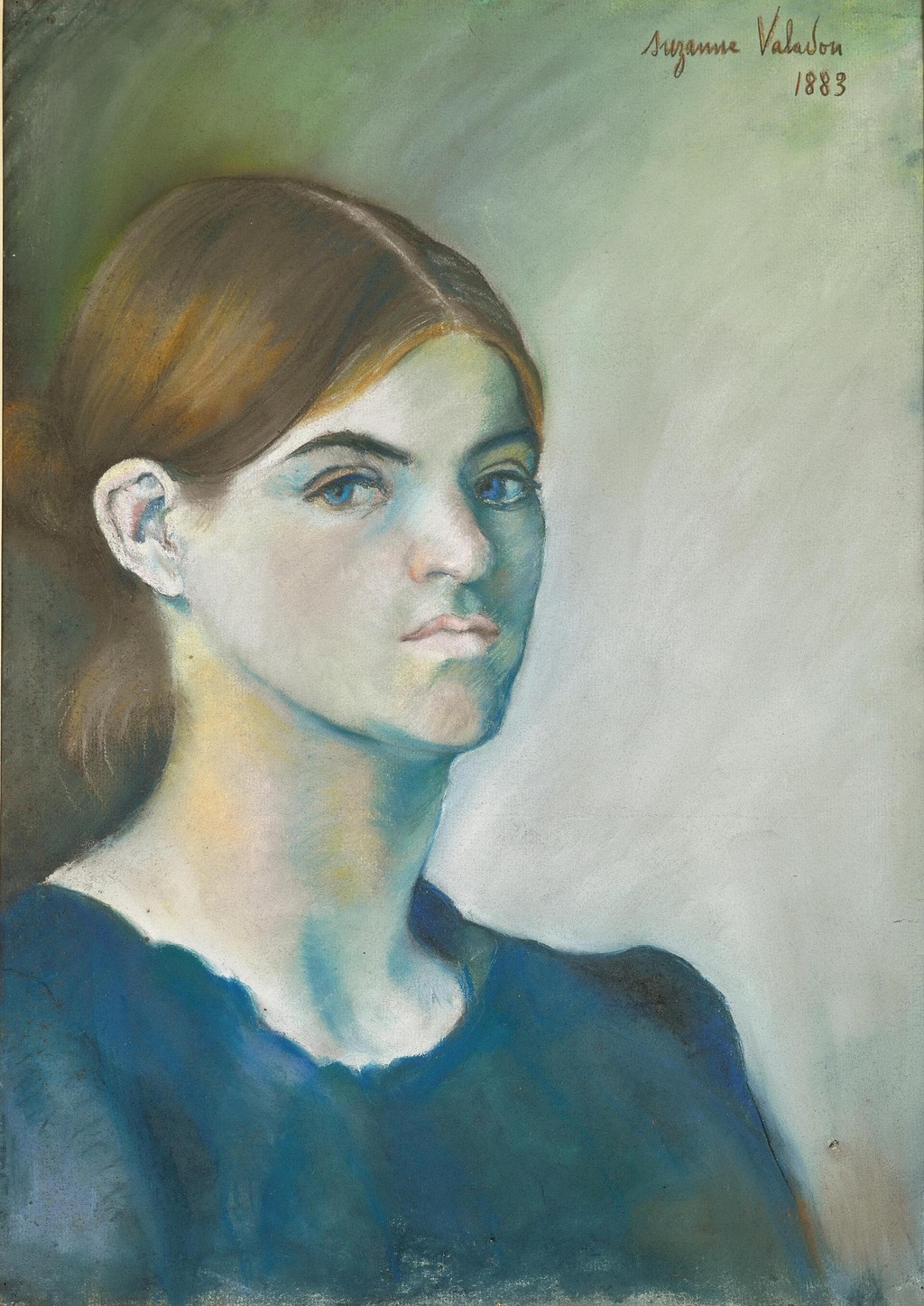
- First surviving workA pastel self-portrait dated 1883
- Public milestonesSociété Nationale des Beaux-Arts in 1894; first solo exhibition in 1911
- Died7 April 1938 in Paris
Suzanne Valadon in context
Impressionism
c. 1860–1886Post-Impressionism
c. 1886–1905Symbolism
c. 1880–1910Fauvism
c. 1905–1910School of Paris
c. 1900–1940Edgar Degas
1834–1917Pierre-Auguste Renoir
1841–1919Henri de Toulouse-Lautrec
1864–1901Suzanne Valadon
1865–1938Maurice Utrillo
1883–1955André Utter
1886–1948Self-Portrait
1883Portrait of Erik Satie
1892–93Adam and Eve
1909Family Portrait
1912The Casting of the Net
1914The Abandoned Doll
1921The Blue Room
1923Self-Portrait with Bare Breasts
1931Contents
- Introduction
- Childhood, Work and Montmartre
- Modelling and Learning to See
- Motherhood and Early Drawing
- Degas, Printmaking and the 1894 Salon
- Marriage, Painting and the Turn of 1909
- Rue Cortot and the “Trio Infernal”
- War, Exhibitions and Wider Recognition
- Ageing, Late Work and Death
- Reputation and the Shape of the Career
Childhood, Work and Montmartre
Valadon was born in Bessines-sur-Gartempe in the Haute-Vienne. Musée d’Orsay’s authority record confirms the birth place, 1865 date, civil name and later married names.[3] Her mother was an unmarried domestic worker, and the family moved to Paris. Institutional biographies describe a short education followed by jobs from a young age, including work as a waitress, nanny and circus performer. The exact texture of these years is easily romanticised. What can be retained is the economic fact: Valadon entered art without the financial and social path that supported academy students.[2]
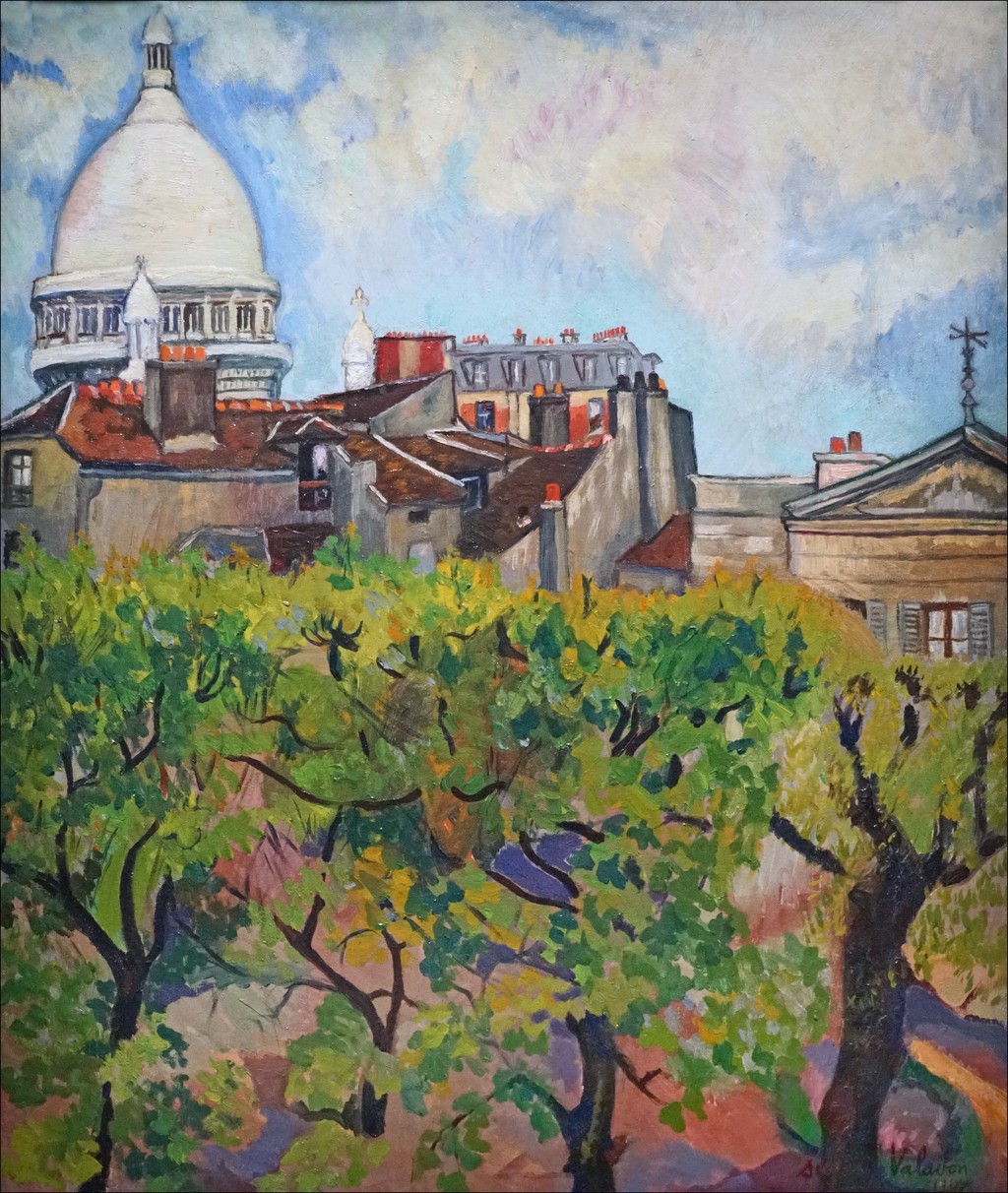
Montmartre was not merely a picturesque backdrop. It was a district of workshops, entertainment venues, expanding streets and modest housing where employment and artistic networks overlapped. The Montmartre and model-to-artist essay places those networks within a physical setting. Valadon’s later studio at 12 rue Cortot belonged to the same geography in which she had first found work.
Modelling and Learning to See
From about 1880 to 1893, Valadon modelled for prominent artists, among them Pierre-Auguste Renoir, Puvis de Chavannes, Jean-Jacques Henner, Federico Zandomeneghi and Henri de Toulouse-Lautrec. Musée d’Orsay identifies her as the model for Renoir’s Dance in the City. Such images belong to the artists who made them; they are evidence of Valadon’s labour and public appearance, not substitutes for her own oeuvre.[4]
Modelling nevertheless placed her in working studios. She observed how painters organised a pose, transferred bodies to flat surfaces and used repetition to solve formal problems. Valadon drew privately. Her 1883 pastel Self-Portrait is the earliest surviving work currently identified by Centre Pompidou and AWARE.[1][5] Its existence makes a clean break between “model” and “artist” impossible. The two kinds of work overlapped for years.
Motherhood and Early Drawing
Valadon gave birth to Maurice in 1883. Her mother helped to raise him, and in 1891 the Catalan writer and artist Miquel Utrillo legally recognised the child, who became Maurice Utrillo. Maurice later established his own career as a painter. Family life supplied Valadon with recurring subjects: her son, her mother and women engaged in washing, dressing and childcare.[1]
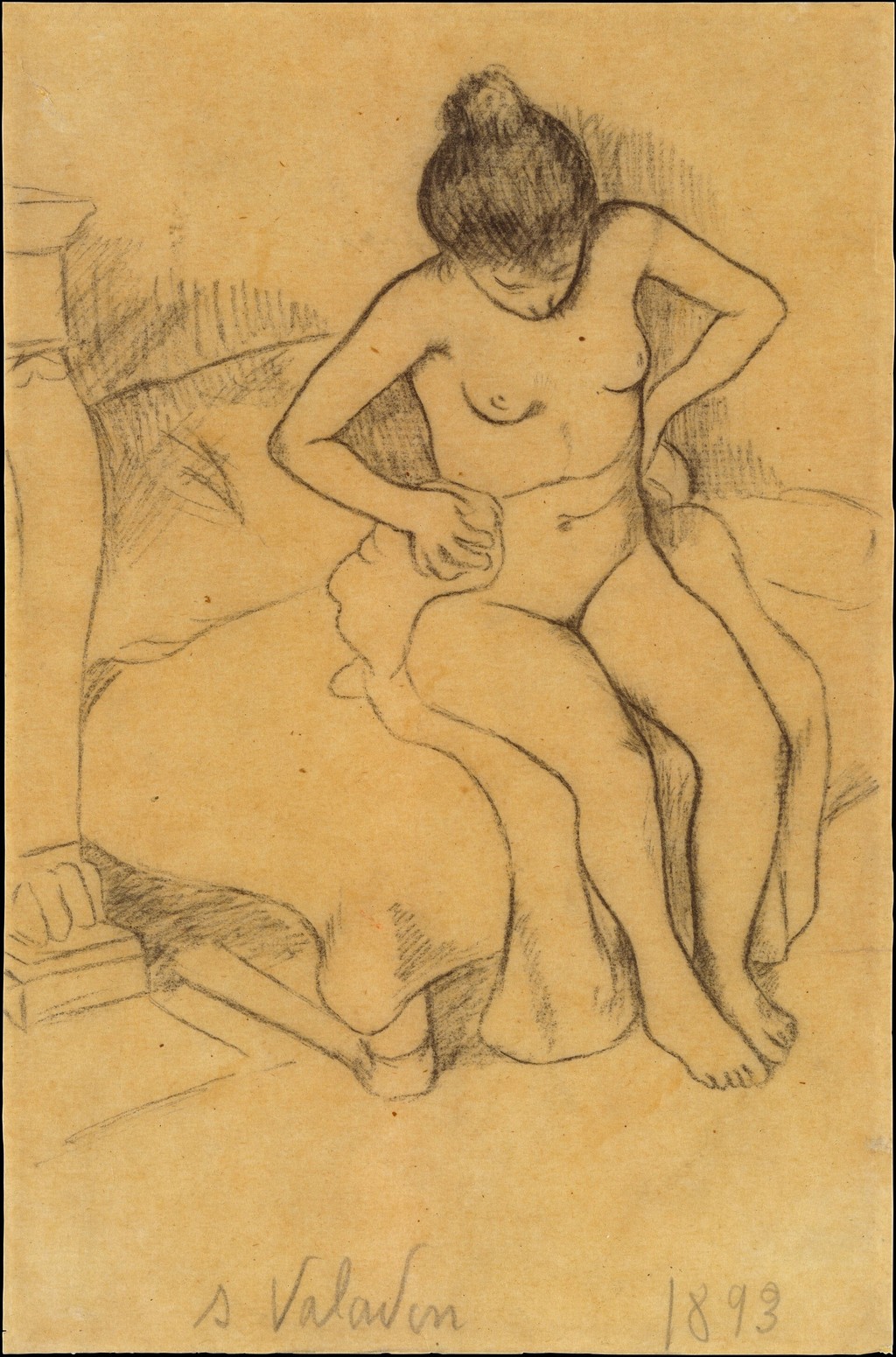
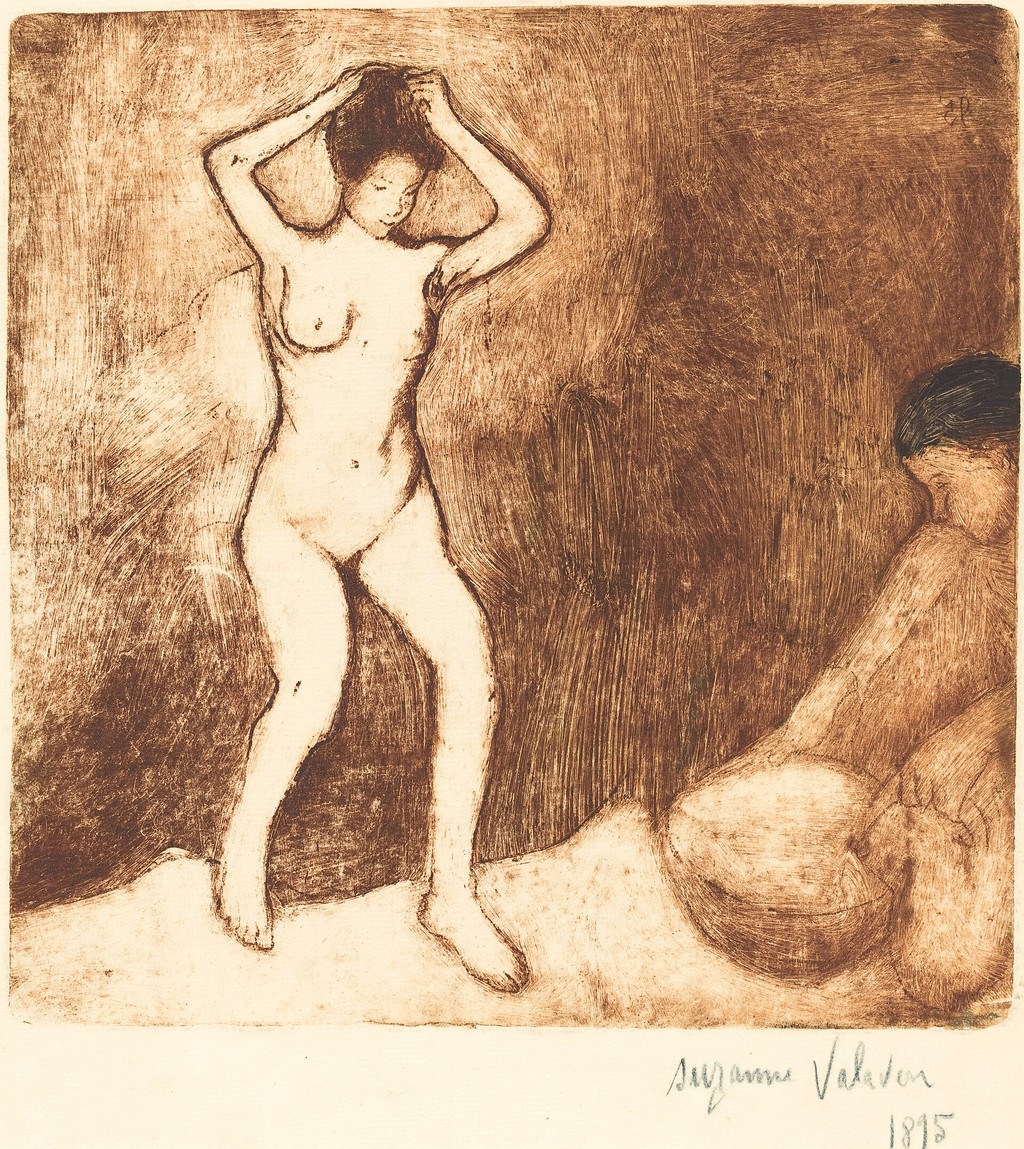
These scenes are neither incidental diary entries nor ideal images of maternity. The bodies twist, lean and tire. A figure may attend to another while remaining absorbed in her own task. The drawings and prints guide examines how black crayon, drypoint and softground etching carried these observations. The Met’s After the Bath (1893), for example, identifies a specific sheet in black crayon on tan wove paper; it does not need a later oil painting to validate it.[6]
Degas, Printmaking and the 1894 Salon
Valadon met Degas through the Montmartre circle. He did not employ her as a model. He responded to her drawings, acquired examples and encouraged her printmaking. MFA Houston’s catalogue essay reports that he eventually owned seventeen drawings and three prints, while AWARE describes her use of his press.[5][7] The relationship should be understood as serious artistic exchange without converting Degas into the author of Valadon’s achievement.
In 1894 Valadon exhibited five drawings at the Salon of the Société Nationale des Beaux-Arts. Museum accounts describe her as the only woman included that year or the first woman admitted to the society; wording varies, so the firm claim is that she exhibited there in 1894 and that the event marked public professional recognition.[2][7] Ambroise Vollard later published her prints, extending their circulation.
Marriage, Painting and the Turn of 1909
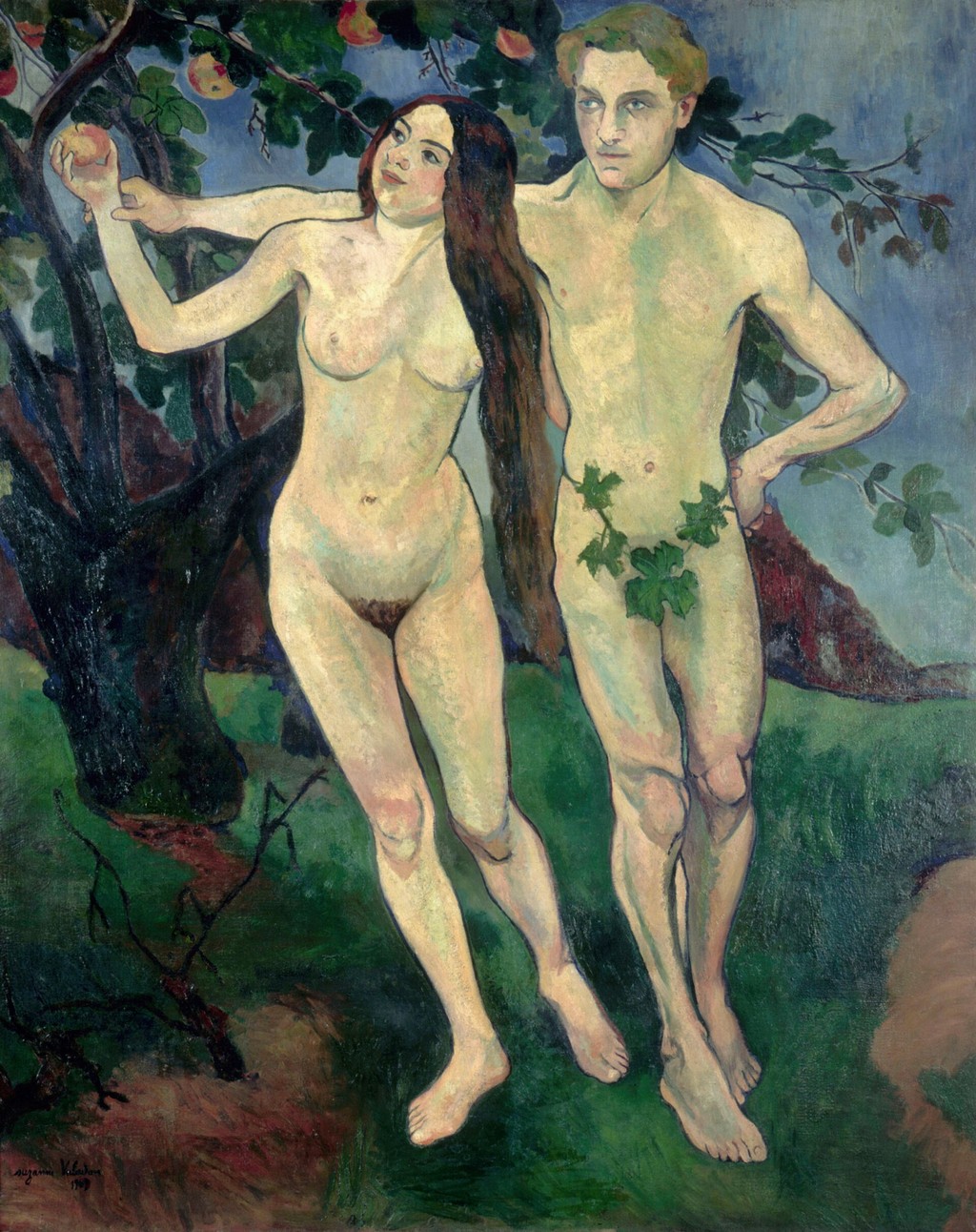
Valadon married the businessman Paul Mousis in 1896. During the marriage she continued to draw and began painting in oil, though works on paper remained substantial. In 1909 she left Mousis and formed a relationship with André Utter, a painter twenty-one years her junior and a friend of Maurice. That year is often treated as a turning point because she concentrated increasingly on painting and made the large double nude Adam and Eve.[1][2]
The Adam and Eve close reading examines what the museum record can establish: Valadon and Utter are represented, the work dates from 1909, and it measures 162 by 131 centimetres. Its autobiographical charge matters, but its scale and command of the biblical subject also announce professional ambition. Valadon exhibited at the Salon d’Automne in 1909 and received her first solo exhibition at the Clovis Sagot gallery in 1911.[1]
Rue Cortot and the “Trio Infernal”
Valadon, Maurice and Utter became known as the “trio infernal”, a phrase that packages difficult relationships into bohemian legend. In 1912 they settled at 12 rue Cortot; Valadon married Utter in 1914. Musée de Montmartre states that the shared years at that address were among her most productive. Its present apartment-studio is a reconstruction based on letters, writings and historic photographs, not a preserved untouched interior.[8][9]
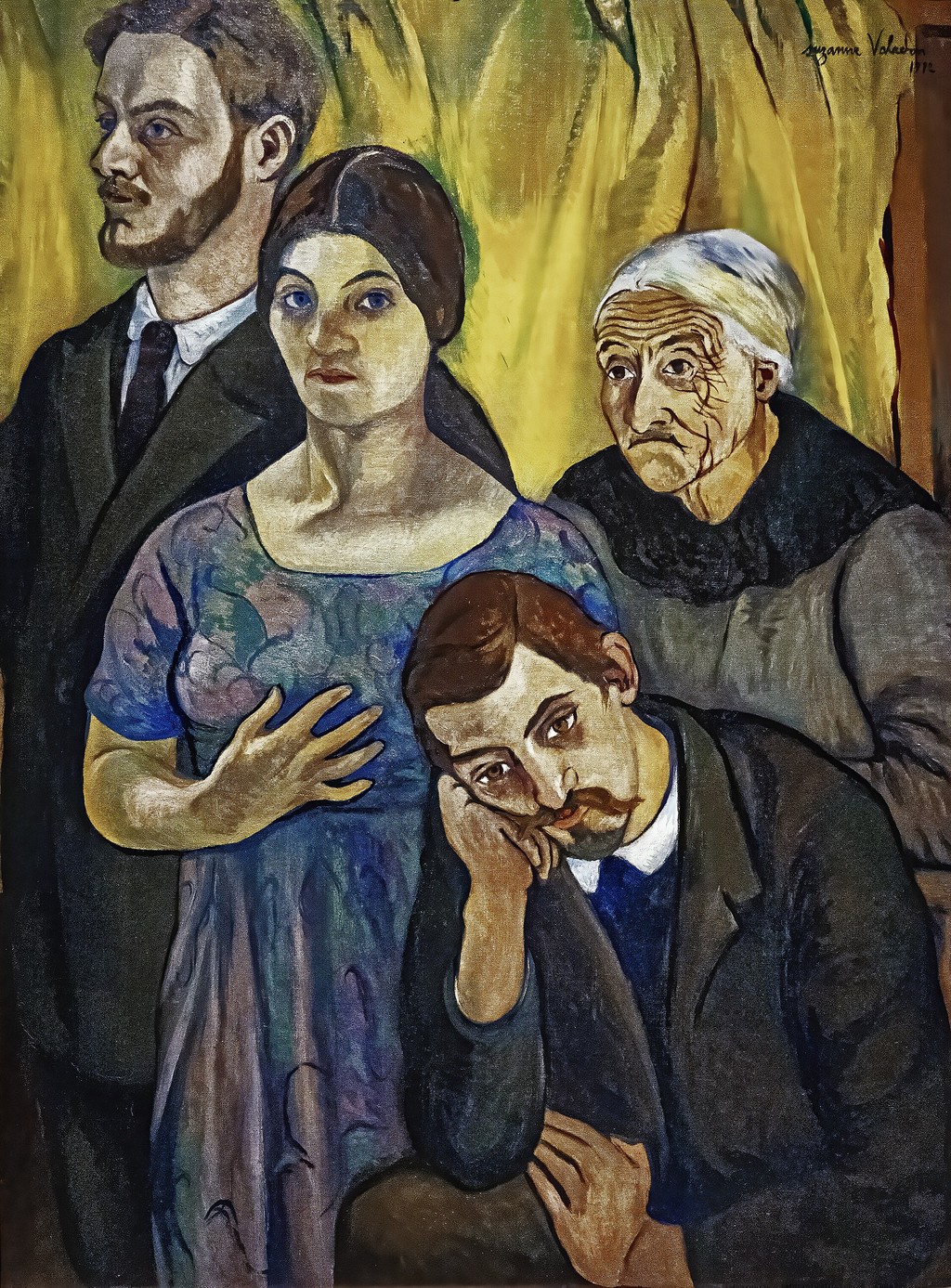
The household entered the art. Family Portrait (1912) includes Valadon, Maurice, Utter and her mother Madeleine. Their compressed grouping does not read as an uncomplicated celebration. Each figure occupies a distinct emotional and formal position. The Family Portrait study considers the picture’s visible tensions while resisting biographical mind-reading.
War, Exhibitions and Wider Recognition
Utter left for military service during the First World War. Valadon’s mother died in 1915. Valadon continued to exhibit, including with Berthe Weill, a dealer important to modern women artists. From 1919 her painting production intensified, and exhibitions carried her work beyond Paris to other European centres and across the Atlantic. She became a member of the Salon d’Automne in 1920. Robert Rey published an early monograph in 1922 or 1923, depending on catalogue convention.[1]
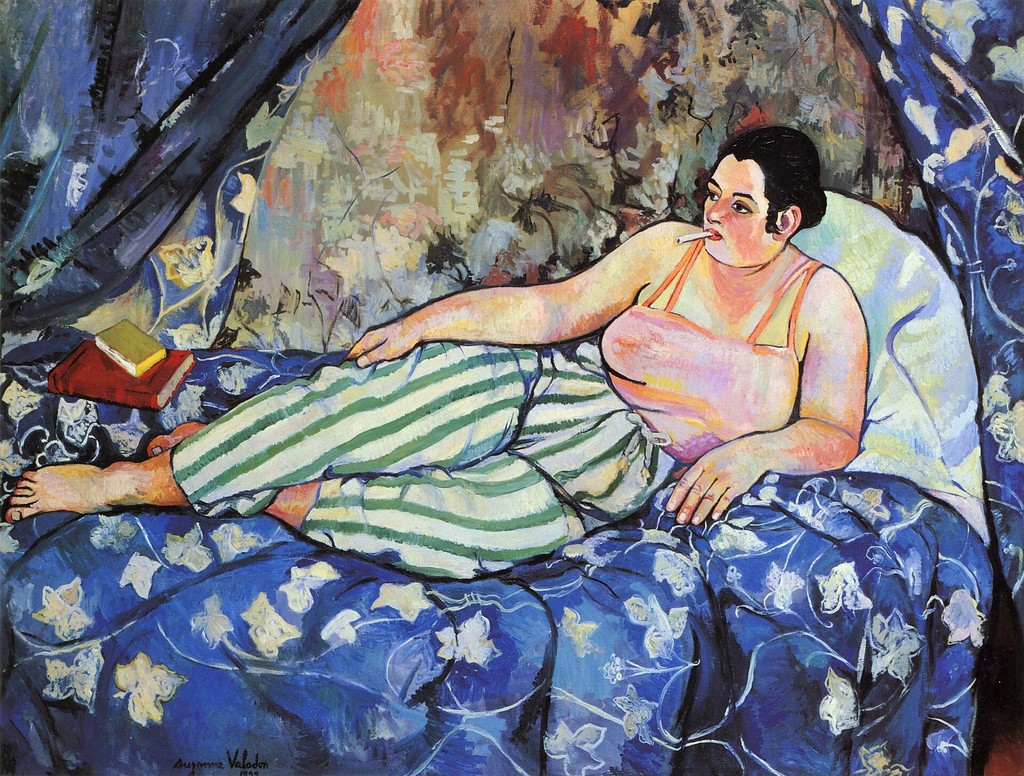
The 1920s brought some of Valadon’s most assured interiors, portraits and nudes. In The Blue Room (1923), a woman in striped trousers reclines among patterned textiles, books and a cigarette. The Blue Room essay traces how current Centre Pompidou curators read the work as a transformation of the odalisque tradition.[10] Its confidence belongs to a mature artist, not a late convert to painting.
Ageing, Late Work and Death
Valadon’s later work includes flower paintings, landscapes, portraits and unsparing self-images. An often-discussed 1931 self-portrait shows her bare-breasted and ageing. AWARE interprets the picture as an innovative refusal of idealisation or shame.[1] That reading is persuasive because it attends to what the image makes visible, yet no single self-portrait should stand for her entire experience of age.
Her relationship with Utter deteriorated in the 1930s. Health problems made painting more difficult, and she increasingly returned to drawing. She exhibited with the group Femmes Artistes Modernes from 1933. In 1937 the French state acquired several works, an institutional recognition shortly before her death in Paris on 7 April 1938.[1][3]
Reputation and the Shape of the Career
Valadon was recognised during her lifetime, then repeatedly narrowed in popular accounts to the men for whom she posed or to the fame of Maurice Utrillo. Recent exhibitions have addressed that imbalance by placing drawing, printmaking, painting and autobiography in one long trajectory. Centre Pompidou’s 2025 retrospective followed exhibitions in Metz, Nantes and Barcelona, emphasising both the historic specificity and contemporary urgency of her work.[10]
The paintings and artworks guide and the portraits and self-portraits essay make that trajectory visible across objects. Her biography matters most when it clarifies choices—access to training, work in studios, family models, exhibition opportunities, changes of medium—rather than when it turns every contour into confession.
Follow Suzanne Valadon's career through four stages
Work, modelling and a private drawing practice
After childhood in Bessines-sur-Gartempe and Paris, Valadon supported herself through varied work and modelled in Montmartre. Drawing overlapped with those sessions: the 1883 self-portrait is her earliest surviving work, and public recognition followed when she exhibited drawings in 1894.
Salon recognition, printmaking and early oils
Degas collected Valadon's drawings and encouraged her intaglio practice, while dealers circulated prints. Family, bathing and everyday bodily actions became persistent subjects; painting developed alongside rather than replacing work on paper.
Large figures, the studio household and public authority
A renewed concentration on painting brought Adam and Eve, Family Portrait and The Casting of the Net. From 1912, the household and studio at rue Cortot joined Valadon, Maurice Utrillo and André Utter during exceptionally productive years.
Modern interiors, flowers, landscapes and ageing
The Blue Room reworked an inherited reclining-woman format through modern clothing, books and smoking. Portraits, self-images, flower paintings and landscapes remained active subjects as exhibitions widened and drawing again became increasingly important late in life.
Researched works directory
This searchable evidence census contains 133 distinct records assembled from public collection data and a reproducible Wikidata snapshot. It is not a catalogue raisonné, not a claim of complete oeuvre coverage, and it keeps works with repeated titles as separate objects.
| Name | Date | Medium |
|---|---|---|
| زنان در حمام | 1909 | Painting |
| Adam and Eve | 1909 | Painting |
| After the bath | 1908 | Painting |
| André Utter and his dogs | 1932 | Painting |
| Anémones dans un verre blanc | 1920 | Painting |
| Black Venus | 1919 | Painting |
| Bouquet de fleurs dans un vase Empire | 1920 | Painting |
| Bouquet de fleurs sur un guéridon | 1925 | Painting |
| Bouquet de fleurs sur une petite table | 1932 | Painting |
| Bouquet de roses | 1936 | Painting |
| Bouquet of flowers | 1930 | Painting |
| Bouquet of flowers 1928 | 1928 | Painting |
| Casting the Net | 1914 | Painting |
| Catherine lying naked on a panther skin | 1923 | Painting |
| Catherine nue se coiffant | 1895 | |
| Châtillon-d'Azergues | 1927 | Painting |
| Chien endormi sur un coussin | 1923 | Painting |
| Deux figures | 1909 | Painting |
| Doctor Robert Le Masle | 1930 | Painting |
| Femme à la contrebasse | 1908 | Painting |
| Femmes au bain | 1893 | |
| Fleurs | 1930 | Painting |
| Fleurs et fougères dans un vase | 1929 | Painting |
| Flowers in front of a Window | 1930 | Painting |
| Fruit bowl | 1917 | Painting |
| Germaine Utter à sa fenêtre | 1926 | Painting |
| Germaine Utter devant sa fenêtre | Date unknown | Painting |
| Gilberte nue se coiffant | 1920 | Painting |
| Grandmother and Grandson | 1910 | Painting |
| Joy of Life | 1911 | Painting |
| Juliet sitting in a chair | 1909 | Painting |
| L'Acrobate, ou La Roue | 1916 | Painting |
| L'avenir dévoilé | 1912 | Painting |
| L'étable en Beaujolais | 1921 | Painting |
| La baigneuse nue | Date unknown | Painting |
| La boîte à violon | 1923 | Painting |
| La Cour du Château de Saint-Bernard | 1930 | Painting |
| La Couturière | 1914 | Painting |
| La Dame au petit chien | 1917 | Painting |
| La grenouille | 1910 | Drawing |
| La rue Cortot | Date unknown | Painting |
| La Toilette | 1895 | |
| La Vachère | 1922 | Painting |
| Landscape at Saint-Bernard (Ain) | 1932 | Painting |
| Le Canard | 1930 | Painting |
| Le Jardin de la rue Cortot | Date unknown | Painting |
| Les lilas et camélias | 1936 | Painting |
| Lilacs and Peonies | 1929 | Painting |
| Marie Coca et sa fille | 1913 | Painting |
| Mauricia Coquiot Portrait | 1915 | Painting |
| Mrs. Robert Rey and her daughter Sylvie | 1920 | Painting |
| Naked in the mirror | 1909–1916 | Painting |
| Nature morte | 1920 | Painting |
| Nature morte à la draperie et au bouquet | 1924 | Painting |
| Nature morte au lapin et à la perdrix | 1930 | Painting |
| Nature morte au poisson | 1926 | Painting |
| Nature morte aux fruits et aux fleurs | 1926 | Painting |
| Nu à la couverture rayée | 1922 | Painting |
| Nu à la draperie blanche | 1914 | Painting |
| Nu allongé sur un divan | 1926 | Painting |
| Nu assis | 1925 | Painting |
| Nu assis au bord d'un lit | 1929 | Painting |
| Nu assis sur un canapé | 1916 | Painting |
| Nu au châle bleu | 1930 | Painting |
| Nu, Suzanne Valadon | 1925 | Artwork |
| Nude Arranging Her Hair | 1916 | Painting |
| Nude on a Red Couch | 1920 | Painting |
| Nude Sitting on the Edge of a Bed | 1929 | Painting |
| Nude with drapery | 1921 | Painting |
| Nude with drapery and armchair | 1921 | Drawing |
| Nude woman with a cat and flowers | 1920 | Painting |
| Nudes | 1919 | Painting |
| Paysage de Bretagne ou Île d'Ouessant | 1912 | Painting |
| Plat d'étain | 1920 | Painting |
| Portrait d'enfant | Date unknown | Painting |
| Portrait de Lily Walton | 1923 | Painting |
| Portrait de Louis Moysés | 1924 | Painting |
| Portrait de Maurice Utrillo | 1921 | Painting |
| Portrait du sculpteur Gibault | 1895 | Painting |
| Portrait of a Woman | 1928 | Painting |
| Portrait of a Woman | 1929 | Painting |
| Portrait of a woman | 1934 | Painting |
| Portrait of Charles Wakefield-Mori | 1922 | Painting |
| Portrait of Erik Satie | 1892 | Painting |
| Portrait of Lily Walton | 1922 | Painting |
| Portrait of Madame Lévy | 1922 | Painting |
| Portrait of Madame Maurice Utrillo, Lucie Valore | 1937 | Painting |
| Portrait of Madame Petridès | 1937 | Painting |
| Portrait of Maurice Utrillo | 1928 | |
| Portrait of Mme Zamaron | 1922 | Painting |
| Portrait of Nora Kars | 1914 | Painting |
| Portraits of the Family | 1912 | Painting |
| Raminou cat study | 1917 | Painting |
| Raminou on his blue cushion | 1919 | Painting |
| Reclining Nude | 1928 | Painting |
| Route dans la forêt de Compiègne | 1914 | Painting |
| Seated Female Nude | 1916 | Painting |
| Seated Nude with Shawl Carpet | 1921 | Painting |
| Self-portrait | 1883 | Drawing |
| Self-Portrait | 1898 | Painting |
| Self-portrait in the mirror | 1927 | Painting |
| Self portrait with bare breasts | 1931 | Painting |
| Sitting nude | 1921 | Painting |
| Spring Flowers | 1928 | Painting |
| Still Life with Fruit | 1937 | Painting |
| Still Life with Fruit Basket | 1920 | Painting |
| Still life with white rose | 1936 | Painting |
| The Abandoned Doll | 1921 | Painting |
| The artist's mother | 1912 | Painting |
| The Bath | 1908 | Drawing |
| The bathers | 1923 | Painting |
| The Blue Room | 1923 | Painting |
| The Rising | 1920 | Painting |
| The two sisters | 1928 | Painting |
| The Woman in White Stockings | 1924 | Painting |
| Tree at Montmagny Quarry | Date unknown | Painting |
| Untitled (Still Life) | 1921 | Painting |
| Utrillo de face | 1925 | Drawing |
| Utrillo de trois-quarts | 1925 | Drawing |
| Utrillo devant son chevalet | 1919 | Painting |
| Utrillo pensif | 1911 | Drawing |
| Utter familly | 1921 | Painting |
| Vase de fleurs | 1917 | Painting |
| Vase de fleurs | 1927 | Painting |
| Vase de fleurs | 1934 | Painting |
| Vase de fleurs et tapis oriental | 1929 | Painting |
| Vase of flowers | 1922 | Painting |
| Woman in an armchair. Portrait of Madame G. | 1919 | Painting |
| Woman Seated | Date unknown | Painting |
| Woman with guitar | 1920 | Painting |
| Young Girl Bathing | 1919 | Painting |
| Young girl crocheting | 1892 | Painting |
| Young Girl in Front of a Window | 1930 | Painting |
Frequently Asked Questions
Her civil name was Marie-Clémentine Valadon. Institutional records also preserve surnames associated with her marriages, including Mousis and Utter, but she exhibited as Suzanne Valadon.[3]
Institutional biographies report brief circus work before modelling and often connect its end to a fall. The episode is plausible and widely repeated, but it should not be allowed to dominate a career supported by decades of dated works and exhibitions.[2]
Yes. Maurice was born in 1883 and later legally recognised by Miquel Utrillo. He became a successful painter and was one of Valadon’s recurring subjects.[1]
Degas encouraged her, collected her drawings and helped her with intaglio printmaking. Calling him a mentor is reasonable; calling Valadon his pupil in a formal academy sense would overstate the arrangement.[5][7]
There was no single instant. The 1894 salon established public recognition for her drawing; a first solo exhibition followed in 1911; regular exhibitions and acquisitions expanded during the 1910s and 1920s; the state acquired several works in 1937.[1]
Discussion
Use this evidence-led guide as a starting point for close looking rather than a final verdict.
Share an observation about Suzanne Valadon Biography or a source that adds useful context.
Reader Insights
Which work most clearly complicates the familiar label of American Impressionist?
Where do training, display, family, place or teaching most productively alter your reading?
Which source or surviving object would you investigate next?
Join the Conversation
Add your reading below, keeping observations specific and evidence clear.
References
- AWARE, Suzanne Valadon, accessed 31 August 2026.
- National Museum of Women in the Arts, Suzanne Valadon, accessed 31 August 2026.
- Musée d’Orsay, Suzanne Valadon artist authority record, accessed 31 August 2026.
- Musée d’Orsay, Dance in the City, accessed 31 August 2026.
- Museum of Fine Arts Houston, Self-Portrait, accessed 31 August 2026.
- Metropolitan Museum of Art, After the Bath, accessed 31 August 2026.
- Centre Pompidou, Suzanne Valadon resource dossier, accessed 31 August 2026.
- Musée de Montmartre, permanent collections and atelier-apartment, accessed 31 August 2026.
- Musée de Montmartre, Valadon, Utrillo and Utter at 12 rue Cortot, accessed 31 August 2026.
- Centre Pompidou, Suzanne Valadon: A Female Gaze, accessed 31 August 2026.
- Self-Portrait, 1883 — Centre Pompidou, public domain.
More VALADON Artworks
Self-Portrait
After the Bath
La Toilette
The Abandoned Doll