


 by Tom Gurney
Tom Gurney BSc (Hons) is an art history expert with over 20 years experience
Page Created on / Page Updated on
Email: tomgurney1@gmail.com / Phone: +44 7429 011000
Thomas Eakins Paintings: Introduction
Thomas Eakins’s paintings are best approached as solutions to different problems of seeing. On the Schuylkill River, he had to make a long, light shell occupy convincing water while a rower’s stroke remained intelligible. In a surgical amphitheatre, he had to organise dozens of witnesses around a difficult procedure. A singer required another kind of observation: breath, posture, concentration, and the almost invisible production of sound. Such subjects explain why Eakins’s realism cannot be reduced to careful surfaces. His pictures depend on measured spaces, selected instants, and relationships made legible through composition.[1][2]
The sequence of major works runs from outdoor sport in the early 1870s through medicine, the nude, performance, and late portraiture. It also reveals a practice extending beyond the canvas. Drawings, watercolours, anatomical exercises, oil studies, repeated sittings, and photographs could all contribute evidence. Their roles varied from project to project, and the finished painting remained a constructed image rather than a photograph translated into pigment.[1][3]
This guide follows those changing pictorial tasks. For Eakins’s life and institutional career, see the biography; for individual likenesses as a category, use the portraits guide. The focus here is the way paintings turn observation into space, action, and attention.
At a Glance
- Principal mediumOil on canvas, alongside substantial work in watercolour and preparatory media [1][3]
- Recurring subjectsRowing, medical instruction, outdoor athletics, music, and portraiture [1][2]
- Early landmarkThe Champion Single Sculls (Max Schmitt in a Single Scull), 1871 [4]
- Largest public ambitionsPortrait of Dr. Samuel D. Gross (The Gross Clinic), 1875, and The Agnew Clinic, 1889 [6][8]
- Working resourcesPerspective, anatomical study, life drawing, oil sketches, photography, and prolonged observation [3][14]
- Late emphasisLife-size portraits of friends, relatives, and respected professionals, often set apart from distracting surroundings [1][12]
Selected Thomas Eakins paintings
Contents
- Introduction
- Painting as Deliberate Construction
- The River as Geometry
- Two Surgical Theatres
- Bodies Outdoors
- Sound and Interior Life
- Studies, Cameras, and Transfer
- A Chronology of Decisions
Painting as Deliberate Construction
Eakins’s academic education placed the human figure at the centre of ambitious art. The Metropolitan Museum of Art notes that his training included life drawing, anatomy, study under Jean-Léon Gérôme in Paris, and a period in Spain before his return to Philadelphia. What he carried into his American work was not a fixed stock of European stories. It was a set of procedures for modelling bodies, controlling perspective, and arranging a many-figure scene.[1]
Those procedures met subjects that belonged to his own city and experience. Modern athletes replaced heroes from legend; surgeons and students occupied the scale of a history painting; musicians were represented through the disciplined work of performance. The Philadelphia Museum of Art’s retrospective grouped major oils with sculpture, drawings, watercolours, and photographs, making visible the range of material that surrounded the painted results.[2] The variety matters because “exact observation” was never a single act. Eakins could watch a body repeatedly, draw its structure, test a pose in oil, calculate a recession, or preserve a configuration with a camera.
The canvas then demanded choices. A painter decides which phase of movement will communicate an action, which bodies will overlap, where light will isolate a hand, and how much contextual detail an expression can bear. Eakins’s pictures often look restrained because their organisation is firm. Horizontals steady a racing scene; a surgeon’s upright body anchors a steep auditorium; a quiet wall gives a sitter room to seem mentally present. This is realism built from selection, not an accumulation of equally weighted facts.
The River as Geometry
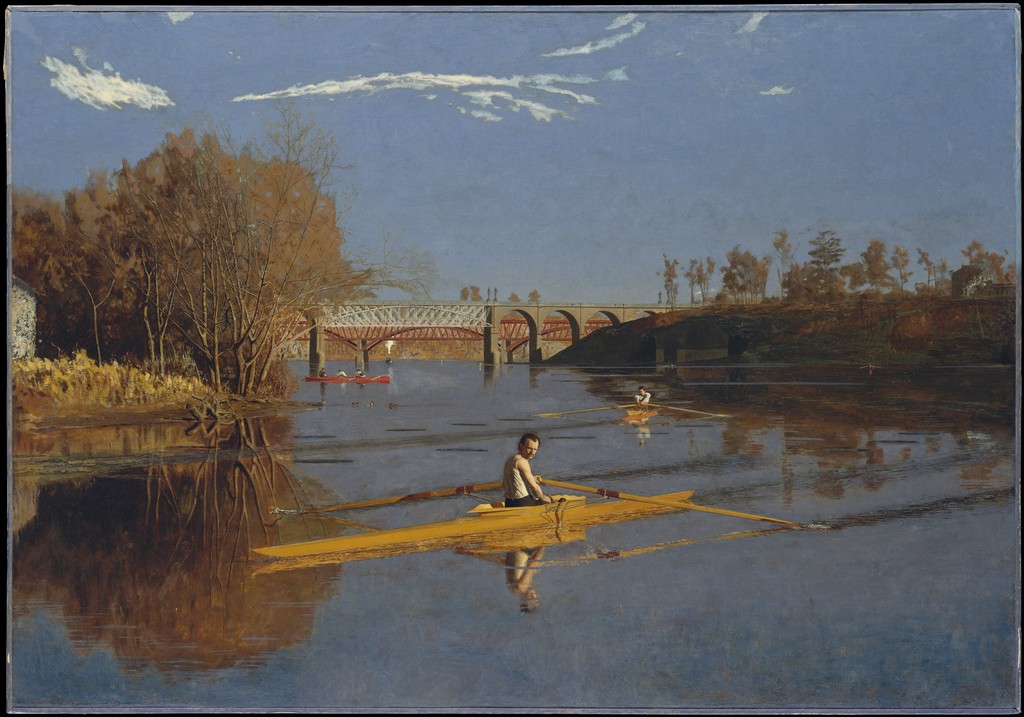
The first great group begins with rowing. In The Champion Single Sculls (Max Schmitt in a Single Scull), the Metropolitan Museum’s holder title identifies both sporting achievement and sitter. The 1871 oil is broad rather than monumental—81.9 by 117.5 centimetres—yet the low racing boat opens a remarkable reach of river around Max Schmitt.[4] Eakins sets Schmitt’s turning head and compressed body against long intervals: extended oars, reflected bridges, opposite banks, and the second shell in which the artist represents himself.
The painting offers a gateway into Eakins’s perspective because every element must agree with a viewpoint close to the water. Shells are unusually narrow; oars project across the surface at changing angles; reflections repeat shapes without becoming solid objects. The geometry provides stability, while small asymmetries prevent stiffness. Schmitt looks away from his direction of travel, and the artist’s distant boat introduces another time and another track. The river is both measured environment and social place.
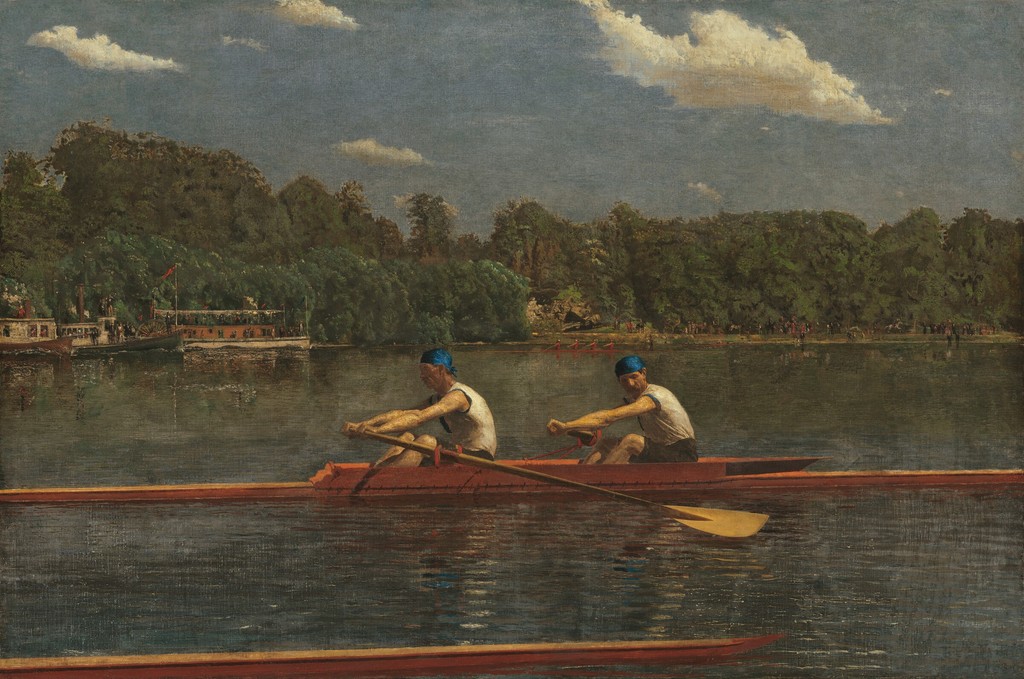
The Biglin Brothers Racing of 1872 changes the problem from solitary balance to paired timing. The National Gallery of Art connects the scene to a five-mile Philadelphia race attended by thousands. John and Barney Biglin were professional champions, not anonymous embodiments of strength. One begins the next stroke while the other glances toward the rival shell; the painting makes their unequal gestures readable as parts of one coordinated effort.[5]
The boat runs beyond the lateral edges, bringing the race close to the viewer. Behind it, crowds, vessels, trees, and sky form calmer bands. The NGA points to diagonals in cloud and foliage that answer the rowers’ leaning torsos.[5] Thus atmosphere, anatomy, and sporting knowledge reinforce one another. The two rowing pages should be read together: Max Schmitt explains how Eakins constructs deep, reflective space around one sculler, whereas The Biglin Brothers Racing shows how a compressed foreground can convey teamwork, rivalry, and public spectacle.
Two Surgical Theatres
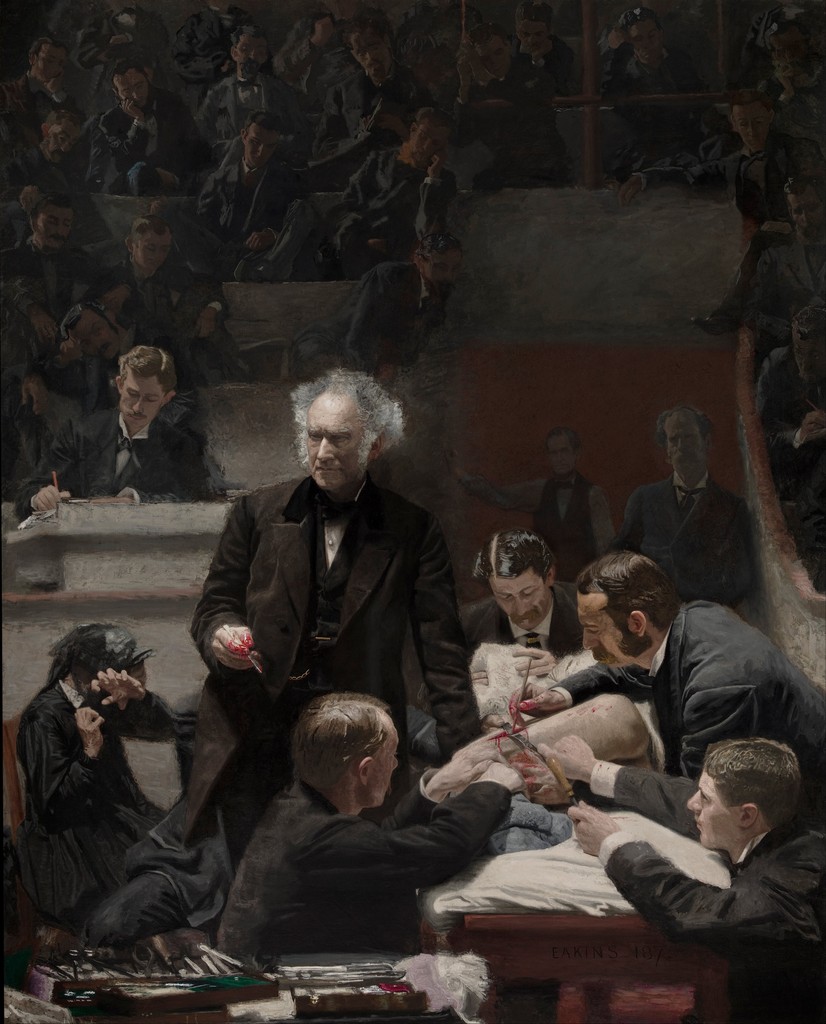
Eakins next enlarged the stakes of modern subject painting. Portrait of Dr. Samuel D. Gross (The Gross Clinic) was conceived for the 1876 Centennial Exhibition and painted in 1875. The Philadelphia Museum of Art identifies Jefferson Medical College’s amphitheatre, Dr Samuel D. Gross, five operating doctors, a patient undergoing treatment for a bone infection, a recoiling woman, ranks of students, and Eakins himself among the observers.[6] These details belong to a carefully governed field rather than a neutral record of an event.
Gross’s lit forehead, bloodied hand, and upright dark coat establish the central axis. Around him, bent doctors converge over a patient whose position is intentionally hard to disentangle. The students recede in a rising curve, their faces catching scattered light. Eakins uses visibility as a hierarchy: professional authority is clear, while the vulnerable body at the centre of the operation is largely obscured. The work was refused a place in the Centennial’s art galleries and appeared in a medical display instead, an outcome that makes its collision of history painting and clinical fact part of its meaning.[6]
Technical investigation has added another layer to close looking. The PMA’s conservation project brought preparatory studies, X-radiographs, and historical images together to examine how the painting was made and altered over time.[7] That evidence cautions against treating a familiar masterpiece as a transparent window. Its present surface has a material history, and Eakins’s commanding arrangement emerged through preparation and revision.
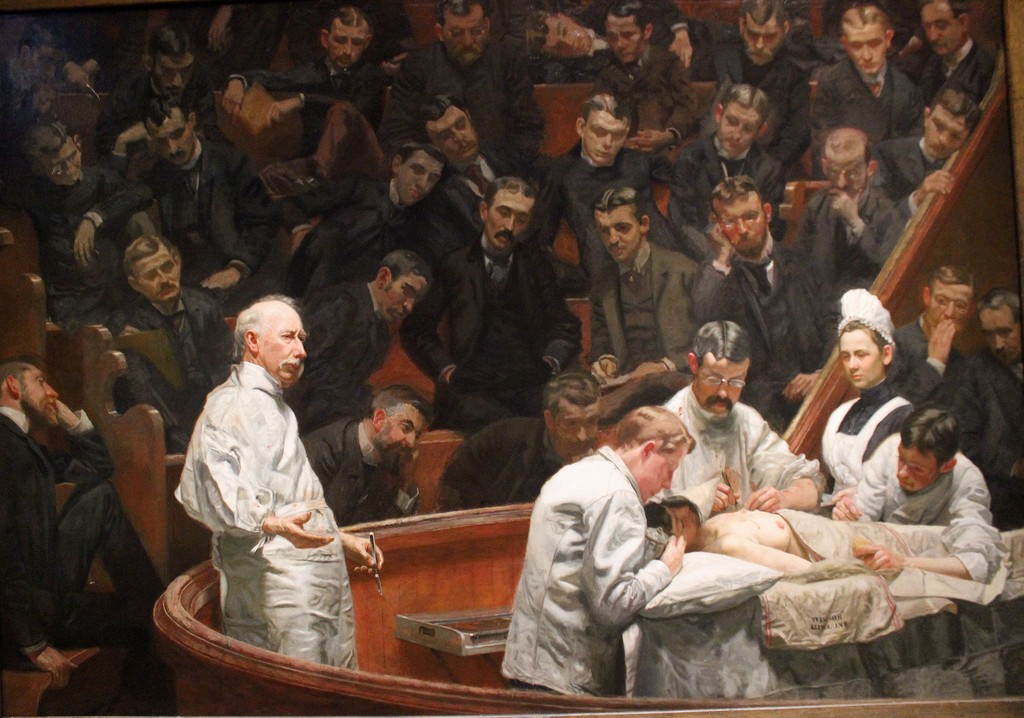
Fourteen years later, The Agnew Clinic revisited medical instruction with a different distribution of bodies and light. The University of Pennsylvania medical class of 1889 commissioned the painting to honour the retiring surgeon D. Hayes Agnew. Penn Nursing identifies the operation as a mastectomy and the nurse at the right as Mary V. Clymer, stressing the growing place of trained assistants within surgery.[8]
Comparison reveals more than stylistic development. Gross turns toward his audience while the operation gathers beneath him in darkness; Agnew stands apart and lectures as assistants perform the procedure across a broad, pale stage. Clymer’s white uniform gives her marked visibility but does not erase the hierarchy that separates surgeon, doctors, nurse, students, and unconscious patient. The later painting therefore opens questions that the earlier one cannot answer alone: who is permitted professional agency, how a female patient is exposed, and what public honour looks like when medical labour is divided among a team.
Bodies Outdoors
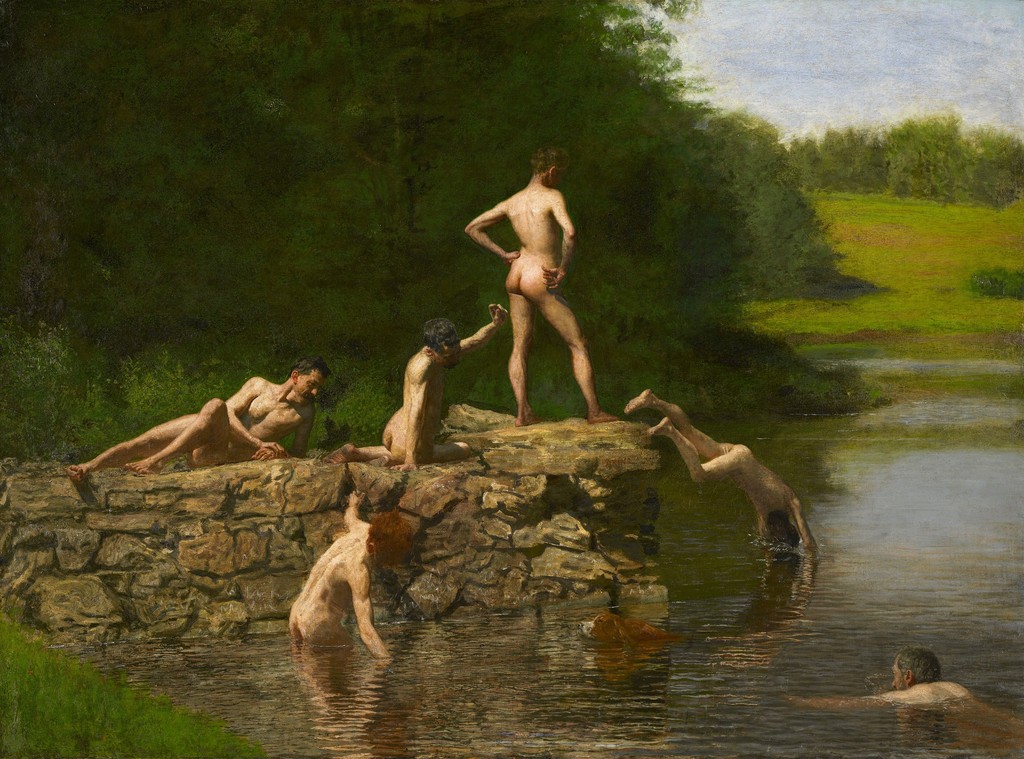
Swimming brings figure study outside, but it does not abandon composition for informal recreation. The Amon Carter Museum of American Art dates the oil to 1885 and uses the holder title Swimming. Its identifiable figures include Eakins and male students, represented standing, sitting, reclining, diving, and moving through the water.[9] Each pose presents a different relation between weight and gravity: planted feet on rock, a body folded before a dive, another suspended in a forward arc, and swimmers supported by the river.
The arrangement can evoke an academic display of the nude while remaining tied to a particular teacher-student circle. That double identity is essential. The museum calls the work a statement of Eakins’s commitment to study from the living model and also records troubling testimony about his forceful promotion of nudity before his departure from the Pennsylvania Academy.[9] Formal calm should not turn the group into timeless, consequence-free bodies.
Photography contributed to the project’s surrounding evidence. A related Getty Museum record identifies a photograph of Eakins with male nudes at the site for Swimming, but the existence of such an image does not make the canvas a one-to-one transfer.[10] The painting separates, balances, and sequences bodies across rock and water. Its gateway is therefore distinct from the photography and working-studies guide, which addresses camera practice and attribution, and from teaching and anatomy, which places life study within institutional authority.
Sound and Interior Life
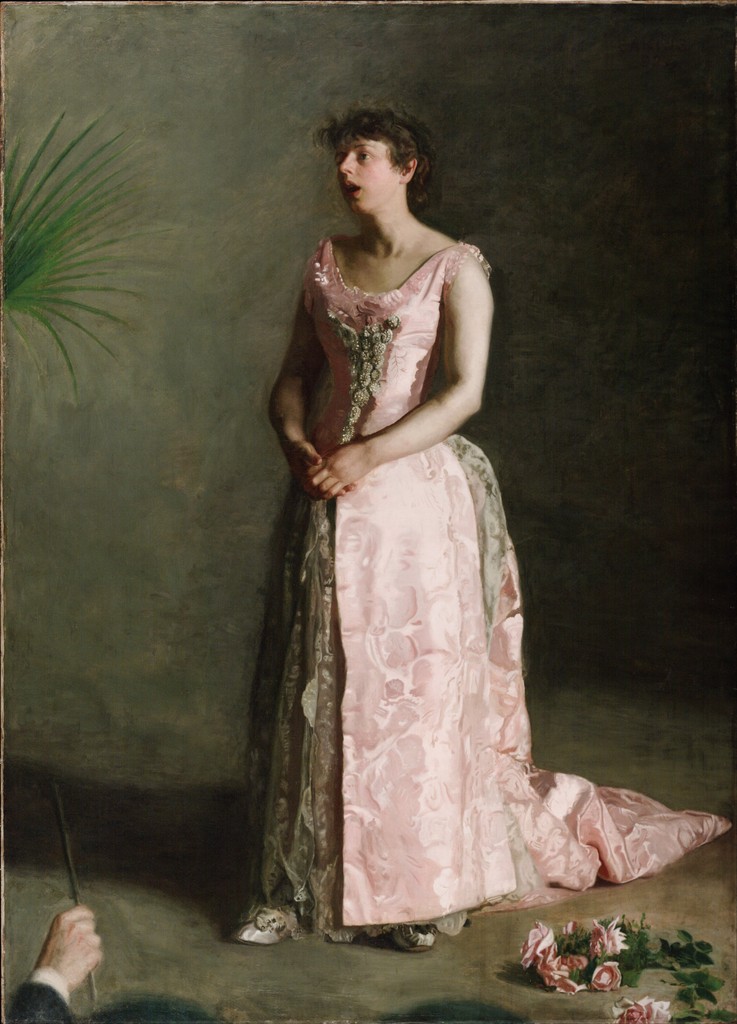
Paint cannot reproduce a voice, yet The Concert Singer makes singing physically credible. Weda Cook posed from 1890 to 1892. The Philadelphia Museum of Art reports that Eakins asked her to repeat a phrase from Mendelssohn while he watched her mouth and throat; he also carved the opening bars into the picture’s frame.[11] Her upright figure, lifted chest, open mouth, and concentrated gaze turn performance into strenuous, practised action. A conductor’s cropped hand enters at the edge, locating her still pose inside musical time.
The work demonstrates that portrait painting could remain an inquiry into movement. The viewer does not see a sequence of mouth shapes, but one selected instant implies breath before and after it. Surface description supports that focus: dress, lace, skin, and hair differ in texture, yet none competes with the face and throat. The portraiture route extends this question across commissioned and self-chosen sitters; Cook’s page concentrates on the unusual challenge of showing an accomplished person at work.
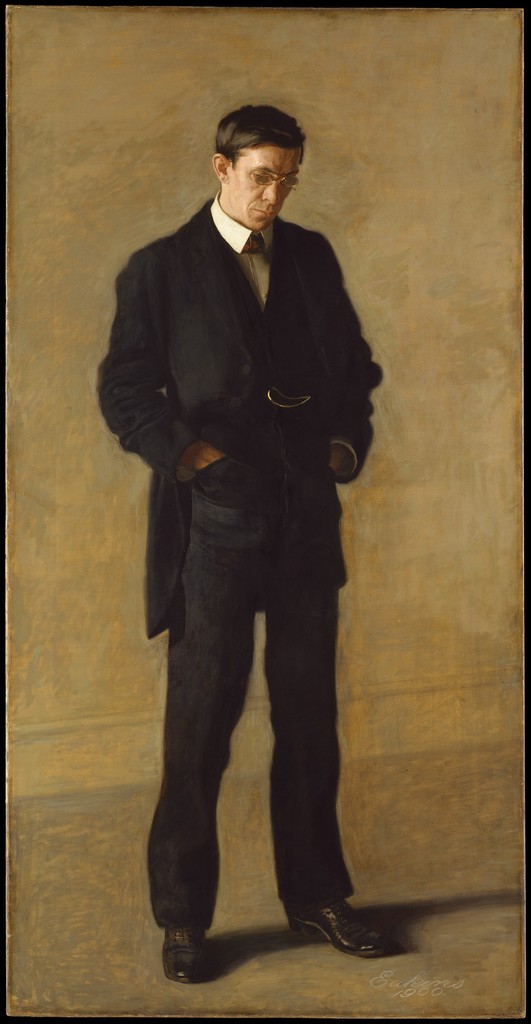
The Thinker: Portrait of Louis N. Kenton offers the complementary problem of inward repose. The Met dates the painting to 1900, identifies the sitter as Eakins’s brother-in-law, and records the imposing dimensions of a tall, narrow canvas: 82 by 42 inches. The familiar short title derives from an inscription apparently added to the reverse by Susan Eakins.[12] Kenton stands alone, without a profession or narrative incident to explain him. Dark clothes merge partly with the subdued setting, while lowered head, planted feet, and hands tucked into his front trouser pockets create the impression of thought as a bodily condition.
Cook and Kenton show two ways duration enters a single image. Cook’s repeated phrase condenses into a moment of controlled exertion; Kenton’s downward focus suspends any obvious action. Neither is merely a facial record. Eakins structures the surrounding emptiness, the direction of the gaze, and the relation of hands or body to the frame so that attention itself becomes the subject. Their individual pages separate performance observed over many sittings from the severe spatial isolation of a late full-length portrait.
Studies, Cameras, and Transfer
The surviving studies resist a simple ladder from first sketch to final oil. The PMA’s survey of works on paper includes life drawings, watercolours, a wash derived from Dr Gross’s painted image, and tracings made from Eakins’s own photographs.[3] A drawing might investigate contour or perspective; a small oil could test colour and grouping; a tracing could isolate information already captured by a lens. These objects document different operations, not interchangeable preliminaries.
Two reserve paintings show how scientific or photographic evidence could enter ambitious composition. In A May Morning in the Park (The Fairman Rogers Four-in-Hand), painted in 1879–80, the PMA connects Eakins’s treatment of horse locomotion to Eadweard Muybridge’s photographs and his representation of wheel speeds to a shared interest in mechanics with the engineer Fairman Rogers.[13] The picture’s knowledge of motion is embedded within a carriage group, landscape, and calculated relations among moving parts.
Arcadia, about 1883, offers more direct physical evidence of transfer. The Met states that Eakins projected photographic images onto the canvas with a magic lantern and incised guide marks in the paint.[14] Yet projection did not determine the whole image. Models still had to be placed within a deliberately classical setting, and photographic fragments had to become a continuous pictorial world. Both works belong naturally beside the camera guide, but they remain paintings because their final coherence depends on arrangement, scale, colour, and material execution.
This broader working system also clarifies what anatomy could and could not do. Structural knowledge helps a shoulder turn convincingly or a rib cage support breath; it does not explain a painting’s emotional pressure. Perspective can locate a body in an amphitheatre; it cannot decide whose face receives light. Eakins’s method becomes most persuasive where technical resources serve a precise human situation.
A Chronology of Decisions
Chronology makes Eakins’s shifts visible without turning the paintings into illustrations of his life. The rowing works of 1871–72 test motion in open air. The Gross Clinic raises a contemporary professional subject to public, monumental scale. Swimming binds the nude to a particular educational community, while The Agnew Clinic reorganises medicine through brighter space and distributed labour. In the 1890s, The Concert Singer brings bodily expertise into portraiture.
Late paintings continue rather than abandon this enquiry. PAFA’s Walt Whitman, painted in 1887–88 at the poet’s Camden home, is a useful contextual counterpart to the standing Kenton. It relies on the weight of a seated, ageing body and the familiarity between artist and sitter, rather than the vertical tension and anonymity of a full-length pose.[15] Boxing and wrestling subjects from the end of the 1890s, including the finished Wrestlers, likewise return to trained bodies under very different indoor conditions from the early river scenes.[1]
The most useful viewing route is therefore comparative. Follow Max Schmitt to The Biglin Brothers for two structures of rowing; set Gross beside Agnew for two images of surgical authority; place Swimming between athletic art and the politics of instruction; then move from Cook’s audible exertion to Kenton’s enclosed thought. Across those transitions, painting remains Eakins’s means of deciding what observation should become.
Researched works directory
This searchable evidence census was assembled from public museum records and a reproducible Wikidata snapshot. It is not a catalogue raisonné, not a claim to complete oeuvre coverage, and not a substitute for the published catalogue literature, which was not used to claim absolute completeness.
| Name | Date | Medium |
|---|---|---|
| A Singer (Mrs. W.H. Bowden) | 1906 | Painting |
| A Singer: Portrait of Mrs. W.H. Bowden | 1906 | Painting |
| A Street Scene | Date unknown | Painting |
| A street scene in Sevilla | 1870 | Painting |
| A Street Scene in Seville | 1870 | Painting |
| African-American Man | 1884 | Photography |
| An Actress (Portrait of Suzanne Santje) | 1903 | Painting |
| Anna Lewis | 1890 | Painting |
| Annie C. Lochrey Husson (Mrs. Louis Husson) | 1905 | Painting |
| Antiquated Music (Portrait of Sarah Sagehorn Frishmuth) | 1900 | Painting |
| Arcadia | 1883 | Painting |
| Arcadia | Date unknown | Sculpture |
| Arcadia: Figure Study, Female Nude | 1883 | Painting |
| Arcadia Sketch | 1883 | Painting |
| Arcadian | Date unknown | Painting |
| Archbishop Diomede Falconio | 1905 | Painting |
| Archbishop James Frederick Wood | 1877 | Painting |
| Archbishop James Frederick Wood (1813-1883) | 1876 | Painting |
| Archbishop William Henry Elder | 1903 | Painting |
| Arthur B. Frost | 1886 | Painting |
| Artist and His Father Hunting Reed Birds: Marsh Landscape Sketch | 1873 | Painting |
| B.J. Blommers | 1904 | Painting |
| Baby at Play | 1876 | Painting |
| Baseball Players Practicing | 1875 | Artwork |
| Benjamin Eakins G38 | Date unknown | Painting |
| Bertrand Gardel (Sketch for The Chess Players) | 1875 | Painting |
| Between Rounds | 1898 | Painting |
| Billy Smith | 1898 | Painting |
| Billy Smith (Sketch for Between Rounds) | 1898 | Painting |
| Boy Reclining | 1883 | Painting |
| Carmelita Requena | 1869 | Painting |
| Charles Edmund Dana | 1902 | Painting |
| Charles Percival Buck | 1904 | Painting |
| Clara | 1890 | Painting |
| Courtship | 1878 | Painting |
| Cowboy Singing | 1892 | Painting |
| Cowboys in the Badlands | 1888 | Painting |
| Cowboys in the Badlands sketch 2 | 1888 | Painting |
| Delaware River Scene | 1881 | Painting |
| Delaware River Study | 1881 | Painting |
| Dr. Agnew (Dr. D. Hayes Agnew) (1818-1892) | 1889 | Painting |
| Dr. Agnew (Dr. D. Hayes Agnew) (1818–1892) | 1889 | Painting |
| Dr. Horatio C. Wood | 1886 | Painting |
| Dr. Thomas H. Fenton | 1916 | Painting |
| Drifting | 1875 | Painting |
| Eakins G184 | 1916 | Painting |
| Ecorché: Relief of a Horse (Josephine) | 1882 | Sculpture |
| Edward W. Redfield | 1905 | Painting |
| Fairman Rogers Four-in-Hand: Landscape Study of Fairmount Park | 1879 | Painting |
| Fairman Rogers Four-in-Hand: Study of a Horse's Leg | 1879 | Painting |
| Fairmount Park (Sketch for The Fairman Rogers Four-in-Hand) | Date unknown | Painting |
| Female Model | 1867 | Painting |
| Female Nude | 1884 | Painting |
| Female Nude from the Back | 1889 | Photography |
| Female Nude (Study) | 1881 | Painting |
| Fifty Years Ago (Young Girl Meditating): Study | 1877 | Painting |
| Figure Study: Masked Nude Woman | Date unknown | Painting |
| Figure Study: Nude Woman, Seated, with Arms Lowered (r) | Date unknown | Painting |
| Figure Study: Nude Woman, Seated, with Arms Raised | Date unknown | Painting |
| [Four Sketches: Seated Man, Sleeping Dog, Two Vases(?)] | Date unknown | Painting |
| Frances Eakins | 1870 | Painting |
| Francis J. Ziegler | 1890 | Painting |
| Frank Hamilton Cushing | 1895 | Painting |
| Frank Jay St. John | 1900 | Painting |
| General E. Burd Grubb (1841-1914) | 1898 | Painting |
| Girl with a Fan; Portrait of Miss Gutierrez | Date unknown | Painting |
| Harriet Husson Carville (Mrs. James G. Carville) | 1904 | Painting |
| Harrison S. Morris | 1896 | Painting |
| Hauling the Seine | 1882 | Painting |
| Head of a Man (Rutherford B. Hayes?) | 1877 | Painting |
| Hiawatha | 1874 | Painting |
| Hiawatha | Date unknown | Artwork |
| Home Ranch | 1892 | Painting |
| Home Scene | 1871 | Painting |
| Homespun | 1881 | Painting |
| In the Studio | 1884 | Painting |
| Interior of a Woodcarver's Shop (Sketch for William Rush Carving His Allegorical Figure of the Schuylkill River) | Date unknown | Painting |
| James MacAlister (Sketch) | 1895 | Painting |
| John Biglin in a Single Scull | 1873 | Painting |
| John Biglin in a Single Scull | 1874 | Painting |
| Joseph R. Woodwell | 1904 | Painting |
| Kathrin | 1872 | Painting |
| Knitting | 1881 | Sculpture |
| Knitting | 1882 | Sculpture |
| Knitting | Date unknown | Sculpture |
| Lafayette Park, Washington, D.C. | 1877 | Painting |
| Landscape | 1881 | Painting |
| Landscape | 1882 | Painting |
| Landscape Sketch | 1880 | Painting |
| Landscape (Sketch for Cowboys in the Bad Lands) | 1887 | Painting |
| Landscape Study: Cultivated Field and Tree | 1874 | Painting |
| Landscape Study: Shoreline with Trees | 1874 | Painting |
| Landscape with a Dog | 1874 | Painting |
| Letitia Wilson Jordan | 1888 | Painting |
| Louis Husson | 1899 | Painting |
| Major Manuel Waldteufel | 1907 | Painting |
| Masked nude standing | 1880 | Painting |
| Maud Cook (Mrs. Robert C. Reid) | 1895 | Painting |
| Mending the Net | 1881 | Painting |
| Mending the Net: Study of a Fisherman | Date unknown | Painting |
| Miss Alice Kurtz | 1903 | Painting |
| Miss Amelia Van Buren | 1891 | Painting |
| Miss Eleanor S. F. Pue | 1907 | Painting |
| Miss Gertrude Murray | 1895 | Painting |
| Monsignor James P. Turner | 1906 | Painting |
| Mother (Annie Williams Gandy) | 1903 | Painting |
| Mrs. Gilbert L. Parker | 1910 | Painting |
| Mrs. Mary Arthur | 1900 | Painting |
| Music | 1904 | Painting |
| Nude man with beard | Date unknown | Painting |
| Nude Woman Standing | 1908 | Painting |
| Old Lady Sewing | 1879 | Painting |
| Portrait of a Little Girl | 1897 | Painting |
| Portrait of a Woman Reading | Date unknown | Painting |
| Portrait of Adam S. Bare | 1903 | Painting |
| Portrait of Alfred Reynolds | Date unknown | Painting |
| Portrait of Arthur Burdett Frost | 1886 | Painting |
| Portrait of Ashbury Wright Lee | 1905 | Painting |
| Portrait of Benjamin Eakins | 1894 | Painting |
| Portrait of Benjamin Eakins (Sketch for The Writing Master) | 1882 | Painting |
| Portrait of Blanche Hurlburt | 1885 | Painting |
| Portrait of Douglass Morgan Hall | 1889 | Painting |
| Portrait of Dr. Edward J. Nolan | 1900 | Painting |
| Portrait of Dr. Samuel D. Gross (The Gross Clinic) | 1875 | Painting |
| Portrait of Edward Taylor Snow | 1904 | Painting |
| Portrait of Elizabeth L. Burton | 1905 | Painting |
| Portrait of Florence Einstein | 1905 | Painting |
| Portrait of Henry O. Tanner | 1902 | Painting |
| Portrait of J. Harry Lewis | 1876 | Painting |
| Portrait of John B. Gest | 1905 | Painting |
| Portrait of Joshua Ballinger Lippincott | 1892 | Painting |
| Portrait of Leslie W. Miller | 1901 | Painting |
| Portrait of Lucy Lewis | 1896 | Painting |
| Portrait of Margaret Eakins in a Skating Costume | 1871 | Painting |
| Portrait of Mary Adeline Williams | 1899 | Painting |
| Portrait of Mary Adeline Williams | 1900 | Painting |
| Portrait of Mrs. Fairman Rogers (Study for The Fairman Rogers Four-in-Hand) | 1879 | Painting |
| Portrait of Mrs. Frank Hamilton Cushing | 1895 | Painting |
| Portrait of Mrs. James Mapes Dodge (Josephine Kern) | 1896 | Painting |
| Portrait of Professor Benjamin H. Rand | 1874 | Painting |
| Portrait of Professor W. D. Marks | 1886 | Painting |
| Portrait of Rear Admiral George Wallace Melville | 1904 | Painting |
| Portrait of Walter S. Macdowell | 1904 | Painting |
| Porträt des Alfred Bryan Wall | 1904 | Painting |
| Porträt des David Wilson Jordan | Date unknown | Painting |
| Porträt des John McLure Hamilton (1853- 1936) | 1895 | Painting |
| Professionals at Rehearsal | 1883 | Painting |
| Professor William D Marks | 1886 | Painting |
| Professor William Woolsey Johnson | 1896 | Painting |
| Pushing for Rail | 1874 | Painting |
| Rail Shooting on the Delaware | 1876 | Painting |
| Rear Admiral Charles Dwight Sigsbee G388-2 | 1903 | Painting |
| Rear Admiral George W. Melville | 1905 | Painting |
| Reclining Male Nude | 1887 | Photography |
| Reclining Nude | Date unknown | Painting |
| Retrospection | 1880 | Painting |
| Riter Fitzgerald | 1895 | Painting |
| Robert M. Lindsay | 1900 | Painting |
| Ruth (Ruth W. Harding) | 1903 | Painting |
| Saddle (Sketch for Cowboys in the Bad Lands) | 1887 | Painting |
| Sailboats Racing on the Delaware | 1874 | Painting |
| Sailboats Racing: Study of the Delaware River | 1874 | Painting |
| Sailing | 1875 | Painting |
| Salutat | 1898 | Painting |
| Seated Figures | 1886 | Painting |
| Self-portrait | 1902 | Painting |
| Seventy Years Ago | 1877 | Painting |
| Shad Fishing at Gloucester on the Delaware: Delaware River and Gloucester Pier | 1881 | Painting |
| Shad Fishing at Gloucester on the Delaware River | 1881 | Painting |
| Shad Fishing at Gloucester on the Delaware River: Study of a Woman's Head | 1881 | Painting |
| Ships and Sailboats on the Delaware | 1874 | Painting |
| Ships and Sailboats on the Delaware: Study | 1874 | Painting |
| Shoreline of the Delaware River, with Fishing Nets | Date unknown | Painting |
| Signora Gomez d'Arza | 1901 | Painting |
| Singing a Pathetic Song | 1881 | Painting |
| Sketch for Cowboys in the Bad Lands | 1887 | Painting |
| Sketch for Music (The Violinist) | 1904 | Painting |
| Sketch for Portrait of Dr. Jacob Mendez da Costa | 1893 | Painting |
| Sketch for Portrait of Leslie W. Miller | 1901 | Painting |
| Sketch for Portrait of Letitia Wilson Jordan | 1888 | Painting |
| Sketch for Portrait of Monsignor James P. Turner | 1906 | Painting |
| Sketch for Portrait of Mother Patricia Waldron | 1903 | Painting |
| Sketch for Portrait of Professor George F. Barker | 1886 | Painting |
| Sketch for Seventy Years Ago | Date unknown | Painting |
| Sketch for The Concert Singer | 1892 | Painting |
| Sketch for The Fairman Rogers Four-in-Hand | 1879 | Painting |
| Sketch for The Gross Clinic | 1875 | Painting |
| Sketch for the Surrender of General Lee to General Grant at Appomatox | Date unknown | Painting |
| Sketch for William Rush and His Model | 1908 | Painting |
| Sketch of a Landscape | 1882 | Painting |
| Sketch of a Man and Study of Drapery | 1882 | Painting |
| Sketch of Harry | 1892 | Painting |
| Sketch of Max Schmitt in a Single Scull | 1874 | Painting |
| Sketches for “Home-Spun”, (recto and verso) | 1881 | Painting |
| Sketches (Four on one panel) | Date unknown | Painting |
| Spinning | 1881 | Painting |
| Spinning | 1882 | Sculpture |
| Spinning: Sketch | 1881 | Painting |
| Starting Out After Rail | 1863 | Painting |
| Starting Out After Rail | 1874 | Painting |
| Study for Arcadia: Youth Playing Pipes | 1883 | Painting |
| Study for "Cowboys in the Badlands | 1887 | Painting |
| Study for "Negro Boy Dancing": The Banjo Player | Date unknown | Painting |
| Study for "Negro Boy Dancing": The Boy | Date unknown | Painting |
| Study for Portrait of John McClure Hamilton | 1895 | Painting |
| Study for Salutat | 1898 | Painting |
| Study for 'The Meadows, Gloucester' | 1882 | Painting |
| Study for "William Rush Carving His Allegorical Figure of the Schuylkill River | 1876 | Painting |
| Study of a Groom | 1879 | Painting |
| Study of a Nude Man | 1869 | Painting |
| Study of a Nude Man (The Strong Man) | 1869 | Painting |
| Study of a Seated Nude Woman Wearing a Mask | 1863 | Drawing |
| Study of a Young Woman | 1868 | Painting |
| Study of Dr Samuel David Gross | 1875 | Painting |
| Study of Horse for The Fairman Rogers Four-in-Hand | 1879 | Painting |
| Swimming | 1885 | Painting |
| Taking the Count | 1898 | Painting |
| Taking the Count, study | 1898 | Painting |
| Taking Up Net | 1881 | Painting |
| Talcott Williams | 1889 | Painting |
| That's a New Game Down in Frisco": Study for the Central Standing Figure | 1878 | Painting |
| The Agnew Clinic | 1889 | Painting |
| The Art Student (James Wright) | 1890 | Painting |
| The Artist's Wife and His Setter Dog | 1884 | Painting |
| The Biglin Brothers Racing | 1872 | Painting |
| The Biglin Brothers Turning the Stake | 1873 | Painting |
| The Black Fan (Portrait of Mrs. Talcott Williams) | 1891 | Painting |
| The Bohemian (Portrait of Franklin Louis Schenck) | 1890 | Painting |
| The Brinton House | 1878 | Painting |
| The Cello Player | 1896 | Painting |
| The Champion Single Sculls (Max Schmitt in a Single Scull) | 1871 | Painting |
| The Chaperone | 1908 | Painting |
| The Chess Players | 1876 | Painting |
| The Concert Singer | 1890–1892 | Painting |
| The Courtship | 1878 | Painting |
| The Crucifixion | 1880 | Painting |
| The Dancing Lesson | 1878 | Painting |
| The Dean's Roll Call | 1899 | Painting |
| The Fairman Rogers Four-in-Hand | 1879 | Painting |
| The Fairman Rogers Four-In-Hand (A May Morning in... | 1899 | Painting |
| The Meadows, Gloucester | 1882 | Painting |
| The Model | 1908 | Painting |
| The Oarsmen (The Schreiber Brothers) | 1874 | Painting |
| The Oboe Player (Portrait of Dr. Benjamin Sharp) | 1903 | Painting |
| The Old-Fashioned Dress (Portrait of Helen Montanverde Parker) | 1908 | Painting |
| The Pair-Oared Shell | 1872 | Painting |
| The Pathetic Song | 1881 | Painting |
| The Pianist | 1896 | Painting |
| The Poleman in the Ma'sh | 1881 | Drawing |
| The Red Shawl | 1890 | Painting |
| The Spinner | 1876 | Painting |
| The Thinker: Portrait of Louis N. Kenton | 1900 | Painting |
| The Timer | 1879 | Painting |
| The Translator, Portrait of Monsignor Hugh T. Henry | 1902 | Painting |
| The Veteran (Portrait of George Reynolds) | Date unknown | Painting |
| The Writing Master | 1882 | Painting |
| The Young Man (Portrait of Kern Dodge) | 1898 | Painting |
| Thomas Eakins and John Laurie Wallace on a Beach | 1883 | Photography |
| Three Boys Wading in a Creek | 1883 | Photography |
| Trenton Battle Monument | 1893 | Sculpture |
| Two Pupils in Greek Dress | 1883 | Photography |
| Views of Harry | 1885 | Painting |
| Walt Whitman | 1887 | Painting |
| Whistling for Plover | 1874 | Painting |
| William H. Macdowell | 1884 | Photography |
| William H. Macdowell and Margaret Eakins in Saltville (or Clinch Mountain), Virginia | 1875 | Photography |
| William Hance Macdowell (1816-1906) | 1897 | Painting |
| William Rush and his Model | 1908 | Painting |
| William Rush and His Model | Date unknown | Painting |
| William Rush Carving His Allegorical Figure of the Schuylkill River | 1876 | Painting |
| William Rush Carving His Allegorical Figure of the Schuylkill River | 1908 | Painting |
| William Rush Carving His Allegorical Figure of the Schuylkill River, Study | 1876 | Painting |
| William Rush's Model | 1908 | Painting |
| Wrestlers | 1899 | Painting |
| Young Girl Meditating | 1877 | Painting |
Frequently Asked Questions
He painted rowers, sailors, hunters, swimmers, surgeons, musicians, boxers, wrestlers, family members, friends, and respected professionals. These categories overlap: a sporting scene may also be a group portrait, and a likeness such as The Concert Singer can represent skilled labour. His most characteristic subjects gave him a concrete problem involving bodies, space, or attention.[1][2]
They join first-hand understanding of the sport to unusually rigorous pictorial design. The Champion Single Sculls opens deep water around one athlete, while The Biglin Brothers Racing compresses paired exertion against a crowded public event. Together they show that Eakins could make perspective and timing carry meaning without resorting to theatrical gesture.[4][5]
Photographs sometimes supplied poses, movement evidence, or forms that could be traced or projected, as Arcadia demonstrates. They were only one resource among drawings, anatomical study, perspective calculations, oil sketches, and observation from life. The painted result could alter spacing, scale, lighting, and emphasis; camera evidence did not automatically dictate the composition.[3][14]
The Gross Clinic concentrates authority in Gross’s commanding figure within a dark, steep theatre. The Agnew Clinic spreads the operation across a lighter, wider platform and makes nurse Mary Clymer conspicuous within a larger team. Their different procedures, audiences, and professional hierarchies reward close comparison rather than a simple claim that the second repeats the first.[6][8]
Begin with The Champion Single Sculls for space and measured action, then compare the two clinics. Continue to Swimming for life study and group design, The Concert Singer for embodied performance, and The Thinker: Portrait of Louis N. Kenton for concentrated stillness. That path samples every major pictorial problem while leaving fuller object histories to their individual guides.[4][6][9][11][12]
Discussion
Use this evidence-led guide as a starting point for close looking rather than a final verdict.
Share an observation about Thomas Eakins Paintings or a source that adds useful context.
Reader Insights
Which material decision best defines Eakins's practice in this group of works?
Where do you see observation and invention working together rather than as opposites?
Which work would you add to the selected group, and what would it change?
Join the Conversation
Add your reading below, keeping observations specific and evidence clear.
References
- The Metropolitan Museum of Art, Thomas Eakins (1844–1916): Painting, accessed 30 August 2026.
- Philadelphia Museum of Art, Thomas Eakins: American Realist, accessed 30 August 2026.
- Philadelphia Museum of Art, Eakins on Paper: Drawings and Watercolors from the Collection, accessed 30 August 2026.
- The Metropolitan Museum of Art, The Champion Single Sculls (Max Schmitt in a Single Scull), accessed 30 August 2026.
- National Gallery of Art, The Biglin Brothers Racing, accessed 30 August 2026.
- Philadelphia Museum of Art, Portrait of Dr. Samuel D. Gross (The Gross Clinic), accessed 30 August 2026.
- Philadelphia Museum of Art, An Eakins Masterpiece Restored: Seeing The Gross Clinic Anew, accessed 30 August 2026.
- University of Pennsylvania School of Nursing, The Agnew Clinic, accessed 30 August 2026.
- Amon Carter Museum of American Art, Swimming, accessed 30 August 2026.
- J. Paul Getty Museum, Thomas Eakins and Male Nudes at the Site of “Swimming”, accessed 30 August 2026.
- Philadelphia Museum of Art, The Concert Singer, accessed 30 August 2026.
- The Metropolitan Museum of Art, The Thinker: Portrait of Louis N. Kenton, accessed 30 August 2026.
- Philadelphia Museum of Art, A May Morning in the Park (The Fairman Rogers Four-in-Hand), accessed 30 August 2026.
- The Metropolitan Museum of Art, Arcadia, accessed 30 August 2026.
- Pennsylvania Academy of the Fine Arts, Walt Whitman, accessed 30 August 2026.
More EAKINS Artworks
The Agnew Clinic image: gallery photograph by Miguel Hermoso Cuesta, cropped and perspective-corrected, under CC BY-SA 4.0.