


 by Tom Gurney
Tom Gurney BSc (Hons) is an art history expert with over 20 years experience
Page Created on / Page Updated on
Email: tomgurney1@gmail.com / Phone: +44 7429 011000
The Thinker: Portrait of Louis N. Kenton: Introduction
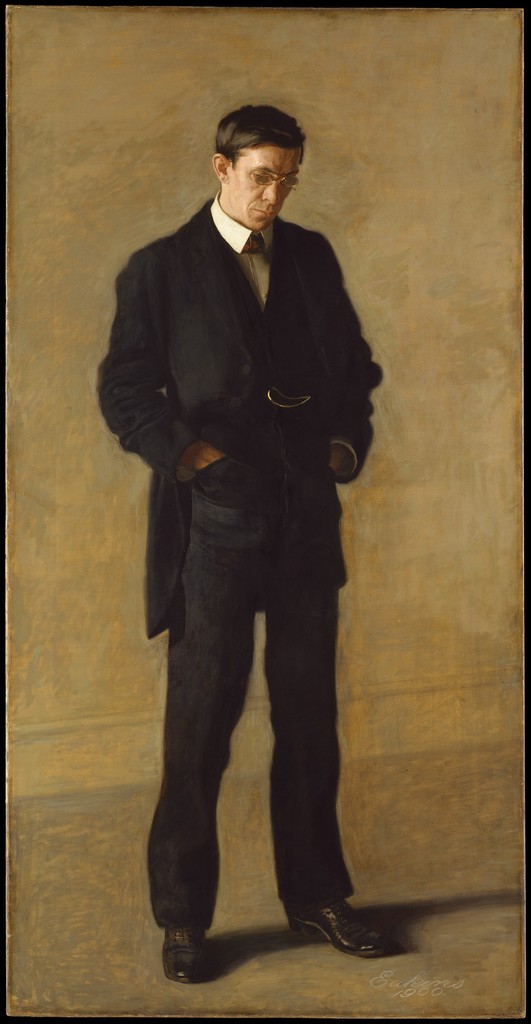
Thomas Eakins gives Louis N. Kenton almost nothing to do in The Thinker: Portrait of Louis N. Kenton. The sitter stands at full length against a mottled wall, his head inclined and his eyes directed down through small spectacles. Both hands are pushed into his trouser pockets. His dark jacket, waistcoat, and trousers form a long vertical mass, interrupted by a white collar, a muted necktie, and the fine curve of a watch chain. One polished shoe faces nearly forward; the other turns out across the floor. There is no desk, book, workplace, or companion to explain the moment.
That reduction makes every remaining choice unusually consequential. The narrow canvas is more than two metres high, so Kenton’s posture addresses the viewer at something close to bodily scale. Yet the portrait does not meet us with a direct look or a display of rank. It asks how a standing person can appear mentally occupied without identifying the occupation of his mind. The Metropolitan Museum of Art dates the oil to 1900, records it as object 17.172, and identifies Kenton as Eakins’s brother-in-law.[1]
The familiar short title encourages a psychological reading, but it also needs qualification. According to the Met, “The Thinker” derives from an inscription on the reverse apparently added by Susan Macdowell Eakins. It is not a transcript of anything Kenton said, nor does it disclose a diagnosis or private history. The painting makes thought plausible through stance, gaze, scale, and withheld context; what the sitter may be thinking remains beyond its evidence.
At a Glance
- Full titleThe Thinker: Portrait of Louis N. Kenton [1]
- Artist and dateThomas Eakins, 1900 [1][2]
- MediumOil on canvas [1][2]
- Dimensions82 × 42 inches (208.3 × 106.7 centimetres) [1][2]
- SitterLouis N. Kenton (1865–1947), Eakins’s brother-in-law [1]
- CollectionThe Metropolitan Museum of Art, object 17.172, acquired through the John Stewart Kennedy Fund in 1917 [1][2]
Thomas Eakins in context
The Gross Clinic
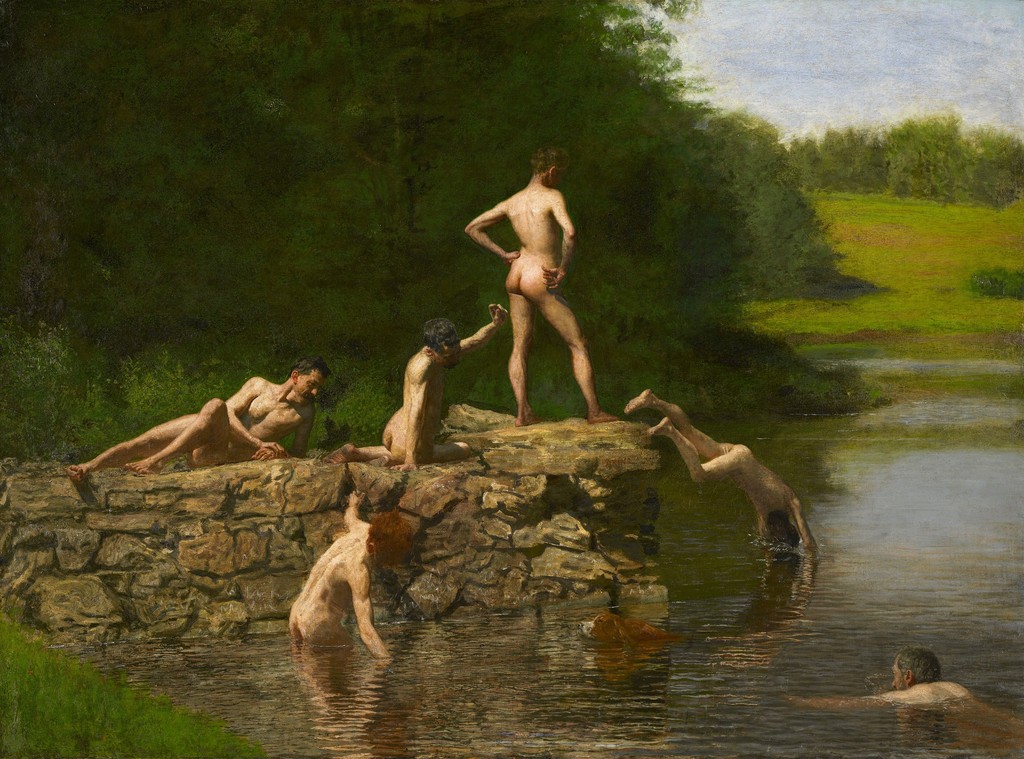
1875Swimming
1885The Agnew Clinic
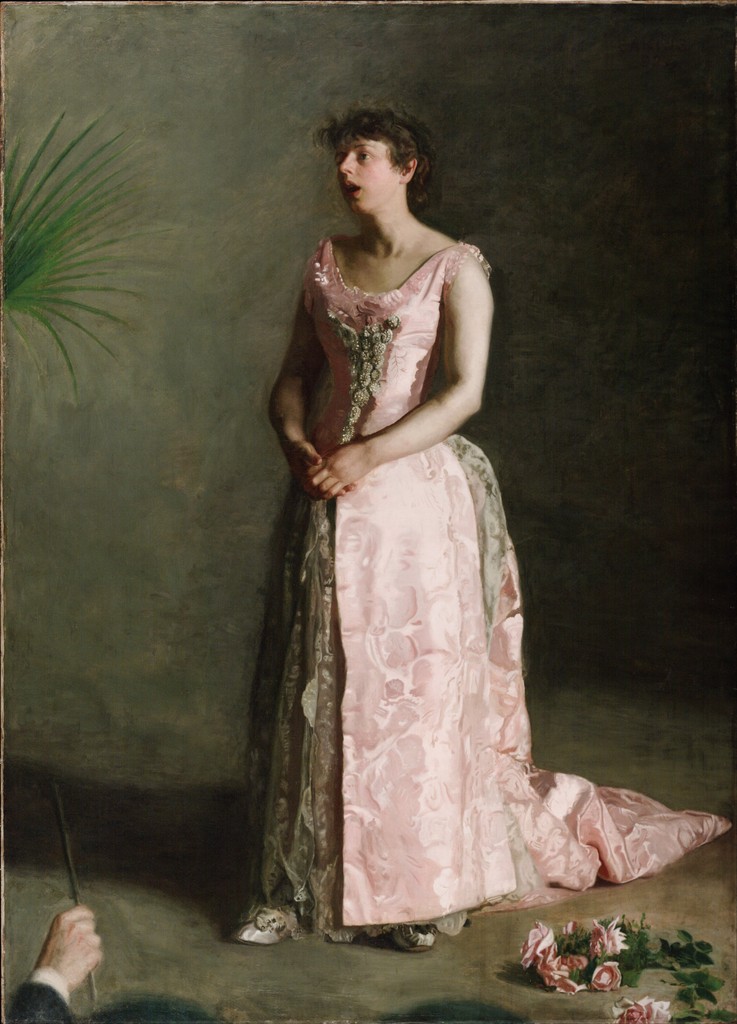
1889The Concert Singer
1890–92The Thinker
1900Contents
- Introduction
- What Is Known About Kenton
- A Body Held in a Narrow Field
- Dress, Hands, and Shoes
- Gaze Without a Story
- Sombre Colour and Selective Finish
- The Title and Its Limits
- A Late Portrait Method
- Exhibitions and the Met
What Is Known About Kenton
Louis N. Kenton entered the Eakins family through marriage. In 1889 he married Elizabeth Macdowell, the sister of Susan Macdowell Eakins. The Met describes the marriage as troubled and apparently brief, while also stressing how little is known about either it or the sitter himself.[1] Those limits are more than gaps to be filled with speculation. They determine what the portrait can responsibly be asked to prove.
Kenton’s family relationship helps explain why he could sit for Eakins, but it does not turn the canvas into a coded account of domestic events. The current museum record does not provide an occupation, a statement by Kenton, or a documented explanation of the pose. His dark city clothes indicate a formally dressed adult man; they do not establish profession or temperament. The Thomas Eakins portraits guide considers this boundary between identity and interpretation across other sitters.
A Body Held in a Narrow Field
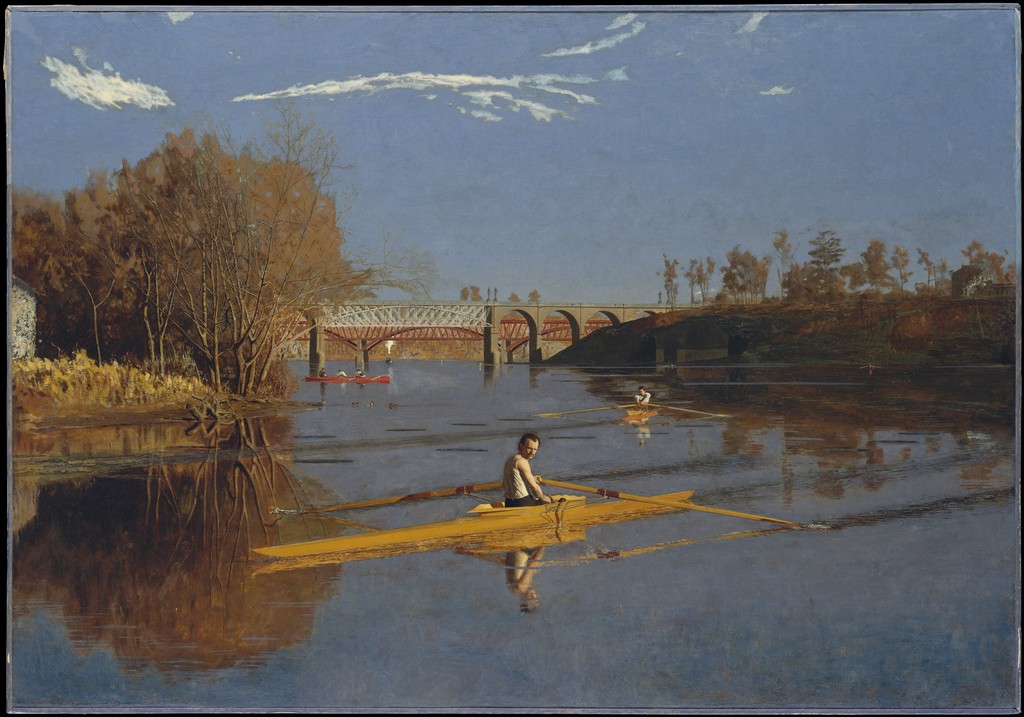
The dimensions establish the first encounter. At 82 inches high and only 42 inches wide, the canvas is almost twice as tall as it is broad.[1] Kenton occupies most of that height, with a modest interval above his hair and enough floor below to hold his shoes and cast shadow. The picture offers neither the roomy architecture of a clinic nor the horizontal reach of the Schuylkill paintings. Its space has been pared to a vertical enclosure around one standing body.
Kenton does not form a rigid column. His shoulders descend at slightly different angles, his head bends forward and towards one side, and his elbows push out from the torso as his hands enter the pockets. Below, the trouser legs separate and end in feet set on different axes. The shoe at the viewer’s left points more directly outward from the surface; the shoe at the viewer’s right turns diagonally and throws a longer dark shape behind it. Those differences keep the stance physically credible without suggesting that he is about to stride away.
The floor is indicated economically. A change in tone near the bottom separates it from the wall, and the shadows beneath the shoes give the body weight. There is no painted platform or furnishing to stabilise him. Balance is carried instead by the spread feet, the long legs, and the broad dark area of the upper clothing. Eakins turns ordinary standing into the portrait’s principal action.
Dress, Hands, and Shoes
The clothing is dark but not blank. A long jacket hangs behind Kenton’s thighs, a buttoned waistcoat closes the centre, and broad trouser legs continue the descending silhouette. Against this almost black structure, the white collar makes a sharp triangular opening around the neck. A reddish-brown tie adds a restrained warm note. Lower down, a gold watch chain curves across the waistcoat and briefly catches the eye before disappearing again into shadow.
These details suggest care in dress without becoming a catalogue of status. There is no medal, uniform, professional instrument, or luxury interior. The watch chain is the only conspicuously bright accessory, and even it is a narrow line. The dark fabric is handled in changing degrees of definition: lapels and cuffs can be followed, while other passages merge softly into neighbouring shadow. Eakins makes black clothing carry structure through differences of edge and tone rather than through decorative pattern.
The hands are especially important because they are present and withheld at once. They do not clasp behind the body, hold a book, or gesture towards the viewer. They enter the front trouser pockets, leaving small warm passages of skin visible at the openings while the elbows widen the jacket. The pose closes off the expressive vocabulary that portrait hands often provide. At the same time, the pockets prevent the figure from looking ceremonially posed. They introduce an everyday informality into a canvas of imposing scale.
At the bottom, the shoes recover a crispness that much of the coat suppresses. Laces, rounded fronts, and small highlights are visible. Their differing directions make the legs feel independently planted, and the scuffed reflections keep them from becoming polished symbols detached from use. Looking from shoes to pockets reveals a portrait constructed from restraint: the feet provide stability while the hands decline to explain the sitter.
Gaze Without a Story
Kenton’s face is the lightest sustained area after the collar. Warm flesh colour separates it from dark hair and coat, while the spectacles create a small horizontal bar across the downward inclination of his head. He does not return the viewer’s gaze. His eyes appear directed towards the floor or an indeterminate point before him, and the set of the mouth supplies no obvious social response.
It is reasonable to describe this configuration as inward or contemplative because the title and the Met’s account of the portrait’s reception support those terms.[1] It would be unreasonable to identify a particular memory, anxiety, illness, or family grievance. A lowered gaze can be staged, sustained for a sitting, and organised to fit a canvas. It may generate an impression of introspection without revealing the content—or even the duration—of an actual thought.
The empty surroundings preserve that uncertainty. The wall is a warm field of grey, ochre, and muted green, crossed by visible shifts in the paint. It contains no corner, picture, curtain, or written clue. Only the floor line and cast shadow establish a usable room. The setting therefore does not describe Kenton’s home or workplace. It provides enough atmosphere to hold him while refusing the narrative assistance that furniture might supply.
Sombre Colour and Selective Finish
Contemporary critics noticed the portrait’s restrained palette when it began to circulate in exhibitions in 1900.[1] The description still fits, although “sombre” should not be confused with colourless. Warm tan and grey animate the wall. Flesh, collar, tie, watch chain, cuffs, and shoe highlights form a sparse sequence of lighter or warmer accents down the body. Black clothing varies from dense passages to softer charcoal edges.
The paint also changes speed. The face, spectacles, collar, chain, and shoes invite close inspection because their forms are comparatively definite. Across the wall and floor, strokes remain more open and irregular. The jacket’s outer contours sometimes soften into the surrounding tone, while the lower legs regain weight against the paler ground. Such variation keeps the huge field from becoming uniformly descriptive. Attention is concentrated and released rather than distributed to every inch alike.
Eakins signed and dated the work at the lower right, placing “1900” close to the outward-turned shoe. The Met’s exhibition account interprets that prominent date as part of the portrait’s association with a modern individual at the opening of a new century.[3] That archetypal reading is useful as a history of interpretation, not a literal identity for Kenton. The painting remains a likeness of one named man even when viewers make it stand for wider modern introspection.
The Title and Its Limits
Because Susan Eakins apparently supplied the reverse inscription, the short title should not automatically be treated as Thomas Eakins’s declared programme at the moment of painting.[1] It may record a family understanding, a later label, or an interpretation shaped during the work’s early history. The available institutional evidence does not choose among those possibilities.
The Met’s 2002 exhibition placed the portrait between individuality and an image of modern man.[3] A cautious reading can retain both scales. Kenton’s spectacles, watch chain, pocketed hands, stance, and shoes resist conversion into a generic emblem. At the same time, the absence of occupation or setting allows the portrait to exceed one family biography. The result is not a diagnosis but a tension between a specific body and an interpretive title.
A Late Portrait Method
The work belongs to a period when portraiture dominated Eakins’s painting. The Met’s survey notes that from 1887 he concentrated primarily on likenesses, frequently at life scale, often isolating friends and acquaintances from elaborate outdoor settings.[4] The Smithsonian similarly describes his sustained interest in individual achievement, psychological complexity, and vulnerability, while noting that many sitters were people he selected rather than conventional clients.[6]
Comparison with The Concert Singer clarifies the choice. Weda Cook’s portrait uses the body to make professional performance visible; Kenton’s removes any comparable task. Cook’s open mouth and upright breath belong to an audible action, while Kenton’s closed posture offers no public role. Both are full-length figures, yet one expands identity through work and the other concentrates it through suspended explanation. The wider paintings guide places these two solutions beside Eakins’s athletes and surgeons.
Exhibitions and the Met
The Met states that the portrait was widely shown from 1900 and drew notice for unsparing realism, subdued colour, inward pose, and a forceful sense of individual character.[1] Those reports matter because they establish that the qualities now associated with the work were already visible to early audiences. They do not mean that every critic agreed on a single meaning or knew Kenton’s inner life.
The object entered the Met in 1917 through the John Stewart Kennedy Fund and now bears accession number 17.172.[1][2] The museum’s history of its Eakins holdings records a memorial exhibition of sixty paintings in November of that year and notes that curator Bryson Burroughs arranged the purchase of two canvases from the display.[5] The current public object summary does not supply a complete chain of owners before acquisition, so no undocumented intermediate history should be invented.
The Met Open Access record classifies the painting as public domain and assigns it to the American Wing.[2] As currently listed, it is on view at The Met Fifth Avenue in Gallery 771.[1] Gallery placement can change, but institution, object number, dimensions, medium, and acquisition credit provide durable identifiers for finding the exact work.
Researched works directory
This searchable evidence census was assembled from public museum records and a reproducible Wikidata snapshot. It is not a catalogue raisonné, not a claim to complete oeuvre coverage, and not a substitute for the published catalogue literature, which was not used to claim absolute completeness.
| Name | Date | Medium |
|---|---|---|
| A Singer (Mrs. W.H. Bowden) | 1906 | Painting |
| A Singer: Portrait of Mrs. W.H. Bowden | 1906 | Painting |
| A Street Scene | Date unknown | Painting |
| A street scene in Sevilla | 1870 | Painting |
| A Street Scene in Seville | 1870 | Painting |
| African-American Man | 1884 | Photography |
| An Actress (Portrait of Suzanne Santje) | 1903 | Painting |
| Anna Lewis | 1890 | Painting |
| Annie C. Lochrey Husson (Mrs. Louis Husson) | 1905 | Painting |
| Antiquated Music (Portrait of Sarah Sagehorn Frishmuth) | 1900 | Painting |
| Arcadia | 1883 | Painting |
| Arcadia | Date unknown | Sculpture |
| Arcadia: Figure Study, Female Nude | 1883 | Painting |
| Arcadia Sketch | 1883 | Painting |
| Arcadian | Date unknown | Painting |
| Archbishop Diomede Falconio | 1905 | Painting |
| Archbishop James Frederick Wood | 1877 | Painting |
| Archbishop James Frederick Wood (1813-1883) | 1876 | Painting |
| Archbishop William Henry Elder | 1903 | Painting |
| Arthur B. Frost | 1886 | Painting |
| Artist and His Father Hunting Reed Birds: Marsh Landscape Sketch | 1873 | Painting |
| B.J. Blommers | 1904 | Painting |
| Baby at Play | 1876 | Painting |
| Baseball Players Practicing | 1875 | Artwork |
| Benjamin Eakins G38 | Date unknown | Painting |
| Bertrand Gardel (Sketch for The Chess Players) | 1875 | Painting |
| Between Rounds | 1898 | Painting |
| Billy Smith | 1898 | Painting |
| Billy Smith (Sketch for Between Rounds) | 1898 | Painting |
| Boy Reclining | 1883 | Painting |
| Carmelita Requena | 1869 | Painting |
| Charles Edmund Dana | 1902 | Painting |
| Charles Percival Buck | 1904 | Painting |
| Clara | 1890 | Painting |
| Courtship | 1878 | Painting |
| Cowboy Singing | 1892 | Painting |
| Cowboys in the Badlands | 1888 | Painting |
| Cowboys in the Badlands sketch 2 | 1888 | Painting |
| Delaware River Scene | 1881 | Painting |
| Delaware River Study | 1881 | Painting |
| Dr. Agnew (Dr. D. Hayes Agnew) (1818-1892) | 1889 | Painting |
| Dr. Agnew (Dr. D. Hayes Agnew) (1818–1892) | 1889 | Painting |
| Dr. Horatio C. Wood | 1886 | Painting |
| Dr. Thomas H. Fenton | 1916 | Painting |
| Drifting | 1875 | Painting |
| Eakins G184 | 1916 | Painting |
| Ecorché: Relief of a Horse (Josephine) | 1882 | Sculpture |
| Edward W. Redfield | 1905 | Painting |
| Fairman Rogers Four-in-Hand: Landscape Study of Fairmount Park | 1879 | Painting |
| Fairman Rogers Four-in-Hand: Study of a Horse's Leg | 1879 | Painting |
| Fairmount Park (Sketch for The Fairman Rogers Four-in-Hand) | Date unknown | Painting |
| Female Model | 1867 | Painting |
| Female Nude | 1884 | Painting |
| Female Nude from the Back | 1889 | Photography |
| Female Nude (Study) | 1881 | Painting |
| Fifty Years Ago (Young Girl Meditating): Study | 1877 | Painting |
| Figure Study: Masked Nude Woman | Date unknown | Painting |
| Figure Study: Nude Woman, Seated, with Arms Lowered (r) | Date unknown | Painting |
| Figure Study: Nude Woman, Seated, with Arms Raised | Date unknown | Painting |
| [Four Sketches: Seated Man, Sleeping Dog, Two Vases(?)] | Date unknown | Painting |
| Frances Eakins | 1870 | Painting |
| Francis J. Ziegler | 1890 | Painting |
| Frank Hamilton Cushing | 1895 | Painting |
| Frank Jay St. John | 1900 | Painting |
| General E. Burd Grubb (1841-1914) | 1898 | Painting |
| Girl with a Fan; Portrait of Miss Gutierrez | Date unknown | Painting |
| Harriet Husson Carville (Mrs. James G. Carville) | 1904 | Painting |
| Harrison S. Morris | 1896 | Painting |
| Hauling the Seine | 1882 | Painting |
| Head of a Man (Rutherford B. Hayes?) | 1877 | Painting |
| Hiawatha | 1874 | Painting |
| Hiawatha | Date unknown | Artwork |
| Home Ranch | 1892 | Painting |
| Home Scene | 1871 | Painting |
| Homespun | 1881 | Painting |
| In the Studio | 1884 | Painting |
| Interior of a Woodcarver's Shop (Sketch for William Rush Carving His Allegorical Figure of the Schuylkill River) | Date unknown | Painting |
| James MacAlister (Sketch) | 1895 | Painting |
| John Biglin in a Single Scull | 1873 | Painting |
| John Biglin in a Single Scull | 1874 | Painting |
| Joseph R. Woodwell | 1904 | Painting |
| Kathrin | 1872 | Painting |
| Knitting | 1881 | Sculpture |
| Knitting | 1882 | Sculpture |
| Knitting | Date unknown | Sculpture |
| Lafayette Park, Washington, D.C. | 1877 | Painting |
| Landscape | 1881 | Painting |
| Landscape | 1882 | Painting |
| Landscape Sketch | 1880 | Painting |
| Landscape (Sketch for Cowboys in the Bad Lands) | 1887 | Painting |
| Landscape Study: Cultivated Field and Tree | 1874 | Painting |
| Landscape Study: Shoreline with Trees | 1874 | Painting |
| Landscape with a Dog | 1874 | Painting |
| Letitia Wilson Jordan | 1888 | Painting |
| Louis Husson | 1899 | Painting |
| Major Manuel Waldteufel | 1907 | Painting |
| Masked nude standing | 1880 | Painting |
| Maud Cook (Mrs. Robert C. Reid) | 1895 | Painting |
| Mending the Net | 1881 | Painting |
| Mending the Net: Study of a Fisherman | Date unknown | Painting |
| Miss Alice Kurtz | 1903 | Painting |
| Miss Amelia Van Buren | 1891 | Painting |
| Miss Eleanor S. F. Pue | 1907 | Painting |
| Miss Gertrude Murray | 1895 | Painting |
| Monsignor James P. Turner | 1906 | Painting |
| Mother (Annie Williams Gandy) | 1903 | Painting |
| Mrs. Gilbert L. Parker | 1910 | Painting |
| Mrs. Mary Arthur | 1900 | Painting |
| Music | 1904 | Painting |
| Nude man with beard | Date unknown | Painting |
| Nude Woman Standing | 1908 | Painting |
| Old Lady Sewing | 1879 | Painting |
| Portrait of a Little Girl | 1897 | Painting |
| Portrait of a Woman Reading | Date unknown | Painting |
| Portrait of Adam S. Bare | 1903 | Painting |
| Portrait of Alfred Reynolds | Date unknown | Painting |
| Portrait of Arthur Burdett Frost | 1886 | Painting |
| Portrait of Ashbury Wright Lee | 1905 | Painting |
| Portrait of Benjamin Eakins | 1894 | Painting |
| Portrait of Benjamin Eakins (Sketch for The Writing Master) | 1882 | Painting |
| Portrait of Blanche Hurlburt | 1885 | Painting |
| Portrait of Douglass Morgan Hall | 1889 | Painting |
| Portrait of Dr. Edward J. Nolan | 1900 | Painting |
| Portrait of Dr. Samuel D. Gross (The Gross Clinic) | 1875 | Painting |
| Portrait of Edward Taylor Snow | 1904 | Painting |
| Portrait of Elizabeth L. Burton | 1905 | Painting |
| Portrait of Florence Einstein | 1905 | Painting |
| Portrait of Henry O. Tanner | 1902 | Painting |
| Portrait of J. Harry Lewis | 1876 | Painting |
| Portrait of John B. Gest | 1905 | Painting |
| Portrait of Joshua Ballinger Lippincott | 1892 | Painting |
| Portrait of Leslie W. Miller | 1901 | Painting |
| Portrait of Lucy Lewis | 1896 | Painting |
| Portrait of Margaret Eakins in a Skating Costume | 1871 | Painting |
| Portrait of Mary Adeline Williams | 1899 | Painting |
| Portrait of Mary Adeline Williams | 1900 | Painting |
| Portrait of Mrs. Fairman Rogers (Study for The Fairman Rogers Four-in-Hand) | 1879 | Painting |
| Portrait of Mrs. Frank Hamilton Cushing | 1895 | Painting |
| Portrait of Mrs. James Mapes Dodge (Josephine Kern) | 1896 | Painting |
| Portrait of Professor Benjamin H. Rand | 1874 | Painting |
| Portrait of Professor W. D. Marks | 1886 | Painting |
| Portrait of Rear Admiral George Wallace Melville | 1904 | Painting |
| Portrait of Walter S. Macdowell | 1904 | Painting |
| Porträt des Alfred Bryan Wall | 1904 | Painting |
| Porträt des David Wilson Jordan | Date unknown | Painting |
| Porträt des John McLure Hamilton (1853- 1936) | 1895 | Painting |
| Professionals at Rehearsal | 1883 | Painting |
| Professor William D Marks | 1886 | Painting |
| Professor William Woolsey Johnson | 1896 | Painting |
| Pushing for Rail | 1874 | Painting |
| Rail Shooting on the Delaware | 1876 | Painting |
| Rear Admiral Charles Dwight Sigsbee G388-2 | 1903 | Painting |
| Rear Admiral George W. Melville | 1905 | Painting |
| Reclining Male Nude | 1887 | Photography |
| Reclining Nude | Date unknown | Painting |
| Retrospection | 1880 | Painting |
| Riter Fitzgerald | 1895 | Painting |
| Robert M. Lindsay | 1900 | Painting |
| Ruth (Ruth W. Harding) | 1903 | Painting |
| Saddle (Sketch for Cowboys in the Bad Lands) | 1887 | Painting |
| Sailboats Racing on the Delaware | 1874 | Painting |
| Sailboats Racing: Study of the Delaware River | 1874 | Painting |
| Sailing | 1875 | Painting |
| Salutat | 1898 | Painting |
| Seated Figures | 1886 | Painting |
| Self-portrait | 1902 | Painting |
| Seventy Years Ago | 1877 | Painting |
| Shad Fishing at Gloucester on the Delaware: Delaware River and Gloucester Pier | 1881 | Painting |
| Shad Fishing at Gloucester on the Delaware River | 1881 | Painting |
| Shad Fishing at Gloucester on the Delaware River: Study of a Woman's Head | 1881 | Painting |
| Ships and Sailboats on the Delaware | 1874 | Painting |
| Ships and Sailboats on the Delaware: Study | 1874 | Painting |
| Shoreline of the Delaware River, with Fishing Nets | Date unknown | Painting |
| Signora Gomez d'Arza | 1901 | Painting |
| Singing a Pathetic Song | 1881 | Painting |
| Sketch for Cowboys in the Bad Lands | 1887 | Painting |
| Sketch for Music (The Violinist) | 1904 | Painting |
| Sketch for Portrait of Dr. Jacob Mendez da Costa | 1893 | Painting |
| Sketch for Portrait of Leslie W. Miller | 1901 | Painting |
| Sketch for Portrait of Letitia Wilson Jordan | 1888 | Painting |
| Sketch for Portrait of Monsignor James P. Turner | 1906 | Painting |
| Sketch for Portrait of Mother Patricia Waldron | 1903 | Painting |
| Sketch for Portrait of Professor George F. Barker | 1886 | Painting |
| Sketch for Seventy Years Ago | Date unknown | Painting |
| Sketch for The Concert Singer | 1892 | Painting |
| Sketch for The Fairman Rogers Four-in-Hand | 1879 | Painting |
| Sketch for The Gross Clinic | 1875 | Painting |
| Sketch for the Surrender of General Lee to General Grant at Appomatox | Date unknown | Painting |
| Sketch for William Rush and His Model | 1908 | Painting |
| Sketch of a Landscape | 1882 | Painting |
| Sketch of a Man and Study of Drapery | 1882 | Painting |
| Sketch of Harry | 1892 | Painting |
| Sketch of Max Schmitt in a Single Scull | 1874 | Painting |
| Sketches for “Home-Spun”, (recto and verso) | 1881 | Painting |
| Sketches (Four on one panel) | Date unknown | Painting |
| Spinning | 1881 | Painting |
| Spinning | 1882 | Sculpture |
| Spinning: Sketch | 1881 | Painting |
| Starting Out After Rail | 1863 | Painting |
| Starting Out After Rail | 1874 | Painting |
| Study for Arcadia: Youth Playing Pipes | 1883 | Painting |
| Study for "Cowboys in the Badlands | 1887 | Painting |
| Study for "Negro Boy Dancing": The Banjo Player | Date unknown | Painting |
| Study for "Negro Boy Dancing": The Boy | Date unknown | Painting |
| Study for Portrait of John McClure Hamilton | 1895 | Painting |
| Study for Salutat | 1898 | Painting |
| Study for 'The Meadows, Gloucester' | 1882 | Painting |
| Study for "William Rush Carving His Allegorical Figure of the Schuylkill River | 1876 | Painting |
| Study of a Groom | 1879 | Painting |
| Study of a Nude Man | 1869 | Painting |
| Study of a Nude Man (The Strong Man) | 1869 | Painting |
| Study of a Seated Nude Woman Wearing a Mask | 1863 | Drawing |
| Study of a Young Woman | 1868 | Painting |
| Study of Dr Samuel David Gross | 1875 | Painting |
| Study of Horse for The Fairman Rogers Four-in-Hand | 1879 | Painting |
| Swimming | 1885 | Painting |
| Taking the Count | 1898 | Painting |
| Taking the Count, study | 1898 | Painting |
| Taking Up Net | 1881 | Painting |
| Talcott Williams | 1889 | Painting |
| That's a New Game Down in Frisco": Study for the Central Standing Figure | 1878 | Painting |
| The Agnew Clinic | 1889 | Painting |
| The Art Student (James Wright) | 1890 | Painting |
| The Artist's Wife and His Setter Dog | 1884 | Painting |
| The Biglin Brothers Racing | 1872 | Painting |
| The Biglin Brothers Turning the Stake | 1873 | Painting |
| The Black Fan (Portrait of Mrs. Talcott Williams) | 1891 | Painting |
| The Bohemian (Portrait of Franklin Louis Schenck) | 1890 | Painting |
| The Brinton House | 1878 | Painting |
| The Cello Player | 1896 | Painting |
| The Champion Single Sculls (Max Schmitt in a Single Scull) | 1871 | Painting |
| The Chaperone | 1908 | Painting |
| The Chess Players | 1876 | Painting |
| The Concert Singer | 1890–1892 | Painting |
| The Courtship | 1878 | Painting |
| The Crucifixion | 1880 | Painting |
| The Dancing Lesson | 1878 | Painting |
| The Dean's Roll Call | 1899 | Painting |
| The Fairman Rogers Four-in-Hand | 1879 | Painting |
| The Fairman Rogers Four-In-Hand (A May Morning in... | 1899 | Painting |
| The Meadows, Gloucester | 1882 | Painting |
| The Model | 1908 | Painting |
| The Oarsmen (The Schreiber Brothers) | 1874 | Painting |
| The Oboe Player (Portrait of Dr. Benjamin Sharp) | 1903 | Painting |
| The Old-Fashioned Dress (Portrait of Helen Montanverde Parker) | 1908 | Painting |
| The Pair-Oared Shell | 1872 | Painting |
| The Pathetic Song | 1881 | Painting |
| The Pianist | 1896 | Painting |
| The Poleman in the Ma'sh | 1881 | Drawing |
| The Red Shawl | 1890 | Painting |
| The Spinner | 1876 | Painting |
| The Thinker: Portrait of Louis N. Kenton | 1900 | Painting |
| The Timer | 1879 | Painting |
| The Translator, Portrait of Monsignor Hugh T. Henry | 1902 | Painting |
| The Veteran (Portrait of George Reynolds) | Date unknown | Painting |
| The Writing Master | 1882 | Painting |
| The Young Man (Portrait of Kern Dodge) | 1898 | Painting |
| Thomas Eakins and John Laurie Wallace on a Beach | 1883 | Photography |
| Three Boys Wading in a Creek | 1883 | Photography |
| Trenton Battle Monument | 1893 | Sculpture |
| Two Pupils in Greek Dress | 1883 | Photography |
| Views of Harry | 1885 | Painting |
| Walt Whitman | 1887 | Painting |
| Whistling for Plover | 1874 | Painting |
| William H. Macdowell | 1884 | Photography |
| William H. Macdowell and Margaret Eakins in Saltville (or Clinch Mountain), Virginia | 1875 | Photography |
| William Hance Macdowell (1816-1906) | 1897 | Painting |
| William Rush and his Model | 1908 | Painting |
| William Rush and His Model | Date unknown | Painting |
| William Rush Carving His Allegorical Figure of the Schuylkill River | 1876 | Painting |
| William Rush Carving His Allegorical Figure of the Schuylkill River | 1908 | Painting |
| William Rush Carving His Allegorical Figure of the Schuylkill River, Study | 1876 | Painting |
| William Rush's Model | 1908 | Painting |
| Wrestlers | 1899 | Painting |
| Young Girl Meditating | 1877 | Painting |
Frequently Asked Questions
Kenton lived from 1865 to 1947 and was Eakins’s brother-in-law. He married Elizabeth Macdowell, Susan Macdowell Eakins’s sister, in 1889. The Met says very little else is known about him, so the portrait should not be used to invent a profession, emotional history, or explanation for his pose.[1]
The title comes from an inscription on the reverse apparently added by Susan Eakins. Kenton’s lowered head and averted gaze support an interpretation of contemplation, but neither title nor posture identifies a specific thought. The work suggests inward attention while withholding its subject.[1]
Both hands are inserted into the front pockets of his trousers. Small areas of skin remain visible near the pocket openings, and the bent arms push the jacket outward. Their withdrawal removes the gestures and held objects that often help explain a portrait sitter.
The oil measures 82 by 42 inches, or 208.3 by 106.7 centimetres. It belongs to the Metropolitan Museum of Art as object 17.172 and was acquired in 1917 through the John Stewart Kennedy Fund. The Met currently lists it on view at Fifth Avenue in Gallery 771.[1][2]
It belongs to the portrait-centred phase that followed 1886, when Eakins frequently worked at bodily scale and reduced distracting surroundings. Its distinction lies in combining a full-length format with no named occupation or activity. The sitter’s stance, clothing, gaze, and empty setting carry an interpretive weight that professional action carries elsewhere.[4]
Discussion
Use this evidence-led guide as a starting point for close looking rather than a final verdict.
Share an observation about The Thinker: Portrait of Louis N. Kenton or a source that adds useful context.
Reader Insights
Which detail most changes your reading of The Thinker: Portrait of Louis N. Kenton?
How do scale, support, medium or present museum evidence shape the encounter?
What remains uncertain when visual inference is separated from documented fact?
Join the Conversation
Add your reading below, keeping observations specific and evidence clear.
References
- The Metropolitan Museum of Art, The Thinker: Portrait of Louis N. Kenton, accessed 30 August 2026.
- The Metropolitan Museum of Art Open Access API, Object 10827, accessed 30 August 2026.
- The Metropolitan Museum of Art, Thomas Eakins: Exhibition Overview, accessed 30 August 2026.
- The Metropolitan Museum of Art, Thomas Eakins (1844–1916): Painting, accessed 30 August 2026.
- H. Barbara Weinberg with Jeff L. Rosenheim, Thomas Eakins and The Metropolitan Museum of Art, accessed 30 August 2026.
- Smithsonian American Art Museum, Thomas Eakins, accessed 30 August 2026.
More EAKINS Artworks
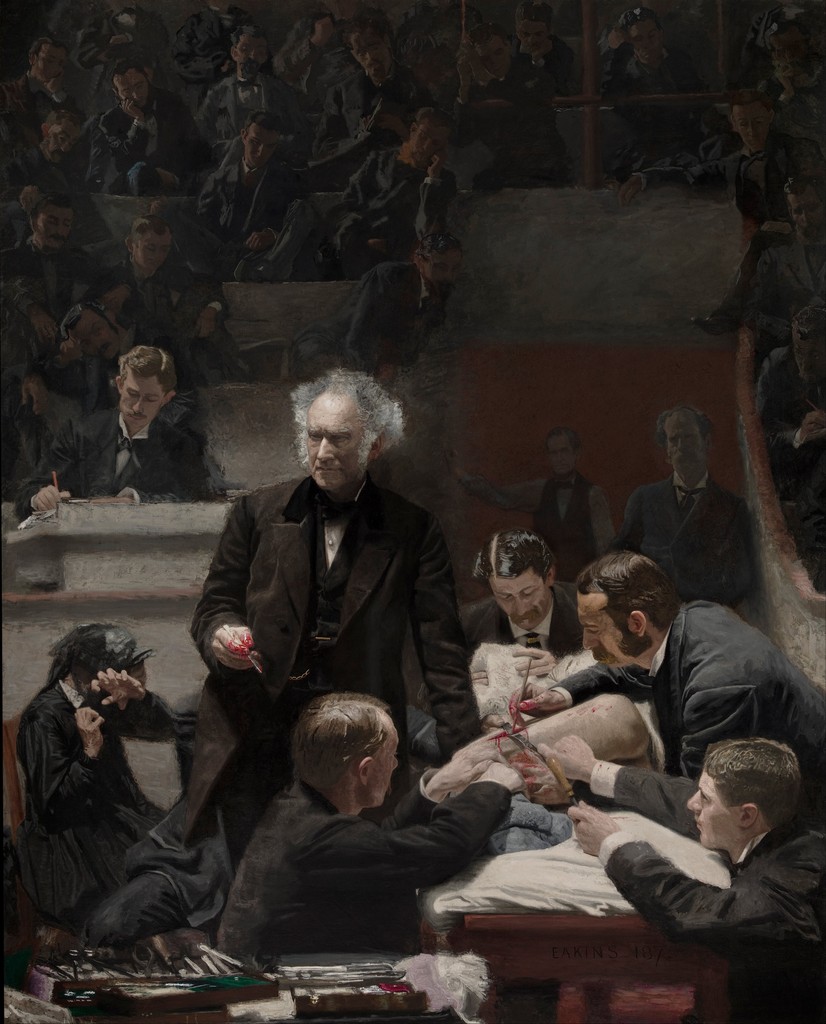
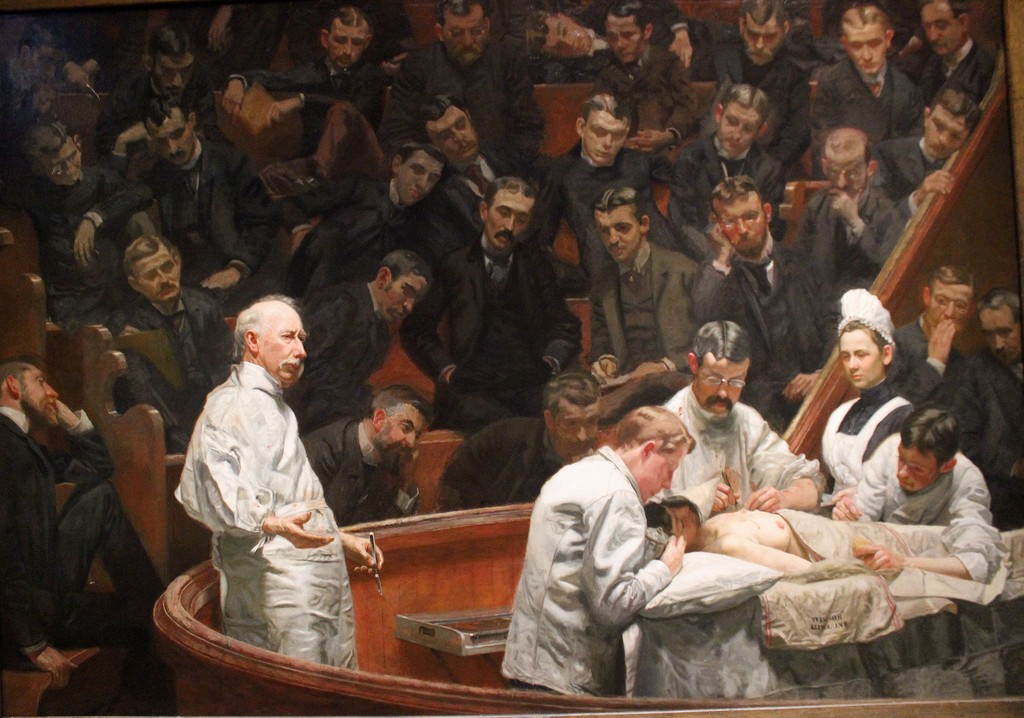
The Agnew Clinic image: gallery photograph by Miguel Hermoso Cuesta, cropped and perspective-corrected, under CC BY-SA 4.0.