


 by Tom Gurney
Tom Gurney BSc (Hons) is an art history expert with over 20 years experience
Page Created on / Page Updated on
Email: tomgurney1@gmail.com / Phone: +44 7429 011000
The Gross Clinic: Introduction
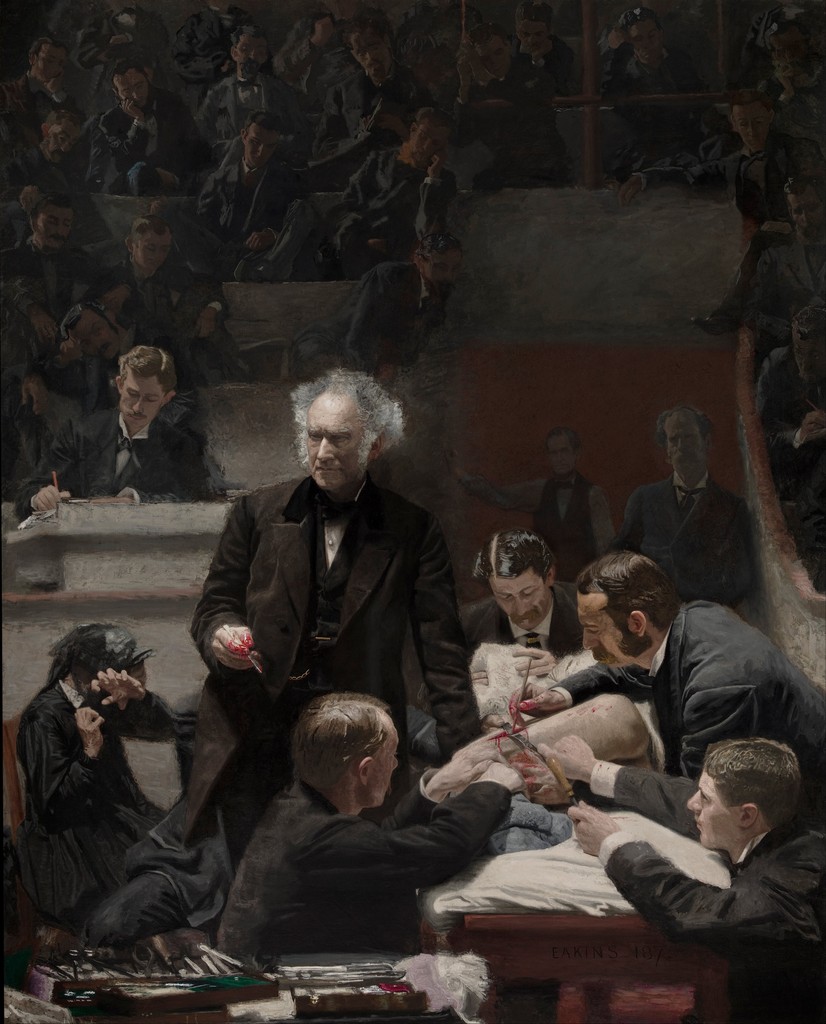
Thomas Eakins made Portrait of Dr. Samuel D. Gross (The Gross Clinic) in 1875 as an audacious image of contemporary knowledge. A surgeon in an ordinary black coat interrupts his work to address students. Around him, assistants lean over an anaesthetised patient whose wounded thigh is exposed to view; a woman turns away; ranks of observers climb into darkness. The setting is not imagined antiquity but the surgical amphitheatre at Jefferson Medical College in Philadelphia. Eakins intended the huge canvas for the city’s 1876 Centennial Exhibition, where its modern subject, blood, and difficult visibility tested what an ambitious American painting might contain.[1][2]
The familiar short title can obscure the work’s double purpose. This is a group scene of an operation, yet its formal holder title begins with “Portrait of Dr. Samuel D. Gross.” Gross appears as physician, lecturer, and organising presence. His lighted head and red hand arrest the eye before the surrounding clinic becomes intelligible. Eakins does not simply document a medical event. He builds a hierarchy of attention in which professional command, collective labour, patient vulnerability, and spectatorship remain uncomfortably close.
Its material and civic histories are equally important. The painting passed from Eakins to Jefferson alumni and the medical college in 1878, long before the public campaign that kept it in Philadelphia in 2006–07. Conservation has also changed how it can be seen: technical study demonstrated that an aggressive cleaning in the 1920s had removed some of Eakins’s dark paint, altering depth and emphasis. The work now belongs jointly to the Pennsylvania Academy of the Fine Arts and the Philadelphia Museum of Art.[2][3][4]
At a Glance
- Artist and dateThomas Eakins, 1875 [1][2]
- Formal titlePortrait of Dr. Samuel D. Gross (The Gross Clinic) [1]
- Medium and sizeOil on canvas, 96 by 78 1/2 inches (243.84 by 199.39 centimetres) [2]
- SettingThe surgical amphitheatre of Jefferson Medical College, now part of Thomas Jefferson University [1]
- ProcedureTreatment of osteomyelitis in the patient’s left thigh, involving removal of infected or dead bone tissue rather than amputation [2][3][7]
- Current ownershipJointly owned by PAFA and the Philadelphia Museum of Art following their 2007 acquisition [2][4]
Thomas Eakins in context
The Gross Clinic
1875Swimming
1885The Agnew Clinic
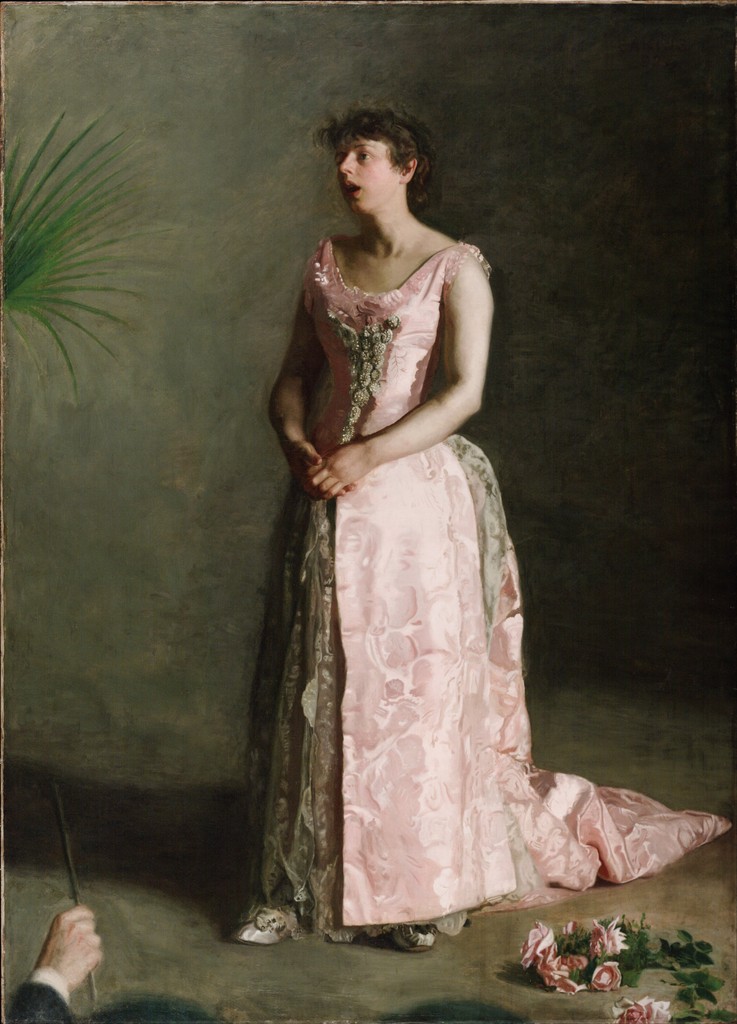
1889The Concert Singer
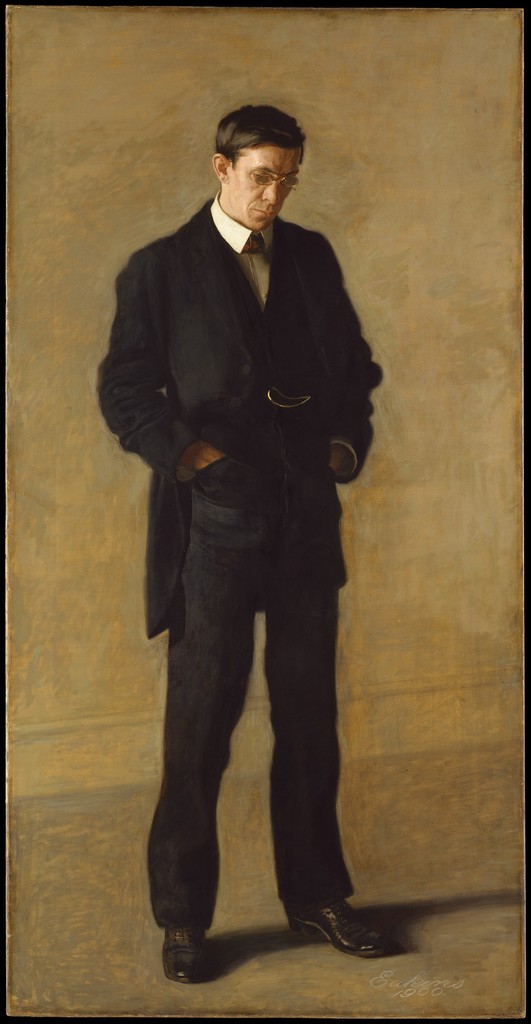
1890–92The Thinker
1900Contents
- Introduction
- An Operation and a Portrait
- Gross and the Teaching Theatre
- Light, Depth, and Withheld Information
- Visibility and Medical Authority
- The Centennial Encounter
- A Surface Changed and Recovered
- Ownership and a Philadelphia Campaign
- Gross and Agnew
An Operation and a Portrait
The painting is almost eight feet high, so Dr Gross meets a standing viewer at commanding scale. He occupies the centre without being enclosed by the operating group. His torso forms a dark, upright column; his grey hair and forehead catch the overhead light; his left hand rests near his waist while his right extends outward, wet with blood and holding a scalpel. That hand connects two activities. It has participated in the procedure, but its pause also belongs to a lecturer demonstrating what has been done.
The doctors around the patient form a lower, denser knot. Limbs, instruments, sheets, and dark sleeves cross at short intervals. The patient’s face is concealed beneath a folded cloth carrying chloroform, and most of the body remains hard to assemble. Only the left thigh, part of the buttocks, and socked feet are clearly available. The Philadelphia Museum of Art’s educational account identifies James M. Barton probing the opening, Charles S. Briggs holding the legs, Daniel M. Appel using a retractor, W. Joseph Hearn administering the anaesthetic, and Franklin West recording the clinic.[3] These names turn apparent supporting figures into participants with differentiated tasks.
Eakins distributes portraiture across the theatre without surrendering Gross’s primacy. Individual student faces emerge at varying levels of clarity. At the far right, the artist inserts himself beyond the tunnel railing, bent over a sketch or notes. His self-representation matters less as a signature in disguise than as a declaration of position: he belongs among those looking, while remaining outside the operating team.[1] For a wider account of how Eakins represented people through specialised work, see the portraits guide.
The woman at lower left occupies another kind of position. Current museum records preserve the traditional identification as the patient’s mother while qualifying it rather than presenting it as certain. She shields her eyes and draws inward, setting emotional recoil against Gross’s composed address.[1][2] Her gesture is not proof of a simple opposition between feminine feeling and masculine reason. It is a sharply visible response within a room where the patient’s own face and voice are unavailable.
Gross and the Teaching Theatre
Samuel David Gross was already an eminent surgeon when Eakins chose him. A Jefferson graduate of 1828, he taught in Cincinnati and Louisville before returning to his alma mater as professor of surgery in 1856. His books included A System of Surgery, first published in 1859, and the wartime Manual of Military Surgery. Jefferson’s archive also records his part in founding professional associations, including the American Surgical Association, and his long standing as a medical educator.[6]
The procedure in the picture belongs to that authority. PAFA identifies the condition as osteomyelitis, a bone infection. Jefferson’s history of orthopaedic surgery describes the operation more specifically as removal of a sequestrum—dead bone—from the femur.[2][7] The distinction is consequential. Gross was demonstrating a treatment that might preserve the limb, and the exposed thigh becomes the location of a modern clinical intervention rather than an undefined scene of cutting.
The room makes teaching inseparable from surgery. Students occupy curved, steeply rising benches, watching an actual patient rather than only hearing a lecture. Gross pivots between the operating table and that audience. His assistants continue the procedure while he explains it, turning manual work into shared instruction. The painting therefore represents knowledge as something enacted before witnesses: a method is performed, described, recorded, and scrutinised at once.
That structure also clarifies Eakins’s interest. He had attended anatomy teaching and surgical demonstrations at Jefferson before his European art training.[3] He was not a physician, and the painting should not be used to promote him into one. His experience instead supplied an informed spectator’s understanding of an amphitheatre, a body under treatment, and the authority attached to clinical demonstration. The project’s teaching and anatomy guide follows how anatomical knowledge later entered his art instruction without confusing artistic study with medical qualification.
Light, Depth, and Withheld Information
The operating area is the brightest part of a generally dark canvas, but Eakins does not illuminate everything equally. Light isolates Gross’s head, the patient’s skin, white sheets, and the working hands. The seated students become progressively harder to distinguish. Their rising semicircle is perceptible as a collective audience before many faces can be read individually. This difference in clarity gives the theatre depth and makes attention itself the picture’s subject.
Several lines converge near the operation. The slant of the mother’s covered face, the doctors’ lowered heads, Gross’s extended hand, and the pale planes of bedding all direct the eye towards the incision. Yet the body there remains visually confusing. That difficulty is not a flaw to be solved by imaginative reconstruction. The PMA notes that viewers can see the thigh and other fragments without easily grasping the patient’s whole position.[1] Eakins offers clinical specificity and bodily concealment at the same time.
Red is correspondingly concentrated. It appears on Gross’s fingers and scalpel, around the opening, along instruments, and in the warm field of the passage behind him. Against black coats, grey architecture, and pale cloth, these red notes become structural signals rather than indiscriminate gore. They connect the surgeon’s paused gesture to the work proceeding below and help explain why early viewers could find the image both formally compelling and physically disturbing.
The cropping intensifies the encounter. Figures press against the lower and side edges, while the benches continue beyond what can be comfortably counted. The viewer occupies neither the secure distance of the students nor the working space of the doctors. Instead, the large vertical format places us near the operating field while withholding the settled viewpoint a detached diagram would provide. The result is close enough to demand attention and complex enough to frustrate mastery.
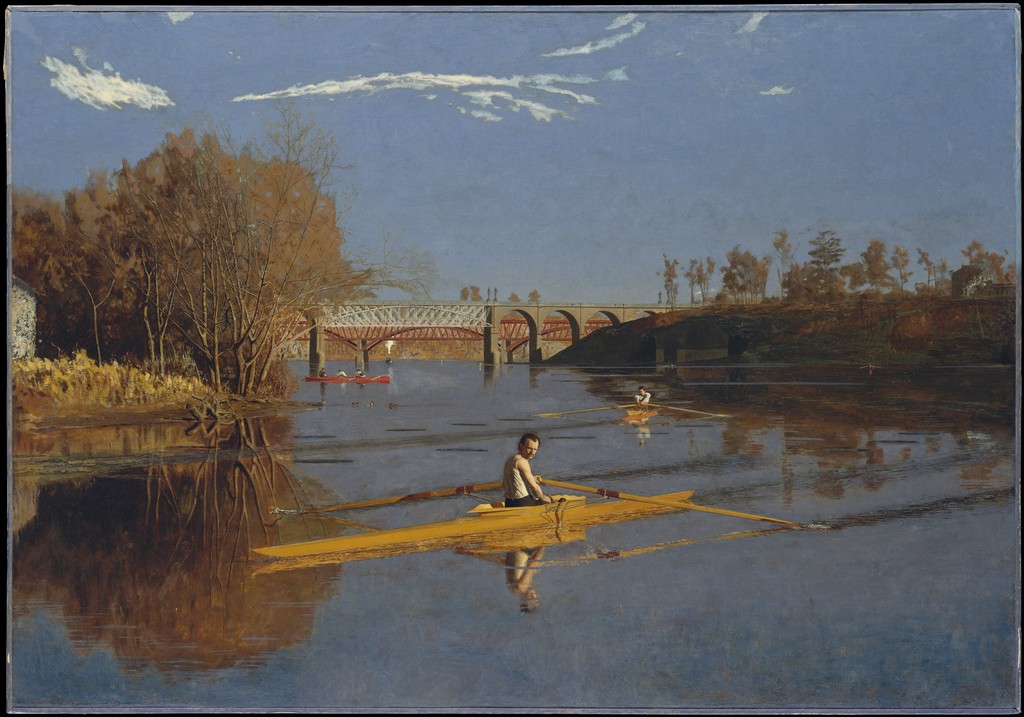
These decisions place The Gross Clinic within Eakins’s broader practice without making it representative of every painting he made. The horizontal calm of Max Schmitt in a Single Scull distributes attention across river and distance; the clinic compresses bodies around a focal wound and drives space steeply upward. Both depend on exact spatial construction, but they ask the viewer to inhabit radically different kinds of observation. The paintings guide develops that comparison across the cluster.
Visibility and Medical Authority
The clinic’s educational purpose does not make its visual relationships neutral. Gross can turn away from the patient and retain command because assistants sustain the procedure. His face and professional identity are public; the patient is anaesthetised, partly naked, and unnamed in the institutional accounts used here. The mother is visible through distress but is not integrated into the medical work. Students observe from above. Eakins organises each role with remarkable clarity even while the patient’s body remains hard to comprehend.
PAFA’s current interpretation explicitly asks what it means to depict a body exposed and vulnerable to the viewer’s gaze.[2] That question should not be answered by imposing present-day details absent from the record. It arises directly from the picture’s distribution of agency. Doctors handle, explain, and record; students watch; the artist observes; the patient is acted upon. At the same time, treatment of the infection is the reason this group has assembled. The work holds therapeutic skill and unequal visibility together.
Gross’s authority is therefore more complicated than heroic isolation. Five colleagues make the clinic function, and the clerk preserves its proceedings. The painting celebrates a senior surgeon, but it also shows expertise passing through a coordinated institution. Eakins’s portrait becomes monumental because Gross occupies a network of labour, education, instruments, and witnesses—not because everyone else disappears.
The Centennial Encounter
Eakins painted the canvas with the 1876 Centennial Exhibition in mind. The event offered an international audience in his home city, and the young artist hoped to display his ability while honouring Philadelphia’s scientific achievement.[1] Yet the work did not enter the fair’s main art galleries. It was installed instead with medical material in a model United States Army field hospital, reportedly after the art jury judged its subject unsuitable or too gruesome for the art building.[1][4]
That placement did not produce one uniform verdict. The PMA preserves a contemporary newspaper response that regarded the painting as finer than anything in the American art section and criticised the selection committee’s squeamishness. Other commentary objected to its bloody subject or treated its realism as ugly and inartistic.[1][3] It is therefore more accurate to speak of divided reception than blanket rejection by the public. The jury’s decision controlled location; it did not dictate every viewer’s response.
Nor did the Centennial settle the painting’s status. Its refusal from the art galleries has become a powerful episode in Eakins’s story, but later events resist a simple myth of total neglect. Alumni purchased the canvas from him for $200 and presented it to Jefferson Medical College in 1878.[4] The work gained an institutional home only two years after its disputed exhibition, where generations of medical students encountered it as both art and part of Jefferson’s history.
A Surface Changed and Recovered
Darkness in The Gross Clinic is partly original design and partly conservation history. Early photographs helped scholars establish that a restorer had altered the canvas around 1925. Attempting to brighten areas whose muted colour had been misunderstood, the restorer removed portions of Eakins’s paint. The most conspicuous loss occurred in the passage to the right of Gross, where stripping away a deep brown finishing layer exposed a red-orange foundation and damaged figures.[3]
The change affected more than colour. A lighter passage seemed to advance, weakening the spatial recession behind Gross and drawing attention away from the operating group. The damage therefore disrupted the picture’s hierarchy: a zone intended to remain shadowed competed with the chief action. Conservation evidence confirms that tonal organisation was one of Eakins’s means of structuring space, not merely a sombre atmosphere applied over a finished design.
After a technical examination in 2009, conservators removed varnish and retouching applied during a 1961 treatment. They analysed surviving remnants of the artist’s dark surface and in 2010 restored the effect only where original paint had been lost, using a thin, reversible transparent layer. The PMA stresses that this retouching did not cover surviving Eakins paint.[3] Preparatory studies, X-radiographs, and historical photographs were presented with the conserved canvas, allowing viewers to distinguish artistic revision, later damage, and modern treatment.[5]
This history changes close looking. What appears to be one continuous 1875 surface has undergone cleaning, loss, varnishing, and carefully limited reintegration. Conservation did not return the work to an untouched state; that state cannot be recreated. It made documented damage less disruptive while preserving the distinction between original material and later intervention.
Ownership and a Philadelphia Campaign
Jefferson Medical College held the painting from the alumni gift of 1878 until the proposed sale announced in 2006. Thomas Jefferson University’s institutional history records a sale price of $68 million and the intense disagreement it provoked among alumni.[8] The Philadelphia Museum of Art records that Jefferson gave Philadelphia institutions an opportunity to match the offer. PAFA and the PMA then acquired the canvas jointly in 2007 after a large public fundraising effort, and its current PAFA credit acknowledges more than 3,400 donors.[2][4]
The chronology matters. The campaign did not rescue a picture that had wandered anonymously since the Centennial, nor did PAFA or the PMA own it during its first reception. Jefferson alumni had already bought it directly from Eakins and placed it at the medical college. The 2006–07 effort was a later transfer shaped by the work’s accumulated civic and institutional significance. Joint ownership now gives both an art academy and a museum responsibility for a painting that began by testing the boundary between medical demonstration and fine art.
Gross and Agnew
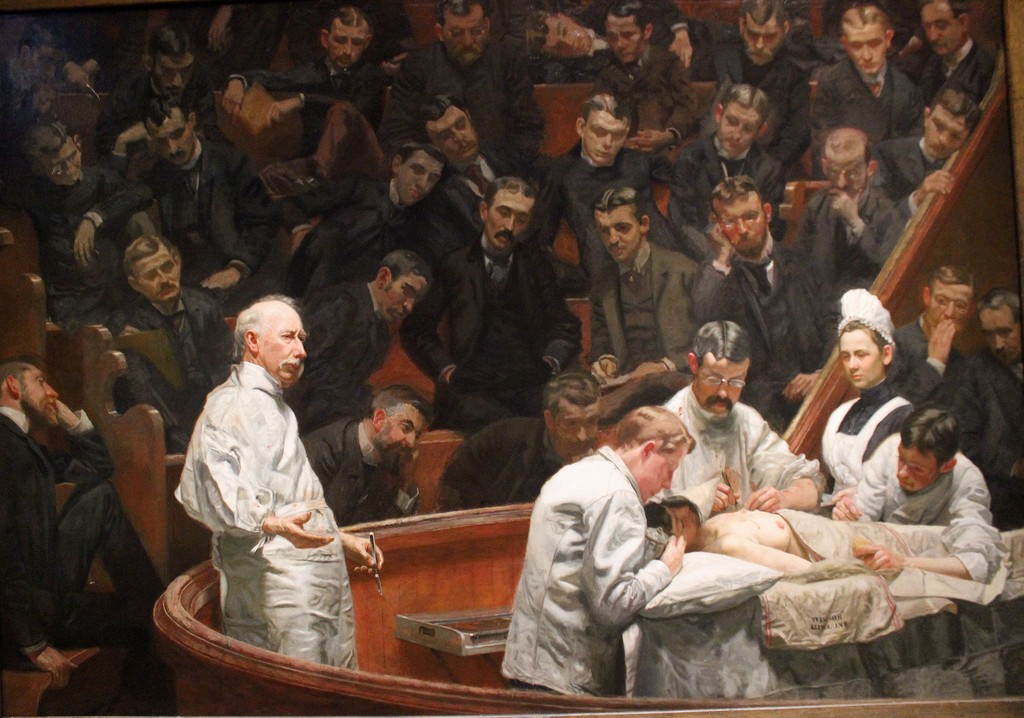
Eakins returned to a surgical amphitheatre fourteen years later in The Agnew Clinic. The later canvas was commissioned by University of Pennsylvania medical students to honour D. Hayes Agnew, unlike the self-initiated Centennial project. It depicts a mastectomy in a brighter, wider space; assistants perform much of the operation while Agnew lectures apart, and nurse Mary V. Clymer stands visibly within the professional team.[9]
Comparison should not make one clinic a simple update of the other. The paintings concern different surgeons, institutions, procedures, commissions, and moments in Eakins’s career. The Gross Clinic concentrates light and authority around a surgeon whose bloodied hand joins operation to lecture. The Agnew Clinic distributes action across a broader platform and gives nursing labour a named presence. Together they show Eakins revisiting the medical theatre as its social and visual organisation changed.
Researched works directory
This searchable evidence census was assembled from public museum records and a reproducible Wikidata snapshot. It is not a catalogue raisonné, not a claim to complete oeuvre coverage, and not a substitute for the published catalogue literature, which was not used to claim absolute completeness.
| Name | Date | Medium |
|---|---|---|
| A Singer (Mrs. W.H. Bowden) | 1906 | Painting |
| A Singer: Portrait of Mrs. W.H. Bowden | 1906 | Painting |
| A Street Scene | Date unknown | Painting |
| A street scene in Sevilla | 1870 | Painting |
| A Street Scene in Seville | 1870 | Painting |
| African-American Man | 1884 | Photography |
| An Actress (Portrait of Suzanne Santje) | 1903 | Painting |
| Anna Lewis | 1890 | Painting |
| Annie C. Lochrey Husson (Mrs. Louis Husson) | 1905 | Painting |
| Antiquated Music (Portrait of Sarah Sagehorn Frishmuth) | 1900 | Painting |
| Arcadia | 1883 | Painting |
| Arcadia | Date unknown | Sculpture |
| Arcadia: Figure Study, Female Nude | 1883 | Painting |
| Arcadia Sketch | 1883 | Painting |
| Arcadian | Date unknown | Painting |
| Archbishop Diomede Falconio | 1905 | Painting |
| Archbishop James Frederick Wood | 1877 | Painting |
| Archbishop James Frederick Wood (1813-1883) | 1876 | Painting |
| Archbishop William Henry Elder | 1903 | Painting |
| Arthur B. Frost | 1886 | Painting |
| Artist and His Father Hunting Reed Birds: Marsh Landscape Sketch | 1873 | Painting |
| B.J. Blommers | 1904 | Painting |
| Baby at Play | 1876 | Painting |
| Baseball Players Practicing | 1875 | Artwork |
| Benjamin Eakins G38 | Date unknown | Painting |
| Bertrand Gardel (Sketch for The Chess Players) | 1875 | Painting |
| Between Rounds | 1898 | Painting |
| Billy Smith | 1898 | Painting |
| Billy Smith (Sketch for Between Rounds) | 1898 | Painting |
| Boy Reclining | 1883 | Painting |
| Carmelita Requena | 1869 | Painting |
| Charles Edmund Dana | 1902 | Painting |
| Charles Percival Buck | 1904 | Painting |
| Clara | 1890 | Painting |
| Courtship | 1878 | Painting |
| Cowboy Singing | 1892 | Painting |
| Cowboys in the Badlands | 1888 | Painting |
| Cowboys in the Badlands sketch 2 | 1888 | Painting |
| Delaware River Scene | 1881 | Painting |
| Delaware River Study | 1881 | Painting |
| Dr. Agnew (Dr. D. Hayes Agnew) (1818-1892) | 1889 | Painting |
| Dr. Agnew (Dr. D. Hayes Agnew) (1818–1892) | 1889 | Painting |
| Dr. Horatio C. Wood | 1886 | Painting |
| Dr. Thomas H. Fenton | 1916 | Painting |
| Drifting | 1875 | Painting |
| Eakins G184 | 1916 | Painting |
| Ecorché: Relief of a Horse (Josephine) | 1882 | Sculpture |
| Edward W. Redfield | 1905 | Painting |
| Fairman Rogers Four-in-Hand: Landscape Study of Fairmount Park | 1879 | Painting |
| Fairman Rogers Four-in-Hand: Study of a Horse's Leg | 1879 | Painting |
| Fairmount Park (Sketch for The Fairman Rogers Four-in-Hand) | Date unknown | Painting |
| Female Model | 1867 | Painting |
| Female Nude | 1884 | Painting |
| Female Nude from the Back | 1889 | Photography |
| Female Nude (Study) | 1881 | Painting |
| Fifty Years Ago (Young Girl Meditating): Study | 1877 | Painting |
| Figure Study: Masked Nude Woman | Date unknown | Painting |
| Figure Study: Nude Woman, Seated, with Arms Lowered (r) | Date unknown | Painting |
| Figure Study: Nude Woman, Seated, with Arms Raised | Date unknown | Painting |
| [Four Sketches: Seated Man, Sleeping Dog, Two Vases(?)] | Date unknown | Painting |
| Frances Eakins | 1870 | Painting |
| Francis J. Ziegler | 1890 | Painting |
| Frank Hamilton Cushing | 1895 | Painting |
| Frank Jay St. John | 1900 | Painting |
| General E. Burd Grubb (1841-1914) | 1898 | Painting |
| Girl with a Fan; Portrait of Miss Gutierrez | Date unknown | Painting |
| Harriet Husson Carville (Mrs. James G. Carville) | 1904 | Painting |
| Harrison S. Morris | 1896 | Painting |
| Hauling the Seine | 1882 | Painting |
| Head of a Man (Rutherford B. Hayes?) | 1877 | Painting |
| Hiawatha | 1874 | Painting |
| Hiawatha | Date unknown | Artwork |
| Home Ranch | 1892 | Painting |
| Home Scene | 1871 | Painting |
| Homespun | 1881 | Painting |
| In the Studio | 1884 | Painting |
| Interior of a Woodcarver's Shop (Sketch for William Rush Carving His Allegorical Figure of the Schuylkill River) | Date unknown | Painting |
| James MacAlister (Sketch) | 1895 | Painting |
| John Biglin in a Single Scull | 1873 | Painting |
| John Biglin in a Single Scull | 1874 | Painting |
| Joseph R. Woodwell | 1904 | Painting |
| Kathrin | 1872 | Painting |
| Knitting | 1881 | Sculpture |
| Knitting | 1882 | Sculpture |
| Knitting | Date unknown | Sculpture |
| Lafayette Park, Washington, D.C. | 1877 | Painting |
| Landscape | 1881 | Painting |
| Landscape | 1882 | Painting |
| Landscape Sketch | 1880 | Painting |
| Landscape (Sketch for Cowboys in the Bad Lands) | 1887 | Painting |
| Landscape Study: Cultivated Field and Tree | 1874 | Painting |
| Landscape Study: Shoreline with Trees | 1874 | Painting |
| Landscape with a Dog | 1874 | Painting |
| Letitia Wilson Jordan | 1888 | Painting |
| Louis Husson | 1899 | Painting |
| Major Manuel Waldteufel | 1907 | Painting |
| Masked nude standing | 1880 | Painting |
| Maud Cook (Mrs. Robert C. Reid) | 1895 | Painting |
| Mending the Net | 1881 | Painting |
| Mending the Net: Study of a Fisherman | Date unknown | Painting |
| Miss Alice Kurtz | 1903 | Painting |
| Miss Amelia Van Buren | 1891 | Painting |
| Miss Eleanor S. F. Pue | 1907 | Painting |
| Miss Gertrude Murray | 1895 | Painting |
| Monsignor James P. Turner | 1906 | Painting |
| Mother (Annie Williams Gandy) | 1903 | Painting |
| Mrs. Gilbert L. Parker | 1910 | Painting |
| Mrs. Mary Arthur | 1900 | Painting |
| Music | 1904 | Painting |
| Nude man with beard | Date unknown | Painting |
| Nude Woman Standing | 1908 | Painting |
| Old Lady Sewing | 1879 | Painting |
| Portrait of a Little Girl | 1897 | Painting |
| Portrait of a Woman Reading | Date unknown | Painting |
| Portrait of Adam S. Bare | 1903 | Painting |
| Portrait of Alfred Reynolds | Date unknown | Painting |
| Portrait of Arthur Burdett Frost | 1886 | Painting |
| Portrait of Ashbury Wright Lee | 1905 | Painting |
| Portrait of Benjamin Eakins | 1894 | Painting |
| Portrait of Benjamin Eakins (Sketch for The Writing Master) | 1882 | Painting |
| Portrait of Blanche Hurlburt | 1885 | Painting |
| Portrait of Douglass Morgan Hall | 1889 | Painting |
| Portrait of Dr. Edward J. Nolan | 1900 | Painting |
| Portrait of Dr. Samuel D. Gross (The Gross Clinic) | 1875 | Painting |
| Portrait of Edward Taylor Snow | 1904 | Painting |
| Portrait of Elizabeth L. Burton | 1905 | Painting |
| Portrait of Florence Einstein | 1905 | Painting |
| Portrait of Henry O. Tanner | 1902 | Painting |
| Portrait of J. Harry Lewis | 1876 | Painting |
| Portrait of John B. Gest | 1905 | Painting |
| Portrait of Joshua Ballinger Lippincott | 1892 | Painting |
| Portrait of Leslie W. Miller | 1901 | Painting |
| Portrait of Lucy Lewis | 1896 | Painting |
| Portrait of Margaret Eakins in a Skating Costume | 1871 | Painting |
| Portrait of Mary Adeline Williams | 1899 | Painting |
| Portrait of Mary Adeline Williams | 1900 | Painting |
| Portrait of Mrs. Fairman Rogers (Study for The Fairman Rogers Four-in-Hand) | 1879 | Painting |
| Portrait of Mrs. Frank Hamilton Cushing | 1895 | Painting |
| Portrait of Mrs. James Mapes Dodge (Josephine Kern) | 1896 | Painting |
| Portrait of Professor Benjamin H. Rand | 1874 | Painting |
| Portrait of Professor W. D. Marks | 1886 | Painting |
| Portrait of Rear Admiral George Wallace Melville | 1904 | Painting |
| Portrait of Walter S. Macdowell | 1904 | Painting |
| Porträt des Alfred Bryan Wall | 1904 | Painting |
| Porträt des David Wilson Jordan | Date unknown | Painting |
| Porträt des John McLure Hamilton (1853- 1936) | 1895 | Painting |
| Professionals at Rehearsal | 1883 | Painting |
| Professor William D Marks | 1886 | Painting |
| Professor William Woolsey Johnson | 1896 | Painting |
| Pushing for Rail | 1874 | Painting |
| Rail Shooting on the Delaware | 1876 | Painting |
| Rear Admiral Charles Dwight Sigsbee G388-2 | 1903 | Painting |
| Rear Admiral George W. Melville | 1905 | Painting |
| Reclining Male Nude | 1887 | Photography |
| Reclining Nude | Date unknown | Painting |
| Retrospection | 1880 | Painting |
| Riter Fitzgerald | 1895 | Painting |
| Robert M. Lindsay | 1900 | Painting |
| Ruth (Ruth W. Harding) | 1903 | Painting |
| Saddle (Sketch for Cowboys in the Bad Lands) | 1887 | Painting |
| Sailboats Racing on the Delaware | 1874 | Painting |
| Sailboats Racing: Study of the Delaware River | 1874 | Painting |
| Sailing | 1875 | Painting |
| Salutat | 1898 | Painting |
| Seated Figures | 1886 | Painting |
| Self-portrait | 1902 | Painting |
| Seventy Years Ago | 1877 | Painting |
| Shad Fishing at Gloucester on the Delaware: Delaware River and Gloucester Pier | 1881 | Painting |
| Shad Fishing at Gloucester on the Delaware River | 1881 | Painting |
| Shad Fishing at Gloucester on the Delaware River: Study of a Woman's Head | 1881 | Painting |
| Ships and Sailboats on the Delaware | 1874 | Painting |
| Ships and Sailboats on the Delaware: Study | 1874 | Painting |
| Shoreline of the Delaware River, with Fishing Nets | Date unknown | Painting |
| Signora Gomez d'Arza | 1901 | Painting |
| Singing a Pathetic Song | 1881 | Painting |
| Sketch for Cowboys in the Bad Lands | 1887 | Painting |
| Sketch for Music (The Violinist) | 1904 | Painting |
| Sketch for Portrait of Dr. Jacob Mendez da Costa | 1893 | Painting |
| Sketch for Portrait of Leslie W. Miller | 1901 | Painting |
| Sketch for Portrait of Letitia Wilson Jordan | 1888 | Painting |
| Sketch for Portrait of Monsignor James P. Turner | 1906 | Painting |
| Sketch for Portrait of Mother Patricia Waldron | 1903 | Painting |
| Sketch for Portrait of Professor George F. Barker | 1886 | Painting |
| Sketch for Seventy Years Ago | Date unknown | Painting |
| Sketch for The Concert Singer | 1892 | Painting |
| Sketch for The Fairman Rogers Four-in-Hand | 1879 | Painting |
| Sketch for The Gross Clinic | 1875 | Painting |
| Sketch for the Surrender of General Lee to General Grant at Appomatox | Date unknown | Painting |
| Sketch for William Rush and His Model | 1908 | Painting |
| Sketch of a Landscape | 1882 | Painting |
| Sketch of a Man and Study of Drapery | 1882 | Painting |
| Sketch of Harry | 1892 | Painting |
| Sketch of Max Schmitt in a Single Scull | 1874 | Painting |
| Sketches for “Home-Spun”, (recto and verso) | 1881 | Painting |
| Sketches (Four on one panel) | Date unknown | Painting |
| Spinning | 1881 | Painting |
| Spinning | 1882 | Sculpture |
| Spinning: Sketch | 1881 | Painting |
| Starting Out After Rail | 1863 | Painting |
| Starting Out After Rail | 1874 | Painting |
| Study for Arcadia: Youth Playing Pipes | 1883 | Painting |
| Study for "Cowboys in the Badlands | 1887 | Painting |
| Study for "Negro Boy Dancing": The Banjo Player | Date unknown | Painting |
| Study for "Negro Boy Dancing": The Boy | Date unknown | Painting |
| Study for Portrait of John McClure Hamilton | 1895 | Painting |
| Study for Salutat | 1898 | Painting |
| Study for 'The Meadows, Gloucester' | 1882 | Painting |
| Study for "William Rush Carving His Allegorical Figure of the Schuylkill River | 1876 | Painting |
| Study of a Groom | 1879 | Painting |
| Study of a Nude Man | 1869 | Painting |
| Study of a Nude Man (The Strong Man) | 1869 | Painting |
| Study of a Seated Nude Woman Wearing a Mask | 1863 | Drawing |
| Study of a Young Woman | 1868 | Painting |
| Study of Dr Samuel David Gross | 1875 | Painting |
| Study of Horse for The Fairman Rogers Four-in-Hand | 1879 | Painting |
| Swimming | 1885 | Painting |
| Taking the Count | 1898 | Painting |
| Taking the Count, study | 1898 | Painting |
| Taking Up Net | 1881 | Painting |
| Talcott Williams | 1889 | Painting |
| That's a New Game Down in Frisco": Study for the Central Standing Figure | 1878 | Painting |
| The Agnew Clinic | 1889 | Painting |
| The Art Student (James Wright) | 1890 | Painting |
| The Artist's Wife and His Setter Dog | 1884 | Painting |
| The Biglin Brothers Racing | 1872 | Painting |
| The Biglin Brothers Turning the Stake | 1873 | Painting |
| The Black Fan (Portrait of Mrs. Talcott Williams) | 1891 | Painting |
| The Bohemian (Portrait of Franklin Louis Schenck) | 1890 | Painting |
| The Brinton House | 1878 | Painting |
| The Cello Player | 1896 | Painting |
| The Champion Single Sculls (Max Schmitt in a Single Scull) | 1871 | Painting |
| The Chaperone | 1908 | Painting |
| The Chess Players | 1876 | Painting |
| The Concert Singer | 1890–1892 | Painting |
| The Courtship | 1878 | Painting |
| The Crucifixion | 1880 | Painting |
| The Dancing Lesson | 1878 | Painting |
| The Dean's Roll Call | 1899 | Painting |
| The Fairman Rogers Four-in-Hand | 1879 | Painting |
| The Fairman Rogers Four-In-Hand (A May Morning in... | 1899 | Painting |
| The Meadows, Gloucester | 1882 | Painting |
| The Model | 1908 | Painting |
| The Oarsmen (The Schreiber Brothers) | 1874 | Painting |
| The Oboe Player (Portrait of Dr. Benjamin Sharp) | 1903 | Painting |
| The Old-Fashioned Dress (Portrait of Helen Montanverde Parker) | 1908 | Painting |
| The Pair-Oared Shell | 1872 | Painting |
| The Pathetic Song | 1881 | Painting |
| The Pianist | 1896 | Painting |
| The Poleman in the Ma'sh | 1881 | Drawing |
| The Red Shawl | 1890 | Painting |
| The Spinner | 1876 | Painting |
| The Thinker: Portrait of Louis N. Kenton | 1900 | Painting |
| The Timer | 1879 | Painting |
| The Translator, Portrait of Monsignor Hugh T. Henry | 1902 | Painting |
| The Veteran (Portrait of George Reynolds) | Date unknown | Painting |
| The Writing Master | 1882 | Painting |
| The Young Man (Portrait of Kern Dodge) | 1898 | Painting |
| Thomas Eakins and John Laurie Wallace on a Beach | 1883 | Photography |
| Three Boys Wading in a Creek | 1883 | Photography |
| Trenton Battle Monument | 1893 | Sculpture |
| Two Pupils in Greek Dress | 1883 | Photography |
| Views of Harry | 1885 | Painting |
| Walt Whitman | 1887 | Painting |
| Whistling for Plover | 1874 | Painting |
| William H. Macdowell | 1884 | Photography |
| William H. Macdowell and Margaret Eakins in Saltville (or Clinch Mountain), Virginia | 1875 | Photography |
| William Hance Macdowell (1816-1906) | 1897 | Painting |
| William Rush and his Model | 1908 | Painting |
| William Rush and His Model | Date unknown | Painting |
| William Rush Carving His Allegorical Figure of the Schuylkill River | 1876 | Painting |
| William Rush Carving His Allegorical Figure of the Schuylkill River | 1908 | Painting |
| William Rush Carving His Allegorical Figure of the Schuylkill River, Study | 1876 | Painting |
| William Rush's Model | 1908 | Painting |
| Wrestlers | 1899 | Painting |
| Young Girl Meditating | 1877 | Painting |
Frequently Asked Questions
The doctors are treating osteomyelitis, a bone infection, in the patient’s left thigh. Jefferson’s orthopaedic history describes the procedure as removal of a sequestrum, or dead piece of bone, from the femur. The operation is not an amputation. Gross pauses with a scalpel while colleagues probe the opening, hold the leg, retract tissue, administer chloroform, and record the clinic.[2][3][7]
Dr Samuel D. Gross stands at the centre. The PMA identifies the principal assistants as James M. Barton, Charles S. Briggs, Daniel M. Appel, W. Joseph Hearn, and Franklin West. Eakins appears among the observers at the right, writing or sketching. A woman at lower left is traditionally, but not conclusively, identified as the patient’s mother; students fill the ascending benches.[1][3]
It was refused a place in the Centennial’s main art galleries, apparently because the jury regarded the modern surgical subject and explicit blood as too brutal or disturbing. The canvas was displayed with a model army hospital instead. Surviving criticism was mixed: some viewers objected strongly, while others praised its composition and argued that it surpassed work admitted to the art section.[1][3][4]
Historical photographs and technical examination showed that a cleaning around 1925 removed some of Eakins’s dark upper paint, especially in the passage behind and to the right of Gross. This exposed a warmer foundation, flattened the illusion of recession, and distracted from the surgical group. Treatment in 2009–10 removed later varnish and retouching and used reversible, transparent paint only across documented losses.[3][5]
It is jointly owned by PAFA and the PMA. Jefferson alumni bought the painting from Eakins and gave it to Jefferson Medical College in 1878. When Thomas Jefferson University arranged a sale in 2006, a Philadelphia campaign enabled the two art institutions to acquire it together in 2007. Those are separate stages of provenance, not one continuous acquisition event.[2][4][8]
Discussion
Use this evidence-led guide as a starting point for close looking rather than a final verdict.
Share an observation about The Gross Clinic or a source that adds useful context.
Reader Insights
Which detail most changes your reading of The Gross Clinic?
How do scale, support, medium or present museum evidence shape the encounter?
What remains uncertain when visual inference is separated from documented fact?
Join the Conversation
Add your reading below, keeping observations specific and evidence clear.
References
- Philadelphia Museum of Art, Portrait of Dr. Samuel D. Gross (The Gross Clinic), accessed 30 August 2026.
- Pennsylvania Academy of the Fine Arts, Portrait of Dr. Samuel D. Gross (The Gross Clinic), accessed 30 August 2026.
- Philadelphia Museum of Art, Portrait of Dr. Samuel D. Gross (The Gross Clinic): Education Resource, accessed 30 August 2026.
- Philadelphia Museum of Art, Thomas Eakins’ The Gross Clinic, accessed 30 August 2026.
- Philadelphia Museum of Art, An Eakins Masterpiece Restored: Seeing The Gross Clinic Anew, accessed 30 August 2026.
- Thomas Jefferson University Archives, Samuel D. Gross, accessed 30 August 2026.
- Thomas Jefferson University, Department of Orthopaedic Surgery, Department History, accessed 30 August 2026.
- Thomas Jefferson University, 100 Years of the Bulletin, accessed 30 August 2026.
- University of Pennsylvania School of Nursing, Eakins and Clymer, accessed 30 August 2026.
More EAKINS Artworks
The Agnew Clinic image: gallery photograph by Miguel Hermoso Cuesta, cropped and perspective-corrected, under CC BY-SA 4.0.