


 by Tom Gurney
Tom Gurney BSc (Hons) is an art history expert with over 20 years experience
Page Created on / Page Updated on
Email: tomgurney1@gmail.com / Phone: +44 7429 011000
The Agnew Clinic: Introduction
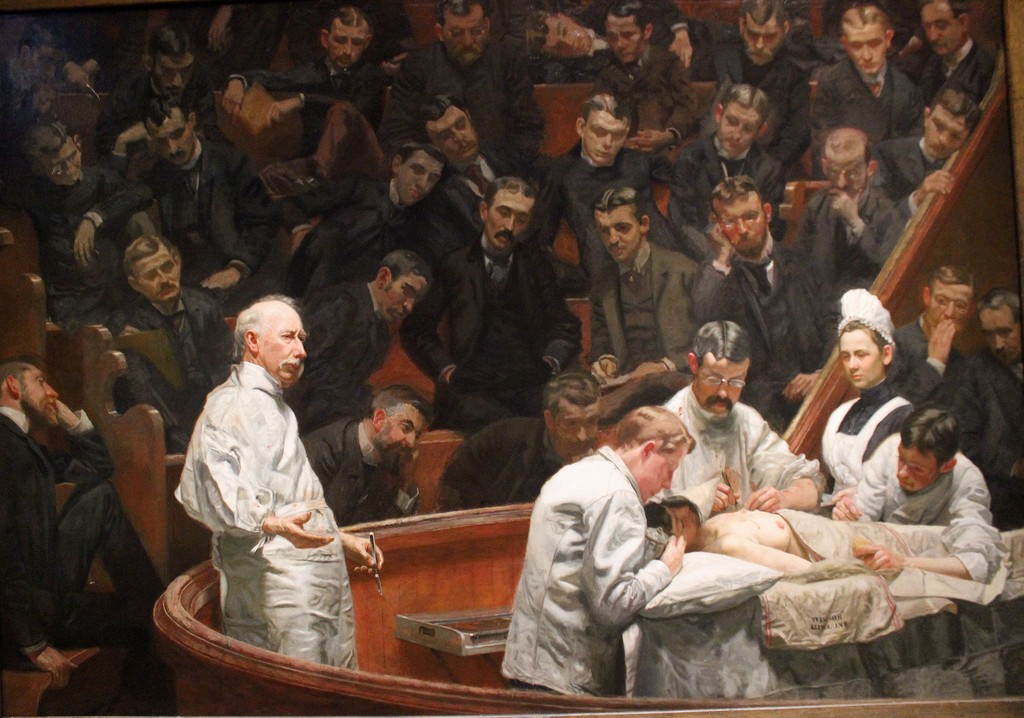
Thomas Eakins’s The Agnew Clinic stretches a surgical demonstration across a broad, crowded amphitheatre. At the left, Dr D. Hayes Agnew stands apart in a pale operating gown, one hand open towards the students seated above him. To the right, three physicians cluster around an unconscious woman undergoing a mastectomy. Nurse Mary V. Clymer waits beside them in a white cap and apron. The patient, medical team, lecturer, and audience occupy one continuous space, yet Eakins gives each a different degree of visibility and authority.
The University of Pennsylvania Art Collection records the painting as an 1889 oil on canvas, legacy accession 1889.0001. At approximately 214.5 by 300 centimetres, it is wider than it is high and large enough for individual members of the medical classes to appear as portraits rather than an anonymous crowd.[1][2] Its scale and format answer the occasion: Penn students commissioned Eakins to honour Agnew at his retirement, but the artist replaced a conventional likeness with an image of teaching, surgery, and institutional life.
The painting remains Penn property. It is housed at the Philadelphia Museum of Art under a renewable loan arrangement, not owned by that museum.[2] This is also a different object from the PMA’s 1893 photogravure numbered 69110.[6] Keeping those identities separate is the first condition of understanding the work’s history.
At a Glance
- Artist and dateThomas Eakins, 1889 [1]
- Medium and dimensionsOil on canvas, 84 3/8 × 118 1/8 inches (214.5 × 300 centimetres) [1]
- CommissionRequested by Penn medical students to commemorate the retiring surgeon and professor D. Hayes Agnew [2]
- ProcedureA mastectomy performed on an unconscious woman before students in a surgical amphitheatre [2][3]
- Named nurseMary V. Clymer, then a student at the Hospital of the University of Pennsylvania Training School for Nurses [2][3]
- Owner and locationUniversity of Pennsylvania Art Collection, legacy accession 1889.0001; housed at the Philadelphia Museum of Art on renewable loan [1][2]
Thomas Eakins in context
The Gross Clinic
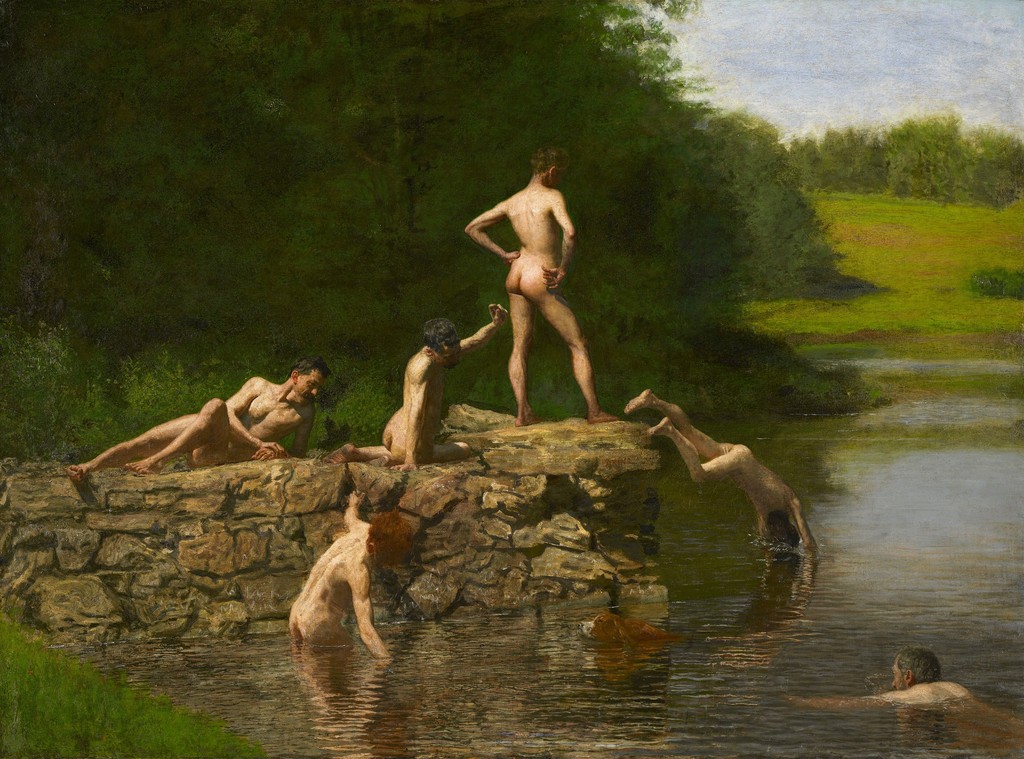
1875Swimming
1885The Agnew Clinic
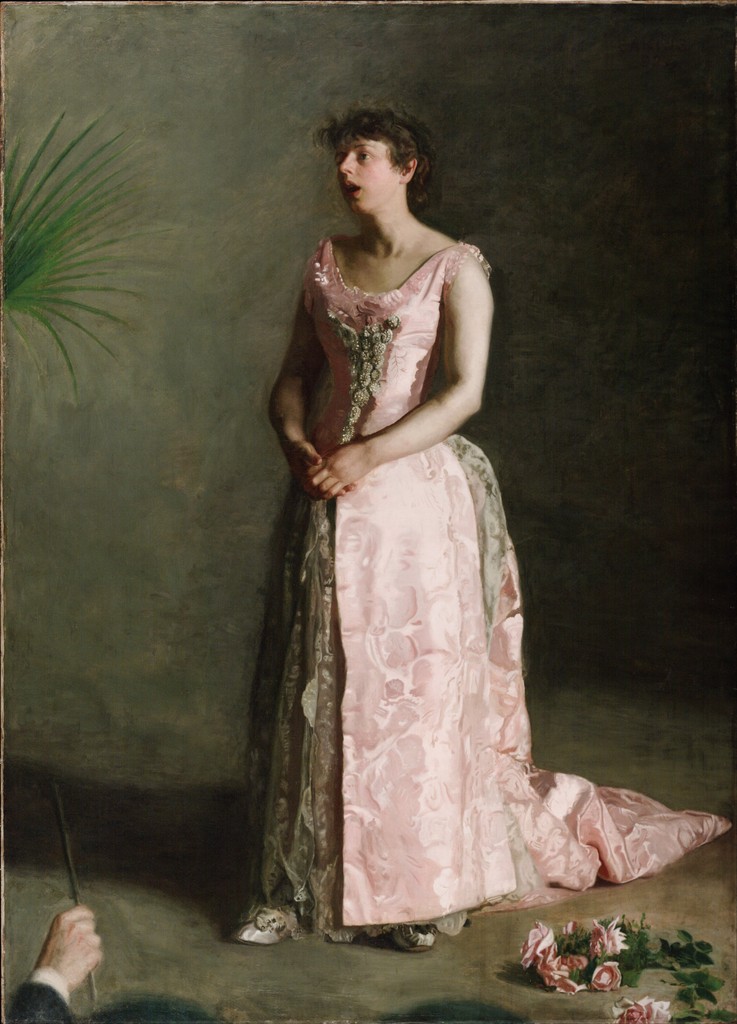
1889The Concert Singer
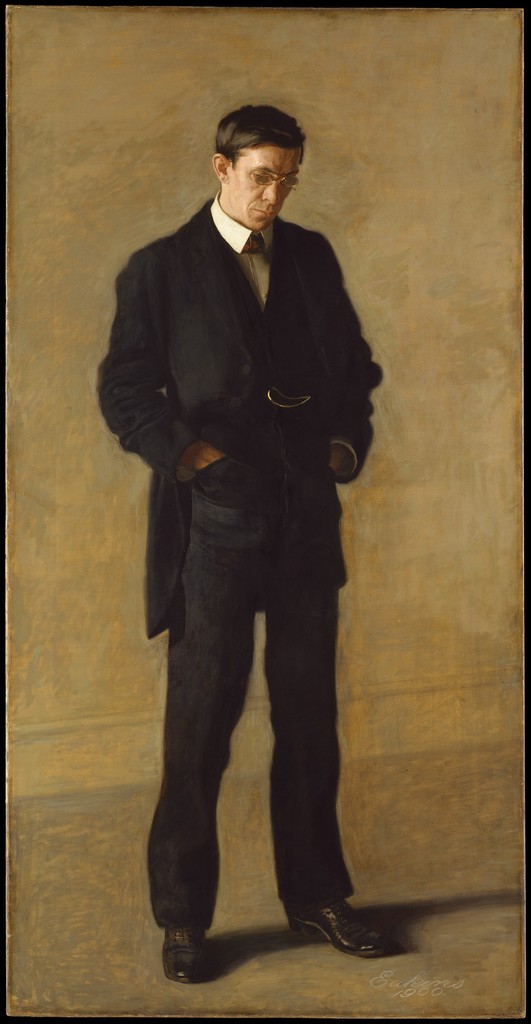
1890–92The Thinker
1900Contents
- Introduction
- A Class Commissions a Monument
- D. Hayes Agnew
- Surgery as Teaching
- Mary Clymer’s Place
- An Antiseptic-Era Theatre
- A Wide Amphitheatre
- Two Clinics, Different Systems
- Reception and Reproduction
- Penn Ownership and PMA Care
A Class Commissions a Monument
In the spring of 1889, students in Penn’s Medical Department asked Eakins to make a portrait of the professor whose retirement closed a long teaching career. Penn Today gives the commission price as $750.[5] The choice of artist carried an obvious precedent: fourteen years earlier, Eakins had placed Samuel D. Gross at the centre of an operation before Jefferson Medical College students. The new patrons could expect a serious image of their own institution, but they did not receive a repeat composition with a different face.
Eakins completed the enormous canvas in time for commencement at Philadelphia’s Academy of Music on 1 May 1889. After William Osler delivered the valedictory address, representatives of three medical classes presented the painting to the University. S. Weir Mitchell accepted it for Penn’s trustees, and Agnew responded to the students’ applause.[2] The ceremony established the work as a collective gift as well as a portrait. It honoured one teacher through the community that had learned from him.
The audience inside the picture makes that community visible. Penn Archives identifies twenty-five students from the classes of 1889, 1890, and 1891 and a postgraduate course, together with operating physicians, Clymer, Eakins, and Agnew.[2] Only part of the graduating class appears, so the tiers should not be described as a complete class photograph. Their individually differentiated heads instead turn a public body of students into witnesses with recognisable places in the institution.
D. Hayes Agnew
David Hayes Agnew had earned authority through surgery, anatomy, and decades of teaching. A Penn medical graduate of 1838, he established the Philadelphia School of Operative Surgery in 1854 and held appointments at several city hospitals. He became Penn’s professor of clinical and demonstrative surgery in 1871 and, in 1877, the first holder of its John Rhea Barton Professorship of Surgery.[4] When President James Garfield was shot in 1881, Agnew served as a senior surgical consultant during the president’s final illness.[4][5]
Those achievements explain the commission without reducing the canvas to biography. Eakins does not surround Agnew with diplomas, books, or ceremonial furnishings. The surgeon is represented through a professional relation: he speaks while colleagues carry out a procedure and students watch. His position at the edge of the operating group conveys seniority. He can pause, explain, and gesture because a trained team maintains the work beside him.
Agnew’s isolation is carefully judged. His light coat connects him to the assistants, but the curved wooden rail encloses him in a separate pocket at the left. His white hair and moustache meet the dark suits of the auditorium behind. One hand holds a small instrument; the other opens palm-up in a lecturer’s gesture. The body is steady rather than theatrical. Eakins makes command readable through spacing and attention, not through heroic costume.
Surgery as Teaching
The operation is a mastectomy on an unconscious woman.[2][3] Eakins places her bare upper torso within a knot of pale sleeves, sheets, hands, and instruments. Her face is mostly obscured by the physician at her head, while her body lies horizontally across the right foreground. The procedure is specific enough to be understood, yet the patient is not named in the consulted institutional records. She should not be assigned an invented biography or treated as mere visual evidence of medical progress.
Three physicians perform the operation: J. William White, Joseph Leidy, and Ellwood R. Kirby. Penn Archives also identifies Frederick H. Milliken at the far right, near Eakins’s small self-representation.[2] Naming these participants changes the scene. Agnew remains its commemorated subject, but surgical action belongs to a team whose members have separate tasks and institutional roles.
The steep benches make that action educational. Students lean forward, take notes, exchange glances, or look directly towards the patient. Their dark clothing forms an irregular wall above the pale operating area. Unlike a diagram, the painting includes distraction, fatigue, curiosity, and varied attention. Knowledge is not pictured as information passing cleanly from one mind to another. It is demonstrated through bodies, instruments, explanation, and observation in a room full of people.
This is why The Agnew Clinic belongs beside the project’s teaching and anatomy guide. Eakins had observed medical instruction before becoming an art teacher, and he understood the amphitheatre as a place where looking was organised by rank. The canvas makes that organisation visible without claiming that visibility is impartial.
Mary Clymer’s Place
Mary V. Clymer stands immediately behind the patient, conspicuous in a white cap, pale apron, and dark dress. Penn Nursing identifies her as the nurse in the scene and as a student in the Hospital of the University of Pennsylvania Training School for Nurses from 1887 to 1889. She graduated in the painting’s year and received the school’s Nightingale Medal.[3] These facts establish her as a trained participant, not an allegorical accessory or an unidentified attendant.
Her work belonged to a changing surgical system. Penn Nursing notes the increasing reliance on assistants and explains that student nurses gained experience in the hospital while training.[3] Clymer’s position therefore records labour essential to the procedure, even though the hierarchy is unequal. The doctors bend over the incision, Agnew addresses the theatre, and male students fill the benches. Clymer stands ready at the margin of the operating group, professionally included but not given the same authority.
Her expression deserves restraint. She looks towards the patient with a composed, unsmiling face, but paint cannot disclose exactly what she thought or felt. Penn Nursing uses Clymer’s surviving writings to place such composure within a nursing ethic of maintaining dignity and attending to the patient.[3] That evidence is more useful than declaring her cold, frightened, or detached. It returns a named woman’s professional history to a figure too often discussed only as a symbol.
Clymer also creates a charged visual relation with the unconscious patient. Both are women within a scene commissioned, performed, and observed principally by men, but their positions are not interchangeable. One is clothed, upright, named, and working; the other is exposed, horizontal, unnamed, and acted upon. Eakins places them close enough for viewers to register the difference without resolving its ethical weight.
An Antiseptic-Era Theatre
Penn’s historical account reads the later clinic against changes associated with Joseph Lister’s promotion of antiseptic surgery. Agnew and his colleagues wear clean pale gowns, instruments are kept in a covered case, and a nurse belongs to the operating team.[2] The brighter palette is consequently more than a stylistic preference. White and cream surfaces help make cleanliness, divided labour, and new institutional expectations visible.
The painting should not be mistaken for a modern operating room. The students remain in ordinary dark suits, no one wears a surgical mask, and the open amphitheatre brings a large audience close to the patient.[6] Antiseptic practice was developing, not complete. Eakins records a moment of transition in which clean gowns and managed instruments coexist with arrangements that later medicine would reject.
This historically mixed condition distinguishes change from triumph. The patient’s treatment depends on professional expertise, but her exposure also serves a lesson and a commemorative painting. Clymer’s presence marks the growing importance of nursing, but she remains alone among the visible women with agency. Medical modernisation alters the room without making every relationship equal.
A Wide Amphitheatre
The horizontal canvas allows Eakins to distribute attention instead of forcing every line towards Agnew. The lecturer holds the lower left; the operation occupies the lower right; the students climb across the entire upper field. A reddish wooden barrier runs between them, bending around Agnew and extending behind the surgical team. On the far right, a stair rail rises steeply through the audience, giving the crowded tiers a second directional force.
Pale clothing creates a broken band across the foreground. Agnew stands as one vertical shape, the assistants overlap as a compact group, and Clymer’s cap and apron form another bright punctuation. The patient’s bare torso and sheets create a low horizontal beneath them. These intervals let the viewer separate teaching from operation and nursing from surgery before recognising how closely they depend on one another.
The audience is darker but not formless. Faces emerge against black coats and warm wooden seats, each modelled with enough variation to resist repetition. Some heads form small diagonals towards the procedure; others turn sideways or sink into hands. The effect is neither the order of a posed class photograph nor the blur of a generic crowd. Eakins uses portrait detail to make observation itself look uneven.
At the scale of the selected reproduction, paint handling shifts with pictorial purpose. Agnew’s head, Clymer’s cap, and the nearest surgical hands are sharply articulated, while much of the upper theatre is compressed into darker, softer passages. This is an observation about the visible image, not a claim about undocumented technical analysis. The hierarchy arises from contrast, placement, and degree of finish as much as from narrative importance.
Two Clinics, Different Systems
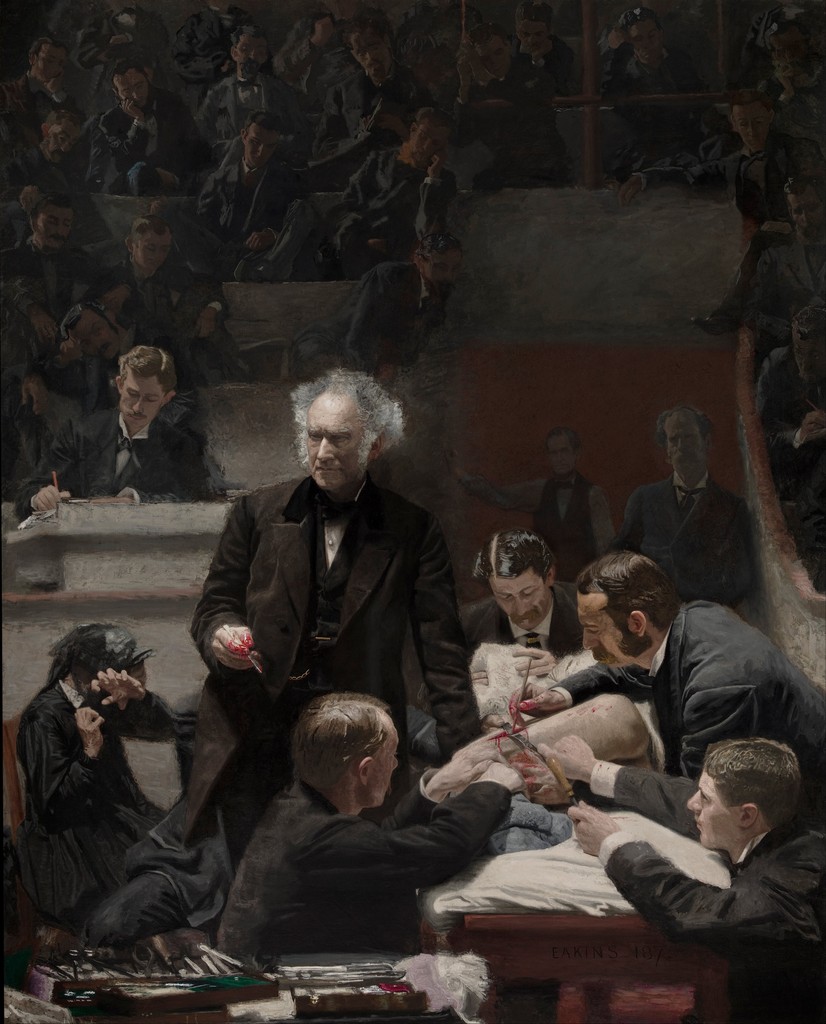
Comparison with The Gross Clinic reveals how decisively Eakins rethought the medical subject. The 1875 canvas is vertical, dark, and compressed around Samuel Gross. Gross’s bloodied hand joins lecturer and operator, and the patient’s body is difficult to assemble beneath the clustered doctors. A recoiling woman sits outside the professional group. The PMA identifies it as a self-initiated work intended for the Centennial Exhibition.[8]
The Agnew commission is wider, lighter, and more explicitly collective. Agnew stands away from the incision while assistants operate. Clymer replaces the earlier lay spectator as the principal upright woman, appearing within the medical workforce rather than outside it. The operation differs as well: the earlier doctors treat bone infection in a thigh, while the later team performs a mastectomy.[2][8]
These contrasts do not make 1889 a simple correction of 1875. The later painting still centres a celebrated male surgeon, exposes an unnamed patient, and arranges spectators above the procedure. Its antiseptic-era signs are real, but incomplete. Readers can use the wider paintings guide to follow Eakins’s changing construction of professional action; the two clinics are strongest when their separate commissions, institutions, operations, and ownership histories remain intact.
Reception and Reproduction
The unveiling at commencement gave the painting an enthusiastic institutional reception, but later exhibition history was less straightforward. Penn Nursing reports that PAFA refused it for exhibition in 1891 and that it was not publicly shown again until the World’s Columbian Exposition in Chicago in 1893.[3] Objections focused on blood and the exposed breast, showing that professional commemoration did not protect the work from contemporary rules about what could appear before a mixed art audience.
The 1893 date also produces a cataloguing trap. PMA object 69110 is titled The Agnew Clinic, but it is a photogravure by an unknown maker, not Eakins’s Penn-owned oil. The museum explains that Eakins prepared a special black-and-white painted version because contemporary photographic processes translated colours unevenly; that version became the basis for reproduction.[6] A shared title and subject therefore conceal different media, dates, makers, accessions, and owners.
The distinction matters beyond record keeping. Reproduction helped the composition circulate when the huge original could not travel easily, but a monochrome print necessarily changes the relations among pale gowns, flesh, dark suits, and warm wood. Close reading of colour and paint should be based on the 1889 oil, while the photogravure belongs to the history of how the image reached viewers.
Penn Ownership and PMA Care
The students gave the painting to the University at its 1889 unveiling, and Penn retains ownership.[2] For many years it hung in the John Morgan Building. Penn Today records that a steam leak in 2000 damaged the work, after which it was removed, restored, and included in the Eakins retrospective shown in Paris and New York. It then entered the care of the Philadelphia Museum of Art.[5]
The current Penn Archives wording is precise: the oil is housed at the PMA under a renewable loan arrangement.[2] A PMA exhibition record likewise identifies it as a loan from the University’s medical school.[7] “In the Philadelphia Museum of Art” describes location and care; it does not transfer title. Penn Art Collection accession 1889.0001 remains the governing identity.
That stewardship gives the work a layered institutional life. Medical students commissioned it, trustees accepted it, generations encountered it at Penn, and museum care now makes it available in an art-historical setting. To look responsibly is to keep all of those roles in view: Eakins made the canvas, Penn owns it, and the PMA houses it on loan.
Researched works directory
This searchable evidence census was assembled from public museum records and a reproducible Wikidata snapshot. It is not a catalogue raisonné, not a claim to complete oeuvre coverage, and not a substitute for the published catalogue literature, which was not used to claim absolute completeness.
| Name | Date | Medium |
|---|---|---|
| A Singer (Mrs. W.H. Bowden) | 1906 | Painting |
| A Singer: Portrait of Mrs. W.H. Bowden | 1906 | Painting |
| A Street Scene | Date unknown | Painting |
| A street scene in Sevilla | 1870 | Painting |
| A Street Scene in Seville | 1870 | Painting |
| African-American Man | 1884 | Photography |
| An Actress (Portrait of Suzanne Santje) | 1903 | Painting |
| Anna Lewis | 1890 | Painting |
| Annie C. Lochrey Husson (Mrs. Louis Husson) | 1905 | Painting |
| Antiquated Music (Portrait of Sarah Sagehorn Frishmuth) | 1900 | Painting |
| Arcadia | 1883 | Painting |
| Arcadia | Date unknown | Sculpture |
| Arcadia: Figure Study, Female Nude | 1883 | Painting |
| Arcadia Sketch | 1883 | Painting |
| Arcadian | Date unknown | Painting |
| Archbishop Diomede Falconio | 1905 | Painting |
| Archbishop James Frederick Wood | 1877 | Painting |
| Archbishop James Frederick Wood (1813-1883) | 1876 | Painting |
| Archbishop William Henry Elder | 1903 | Painting |
| Arthur B. Frost | 1886 | Painting |
| Artist and His Father Hunting Reed Birds: Marsh Landscape Sketch | 1873 | Painting |
| B.J. Blommers | 1904 | Painting |
| Baby at Play | 1876 | Painting |
| Baseball Players Practicing | 1875 | Artwork |
| Benjamin Eakins G38 | Date unknown | Painting |
| Bertrand Gardel (Sketch for The Chess Players) | 1875 | Painting |
| Between Rounds | 1898 | Painting |
| Billy Smith | 1898 | Painting |
| Billy Smith (Sketch for Between Rounds) | 1898 | Painting |
| Boy Reclining | 1883 | Painting |
| Carmelita Requena | 1869 | Painting |
| Charles Edmund Dana | 1902 | Painting |
| Charles Percival Buck | 1904 | Painting |
| Clara | 1890 | Painting |
| Courtship | 1878 | Painting |
| Cowboy Singing | 1892 | Painting |
| Cowboys in the Badlands | 1888 | Painting |
| Cowboys in the Badlands sketch 2 | 1888 | Painting |
| Delaware River Scene | 1881 | Painting |
| Delaware River Study | 1881 | Painting |
| Dr. Agnew (Dr. D. Hayes Agnew) (1818-1892) | 1889 | Painting |
| Dr. Agnew (Dr. D. Hayes Agnew) (1818–1892) | 1889 | Painting |
| Dr. Horatio C. Wood | 1886 | Painting |
| Dr. Thomas H. Fenton | 1916 | Painting |
| Drifting | 1875 | Painting |
| Eakins G184 | 1916 | Painting |
| Ecorché: Relief of a Horse (Josephine) | 1882 | Sculpture |
| Edward W. Redfield | 1905 | Painting |
| Fairman Rogers Four-in-Hand: Landscape Study of Fairmount Park | 1879 | Painting |
| Fairman Rogers Four-in-Hand: Study of a Horse's Leg | 1879 | Painting |
| Fairmount Park (Sketch for The Fairman Rogers Four-in-Hand) | Date unknown | Painting |
| Female Model | 1867 | Painting |
| Female Nude | 1884 | Painting |
| Female Nude from the Back | 1889 | Photography |
| Female Nude (Study) | 1881 | Painting |
| Fifty Years Ago (Young Girl Meditating): Study | 1877 | Painting |
| Figure Study: Masked Nude Woman | Date unknown | Painting |
| Figure Study: Nude Woman, Seated, with Arms Lowered (r) | Date unknown | Painting |
| Figure Study: Nude Woman, Seated, with Arms Raised | Date unknown | Painting |
| [Four Sketches: Seated Man, Sleeping Dog, Two Vases(?)] | Date unknown | Painting |
| Frances Eakins | 1870 | Painting |
| Francis J. Ziegler | 1890 | Painting |
| Frank Hamilton Cushing | 1895 | Painting |
| Frank Jay St. John | 1900 | Painting |
| General E. Burd Grubb (1841-1914) | 1898 | Painting |
| Girl with a Fan; Portrait of Miss Gutierrez | Date unknown | Painting |
| Harriet Husson Carville (Mrs. James G. Carville) | 1904 | Painting |
| Harrison S. Morris | 1896 | Painting |
| Hauling the Seine | 1882 | Painting |
| Head of a Man (Rutherford B. Hayes?) | 1877 | Painting |
| Hiawatha | 1874 | Painting |
| Hiawatha | Date unknown | Artwork |
| Home Ranch | 1892 | Painting |
| Home Scene | 1871 | Painting |
| Homespun | 1881 | Painting |
| In the Studio | 1884 | Painting |
| Interior of a Woodcarver's Shop (Sketch for William Rush Carving His Allegorical Figure of the Schuylkill River) | Date unknown | Painting |
| James MacAlister (Sketch) | 1895 | Painting |
| John Biglin in a Single Scull | 1873 | Painting |
| John Biglin in a Single Scull | 1874 | Painting |
| Joseph R. Woodwell | 1904 | Painting |
| Kathrin | 1872 | Painting |
| Knitting | 1881 | Sculpture |
| Knitting | 1882 | Sculpture |
| Knitting | Date unknown | Sculpture |
| Lafayette Park, Washington, D.C. | 1877 | Painting |
| Landscape | 1881 | Painting |
| Landscape | 1882 | Painting |
| Landscape Sketch | 1880 | Painting |
| Landscape (Sketch for Cowboys in the Bad Lands) | 1887 | Painting |
| Landscape Study: Cultivated Field and Tree | 1874 | Painting |
| Landscape Study: Shoreline with Trees | 1874 | Painting |
| Landscape with a Dog | 1874 | Painting |
| Letitia Wilson Jordan | 1888 | Painting |
| Louis Husson | 1899 | Painting |
| Major Manuel Waldteufel | 1907 | Painting |
| Masked nude standing | 1880 | Painting |
| Maud Cook (Mrs. Robert C. Reid) | 1895 | Painting |
| Mending the Net | 1881 | Painting |
| Mending the Net: Study of a Fisherman | Date unknown | Painting |
| Miss Alice Kurtz | 1903 | Painting |
| Miss Amelia Van Buren | 1891 | Painting |
| Miss Eleanor S. F. Pue | 1907 | Painting |
| Miss Gertrude Murray | 1895 | Painting |
| Monsignor James P. Turner | 1906 | Painting |
| Mother (Annie Williams Gandy) | 1903 | Painting |
| Mrs. Gilbert L. Parker | 1910 | Painting |
| Mrs. Mary Arthur | 1900 | Painting |
| Music | 1904 | Painting |
| Nude man with beard | Date unknown | Painting |
| Nude Woman Standing | 1908 | Painting |
| Old Lady Sewing | 1879 | Painting |
| Portrait of a Little Girl | 1897 | Painting |
| Portrait of a Woman Reading | Date unknown | Painting |
| Portrait of Adam S. Bare | 1903 | Painting |
| Portrait of Alfred Reynolds | Date unknown | Painting |
| Portrait of Arthur Burdett Frost | 1886 | Painting |
| Portrait of Ashbury Wright Lee | 1905 | Painting |
| Portrait of Benjamin Eakins | 1894 | Painting |
| Portrait of Benjamin Eakins (Sketch for The Writing Master) | 1882 | Painting |
| Portrait of Blanche Hurlburt | 1885 | Painting |
| Portrait of Douglass Morgan Hall | 1889 | Painting |
| Portrait of Dr. Edward J. Nolan | 1900 | Painting |
| Portrait of Dr. Samuel D. Gross (The Gross Clinic) | 1875 | Painting |
| Portrait of Edward Taylor Snow | 1904 | Painting |
| Portrait of Elizabeth L. Burton | 1905 | Painting |
| Portrait of Florence Einstein | 1905 | Painting |
| Portrait of Henry O. Tanner | 1902 | Painting |
| Portrait of J. Harry Lewis | 1876 | Painting |
| Portrait of John B. Gest | 1905 | Painting |
| Portrait of Joshua Ballinger Lippincott | 1892 | Painting |
| Portrait of Leslie W. Miller | 1901 | Painting |
| Portrait of Lucy Lewis | 1896 | Painting |
| Portrait of Margaret Eakins in a Skating Costume | 1871 | Painting |
| Portrait of Mary Adeline Williams | 1899 | Painting |
| Portrait of Mary Adeline Williams | 1900 | Painting |
| Portrait of Mrs. Fairman Rogers (Study for The Fairman Rogers Four-in-Hand) | 1879 | Painting |
| Portrait of Mrs. Frank Hamilton Cushing | 1895 | Painting |
| Portrait of Mrs. James Mapes Dodge (Josephine Kern) | 1896 | Painting |
| Portrait of Professor Benjamin H. Rand | 1874 | Painting |
| Portrait of Professor W. D. Marks | 1886 | Painting |
| Portrait of Rear Admiral George Wallace Melville | 1904 | Painting |
| Portrait of Walter S. Macdowell | 1904 | Painting |
| Porträt des Alfred Bryan Wall | 1904 | Painting |
| Porträt des David Wilson Jordan | Date unknown | Painting |
| Porträt des John McLure Hamilton (1853- 1936) | 1895 | Painting |
| Professionals at Rehearsal | 1883 | Painting |
| Professor William D Marks | 1886 | Painting |
| Professor William Woolsey Johnson | 1896 | Painting |
| Pushing for Rail | 1874 | Painting |
| Rail Shooting on the Delaware | 1876 | Painting |
| Rear Admiral Charles Dwight Sigsbee G388-2 | 1903 | Painting |
| Rear Admiral George W. Melville | 1905 | Painting |
| Reclining Male Nude | 1887 | Photography |
| Reclining Nude | Date unknown | Painting |
| Retrospection | 1880 | Painting |
| Riter Fitzgerald | 1895 | Painting |
| Robert M. Lindsay | 1900 | Painting |
| Ruth (Ruth W. Harding) | 1903 | Painting |
| Saddle (Sketch for Cowboys in the Bad Lands) | 1887 | Painting |
| Sailboats Racing on the Delaware | 1874 | Painting |
| Sailboats Racing: Study of the Delaware River | 1874 | Painting |
| Sailing | 1875 | Painting |
| Salutat | 1898 | Painting |
| Seated Figures | 1886 | Painting |
| Self-portrait | 1902 | Painting |
| Seventy Years Ago | 1877 | Painting |
| Shad Fishing at Gloucester on the Delaware: Delaware River and Gloucester Pier | 1881 | Painting |
| Shad Fishing at Gloucester on the Delaware River | 1881 | Painting |
| Shad Fishing at Gloucester on the Delaware River: Study of a Woman's Head | 1881 | Painting |
| Ships and Sailboats on the Delaware | 1874 | Painting |
| Ships and Sailboats on the Delaware: Study | 1874 | Painting |
| Shoreline of the Delaware River, with Fishing Nets | Date unknown | Painting |
| Signora Gomez d'Arza | 1901 | Painting |
| Singing a Pathetic Song | 1881 | Painting |
| Sketch for Cowboys in the Bad Lands | 1887 | Painting |
| Sketch for Music (The Violinist) | 1904 | Painting |
| Sketch for Portrait of Dr. Jacob Mendez da Costa | 1893 | Painting |
| Sketch for Portrait of Leslie W. Miller | 1901 | Painting |
| Sketch for Portrait of Letitia Wilson Jordan | 1888 | Painting |
| Sketch for Portrait of Monsignor James P. Turner | 1906 | Painting |
| Sketch for Portrait of Mother Patricia Waldron | 1903 | Painting |
| Sketch for Portrait of Professor George F. Barker | 1886 | Painting |
| Sketch for Seventy Years Ago | Date unknown | Painting |
| Sketch for The Concert Singer | 1892 | Painting |
| Sketch for The Fairman Rogers Four-in-Hand | 1879 | Painting |
| Sketch for The Gross Clinic | 1875 | Painting |
| Sketch for the Surrender of General Lee to General Grant at Appomatox | Date unknown | Painting |
| Sketch for William Rush and His Model | 1908 | Painting |
| Sketch of a Landscape | 1882 | Painting |
| Sketch of a Man and Study of Drapery | 1882 | Painting |
| Sketch of Harry | 1892 | Painting |
| Sketch of Max Schmitt in a Single Scull | 1874 | Painting |
| Sketches for “Home-Spun”, (recto and verso) | 1881 | Painting |
| Sketches (Four on one panel) | Date unknown | Painting |
| Spinning | 1881 | Painting |
| Spinning | 1882 | Sculpture |
| Spinning: Sketch | 1881 | Painting |
| Starting Out After Rail | 1863 | Painting |
| Starting Out After Rail | 1874 | Painting |
| Study for Arcadia: Youth Playing Pipes | 1883 | Painting |
| Study for "Cowboys in the Badlands | 1887 | Painting |
| Study for "Negro Boy Dancing": The Banjo Player | Date unknown | Painting |
| Study for "Negro Boy Dancing": The Boy | Date unknown | Painting |
| Study for Portrait of John McClure Hamilton | 1895 | Painting |
| Study for Salutat | 1898 | Painting |
| Study for 'The Meadows, Gloucester' | 1882 | Painting |
| Study for "William Rush Carving His Allegorical Figure of the Schuylkill River | 1876 | Painting |
| Study of a Groom | 1879 | Painting |
| Study of a Nude Man | 1869 | Painting |
| Study of a Nude Man (The Strong Man) | 1869 | Painting |
| Study of a Seated Nude Woman Wearing a Mask | 1863 | Drawing |
| Study of a Young Woman | 1868 | Painting |
| Study of Dr Samuel David Gross | 1875 | Painting |
| Study of Horse for The Fairman Rogers Four-in-Hand | 1879 | Painting |
| Swimming | 1885 | Painting |
| Taking the Count | 1898 | Painting |
| Taking the Count, study | 1898 | Painting |
| Taking Up Net | 1881 | Painting |
| Talcott Williams | 1889 | Painting |
| That's a New Game Down in Frisco": Study for the Central Standing Figure | 1878 | Painting |
| The Agnew Clinic | 1889 | Painting |
| The Art Student (James Wright) | 1890 | Painting |
| The Artist's Wife and His Setter Dog | 1884 | Painting |
| The Biglin Brothers Racing | 1872 | Painting |
| The Biglin Brothers Turning the Stake | 1873 | Painting |
| The Black Fan (Portrait of Mrs. Talcott Williams) | 1891 | Painting |
| The Bohemian (Portrait of Franklin Louis Schenck) | 1890 | Painting |
| The Brinton House | 1878 | Painting |
| The Cello Player | 1896 | Painting |
| The Champion Single Sculls (Max Schmitt in a Single Scull) | 1871 | Painting |
| The Chaperone | 1908 | Painting |
| The Chess Players | 1876 | Painting |
| The Concert Singer | 1890–1892 | Painting |
| The Courtship | 1878 | Painting |
| The Crucifixion | 1880 | Painting |
| The Dancing Lesson | 1878 | Painting |
| The Dean's Roll Call | 1899 | Painting |
| The Fairman Rogers Four-in-Hand | 1879 | Painting |
| The Fairman Rogers Four-In-Hand (A May Morning in... | 1899 | Painting |
| The Meadows, Gloucester | 1882 | Painting |
| The Model | 1908 | Painting |
| The Oarsmen (The Schreiber Brothers) | 1874 | Painting |
| The Oboe Player (Portrait of Dr. Benjamin Sharp) | 1903 | Painting |
| The Old-Fashioned Dress (Portrait of Helen Montanverde Parker) | 1908 | Painting |
| The Pair-Oared Shell | 1872 | Painting |
| The Pathetic Song | 1881 | Painting |
| The Pianist | 1896 | Painting |
| The Poleman in the Ma'sh | 1881 | Drawing |
| The Red Shawl | 1890 | Painting |
| The Spinner | 1876 | Painting |
| The Thinker: Portrait of Louis N. Kenton | 1900 | Painting |
| The Timer | 1879 | Painting |
| The Translator, Portrait of Monsignor Hugh T. Henry | 1902 | Painting |
| The Veteran (Portrait of George Reynolds) | Date unknown | Painting |
| The Writing Master | 1882 | Painting |
| The Young Man (Portrait of Kern Dodge) | 1898 | Painting |
| Thomas Eakins and John Laurie Wallace on a Beach | 1883 | Photography |
| Three Boys Wading in a Creek | 1883 | Photography |
| Trenton Battle Monument | 1893 | Sculpture |
| Two Pupils in Greek Dress | 1883 | Photography |
| Views of Harry | 1885 | Painting |
| Walt Whitman | 1887 | Painting |
| Whistling for Plover | 1874 | Painting |
| William H. Macdowell | 1884 | Photography |
| William H. Macdowell and Margaret Eakins in Saltville (or Clinch Mountain), Virginia | 1875 | Photography |
| William Hance Macdowell (1816-1906) | 1897 | Painting |
| William Rush and his Model | 1908 | Painting |
| William Rush and His Model | Date unknown | Painting |
| William Rush Carving His Allegorical Figure of the Schuylkill River | 1876 | Painting |
| William Rush Carving His Allegorical Figure of the Schuylkill River | 1908 | Painting |
| William Rush Carving His Allegorical Figure of the Schuylkill River, Study | 1876 | Painting |
| William Rush's Model | 1908 | Painting |
| Wrestlers | 1899 | Painting |
| Young Girl Meditating | 1877 | Painting |
Frequently Asked Questions
It depicts a mastectomy performed on an unconscious woman. Three physicians operate while Agnew lectures, Mary V. Clymer assists as nurse, and medical students observe from the amphitheatre. The institutional accounts do not name the patient, so assigning her an identity or personal history would go beyond the evidence.[2][3]
They wanted to honour D. Hayes Agnew upon his retirement from a distinguished career as surgeon and medical educator. Instead of making a conventional portrait, Eakins showed professional authority in action: Agnew teaches while a coordinated team carries out surgery before students. The work was presented to Penn at commencement on 1 May 1889.[2][4]
Clymer was a student nurse at the Hospital of the University of Pennsylvania Training School from 1887 to 1889. She graduated and received its Nightingale Medal in 1889. Her named presence in the painting records nursing as skilled hospital labour, though her place beside male physicians and students also makes the profession’s unequal status visible.[3]
The Agnew Clinic is a horizontal, student-commissioned Penn picture of a mastectomy in 1889. It separates Agnew from the operating team and includes Clymer within a brighter antiseptic-era setting. The Gross Clinic is a vertical, self-initiated Jefferson picture of bone surgery from 1875, concentrating authority and darkness around Gross. They are related investigations, not two versions of one event.[2][8]
The University of Pennsylvania owns the 1889 oil, legacy accession 1889.0001, and the Philadelphia Museum of Art houses it under renewable loan.[1][2][7] PMA 69110 is a separate photogravure dated 1893 and credited to an unknown maker. It reproduces the composition but is not the large Penn canvas.[6]
Discussion
Use this evidence-led guide as a starting point for close looking rather than a final verdict.
Share an observation about The Agnew Clinic or a source that adds useful context.
Reader Insights
Which detail most changes your reading of The Agnew Clinic?
How do scale, support, medium or present museum evidence shape the encounter?
What remains uncertain when visual inference is separated from documented fact?
Join the Conversation
Add your reading below, keeping observations specific and evidence clear.
References
- University of Pennsylvania Art Collection, The Agnew Clinic, accessed 30 August 2026.
- University of Pennsylvania Archives, Medical Class of 1889: Commissioning of Thomas Eakins to Paint “The Agnew Clinic”, accessed 30 August 2026.
- University of Pennsylvania School of Nursing, The Agnew Clinic: Eakins and Clymer, accessed 30 August 2026.
- University of Pennsylvania Archives, David Hayes Agnew, accessed 30 August 2026.
- Penn Today, Ask Benny: Is Eakins’ Famous Painting Still on Campus?, accessed 30 August 2026.
- Philadelphia Museum of Art, The Agnew Clinic, 1893 photogravure, object 69110, accessed 30 August 2026.
- Philadelphia Museum of Art, Philadelphia Treasures: Eakins’s Gross Clinic and Saint-Gaudens’s Angel of Purity, accessed 30 August 2026.
- Philadelphia Museum of Art, Portrait of Dr. Samuel D. Gross (The Gross Clinic), accessed 30 August 2026.
More EAKINS Artworks
The Agnew Clinic image: gallery photograph by Miguel Hermoso Cuesta, cropped and perspective-corrected, under CC BY-SA 4.0.