


 by Tom Gurney
Tom Gurney BSc (Hons) is an art history expert with over 20 years experience
Page Created on / Page Updated on
Email: tomgurney1@gmail.com / Phone: +44 7429 011000
Photography and Working Studies: Introduction
Thomas Eakins did not treat photography as a passive record of things he had already seen. By 1880, the camera had entered both his working life and his teaching. He learned to operate a wooden view camera, prepare glass-plate negatives, and make enlarged platinum prints. Those processes gave him different kinds of evidence: an arrested gesture, the relation of a body to its surroundings, a configuration that could be studied after the models had dispersed, or a print whose cropping turned an exposure into a finished image.[1]
The surviving photographs also require unusually careful reading. Some are firmly assigned to Eakins; others belong to a shared practice involving students, relatives, and colleagues. A negative and a print need not have been made by the same person. The Pennsylvania Academy of the Fine Arts therefore presents photographs by Eakins and his circle, not an undifferentiated archive by one hand.[2] That distinction makes the photographs more interesting, not less: they reveal a studio culture in which taking, developing, printing, posing, and looking could be distributed among several participants.
This guide follows the camera through those overlapping roles. It explains equipment and printmaking, pose and movement, classroom practice, and the selective transfer of photographic information into paintings. It also supplies a practical rule for attribution: begin with the current record for the individual object, and never turn proximity to Eakins into automatic authorship.
At a Glance
- Main periodPhotography became part of Eakins's professional and personal practice by 1880, with most surviving work dating from the 1880s and 1890s [1]
- EquipmentA wooden view camera using glass-plate negatives [1]
- PrintsPlatinum prints were a particular achievement, although albumen and later prints also survive in institutional collections [1][2]
- Recurring subjectsStudents, relatives, friends, self-portraits, clothed and nude figure studies, motion, and outdoor groups [1][2]
- Teaching roleThe camera trained sustained observation alongside anatomy, drawing, modelling, and study from life [1]
- Attribution ruleCredit the maker and printer named by the object record; otherwise retain the institution's broader “Eakins and his circle” designation [2]
Contents
- Introduction
- A Camera in Practice
- Negative, Print, and Crop
- Two Pupils, Two Records
- Figures and Motion
- From Study to Painting
- Swimming and Sequence
- Authorship in a Circle
A Camera in Practice
Eakins came to the camera after years of drawing bodies, calculating perspective, and observing skilled movement. It joined that existing practice rather than displacing it. The Met describes the camera as a teaching device comparable to anatomical drawing: a modern instrument that could make the eye attend to what was present instead of supplying a conventional formula for the body.[1] The machine could fix a fraction of a gesture, but knowing what that fraction meant still depended on sustained looking.
The apparatus imposed its own discipline. A wooden view camera was more deliberate than a handheld snapshot camera. Glass plates had to be handled and exposed; models and camera had to be arranged in relation to light; a negative then had to become a positive print. Eakins mastered those stages and expected students to learn photography as well. More than 225 negatives survive in the Charles Bregler collection at PAFA, while the Met reports roughly 800 images attributed to Eakins and his circle. PAFA's wider Bregler acquisition, made in 1985, contains more than 600 photographic prints and negatives.[1][2]
Those totals describe different bodies of material, so they should not be added into a supposed personal tally. They instead indicate the scale of a collaborative photographic environment. The Met's retrospective likewise exhibited about sixty photographs by the artist and his circle, placing the medium beside Eakins's paintings, drawings, watercolours, and sculpture.[3] Readers approaching the photographs from the Thomas Eakins overview should therefore expect both individual works and a network of studio activity.
Photography also crossed the boundary between work and ordinary life. Academy studios supplied models, casts, cameras, and shared experiments, while the Eakins household and excursions beyond Philadelphia supplied relatives, animals, landscapes, and informal groups. PAFA's exhibition joined these fields rather than isolating a technical archive from intimate experience.[2] A family photograph may still involve precise posing and printing; a classroom study may retain the peculiar presence of one person. The medium let professional enquiry and personal association occupy the same sheet.
Negative, Print, and Crop
A photograph is not exhausted by the moment of exposure. Choice continues in development, printing, enlargement, and cropping. Eakins's platinum prints are important because they make that chain visible. Platinum paper could yield a broad, quiet tonal range, and an enlarged print could give a study a presence independent of the small glass negative from which it began. The Met argues that Eakins came to regard his strongest photographs as works on paper comparable in status to his watercolours.[1]
Object records help reconstruct that chain without pretending it is complete. Medium separates a platinum print from an albumen print; dimensions distinguish one sheet from another; a printer credit identifies work performed after the negative existed. Multiple prints can come from one negative, while cropping can make their boundaries and visual emphasis differ. The most dependable unit is therefore the accessioned object in front of the museum, not a generic image stripped of its material history.
[Thomas Eakins and John Laurie Wallace on a Beach] is a useful example. The Met identifies Eakins as artist and dates the platinum print to about 1883. Eakins and his student adopt balanced poses associated with classical sculpture during a probable school excursion to the New Jersey coast. More revealingly, the museum records that Eakins enlarged a horizontal source image and cropped it into a vertical format. The final proportion concentrates the two standing bodies and demonstrates that photographic composition could continue in the darkroom.[6]
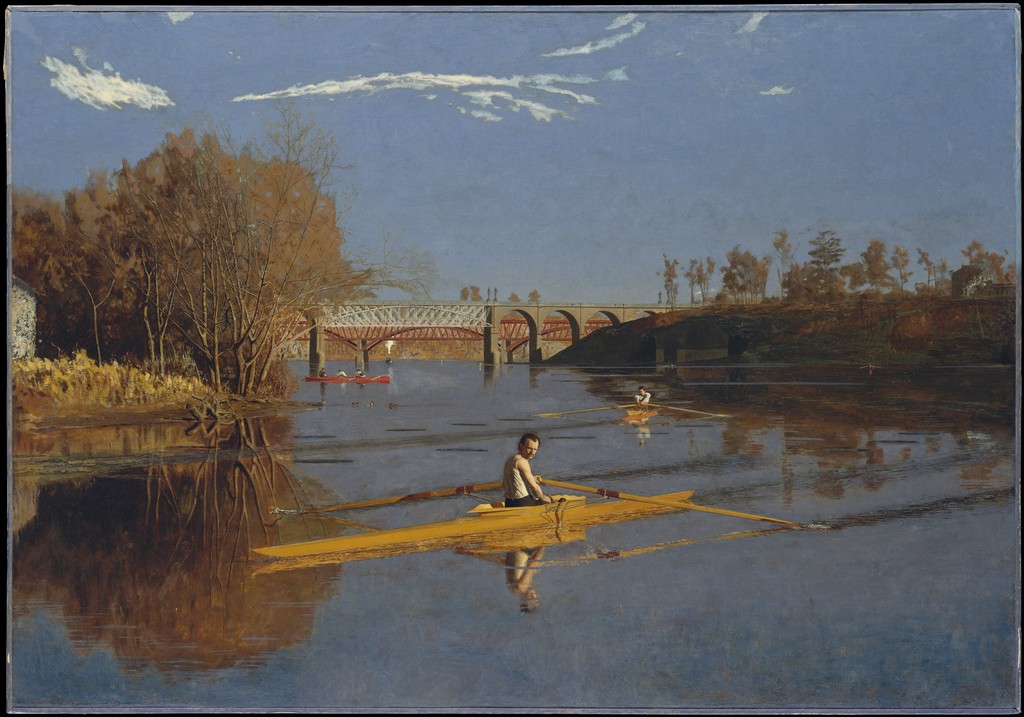
The photographic Self-Portrait of 1889–94 makes a different claim. It is a platinum print, Met object 1985.1027.20, and the current record assigns the image to Thomas Eakins.[7] Unlike the small Eakins rowing in The Champion Single Sculls, the photographed artist confronts the apparatus as his principal subject. PAFA's survey of his photographs is broader still: it includes self-images made by Eakins, commercial photographers, relatives, and friends.[2] “Portrait of Eakins” and “self-portrait by Eakins” are therefore not interchangeable descriptions.
Two Pupils, Two Records
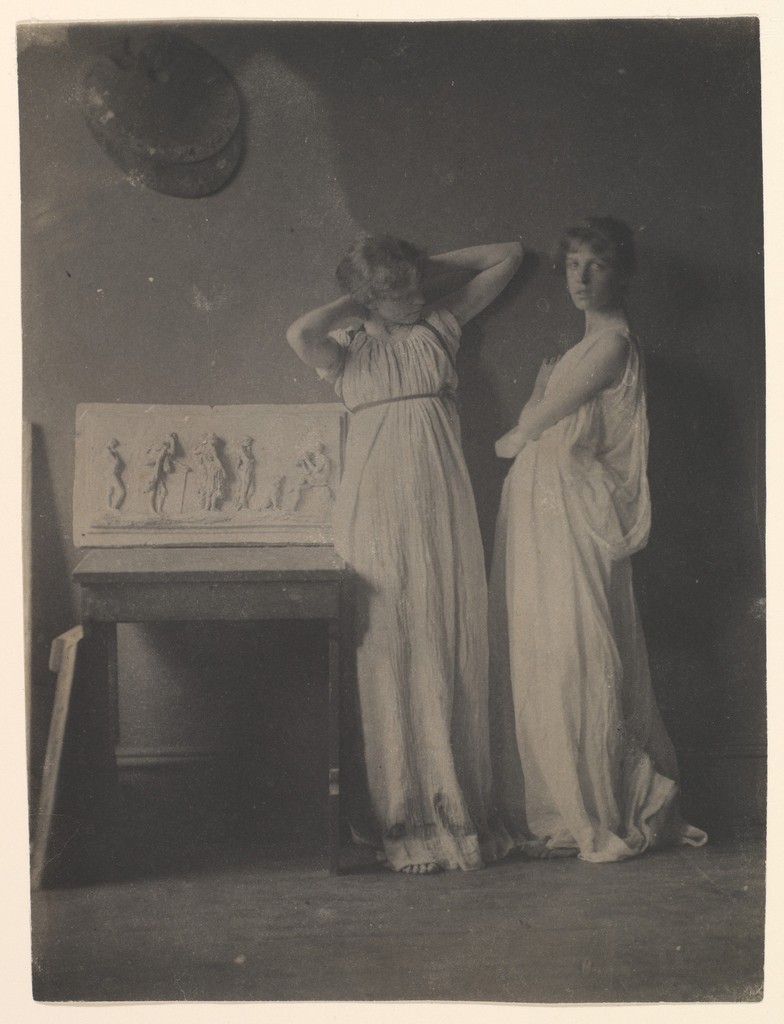
The Met holds two photographs with the identical title Two Pupils in Greek Dress. They must be kept separate. Object 41.142.3, dated to the 1880s, measures 22.4 by 16.7 centimetres. Its record names Thomas Eakins as artist and Susan Macdowell Eakins as printer. The pupils' stances answer a sculpted relief beside them, turning costume and pose into a comparative study.[4]
Object 43.87.17 is dated 1883 and is substantially larger, at 36.8 by 26.7 centimetres. Its two posed students echo figures in Eakins's Arcadia relief, which is visible on a worktable. The present Met record assigns the photograph to Thomas Eakins but does not attach Susan's printer credit to this accession.[5] Even if two records share title, models, or purpose, a credit belonging to one should not migrate to the other.
Susan Macdowell Eakins's named role on 41.142.3 is more than a clerical detail. Printing required choices about exposure, tonal balance, scale, and finish. “Artist: Thomas Eakins; printer: Susan Macdowell Eakins” preserves two forms of labour within one object. It also shows why item-level records are preferable to a general phrase such as “a photograph by Eakins.” The selected contextual image for this guide is the Susan-printed 41.142.3, not the separate 43.87.17.
Figures and Motion
Many Eakins photographs place the body under controlled scrutiny, yet they do not all perform the same task. A clothed pose could test balance and gesture. A nude sequence could compare shifts of weight. An outdoor group could preserve the changing intervals between bodies. A motion study could stack successive phases of action. The camera's capacity to stop time expanded the evidence available to a painter already preoccupied with how exertion becomes visible.
The Met's Bill Duckett Nude, at the Art Students' League of Philadelphia, about 1889, belongs to this enquiry. Its record connects Eakins's practice both to motion studies made with Eadweard Muybridge and to a systematic inventory of natural poses. It also identifies Duckett and locates the print in the more permissive environment of the Art Students' League after Eakins left PAFA.[8] The enlarged platinum print is not merely anatomical documentation: lighting, contour, and the seated figure's inward turn give the study a deliberate emotional register.
Another Met object, Female Nude from the Back, about 1889, opens the studio itself to view. The model rests on a low platform, the camera occupies one side of the encounter, and a student draws in shadow. The museum explicitly describes Eakins's photography at this date as serving three possibilities: classroom instruction, study for paintings, and independent photographic art.[9] One image could make those practices visible together without proving that every class photograph led to a canvas.
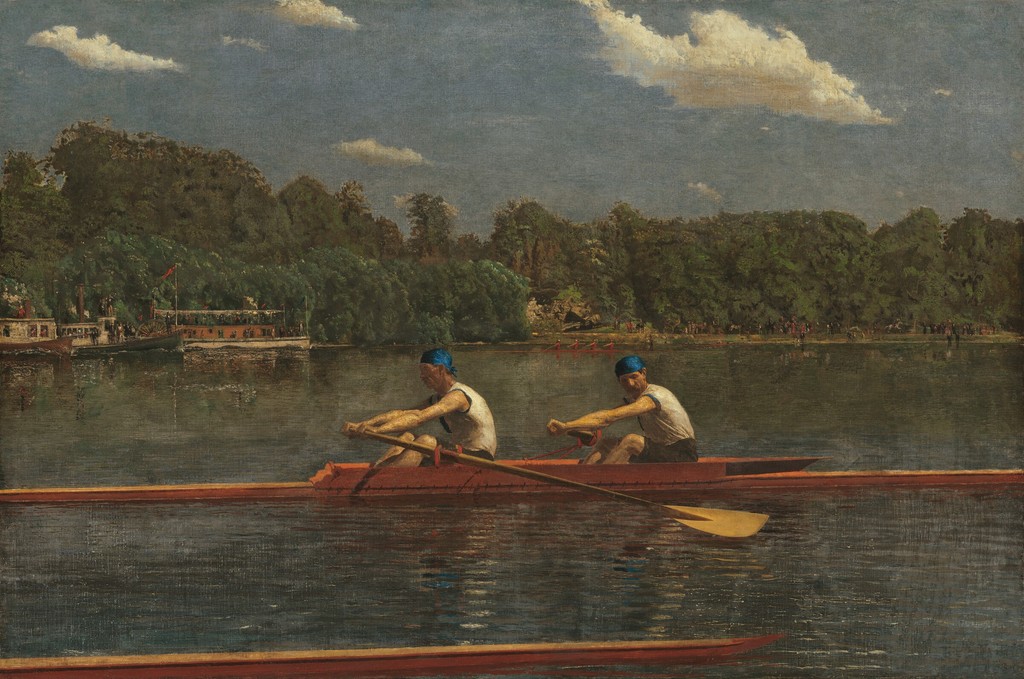
Chronology prevents a further mistake. The rowing oils Max Schmitt in a Single Scull and The Biglin Brothers Racing were painted in 1871 and 1872, before the documented incorporation of photography into Eakins's practice. Their convincing action should not be retroactively explained by a camera. They establish the older resources—first-hand sporting knowledge, drawing, perspective, and observation—to which photographic motion research was later added.[3]
From Study to Painting
The relation between a photograph and a painting ranged from loose investigation to demonstrable transfer. The Met cautions that Eakins did not generally employ photographs as direct preparations, even though important exceptions survive.[1] That finding rejects two equally misleading extremes: the camera was neither irrelevant nor a machine that composed every finished canvas for him.
The Philadelphia Museum of Art's technical account of Mending the Net provides unusually concrete evidence. Eakins first established the landscape on canvas, then projected selected photographic studies one at a time to mark the positions and salient features of figures and other elements. Oil sketches made at the site preserved colour information, and toning glazes unified the assembled scene.[10] The procedure is additive and selective. Separate observations become a single pictorial time and place through projection, painting, and revision.
That sequence also clarifies what the photograph could not supply. A monochrome study did not carry the remembered colour of the site, which came from separate oil notes. Nor could several isolated exposures unify themselves into atmosphere or decide how one figure should command attention. Projection transferred bounded information; the painted surface established continuity. Technical evidence is most useful when it identifies each resource's limited job instead of making the camera responsible for the whole image.
For Shad Fishing at Gloucester on the Delaware River, the PMA records an even more legible sequence of decisions. A distant photograph helped establish the overall arrangement; a closer view supplied replacement or additional fishermen. Eakins removed spectators recorded by the camera and shifted his family into a lower position.[11] This is the opposite of mechanical copying. The photographs offer candidates for inclusion, while the painter changes scale, membership, and emphasis.
Other objects extend the range. In The Fairman Rogers Four-in-Hand, Eakins used new photographic information about horse locomotion associated with Muybridge while also calculating the different rotational speeds of the carriage wheels.[12] In Arcadia, the Met has found projected photographic images and incised reference marks in the paint surface.[13] The PMA's works-on-paper survey adds photographic tracings to the evidence, placing them beside life drawings, pen-and-ink studies, and watercolours.[1] The paintings guide is best read with this varied toolkit in mind: photographic information enters a painting through decisions about scale, colour, spacing, and meaning.
Swimming and Sequence
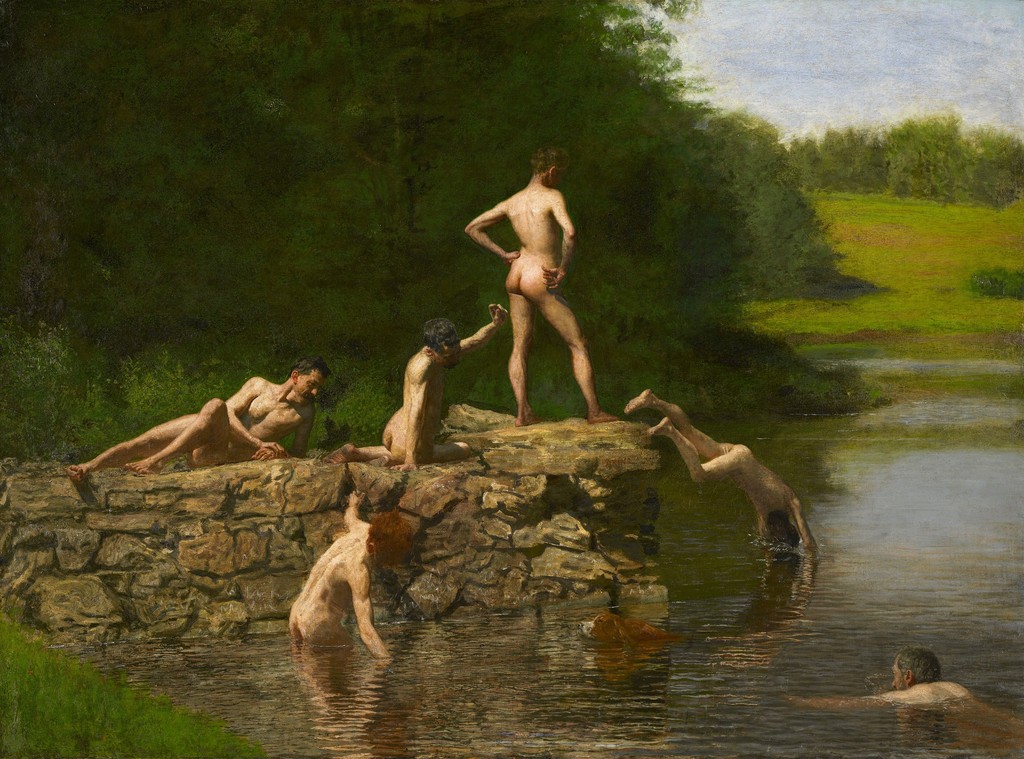
The photographs surrounding Swimming bring figure study, teaching, outdoor community, and composition into one project. A Getty photograph dated 1884 shows Eakins with male nudes at the site associated with the painting. The museum assigns the photograph to Thomas Eakins; the arrangement belongs to a wider series rather than serving as a complete miniature of the later oil.[14]
The Amon Carter Museum dates Swimming to 1885 and identifies its figures as Eakins and male students. Standing, seated, reclining, diving, and swimming bodies offer successive relations to gravity and water, but they have been re-ordered into a deliberate field.[15] The photographs helped retain poses and group relations; the painting spaces those elements across rock, air, and river. Comparison should attend to changes as closely as similarities.
This project also connects the camera to institutional authority. The models were members of a teacher-student community, and the nudity central to Eakins's programme became entangled with serious disputes over his conduct. PAFA notes that photography of unclothed professional models, teachers, and students contributed to the controversy ending his Academy position in 1886.[2] The fuller teaching and anatomy guide addresses that history. Here the essential point is narrower: an image may be formally experimental and educational while still being produced within unequal relationships that deserve scrutiny.
Authorship in a Circle
Attribution is most secure when it moves from object outward. First check the title, accession number, date, medium, and dimensions. Then read every role in the credit line: artist, photographer, printer, or attributed maker. Finally, preserve qualifications such as “attributed to” or “Eakins and his circle.” A shared studio, the same model, or a familiar backdrop can support context without proving who operated the shutter.
This method protects distinct kinds of evidence. It keeps Susan Macdowell Eakins's printer credit attached to the correct Two Pupils print. It distinguishes Eakins's photographic self-portrait from portraits of him made by other people. It also prevents the hundreds of PAFA photographs associated with Eakins's teaching circle from becoming an inflated list of works personally made by him.[2][4][7]
The result is not a diminished Eakins. It is a more accurate picture of how innovative practice can be collective. His importance lies partly in making photography consequential within an American art school and a painter's studio: as technical craft, observational discipline, means of collaboration, source of motion evidence, and independent art on paper. The biography situates this activity within his career; the individual photographs show that the camera's history depends on many precisely named acts.
Researched works directory
This searchable evidence census was assembled from public museum records and a reproducible Wikidata snapshot. It is not a catalogue raisonné, not a claim to complete oeuvre coverage, and not a substitute for the published catalogue literature, which was not used to claim absolute completeness.
| Name | Date | Medium |
|---|---|---|
| A Singer (Mrs. W.H. Bowden) | 1906 | Painting |
| A Singer: Portrait of Mrs. W.H. Bowden | 1906 | Painting |
| A Street Scene | Date unknown | Painting |
| A street scene in Sevilla | 1870 | Painting |
| A Street Scene in Seville | 1870 | Painting |
| African-American Man | 1884 | Photography |
| An Actress (Portrait of Suzanne Santje) | 1903 | Painting |
| Anna Lewis | 1890 | Painting |
| Annie C. Lochrey Husson (Mrs. Louis Husson) | 1905 | Painting |
| Antiquated Music (Portrait of Sarah Sagehorn Frishmuth) | 1900 | Painting |
| Arcadia | 1883 | Painting |
| Arcadia | Date unknown | Sculpture |
| Arcadia: Figure Study, Female Nude | 1883 | Painting |
| Arcadia Sketch | 1883 | Painting |
| Arcadian | Date unknown | Painting |
| Archbishop Diomede Falconio | 1905 | Painting |
| Archbishop James Frederick Wood | 1877 | Painting |
| Archbishop James Frederick Wood (1813-1883) | 1876 | Painting |
| Archbishop William Henry Elder | 1903 | Painting |
| Arthur B. Frost | 1886 | Painting |
| Artist and His Father Hunting Reed Birds: Marsh Landscape Sketch | 1873 | Painting |
| B.J. Blommers | 1904 | Painting |
| Baby at Play | 1876 | Painting |
| Baseball Players Practicing | 1875 | Artwork |
| Benjamin Eakins G38 | Date unknown | Painting |
| Bertrand Gardel (Sketch for The Chess Players) | 1875 | Painting |
| Between Rounds | 1898 | Painting |
| Billy Smith | 1898 | Painting |
| Billy Smith (Sketch for Between Rounds) | 1898 | Painting |
| Boy Reclining | 1883 | Painting |
| Carmelita Requena | 1869 | Painting |
| Charles Edmund Dana | 1902 | Painting |
| Charles Percival Buck | 1904 | Painting |
| Clara | 1890 | Painting |
| Courtship | 1878 | Painting |
| Cowboy Singing | 1892 | Painting |
| Cowboys in the Badlands | 1888 | Painting |
| Cowboys in the Badlands sketch 2 | 1888 | Painting |
| Delaware River Scene | 1881 | Painting |
| Delaware River Study | 1881 | Painting |
| Dr. Agnew (Dr. D. Hayes Agnew) (1818-1892) | 1889 | Painting |
| Dr. Agnew (Dr. D. Hayes Agnew) (1818–1892) | 1889 | Painting |
| Dr. Horatio C. Wood | 1886 | Painting |
| Dr. Thomas H. Fenton | 1916 | Painting |
| Drifting | 1875 | Painting |
| Eakins G184 | 1916 | Painting |
| Ecorché: Relief of a Horse (Josephine) | 1882 | Sculpture |
| Edward W. Redfield | 1905 | Painting |
| Fairman Rogers Four-in-Hand: Landscape Study of Fairmount Park | 1879 | Painting |
| Fairman Rogers Four-in-Hand: Study of a Horse's Leg | 1879 | Painting |
| Fairmount Park (Sketch for The Fairman Rogers Four-in-Hand) | Date unknown | Painting |
| Female Model | 1867 | Painting |
| Female Nude | 1884 | Painting |
| Female Nude from the Back | 1889 | Photography |
| Female Nude (Study) | 1881 | Painting |
| Fifty Years Ago (Young Girl Meditating): Study | 1877 | Painting |
| Figure Study: Masked Nude Woman | Date unknown | Painting |
| Figure Study: Nude Woman, Seated, with Arms Lowered (r) | Date unknown | Painting |
| Figure Study: Nude Woman, Seated, with Arms Raised | Date unknown | Painting |
| [Four Sketches: Seated Man, Sleeping Dog, Two Vases(?)] | Date unknown | Painting |
| Frances Eakins | 1870 | Painting |
| Francis J. Ziegler | 1890 | Painting |
| Frank Hamilton Cushing | 1895 | Painting |
| Frank Jay St. John | 1900 | Painting |
| General E. Burd Grubb (1841-1914) | 1898 | Painting |
| Girl with a Fan; Portrait of Miss Gutierrez | Date unknown | Painting |
| Harriet Husson Carville (Mrs. James G. Carville) | 1904 | Painting |
| Harrison S. Morris | 1896 | Painting |
| Hauling the Seine | 1882 | Painting |
| Head of a Man (Rutherford B. Hayes?) | 1877 | Painting |
| Hiawatha | 1874 | Painting |
| Hiawatha | Date unknown | Artwork |
| Home Ranch | 1892 | Painting |
| Home Scene | 1871 | Painting |
| Homespun | 1881 | Painting |
| In the Studio | 1884 | Painting |
| Interior of a Woodcarver's Shop (Sketch for William Rush Carving His Allegorical Figure of the Schuylkill River) | Date unknown | Painting |
| James MacAlister (Sketch) | 1895 | Painting |
| John Biglin in a Single Scull | 1873 | Painting |
| John Biglin in a Single Scull | 1874 | Painting |
| Joseph R. Woodwell | 1904 | Painting |
| Kathrin | 1872 | Painting |
| Knitting | 1881 | Sculpture |
| Knitting | 1882 | Sculpture |
| Knitting | Date unknown | Sculpture |
| Lafayette Park, Washington, D.C. | 1877 | Painting |
| Landscape | 1881 | Painting |
| Landscape | 1882 | Painting |
| Landscape Sketch | 1880 | Painting |
| Landscape (Sketch for Cowboys in the Bad Lands) | 1887 | Painting |
| Landscape Study: Cultivated Field and Tree | 1874 | Painting |
| Landscape Study: Shoreline with Trees | 1874 | Painting |
| Landscape with a Dog | 1874 | Painting |
| Letitia Wilson Jordan | 1888 | Painting |
| Louis Husson | 1899 | Painting |
| Major Manuel Waldteufel | 1907 | Painting |
| Masked nude standing | 1880 | Painting |
| Maud Cook (Mrs. Robert C. Reid) | 1895 | Painting |
| Mending the Net | 1881 | Painting |
| Mending the Net: Study of a Fisherman | Date unknown | Painting |
| Miss Alice Kurtz | 1903 | Painting |
| Miss Amelia Van Buren | 1891 | Painting |
| Miss Eleanor S. F. Pue | 1907 | Painting |
| Miss Gertrude Murray | 1895 | Painting |
| Monsignor James P. Turner | 1906 | Painting |
| Mother (Annie Williams Gandy) | 1903 | Painting |
| Mrs. Gilbert L. Parker | 1910 | Painting |
| Mrs. Mary Arthur | 1900 | Painting |
| Music | 1904 | Painting |
| Nude man with beard | Date unknown | Painting |
| Nude Woman Standing | 1908 | Painting |
| Old Lady Sewing | 1879 | Painting |
| Portrait of a Little Girl | 1897 | Painting |
| Portrait of a Woman Reading | Date unknown | Painting |
| Portrait of Adam S. Bare | 1903 | Painting |
| Portrait of Alfred Reynolds | Date unknown | Painting |
| Portrait of Arthur Burdett Frost | 1886 | Painting |
| Portrait of Ashbury Wright Lee | 1905 | Painting |
| Portrait of Benjamin Eakins | 1894 | Painting |
| Portrait of Benjamin Eakins (Sketch for The Writing Master) | 1882 | Painting |
| Portrait of Blanche Hurlburt | 1885 | Painting |
| Portrait of Douglass Morgan Hall | 1889 | Painting |
| Portrait of Dr. Edward J. Nolan | 1900 | Painting |
| Portrait of Dr. Samuel D. Gross (The Gross Clinic) | 1875 | Painting |
| Portrait of Edward Taylor Snow | 1904 | Painting |
| Portrait of Elizabeth L. Burton | 1905 | Painting |
| Portrait of Florence Einstein | 1905 | Painting |
| Portrait of Henry O. Tanner | 1902 | Painting |
| Portrait of J. Harry Lewis | 1876 | Painting |
| Portrait of John B. Gest | 1905 | Painting |
| Portrait of Joshua Ballinger Lippincott | 1892 | Painting |
| Portrait of Leslie W. Miller | 1901 | Painting |
| Portrait of Lucy Lewis | 1896 | Painting |
| Portrait of Margaret Eakins in a Skating Costume | 1871 | Painting |
| Portrait of Mary Adeline Williams | 1899 | Painting |
| Portrait of Mary Adeline Williams | 1900 | Painting |
| Portrait of Mrs. Fairman Rogers (Study for The Fairman Rogers Four-in-Hand) | 1879 | Painting |
| Portrait of Mrs. Frank Hamilton Cushing | 1895 | Painting |
| Portrait of Mrs. James Mapes Dodge (Josephine Kern) | 1896 | Painting |
| Portrait of Professor Benjamin H. Rand | 1874 | Painting |
| Portrait of Professor W. D. Marks | 1886 | Painting |
| Portrait of Rear Admiral George Wallace Melville | 1904 | Painting |
| Portrait of Walter S. Macdowell | 1904 | Painting |
| Porträt des Alfred Bryan Wall | 1904 | Painting |
| Porträt des David Wilson Jordan | Date unknown | Painting |
| Porträt des John McLure Hamilton (1853- 1936) | 1895 | Painting |
| Professionals at Rehearsal | 1883 | Painting |
| Professor William D Marks | 1886 | Painting |
| Professor William Woolsey Johnson | 1896 | Painting |
| Pushing for Rail | 1874 | Painting |
| Rail Shooting on the Delaware | 1876 | Painting |
| Rear Admiral Charles Dwight Sigsbee G388-2 | 1903 | Painting |
| Rear Admiral George W. Melville | 1905 | Painting |
| Reclining Male Nude | 1887 | Photography |
| Reclining Nude | Date unknown | Painting |
| Retrospection | 1880 | Painting |
| Riter Fitzgerald | 1895 | Painting |
| Robert M. Lindsay | 1900 | Painting |
| Ruth (Ruth W. Harding) | 1903 | Painting |
| Saddle (Sketch for Cowboys in the Bad Lands) | 1887 | Painting |
| Sailboats Racing on the Delaware | 1874 | Painting |
| Sailboats Racing: Study of the Delaware River | 1874 | Painting |
| Sailing | 1875 | Painting |
| Salutat | 1898 | Painting |
| Seated Figures | 1886 | Painting |
| Self-portrait | 1902 | Painting |
| Seventy Years Ago | 1877 | Painting |
| Shad Fishing at Gloucester on the Delaware: Delaware River and Gloucester Pier | 1881 | Painting |
| Shad Fishing at Gloucester on the Delaware River | 1881 | Painting |
| Shad Fishing at Gloucester on the Delaware River: Study of a Woman's Head | 1881 | Painting |
| Ships and Sailboats on the Delaware | 1874 | Painting |
| Ships and Sailboats on the Delaware: Study | 1874 | Painting |
| Shoreline of the Delaware River, with Fishing Nets | Date unknown | Painting |
| Signora Gomez d'Arza | 1901 | Painting |
| Singing a Pathetic Song | 1881 | Painting |
| Sketch for Cowboys in the Bad Lands | 1887 | Painting |
| Sketch for Music (The Violinist) | 1904 | Painting |
| Sketch for Portrait of Dr. Jacob Mendez da Costa | 1893 | Painting |
| Sketch for Portrait of Leslie W. Miller | 1901 | Painting |
| Sketch for Portrait of Letitia Wilson Jordan | 1888 | Painting |
| Sketch for Portrait of Monsignor James P. Turner | 1906 | Painting |
| Sketch for Portrait of Mother Patricia Waldron | 1903 | Painting |
| Sketch for Portrait of Professor George F. Barker | 1886 | Painting |
| Sketch for Seventy Years Ago | Date unknown | Painting |
| Sketch for The Concert Singer | 1892 | Painting |
| Sketch for The Fairman Rogers Four-in-Hand | 1879 | Painting |
| Sketch for The Gross Clinic | 1875 | Painting |
| Sketch for the Surrender of General Lee to General Grant at Appomatox | Date unknown | Painting |
| Sketch for William Rush and His Model | 1908 | Painting |
| Sketch of a Landscape | 1882 | Painting |
| Sketch of a Man and Study of Drapery | 1882 | Painting |
| Sketch of Harry | 1892 | Painting |
| Sketch of Max Schmitt in a Single Scull | 1874 | Painting |
| Sketches for “Home-Spun”, (recto and verso) | 1881 | Painting |
| Sketches (Four on one panel) | Date unknown | Painting |
| Spinning | 1881 | Painting |
| Spinning | 1882 | Sculpture |
| Spinning: Sketch | 1881 | Painting |
| Starting Out After Rail | 1863 | Painting |
| Starting Out After Rail | 1874 | Painting |
| Study for Arcadia: Youth Playing Pipes | 1883 | Painting |
| Study for "Cowboys in the Badlands | 1887 | Painting |
| Study for "Negro Boy Dancing": The Banjo Player | Date unknown | Painting |
| Study for "Negro Boy Dancing": The Boy | Date unknown | Painting |
| Study for Portrait of John McClure Hamilton | 1895 | Painting |
| Study for Salutat | 1898 | Painting |
| Study for 'The Meadows, Gloucester' | 1882 | Painting |
| Study for "William Rush Carving His Allegorical Figure of the Schuylkill River | 1876 | Painting |
| Study of a Groom | 1879 | Painting |
| Study of a Nude Man | 1869 | Painting |
| Study of a Nude Man (The Strong Man) | 1869 | Painting |
| Study of a Seated Nude Woman Wearing a Mask | 1863 | Drawing |
| Study of a Young Woman | 1868 | Painting |
| Study of Dr Samuel David Gross | 1875 | Painting |
| Study of Horse for The Fairman Rogers Four-in-Hand | 1879 | Painting |
| Swimming | 1885 | Painting |
| Taking the Count | 1898 | Painting |
| Taking the Count, study | 1898 | Painting |
| Taking Up Net | 1881 | Painting |
| Talcott Williams | 1889 | Painting |
| That's a New Game Down in Frisco": Study for the Central Standing Figure | 1878 | Painting |
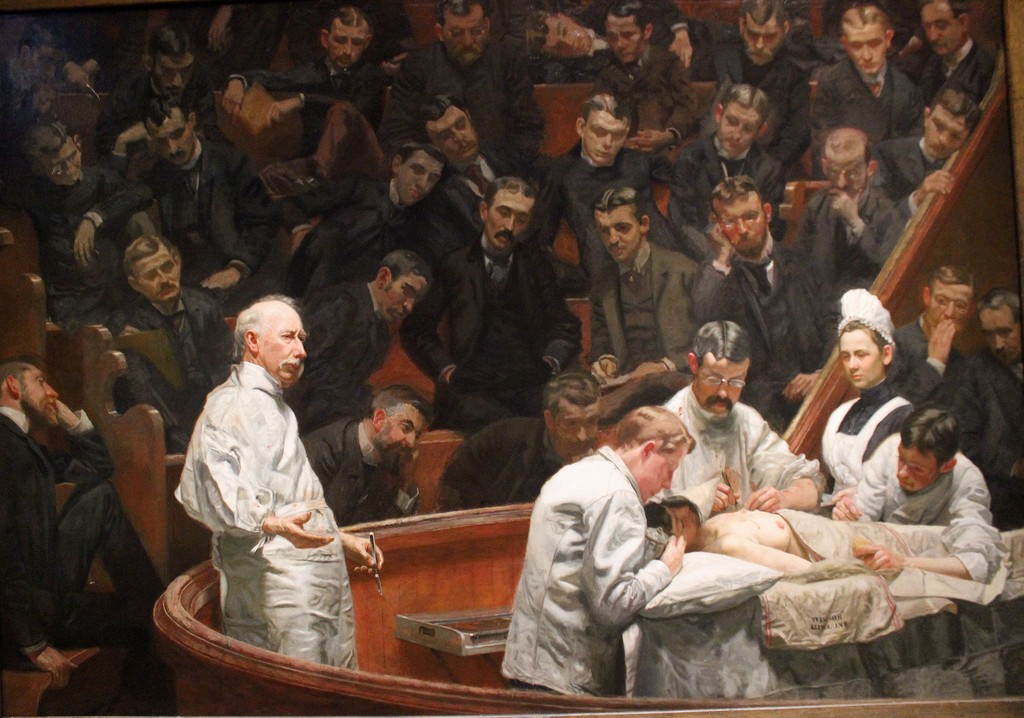
| The Agnew Clinic | 1889 | Painting |
| The Art Student (James Wright) | 1890 | Painting |
| The Artist's Wife and His Setter Dog | 1884 | Painting |
| The Biglin Brothers Racing | 1872 | Painting |
| The Biglin Brothers Turning the Stake | 1873 | Painting |
| The Black Fan (Portrait of Mrs. Talcott Williams) | 1891 | Painting |
| The Bohemian (Portrait of Franklin Louis Schenck) | 1890 | Painting |
| The Brinton House | 1878 | Painting |
| The Cello Player | 1896 | Painting |
| The Champion Single Sculls (Max Schmitt in a Single Scull) | 1871 | Painting |
| The Chaperone | 1908 | Painting |
| The Chess Players | 1876 | Painting |
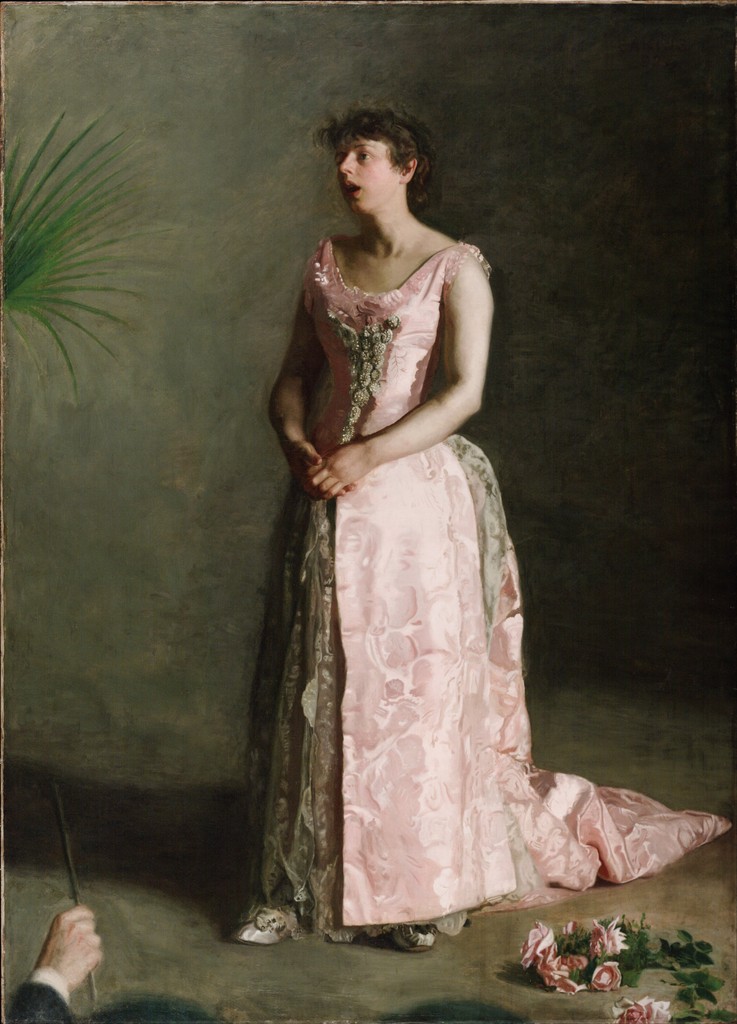
| The Concert Singer | 1890–1892 | Painting |
| The Courtship | 1878 | Painting |
| The Crucifixion | 1880 | Painting |
| The Dancing Lesson | 1878 | Painting |
| The Dean's Roll Call | 1899 | Painting |
| The Fairman Rogers Four-in-Hand | 1879 | Painting |
| The Fairman Rogers Four-In-Hand (A May Morning in... | 1899 | Painting |
| The Meadows, Gloucester | 1882 | Painting |
| The Model | 1908 | Painting |
| The Oarsmen (The Schreiber Brothers) | 1874 | Painting |
| The Oboe Player (Portrait of Dr. Benjamin Sharp) | 1903 | Painting |
| The Old-Fashioned Dress (Portrait of Helen Montanverde Parker) | 1908 | Painting |
| The Pair-Oared Shell | 1872 | Painting |
| The Pathetic Song | 1881 | Painting |
| The Pianist | 1896 | Painting |
| The Poleman in the Ma'sh | 1881 | Drawing |
| The Red Shawl | 1890 | Painting |
| The Spinner | 1876 | Painting |
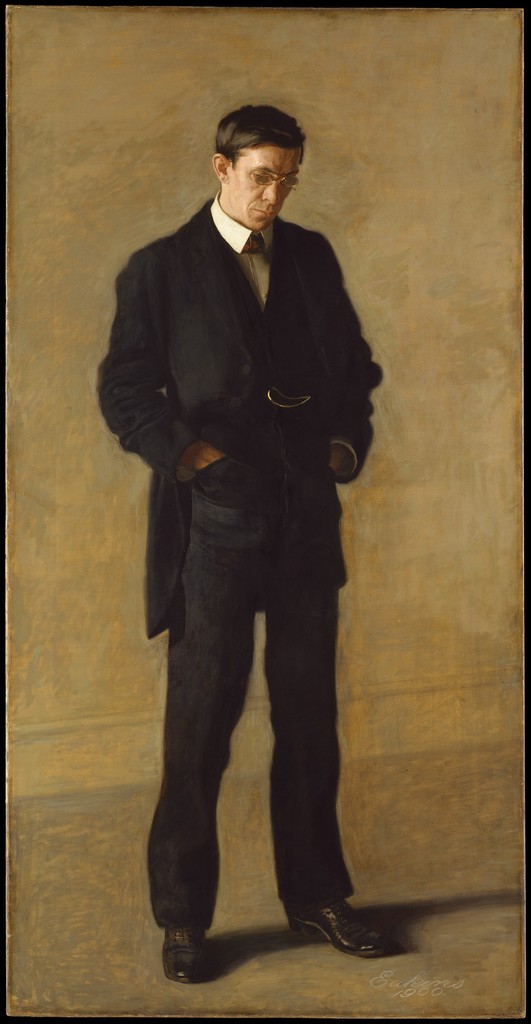
| The Thinker: Portrait of Louis N. Kenton | 1900 | Painting |
| The Timer | 1879 | Painting |
| The Translator, Portrait of Monsignor Hugh T. Henry | 1902 | Painting |
| The Veteran (Portrait of George Reynolds) | Date unknown | Painting |
| The Writing Master | 1882 | Painting |
| The Young Man (Portrait of Kern Dodge) | 1898 | Painting |
| Thomas Eakins and John Laurie Wallace on a Beach | 1883 | Photography |
| Three Boys Wading in a Creek | 1883 | Photography |
| Trenton Battle Monument | 1893 | Sculpture |
| Two Pupils in Greek Dress | 1883 | Photography |
| Views of Harry | 1885 | Painting |
| Walt Whitman | 1887 | Painting |
| Whistling for Plover | 1874 | Painting |
| William H. Macdowell | 1884 | Photography |
| William H. Macdowell and Margaret Eakins in Saltville (or Clinch Mountain), Virginia | 1875 | Photography |
| William Hance Macdowell (1816-1906) | 1897 | Painting |
| William Rush and his Model | 1908 | Painting |
| William Rush and His Model | Date unknown | Painting |
| William Rush Carving His Allegorical Figure of the Schuylkill River | 1876 | Painting |
| William Rush Carving His Allegorical Figure of the Schuylkill River | 1908 | Painting |
| William Rush Carving His Allegorical Figure of the Schuylkill River, Study | 1876 | Painting |
| William Rush's Model | 1908 | Painting |
| Wrestlers | 1899 | Painting |
| Young Girl Meditating | 1877 | Painting |
Frequently Asked Questions
Eakins worked with a wooden view camera and glass-plate negatives. He became particularly accomplished at enlarging and printing selected images on platinum paper, although surviving objects also include albumen prints and later prints made from negatives. Cropping and enlargement were active compositional steps, as the Met's beach portrait of Eakins and John Laurie Wallace demonstrates.[1][6]
No. Direct transfer is documented in selected works, but even there it involved extensive choice. In Mending the Net, projected studies supplied positions and details while oil sketches supplied colour; in Shad Fishing, Eakins removed people, added others from a closer view, and shifted the family group. Arcadia retains projection marks, yet its pictorial world still depends on arrangement and paint.[10][11][13]
They are separate accessions with different dates, dimensions, and credit information. Met 41.142.3 dates from the 1880s and names Susan Macdowell Eakins as printer. Met 43.87.17 is dated 1883, is larger, and currently lists Thomas Eakins without that printer credit. The shared title does not make the records interchangeable.[4][5]
It gave teachers and students a way to preserve poses, compare bodily structures, and examine movement after a sitting ended. A photograph could operate beside drawing and anatomical study rather than replacing either. The same programme also raised questions about nudity, consent, gender, and authority that became part of the conflict around Eakins's teaching at PAFA.[1][2][9]
The answer varies by object. Some current records name Thomas Eakins; some identify another maker or printer; others retain a broader attribution to his circle. The responsible approach is to use the current institutional credit for each accession, including every qualification, rather than assigning the whole archive to Eakins.[2][4]
Discussion
Use this evidence-led guide as a starting point for close looking rather than a final verdict.
Share an observation about Photography and Working Studies or a source that adds useful context.
Reader Insights
Which work most clearly complicates the familiar image of Eakins as a strictly literal realist?
Where do Philadelphia, Paris training, anatomy, photography or institutional life most productively alter your reading?
Which source or surviving object would you investigate next?
Join the Conversation
Add your reading below, keeping observations specific and evidence clear.
References
- The Metropolitan Museum of Art, Thomas Eakins (1844–1916): Photography, 1880s–90s, accessed 30 August 2026.
- Pennsylvania Academy of the Fine Arts, Thomas Eakins: Photographer, accessed 30 August 2026.
- The Metropolitan Museum of Art, Thomas Eakins, accessed 30 August 2026.
- The Metropolitan Museum of Art, Two Pupils in Greek Dress, object 41.142.3, accessed 30 August 2026.
- The Metropolitan Museum of Art, Two Pupils in Greek Dress, object 43.87.17, accessed 30 August 2026.
- The Metropolitan Museum of Art, Thomas Eakins and John Laurie Wallace on a Beach, accessed 30 August 2026.
- The Metropolitan Museum of Art, Self-Portrait, accessed 30 August 2026.
- The Metropolitan Museum of Art, Bill Duckett Nude, at the Art Students' League of Philadelphia, accessed 30 August 2026.
- The Metropolitan Museum of Art, Female Nude from the Back, accessed 30 August 2026.
- Philadelphia Museum of Art, Mending the Net, accessed 30 August 2026.
- Philadelphia Museum of Art, Shad Fishing at Gloucester on the Delaware River, accessed 30 August 2026.
- Philadelphia Museum of Art, A May Morning in the Park (The Fairman Rogers Four-in-Hand), accessed 30 August 2026.
- The Metropolitan Museum of Art, Arcadia, accessed 30 August 2026.
- J. Paul Getty Museum, Thomas Eakins and Male Nudes at the Site of “Swimming”, accessed 30 August 2026.
- Amon Carter Museum of American Art, Swimming, accessed 30 August 2026.
More EAKINS Artworks
The Agnew Clinic image: gallery photograph by Miguel Hermoso Cuesta, cropped and perspective-corrected, under CC BY-SA 4.0.