


 by Tom Gurney
Tom Gurney BSc (Hons) is an art history expert with over 20 years experience
Page Created on / Page Updated on
Email: tomgurney1@gmail.com / Phone: +44 7429 011000
Thomas Eakins Biography: Introduction
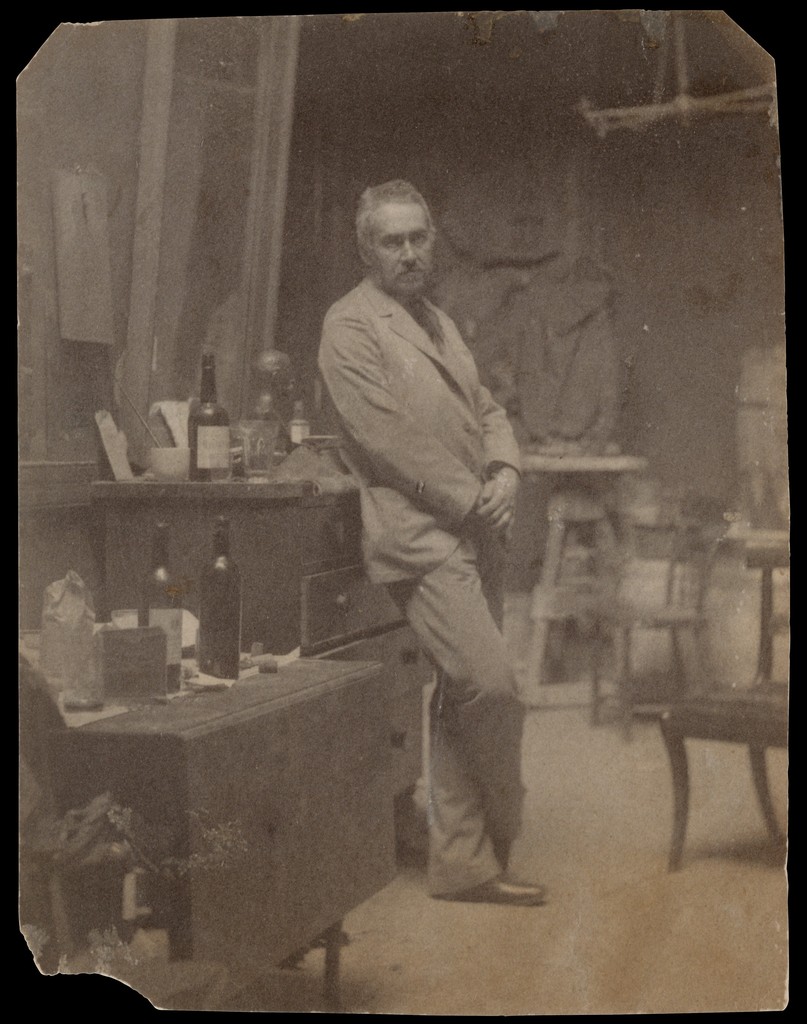
Thomas Eakins built his career around the city in which he was born. Philadelphia supplied his family home, his first schools, the rivers and hospitals he painted, the academy where he taught, and most of the people who sat to him. His four years of European training gave him an academic command of the figure, but he returned in 1870 rather than establishing himself abroad. The long career that followed was therefore both unusually local and outward-looking: a sustained attempt to make contemporary American experience carry the weight traditionally assigned to history painting.[1][2]
That career did not advance in a straight line. Eakins earned authority as a teacher, lost his institutional position amid disputes about classroom practice, and spent much of his later life painting portraits that were seldom conventional commissions. Photography, anatomical study, perspective, sculpture, drawing, and repeated observation all entered his working method. His marriage to the painter and photographer Susan Macdowell joined two artistic lives, although hers was constrained after marriage and revived strongly after his death. A complete biography must therefore hold achievement, conflict, collaboration, and posthumous reputation in the same account.[1][2]
At a Glance
- Full nameThomas Cowperthwaite Eakins [1]
- BornJuly 25, 1844, in Philadelphia, Pennsylvania [1]
- EducationPennsylvania Academy of the Fine Arts and Jefferson Medical College lectures; later the École des Beaux-Arts and private ateliers in Paris [1][2]
- MarriageSusan Hannah Macdowell, painter and photographer, in 1884 [1]
- DiedJune 25, 1916, at his longtime Philadelphia home [2]
- Career arcEuropean training, modern Philadelphia subjects, PAFA teaching and directorship, then an increasingly portrait-centred practice [1][2]
Thomas Eakins in context
Academic and Beaux-Arts training
c. 1820–1900Realism
c. 1840–1900American Realism
c. 1870–1930Jean-Léon Gérôme
1824–1904Eadweard Muybridge
1830–1904Winslow Homer
1836–1910Thomas Eakins
1844–1916Susan Macdowell Eakins
1851–1938Henry Ossawa Tanner
1859–1937The Gross Clinic
1875Swimming
1885The Agnew Clinic
1889The Concert Singer
1890–92The Thinker
1900Contents
- Introduction
- Philadelphia Beginnings
- Paris and Spain
- River, Home, and Early Portraits
- The Gross Clinic
- Academy, Camera, and Marriage
- The Break of 1886
- Portraiture After PAFA
- Late Recognition
- A Life in Context
Philadelphia Beginnings
Eakins was born into a comfortable Philadelphia household, the eldest of four siblings. His father, Benjamin Eakins, taught writing and practised calligraphy, a profession in which the disciplined movement of the hand carried both practical and aesthetic value. Thomas showed ability in mechanical drawing as a young man. He attended Central High School and entered the Pennsylvania Academy of the Fine Arts in 1862, when formal American art education still offered fewer opportunities for sustained figure study than the European academies.[3]
His preparation was broader than art-school attendance alone. From 1862 to 1866 he took classes at PAFA while also attending anatomy lectures and demonstrations at Jefferson Medical College. Anatomy was not a decorative scientific interest added to an artistic career later. It helped establish his conviction that credible representation begins with the structure, weight, and movement of a particular body. Mathematical perspective and careful drawing likewise became practical tools, visible later in the racing shells, medical amphitheatres, and studio interiors surveyed on the paintings page.[2][3]
Philadelphia also offered a dense network of museums, exhibitions, professional schools, river clubs, music-making, and family connections. Those resources mattered after his return, but his first ambition required training abroad. In 1866 he crossed the Atlantic for Paris, following a path that was still relatively uncommon among American students. His surviving letters from 1866 onward include correspondence from those European years, but the archive’s published descriptions—not assumptions about unread letters—provide the evidential boundary for this account.[1][4]
Paris and Spain
Eakins studied in France for almost three years, principally in the École des Beaux-Arts atelier of Jean-Léon Gérôme. Gérôme’s instruction stressed exact drawing, the modelled figure, legible action, and carefully constructed space. Eakins also worked briefly with the portrait painter Léon Bonnat and studied sculpture with Augustin-Alexandre Dumont. Together, those experiences enlarged his means: painted surfaces, three-dimensional form, and anatomical structure could all be tested against one another.[1][2]
Academic training did not make him a simple follower of Gérôme. Its value lay in the demanding procedures he could redirect. A figure had to occupy measurable space; a gesture had to remain plausible; a group had to read across a large canvas. These lessons would later support subjects for which there was little established American precedent, including competitive rowing and surgery in a teaching hospital.
After France, Eakins spent about six months in Spain in 1870. He studied Spanish painting and worked in Madrid and Seville before returning to Philadelphia that July.[1][2] A Street Scene in Seville, painted from the roof of his hotel with a hired family of musicians as models, shows him tackling bright outdoor light and a complicated gathering before leaving Europe. The Metropolitan Museum of Art describes it as an ambitious student work made over more than three months, evidence that direct contemporary observation was already pressing against the conventions of his academic education.[5]
The European period is sometimes treated as a preface to the “real” American career, yet its disciplines remained active for decades. Eakins did not reject academic art when he chose Philadelphia subjects. He relocated its methods, asking whether the Schuylkill River, a medical college, or an unadorned portrait sitter could sustain the seriousness of the figure compositions he had been trained to make.
River, Home, and Early Portraits
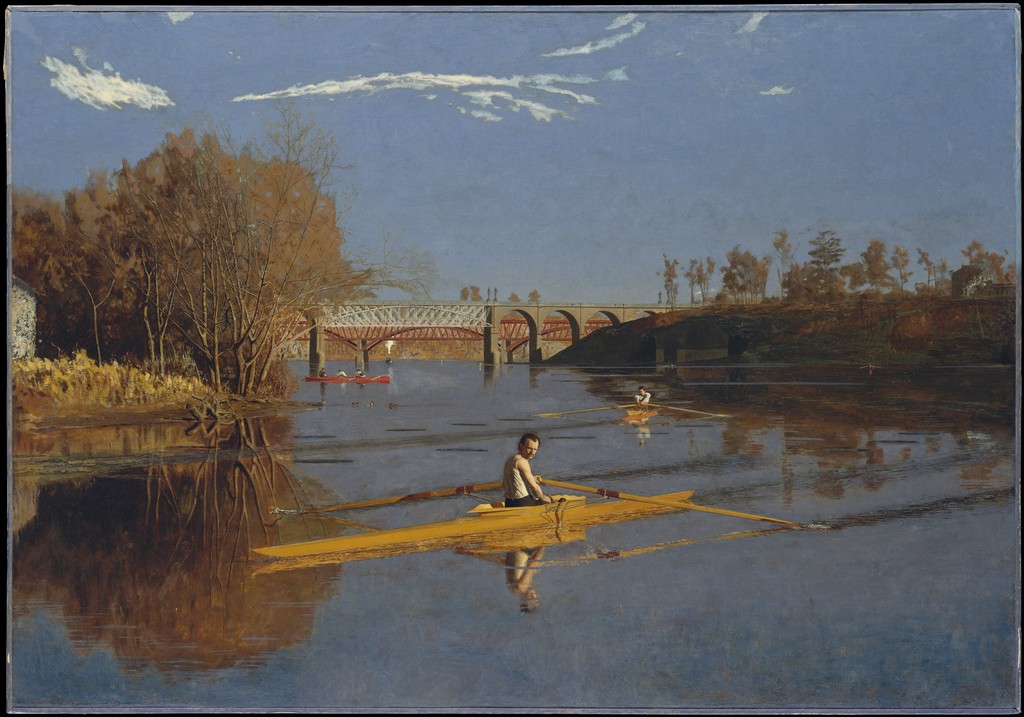
Back in his family’s city, Eakins first looked closely at activities he understood from experience. He was an able rower, and the river pictures of the early 1870s joined personal knowledge to difficult pictorial problems: narrow shells seen in perspective, bodies rotating through a stroke, reflections broken by oars, and recognisable bridges receding across water. Max Schmitt in a Single Scull, completed in 1871, placed his friend in the foreground and included Eakins himself in a second boat.[6]
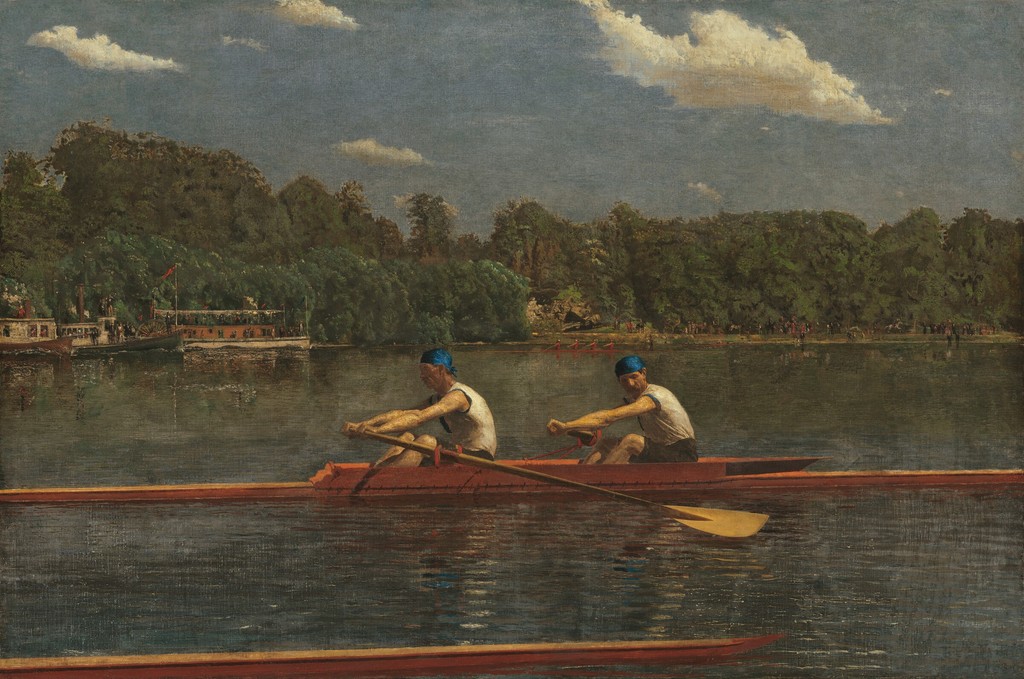
The subject was modern sport rather than an allegory. That choice did not reduce its ambition. Racing required Eakins to organise a long horizontal field while preserving exact relations among athlete, equipment, current, and distance. The Biglin Brothers Racing of 1872 shifted the problem from a single sculler to the synchronised effort of two professionals. Watercolours, oils, drawings, and perspective studies made the rowing sequence one of his first sustained demonstrations that local life could generate a serious body of work.[2]
At the same time, Eakins painted relatives and friends in interiors. Women reading, sewing, playing music, or resting were not merely rehearsals for public portraiture. These quieter images tested how posture, light, and an occupied room could disclose relations among familiar people without theatrical incident. His father appeared repeatedly, eventually becoming the absorbed calligrapher in The Writing Master of 1882. Family access gave Eakins subjects over long periods, but it did not turn every picture into uncomplicated domestic testimony. Composition and character still had to be inferred from what the paintings visibly establish.
This early alternation between outdoor exertion and indoor concentration would endure. Even when Eakins later narrowed his field almost entirely to portraiture, he retained an interest in practised action: writing, playing an instrument, singing, teaching, or simply maintaining a difficult pose. The transition was gradual, not a sudden abandonment of narrative painting.
The Gross Clinic
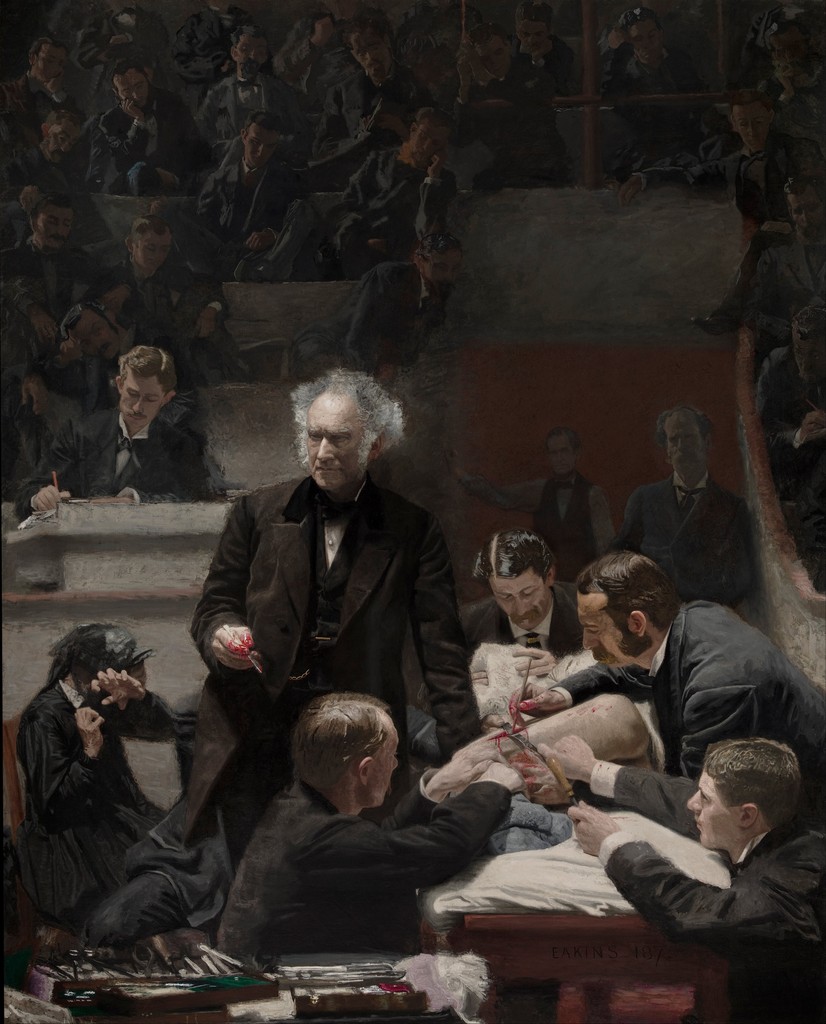
In 1875 Eakins undertook the work that most forcefully announced his ambition. The Gross Clinic presents the surgeon Samuel D. Gross addressing students while five doctors operate on a patient in Jefferson Medical College’s amphitheatre. Eakins placed himself among the spectators. The Philadelphia Museum of Art records that he intended the canvas for the 1876 Centennial Exhibition, hoping to demonstrate his powers while honouring Philadelphia’s scientific achievement.[7]
The painting united several strands of his education. Gross’s upright figure serves as portrait and organising axis; the operation requires anatomical credibility; the steep auditorium calls for controlled perspective; and the grouped witnesses turn professional instruction into public drama. It also risked rejection by showing blood, pain, and living surgery without the distance of historical costume. The work was excluded from the Centennial’s main fine-arts display and shown in a medical setting instead. Contemporary responses ranged from admiration to disgust, confirming that technical scale did not guarantee institutional approval.[7][8]
Its immediate reception should not be converted into a simple story of an unrecognised masterpiece. Jefferson alumni bought the painting from Eakins and presented it to the medical college in 1878, so it acquired an important institutional home early. Nor did one disputed exhibition determine the rest of his career. He continued to paint, exhibit, and teach, while the clinic established a demanding model for his later treatment of professional identity.[7]
The picture is now jointly owned by PAFA and the Philadelphia Museum of Art, following a 2007 campaign to retain it in Philadelphia.[7] That later history reinforces how thoroughly it became attached to the city, but its biography begins with Eakins’s own medical education and his attempt to translate contemporary surgery into monumental painting.
Academy, Camera, and Marriage
Eakins began teaching at PAFA in 1876 and rose to director of instruction in 1882. He pressed for a curriculum centred on the human figure, including anatomical knowledge, work from living models, perspective, and practical investigation rather than copying finished images. His influence was significant, though descriptions that credit one person with transforming an entire institution should be treated as assessments rather than neutral measurements.[1][2]
Around 1880 he acquired a camera. Photography became part of the academy and studio environment in which teachers, students, and models moved between making and being pictured. It could preserve a pose, isolate a phase of motion, or offer material for projection and measurement. The surviving record does not support treating every photograph from that environment as Eakins’s personal exposure. The Metropolitan Museum of Art attributes a large body to “Eakins and his circle,” while object records assign individual photographs more cautiously; the photography and working studies page follows that item-level distinction.[9]
Susan Hannah Macdowell entered this world as an artist, not simply as a future spouse. She met Eakins in 1876, enrolled at PAFA, won prizes there, and exhibited with the Philadelphia Society of Artists in 1879 and 1880. They married in 1884. The Philadelphia Museum of Art identifies her as a talented painter who later took up photography, and the Metropolitan Museum’s portrait of her also calls her both painter and photographer.[10][11]
Marriage changed the conditions of Susan’s career. The museum notes that she largely put aside her artistic ambitions afterward, although she remained active with the camera. It would therefore be misleading either to erase her work or to describe the marriage as an equal professional partnership for which the evidence is incomplete. She was a trained artist whose practice had its own record, and she later returned to painting with renewed purpose.[10]
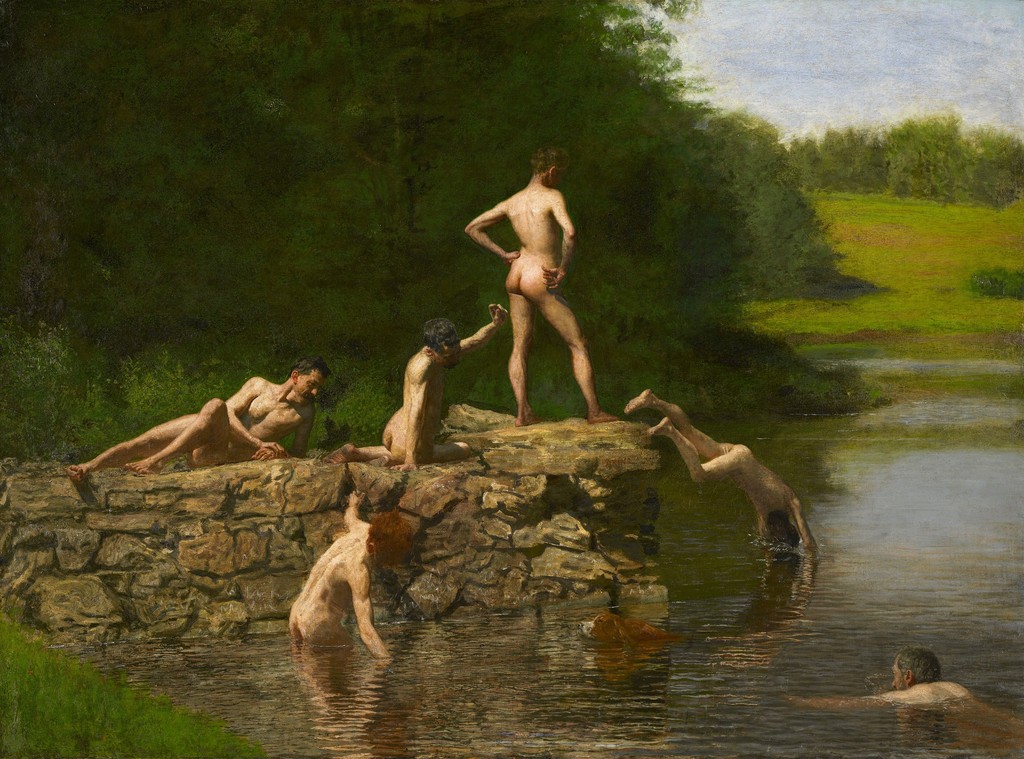
During these same years Eakins received notable commissions and pursued images of the nude figure, including Arcadia and Swimming. The Amon Carter Museum describes Swimming as a group portrait of Eakins and several students as well as a declaration of his belief in firsthand study of the body. Commissioned by PAFA instruction-committee chair Edward H. Coates, it was declined by its patron.[12] The work belongs to the history of teaching, friendship, photography, and institutional unease rather than to a single explanatory label.
The Break of 1886
Tensions over Eakins’s methods culminated in early 1886. During an anatomy demonstration to a class that included women, he removed the loincloth of a male model to trace the course of a muscle. Complaints followed, and PAFA’s board asked him to resign. Institutional sources variously summarise the outcome as resignation, forced resignation, or dismissal; the essential fact is that he lost his teaching and directorial posts at the Academy.[1][2]
The episode should be neither sensationalised nor reduced to prudish opposition to art. Nude study was central to Eakins’s pedagogy, but teachers also exercise authority within institutions and owe students clear boundaries. His educational purpose does not by itself settle questions about conduct. Conversely, the dispute did not make anatomical study artistically trivial. The teaching and anatomy page considers the curriculum, student responses, institutional rules, and subsequent influence together.
After his departure, some students withdrew from PAFA and helped form the Art Students’ League of Philadelphia, where Eakins taught in 1886–87. He also continued lecturing elsewhere in Philadelphia and New York.[8] These facts complicate the image of total banishment: he lost his most powerful post and the community divided, yet his teaching relationships did not disappear. The event altered his professional path more than it ended his work.
Portraiture After PAFA
From 1887 onward, portraiture occupied most of Eakins’s attention. Many sitters were people he knew or admired rather than patrons seeking public display. He pared back settings and worked near life size, allowing face, hands, posture, and direction of attention to carry the image. This was not simply retreat after institutional injury. It extended his longstanding interest in people whose knowledge or vocation had shaped their bearing.[2][13]
The 1887–88 portrait Walt Whitman grew from friendship and geographic proximity: Whitman lived across the Delaware River in Camden. PAFA emphasises the mutual admiration between artist and poet and their common interests in individual identity, physical life, and the outdoors.[14] Eakins dispensed with literary props, presenting age through the sitter’s weight, face, and direct presence rather than through an emblematic setting.
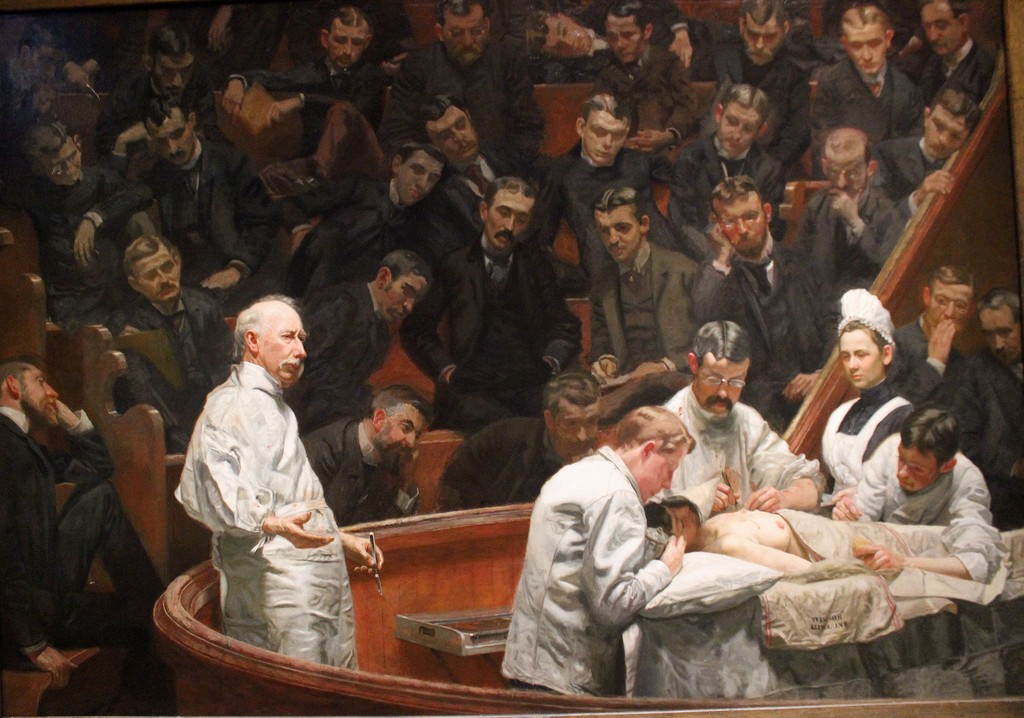
A major public commission followed. University of Pennsylvania medical students asked Eakins to commemorate the retiring surgeon D. Hayes Agnew in 1889. The Agnew Clinic returns to the amphitheatre, but its bright surgical field, larger team, and visible nurse register a different procedure and professional order. Penn Nursing identifies Mary V. Clymer as the nurse and situates the work within changing surgical and nursing practice.[15] Fourteen years after The Gross Clinic, Eakins could revisit medicine without merely repeating his earlier composition.
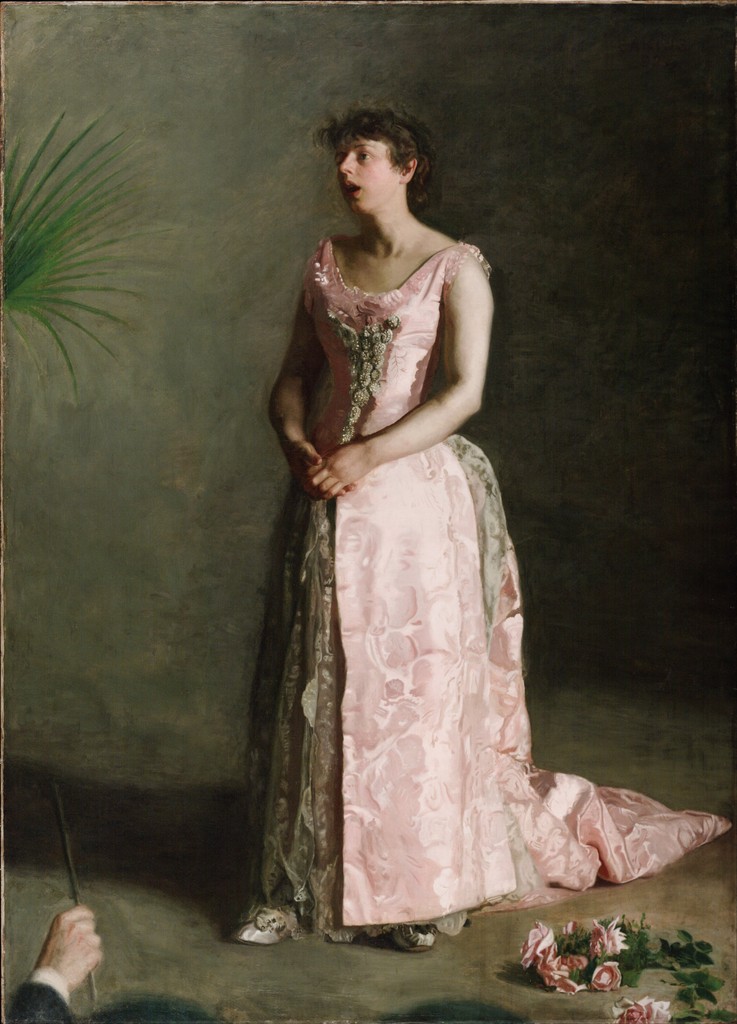
Music offered another route into specialised action. For The Concert Singer, painted from 1890 to 1892, Weda Cook posed repeatedly and sang a phrase by Mendelssohn so that Eakins could observe the physical act of producing a note. He carved the opening music into the painting’s frame, joining portrait, performance, and object.[16] The result is neither a society likeness nor a frozen anecdote: Cook’s concentration makes professional labour visible.
Eakins’s sitters also included physicians, scientists, clergy, artists, teachers, musicians, family members, and former students. His portraits often withheld the social polish expected of commissioned likenesses, which limited their commercial appeal. Yet it would be inaccurate to imagine that no one valued them. Friends accepted sittings, institutions exhibited his work, and portraits entered collections during his lifetime. His position was difficult and uneven, not one of complete isolation.[2][13]
Late Recognition
Eakins briefly returned to large athletic scenes in the late 1890s, painting boxers and wrestlers with the same concern for trained bodies that had shaped the rowing works. The settings were modern sporting venues populated by identifiable contemporaries. At the same time, the quieter portraits continued, including older sitters whose faces and hands carry the evidence of sustained work and age.[2][13]
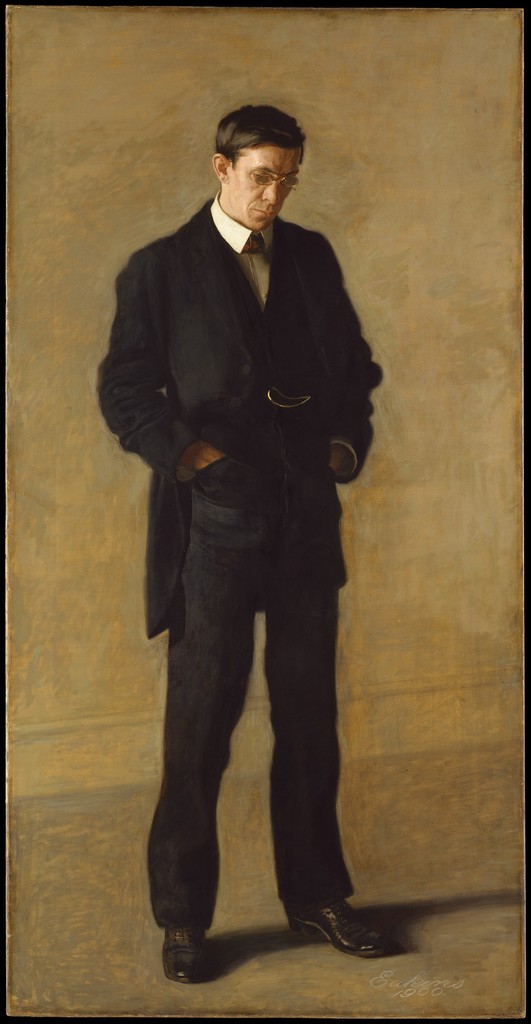
The Thinker: Portrait of Louis N. Kenton of 1900 shows how much Eakins could ask of a standing figure with few narrative cues. Kenton, his brother-in-law, occupies a sparse, dark setting, his head lowered and hands pushed into his pockets. The Metropolitan Museum of Art identifies the life-size canvas as object 17.172 and makes its image available under its open-access programme.[17] Its familiar title names an inward state, but the painting does not illustrate a particular thought. It lets posture, scale, and the sitter’s withdrawal from the viewer carry the portrait.
Recognition became more visible after 1900. Eakins served on exhibition juries and showed his work widely. The National Academy of Design named him an associate in 1902, and PAFA awarded him its Temple Gold Medal in 1904.[8] These honours did not erase earlier conflicts, but they contradict a legend in which the art world ignored him until after death. His reputation expanded during his final decades even while commissions remained limited.
Declining health and eyesight restricted him increasingly, and after 1913 he rarely left home. He died there on June 25, 1916, aged seventy-one.[2][8] The location matters: except for his European years and short absences, the family house and Philadelphia remained the fixed point of a career whose subjects ranged across the city’s social institutions.
Memorial exhibitions quickly gathered the work. The Metropolitan Museum of Art presented sixty paintings in November 1917, followed the next month by a PAFA exhibition of 139 works.[2] By the early 1930s, the Met records, Eakins had acquired the national stature now associated with him. That ascent was not automatic. Exhibitions, scholarship, collecting, and the work of people close to him all helped shape the posthumous view.
Susan Macdowell Eakins was central to that process. After Thomas’s death she resumed painting, producing an intimate posthumous portrait based, it is thought, on one of her photographs. The Philadelphia Museum of Art describes her as a forceful advocate who helped place his art in major public collections.[10] Her stewardship should not eclipse her authorship: the same record that documents her advocacy also preserves a substantial work of her own. Eakins’s afterlife thus depends in part on recognising a woman artist whose career had too often been folded into his.
A Life in Context
Eakins’s biography explains why his subjects repeatedly converge on learning. A rower acquires control through practice; a surgeon performs knowledge before students; a singer’s technique becomes visible in breath and stance; a portrait sitter bears the effects of a profession and an ageing body. His own route through art school, medical lectures, European ateliers, teaching, camera work, and portrait sittings gave him several ways to study those processes.
It also explains why the work remains ethically and historically demanding. Exact observation could produce extraordinary clarity, but the right to observe was not distributed equally among teacher, student, model, patient, and painter. The Academy dispute cannot be detached from his art, nor should it swallow the whole career. Susan’s work cannot be treated as an incidental footnote, and collaborative photographs cannot all be assigned to Thomas by habit. Institutional records make those distinctions possible.[9][10]
The most useful account is consequently neither heroic nor prosecutorial. Eakins was an ambitious artist with formidable technical knowledge, an influential educator whose judgment drew serious objection, and a portraitist whose attachments to Philadelphia gave modern American lives uncommon gravity. His biography provides the chronology; the paintings, photographs, and records preserve the unresolved relationships inside it.
Follow Thomas Eakins's career through four stages
Philadelphia, anatomy, Paris and Spain
Eakins grew up in Philadelphia, studied at PAFA and attended anatomy instruction before training in Paris with Jean-Léon Gérôme and others. Several months in Spain sharpened his attention to direct, materially forceful painting.
Rowers, portraits and a modern clinic
Back in Philadelphia, Eakins made the Schuylkill and people he knew into ambitious subjects. The rowing pictures and The Gross Clinic applied academic discipline to recognisably contemporary American experience.
Teaching, photography and contested authority
At PAFA, Eakins placed anatomy and life study at the centre of training and incorporated photography into studio work. His methods drew loyalty and criticism before the 1886 dispute ended his directorship.
Independent teaching, concentrated portraits and later honours
Eakins continued to teach outside PAFA and increasingly focused on searching portraits of writers, physicians, musicians, artists and friends. Institutional recognition grew late in his life and more fully after his death.
Researched works directory
This searchable evidence census was assembled from public museum records and a reproducible Wikidata snapshot. It is not a catalogue raisonné, not a claim to complete oeuvre coverage, and not a substitute for the published catalogue literature, which was not used to claim absolute completeness.
| Name | Date | Medium |
|---|---|---|
| A Singer (Mrs. W.H. Bowden) | 1906 | Painting |
| A Singer: Portrait of Mrs. W.H. Bowden | 1906 | Painting |
| A Street Scene | Date unknown | Painting |
| A street scene in Sevilla | 1870 | Painting |
| A Street Scene in Seville | 1870 | Painting |
| African-American Man | 1884 | Photography |
| An Actress (Portrait of Suzanne Santje) | 1903 | Painting |
| Anna Lewis | 1890 | Painting |
| Annie C. Lochrey Husson (Mrs. Louis Husson) | 1905 | Painting |
| Antiquated Music (Portrait of Sarah Sagehorn Frishmuth) | 1900 | Painting |
| Arcadia | 1883 | Painting |
| Arcadia | Date unknown | Sculpture |
| Arcadia: Figure Study, Female Nude | 1883 | Painting |
| Arcadia Sketch | 1883 | Painting |
| Arcadian | Date unknown | Painting |
| Archbishop Diomede Falconio | 1905 | Painting |
| Archbishop James Frederick Wood | 1877 | Painting |
| Archbishop James Frederick Wood (1813-1883) | 1876 | Painting |
| Archbishop William Henry Elder | 1903 | Painting |
| Arthur B. Frost | 1886 | Painting |
| Artist and His Father Hunting Reed Birds: Marsh Landscape Sketch | 1873 | Painting |
| B.J. Blommers | 1904 | Painting |
| Baby at Play | 1876 | Painting |
| Baseball Players Practicing | 1875 | Artwork |
| Benjamin Eakins G38 | Date unknown | Painting |
| Bertrand Gardel (Sketch for The Chess Players) | 1875 | Painting |
| Between Rounds | 1898 | Painting |
| Billy Smith | 1898 | Painting |
| Billy Smith (Sketch for Between Rounds) | 1898 | Painting |
| Boy Reclining | 1883 | Painting |
| Carmelita Requena | 1869 | Painting |
| Charles Edmund Dana | 1902 | Painting |
| Charles Percival Buck | 1904 | Painting |
| Clara | 1890 | Painting |
| Courtship | 1878 | Painting |
| Cowboy Singing | 1892 | Painting |
| Cowboys in the Badlands | 1888 | Painting |
| Cowboys in the Badlands sketch 2 | 1888 | Painting |
| Delaware River Scene | 1881 | Painting |
| Delaware River Study | 1881 | Painting |
| Dr. Agnew (Dr. D. Hayes Agnew) (1818-1892) | 1889 | Painting |
| Dr. Agnew (Dr. D. Hayes Agnew) (1818–1892) | 1889 | Painting |
| Dr. Horatio C. Wood | 1886 | Painting |
| Dr. Thomas H. Fenton | 1916 | Painting |
| Drifting | 1875 | Painting |
| Eakins G184 | 1916 | Painting |
| Ecorché: Relief of a Horse (Josephine) | 1882 | Sculpture |
| Edward W. Redfield | 1905 | Painting |
| Fairman Rogers Four-in-Hand: Landscape Study of Fairmount Park | 1879 | Painting |
| Fairman Rogers Four-in-Hand: Study of a Horse's Leg | 1879 | Painting |
| Fairmount Park (Sketch for The Fairman Rogers Four-in-Hand) | Date unknown | Painting |
| Female Model | 1867 | Painting |
| Female Nude | 1884 | Painting |
| Female Nude from the Back | 1889 | Photography |
| Female Nude (Study) | 1881 | Painting |
| Fifty Years Ago (Young Girl Meditating): Study | 1877 | Painting |
| Figure Study: Masked Nude Woman | Date unknown | Painting |
| Figure Study: Nude Woman, Seated, with Arms Lowered (r) | Date unknown | Painting |
| Figure Study: Nude Woman, Seated, with Arms Raised | Date unknown | Painting |
| [Four Sketches: Seated Man, Sleeping Dog, Two Vases(?)] | Date unknown | Painting |
| Frances Eakins | 1870 | Painting |
| Francis J. Ziegler | 1890 | Painting |
| Frank Hamilton Cushing | 1895 | Painting |
| Frank Jay St. John | 1900 | Painting |
| General E. Burd Grubb (1841-1914) | 1898 | Painting |
| Girl with a Fan; Portrait of Miss Gutierrez | Date unknown | Painting |
| Harriet Husson Carville (Mrs. James G. Carville) | 1904 | Painting |
| Harrison S. Morris | 1896 | Painting |
| Hauling the Seine | 1882 | Painting |
| Head of a Man (Rutherford B. Hayes?) | 1877 | Painting |
| Hiawatha | 1874 | Painting |
| Hiawatha | Date unknown | Artwork |
| Home Ranch | 1892 | Painting |
| Home Scene | 1871 | Painting |
| Homespun | 1881 | Painting |
| In the Studio | 1884 | Painting |
| Interior of a Woodcarver's Shop (Sketch for William Rush Carving His Allegorical Figure of the Schuylkill River) | Date unknown | Painting |
| James MacAlister (Sketch) | 1895 | Painting |
| John Biglin in a Single Scull | 1873 | Painting |
| John Biglin in a Single Scull | 1874 | Painting |
| Joseph R. Woodwell | 1904 | Painting |
| Kathrin | 1872 | Painting |
| Knitting | 1881 | Sculpture |
| Knitting | 1882 | Sculpture |
| Knitting | Date unknown | Sculpture |
| Lafayette Park, Washington, D.C. | 1877 | Painting |
| Landscape | 1881 | Painting |
| Landscape | 1882 | Painting |
| Landscape Sketch | 1880 | Painting |
| Landscape (Sketch for Cowboys in the Bad Lands) | 1887 | Painting |
| Landscape Study: Cultivated Field and Tree | 1874 | Painting |
| Landscape Study: Shoreline with Trees | 1874 | Painting |
| Landscape with a Dog | 1874 | Painting |
| Letitia Wilson Jordan | 1888 | Painting |
| Louis Husson | 1899 | Painting |
| Major Manuel Waldteufel | 1907 | Painting |
| Masked nude standing | 1880 | Painting |
| Maud Cook (Mrs. Robert C. Reid) | 1895 | Painting |
| Mending the Net | 1881 | Painting |
| Mending the Net: Study of a Fisherman | Date unknown | Painting |
| Miss Alice Kurtz | 1903 | Painting |
| Miss Amelia Van Buren | 1891 | Painting |
| Miss Eleanor S. F. Pue | 1907 | Painting |
| Miss Gertrude Murray | 1895 | Painting |
| Monsignor James P. Turner | 1906 | Painting |
| Mother (Annie Williams Gandy) | 1903 | Painting |
| Mrs. Gilbert L. Parker | 1910 | Painting |
| Mrs. Mary Arthur | 1900 | Painting |
| Music | 1904 | Painting |
| Nude man with beard | Date unknown | Painting |
| Nude Woman Standing | 1908 | Painting |
| Old Lady Sewing | 1879 | Painting |
| Portrait of a Little Girl | 1897 | Painting |
| Portrait of a Woman Reading | Date unknown | Painting |
| Portrait of Adam S. Bare | 1903 | Painting |
| Portrait of Alfred Reynolds | Date unknown | Painting |
| Portrait of Arthur Burdett Frost | 1886 | Painting |
| Portrait of Ashbury Wright Lee | 1905 | Painting |
| Portrait of Benjamin Eakins | 1894 | Painting |
| Portrait of Benjamin Eakins (Sketch for The Writing Master) | 1882 | Painting |
| Portrait of Blanche Hurlburt | 1885 | Painting |
| Portrait of Douglass Morgan Hall | 1889 | Painting |
| Portrait of Dr. Edward J. Nolan | 1900 | Painting |
| Portrait of Dr. Samuel D. Gross (The Gross Clinic) | 1875 | Painting |
| Portrait of Edward Taylor Snow | 1904 | Painting |
| Portrait of Elizabeth L. Burton | 1905 | Painting |
| Portrait of Florence Einstein | 1905 | Painting |
| Portrait of Henry O. Tanner | 1902 | Painting |
| Portrait of J. Harry Lewis | 1876 | Painting |
| Portrait of John B. Gest | 1905 | Painting |
| Portrait of Joshua Ballinger Lippincott | 1892 | Painting |
| Portrait of Leslie W. Miller | 1901 | Painting |
| Portrait of Lucy Lewis | 1896 | Painting |
| Portrait of Margaret Eakins in a Skating Costume | 1871 | Painting |
| Portrait of Mary Adeline Williams | 1899 | Painting |
| Portrait of Mary Adeline Williams | 1900 | Painting |
| Portrait of Mrs. Fairman Rogers (Study for The Fairman Rogers Four-in-Hand) | 1879 | Painting |
| Portrait of Mrs. Frank Hamilton Cushing | 1895 | Painting |
| Portrait of Mrs. James Mapes Dodge (Josephine Kern) | 1896 | Painting |
| Portrait of Professor Benjamin H. Rand | 1874 | Painting |
| Portrait of Professor W. D. Marks | 1886 | Painting |
| Portrait of Rear Admiral George Wallace Melville | 1904 | Painting |
| Portrait of Walter S. Macdowell | 1904 | Painting |
| Porträt des Alfred Bryan Wall | 1904 | Painting |
| Porträt des David Wilson Jordan | Date unknown | Painting |
| Porträt des John McLure Hamilton (1853- 1936) | 1895 | Painting |
| Professionals at Rehearsal | 1883 | Painting |
| Professor William D Marks | 1886 | Painting |
| Professor William Woolsey Johnson | 1896 | Painting |
| Pushing for Rail | 1874 | Painting |
| Rail Shooting on the Delaware | 1876 | Painting |
| Rear Admiral Charles Dwight Sigsbee G388-2 | 1903 | Painting |
| Rear Admiral George W. Melville | 1905 | Painting |
| Reclining Male Nude | 1887 | Photography |
| Reclining Nude | Date unknown | Painting |
| Retrospection | 1880 | Painting |
| Riter Fitzgerald | 1895 | Painting |
| Robert M. Lindsay | 1900 | Painting |
| Ruth (Ruth W. Harding) | 1903 | Painting |
| Saddle (Sketch for Cowboys in the Bad Lands) | 1887 | Painting |
| Sailboats Racing on the Delaware | 1874 | Painting |
| Sailboats Racing: Study of the Delaware River | 1874 | Painting |
| Sailing | 1875 | Painting |
| Salutat | 1898 | Painting |
| Seated Figures | 1886 | Painting |
| Self-portrait | 1902 | Painting |
| Seventy Years Ago | 1877 | Painting |
| Shad Fishing at Gloucester on the Delaware: Delaware River and Gloucester Pier | 1881 | Painting |
| Shad Fishing at Gloucester on the Delaware River | 1881 | Painting |
| Shad Fishing at Gloucester on the Delaware River: Study of a Woman's Head | 1881 | Painting |
| Ships and Sailboats on the Delaware | 1874 | Painting |
| Ships and Sailboats on the Delaware: Study | 1874 | Painting |
| Shoreline of the Delaware River, with Fishing Nets | Date unknown | Painting |
| Signora Gomez d'Arza | 1901 | Painting |
| Singing a Pathetic Song | 1881 | Painting |
| Sketch for Cowboys in the Bad Lands | 1887 | Painting |
| Sketch for Music (The Violinist) | 1904 | Painting |
| Sketch for Portrait of Dr. Jacob Mendez da Costa | 1893 | Painting |
| Sketch for Portrait of Leslie W. Miller | 1901 | Painting |
| Sketch for Portrait of Letitia Wilson Jordan | 1888 | Painting |
| Sketch for Portrait of Monsignor James P. Turner | 1906 | Painting |
| Sketch for Portrait of Mother Patricia Waldron | 1903 | Painting |
| Sketch for Portrait of Professor George F. Barker | 1886 | Painting |
| Sketch for Seventy Years Ago | Date unknown | Painting |
| Sketch for The Concert Singer | 1892 | Painting |
| Sketch for The Fairman Rogers Four-in-Hand | 1879 | Painting |
| Sketch for The Gross Clinic | 1875 | Painting |
| Sketch for the Surrender of General Lee to General Grant at Appomatox | Date unknown | Painting |
| Sketch for William Rush and His Model | 1908 | Painting |
| Sketch of a Landscape | 1882 | Painting |
| Sketch of a Man and Study of Drapery | 1882 | Painting |
| Sketch of Harry | 1892 | Painting |
| Sketch of Max Schmitt in a Single Scull | 1874 | Painting |
| Sketches for “Home-Spun”, (recto and verso) | 1881 | Painting |
| Sketches (Four on one panel) | Date unknown | Painting |
| Spinning | 1881 | Painting |
| Spinning | 1882 | Sculpture |
| Spinning: Sketch | 1881 | Painting |
| Starting Out After Rail | 1863 | Painting |
| Starting Out After Rail | 1874 | Painting |
| Study for Arcadia: Youth Playing Pipes | 1883 | Painting |
| Study for "Cowboys in the Badlands | 1887 | Painting |
| Study for "Negro Boy Dancing": The Banjo Player | Date unknown | Painting |
| Study for "Negro Boy Dancing": The Boy | Date unknown | Painting |
| Study for Portrait of John McClure Hamilton | 1895 | Painting |
| Study for Salutat | 1898 | Painting |
| Study for 'The Meadows, Gloucester' | 1882 | Painting |
| Study for "William Rush Carving His Allegorical Figure of the Schuylkill River | 1876 | Painting |
| Study of a Groom | 1879 | Painting |
| Study of a Nude Man | 1869 | Painting |
| Study of a Nude Man (The Strong Man) | 1869 | Painting |
| Study of a Seated Nude Woman Wearing a Mask | 1863 | Drawing |
| Study of a Young Woman | 1868 | Painting |
| Study of Dr Samuel David Gross | 1875 | Painting |
| Study of Horse for The Fairman Rogers Four-in-Hand | 1879 | Painting |
| Swimming | 1885 | Painting |
| Taking the Count | 1898 | Painting |
| Taking the Count, study | 1898 | Painting |
| Taking Up Net | 1881 | Painting |
| Talcott Williams | 1889 | Painting |
| That's a New Game Down in Frisco": Study for the Central Standing Figure | 1878 | Painting |
| The Agnew Clinic | 1889 | Painting |
| The Art Student (James Wright) | 1890 | Painting |
| The Artist's Wife and His Setter Dog | 1884 | Painting |
| The Biglin Brothers Racing | 1872 | Painting |
| The Biglin Brothers Turning the Stake | 1873 | Painting |
| The Black Fan (Portrait of Mrs. Talcott Williams) | 1891 | Painting |
| The Bohemian (Portrait of Franklin Louis Schenck) | 1890 | Painting |
| The Brinton House | 1878 | Painting |
| The Cello Player | 1896 | Painting |
| The Champion Single Sculls (Max Schmitt in a Single Scull) | 1871 | Painting |
| The Chaperone | 1908 | Painting |
| The Chess Players | 1876 | Painting |
| The Concert Singer | 1890–1892 | Painting |
| The Courtship | 1878 | Painting |
| The Crucifixion | 1880 | Painting |
| The Dancing Lesson | 1878 | Painting |
| The Dean's Roll Call | 1899 | Painting |
| The Fairman Rogers Four-in-Hand | 1879 | Painting |
| The Fairman Rogers Four-In-Hand (A May Morning in... | 1899 | Painting |
| The Meadows, Gloucester | 1882 | Painting |
| The Model | 1908 | Painting |
| The Oarsmen (The Schreiber Brothers) | 1874 | Painting |
| The Oboe Player (Portrait of Dr. Benjamin Sharp) | 1903 | Painting |
| The Old-Fashioned Dress (Portrait of Helen Montanverde Parker) | 1908 | Painting |
| The Pair-Oared Shell | 1872 | Painting |
| The Pathetic Song | 1881 | Painting |
| The Pianist | 1896 | Painting |
| The Poleman in the Ma'sh | 1881 | Drawing |
| The Red Shawl | 1890 | Painting |
| The Spinner | 1876 | Painting |
| The Thinker: Portrait of Louis N. Kenton | 1900 | Painting |
| The Timer | 1879 | Painting |
| The Translator, Portrait of Monsignor Hugh T. Henry | 1902 | Painting |
| The Veteran (Portrait of George Reynolds) | Date unknown | Painting |
| The Writing Master | 1882 | Painting |
| The Young Man (Portrait of Kern Dodge) | 1898 | Painting |
| Thomas Eakins and John Laurie Wallace on a Beach | 1883 | Photography |
| Three Boys Wading in a Creek | 1883 | Photography |
| Trenton Battle Monument | 1893 | Sculpture |
| Two Pupils in Greek Dress | 1883 | Photography |
| Views of Harry | 1885 | Painting |
| Walt Whitman | 1887 | Painting |
| Whistling for Plover | 1874 | Painting |
| William H. Macdowell | 1884 | Photography |
| William H. Macdowell and Margaret Eakins in Saltville (or Clinch Mountain), Virginia | 1875 | Photography |
| William Hance Macdowell (1816-1906) | 1897 | Painting |
| William Rush and his Model | 1908 | Painting |
| William Rush and His Model | Date unknown | Painting |
| William Rush Carving His Allegorical Figure of the Schuylkill River | 1876 | Painting |
| William Rush Carving His Allegorical Figure of the Schuylkill River | 1908 | Painting |
| William Rush Carving His Allegorical Figure of the Schuylkill River, Study | 1876 | Painting |
| William Rush's Model | 1908 | Painting |
| Wrestlers | 1899 | Painting |
| Young Girl Meditating | 1877 | Painting |
Frequently Asked Questions
Eakins studied at the Pennsylvania Academy of the Fine Arts from 1862 to 1866 and attended anatomy lectures and demonstrations at Jefferson Medical College. From 1866 he trained in Paris, principally with Jean-Léon Gérôme at the École des Beaux-Arts, with shorter periods under Léon Bonnat and the sculptor Augustin-Alexandre Dumont. He then worked in Spain before returning to Philadelphia in July 1870.[1][2]
The institutional sources record his return rather than a single declared motive. Philadelphia offered family, established relationships, art institutions, medical schools, and subjects he knew directly. Once home, he used European academic methods to paint contemporary activities around him, beginning with river sport and domestic scenes. It is safer to describe that productive fit than to invent a private reason not stated in the consulted evidence.[1][3]
They married in 1884, after meeting in 1876 and after Susan had studied and won prizes at PAFA. She was a painter and photographer, not merely a model or keeper of her husband’s papers. Although marriage curtailed her public artistic ambitions, she later returned to painting and played an important part in securing Thomas Eakins’s posthumous reputation.[1][10][11]
Following disputes about his figure-study programme, Eakins removed a loincloth from a male model during a class that included women. Complaints reached the Academy board, which required him to leave his posts. Accounts use slightly different terms for the formal outcome, but agree that he ceased to be PAFA’s director and teacher. Some students later studied with him at the Art Students’ League of Philadelphia.[1][2][8]
His reception was mixed rather than uniformly hostile. Major paintings drew criticism, commissions were irregular, and his Academy career ended in conflict. Yet he exhibited, served on juries, became an associate of the National Academy of Design in 1902, and received PAFA’s Temple Gold Medal in 1904. Large memorial exhibitions in 1917 and Susan Eakins’s advocacy then accelerated the growth of his reputation.[2][8][10]
Discussion
Use this evidence-led guide as a starting point for close looking rather than a final verdict.
Share an observation about Thomas Eakins Biography or a source that adds useful context.
Reader Insights
Which work most clearly complicates the familiar image of Eakins as a strictly literal realist?
Where do Philadelphia, Paris training, anatomy, photography or institutional life most productively alter your reading?
Which source or surviving object would you investigate next?
Join the Conversation
Add your reading below, keeping observations specific and evidence clear.
References
- Archives of American Art, Smithsonian Institution, Biographical Note: Thomas Eakins Letters, 1866–1934, accessed 30 August 2026.
- The Metropolitan Museum of Art, Thomas Eakins (1844–1916): Painting, accessed 30 August 2026.
- The Metropolitan Museum of Art, Thomas Eakins: Exhibition Overview, accessed 30 August 2026.
- Archives of American Art, Smithsonian Institution, Thomas Eakins Letters, 1866–1934, accessed 30 August 2026.
- The Metropolitan Museum of Art, A Street Scene in Seville, accessed 30 August 2026.
- The Metropolitan Museum of Art, The Champion Single Sculls (Max Schmitt in a Single Scull), accessed 30 August 2026.
- Philadelphia Museum of Art, Portrait of Dr. Samuel D. Gross (The Gross Clinic), accessed 30 August 2026.
- Philadelphia Museum of Art, Thomas Eakins: American Realist, accessed 30 August 2026.
- The Metropolitan Museum of Art, Thomas Eakins (1844–1916): Photography, 1880s–90s, accessed 30 August 2026.
- Philadelphia Museum of Art, Susan Macdowell Eakins, Portrait of Thomas Eakins, accessed 30 August 2026.
- The Metropolitan Museum of Art, The Artist’s Wife and His Setter Dog, accessed 30 August 2026.
- Amon Carter Museum of American Art, Swimming, accessed 30 August 2026.
- Smithsonian American Art Museum, Thomas Eakins, accessed 30 August 2026.
- Pennsylvania Academy of the Fine Arts, Walt Whitman, accessed 30 August 2026.
- University of Pennsylvania School of Nursing, Eakins and Clymer, accessed 30 August 2026.
- Philadelphia Museum of Art, The Concert Singer, accessed 30 August 2026.
- The Metropolitan Museum of Art, The Thinker: Portrait of Louis N. Kenton, accessed 30 August 2026.
More EAKINS Artworks
The Agnew Clinic image: gallery photograph by Miguel Hermoso Cuesta, cropped and perspective-corrected, under CC BY-SA 4.0.