


 by Tom Gurney
Tom Gurney BSc (Hons) is an art history expert with over 20 years experience
Page Created on / Page Updated on
Email: tomgurney1@gmail.com / Phone: +44 7429 011000
Thomas Eakins Portraits: Introduction
Portraiture runs through Thomas Eakins’s career, but it does not describe one repeated kind of picture. A likeness might place a physician before students, follow the muscular timing of an athlete, show a singer producing a note, or remove almost every clue except a standing figure. Family members, teachers, friends, artists, writers, doctors, and professional performers all entered this field. The category is therefore wider than a sequence of solemn faces. It includes pictures in which occupation, setting, and action help establish who a person is.[1][2]
The Smithsonian American Art Museum stresses that Eakins often selected people whose achievements interested him instead of depending on the ordinary flow of portrait commissions. The Metropolitan Museum of Art, meanwhile, records both his command of characterisation and the prolonged arrangements he imposed on sitters.[1][3] Neither point makes every likeness a transparent report on a personality. Eakins constructed poses, controlled surroundings, and worked over time. A sound reading begins with those visible and documented choices, then stops short of claiming access to a sitter’s private mind.
This guide follows portraiture as a career-long practice. The broader paintings guide explains how the same methods operate across sport, medicine, and figure composition; here the emphasis falls on relations between artist, sitter, role, and format.
At a Glance
- Career spanPortraits appear from Eakins’s early Philadelphia years through the final decade of his life [2][3]
- Frequent sittersRelatives, teachers, friends, physicians, writers, artists, musicians, and athletes [1][2]
- PatronageA mixture of formal commissions, self-initiated projects, and portraits made after Eakins invited a sitter [1][4]
- Working methodSustained observation, arranged poses, repeated sessions, and, in some cases, related photographic study [2][3]
- FormatsBusts, seated and full-length single figures, portraits in working interiors, and large professional groups [1][2]
- Essential cautionPosture and setting can suggest attention or reserve, but they do not prove a specific thought or diagnosis [10][12]
Contents
- Introduction
- Who Entered the Picture
- Family, Teachers, and Trust
- Portraits in Action
- Change After 1886
- Pose, Costume, and Setting
- Full Length and Inwardness
Who Entered the Picture
Eakins’s portrait practice was shaped by selection. The Smithsonian account describes his respect for achievement and names scientists, physicians, writers, athletes, and musicians among those he asked to pose. Many belonged to Philadelphia networks he knew directly.[1] This preference helps explain why vocation so often matters, yet admiration did not prescribe a single treatment. One sitter may be defined through instruments and activity; another appears with few external signs of work.
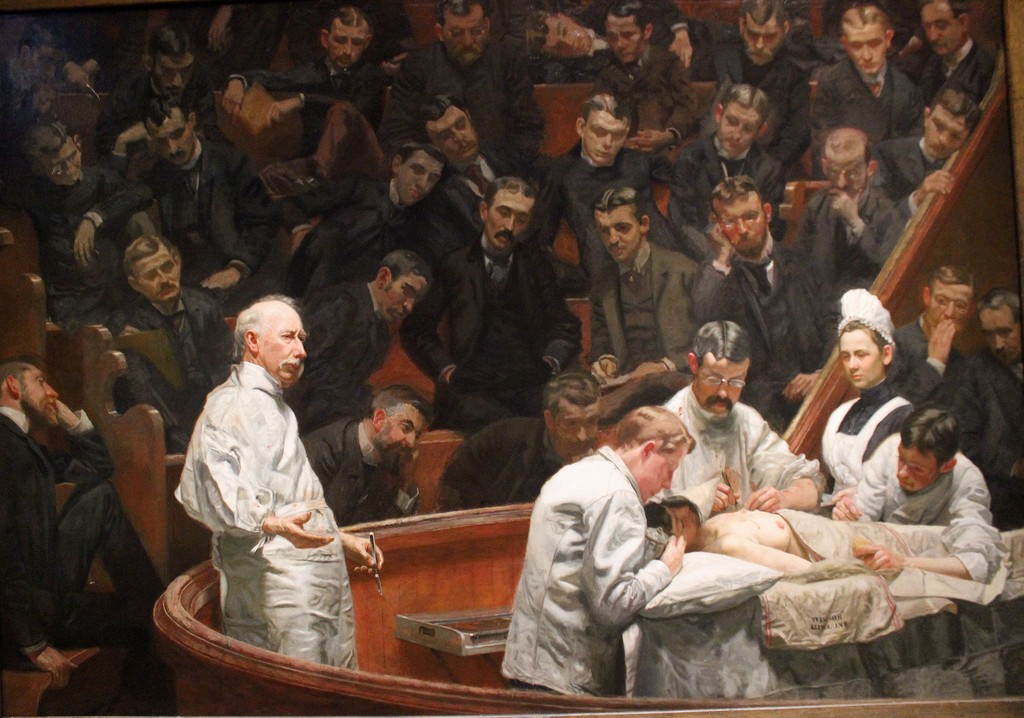
Patronage also varied more than a legend of the commercially rejected artist suggests. In 1874 Eakins invited Benjamin Howard Rand, a former teacher at Central High School and later a Jefferson Medical College professor, to sit for his first monumental portrait outside his family. The completed painting was given to Rand, who subsequently gave it to Jefferson.[4] Portrait of Dr. Samuel D. Gross was initiated by Eakins for the Centennial Exhibition rather than ordered by the surgeon. By contrast, University of Pennsylvania medical students commissioned The Agnew Clinic to honour D. Hayes Agnew on his retirement.[7][8]
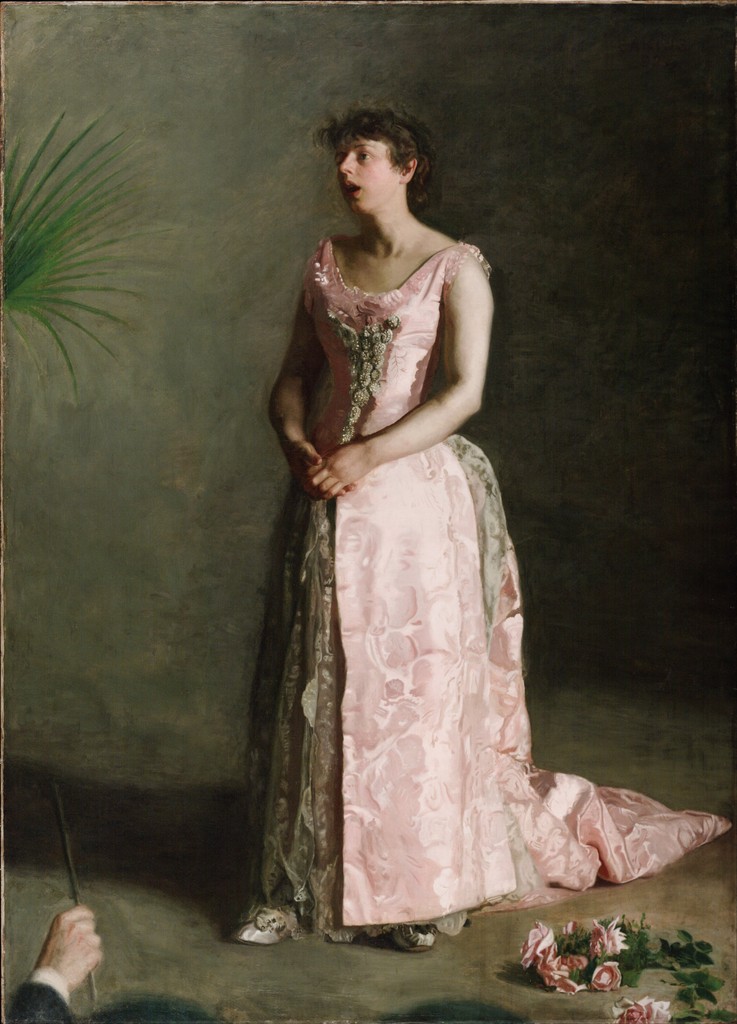
Weda Cook’s The Concert Singer was another invited project, not a society commission. The Philadelphia Museum of Art identifies her as a family friend and describes the work as an extended investigation of musical performance.[2][9] These cases resist a binary choice between paid commission and private experiment. A commemorative group could serve an institution; a large public portrait could begin with the artist; a sitter could contribute time without being the purchaser.
Nor should choosing a sitter be confused with possessing that person’s story. The surviving object records often document occupation, relationship, and the circumstances of a picture more securely than emotion. Those limits are useful. They allow a portrait to remain an encounter between two people rather than evidence for the artist’s unrestricted authority over the sitter’s identity.
Family, Teachers, and Trust
Early and middle-career portraits often grow from familiarity. The Writing Master of 1882 shows Benjamin Eakins copying a document in the copperplate script he taught professionally. The Met notes that Thomas probably received his first drawing lessons from his father and that Benjamin’s investments helped give his son financial independence. The picture honours skilled labour without turning the elder Eakins into a generic emblem of age: the script, desk, hand, and absorbed downward attention belong to a named practice.[5]
Rand’s portrait offers a different balance of closeness and public identity. A microscope and spectroscope establish his scientific work, while a cat, a book, and a crocheted stole introduce the comforts and interruptions of a domestic study. The Philadelphia Museum of Art calls attention to the portrait’s informality and to its importance as Eakins’s major art-gallery submission at the 1876 Centennial after The Gross Clinic was refused admission to that section.[4] Professional distinction is present, but it shares the room with ordinary life.
Susan Macdowell Eakins, herself a painter and photographer, appears in The Artist’s Wife and His Setter Dog. Eakins began it shortly after their 1884 marriage in the studio where they lived with the dog Harry. A photogravure made in 1886 shows that he later altered Susan’s figure, making the canvas evidence of revision rather than a single untouched sitting.[6] The changes should not be converted into a confident account of either spouse’s feelings; the object record supports a history of reworking, not mind-reading.
Friendship could also enable a markedly direct likeness. Eakins painted Walt Whitman in 1887–88 at the poet’s Camden home. PAFA grounds the portrait in the men’s mutual admiration and reports that Whitman preferred it to other images made of him.[11] Its plainness belongs to an established relationship, but familiarity did not produce the same visual result as the domestic detail around Rand or Benjamin Eakins. Trust expanded Eakins’s options; it did not supply a fixed style.
Portraits in Action
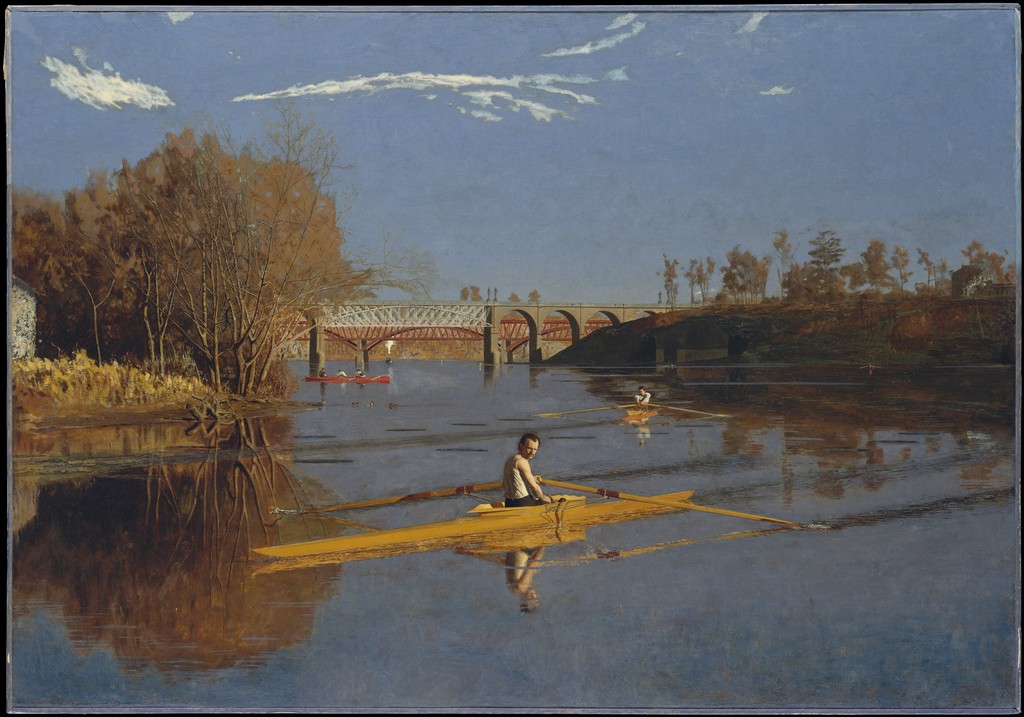
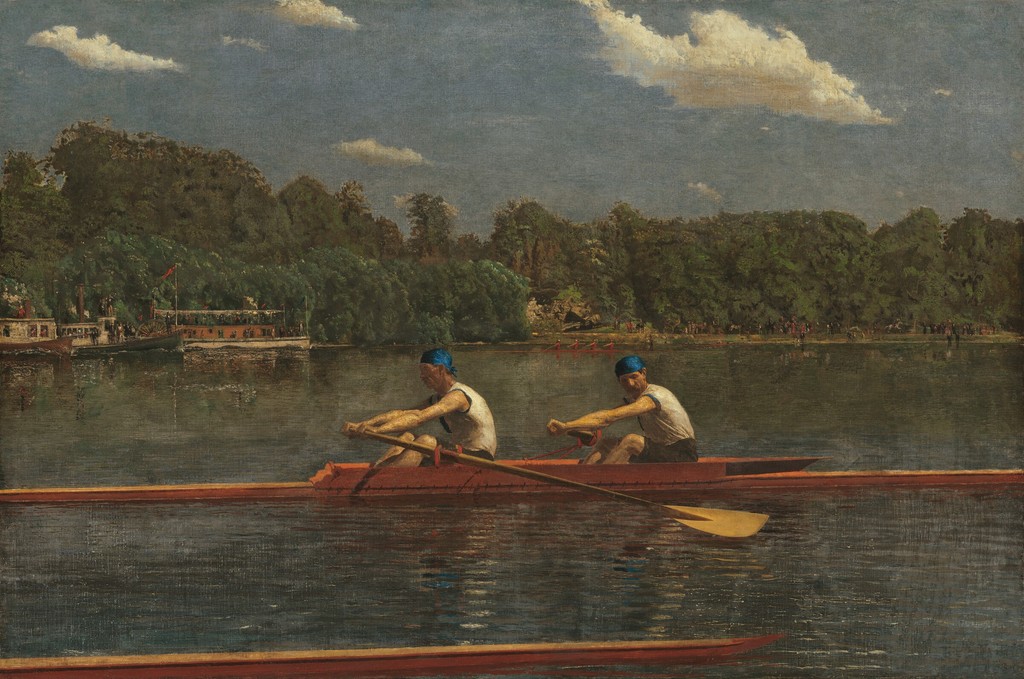
For Eakins, a portrait could identify someone through acquired skill. That principle connects pictures otherwise separated into sporting, medical, and musical subjects. Max Schmitt in a Single Scull places an individual athlete within the balance of boat, oars, current, and familiar river. The Biglin Brothers Racing presents two named professionals through coordinated exertion. These are not conventional studio commissions, yet identity is inseparable from practised action.[2][3]
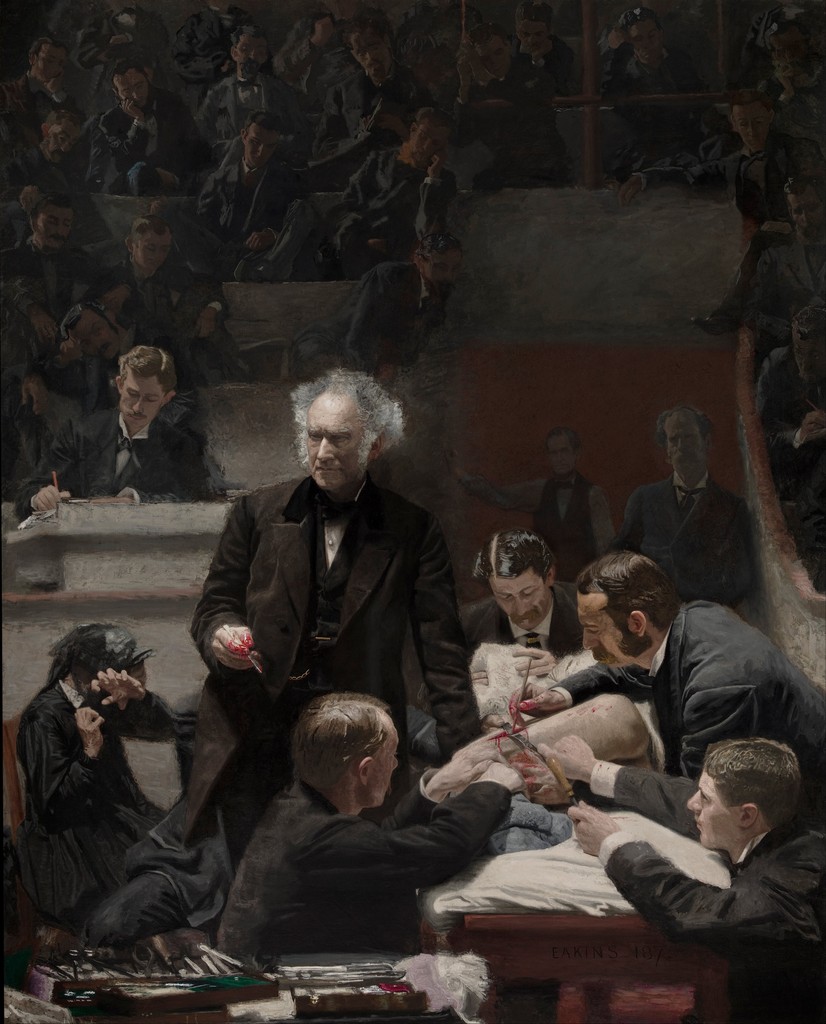
The medical paintings enlarge that idea to institutional scale. In The Gross Clinic, Gross’s upright position, bloodied hand, and address to the amphitheatre establish him simultaneously as surgeon and teacher. Five doctors carry out the procedure while Eakins places himself among the witnesses. The holder title begins with “Portrait of Dr. Samuel D. Gross,” a reminder that the huge group scene is organised around a particular professional presence.[7]
The Agnew Clinic is also a commemorative portrait, but its commission and distribution of work differ. Agnew lectures while assistants operate, and nurse Mary V. Clymer stands conspicuously at the right of the surgical group. Penn’s account identifies Clymer and the operation, allowing the canvas to be read as a set of distinct professional roles rather than a crowd subordinated to facial likeness.[8] Neither clinic should be treated as an enlarged late bust. Their spaces, audiences, vulnerable patients, and hierarchies are part of what portraiture is doing.
The Concert Singer concentrates action within one full-length figure. Cook repeatedly sang the same phrase from Mendelssohn while Eakins observed her mouth and throat; he carved the opening bars into the frame. A conductor’s hand enters from the side, placing her studio pose within performed musical time.[9] The picture differs from the clinics because it isolates rather than multiplies labour. It differs from a static likeness because breath, stance, and vocal effort define the sitter’s public art.
These works make action more than anecdotal background. Equipment, colleagues, audiences, and bodily technique establish relations that a face alone cannot carry. They also prevent “portrait” from becoming synonymous with passivity. Eakins could portray a person by attending to what that person had learned to do.
Change After 1886
Eakins’s departure from the Pennsylvania Academy of the Fine Arts in 1886 altered the balance of his work, but it did not invent his interest in individual sitters. The biography traces the institutional break, while the teaching and anatomy guide examines the contested classroom practices behind it. Portraits of his father, Rand, Gross, rowers, family members, and musicians had already established several approaches before that crisis.[2][4][5][7]
The Philadelphia Museum of Art connects the dismissal, a period of depression, and Eakins’s subsequent concentration on portrait studies.[9] That institutional account supports a major shift in emphasis, not a claim that every later canvas expresses the same personal state. The late practice includes professional performers, relatives, old friends, respected public figures, and people known only indirectly. Some are shown working; others sit or stand in reduced settings.
Extended sittings became one source of the portraits’ density. The Met reports that Eakins carefully managed pose, dress, and setting, and that his demands could tire those who sat for him. For The Concert Singer, Cook began more than eighty sessions by singing the same melody so he could watch its physical production.[3] The number is exceptional enough to resist becoming a casual rule for every work. Different portraits preserve different kinds of evidence about duration.
Nor does the record justify making dissatisfaction the universal response. Some potential patrons feared an unsparing result, and some friends did not take the finished paintings, but Rand accepted his portrait, Whitman valued his, and institutions exhibited Eakins during his lifetime.[1][3][4][11] Commercial difficulty matters, especially when compared with more flattering conventions, yet it cannot explain every choice of sitter or every later format.
Pose, Costume, and Setting
The apparent directness of Eakins’s portraits can obscure how much arranging preceded it. The Met’s retrospective describes him supervising pose, clothing, and surroundings, then recording their details with unusual care.[3] These decisions are not falsifications of the sitter; they are the means by which a painting gives some facts greater weight than others. A chair changes the body’s balance, a long coat extends a standing silhouette, and a worktable directs attention towards the hands. Even an undecorated background is a choice about what the viewer will not be asked to consider.
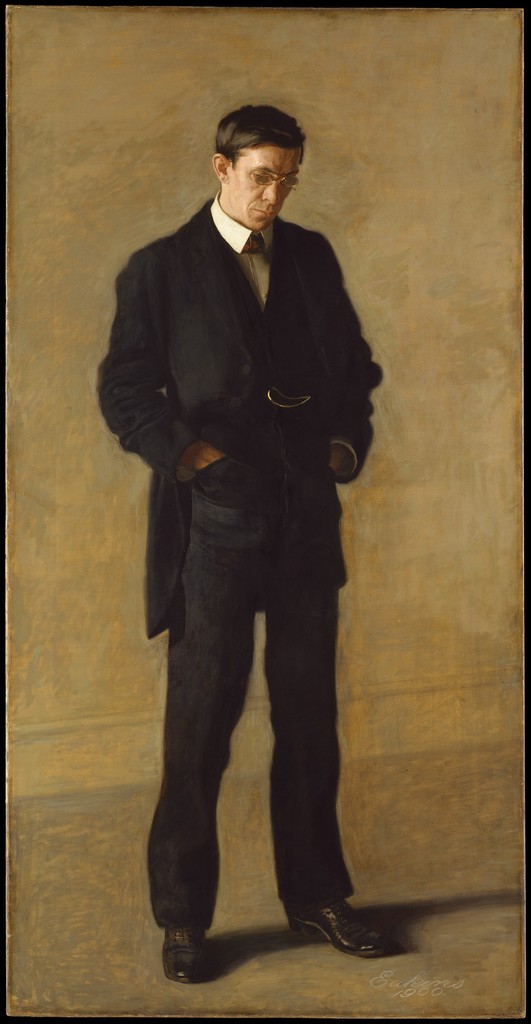
Comparisons make that construction easier to see. Benjamin Eakins bends over a horizontal document, so the father’s lowered face, writing arm, page, and desktop form one compact field.[5] Cook’s vertical dress and lifted chest help translate breath into a full-length image, while the cropped conductor brings an off-canvas collaborator into the event.[9] Kenton also stands, yet both hands are inserted into his front trouser pockets and the narrow room supplies no task. Similar downward attention therefore serves different identities rather than proving one standard mood.[10]
Costume can identify public role, but it can also withhold it. Gross’s dark professional coat separates him from the operating team, whereas Rand’s study mixes scientific instruments with a domestic cat and textiles.[4][7] In Mother (Annie Williams Gandy), morning dress replaces ceremonial presentation.[12] None of those clothes should be read as a complete social biography. They establish the terms under which a sitter appears in this particular object.
Revision further complicates any belief that the first pose simply passed onto canvas. The earlier photogravure of Susan Eakins’s portrait documents a figure that was subsequently changed.[6] That evidence does not explain every motive, but it does reveal portrait-making as an activity capable of continuing after an initial arrangement. Looking for alteration, duration, and selection gives the viewer firmer ground than treating resemblance as an instantaneous capture.
Full Length and Inwardness
Two major full-length portraits show why format should come before a general label such as “psychological.” Cook stands before a dark field, her light dress extending nearly through the height of The Concert Singer. The visible conductor’s hand and documented singing sessions make concentration legible as performance.[9] In The Thinker: Portrait of Louis N. Kenton, an 82-by-42-inch canvas gives the solitary figure a much narrower vertical enclosure. Kenton lowers his head and inserts both hands into his front trouser pockets; no workplace or audience explains the pose.[10]
The Met identifies Kenton as Eakins’s brother-in-law but says little is known about him. It also explains that the familiar title comes from an inscription apparently added to the reverse by Susan Eakins. Contemporary critics praised the portrait’s sober colour and introspective bearing after it began to circulate in exhibitions in 1900.[10] Those are firm grounds for discussing how the work was seen. They do not reveal what Kenton was thinking, whether the stance recorded a habitual mood, or whether the image diagnoses the sitter.
Scale is not the only route to inward attention. Mother (Annie Williams Gandy), painted around 1903, is a 24-by-20-inch bust of a close friend of Thomas and Susan. The Smithsonian notes the morning coat and braids that make the encounter seem informal, as well as the unidealised lines of the face.[12] Compared with Kenton’s long coat and surrounding vertical space, the smaller picture brings the viewer close. Both can be described as pensive, but the distinct visual evidence should remain visible beneath that shared adjective.
This is also why “severe” is inadequate as a verdict on the whole portrait practice. Rand’s cat disrupts his scholarly concentration; Benjamin Eakins works at an exact craft; Gross addresses students; Cook sings; Whitman meets the viewer from a familiar room; Kenton withdraws his gaze. Dark palettes and unembellished faces recur, yet purpose, format, and relationship keep changing.
A careful viewer can ask a sequence of grounded questions. Was the picture commissioned, invited, or made within a family? What does the holder know about the sitter? Which objects or colleagues establish a role? How large is the canvas, and what portion of it does the body occupy? Is repeated sitting documented, or merely assumed? Such questions make room for psychological complexity without pretending that a painted posture is a transcript of consciousness.
Researched works directory
This searchable evidence census was assembled from public museum records and a reproducible Wikidata snapshot. It is not a catalogue raisonné, not a claim to complete oeuvre coverage, and not a substitute for the published catalogue literature, which was not used to claim absolute completeness.
| Name | Date | Medium |
|---|---|---|
| A Singer (Mrs. W.H. Bowden) | 1906 | Painting |
| A Singer: Portrait of Mrs. W.H. Bowden | 1906 | Painting |
| A Street Scene | Date unknown | Painting |
| A street scene in Sevilla | 1870 | Painting |
| A Street Scene in Seville | 1870 | Painting |
| African-American Man | 1884 | Photography |
| An Actress (Portrait of Suzanne Santje) | 1903 | Painting |
| Anna Lewis | 1890 | Painting |
| Annie C. Lochrey Husson (Mrs. Louis Husson) | 1905 | Painting |
| Antiquated Music (Portrait of Sarah Sagehorn Frishmuth) | 1900 | Painting |
| Arcadia | 1883 | Painting |
| Arcadia | Date unknown | Sculpture |
| Arcadia: Figure Study, Female Nude | 1883 | Painting |
| Arcadia Sketch | 1883 | Painting |
| Arcadian | Date unknown | Painting |
| Archbishop Diomede Falconio | 1905 | Painting |
| Archbishop James Frederick Wood | 1877 | Painting |
| Archbishop James Frederick Wood (1813-1883) | 1876 | Painting |
| Archbishop William Henry Elder | 1903 | Painting |
| Arthur B. Frost | 1886 | Painting |
| Artist and His Father Hunting Reed Birds: Marsh Landscape Sketch | 1873 | Painting |
| B.J. Blommers | 1904 | Painting |
| Baby at Play | 1876 | Painting |
| Baseball Players Practicing | 1875 | Artwork |
| Benjamin Eakins G38 | Date unknown | Painting |
| Bertrand Gardel (Sketch for The Chess Players) | 1875 | Painting |
| Between Rounds | 1898 | Painting |
| Billy Smith | 1898 | Painting |
| Billy Smith (Sketch for Between Rounds) | 1898 | Painting |
| Boy Reclining | 1883 | Painting |
| Carmelita Requena | 1869 | Painting |
| Charles Edmund Dana | 1902 | Painting |
| Charles Percival Buck | 1904 | Painting |
| Clara | 1890 | Painting |
| Courtship | 1878 | Painting |
| Cowboy Singing | 1892 | Painting |
| Cowboys in the Badlands | 1888 | Painting |
| Cowboys in the Badlands sketch 2 | 1888 | Painting |
| Delaware River Scene | 1881 | Painting |
| Delaware River Study | 1881 | Painting |
| Dr. Agnew (Dr. D. Hayes Agnew) (1818-1892) | 1889 | Painting |
| Dr. Agnew (Dr. D. Hayes Agnew) (1818–1892) | 1889 | Painting |
| Dr. Horatio C. Wood | 1886 | Painting |
| Dr. Thomas H. Fenton | 1916 | Painting |
| Drifting | 1875 | Painting |
| Eakins G184 | 1916 | Painting |
| Ecorché: Relief of a Horse (Josephine) | 1882 | Sculpture |
| Edward W. Redfield | 1905 | Painting |
| Fairman Rogers Four-in-Hand: Landscape Study of Fairmount Park | 1879 | Painting |
| Fairman Rogers Four-in-Hand: Study of a Horse's Leg | 1879 | Painting |
| Fairmount Park (Sketch for The Fairman Rogers Four-in-Hand) | Date unknown | Painting |
| Female Model | 1867 | Painting |
| Female Nude | 1884 | Painting |
| Female Nude from the Back | 1889 | Photography |
| Female Nude (Study) | 1881 | Painting |
| Fifty Years Ago (Young Girl Meditating): Study | 1877 | Painting |
| Figure Study: Masked Nude Woman | Date unknown | Painting |
| Figure Study: Nude Woman, Seated, with Arms Lowered (r) | Date unknown | Painting |
| Figure Study: Nude Woman, Seated, with Arms Raised | Date unknown | Painting |
| [Four Sketches: Seated Man, Sleeping Dog, Two Vases(?)] | Date unknown | Painting |
| Frances Eakins | 1870 | Painting |
| Francis J. Ziegler | 1890 | Painting |
| Frank Hamilton Cushing | 1895 | Painting |
| Frank Jay St. John | 1900 | Painting |
| General E. Burd Grubb (1841-1914) | 1898 | Painting |
| Girl with a Fan; Portrait of Miss Gutierrez | Date unknown | Painting |
| Harriet Husson Carville (Mrs. James G. Carville) | 1904 | Painting |
| Harrison S. Morris | 1896 | Painting |
| Hauling the Seine | 1882 | Painting |
| Head of a Man (Rutherford B. Hayes?) | 1877 | Painting |
| Hiawatha | 1874 | Painting |
| Hiawatha | Date unknown | Artwork |
| Home Ranch | 1892 | Painting |
| Home Scene | 1871 | Painting |
| Homespun | 1881 | Painting |
| In the Studio | 1884 | Painting |
| Interior of a Woodcarver's Shop (Sketch for William Rush Carving His Allegorical Figure of the Schuylkill River) | Date unknown | Painting |
| James MacAlister (Sketch) | 1895 | Painting |
| John Biglin in a Single Scull | 1873 | Painting |
| John Biglin in a Single Scull | 1874 | Painting |
| Joseph R. Woodwell | 1904 | Painting |
| Kathrin | 1872 | Painting |
| Knitting | 1881 | Sculpture |
| Knitting | 1882 | Sculpture |
| Knitting | Date unknown | Sculpture |
| Lafayette Park, Washington, D.C. | 1877 | Painting |
| Landscape | 1881 | Painting |
| Landscape | 1882 | Painting |
| Landscape Sketch | 1880 | Painting |
| Landscape (Sketch for Cowboys in the Bad Lands) | 1887 | Painting |
| Landscape Study: Cultivated Field and Tree | 1874 | Painting |
| Landscape Study: Shoreline with Trees | 1874 | Painting |
| Landscape with a Dog | 1874 | Painting |
| Letitia Wilson Jordan | 1888 | Painting |
| Louis Husson | 1899 | Painting |
| Major Manuel Waldteufel | 1907 | Painting |
| Masked nude standing | 1880 | Painting |
| Maud Cook (Mrs. Robert C. Reid) | 1895 | Painting |
| Mending the Net | 1881 | Painting |
| Mending the Net: Study of a Fisherman | Date unknown | Painting |
| Miss Alice Kurtz | 1903 | Painting |
| Miss Amelia Van Buren | 1891 | Painting |
| Miss Eleanor S. F. Pue | 1907 | Painting |
| Miss Gertrude Murray | 1895 | Painting |
| Monsignor James P. Turner | 1906 | Painting |
| Mother (Annie Williams Gandy) | 1903 | Painting |
| Mrs. Gilbert L. Parker | 1910 | Painting |
| Mrs. Mary Arthur | 1900 | Painting |
| Music | 1904 | Painting |
| Nude man with beard | Date unknown | Painting |
| Nude Woman Standing | 1908 | Painting |
| Old Lady Sewing | 1879 | Painting |
| Portrait of a Little Girl | 1897 | Painting |
| Portrait of a Woman Reading | Date unknown | Painting |
| Portrait of Adam S. Bare | 1903 | Painting |
| Portrait of Alfred Reynolds | Date unknown | Painting |
| Portrait of Arthur Burdett Frost | 1886 | Painting |
| Portrait of Ashbury Wright Lee | 1905 | Painting |
| Portrait of Benjamin Eakins | 1894 | Painting |
| Portrait of Benjamin Eakins (Sketch for The Writing Master) | 1882 | Painting |
| Portrait of Blanche Hurlburt | 1885 | Painting |
| Portrait of Douglass Morgan Hall | 1889 | Painting |
| Portrait of Dr. Edward J. Nolan | 1900 | Painting |
| Portrait of Dr. Samuel D. Gross (The Gross Clinic) | 1875 | Painting |
| Portrait of Edward Taylor Snow | 1904 | Painting |
| Portrait of Elizabeth L. Burton | 1905 | Painting |
| Portrait of Florence Einstein | 1905 | Painting |
| Portrait of Henry O. Tanner | 1902 | Painting |
| Portrait of J. Harry Lewis | 1876 | Painting |
| Portrait of John B. Gest | 1905 | Painting |
| Portrait of Joshua Ballinger Lippincott | 1892 | Painting |
| Portrait of Leslie W. Miller | 1901 | Painting |
| Portrait of Lucy Lewis | 1896 | Painting |
| Portrait of Margaret Eakins in a Skating Costume | 1871 | Painting |
| Portrait of Mary Adeline Williams | 1899 | Painting |
| Portrait of Mary Adeline Williams | 1900 | Painting |
| Portrait of Mrs. Fairman Rogers (Study for The Fairman Rogers Four-in-Hand) | 1879 | Painting |
| Portrait of Mrs. Frank Hamilton Cushing | 1895 | Painting |
| Portrait of Mrs. James Mapes Dodge (Josephine Kern) | 1896 | Painting |
| Portrait of Professor Benjamin H. Rand | 1874 | Painting |
| Portrait of Professor W. D. Marks | 1886 | Painting |
| Portrait of Rear Admiral George Wallace Melville | 1904 | Painting |
| Portrait of Walter S. Macdowell | 1904 | Painting |
| Porträt des Alfred Bryan Wall | 1904 | Painting |
| Porträt des David Wilson Jordan | Date unknown | Painting |
| Porträt des John McLure Hamilton (1853- 1936) | 1895 | Painting |
| Professionals at Rehearsal | 1883 | Painting |
| Professor William D Marks | 1886 | Painting |
| Professor William Woolsey Johnson | 1896 | Painting |
| Pushing for Rail | 1874 | Painting |
| Rail Shooting on the Delaware | 1876 | Painting |
| Rear Admiral Charles Dwight Sigsbee G388-2 | 1903 | Painting |
| Rear Admiral George W. Melville | 1905 | Painting |
| Reclining Male Nude | 1887 | Photography |
| Reclining Nude | Date unknown | Painting |
| Retrospection | 1880 | Painting |
| Riter Fitzgerald | 1895 | Painting |
| Robert M. Lindsay | 1900 | Painting |
| Ruth (Ruth W. Harding) | 1903 | Painting |
| Saddle (Sketch for Cowboys in the Bad Lands) | 1887 | Painting |
| Sailboats Racing on the Delaware | 1874 | Painting |
| Sailboats Racing: Study of the Delaware River | 1874 | Painting |
| Sailing | 1875 | Painting |
| Salutat | 1898 | Painting |
| Seated Figures | 1886 | Painting |
| Self-portrait | 1902 | Painting |
| Seventy Years Ago | 1877 | Painting |
| Shad Fishing at Gloucester on the Delaware: Delaware River and Gloucester Pier | 1881 | Painting |
| Shad Fishing at Gloucester on the Delaware River | 1881 | Painting |
| Shad Fishing at Gloucester on the Delaware River: Study of a Woman's Head | 1881 | Painting |
| Ships and Sailboats on the Delaware | 1874 | Painting |
| Ships and Sailboats on the Delaware: Study | 1874 | Painting |
| Shoreline of the Delaware River, with Fishing Nets | Date unknown | Painting |
| Signora Gomez d'Arza | 1901 | Painting |
| Singing a Pathetic Song | 1881 | Painting |
| Sketch for Cowboys in the Bad Lands | 1887 | Painting |
| Sketch for Music (The Violinist) | 1904 | Painting |
| Sketch for Portrait of Dr. Jacob Mendez da Costa | 1893 | Painting |
| Sketch for Portrait of Leslie W. Miller | 1901 | Painting |
| Sketch for Portrait of Letitia Wilson Jordan | 1888 | Painting |
| Sketch for Portrait of Monsignor James P. Turner | 1906 | Painting |
| Sketch for Portrait of Mother Patricia Waldron | 1903 | Painting |
| Sketch for Portrait of Professor George F. Barker | 1886 | Painting |
| Sketch for Seventy Years Ago | Date unknown | Painting |
| Sketch for The Concert Singer | 1892 | Painting |
| Sketch for The Fairman Rogers Four-in-Hand | 1879 | Painting |
| Sketch for The Gross Clinic | 1875 | Painting |
| Sketch for the Surrender of General Lee to General Grant at Appomatox | Date unknown | Painting |
| Sketch for William Rush and His Model | 1908 | Painting |
| Sketch of a Landscape | 1882 | Painting |
| Sketch of a Man and Study of Drapery | 1882 | Painting |
| Sketch of Harry | 1892 | Painting |
| Sketch of Max Schmitt in a Single Scull | 1874 | Painting |
| Sketches for “Home-Spun”, (recto and verso) | 1881 | Painting |
| Sketches (Four on one panel) | Date unknown | Painting |
| Spinning | 1881 | Painting |
| Spinning | 1882 | Sculpture |
| Spinning: Sketch | 1881 | Painting |
| Starting Out After Rail | 1863 | Painting |
| Starting Out After Rail | 1874 | Painting |
| Study for Arcadia: Youth Playing Pipes | 1883 | Painting |
| Study for "Cowboys in the Badlands | 1887 | Painting |
| Study for "Negro Boy Dancing": The Banjo Player | Date unknown | Painting |
| Study for "Negro Boy Dancing": The Boy | Date unknown | Painting |
| Study for Portrait of John McClure Hamilton | 1895 | Painting |
| Study for Salutat | 1898 | Painting |
| Study for 'The Meadows, Gloucester' | 1882 | Painting |
| Study for "William Rush Carving His Allegorical Figure of the Schuylkill River | 1876 | Painting |
| Study of a Groom | 1879 | Painting |
| Study of a Nude Man | 1869 | Painting |
| Study of a Nude Man (The Strong Man) | 1869 | Painting |
| Study of a Seated Nude Woman Wearing a Mask | 1863 | Drawing |
| Study of a Young Woman | 1868 | Painting |
| Study of Dr Samuel David Gross | 1875 | Painting |
| Study of Horse for The Fairman Rogers Four-in-Hand | 1879 | Painting |
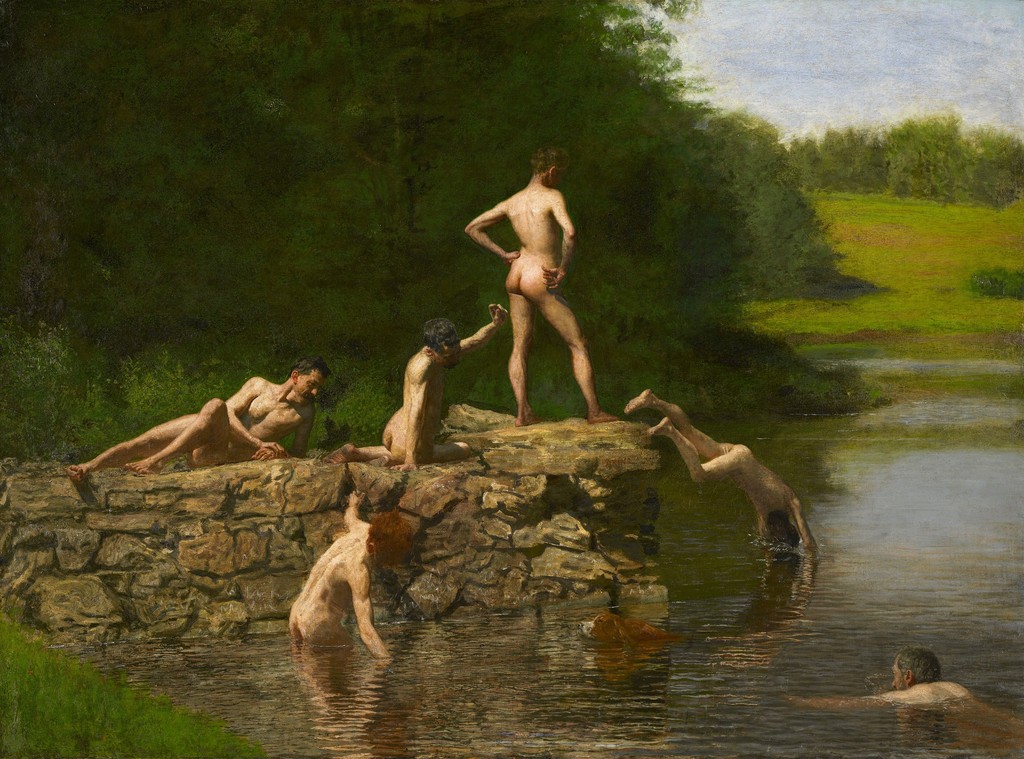
| Swimming | 1885 | Painting |
| Taking the Count | 1898 | Painting |
| Taking the Count, study | 1898 | Painting |
| Taking Up Net | 1881 | Painting |
| Talcott Williams | 1889 | Painting |
| That's a New Game Down in Frisco": Study for the Central Standing Figure | 1878 | Painting |
| The Agnew Clinic | 1889 | Painting |
| The Art Student (James Wright) | 1890 | Painting |
| The Artist's Wife and His Setter Dog | 1884 | Painting |
| The Biglin Brothers Racing | 1872 | Painting |
| The Biglin Brothers Turning the Stake | 1873 | Painting |
| The Black Fan (Portrait of Mrs. Talcott Williams) | 1891 | Painting |
| The Bohemian (Portrait of Franklin Louis Schenck) | 1890 | Painting |
| The Brinton House | 1878 | Painting |
| The Cello Player | 1896 | Painting |
| The Champion Single Sculls (Max Schmitt in a Single Scull) | 1871 | Painting |
| The Chaperone | 1908 | Painting |
| The Chess Players | 1876 | Painting |
| The Concert Singer | 1890–1892 | Painting |
| The Courtship | 1878 | Painting |
| The Crucifixion | 1880 | Painting |
| The Dancing Lesson | 1878 | Painting |
| The Dean's Roll Call | 1899 | Painting |
| The Fairman Rogers Four-in-Hand | 1879 | Painting |
| The Fairman Rogers Four-In-Hand (A May Morning in... | 1899 | Painting |
| The Meadows, Gloucester | 1882 | Painting |
| The Model | 1908 | Painting |
| The Oarsmen (The Schreiber Brothers) | 1874 | Painting |
| The Oboe Player (Portrait of Dr. Benjamin Sharp) | 1903 | Painting |
| The Old-Fashioned Dress (Portrait of Helen Montanverde Parker) | 1908 | Painting |
| The Pair-Oared Shell | 1872 | Painting |
| The Pathetic Song | 1881 | Painting |
| The Pianist | 1896 | Painting |
| The Poleman in the Ma'sh | 1881 | Drawing |
| The Red Shawl | 1890 | Painting |
| The Spinner | 1876 | Painting |
| The Thinker: Portrait of Louis N. Kenton | 1900 | Painting |
| The Timer | 1879 | Painting |
| The Translator, Portrait of Monsignor Hugh T. Henry | 1902 | Painting |
| The Veteran (Portrait of George Reynolds) | Date unknown | Painting |
| The Writing Master | 1882 | Painting |
| The Young Man (Portrait of Kern Dodge) | 1898 | Painting |
| Thomas Eakins and John Laurie Wallace on a Beach | 1883 | Photography |
| Three Boys Wading in a Creek | 1883 | Photography |
| Trenton Battle Monument | 1893 | Sculpture |
| Two Pupils in Greek Dress | 1883 | Photography |
| Views of Harry | 1885 | Painting |
| Walt Whitman | 1887 | Painting |
| Whistling for Plover | 1874 | Painting |
| William H. Macdowell | 1884 | Photography |
| William H. Macdowell and Margaret Eakins in Saltville (or Clinch Mountain), Virginia | 1875 | Photography |
| William Hance Macdowell (1816-1906) | 1897 | Painting |
| William Rush and his Model | 1908 | Painting |
| William Rush and His Model | Date unknown | Painting |
| William Rush Carving His Allegorical Figure of the Schuylkill River | 1876 | Painting |
| William Rush Carving His Allegorical Figure of the Schuylkill River | 1908 | Painting |
| William Rush Carving His Allegorical Figure of the Schuylkill River, Study | 1876 | Painting |
| William Rush's Model | 1908 | Painting |
| Wrestlers | 1899 | Painting |
| Young Girl Meditating | 1877 | Painting |
Frequently Asked Questions
They broaden portraiture beyond social appearance. Eakins could represent accomplishment through a working hand, a medical demonstration, athletic timing, vocal effort, or sustained stillness. His strongest likenesses connect a named person to a particular body, role, and setting while leaving parts of character unresolved.[1][2]
No. Some major works were commissioned, including The Agnew Clinic, but Eakins often selected and invited sitters himself. He initiated the portraits of Rand, Gross, and Cook under different arrangements. The resulting practice mixed institutional commemoration, public ambition, friendship, family access, and personal artistic choice.[1][4][7][8][9]
The Philadelphia Museum of Art links Eakins’s loss of his PAFA position and a difficult interruption in painting to a later concentration on portraits.[9] The shift was substantial, but portraiture had been central much earlier. It is best understood as an increased emphasis after an institutional rupture, not as an entirely new practice born in one year.
It is a full-length portrait of Weda Cook and also a representation of professional performance. Her identity, repeated singing sessions, arranged dress, conductor’s hand, and musically carved frame all matter. Calling it a portrait does not require removing the activity that makes this particular sitter intelligible.[2][9]
It establishes Kenton’s physical presence through scale, dress, lowered head, withheld hands, and sparse surroundings. Its exhibition history supports discussion of introspection, but the Met notes that little is known about the sitter and that the title was added on the reverse, apparently by Susan Eakins. The painting suggests thought without identifying its content.[10]
Discussion
Use this evidence-led guide as a starting point for close looking rather than a final verdict.
Share an observation about Thomas Eakins Portraits or a source that adds useful context.
Reader Insights
Which work most clearly complicates the familiar image of Eakins as a strictly literal realist?
Where do Philadelphia, Paris training, anatomy, photography or institutional life most productively alter your reading?
Which source or surviving object would you investigate next?
Join the Conversation
Add your reading below, keeping observations specific and evidence clear.
References
- Smithsonian American Art Museum, Thomas Eakins, accessed 30 August 2026.
- Philadelphia Museum of Art, Thomas Eakins: American Realist, accessed 30 August 2026.
- The Metropolitan Museum of Art, Thomas Eakins: Exhibition Overview, accessed 30 August 2026.
- Philadelphia Museum of Art, Portrait of Dr. Benjamin H. Rand, accessed 30 August 2026.
- The Metropolitan Museum of Art, The Writing Master, accessed 30 August 2026.
- The Metropolitan Museum of Art, The Artist’s Wife and His Setter Dog, accessed 30 August 2026.
- Philadelphia Museum of Art, Portrait of Dr. Samuel D. Gross (The Gross Clinic), accessed 30 August 2026.
- University of Pennsylvania School of Nursing, Eakins and Clymer, accessed 30 August 2026.
- Philadelphia Museum of Art, The Concert Singer, accessed 30 August 2026.
- The Metropolitan Museum of Art, The Thinker: Portrait of Louis N. Kenton, accessed 30 August 2026.
- Pennsylvania Academy of the Fine Arts, Walt Whitman, accessed 30 August 2026.
- Smithsonian American Art Museum, Mother (Annie Williams Gandy), accessed 30 August 2026.
More EAKINS Artworks
The Agnew Clinic image: gallery photograph by Miguel Hermoso Cuesta, cropped and perspective-corrected, under CC BY-SA 4.0.