


 by Tom Gurney
Tom Gurney BSc (Hons) is an art history expert with over 20 years experience
Page Created on / Page Updated on
Email: tomgurney1@gmail.com / Phone: +44 7429 011000
Swimming: Introduction
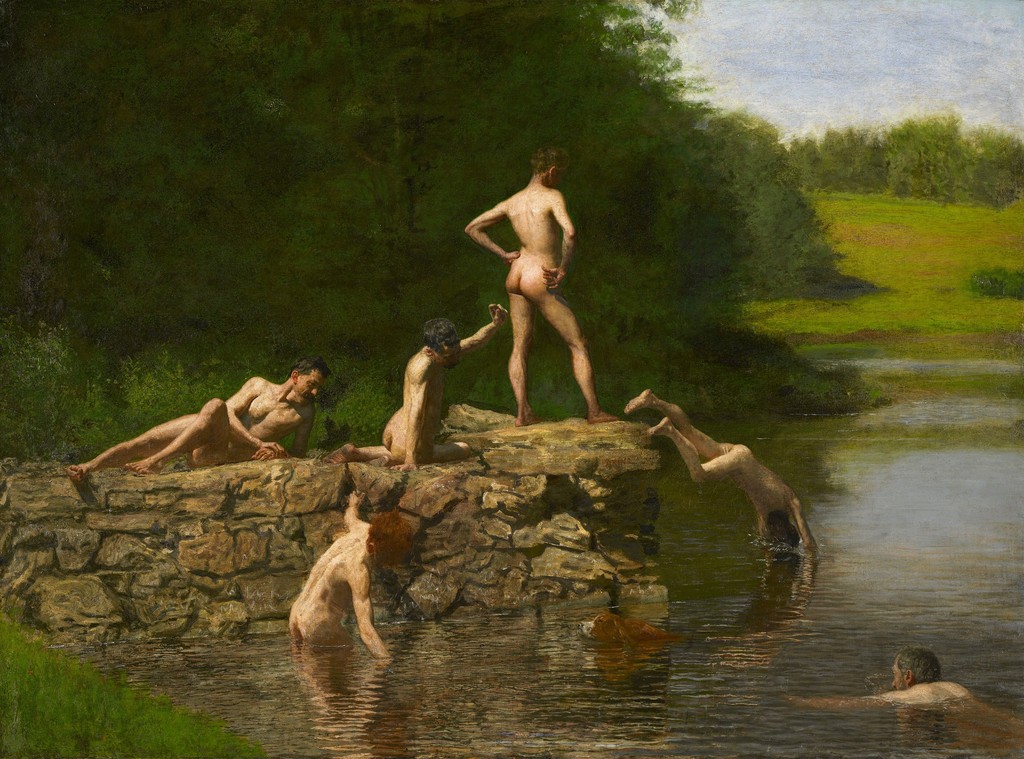
Thomas Eakins’s Swimming gathers six nude men, a dog, a low stone ledge, and a quiet reach of water into one of his most carefully differentiated figure compositions. One man reclines, another sits upright, a third stands with his back to us, a fourth dives, a fifth wades, and Eakins himself swims at the lower right. Their actions do not merge into a general image of “bathers.” Each body meets gravity, stone, or water in a different way.
The Amon Carter Museum of American Art dates the oil on canvas to 1885 and records it as accession 1990.19.1. The museum uses the concise title Swimming, gives the dimensions as 27 3/8 by 36 3/8 inches, and notes the signature and date “EAKINS 1885” on the central rock.[1] These object facts correct older labels on the reverse that used The Swimming Hole and an erroneous date of 1883. They also distinguish the holder record from a modern image filename that misdates the painting.
Close looking reveals a work poised between recreation, group portraiture, artistic training, and public declaration. Edward H. Coates, head of the Pennsylvania Academy of the Fine Arts’ Committee on Instruction, commissioned Eakins to make a painting for the institution. What Eakins produced brought his commitment to nude life study into view through portraits of himself and male students.[2][3] The commission was refused. That history makes the canvas’s surface calm more, rather than less, complicated.
At a Glance
- Current titleSwimming; the work was long known as The Swimming Hole [1][2]
- Artist and dateThomas Eakins, 1885, signed and dated on the central rock [1]
- Medium and sizeOil on canvas, 27 3/8 × 36 3/8 inches [1]
- FiguresSix nude men in distinct poses, including Eakins swimming towards his dog, Harry [1]
- CommissionRequested by Edward H. Coates for the Pennsylvania Academy, then declined after exhibition in 1885 [2][3]
- CollectionAmon Carter Museum of American Art, Fort Worth, accession 1990.19.1 [1]
Thomas Eakins in context
The Gross Clinic
1875Swimming
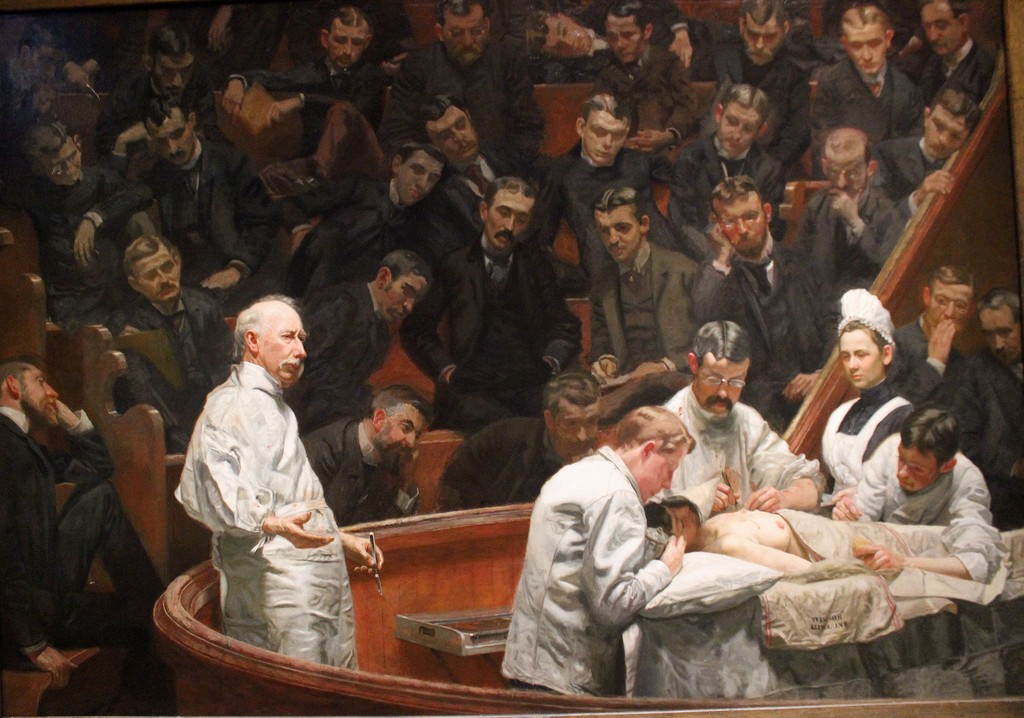
1885The Agnew Clinic
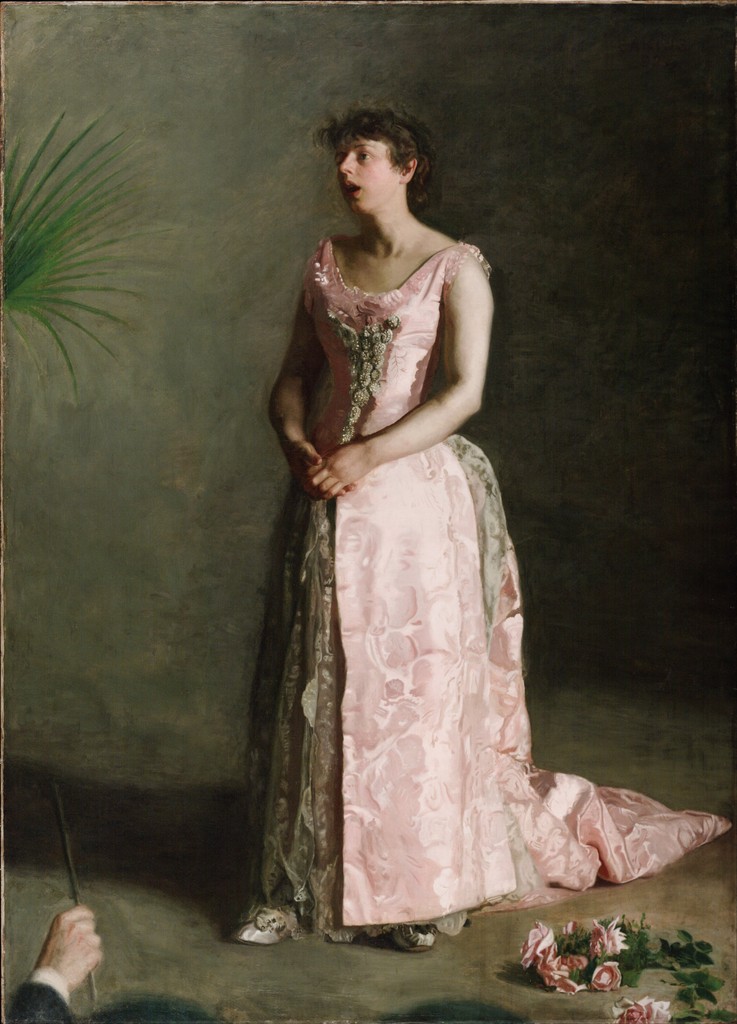
1889The Concert Singer
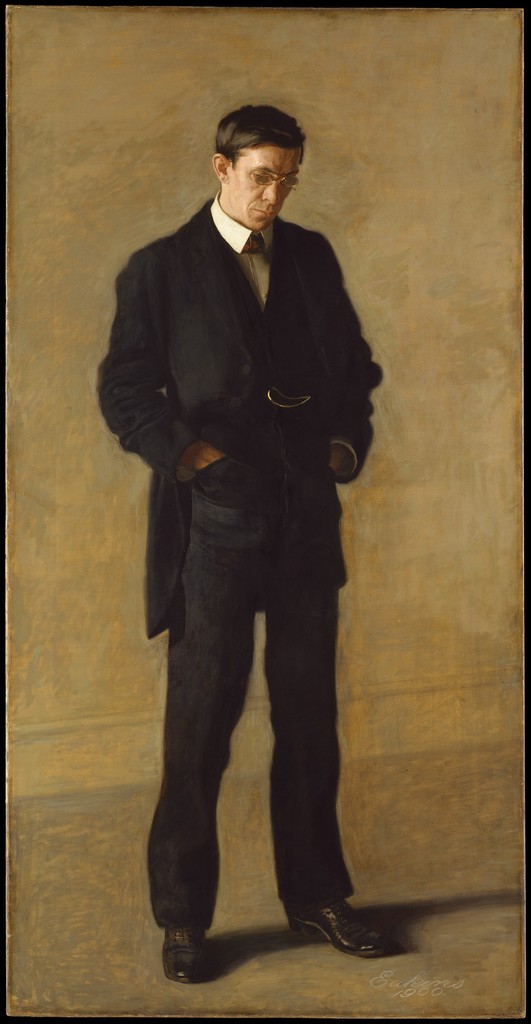
1890–92The Thinker
1900Contents
- Introduction
- Six Bodies, Six States
- Rock, Water, and Reflection
- Life Study Outdoors
- Photographs and Preparatory Studies
- Commission, Refusal, and Names
- Community and Unequal Authority
- How to Look at Swimming
Six Bodies, Six States
The human figures form a broken progression across the canvas, but they should first be read as six separate physical situations. At the far left, a reclining man extends his legs along the masonry and props his upper body above it. His bent torso is neither fully at rest nor preparing for an obvious action. Light passes unevenly across chest, abdomen, thigh, and shin, so the pose becomes an exercise in how one body turns through several planes.
The seated man beside him presents a different structure. His legs fold under and around him while his upright torso rises from a compact base. One arm lifts towards the standing figure, interrupting the darker vegetation behind them. The gesture may suggest conversation or attention, but the painting does not provide words or a fixed narrative. What it makes clear is the contrast between a body gathered close to the ground and one extended vertically.
That vertical body occupies the crest of the ledge. Seen from behind, the standing man plants his feet apart and shifts his weight rather than adopting rigid symmetry. One hand rests near his hip; the other side of his body is partly defined by the raised hand of the seated companion. His pale back and legs are set against deep green foliage, making him the tallest and most immediately legible figure. Even so, his turned head and withheld face deny the frontal address expected from a formal portrait.
To the right, the diver converts that upright stability into an arc. His hands and head have reached the water while his legs remain in the air. The body joins two zones at once: feet against the bright field beyond, shoulders descending into reflection. Eakins has selected an unstable fraction of movement and given it a firm outline. The dive is not explained as a sequence, yet its direction is unmistakable.
Below the ledge, the wading man is supported by the water rather than by stone. Only part of his body remains visible, and the surface interrupts the continuity that anatomy could describe in a studio. His upward turn carries attention back towards the group. At the lower right, the sixth man swims almost horizontally into the composition. The Carter identifies this figure as Eakins and the brown head ahead of him as his setter, Harry.[1] Teacher and dog occupy the least elevated part of the scene, partly cropped by the lower edge.
These poses tempt a temporal reading: recline, sit, stand, dive, enter, swim. They are not successive frames of one person, however, and their order is not a swimming lesson. The arrangement is better understood as a comparison. Stone bears weight; air briefly suspends it; water hides and supports it. Six individuals allow Eakins to set those conditions beside one another without repeating a pose.
Rock, Water, and Reflection
The low masonry is the painting’s physical and compositional hinge. Its rough horizontal top supports three men, while its broken face drops towards the wader and the dog. The structure is visibly made rather than a pristine classical platform. Irregular stones, dark joints, and plants at the left keep the setting tied to a used landscape even as the figures recall the ordered display of an academy exercise.
A related Getty photograph places Eakins and students at Mill Creek near Bryn Mawr, Pennsylvania, the site associated with the project.[4] That record grounds the excursion geographically, but the canvas should not be treated as a topographical transcript. Eakins opens a bright meadow beyond the diver, masses the left side in shadow, and lets the water expand into a comparatively empty right foreground. Place supplies material; composition assigns it weight.
The water is not one uniform mirror. Near the ledge it is darkened by stone and foliage. Around the wader, dog, and swimmer, small strokes break reflected forms into shifting fragments. Farther right, the surface grows lighter and smoother, carrying pale sky and the opposite bank. The diver enters along the border between those zones. His pale body is clear above the surface, then disrupted at contact, making immersion visible without splashy drama.
The broad rightward opening gives the swimmer somewhere to travel. Eakins’s head and outstretched arm sit close to the edge, while Harry occupies the interval between artist and ledge. Their movement counterbalances the diver, whose body travels down and left into the water. One action enters the pool; the other crosses it. The apparent tranquillity depends on this opposition.
Life Study Outdoors
The nude was central to Eakins’s teaching because he believed artists needed firsthand knowledge of the living body. The Carter describes Swimming as a declaration of that commitment and as his vision of a modern community devoted to life study.[1] The RISD Museum’s exhibition on the picture similarly joined scientific study of the body to the continuing vitality of the classical tradition.[2] The painting makes those ideas concrete without dressing its participants as characters from antiquity.
Its classicism lies partly in comparison and order. The standing back, folded seated body, extended recliner, plunging diver, wader, and swimmer offer multiple views of structure and action. Their nudity allows shoulders, pelvises, knees, and changes of weight to be studied directly. Yet these are not anonymous ideal forms. The Carter stresses that viewers recognised portraits of Eakins and his students, a fact that contributed to charges of indecency.[1]
That overlap is essential. Informal nude swimming could belong to modern recreation, but an oil commissioned for an art institution made the scene public and durable. Eakins translated the freedom of an outing into a picture whose figures could be examined by people outside the group. The result is neither simply a classroom demonstration nor simply an unobserved leisure scene. It places a particular community under the conditions of exhibition.
Most faces are turned away, lowered, or seen obliquely. This reduces conventional portrait address while preserving the specificity of bodies. It also creates a productive contradiction: the people could be identifiable to contemporaries even though the canvas does not organise them around facial likeness. For a broader account of how role and pose establish identity in Eakins, see the portraits guide. Here, a person is distinguished through posture and relation to the group.
Photographs and Preparatory Studies
The surviving preparation is unusually useful because it documents several different acts of looking. The Getty’s 1884 albumen silver print, object 84.XM.811.1, measures 9.3 by 12.1 centimetres. Its current record credits Thomas Eakins and describes him standing slightly apart while students gather in and out of the water at Mill Creek. The photograph belongs to a series and was used in developing the painting.[4]
That statement does not make the camera a hidden author of the canvas. The photographed group and painted group differ in spacing, hierarchy, and action. A lens fixed one arrangement at one exposure; the painting distributes bodies into a long sequence and gives the standing figure a commanding place against shadow. The Met identifies Swimming as one of the relatively small number of Eakins oils with direct photographic counterparts, while emphasising that he did not generally use photographs as straightforward preparations for paintings.[7]
Two small oil sketches at the Carter show other parts of the process. One, accession 1990.19.3.A, isolates the stone projection, water, and surrounding vegetation.[5] Another, 1990.19.3.B, studies a standing male nude from behind against green and blue.[6] Both are dated about 1884 and painted on paperboard. Their separation is instructive: landscape structure and a single body could be considered independently before joining a many-figure canvas.
The evidence therefore points to accumulation and revision. Eakins could visit the site, make photographic records, paint small colour studies, and then reorganise these observations. The diver’s arc, broad vacant water, and intervals between the men are decisions of the finished composition, not automatic products of the shutter. The photography and working-studies guide examines that wider toolkit and the need to distinguish photographs by Eakins from those made by people in his circle.
Commission, Refusal, and Names
The commission raised the stakes before the painting was complete. The Philadelphia Museum of Art identifies Edward H. Coates as head of PAFA’s Committee on Instruction and states that he asked Eakins to create a work for the institution.[3] A picture of recognisable students practising the nude therefore emerged from within the Academy’s own structure rather than from an unsolicited private experiment.
When Swimming appeared in the Academy’s annual exhibition in 1885, the hoped-for institutional success did not follow. RISD records that the patron declined it and requested the more conventional The Pathetic Song instead.[2] This was not merely a change of decorative preference. The nude students gave Eakins’s educational principles a public form at a moment when those principles and his conduct were already under scrutiny.
Title history preserves part of the picture’s changing reception. The Carter now uses Swimming. RISD notes that it was long known as The Swimming Hole, and the Getty record calls Swimming its original title.[2][4] Labels attached to the back document older uses of The Swimming Hole and the outdated year 1883, but the holder’s current catalogue and the dated signature establish 1885.[1] A historical label is evidence of past cataloguing, not authority to override the object record.
After the refusal, the canvas returned to Eakins. RISD states that it was shown only twice more during his lifetime, in 1886 and 1887, and remained with him until his death in 1916. In 1925, Susan Macdowell Eakins sold it to the Fort Worth Art Association for seven hundred dollars raised by public subscription.[2] The Carter’s credit line confirms the Friends of Art purchase and records the museum’s acquisition in 1990 from the Modern Art Museum of Fort Worth through grants and local donations.[1]
Community and Unequal Authority
The group can look self-contained and harmonious. Bodies share one site without visible conflict; the seated figure gestures towards the standing man; Eakins and Harry move back towards the others. The Carter’s phrase “community of artists” captures the aspiration represented by that arrangement.[1] Composition, however, cannot prove that every participant experienced the teacher’s programme in the same way.
Eakins held institutional authority over the students whose bodies entered his teaching, photographs, and commissioned painting. The Carter records both student support and troubling testimony about his forceful promotion of nude study.[1] PAFA likewise explains that unclothed posing by models, students, and teachers was intended as experimental education but contributed to the dispute around his forced resignation in 1886.[8] Those accounts do not permit the students to be treated as a unanimous circle.
The chronology needs care. RISD connects the painting’s hostile reception with growing opposition but stops short of making it the sole cause of Eakins’s departure. The immediate 1886 crisis followed his removal of a male model’s loincloth during a class that included women.[2] Swimming belongs to the conditions around that break; it does not document the classroom incident itself. The teaching and anatomy guide follows that institutional history in detail.
The canvas nevertheless poses a durable question about looking. Its artistic achievement depends on close study of named people, while its commission moved their nudity from a bounded outing into a public exhibition. Teacher, students, patron, and later viewers did not hold equal control over that movement. A responsible reading can admire the precise orchestration of bodies while recognising the power through which such an image was made and displayed.
How to Look at Swimming
Begin with the six verbs the bodies make visible: recline, sit, stand, dive, wade, swim. Then look at the supports beneath them—masonry, air, water—and at the way reflection interrupts form. Follow the opposing diagonals of diver and swimmer, and notice how the dog carries attention through the open lower field.
Next compare the painting with the Getty photograph and Carter sketches. Similarity confirms preparation; difference reveals composition. Finally, hold the formal order against the commission’s refusal and the teacher-student hierarchy. The broader paintings guide places this work beside Eakins’s rowers, surgeons, musicians, and portraits, but Swimming remains singular in making artistic study itself the subject of a modern group picture.
Researched works directory
This searchable evidence census was assembled from public museum records and a reproducible Wikidata snapshot. It is not a catalogue raisonné, not a claim to complete oeuvre coverage, and not a substitute for the published catalogue literature, which was not used to claim absolute completeness.
| Name | Date | Medium |
|---|---|---|
| A Singer (Mrs. W.H. Bowden) | 1906 | Painting |
| A Singer: Portrait of Mrs. W.H. Bowden | 1906 | Painting |
| A Street Scene | Date unknown | Painting |
| A street scene in Sevilla | 1870 | Painting |
| A Street Scene in Seville | 1870 | Painting |
| African-American Man | 1884 | Photography |
| An Actress (Portrait of Suzanne Santje) | 1903 | Painting |
| Anna Lewis | 1890 | Painting |
| Annie C. Lochrey Husson (Mrs. Louis Husson) | 1905 | Painting |
| Antiquated Music (Portrait of Sarah Sagehorn Frishmuth) | 1900 | Painting |
| Arcadia | 1883 | Painting |
| Arcadia | Date unknown | Sculpture |
| Arcadia: Figure Study, Female Nude | 1883 | Painting |
| Arcadia Sketch | 1883 | Painting |
| Arcadian | Date unknown | Painting |
| Archbishop Diomede Falconio | 1905 | Painting |
| Archbishop James Frederick Wood | 1877 | Painting |
| Archbishop James Frederick Wood (1813-1883) | 1876 | Painting |
| Archbishop William Henry Elder | 1903 | Painting |
| Arthur B. Frost | 1886 | Painting |
| Artist and His Father Hunting Reed Birds: Marsh Landscape Sketch | 1873 | Painting |
| B.J. Blommers | 1904 | Painting |
| Baby at Play | 1876 | Painting |
| Baseball Players Practicing | 1875 | Artwork |
| Benjamin Eakins G38 | Date unknown | Painting |
| Bertrand Gardel (Sketch for The Chess Players) | 1875 | Painting |
| Between Rounds | 1898 | Painting |
| Billy Smith | 1898 | Painting |
| Billy Smith (Sketch for Between Rounds) | 1898 | Painting |
| Boy Reclining | 1883 | Painting |
| Carmelita Requena | 1869 | Painting |
| Charles Edmund Dana | 1902 | Painting |
| Charles Percival Buck | 1904 | Painting |
| Clara | 1890 | Painting |
| Courtship | 1878 | Painting |
| Cowboy Singing | 1892 | Painting |
| Cowboys in the Badlands | 1888 | Painting |
| Cowboys in the Badlands sketch 2 | 1888 | Painting |
| Delaware River Scene | 1881 | Painting |
| Delaware River Study | 1881 | Painting |
| Dr. Agnew (Dr. D. Hayes Agnew) (1818-1892) | 1889 | Painting |
| Dr. Agnew (Dr. D. Hayes Agnew) (1818–1892) | 1889 | Painting |
| Dr. Horatio C. Wood | 1886 | Painting |
| Dr. Thomas H. Fenton | 1916 | Painting |
| Drifting | 1875 | Painting |
| Eakins G184 | 1916 | Painting |
| Ecorché: Relief of a Horse (Josephine) | 1882 | Sculpture |
| Edward W. Redfield | 1905 | Painting |
| Fairman Rogers Four-in-Hand: Landscape Study of Fairmount Park | 1879 | Painting |
| Fairman Rogers Four-in-Hand: Study of a Horse's Leg | 1879 | Painting |
| Fairmount Park (Sketch for The Fairman Rogers Four-in-Hand) | Date unknown | Painting |
| Female Model | 1867 | Painting |
| Female Nude | 1884 | Painting |
| Female Nude from the Back | 1889 | Photography |
| Female Nude (Study) | 1881 | Painting |
| Fifty Years Ago (Young Girl Meditating): Study | 1877 | Painting |
| Figure Study: Masked Nude Woman | Date unknown | Painting |
| Figure Study: Nude Woman, Seated, with Arms Lowered (r) | Date unknown | Painting |
| Figure Study: Nude Woman, Seated, with Arms Raised | Date unknown | Painting |
| [Four Sketches: Seated Man, Sleeping Dog, Two Vases(?)] | Date unknown | Painting |
| Frances Eakins | 1870 | Painting |
| Francis J. Ziegler | 1890 | Painting |
| Frank Hamilton Cushing | 1895 | Painting |
| Frank Jay St. John | 1900 | Painting |
| General E. Burd Grubb (1841-1914) | 1898 | Painting |
| Girl with a Fan; Portrait of Miss Gutierrez | Date unknown | Painting |
| Harriet Husson Carville (Mrs. James G. Carville) | 1904 | Painting |
| Harrison S. Morris | 1896 | Painting |
| Hauling the Seine | 1882 | Painting |
| Head of a Man (Rutherford B. Hayes?) | 1877 | Painting |
| Hiawatha | 1874 | Painting |
| Hiawatha | Date unknown | Artwork |
| Home Ranch | 1892 | Painting |
| Home Scene | 1871 | Painting |
| Homespun | 1881 | Painting |
| In the Studio | 1884 | Painting |
| Interior of a Woodcarver's Shop (Sketch for William Rush Carving His Allegorical Figure of the Schuylkill River) | Date unknown | Painting |
| James MacAlister (Sketch) | 1895 | Painting |
| John Biglin in a Single Scull | 1873 | Painting |
| John Biglin in a Single Scull | 1874 | Painting |
| Joseph R. Woodwell | 1904 | Painting |
| Kathrin | 1872 | Painting |
| Knitting | 1881 | Sculpture |
| Knitting | 1882 | Sculpture |
| Knitting | Date unknown | Sculpture |
| Lafayette Park, Washington, D.C. | 1877 | Painting |
| Landscape | 1881 | Painting |
| Landscape | 1882 | Painting |
| Landscape Sketch | 1880 | Painting |
| Landscape (Sketch for Cowboys in the Bad Lands) | 1887 | Painting |
| Landscape Study: Cultivated Field and Tree | 1874 | Painting |
| Landscape Study: Shoreline with Trees | 1874 | Painting |
| Landscape with a Dog | 1874 | Painting |
| Letitia Wilson Jordan | 1888 | Painting |
| Louis Husson | 1899 | Painting |
| Major Manuel Waldteufel | 1907 | Painting |
| Masked nude standing | 1880 | Painting |
| Maud Cook (Mrs. Robert C. Reid) | 1895 | Painting |
| Mending the Net | 1881 | Painting |
| Mending the Net: Study of a Fisherman | Date unknown | Painting |
| Miss Alice Kurtz | 1903 | Painting |
| Miss Amelia Van Buren | 1891 | Painting |
| Miss Eleanor S. F. Pue | 1907 | Painting |
| Miss Gertrude Murray | 1895 | Painting |
| Monsignor James P. Turner | 1906 | Painting |
| Mother (Annie Williams Gandy) | 1903 | Painting |
| Mrs. Gilbert L. Parker | 1910 | Painting |
| Mrs. Mary Arthur | 1900 | Painting |
| Music | 1904 | Painting |
| Nude man with beard | Date unknown | Painting |
| Nude Woman Standing | 1908 | Painting |
| Old Lady Sewing | 1879 | Painting |
| Portrait of a Little Girl | 1897 | Painting |
| Portrait of a Woman Reading | Date unknown | Painting |
| Portrait of Adam S. Bare | 1903 | Painting |
| Portrait of Alfred Reynolds | Date unknown | Painting |
| Portrait of Arthur Burdett Frost | 1886 | Painting |
| Portrait of Ashbury Wright Lee | 1905 | Painting |
| Portrait of Benjamin Eakins | 1894 | Painting |
| Portrait of Benjamin Eakins (Sketch for The Writing Master) | 1882 | Painting |
| Portrait of Blanche Hurlburt | 1885 | Painting |
| Portrait of Douglass Morgan Hall | 1889 | Painting |
| Portrait of Dr. Edward J. Nolan | 1900 | Painting |
| Portrait of Dr. Samuel D. Gross (The Gross Clinic) | 1875 | Painting |
| Portrait of Edward Taylor Snow | 1904 | Painting |
| Portrait of Elizabeth L. Burton | 1905 | Painting |
| Portrait of Florence Einstein | 1905 | Painting |
| Portrait of Henry O. Tanner | 1902 | Painting |
| Portrait of J. Harry Lewis | 1876 | Painting |
| Portrait of John B. Gest | 1905 | Painting |
| Portrait of Joshua Ballinger Lippincott | 1892 | Painting |
| Portrait of Leslie W. Miller | 1901 | Painting |
| Portrait of Lucy Lewis | 1896 | Painting |
| Portrait of Margaret Eakins in a Skating Costume | 1871 | Painting |
| Portrait of Mary Adeline Williams | 1899 | Painting |
| Portrait of Mary Adeline Williams | 1900 | Painting |
| Portrait of Mrs. Fairman Rogers (Study for The Fairman Rogers Four-in-Hand) | 1879 | Painting |
| Portrait of Mrs. Frank Hamilton Cushing | 1895 | Painting |
| Portrait of Mrs. James Mapes Dodge (Josephine Kern) | 1896 | Painting |
| Portrait of Professor Benjamin H. Rand | 1874 | Painting |
| Portrait of Professor W. D. Marks | 1886 | Painting |
| Portrait of Rear Admiral George Wallace Melville | 1904 | Painting |
| Portrait of Walter S. Macdowell | 1904 | Painting |
| Porträt des Alfred Bryan Wall | 1904 | Painting |
| Porträt des David Wilson Jordan | Date unknown | Painting |
| Porträt des John McLure Hamilton (1853- 1936) | 1895 | Painting |
| Professionals at Rehearsal | 1883 | Painting |
| Professor William D Marks | 1886 | Painting |
| Professor William Woolsey Johnson | 1896 | Painting |
| Pushing for Rail | 1874 | Painting |
| Rail Shooting on the Delaware | 1876 | Painting |
| Rear Admiral Charles Dwight Sigsbee G388-2 | 1903 | Painting |
| Rear Admiral George W. Melville | 1905 | Painting |
| Reclining Male Nude | 1887 | Photography |
| Reclining Nude | Date unknown | Painting |
| Retrospection | 1880 | Painting |
| Riter Fitzgerald | 1895 | Painting |
| Robert M. Lindsay | 1900 | Painting |
| Ruth (Ruth W. Harding) | 1903 | Painting |
| Saddle (Sketch for Cowboys in the Bad Lands) | 1887 | Painting |
| Sailboats Racing on the Delaware | 1874 | Painting |
| Sailboats Racing: Study of the Delaware River | 1874 | Painting |
| Sailing | 1875 | Painting |
| Salutat | 1898 | Painting |
| Seated Figures | 1886 | Painting |
| Self-portrait | 1902 | Painting |
| Seventy Years Ago | 1877 | Painting |
| Shad Fishing at Gloucester on the Delaware: Delaware River and Gloucester Pier | 1881 | Painting |
| Shad Fishing at Gloucester on the Delaware River | 1881 | Painting |
| Shad Fishing at Gloucester on the Delaware River: Study of a Woman's Head | 1881 | Painting |
| Ships and Sailboats on the Delaware | 1874 | Painting |
| Ships and Sailboats on the Delaware: Study | 1874 | Painting |
| Shoreline of the Delaware River, with Fishing Nets | Date unknown | Painting |
| Signora Gomez d'Arza | 1901 | Painting |
| Singing a Pathetic Song | 1881 | Painting |
| Sketch for Cowboys in the Bad Lands | 1887 | Painting |
| Sketch for Music (The Violinist) | 1904 | Painting |
| Sketch for Portrait of Dr. Jacob Mendez da Costa | 1893 | Painting |
| Sketch for Portrait of Leslie W. Miller | 1901 | Painting |
| Sketch for Portrait of Letitia Wilson Jordan | 1888 | Painting |
| Sketch for Portrait of Monsignor James P. Turner | 1906 | Painting |
| Sketch for Portrait of Mother Patricia Waldron | 1903 | Painting |
| Sketch for Portrait of Professor George F. Barker | 1886 | Painting |
| Sketch for Seventy Years Ago | Date unknown | Painting |
| Sketch for The Concert Singer | 1892 | Painting |
| Sketch for The Fairman Rogers Four-in-Hand | 1879 | Painting |
| Sketch for The Gross Clinic | 1875 | Painting |
| Sketch for the Surrender of General Lee to General Grant at Appomatox | Date unknown | Painting |
| Sketch for William Rush and His Model | 1908 | Painting |
| Sketch of a Landscape | 1882 | Painting |
| Sketch of a Man and Study of Drapery | 1882 | Painting |
| Sketch of Harry | 1892 | Painting |
| Sketch of Max Schmitt in a Single Scull | 1874 | Painting |
| Sketches for “Home-Spun”, (recto and verso) | 1881 | Painting |
| Sketches (Four on one panel) | Date unknown | Painting |
| Spinning | 1881 | Painting |
| Spinning | 1882 | Sculpture |
| Spinning: Sketch | 1881 | Painting |
| Starting Out After Rail | 1863 | Painting |
| Starting Out After Rail | 1874 | Painting |
| Study for Arcadia: Youth Playing Pipes | 1883 | Painting |
| Study for "Cowboys in the Badlands | 1887 | Painting |
| Study for "Negro Boy Dancing": The Banjo Player | Date unknown | Painting |
| Study for "Negro Boy Dancing": The Boy | Date unknown | Painting |
| Study for Portrait of John McClure Hamilton | 1895 | Painting |
| Study for Salutat | 1898 | Painting |
| Study for 'The Meadows, Gloucester' | 1882 | Painting |
| Study for "William Rush Carving His Allegorical Figure of the Schuylkill River | 1876 | Painting |
| Study of a Groom | 1879 | Painting |
| Study of a Nude Man | 1869 | Painting |
| Study of a Nude Man (The Strong Man) | 1869 | Painting |
| Study of a Seated Nude Woman Wearing a Mask | 1863 | Drawing |
| Study of a Young Woman | 1868 | Painting |
| Study of Dr Samuel David Gross | 1875 | Painting |
| Study of Horse for The Fairman Rogers Four-in-Hand | 1879 | Painting |
| Swimming | 1885 | Painting |
| Taking the Count | 1898 | Painting |
| Taking the Count, study | 1898 | Painting |
| Taking Up Net | 1881 | Painting |
| Talcott Williams | 1889 | Painting |
| That's a New Game Down in Frisco": Study for the Central Standing Figure | 1878 | Painting |
| The Agnew Clinic | 1889 | Painting |
| The Art Student (James Wright) | 1890 | Painting |
| The Artist's Wife and His Setter Dog | 1884 | Painting |
| The Biglin Brothers Racing | 1872 | Painting |
| The Biglin Brothers Turning the Stake | 1873 | Painting |
| The Black Fan (Portrait of Mrs. Talcott Williams) | 1891 | Painting |
| The Bohemian (Portrait of Franklin Louis Schenck) | 1890 | Painting |
| The Brinton House | 1878 | Painting |
| The Cello Player | 1896 | Painting |
| The Champion Single Sculls (Max Schmitt in a Single Scull) | 1871 | Painting |
| The Chaperone | 1908 | Painting |
| The Chess Players | 1876 | Painting |
| The Concert Singer | 1890–1892 | Painting |
| The Courtship | 1878 | Painting |
| The Crucifixion | 1880 | Painting |
| The Dancing Lesson | 1878 | Painting |
| The Dean's Roll Call | 1899 | Painting |
| The Fairman Rogers Four-in-Hand | 1879 | Painting |
| The Fairman Rogers Four-In-Hand (A May Morning in... | 1899 | Painting |
| The Meadows, Gloucester | 1882 | Painting |
| The Model | 1908 | Painting |
| The Oarsmen (The Schreiber Brothers) | 1874 | Painting |
| The Oboe Player (Portrait of Dr. Benjamin Sharp) | 1903 | Painting |
| The Old-Fashioned Dress (Portrait of Helen Montanverde Parker) | 1908 | Painting |
| The Pair-Oared Shell | 1872 | Painting |
| The Pathetic Song | 1881 | Painting |
| The Pianist | 1896 | Painting |
| The Poleman in the Ma'sh | 1881 | Drawing |
| The Red Shawl | 1890 | Painting |
| The Spinner | 1876 | Painting |
| The Thinker: Portrait of Louis N. Kenton | 1900 | Painting |
| The Timer | 1879 | Painting |
| The Translator, Portrait of Monsignor Hugh T. Henry | 1902 | Painting |
| The Veteran (Portrait of George Reynolds) | Date unknown | Painting |
| The Writing Master | 1882 | Painting |
| The Young Man (Portrait of Kern Dodge) | 1898 | Painting |
| Thomas Eakins and John Laurie Wallace on a Beach | 1883 | Photography |
| Three Boys Wading in a Creek | 1883 | Photography |
| Trenton Battle Monument | 1893 | Sculpture |
| Two Pupils in Greek Dress | 1883 | Photography |
| Views of Harry | 1885 | Painting |
| Walt Whitman | 1887 | Painting |
| Whistling for Plover | 1874 | Painting |
| William H. Macdowell | 1884 | Photography |
| William H. Macdowell and Margaret Eakins in Saltville (or Clinch Mountain), Virginia | 1875 | Photography |
| William Hance Macdowell (1816-1906) | 1897 | Painting |
| William Rush and his Model | 1908 | Painting |
| William Rush and His Model | Date unknown | Painting |
| William Rush Carving His Allegorical Figure of the Schuylkill River | 1876 | Painting |
| William Rush Carving His Allegorical Figure of the Schuylkill River | 1908 | Painting |
| William Rush Carving His Allegorical Figure of the Schuylkill River, Study | 1876 | Painting |
| William Rush's Model | 1908 | Painting |
| Wrestlers | 1899 | Painting |
| Young Girl Meditating | 1877 | Painting |
Frequently Asked Questions
The Amon Carter Museum currently uses Swimming, and that is the governing title. RISD notes that the work was long known as The Swimming Hole, while the Getty record describes Swimming as the original title. The alternate name remains useful for historical searches, but it should not replace the holder’s current catalogue title.[1][2][4]
The correct date is 1885. Eakins signed and dated the central rock, and the Carter’s current object record uses that year. Some old labels on the reverse say 1883, and a modern image filename also misdates the work; neither overrides the signed painting and holder record.[1]
They are Eakins and members of his male student circle, represented reclining, sitting, standing, diving, wading, and swimming. The Carter specifically identifies Eakins as the swimmer at the lower right heading towards his dog, Harry. The consulted institutional records do not securely name every student, so the remaining figures should not be assigned identities by guesswork.[1]
No. A Getty photograph from 1884 was part of the project, and the Met calls Swimming an important painting with a direct photographic counterpart. Yet the canvas changes the group’s spacing, actions, and visual hierarchy. Small Carter oil sketches separately study the site and a standing figure, confirming a process that combined several kinds of evidence.[4][5][6][7]
Its recognisable nude students made Eakins’s commitment to life study unusually public and challenged contemporary expectations of propriety. The patron declined the painting after its 1885 exhibition and requested The Pathetic Song. After remaining with Eakins, it was bought for Fort Worth in 1925 and entered the Amon Carter Museum in 1990, where it is accession 1990.19.1.[1][2][3]
Discussion
Use this evidence-led guide as a starting point for close looking rather than a final verdict.
Share an observation about Swimming or a source that adds useful context.
Reader Insights
Which detail most changes your reading of Swimming?
How do scale, support, medium or present museum evidence shape the encounter?
What remains uncertain when visual inference is separated from documented fact?
Join the Conversation
Add your reading below, keeping observations specific and evidence clear.
References
- Amon Carter Museum of American Art, Swimming, accessed 30 August 2026.
- RISD Museum, Thomas Eakins and the Swimming Picture, accessed 30 August 2026.
- Philadelphia Museum of Art, Thomas Eakins: American Realist, accessed 30 August 2026.
- J. Paul Getty Museum, Thomas Eakins and Male Nudes at the Site of “Swimming”, accessed 30 August 2026.
- Amon Carter Museum of American Art, Sketch for “Swimming”, accession 1990.19.3.A, accessed 30 August 2026.
- Amon Carter Museum of American Art, Sketch for “Swimming”, accession 1990.19.3.B, accessed 30 August 2026.
- The Metropolitan Museum of Art, Thomas Eakins (1844–1916): Photography, 1880s–90s, accessed 30 August 2026.
- Pennsylvania Academy of the Fine Arts, Thomas Eakins: Photographer, accessed 30 August 2026.
More EAKINS Artworks
The Agnew Clinic image: gallery photograph by Miguel Hermoso Cuesta, cropped and perspective-corrected, under CC BY-SA 4.0.