


 by Tom Gurney
Tom Gurney BSc (Hons) is an art history expert with over 20 years experience
Page Created on / Page Updated on
Email: tomgurney1@gmail.com / Phone: +44 7429 011000
The Biglin Brothers Racing: Introduction
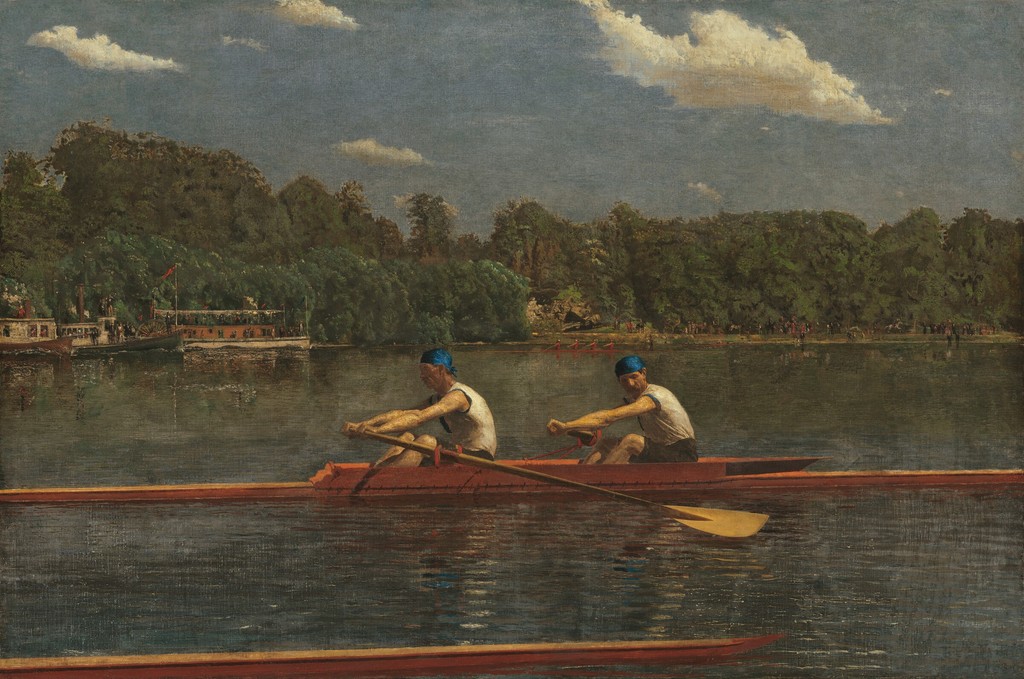
Thomas Eakins places a race in full view and withholds its finish. Two professional oarsmen drive a long pair-oared shell across the Schuylkill River, while the clipped bow of a competitor enters along the lower edge. John and Bernard “Barney” Biglin do not perform identical gestures. One looks towards the rival boat and the other begins the next stroke, so their teamwork appears as an exchange of information as well as muscular effort. The distant crowds, steam vessels, and smaller craft turn their exertion into a public event.[1]
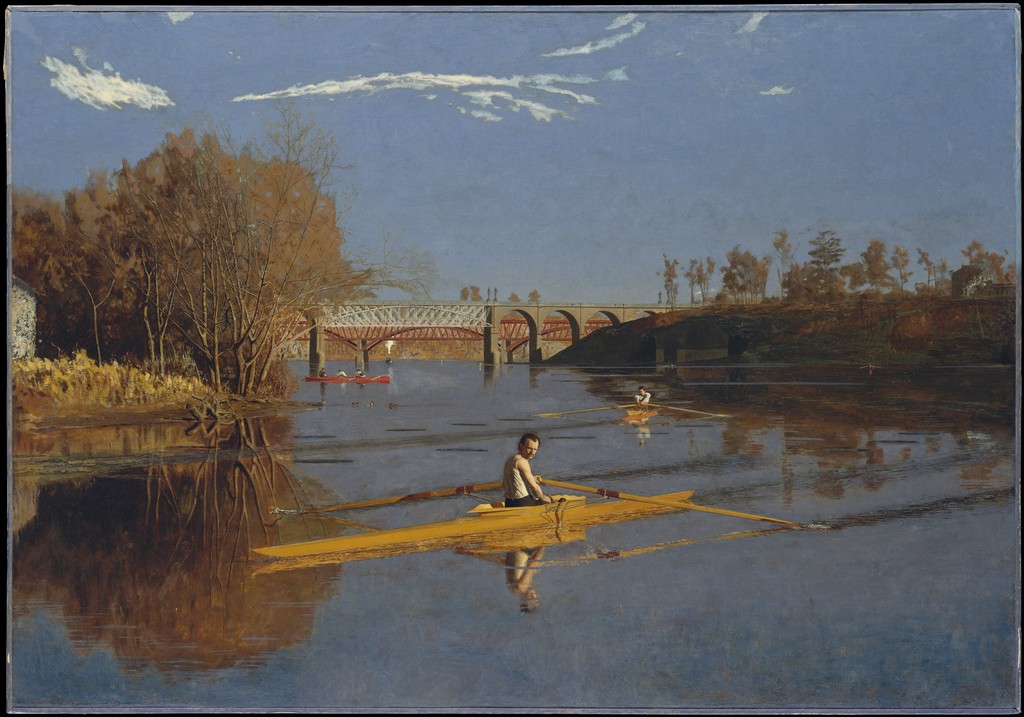
Painted in 1872, The Biglin Brothers Racing belongs to the National Gallery of Art in Washington, where it is recorded as oil on canvas, 61.2 by 91.6 centimetres, accession 1953.7.1. Its present title distinguishes an actual race from the practice scene in The Pair-Oared Shell and the later turning manoeuvre in The Biglin Brothers Turning the Stake. It is also fundamentally different from Eakins’s portrait of Max Schmitt: two professional brothers share one boat here, and rivalry crowds the foreground.[1][4][5]
The picture rewards looking at several speeds. From a distance it is a lucid band of boat, water, wooded shore, and clouded sky. Up close, oar shafts, glances, wakes, spectators, and reflected colour convert those horizontal layers into a race. Eakins knew rowing firsthand, but the painting is not an unedited transcript of sport. It selects a phase of action, reorganises the recorded weather, and uses calculated space to make a fraction of the contest intelligible.[1][2]
At a Glance
- ArtistThomas Eakins [1]
- Title and dateThe Biglin Brothers Racing, 1872 [1]
- MediumOil on canvas [1]
- Dimensions61.2 × 91.6 cm (24 1/8 × 36 1/16 in.) [1]
- CollectionNational Gallery of Art, Washington, accession 1953.7.1 [1]
- SubjectJohn and Bernard “Barney” Biglin racing a pair-oared shell on Philadelphia’s Schuylkill River [1][2]
Thomas Eakins in context
The Gross Clinic
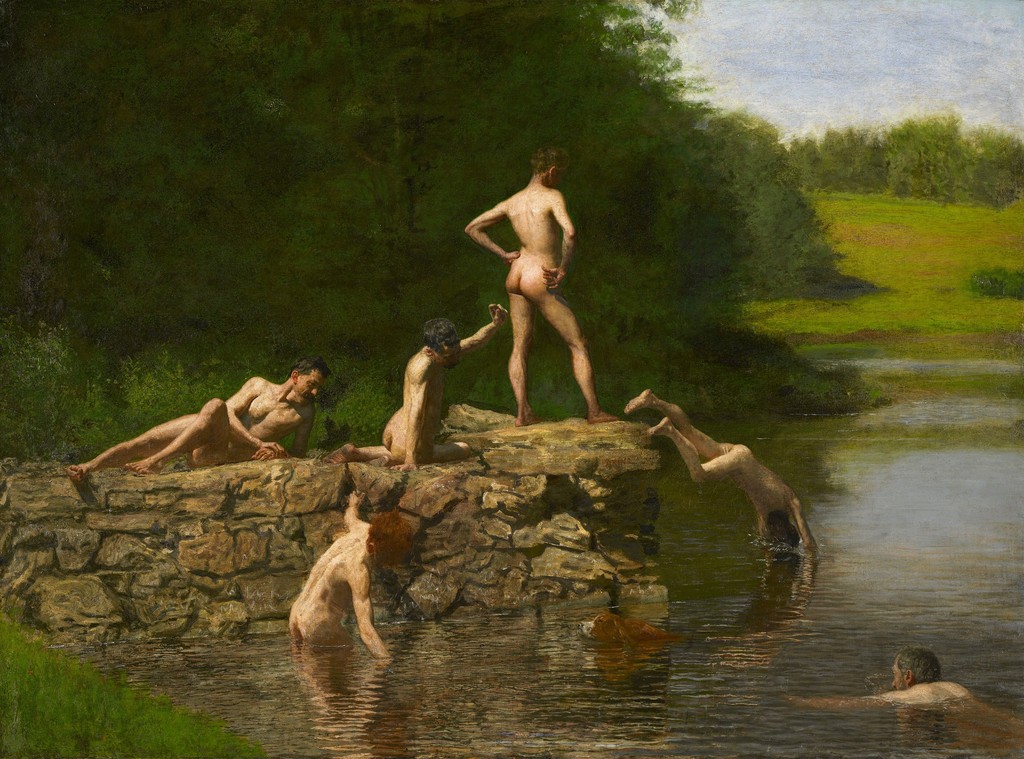
1875Swimming
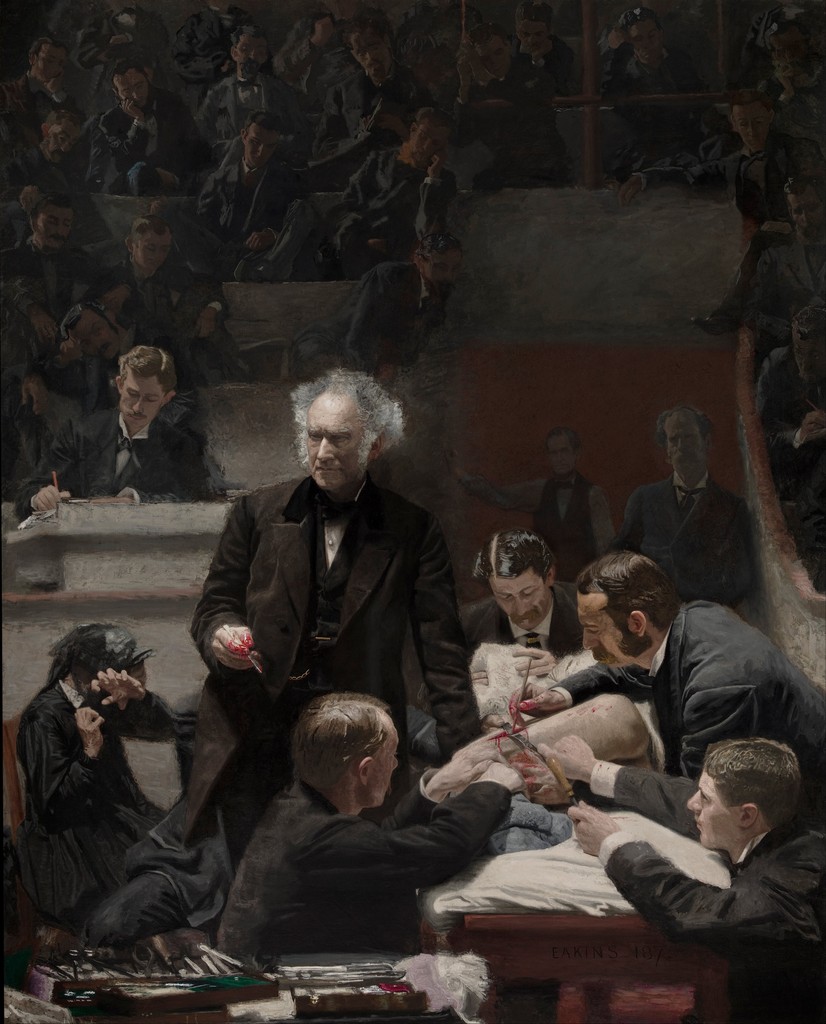
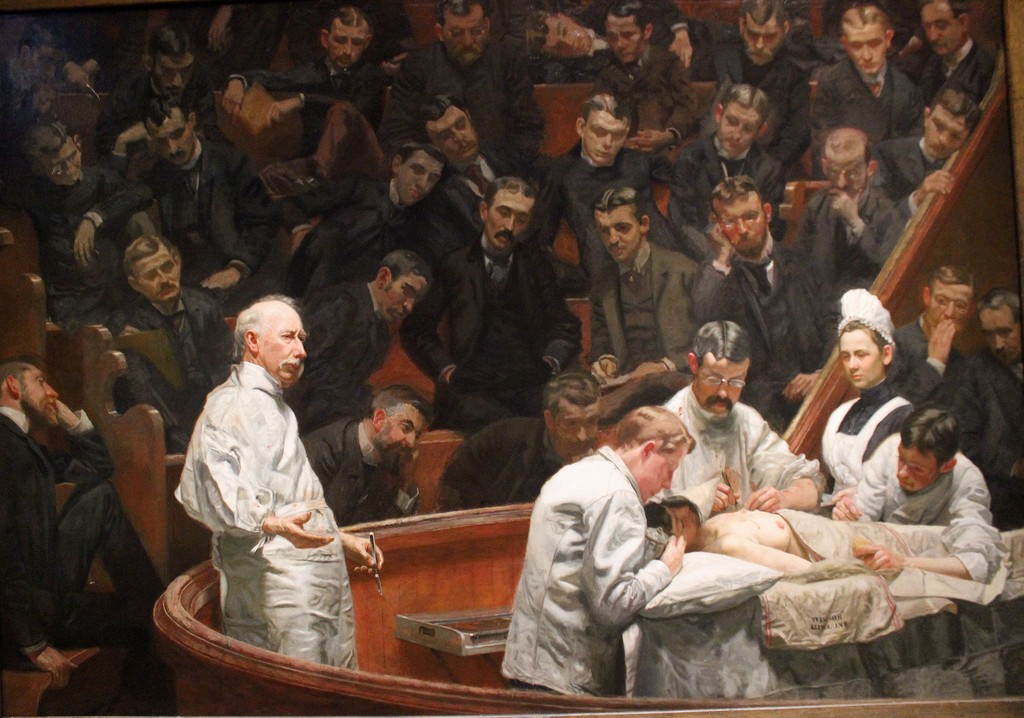
1885The Agnew Clinic
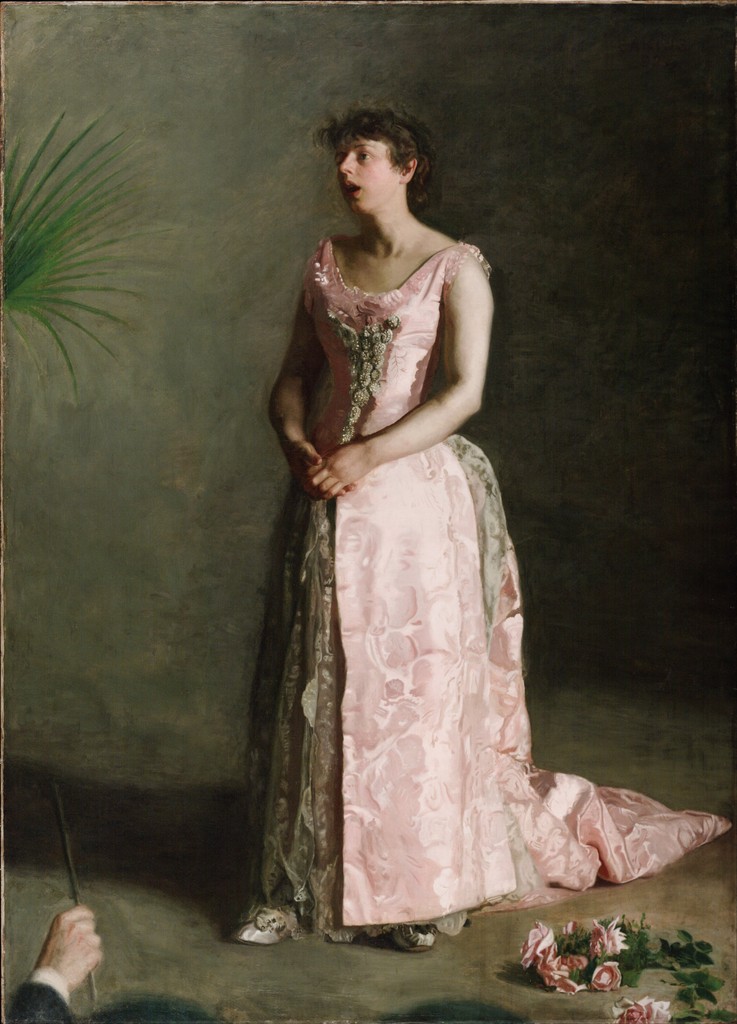
1889The Concert Singer
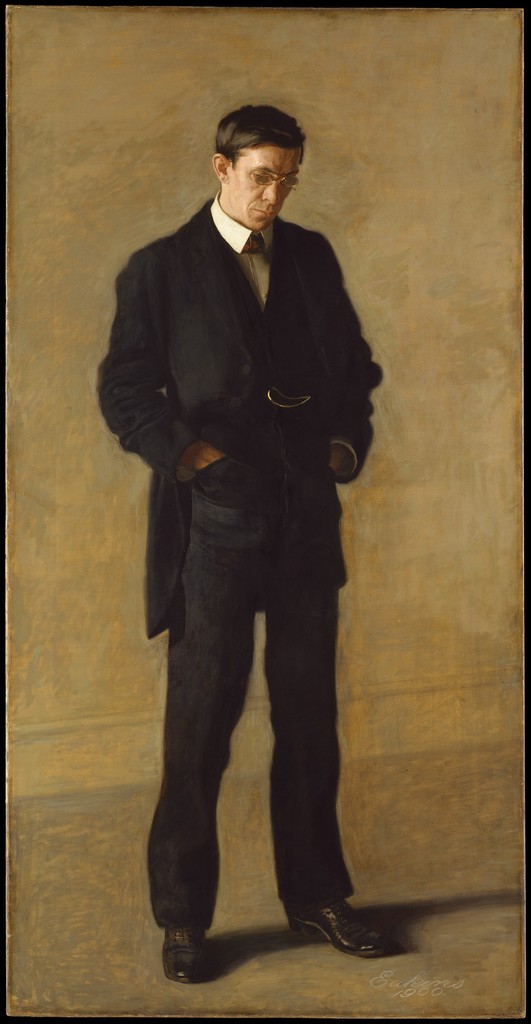
1890–92The Thinker
1900Contents
- Introduction
- A Race on the Schuylkill
- The Course Across the Canvas
- Two Bodies, One Rhythm
- Weather, Light, and Selected Fact
- How Eakins Prepared the Picture
- One Moment in a Rowing Sequence
- From Studio to Washington
A Race on the Schuylkill
The likely occasion was a five-mile match held on May 20, 1872. John and Barney Biglin of New York raced Harry Coulter and Lewis Cavitt of Pittsburgh on the Schuylkill. The National Gallery’s collection catalogue identifies the contest as a heavily anticipated wagered match and records that rain and high winds delayed its start until early evening. The Pittsburgh pair led initially; the Biglins passed them, extended their advantage, and won decisively. Contemporary reports described banks crowded with people and vehicles and a river busy with club boats and spectator vessels.[2]
Eakins compresses that sporting culture into small but purposeful marks. Spectators make an uneven pale line beneath the trees. A crowded steamboat and another vessel occupy the left background, while a four-oared crew in red sits farther across the water. The rival shell is most immediate of all: its bow is so close to the picture edge that its crew remains outside the frame. The race is therefore not conveyed through a panoramic inventory. Near and far signs let viewers reconstruct a much larger event from a restricted stretch of river.[1]
The Biglins were celebrated professionals rather than anonymous models borrowed for a sporting theme. The NGA records them as New Yorkers who became world champions after the race. Their blue head coverings, light sleeveless shirts, and blue rowing clothes also correspond to the period accounts consulted for the Gallery’s systematic catalogue.[1][2] Eakins gives modern athletic labour the seriousness of an ambitious figure painting without disguising it as mythology or history.
The Course Across the Canvas
The shell seems to run laterally across the viewer’s field, nearly parallel to the canvas. That strong horizontal is crossed by a diagonal course of effort. The brothers lean along the direction of travel; the oar shafts descend across boat and water; the visible blade cuts a pale shape against the dark river. Above them, sloping cloud and treetop contours echo the angles of their torsos. The National Gallery points to this correspondence while also noting how the distant shore and red boats divide the space into calmer bands.[1]
Those two systems—horizontal setting and diagonal action—keep the painting poised between measurement and urgency. The low boat forms a narrow strip across the middle foreground, but the bodies refuse to settle into it. Arms extend, shoulders rotate, and bent knees rise above the gunwale. Even the foreground competitor acts as a directional sign: because only its leading section is visible, the viewer imagines the missing rowers and the continuing course beyond the frame.
Eakins’s viewpoint is close to water level. We do not look down from the crowded bank or occupy the elevated deck of a spectator boat. The athletes consequently meet the wooded shore as a compact silhouette, while their shell and oars dominate the lower field. This low position also prevents the water from becoming an empty gap. Reflections and small disruptions stitch boat, athletes, and distant traffic into the same surface.
The race moves from left to right even though the men face back towards the left, as rowers do. That opposition matters. Their bodies pull against the direction in which the shell travels, allowing the image to contain force and result at once. It also makes Barney’s backward glance narratively useful: he can judge the rival’s stern without turning the whole boat into a theatrical confrontation.[1]
Two Bodies, One Rhythm
Pair-oared rowing requires the brothers to convert separate efforts into one course. The NGA catalogue identifies John as the bow oar and Barney as the stroke. In the painting, their extended arms and forward inclinations establish a shared phase, but small differences prevent them from becoming duplicates. Barney looks over his shoulder towards the opposition; John’s attention stays with the next pull. The current NGA interpretation describes John beginning the next stroke while Barney gauges their position.[1][2]
This is synchronisation represented through variation. If every limb matched exactly, the pair might resemble a diagram. Instead, the body nearest the bow appears slightly more enclosed and downward-looking, while the forward figure opens towards the left. Their hands occupy different intervals along the boat, and the oars cross the composition at different points. Eakins makes rhythm legible without erasing each rower’s responsibility.
The result also expands the meaning of portraiture. John and Barney are recognisable professional athletes, yet facial detail is subordinate to practiced coordination. Their identity lies in timing, equipment, clothing, and competitive awareness. The broader portraits guide shows how Eakins could define sitters through what they had learned to do; here the brothers’ joint expertise is the subject.
Weather, Light, and Selected Fact
The historical race was delayed by unsettled weather, but Eakins does not reproduce a rain-darkened evening literally. The NGA catalogue observes that the painted sky looks clearer and the sun higher than the documented conditions would suggest. Large cream clouds remain, yet blue-grey openings brighten the air and light catches the rowers’ shirts, arms, and caps. The river below is darker, so their bodies and the warm shell read decisively against it.[2]
That discrepancy is evidence of construction, not carelessness. A more literal late-evening gloom could have made the bodies, oars, and rival boat harder to distinguish. Eakins retains enough cloud to evoke changeable weather, then adjusts illumination to organise the race. Red accents in boats and distant shirts carry across the cool field; blue headscarves bind the brothers together; pale highlights on water break up its broad shadow.
The altered conditions also warn against reading every detail as a frozen eyewitness report. The painting is close to the event in costume, spectatorship, and the state of the race, but it makes those facts serve visibility. This tension between observed evidence and pictorial choice is central to Eakins’s paintings: realism here means constructing a credible relation among bodies, objects, light, and space.
How Eakins Prepared the Picture
The National Gallery’s technical account describes fine plain-weave canvas over a smooth white ground, followed by a slick charcoal-grey layer. In parts of the water, Eakins scraped through paint to reveal that darker tone, possibly to create a shimmering effect. Paint thickness and texture vary, but adjacent areas were often brought up to one another without extensive overlap. Later treatment also found abrasion and earlier intervention in the boat, water, and sky, reminders that the surface has its own history.[2]
Preparation governed the space as well. A perspective drawing for The Biglin Brothers Racing survives, and the catalogue records prick marks around the figures that may indicate transfer from a drawing or cartoon. Such evidence does not make the result mechanical. It shows Eakins solving separate problems—body positions, the narrow shell, oar angles, shore, and reflection—before joining them on canvas.[2]
The rowing series predates Eakins’s documented adoption of photography around 1880. Its action should therefore not be explained by a camera that had not yet entered his working routine. The relevant tools were firsthand knowledge, observation, drawing, perspective, and transfer. The later photography and working-studies guide helps clarify what the camera eventually added; this painting demonstrates how much he could analyse without it.
One Moment in a Rowing Sequence
The National Gallery’s 1996 rowing exhibition brought together all of Eakins’s known rowing subjects: nine paintings and fourteen works on paper. The compact group was made between 1870 and 1874, early in his mature Philadelphia practice.[3] Within it, The Biglin Brothers Racing is neither a generic river scene nor a summary of every Biglin image.
The Champion Single Sculls (Max Schmitt in a Single Scull) dates from 1871 and belongs to the Metropolitan Museum of Art. Max Schmitt occupies a single scull, handles two oars, and turns his head while Eakins appears in a second boat farther away. Its extended reflective space makes an individual balance against the river. The Biglin painting instead tightens attention around two athletes, one oar apiece, an immediate opponent, and a mass audience.[6]
The Philadelphia Museum of Art’s The Pair-Oared Shell, also dated 1872, shows John and Barney practising in the early evening beneath the old Columbia Railroad Bridge. It establishes their cooperation outside the famous contest.[4] The Cleveland Museum of Art’s larger The Biglin Brothers Turning the Stake of 1873 depicts a later racing problem: negotiating the halfway marker while the Pittsburgh pair trails in the distance.[5] Practice, straight-course racing, and turning are distinct situations, not alternate titles for one composition.
This sequence reveals Eakins varying the visual problem while returning to the same athletes. A single body can be measured against deep space; a pair can form a repeated rhythm; a turn can bend the boat and course around a point. Readers seeking the career context can return to the Thomas Eakins overview, but this picture’s particular achievement lies in the compressed instant when teamwork, surveillance, and forward momentum coincide.
From Studio to Washington
The painting remained with Eakins and passed to Susan Macdowell Eakins after his death. In 1933 it was sold through E. & A. Milch to the Whitney Museum of American Art. It later moved through M. Knoedler & Company to Mr and Mrs Cornelius Vanderbilt Whitney, whose 1953 bequest brought it to the National Gallery of Art.[1]
Early exhibition records used variants such as Biglen Brothers Ready to Start Race. Eakins himself often misspelled the family name “Biglen,” and the image was once understood as showing the pair awaiting a start. The NGA catalogue argues that the race is already underway: the oars are returning towards the water, vessels follow the contest, and a horse moves along the bank. The current institutional title, The Biglin Brothers Racing, preserves both the sitters’ correct name and the action represented.[1][2]
Researched works directory
This searchable evidence census was assembled from public museum records and a reproducible Wikidata snapshot. It is not a catalogue raisonné, not a claim to complete oeuvre coverage, and not a substitute for the published catalogue literature, which was not used to claim absolute completeness.
| Name | Date | Medium |
|---|---|---|
| A Singer (Mrs. W.H. Bowden) | 1906 | Painting |
| A Singer: Portrait of Mrs. W.H. Bowden | 1906 | Painting |
| A Street Scene | Date unknown | Painting |
| A street scene in Sevilla | 1870 | Painting |
| A Street Scene in Seville | 1870 | Painting |
| African-American Man | 1884 | Photography |
| An Actress (Portrait of Suzanne Santje) | 1903 | Painting |
| Anna Lewis | 1890 | Painting |
| Annie C. Lochrey Husson (Mrs. Louis Husson) | 1905 | Painting |
| Antiquated Music (Portrait of Sarah Sagehorn Frishmuth) | 1900 | Painting |
| Arcadia | 1883 | Painting |
| Arcadia | Date unknown | Sculpture |
| Arcadia: Figure Study, Female Nude | 1883 | Painting |
| Arcadia Sketch | 1883 | Painting |
| Arcadian | Date unknown | Painting |
| Archbishop Diomede Falconio | 1905 | Painting |
| Archbishop James Frederick Wood | 1877 | Painting |
| Archbishop James Frederick Wood (1813-1883) | 1876 | Painting |
| Archbishop William Henry Elder | 1903 | Painting |
| Arthur B. Frost | 1886 | Painting |
| Artist and His Father Hunting Reed Birds: Marsh Landscape Sketch | 1873 | Painting |
| B.J. Blommers | 1904 | Painting |
| Baby at Play | 1876 | Painting |
| Baseball Players Practicing | 1875 | Artwork |
| Benjamin Eakins G38 | Date unknown | Painting |
| Bertrand Gardel (Sketch for The Chess Players) | 1875 | Painting |
| Between Rounds | 1898 | Painting |
| Billy Smith | 1898 | Painting |
| Billy Smith (Sketch for Between Rounds) | 1898 | Painting |
| Boy Reclining | 1883 | Painting |
| Carmelita Requena | 1869 | Painting |
| Charles Edmund Dana | 1902 | Painting |
| Charles Percival Buck | 1904 | Painting |
| Clara | 1890 | Painting |
| Courtship | 1878 | Painting |
| Cowboy Singing | 1892 | Painting |
| Cowboys in the Badlands | 1888 | Painting |
| Cowboys in the Badlands sketch 2 | 1888 | Painting |
| Delaware River Scene | 1881 | Painting |
| Delaware River Study | 1881 | Painting |
| Dr. Agnew (Dr. D. Hayes Agnew) (1818-1892) | 1889 | Painting |
| Dr. Agnew (Dr. D. Hayes Agnew) (1818–1892) | 1889 | Painting |
| Dr. Horatio C. Wood | 1886 | Painting |
| Dr. Thomas H. Fenton | 1916 | Painting |
| Drifting | 1875 | Painting |
| Eakins G184 | 1916 | Painting |
| Ecorché: Relief of a Horse (Josephine) | 1882 | Sculpture |
| Edward W. Redfield | 1905 | Painting |
| Fairman Rogers Four-in-Hand: Landscape Study of Fairmount Park | 1879 | Painting |
| Fairman Rogers Four-in-Hand: Study of a Horse's Leg | 1879 | Painting |
| Fairmount Park (Sketch for The Fairman Rogers Four-in-Hand) | Date unknown | Painting |
| Female Model | 1867 | Painting |
| Female Nude | 1884 | Painting |
| Female Nude from the Back | 1889 | Photography |
| Female Nude (Study) | 1881 | Painting |
| Fifty Years Ago (Young Girl Meditating): Study | 1877 | Painting |
| Figure Study: Masked Nude Woman | Date unknown | Painting |
| Figure Study: Nude Woman, Seated, with Arms Lowered (r) | Date unknown | Painting |
| Figure Study: Nude Woman, Seated, with Arms Raised | Date unknown | Painting |
| [Four Sketches: Seated Man, Sleeping Dog, Two Vases(?)] | Date unknown | Painting |
| Frances Eakins | 1870 | Painting |
| Francis J. Ziegler | 1890 | Painting |
| Frank Hamilton Cushing | 1895 | Painting |
| Frank Jay St. John | 1900 | Painting |
| General E. Burd Grubb (1841-1914) | 1898 | Painting |
| Girl with a Fan; Portrait of Miss Gutierrez | Date unknown | Painting |
| Harriet Husson Carville (Mrs. James G. Carville) | 1904 | Painting |
| Harrison S. Morris | 1896 | Painting |
| Hauling the Seine | 1882 | Painting |
| Head of a Man (Rutherford B. Hayes?) | 1877 | Painting |
| Hiawatha | 1874 | Painting |
| Hiawatha | Date unknown | Artwork |
| Home Ranch | 1892 | Painting |
| Home Scene | 1871 | Painting |
| Homespun | 1881 | Painting |
| In the Studio | 1884 | Painting |
| Interior of a Woodcarver's Shop (Sketch for William Rush Carving His Allegorical Figure of the Schuylkill River) | Date unknown | Painting |
| James MacAlister (Sketch) | 1895 | Painting |
| John Biglin in a Single Scull | 1873 | Painting |
| John Biglin in a Single Scull | 1874 | Painting |
| Joseph R. Woodwell | 1904 | Painting |
| Kathrin | 1872 | Painting |
| Knitting | 1881 | Sculpture |
| Knitting | 1882 | Sculpture |
| Knitting | Date unknown | Sculpture |
| Lafayette Park, Washington, D.C. | 1877 | Painting |
| Landscape | 1881 | Painting |
| Landscape | 1882 | Painting |
| Landscape Sketch | 1880 | Painting |
| Landscape (Sketch for Cowboys in the Bad Lands) | 1887 | Painting |
| Landscape Study: Cultivated Field and Tree | 1874 | Painting |
| Landscape Study: Shoreline with Trees | 1874 | Painting |
| Landscape with a Dog | 1874 | Painting |
| Letitia Wilson Jordan | 1888 | Painting |
| Louis Husson | 1899 | Painting |
| Major Manuel Waldteufel | 1907 | Painting |
| Masked nude standing | 1880 | Painting |
| Maud Cook (Mrs. Robert C. Reid) | 1895 | Painting |
| Mending the Net | 1881 | Painting |
| Mending the Net: Study of a Fisherman | Date unknown | Painting |
| Miss Alice Kurtz | 1903 | Painting |
| Miss Amelia Van Buren | 1891 | Painting |
| Miss Eleanor S. F. Pue | 1907 | Painting |
| Miss Gertrude Murray | 1895 | Painting |
| Monsignor James P. Turner | 1906 | Painting |
| Mother (Annie Williams Gandy) | 1903 | Painting |
| Mrs. Gilbert L. Parker | 1910 | Painting |
| Mrs. Mary Arthur | 1900 | Painting |
| Music | 1904 | Painting |
| Nude man with beard | Date unknown | Painting |
| Nude Woman Standing | 1908 | Painting |
| Old Lady Sewing | 1879 | Painting |
| Portrait of a Little Girl | 1897 | Painting |
| Portrait of a Woman Reading | Date unknown | Painting |
| Portrait of Adam S. Bare | 1903 | Painting |
| Portrait of Alfred Reynolds | Date unknown | Painting |
| Portrait of Arthur Burdett Frost | 1886 | Painting |
| Portrait of Ashbury Wright Lee | 1905 | Painting |
| Portrait of Benjamin Eakins | 1894 | Painting |
| Portrait of Benjamin Eakins (Sketch for The Writing Master) | 1882 | Painting |
| Portrait of Blanche Hurlburt | 1885 | Painting |
| Portrait of Douglass Morgan Hall | 1889 | Painting |
| Portrait of Dr. Edward J. Nolan | 1900 | Painting |
| Portrait of Dr. Samuel D. Gross (The Gross Clinic) | 1875 | Painting |
| Portrait of Edward Taylor Snow | 1904 | Painting |
| Portrait of Elizabeth L. Burton | 1905 | Painting |
| Portrait of Florence Einstein | 1905 | Painting |
| Portrait of Henry O. Tanner | 1902 | Painting |
| Portrait of J. Harry Lewis | 1876 | Painting |
| Portrait of John B. Gest | 1905 | Painting |
| Portrait of Joshua Ballinger Lippincott | 1892 | Painting |
| Portrait of Leslie W. Miller | 1901 | Painting |
| Portrait of Lucy Lewis | 1896 | Painting |
| Portrait of Margaret Eakins in a Skating Costume | 1871 | Painting |
| Portrait of Mary Adeline Williams | 1899 | Painting |
| Portrait of Mary Adeline Williams | 1900 | Painting |
| Portrait of Mrs. Fairman Rogers (Study for The Fairman Rogers Four-in-Hand) | 1879 | Painting |
| Portrait of Mrs. Frank Hamilton Cushing | 1895 | Painting |
| Portrait of Mrs. James Mapes Dodge (Josephine Kern) | 1896 | Painting |
| Portrait of Professor Benjamin H. Rand | 1874 | Painting |
| Portrait of Professor W. D. Marks | 1886 | Painting |
| Portrait of Rear Admiral George Wallace Melville | 1904 | Painting |
| Portrait of Walter S. Macdowell | 1904 | Painting |
| Porträt des Alfred Bryan Wall | 1904 | Painting |
| Porträt des David Wilson Jordan | Date unknown | Painting |
| Porträt des John McLure Hamilton (1853- 1936) | 1895 | Painting |
| Professionals at Rehearsal | 1883 | Painting |
| Professor William D Marks | 1886 | Painting |
| Professor William Woolsey Johnson | 1896 | Painting |
| Pushing for Rail | 1874 | Painting |
| Rail Shooting on the Delaware | 1876 | Painting |
| Rear Admiral Charles Dwight Sigsbee G388-2 | 1903 | Painting |
| Rear Admiral George W. Melville | 1905 | Painting |
| Reclining Male Nude | 1887 | Photography |
| Reclining Nude | Date unknown | Painting |
| Retrospection | 1880 | Painting |
| Riter Fitzgerald | 1895 | Painting |
| Robert M. Lindsay | 1900 | Painting |
| Ruth (Ruth W. Harding) | 1903 | Painting |
| Saddle (Sketch for Cowboys in the Bad Lands) | 1887 | Painting |
| Sailboats Racing on the Delaware | 1874 | Painting |
| Sailboats Racing: Study of the Delaware River | 1874 | Painting |
| Sailing | 1875 | Painting |
| Salutat | 1898 | Painting |
| Seated Figures | 1886 | Painting |
| Self-portrait | 1902 | Painting |
| Seventy Years Ago | 1877 | Painting |
| Shad Fishing at Gloucester on the Delaware: Delaware River and Gloucester Pier | 1881 | Painting |
| Shad Fishing at Gloucester on the Delaware River | 1881 | Painting |
| Shad Fishing at Gloucester on the Delaware River: Study of a Woman's Head | 1881 | Painting |
| Ships and Sailboats on the Delaware | 1874 | Painting |
| Ships and Sailboats on the Delaware: Study | 1874 | Painting |
| Shoreline of the Delaware River, with Fishing Nets | Date unknown | Painting |
| Signora Gomez d'Arza | 1901 | Painting |
| Singing a Pathetic Song | 1881 | Painting |
| Sketch for Cowboys in the Bad Lands | 1887 | Painting |
| Sketch for Music (The Violinist) | 1904 | Painting |
| Sketch for Portrait of Dr. Jacob Mendez da Costa | 1893 | Painting |
| Sketch for Portrait of Leslie W. Miller | 1901 | Painting |
| Sketch for Portrait of Letitia Wilson Jordan | 1888 | Painting |
| Sketch for Portrait of Monsignor James P. Turner | 1906 | Painting |
| Sketch for Portrait of Mother Patricia Waldron | 1903 | Painting |
| Sketch for Portrait of Professor George F. Barker | 1886 | Painting |
| Sketch for Seventy Years Ago | Date unknown | Painting |
| Sketch for The Concert Singer | 1892 | Painting |
| Sketch for The Fairman Rogers Four-in-Hand | 1879 | Painting |
| Sketch for The Gross Clinic | 1875 | Painting |
| Sketch for the Surrender of General Lee to General Grant at Appomatox | Date unknown | Painting |
| Sketch for William Rush and His Model | 1908 | Painting |
| Sketch of a Landscape | 1882 | Painting |
| Sketch of a Man and Study of Drapery | 1882 | Painting |
| Sketch of Harry | 1892 | Painting |
| Sketch of Max Schmitt in a Single Scull | 1874 | Painting |
| Sketches for “Home-Spun”, (recto and verso) | 1881 | Painting |
| Sketches (Four on one panel) | Date unknown | Painting |
| Spinning | 1881 | Painting |
| Spinning | 1882 | Sculpture |
| Spinning: Sketch | 1881 | Painting |
| Starting Out After Rail | 1863 | Painting |
| Starting Out After Rail | 1874 | Painting |
| Study for Arcadia: Youth Playing Pipes | 1883 | Painting |
| Study for "Cowboys in the Badlands | 1887 | Painting |
| Study for "Negro Boy Dancing": The Banjo Player | Date unknown | Painting |
| Study for "Negro Boy Dancing": The Boy | Date unknown | Painting |
| Study for Portrait of John McClure Hamilton | 1895 | Painting |
| Study for Salutat | 1898 | Painting |
| Study for 'The Meadows, Gloucester' | 1882 | Painting |
| Study for "William Rush Carving His Allegorical Figure of the Schuylkill River | 1876 | Painting |
| Study of a Groom | 1879 | Painting |
| Study of a Nude Man | 1869 | Painting |
| Study of a Nude Man (The Strong Man) | 1869 | Painting |
| Study of a Seated Nude Woman Wearing a Mask | 1863 | Drawing |
| Study of a Young Woman | 1868 | Painting |
| Study of Dr Samuel David Gross | 1875 | Painting |
| Study of Horse for The Fairman Rogers Four-in-Hand | 1879 | Painting |
| Swimming | 1885 | Painting |
| Taking the Count | 1898 | Painting |
| Taking the Count, study | 1898 | Painting |
| Taking Up Net | 1881 | Painting |
| Talcott Williams | 1889 | Painting |
| That's a New Game Down in Frisco": Study for the Central Standing Figure | 1878 | Painting |
| The Agnew Clinic | 1889 | Painting |
| The Art Student (James Wright) | 1890 | Painting |
| The Artist's Wife and His Setter Dog | 1884 | Painting |
| The Biglin Brothers Racing | 1872 | Painting |
| The Biglin Brothers Turning the Stake | 1873 | Painting |
| The Black Fan (Portrait of Mrs. Talcott Williams) | 1891 | Painting |
| The Bohemian (Portrait of Franklin Louis Schenck) | 1890 | Painting |
| The Brinton House | 1878 | Painting |
| The Cello Player | 1896 | Painting |
| The Champion Single Sculls (Max Schmitt in a Single Scull) | 1871 | Painting |
| The Chaperone | 1908 | Painting |
| The Chess Players | 1876 | Painting |
| The Concert Singer | 1890–1892 | Painting |
| The Courtship | 1878 | Painting |
| The Crucifixion | 1880 | Painting |
| The Dancing Lesson | 1878 | Painting |
| The Dean's Roll Call | 1899 | Painting |
| The Fairman Rogers Four-in-Hand | 1879 | Painting |
| The Fairman Rogers Four-In-Hand (A May Morning in... | 1899 | Painting |
| The Meadows, Gloucester | 1882 | Painting |
| The Model | 1908 | Painting |
| The Oarsmen (The Schreiber Brothers) | 1874 | Painting |
| The Oboe Player (Portrait of Dr. Benjamin Sharp) | 1903 | Painting |
| The Old-Fashioned Dress (Portrait of Helen Montanverde Parker) | 1908 | Painting |
| The Pair-Oared Shell | 1872 | Painting |
| The Pathetic Song | 1881 | Painting |
| The Pianist | 1896 | Painting |
| The Poleman in the Ma'sh | 1881 | Drawing |
| The Red Shawl | 1890 | Painting |
| The Spinner | 1876 | Painting |
| The Thinker: Portrait of Louis N. Kenton | 1900 | Painting |
| The Timer | 1879 | Painting |
| The Translator, Portrait of Monsignor Hugh T. Henry | 1902 | Painting |
| The Veteran (Portrait of George Reynolds) | Date unknown | Painting |
| The Writing Master | 1882 | Painting |
| The Young Man (Portrait of Kern Dodge) | 1898 | Painting |
| Thomas Eakins and John Laurie Wallace on a Beach | 1883 | Photography |
| Three Boys Wading in a Creek | 1883 | Photography |
| Trenton Battle Monument | 1893 | Sculpture |
| Two Pupils in Greek Dress | 1883 | Photography |
| Views of Harry | 1885 | Painting |
| Walt Whitman | 1887 | Painting |
| Whistling for Plover | 1874 | Painting |
| William H. Macdowell | 1884 | Photography |
| William H. Macdowell and Margaret Eakins in Saltville (or Clinch Mountain), Virginia | 1875 | Photography |
| William Hance Macdowell (1816-1906) | 1897 | Painting |
| William Rush and his Model | 1908 | Painting |
| William Rush and His Model | Date unknown | Painting |
| William Rush Carving His Allegorical Figure of the Schuylkill River | 1876 | Painting |
| William Rush Carving His Allegorical Figure of the Schuylkill River | 1908 | Painting |
| William Rush Carving His Allegorical Figure of the Schuylkill River, Study | 1876 | Painting |
| William Rush's Model | 1908 | Painting |
| Wrestlers | 1899 | Painting |
| Young Girl Meditating | 1877 | Painting |
Frequently Asked Questions
They are the New York professionals John and Bernard “Barney” Biglin. They defeated Harry Coulter and Lewis Cavitt of Pittsburgh in a five-mile Schuylkill race on May 20, 1872. Eakins painted the brothers repeatedly, but the current NGA work specifically shows the celebrated contest rather than a training session.[1][2][4]
It is grounded in the event: the athletes, clothing, opposition, spectators, and river traffic correspond to institutional research. Eakins nevertheless adjusted the weather and light, and he selected a comprehensible phase of action. It should be read as a carefully constructed account, not a frame-by-frame document.[1][2]
Max Schmitt rows alone in a scull and operates two oars, with Eakins farther back on the river. The Biglin brothers share a pair-oared shell and each pulls one oar while monitoring a nearby rival. The later picture replaces solitary balance and spacious reflection with teamwork and competitive pressure.[6]
There is no need to assume that he did. The painting dates from 1872, before photography became a documented part of his practice. The NGA instead records a surviving perspective drawing and possible transfer marks around the figures, alongside Eakins’s direct knowledge of rowing.[2]
It turns professional sport into a complex modern subject. Bodies, boat, opponent, weather, spectators, and measured river space all contribute to the meaning. Its strongest effect is not raw speed but coordinated judgment: two athletes remain individually alert while sustaining one competitive rhythm.[1][2]
Discussion
Use this evidence-led guide as a starting point for close looking rather than a final verdict.
Share an observation about The Biglin Brothers Racing or a source that adds useful context.
Reader Insights
Which detail most changes your reading of The Biglin Brothers Racing?
How do scale, support, medium or present museum evidence shape the encounter?
What remains uncertain when visual inference is separated from documented fact?
Join the Conversation
Add your reading below, keeping observations specific and evidence clear.
References
- National Gallery of Art, The Biglin Brothers Racing, accessed 30 August 2026.
- National Gallery of Art, American Paintings of the Nineteenth Century, Part I, pp. 157–162, accessed 30 August 2026.
- National Gallery of Art, Thomas Eakins: The Rowing Pictures, accessed 30 August 2026.
- Philadelphia Museum of Art, The Pair-Oared Shell, accessed 30 August 2026.
- Cleveland Museum of Art, The Biglin Brothers Turning the Stake, accessed 30 August 2026.
- The Metropolitan Museum of Art, The Champion Single Sculls (Max Schmitt in a Single Scull), accessed 30 August 2026.
More EAKINS Artworks
The Agnew Clinic image: gallery photograph by Miguel Hermoso Cuesta, cropped and perspective-corrected, under CC BY-SA 4.0.