


 by Tom Gurney
Tom Gurney BSc (Hons) is an art history expert with over 20 years experience
Page Created on / Page Updated on
Email: tomgurney1@gmail.com / Phone: +44 7429 011000
The Concert Singer: Introduction
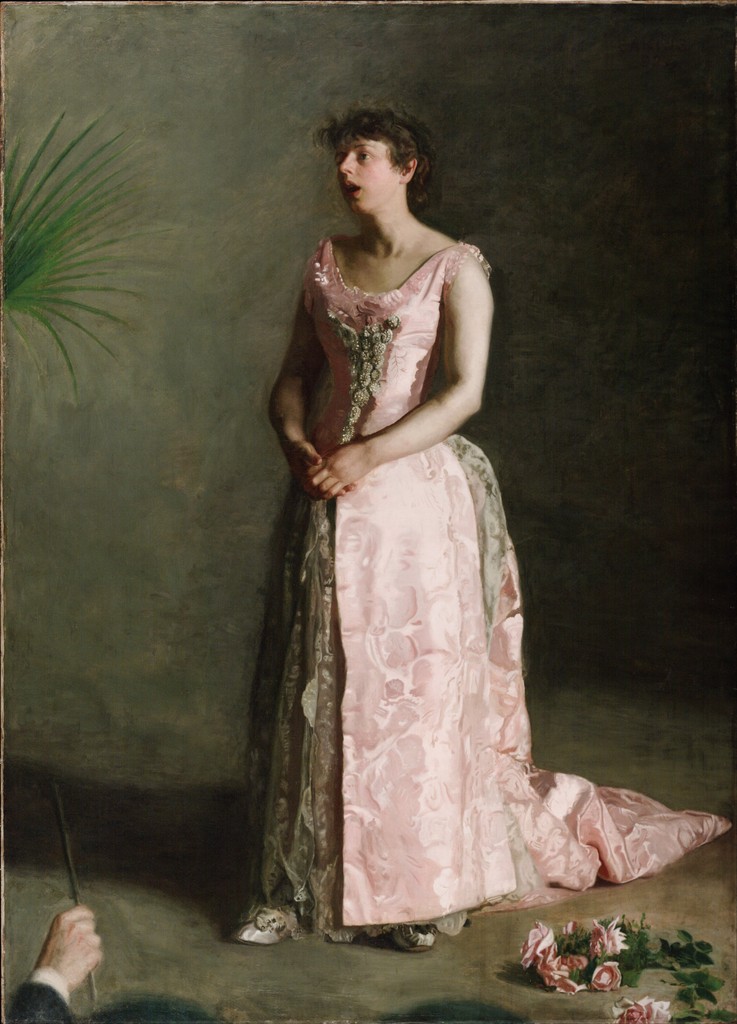
Thomas Eakins’s The Concert Singer shows Weda Cook at the instant a note has made singing visible. Her mouth is open, her chest lifted, and her hands held together at the front of a pale pink dress. A conductor’s hand and baton enter at the lower left, while cut flowers lie near the hem. Cook is the only complete figure, but these partial presences make her belong to an event rather than an isolated studio pose.
The Philadelphia Museum of Art dates the oil on canvas to 1890–92 and identifies Cook as its performer. Its account is unusually specific about method: she repeatedly sang one phrase while Eakins watched the action of her mouth and throat, and he carved the opening bars of the music into the picture’s frame.[1] Paint cannot transmit her voice. Instead, body, gesture, surrounding objects, and frame give viewers several ways to recognise that a voice is being produced.
At roughly 1.91 metres high, the painting approaches the scale of the standing singer herself. That size makes a small physical interval—the shape of the lips, the stretch of the neck, the slight expansion beneath the bodice—carry the work’s main action. The result is both a portrait of a named professional and an exacting inquiry into performance. It asks how sustained practice, normally heard through time, can be concentrated into one silent image.
At a Glance
- Artist and dateThomas Eakins, 1890–92 [1]
- SitterWeda Cook, a successful professional singer and family friend who was twenty-three when posing began [2][3]
- MediumOil on canvas [1]
- ScaleApproximately 75 1/8 × 54 1/4 inches, close to life size [1]
- Working processMore than eighty sittings, each beginning with Cook singing the same melody for Eakins’s observation [3]
- CollectionPhiladelphia Museum of Art, object 42499, accession 1929-184-19 [1]
Thomas Eakins in context
The Gross Clinic
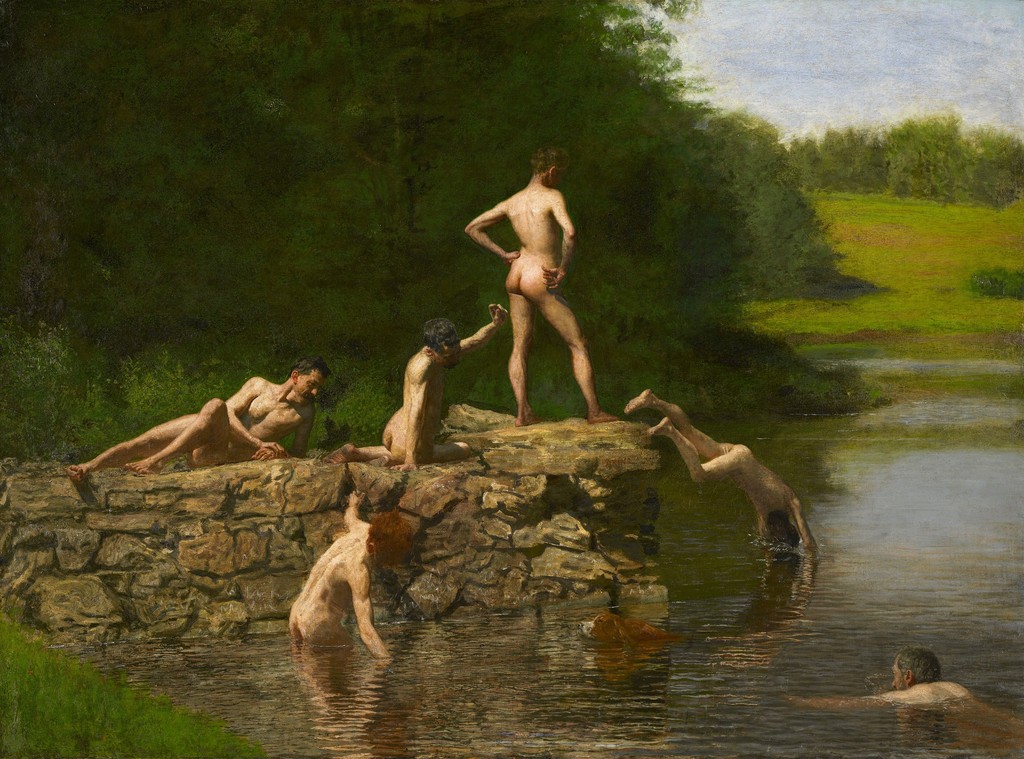
1875Swimming
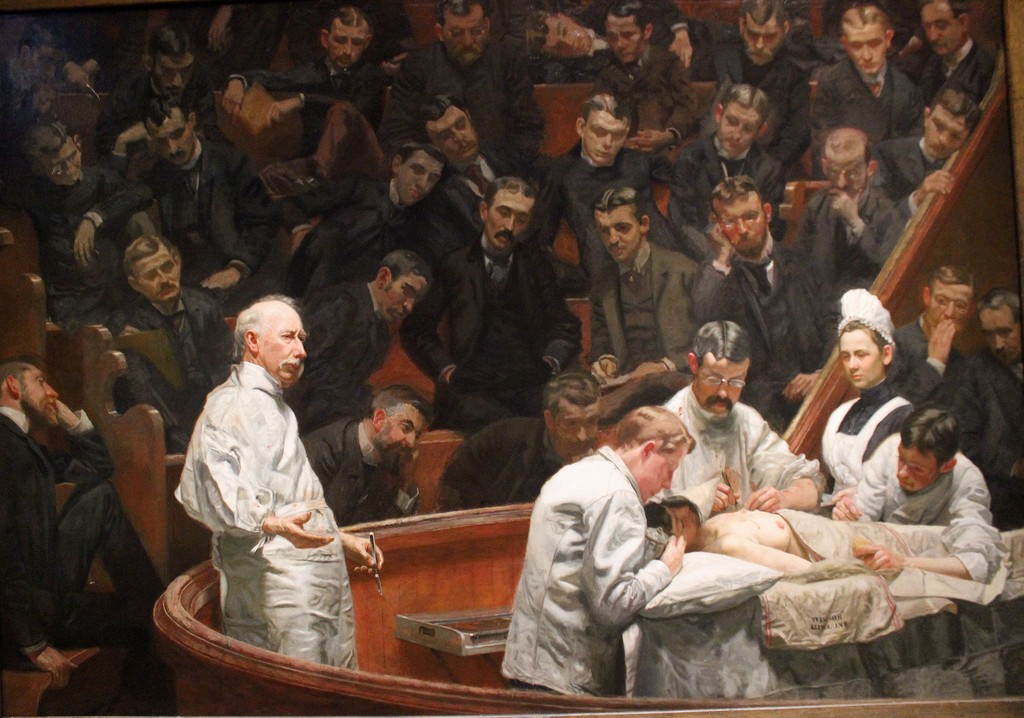
1885The Agnew Clinic
1889The Concert Singer
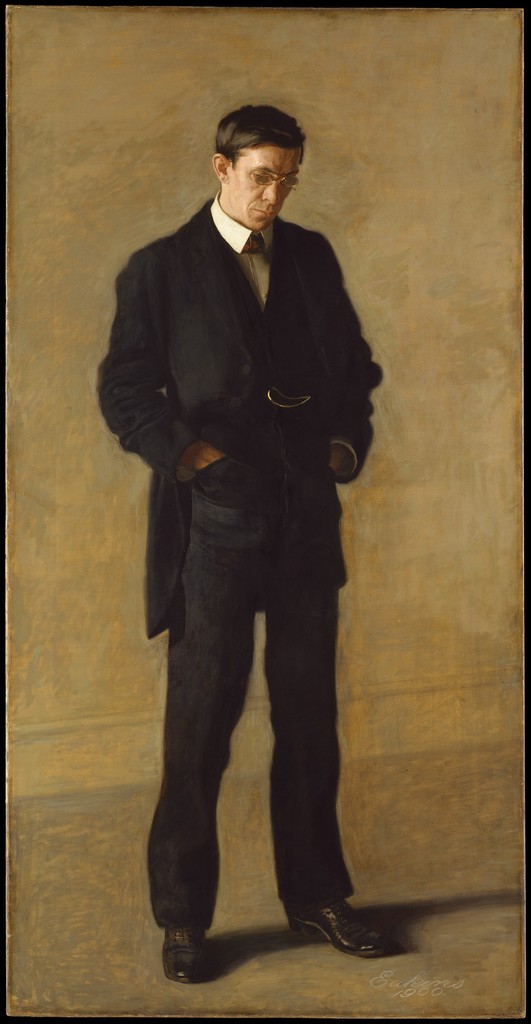
1890–92The Thinker
1900Contents
- Introduction
- Weda Cook, Singer and Sitter
- More Than Eighty Sittings
- Mouth, Breath, and Bearing
- Baton, Score, and Musical Time
- Dress, Flowers, and an Invented Stage
- Scale and Painted Surface
- A Late Portrait at Work
- From Studio to Philadelphia
Weda Cook, Singer and Sitter
Cook was not an anonymous model dressed to represent “music”. The museum describes her as an active and successful singer whom Eakins met through mutual friends. She was twenty-three in 1890, when the sittings began, and her professional schedule meant that she posed when she could over the next two years.[2] Those facts change the picture’s terms. Eakins did not invent a generic performer and add a face; he asked a working musician to repeat an activity she knew intimately.
The arrangement was also not a conventional paid portrait commission. Eakins invited Cook to pose, and the painting remained his project.[2] This gives her labour a complicated place in its history. Her likeness, time, dress, and physical knowledge made the work possible, although Eakins controlled the composition and retained the canvas. Acknowledging Cook as a participant does not turn the picture into a collaboration for which no such authorship is documented. It does prevent her from becoming mere material for an artist’s experiment.
The museum’s career account says Eakins was interested in musicians’ disciplined effort and frequently represented accomplished people in the activity through which they had earned distinction.[2] Cook therefore belongs to the larger portraits in which profession is disclosed through posture and action. Yet her page requires its own focus. Unlike a doctor’s instruments or an athlete’s boat, the singer’s essential instrument is her breathing body, and the product of her work leaves no visible object behind.
More Than Eighty Sittings
The Metropolitan Museum of Art records that Cook began each of more than eighty sittings by singing the same melody so Eakins could study the action of her vocal cords.[3] The Philadelphia museum’s wording is slightly more cautious and closer to what a painter could see: Cook recalled repeating a phrase while he watched her mouth and throat.[1] Read together, the sources establish prolonged, repeated observation without suggesting that Eakins literally saw a hidden anatomical structure.
PMA’s teaching material identifies the phrase as “O Rest in the Lord” from Mendelssohn’s Elijah.[2] That documented account permits the music to be named; it does not make the painting an audible record of a complete performance. The same source says it is thought that Eakins selected the vowel in “rest”. The qualification matters. The open mouth may be consistent with that proposal, but the canvas cannot verify a precise sound on its own.
Repetition offered information unavailable in a single held pose. A singer can imitate an open mouth silently, but breath changes the chest, neck, jaw, and balance of the whole figure. Beginning a sitting with the phrase allowed Eakins to compare those linked actions again and again. The final image is therefore not one exposure preserved intact. It is a selected instant built from many returns.
Duration also resists a romantic idea of effortless inspiration. Cook’s successful career limited when she could attend, and more than eighty sessions spread across two years asked substantial patience from both sitter and painter.[2][3] The completed surface suppresses that stop-and-start history. Only the concentrated pose remains, making the labour of production almost as quiet as the unheard note.
Mouth, Breath, and Bearing
Cook’s open mouth is the smallest conspicuous shape in a very large canvas. It draws attention because the face and throat rise out of shadow and because her gaze travels past the viewer rather than meeting it. Her jaw is lowered without becoming a theatrical grimace. Light catches the cheek, neck, and upper chest, joining facial expression to the body that supports the sound.
The painting does not diagram breathing. No labelled muscle or sequence explains vocal technique. Instead, the upright stance gives the torso room, while the slightly elevated chest and exposed line of the neck make exertion available to observation. These features support a reading of controlled breath; they cannot tell us the volume, quality, or emotional colour of Cook’s voice. The picture makes performance credible without pretending that sight can replace hearing.
Her hands intensify this control. They meet low at the front of the body rather than rising in an illustrative gesture. One hand seems to settle over the other, containing movement while the mouth carries the action. The contrast separates this portrait from an image of dramatic acting. Cook’s fingers do not narrate the text of the song, and her face does not supply a certain private emotion. What the canvas firmly presents is professional attention organised through the whole body.
This emphasis has anatomical precision without reducing Cook to anatomy. Eakins had long made bodily structure part of his painting and teaching, as the broader paintings guide explains.[6] Here knowledge of the body serves the likeness of a particular singer. The mouth, throat, chest, stance, and hands matter because Cook has trained them to work together.
Baton, Score, and Musical Time
At the lower left, a pale hand holds a slender baton. The conductor’s body remains outside the image, so this fragment performs two tasks at once. It provides a beat that Cook can follow, and it establishes a position for an audience: we stand somewhere within the performance space rather than looking at a solitary figure against a wall. The cropped wrist also makes the scene feel larger than the canvas, as though musicians and listeners continue beyond its boundaries.
Eakins planned that interruption. PMA preserves a small oil sketch for the painting, dated about 1890, and its teaching account notes that the preliminary work already includes the conductor’s hand.[2][4] The fragment was therefore not an accidental late addition. It belonged to the pictorial problem before the full-size canvas was finished.
The frame supplied another form of evidence. Eakins carved the opening bars of the song into it, placing a score around the painted performance rather than putting sheet music into Cook’s hands.[1] This choice preserves her uncluttered silhouette while making the named composition materially present. Musical notation can specify pitch and duration for someone able to read it, but it still produces no sound by itself. The carved score, painted mouth, and baton each point towards music through a different silent code.
Their times also differ. The baton marks a passing beat; the notation sets out a sequence; the portrait fixes one selected configuration. Together they prevent stillness from becoming inactivity. The painting cannot unfold like the phrase Cook sang, but it can make viewers aware of what came immediately before and what must follow.
Dress, Flowers, and an Invented Stage
Cook did not pose on a concert platform. The Philadelphia Museum of Art states that Eakins painted her in his studio and constructed the sense of a public performance there.[2] The muted wall, palm fronds at the left, bouquet on the floor, and conductor’s hand create a spare stage without providing an identifiable venue. These details establish occasion while keeping attention on the singer.
The pink dress is treated as structure as well as finery. PMA identifies silk brocade, lace, and seed-pearl trim.[2] The fitted bodice makes the upper body’s expansion legible; the long skirt establishes an unbroken vertical before its train spreads towards the right edge. Light changes across the patterned silk, sometimes describing its sheen and sometimes allowing the folds to merge into the dimmer setting. The gown announces public presentation, but it does not make Cook a passive display. Its cut and surface help articulate stance.
The bouquet is already down rather than being offered. It may evoke the conventions of applause or tribute, but the consulted records do not establish who placed it there or what story it carries. Visually, its scattered pinks repeat the dress near the ground and counter the conductor’s hand across the lower edge. That formal relation is secure; a sentimental narrative would be speculation.
Scale and Painted Surface
The near-life-size format makes Cook’s full figure confront the viewer as a physical presence. Unlike a bust, it must coordinate head, rib cage, clasped hands, hips, feet, and trailing fabric within one upright rhythm. Unlike Eakins’s crowded medical pictures, it cannot distribute attention among many faces. Small changes of balance consequently become important.
Surface differences keep the large field active. Brocade catches broad, cool highlights; lace and pearls divide the neckline into smaller marks; skin is modelled more softly; the background absorbs detail. The face is not the brightest object, yet changes around the mouth remain legible because they are framed by the darker hair and surrounding wall. Technique directs looking through relative emphasis rather than through a spotlight effect.
Eakins’s preliminary sketch confirms that the finished painting emerged through planning, not through one prolonged application before the sitter.[4] Repeated performance supplied observation, while scale, cropping, texture, and spacing belonged to composition. The result feels immediate because those slow decisions have been made unobtrusive.
A Late Portrait at Work
The Philadelphia Museum places The Concert Singer within Eakins’s increased concentration on portraiture after his departure from the Pennsylvania Academy of the Fine Arts.[1] That context is useful, but it should not turn Cook into an illustration of the artist’s personal difficulties. The painting is an outward-looking study of someone else’s profession, made several years after the institutional break.
It also complicates any claim that Eakins’s later likenesses always remove work and setting. The Smithsonian notes his tendency to choose scientists, physicians, writers, athletes, and musicians whose achievements he respected.[5] Here the stage is compressed, not erased. A hand, baton, flowers, formal dress, and frame notation are enough to identify Cook’s public role while leaving her body dominant.
Comparison with The Thinker: Portrait of Louis N. Kenton clarifies the difference. Kenton stands in a narrow, sparse space with lowered head and hidden hands; the Met warns through its record that even the familiar short title has a later history and does not reveal a particular thought.[7] Cook’s attention has a documented external object: a phrase she is singing under a conductor’s beat. Both portraits use standing scale and dark surroundings, but one makes practised sound visible while the other withholds the content of stillness.
From Studio to Philadelphia
Eakins retained the painting rather than transferring it to Cook. The Philadelphia Museum of Art’s accession record identifies it as 1929-184-19 and credits the gift to Susan Macdowell Eakins and Mary Adeline Williams.[1] That route places the canvas among the body of work preserved and dispersed after the artist’s death. It is now in the museum’s collection in Philadelphia, the city in which Cook performed, posed, and was painted.
The frame is part of that object history, not a decorative afterthought. Reproductions that crop it away also remove the carved bars through which Eakins connected the painting to the documented phrase. Object 42499 is therefore best understood as a combined painted and framed construction. Its current museum home allows the performer, the portrait, and the material trace of music to remain together.
Researched works directory
This searchable evidence census was assembled from public museum records and a reproducible Wikidata snapshot. It is not a catalogue raisonné, not a claim to complete oeuvre coverage, and not a substitute for the published catalogue literature, which was not used to claim absolute completeness.
| Name | Date | Medium |
|---|---|---|
| A Singer (Mrs. W.H. Bowden) | 1906 | Painting |
| A Singer: Portrait of Mrs. W.H. Bowden | 1906 | Painting |
| A Street Scene | Date unknown | Painting |
| A street scene in Sevilla | 1870 | Painting |
| A Street Scene in Seville | 1870 | Painting |
| African-American Man | 1884 | Photography |
| An Actress (Portrait of Suzanne Santje) | 1903 | Painting |
| Anna Lewis | 1890 | Painting |
| Annie C. Lochrey Husson (Mrs. Louis Husson) | 1905 | Painting |
| Antiquated Music (Portrait of Sarah Sagehorn Frishmuth) | 1900 | Painting |
| Arcadia | 1883 | Painting |
| Arcadia | Date unknown | Sculpture |
| Arcadia: Figure Study, Female Nude | 1883 | Painting |
| Arcadia Sketch | 1883 | Painting |
| Arcadian | Date unknown | Painting |
| Archbishop Diomede Falconio | 1905 | Painting |
| Archbishop James Frederick Wood | 1877 | Painting |
| Archbishop James Frederick Wood (1813-1883) | 1876 | Painting |
| Archbishop William Henry Elder | 1903 | Painting |
| Arthur B. Frost | 1886 | Painting |
| Artist and His Father Hunting Reed Birds: Marsh Landscape Sketch | 1873 | Painting |
| B.J. Blommers | 1904 | Painting |
| Baby at Play | 1876 | Painting |
| Baseball Players Practicing | 1875 | Artwork |
| Benjamin Eakins G38 | Date unknown | Painting |
| Bertrand Gardel (Sketch for The Chess Players) | 1875 | Painting |
| Between Rounds | 1898 | Painting |
| Billy Smith | 1898 | Painting |
| Billy Smith (Sketch for Between Rounds) | 1898 | Painting |
| Boy Reclining | 1883 | Painting |
| Carmelita Requena | 1869 | Painting |
| Charles Edmund Dana | 1902 | Painting |
| Charles Percival Buck | 1904 | Painting |
| Clara | 1890 | Painting |
| Courtship | 1878 | Painting |
| Cowboy Singing | 1892 | Painting |
| Cowboys in the Badlands | 1888 | Painting |
| Cowboys in the Badlands sketch 2 | 1888 | Painting |
| Delaware River Scene | 1881 | Painting |
| Delaware River Study | 1881 | Painting |
| Dr. Agnew (Dr. D. Hayes Agnew) (1818-1892) | 1889 | Painting |
| Dr. Agnew (Dr. D. Hayes Agnew) (1818–1892) | 1889 | Painting |
| Dr. Horatio C. Wood | 1886 | Painting |
| Dr. Thomas H. Fenton | 1916 | Painting |
| Drifting | 1875 | Painting |
| Eakins G184 | 1916 | Painting |
| Ecorché: Relief of a Horse (Josephine) | 1882 | Sculpture |
| Edward W. Redfield | 1905 | Painting |
| Fairman Rogers Four-in-Hand: Landscape Study of Fairmount Park | 1879 | Painting |
| Fairman Rogers Four-in-Hand: Study of a Horse's Leg | 1879 | Painting |
| Fairmount Park (Sketch for The Fairman Rogers Four-in-Hand) | Date unknown | Painting |
| Female Model | 1867 | Painting |
| Female Nude | 1884 | Painting |
| Female Nude from the Back | 1889 | Photography |
| Female Nude (Study) | 1881 | Painting |
| Fifty Years Ago (Young Girl Meditating): Study | 1877 | Painting |
| Figure Study: Masked Nude Woman | Date unknown | Painting |
| Figure Study: Nude Woman, Seated, with Arms Lowered (r) | Date unknown | Painting |
| Figure Study: Nude Woman, Seated, with Arms Raised | Date unknown | Painting |
| [Four Sketches: Seated Man, Sleeping Dog, Two Vases(?)] | Date unknown | Painting |
| Frances Eakins | 1870 | Painting |
| Francis J. Ziegler | 1890 | Painting |
| Frank Hamilton Cushing | 1895 | Painting |
| Frank Jay St. John | 1900 | Painting |
| General E. Burd Grubb (1841-1914) | 1898 | Painting |
| Girl with a Fan; Portrait of Miss Gutierrez | Date unknown | Painting |
| Harriet Husson Carville (Mrs. James G. Carville) | 1904 | Painting |
| Harrison S. Morris | 1896 | Painting |
| Hauling the Seine | 1882 | Painting |
| Head of a Man (Rutherford B. Hayes?) | 1877 | Painting |
| Hiawatha | 1874 | Painting |
| Hiawatha | Date unknown | Artwork |
| Home Ranch | 1892 | Painting |
| Home Scene | 1871 | Painting |
| Homespun | 1881 | Painting |
| In the Studio | 1884 | Painting |
| Interior of a Woodcarver's Shop (Sketch for William Rush Carving His Allegorical Figure of the Schuylkill River) | Date unknown | Painting |
| James MacAlister (Sketch) | 1895 | Painting |
| John Biglin in a Single Scull | 1873 | Painting |
| John Biglin in a Single Scull | 1874 | Painting |
| Joseph R. Woodwell | 1904 | Painting |
| Kathrin | 1872 | Painting |
| Knitting | 1881 | Sculpture |
| Knitting | 1882 | Sculpture |
| Knitting | Date unknown | Sculpture |
| Lafayette Park, Washington, D.C. | 1877 | Painting |
| Landscape | 1881 | Painting |
| Landscape | 1882 | Painting |
| Landscape Sketch | 1880 | Painting |
| Landscape (Sketch for Cowboys in the Bad Lands) | 1887 | Painting |
| Landscape Study: Cultivated Field and Tree | 1874 | Painting |
| Landscape Study: Shoreline with Trees | 1874 | Painting |
| Landscape with a Dog | 1874 | Painting |
| Letitia Wilson Jordan | 1888 | Painting |
| Louis Husson | 1899 | Painting |
| Major Manuel Waldteufel | 1907 | Painting |
| Masked nude standing | 1880 | Painting |
| Maud Cook (Mrs. Robert C. Reid) | 1895 | Painting |
| Mending the Net | 1881 | Painting |
| Mending the Net: Study of a Fisherman | Date unknown | Painting |
| Miss Alice Kurtz | 1903 | Painting |
| Miss Amelia Van Buren | 1891 | Painting |
| Miss Eleanor S. F. Pue | 1907 | Painting |
| Miss Gertrude Murray | 1895 | Painting |
| Monsignor James P. Turner | 1906 | Painting |
| Mother (Annie Williams Gandy) | 1903 | Painting |
| Mrs. Gilbert L. Parker | 1910 | Painting |
| Mrs. Mary Arthur | 1900 | Painting |
| Music | 1904 | Painting |
| Nude man with beard | Date unknown | Painting |
| Nude Woman Standing | 1908 | Painting |
| Old Lady Sewing | 1879 | Painting |
| Portrait of a Little Girl | 1897 | Painting |
| Portrait of a Woman Reading | Date unknown | Painting |
| Portrait of Adam S. Bare | 1903 | Painting |
| Portrait of Alfred Reynolds | Date unknown | Painting |
| Portrait of Arthur Burdett Frost | 1886 | Painting |
| Portrait of Ashbury Wright Lee | 1905 | Painting |
| Portrait of Benjamin Eakins | 1894 | Painting |
| Portrait of Benjamin Eakins (Sketch for The Writing Master) | 1882 | Painting |
| Portrait of Blanche Hurlburt | 1885 | Painting |
| Portrait of Douglass Morgan Hall | 1889 | Painting |
| Portrait of Dr. Edward J. Nolan | 1900 | Painting |
| Portrait of Dr. Samuel D. Gross (The Gross Clinic) | 1875 | Painting |
| Portrait of Edward Taylor Snow | 1904 | Painting |
| Portrait of Elizabeth L. Burton | 1905 | Painting |
| Portrait of Florence Einstein | 1905 | Painting |
| Portrait of Henry O. Tanner | 1902 | Painting |
| Portrait of J. Harry Lewis | 1876 | Painting |
| Portrait of John B. Gest | 1905 | Painting |
| Portrait of Joshua Ballinger Lippincott | 1892 | Painting |
| Portrait of Leslie W. Miller | 1901 | Painting |
| Portrait of Lucy Lewis | 1896 | Painting |
| Portrait of Margaret Eakins in a Skating Costume | 1871 | Painting |
| Portrait of Mary Adeline Williams | 1899 | Painting |
| Portrait of Mary Adeline Williams | 1900 | Painting |
| Portrait of Mrs. Fairman Rogers (Study for The Fairman Rogers Four-in-Hand) | 1879 | Painting |
| Portrait of Mrs. Frank Hamilton Cushing | 1895 | Painting |
| Portrait of Mrs. James Mapes Dodge (Josephine Kern) | 1896 | Painting |
| Portrait of Professor Benjamin H. Rand | 1874 | Painting |
| Portrait of Professor W. D. Marks | 1886 | Painting |
| Portrait of Rear Admiral George Wallace Melville | 1904 | Painting |
| Portrait of Walter S. Macdowell | 1904 | Painting |
| Porträt des Alfred Bryan Wall | 1904 | Painting |
| Porträt des David Wilson Jordan | Date unknown | Painting |
| Porträt des John McLure Hamilton (1853- 1936) | 1895 | Painting |
| Professionals at Rehearsal | 1883 | Painting |
| Professor William D Marks | 1886 | Painting |
| Professor William Woolsey Johnson | 1896 | Painting |
| Pushing for Rail | 1874 | Painting |
| Rail Shooting on the Delaware | 1876 | Painting |
| Rear Admiral Charles Dwight Sigsbee G388-2 | 1903 | Painting |
| Rear Admiral George W. Melville | 1905 | Painting |
| Reclining Male Nude | 1887 | Photography |
| Reclining Nude | Date unknown | Painting |
| Retrospection | 1880 | Painting |
| Riter Fitzgerald | 1895 | Painting |
| Robert M. Lindsay | 1900 | Painting |
| Ruth (Ruth W. Harding) | 1903 | Painting |
| Saddle (Sketch for Cowboys in the Bad Lands) | 1887 | Painting |
| Sailboats Racing on the Delaware | 1874 | Painting |
| Sailboats Racing: Study of the Delaware River | 1874 | Painting |
| Sailing | 1875 | Painting |
| Salutat | 1898 | Painting |
| Seated Figures | 1886 | Painting |
| Self-portrait | 1902 | Painting |
| Seventy Years Ago | 1877 | Painting |
| Shad Fishing at Gloucester on the Delaware: Delaware River and Gloucester Pier | 1881 | Painting |
| Shad Fishing at Gloucester on the Delaware River | 1881 | Painting |
| Shad Fishing at Gloucester on the Delaware River: Study of a Woman's Head | 1881 | Painting |
| Ships and Sailboats on the Delaware | 1874 | Painting |
| Ships and Sailboats on the Delaware: Study | 1874 | Painting |
| Shoreline of the Delaware River, with Fishing Nets | Date unknown | Painting |
| Signora Gomez d'Arza | 1901 | Painting |
| Singing a Pathetic Song | 1881 | Painting |
| Sketch for Cowboys in the Bad Lands | 1887 | Painting |
| Sketch for Music (The Violinist) | 1904 | Painting |
| Sketch for Portrait of Dr. Jacob Mendez da Costa | 1893 | Painting |
| Sketch for Portrait of Leslie W. Miller | 1901 | Painting |
| Sketch for Portrait of Letitia Wilson Jordan | 1888 | Painting |
| Sketch for Portrait of Monsignor James P. Turner | 1906 | Painting |
| Sketch for Portrait of Mother Patricia Waldron | 1903 | Painting |
| Sketch for Portrait of Professor George F. Barker | 1886 | Painting |
| Sketch for Seventy Years Ago | Date unknown | Painting |
| Sketch for The Concert Singer | 1892 | Painting |
| Sketch for The Fairman Rogers Four-in-Hand | 1879 | Painting |
| Sketch for The Gross Clinic | 1875 | Painting |
| Sketch for the Surrender of General Lee to General Grant at Appomatox | Date unknown | Painting |
| Sketch for William Rush and His Model | 1908 | Painting |
| Sketch of a Landscape | 1882 | Painting |
| Sketch of a Man and Study of Drapery | 1882 | Painting |
| Sketch of Harry | 1892 | Painting |
| Sketch of Max Schmitt in a Single Scull | 1874 | Painting |
| Sketches for “Home-Spun”, (recto and verso) | 1881 | Painting |
| Sketches (Four on one panel) | Date unknown | Painting |
| Spinning | 1881 | Painting |
| Spinning | 1882 | Sculpture |
| Spinning: Sketch | 1881 | Painting |
| Starting Out After Rail | 1863 | Painting |
| Starting Out After Rail | 1874 | Painting |
| Study for Arcadia: Youth Playing Pipes | 1883 | Painting |
| Study for "Cowboys in the Badlands | 1887 | Painting |
| Study for "Negro Boy Dancing": The Banjo Player | Date unknown | Painting |
| Study for "Negro Boy Dancing": The Boy | Date unknown | Painting |
| Study for Portrait of John McClure Hamilton | 1895 | Painting |
| Study for Salutat | 1898 | Painting |
| Study for 'The Meadows, Gloucester' | 1882 | Painting |
| Study for "William Rush Carving His Allegorical Figure of the Schuylkill River | 1876 | Painting |
| Study of a Groom | 1879 | Painting |
| Study of a Nude Man | 1869 | Painting |
| Study of a Nude Man (The Strong Man) | 1869 | Painting |
| Study of a Seated Nude Woman Wearing a Mask | 1863 | Drawing |
| Study of a Young Woman | 1868 | Painting |
| Study of Dr Samuel David Gross | 1875 | Painting |
| Study of Horse for The Fairman Rogers Four-in-Hand | 1879 | Painting |
| Swimming | 1885 | Painting |
| Taking the Count | 1898 | Painting |
| Taking the Count, study | 1898 | Painting |
| Taking Up Net | 1881 | Painting |
| Talcott Williams | 1889 | Painting |
| That's a New Game Down in Frisco": Study for the Central Standing Figure | 1878 | Painting |
| The Agnew Clinic | 1889 | Painting |
| The Art Student (James Wright) | 1890 | Painting |
| The Artist's Wife and His Setter Dog | 1884 | Painting |
| The Biglin Brothers Racing | 1872 | Painting |
| The Biglin Brothers Turning the Stake | 1873 | Painting |
| The Black Fan (Portrait of Mrs. Talcott Williams) | 1891 | Painting |
| The Bohemian (Portrait of Franklin Louis Schenck) | 1890 | Painting |
| The Brinton House | 1878 | Painting |
| The Cello Player | 1896 | Painting |
| The Champion Single Sculls (Max Schmitt in a Single Scull) | 1871 | Painting |
| The Chaperone | 1908 | Painting |
| The Chess Players | 1876 | Painting |
| The Concert Singer | 1890–1892 | Painting |
| The Courtship | 1878 | Painting |
| The Crucifixion | 1880 | Painting |
| The Dancing Lesson | 1878 | Painting |
| The Dean's Roll Call | 1899 | Painting |
| The Fairman Rogers Four-in-Hand | 1879 | Painting |
| The Fairman Rogers Four-In-Hand (A May Morning in... | 1899 | Painting |
| The Meadows, Gloucester | 1882 | Painting |
| The Model | 1908 | Painting |
| The Oarsmen (The Schreiber Brothers) | 1874 | Painting |
| The Oboe Player (Portrait of Dr. Benjamin Sharp) | 1903 | Painting |
| The Old-Fashioned Dress (Portrait of Helen Montanverde Parker) | 1908 | Painting |
| The Pair-Oared Shell | 1872 | Painting |
| The Pathetic Song | 1881 | Painting |
| The Pianist | 1896 | Painting |
| The Poleman in the Ma'sh | 1881 | Drawing |
| The Red Shawl | 1890 | Painting |
| The Spinner | 1876 | Painting |
| The Thinker: Portrait of Louis N. Kenton | 1900 | Painting |
| The Timer | 1879 | Painting |
| The Translator, Portrait of Monsignor Hugh T. Henry | 1902 | Painting |
| The Veteran (Portrait of George Reynolds) | Date unknown | Painting |
| The Writing Master | 1882 | Painting |
| The Young Man (Portrait of Kern Dodge) | 1898 | Painting |
| Thomas Eakins and John Laurie Wallace on a Beach | 1883 | Photography |
| Three Boys Wading in a Creek | 1883 | Photography |
| Trenton Battle Monument | 1893 | Sculpture |
| Two Pupils in Greek Dress | 1883 | Photography |
| Views of Harry | 1885 | Painting |
| Walt Whitman | 1887 | Painting |
| Whistling for Plover | 1874 | Painting |
| William H. Macdowell | 1884 | Photography |
| William H. Macdowell and Margaret Eakins in Saltville (or Clinch Mountain), Virginia | 1875 | Photography |
| William Hance Macdowell (1816-1906) | 1897 | Painting |
| William Rush and his Model | 1908 | Painting |
| William Rush and His Model | Date unknown | Painting |
| William Rush Carving His Allegorical Figure of the Schuylkill River | 1876 | Painting |
| William Rush Carving His Allegorical Figure of the Schuylkill River | 1908 | Painting |
| William Rush Carving His Allegorical Figure of the Schuylkill River, Study | 1876 | Painting |
| William Rush's Model | 1908 | Painting |
| Wrestlers | 1899 | Painting |
| Young Girl Meditating | 1877 | Painting |
Frequently Asked Questions
She is Weda Cook, a professional singer and friend of the Eakins family. PMA says she was twenty-three when the project began in 1890 and that her active career required the sittings to be arranged over two years. She is a named practitioner represented at work, not an unidentified model personifying music.[2][3]
PMA’s teaching material identifies “O Rest in the Lord” from Felix Mendelssohn’s Elijah. Cook repeated the phrase so Eakins could observe the physical production of song. A proposal that he chose a particular vowel remains qualified by the museum; the painting alone cannot prove the exact sound represented.[1][2]
The cropped hand and baton imply a beat and extend the performance beyond the canvas without competing with Cook’s full figure. A preparatory oil sketch already includes the hand, showing that Eakins planned this partial presence early. The consulted museum records do not require the conductor to be identified for the device to work.[2][4]
It is grounded in Cook’s repeated singing, but it was arranged in Eakins’s studio rather than painted during a public concert. Dress, flowers, palm, conductor, and carved music create a plausible performance setting. The picture combines observation with construction; it is neither fantasy nor documentary transcription.[1][2]
The painting belongs to the Philadelphia Museum of Art, where its online record is object 42499 and its accession number is 1929-184-19. The museum dates it to 1890–92 and catalogues it as oil on canvas. Its recorded 1929 gift brought the painting into the public collection where it remains.[1]
Discussion
Use this evidence-led guide as a starting point for close looking rather than a final verdict.
Share an observation about The Concert Singer or a source that adds useful context.
Reader Insights
Which detail most changes your reading of The Concert Singer?
How do scale, support, medium or present museum evidence shape the encounter?
What remains uncertain when visual inference is separated from documented fact?
Join the Conversation
Add your reading below, keeping observations specific and evidence clear.
References
- Philadelphia Museum of Art, The Concert Singer, accessed 30 August 2026.
- Philadelphia Museum of Art, Thomas Eakins: American Realist, accessed 30 August 2026.
- The Metropolitan Museum of Art, Thomas Eakins: Exhibition Overview, accessed 30 August 2026.
- Philadelphia Museum of Art, Sketch for “The Concert Singer”, accessed 30 August 2026.
- Smithsonian American Art Museum, Thomas Eakins, accessed 30 August 2026.
- The Metropolitan Museum of Art, Thomas Eakins (1844–1916): Painting, accessed 30 August 2026.
- The Metropolitan Museum of Art, The Thinker: Portrait of Louis N. Kenton, accessed 30 August 2026.
More EAKINS Artworks
The Agnew Clinic image: gallery photograph by Miguel Hermoso Cuesta, cropped and perspective-corrected, under CC BY-SA 4.0.