


 by Tom Gurney
Tom Gurney BSc (Hons) is an art history expert with over 20 years experience
Page Created on / Page Updated on
Email: tomgurney1@gmail.com / Phone: +44 7429 011000
Teaching and Anatomy: Introduction
Thomas Eakins approached art education as a practical investigation of how bodies occupy space. Anatomy disclosed structure beneath the skin; life drawing tested that knowledge against individual people; perspective located figures and objects within a measurable setting. Photography added another means of examining pose, movement, and the relation between a body and its surroundings. At the Pennsylvania Academy of the Fine Arts, these interests became parts of an unusually integrated programme rather than isolated technical exercises.[1][2]
That programme was influential, but influence does not settle every question about its delivery. Eakins’s commitment to study from the nude brought valuable opportunities and serious disputes over consent, authority, and classroom boundaries. His departure from PAFA in 1886 belongs in the same history as his pedagogical innovations, without serving either as a melodramatic fall or as an inconvenience to be explained away. Teaching shaped his art, his relationships with students, and the institutions in which he worked; it must be judged with equal attention to method and responsibility.
At a Glance
- Early preparationArt classes at PAFA alongside anatomy lectures and medical demonstrations at Jefferson Medical College [1][2]
- Academy roleProfessor of drawing and painting from 1879 and director from 1882 until his departure in 1886 [1]
- Core studiesAnatomy, dissection, work from living models, perspective, and mechanical drawing [1][2]
- Classroom cameraA means of analysing pose and figure-ground relationships, not merely recording a finished arrangement [1][2]
- Institutional breakPAFA asked Eakins to resign after disputes about his use of nude models and conduct during an anatomy class [1]
- Later teachingWork with the Art Students’ League of Philadelphia and further lectures in Philadelphia and New York [1]
Contents
- Introduction
- Learning the Body
- A Curriculum of Looking
- Drawing Space Clearly
- The Camera in Class
- Authority and the 1886 Dispute
- After the Academy
- Knowledge in the Art
- A Demanding Legacy
Learning the Body
Eakins’s pedagogy began with his own education. Before leaving for Europe in 1866, he attended PAFA and followed anatomy instruction and clinical demonstrations at Jefferson Medical College. Paris then supplied sustained academic training in the figure, painting, and sculpture. When he returned to Philadelphia in 1870, he possessed several ways to understand form: observation of a living model, knowledge of bones and muscles, modelling in three dimensions, and the geometry of pictorial space.[2]
These were connected forms of evidence, not guarantees of truth. A dissected body can reveal attachments and structures that are difficult to see in life, but it cannot reproduce balance, breath, or a changing expression. A model provides those visible conditions, while perspective helps the artist test whether separate observations belong together coherently. PAFA’s account credits Eakins’s teaching era with greatly increasing attention to human anatomy, including cadaver dissection and study from the nude.[3] The claim is most useful when read as a change of emphasis within an institution, not as proof that one teacher alone invented American figure study.
The distinction matters because Eakins taught students to move between general structure and individual variation. An anatomical diagram identifies a typical arrangement; a person presents a particular build, posture, and distribution of weight. Art begins in the decisions required to reconcile those kinds of knowledge. That is why his curriculum belonged to drawing and painting rather than to medical training, even when some of its materials came from medicine.
His path from Jefferson’s demonstrations to an artist’s classroom is traced more fully in the biography. The connection should not be mistaken for a claim that he trained as a surgeon or turned painters into medical specialists. He borrowed investigative habits: look beneath an appearance, understand the mechanism of an action, and check a general rule against a specific case. In the studio, those habits served representation. A shoulder was studied so that its turn could be drawn convincingly, not so that a student could diagnose it.[1][2]
A Curriculum of Looking
At PAFA, Eakins pressed students beyond copying polished works or relying only on casts. Work from life made proportion a question to be answered in each pose. Dissection allowed a muscle’s visible action to be related to its position beneath the surface. Wax or plaster modelling could make a form available in the round. Such exercises asked students to verify what they thought they knew instead of repeating a conventional outline.[3]
The classroom was also a social setting governed by schedules, separate levels of experience, institutional rules, and unequal roles. Teachers selected problems and models; students were expected to look and make images; models’ bodies became the material of instruction. A photograph in the Philadelphia Museum of Art collection records Eakins with students at the Academy, giving the programme a collective setting rather than the appearance of a solitary master transmitting ideas to anonymous followers.[5] It cannot tell us that everyone in the room agreed with his methods. Institutional photographs show participation, not unanimity.
Students encountered this programme differently. Some valued its directness and later supported Eakins; others objected to particular practices or to the way he exercised authority. The historical record therefore resists a simple division between enlightened instruction and conservative opposition. Rigorous life study could enlarge an artist’s knowledge while a teacher’s decisions about exposure and participation could still violate expectations or boundaries. Both propositions can be true at once.
Nor was there one mandatory path from exercise to finished picture. A student might draw a model to understand contour, build a small form to test volume, or photograph a pose for later comparison. Each method made some information clearer and left other qualities unavailable. This plural structure helps explain why Eakins valued exact procedures without settling on one mechanical formula for art.[3]
Drawing Space Clearly
Eakins treated perspective as something an artist could reason through. The public description of his surviving drawing manual identifies lectures on linear perspective, mechanical drawing, reflections, and sculptural relief. He prepared a manuscript and illustrations for students, but abandoned publication after leaving PAFA; drafts now divided between the Academy and the Philadelphia Museum of Art were later brought together by editors.[4] The modern publication record establishes the project’s scope without requiring claims about pages that have not been consulted.
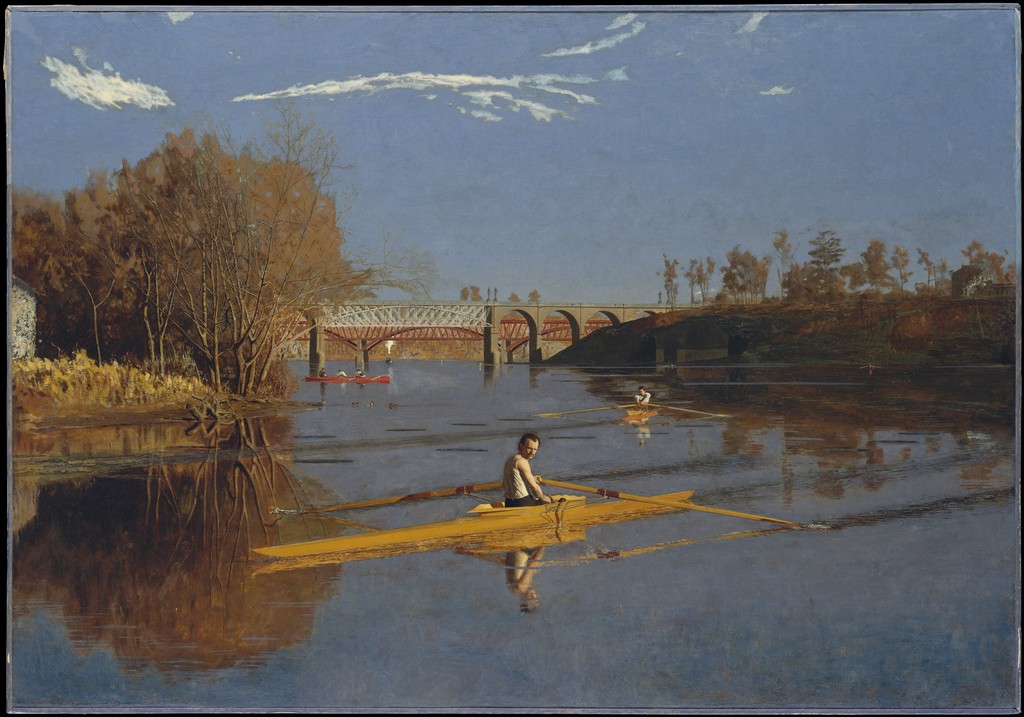
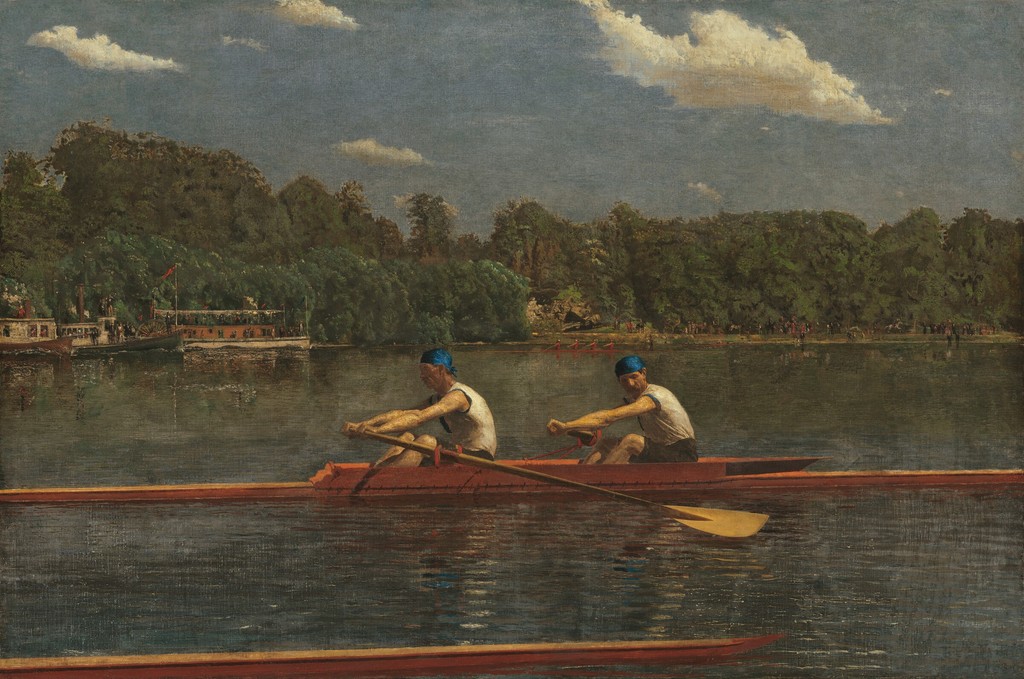
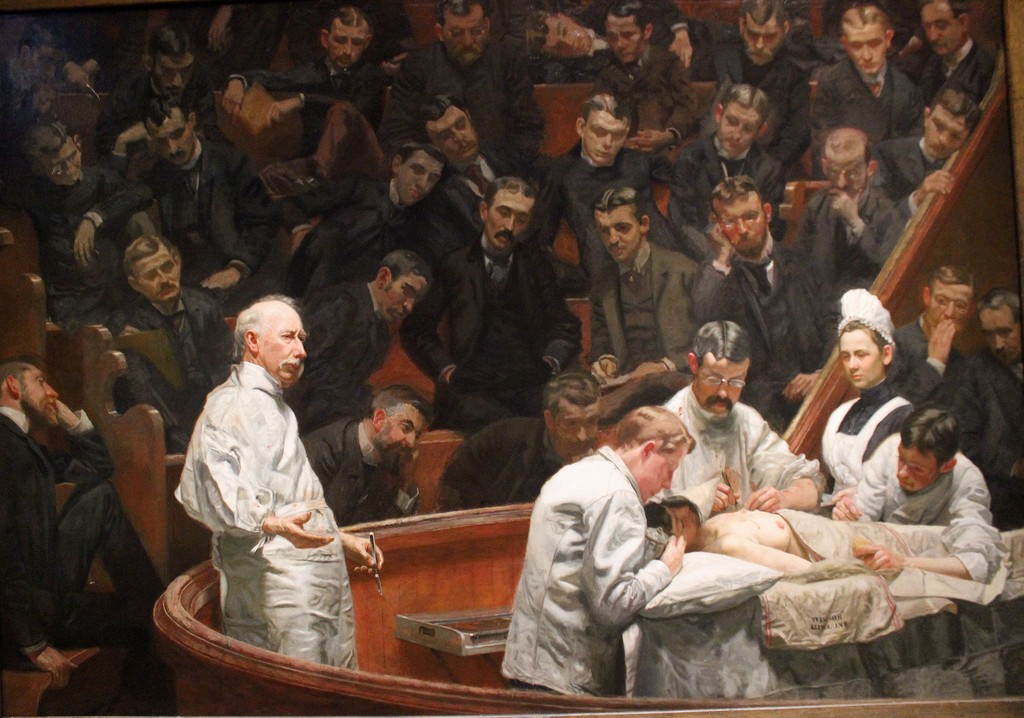
This range makes sense beside his pictures. A racing shell narrows sharply as it recedes, an oar crosses reflective water, and the curved ranks of an amphitheatre place many spectators above a central action. Perspective was not a decorative display of calculation. It let an artist test spatial relationships whose credibility supports the subject. The paintings guide follows those problems from the Schuylkill River to the surgical theatres.
Mechanical drawing also connected Eakins to a practical Philadelphia culture familiar with designed objects, instruments, and measured construction. Yet his pictures do not look like engineering diagrams. Geometry sets the conditions in which a figure can move or stand; light, colour, gesture, and selection create the human emphasis. Teaching perspective thus served observation without pretending that measurement alone could make a work of art.
The Camera in Class
By about 1880, photography had entered Eakins’s professional and domestic practice. The Metropolitan Museum of Art describes him using a wooden view camera, glass-plate negatives, and platinum printing, while expecting students to learn the medium’s technical demands. It characterises the camera as a teaching device comparable to anatomical drawing: a way to refine looking and explore complex relations between figure and ground.[6]
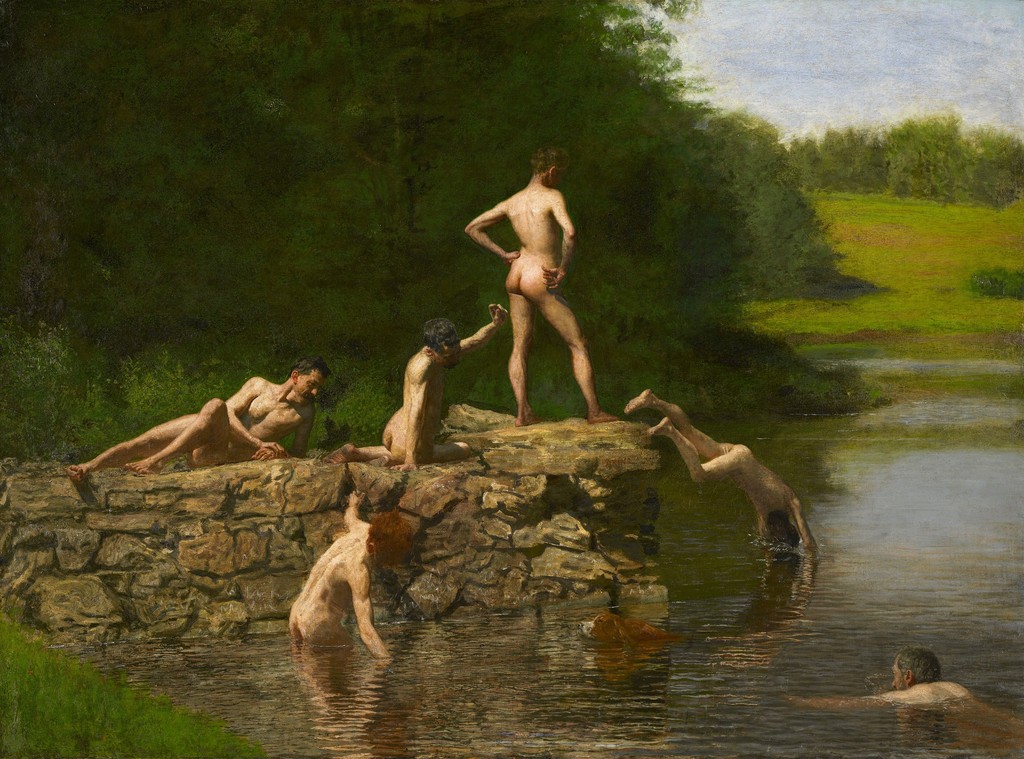
This did not make every photograph a preliminary sketch for a painting. The Met notes that only a small number of oils have direct photographic counterparts, with Swimming and Arcadia among the most prominent. Many camera studies instead examine a pose, a sequence, a group, or a person on their own terms. The photography and working-studies guide separates these functions and follows object-level attributions, since hundreds of surviving images are assigned to Eakins and his circle rather than automatically to him alone.[6]
PAFA’s survey of Eakins as photographer similarly places the medium within teaching, portraiture, family life, landscape, and sustained study of the nude. Its core collection came from Charles Bregler, a former student, and includes hundreds of prints and negatives. PAFA also stresses that photographs made at the Academy involved Eakins and members of his circle.[7] A shared studio, equipment, or model does not by itself establish who exposed a plate; responsible interpretation must preserve those distinctions.
The camera changed the duration of looking. A live pose ends, muscles tire, and gestures shift. A plate fixes one configuration that can be compared or revisited. But the image also reflects framing, timing, lighting, printing, and decisions about who was placed before the lens. Photography did not remove authority from the classroom encounter. It preserved the consequences of that encounter in an especially durable form.
Authority and the 1886 Dispute
In January 1886, Eakins removed the loincloth from a male model during an anatomy demonstration for a class that included women. Complaints reached PAFA’s board, and he was required to leave his directorial and teaching positions. Museum accounts variously use the language of dismissal, resignation, or forced resignation, but they agree on the institutional outcome and its connection to contested use of the nude.[1][3]
The episode should not be reduced to a quarrel over whether artists needed anatomical knowledge. It concerned the conditions under which a teacher made a body visible and the authority he assumed in doing so. A pedagogical purpose does not supply blanket permission. Students and models occupied positions with less institutional power than the director, and objections cannot be dismissed merely because the study of anatomy produced important art.
Nor does the conflict require treating life drawing itself as suspect. PAFA records that study from the model and other changes associated with Eakins’s era remained within its curriculum long after he left.[3] The durable educational practice and the disputed act are not identical. Separating them allows a more exact assessment: anatomical and observational training could be valuable, while a specific exercise of authority could still cross an important line.
Swimming makes the difficulty visible in another form. The Amon Carter Museum identifies the 1885 painting as a group portrait of Eakins and several male students and relates it to his ideal of a community devoted to life study. The same record notes both student support and unsettling accounts of aggressive pressure concerning nudity.[9] Formal balance on the canvas does not cancel those testimonies, just as controversy does not erase the painting’s carefully organised inquiry into bodies at rest, diving, and moving through water.
After the Academy
Eakins’s separation from PAFA broke a major institutional relationship, but it did not end his teaching. A group of students left the Academy and formed the Art Students’ League of Philadelphia, where he instructed during 1886–87; he also continued lecturing elsewhere in Philadelphia and New York.[1] Calling that group supportive is accurate. Treating it as representative of every student response would not be.
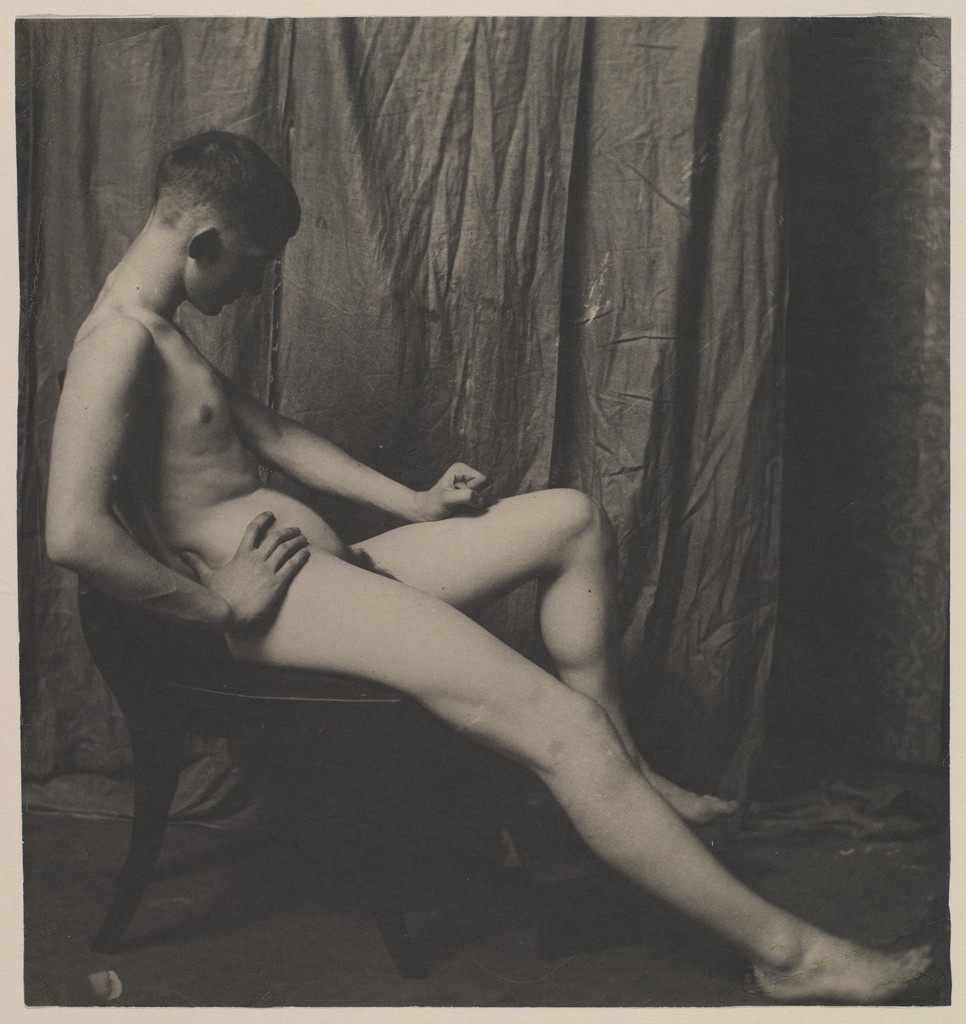
The Met’s Bill Duckett Nude, at the Art Students’ League of Philadelphia provides a precise object from this later setting. It is a platinum print of about 1889, object 43.87.20, and the museum identifies Duckett as a young companion of Walt Whitman. The title locates the study at the League, while the record states that Eakins made several photographs of him there.[8] No broader claim about Duckett’s views, motives, or relationship with the artist is needed to understand the image as a deliberate study of a seated figure.
The print is neither evidence that the League lacked boundaries nor proof that all post-PAFA teaching reproduced the earlier dispute. It establishes a continuing intersection of camera work, life study, and instruction. Its careful illumination and enclosed pose also show why a study could exceed a merely utilitarian function. The image preserves an individual person, not an interchangeable anatomical specimen.
Knowledge in the Art
Eakins’s anatomical education is most obvious in subjects where trained action matters, but it should not be used as a universal explanation. The Gross Clinic predates his PAFA directorship and draws on his own medical observation: surgeon Samuel D. Gross addresses students while doctors operate in Jefferson Medical College’s amphitheatre.[11] Knowledge of anatomy helped Eakins construct the action, yet the painting also depends on hierarchy, lighting, portraiture, and the controlled visibility of the patient.
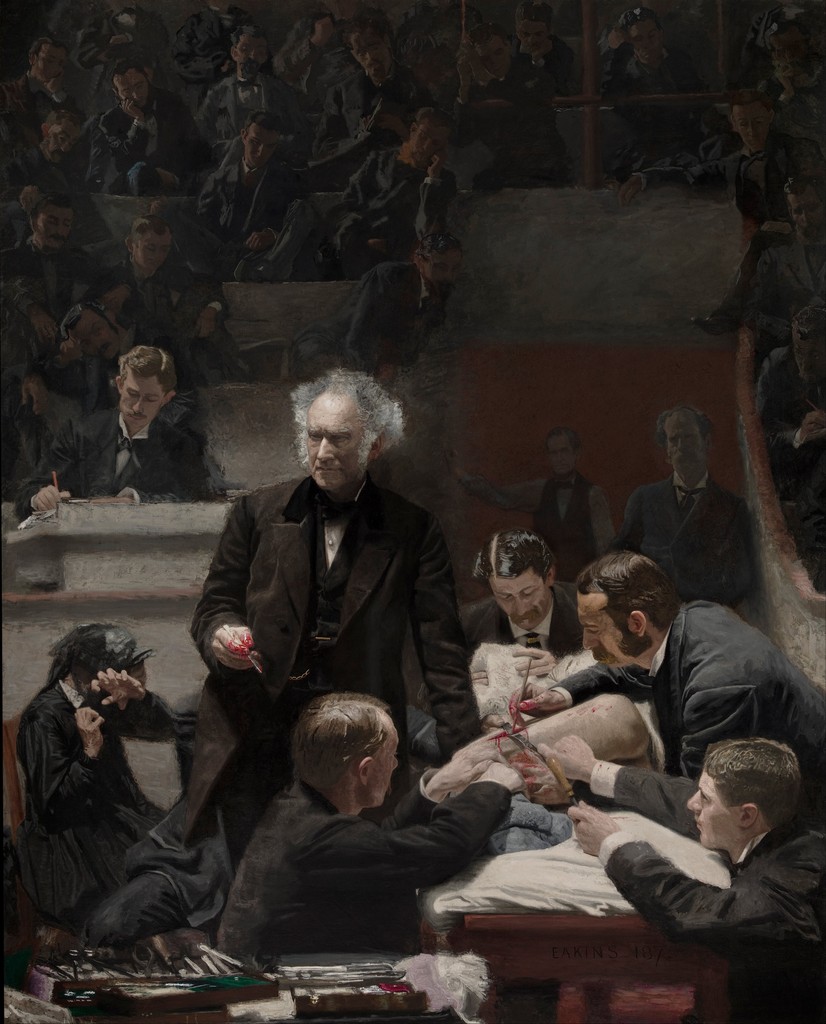
The Agnew Clinic revisits medical instruction in 1889. Penn Nursing’s account identifies nurse Mary V. Clymer within the surgical team and places the operation in the history of changing medical and nursing practice.[12] Perspective arranges the amphitheatre, but arrangement also carries social meaning: surgeon, assistants, nurse, patient, and students occupy distinct positions. Technical command makes those relations legible; it does not make them neutral.
In portraits, anatomical knowledge operates more quietly. A sitter’s shoulders settle into clothing, hands bear weight or withdraw, and fatigue can register in the face. These effects are not demonstrations of named muscles. The portraits guide shows how sustained sittings, composition, and personal knowledge worked with bodily observation. Eakins’s strongest likenesses preserve character as an open question rather than presenting physiology as destiny.[10]
The same restraint is useful when considering influence. Students could absorb habits of close looking, modelling, or spatial construction without becoming replicas of their teacher. An institution could retain life study while rejecting his conduct. A photograph could serve instruction and still become an independent object. Eakins’s legacy lies partly in these separable possibilities, not in a single method transmitted unchanged.
A Demanding Legacy
Eakins made art education answerable to observed structure, lived posture, and intelligible space. His drawing project joined geometry to studio practice; his camera work expanded the evidence available to students; his anatomical programme refused vague formulas for the body. These were consequential contributions to Philadelphia teaching.[3][4][6]
They are best understood without converting innovation into exoneration. The 1886 dispute shows that seriousness of purpose does not remove obligations to students and models. The later League shows that support persisted, but not that opinion was unanimous. The artworks show anatomy becoming composition, not a licence for every pedagogical choice. Read this way, Eakins’s teaching remains valuable precisely because its achievements and its limits can both be examined.
Researched works directory
This searchable evidence census was assembled from public museum records and a reproducible Wikidata snapshot. It is not a catalogue raisonné, not a claim to complete oeuvre coverage, and not a substitute for the published catalogue literature, which was not used to claim absolute completeness.
| Name | Date | Medium |
|---|---|---|
| A Singer (Mrs. W.H. Bowden) | 1906 | Painting |
| A Singer: Portrait of Mrs. W.H. Bowden | 1906 | Painting |
| A Street Scene | Date unknown | Painting |
| A street scene in Sevilla | 1870 | Painting |
| A Street Scene in Seville | 1870 | Painting |
| African-American Man | 1884 | Photography |
| An Actress (Portrait of Suzanne Santje) | 1903 | Painting |
| Anna Lewis | 1890 | Painting |
| Annie C. Lochrey Husson (Mrs. Louis Husson) | 1905 | Painting |
| Antiquated Music (Portrait of Sarah Sagehorn Frishmuth) | 1900 | Painting |
| Arcadia | 1883 | Painting |
| Arcadia | Date unknown | Sculpture |
| Arcadia: Figure Study, Female Nude | 1883 | Painting |
| Arcadia Sketch | 1883 | Painting |
| Arcadian | Date unknown | Painting |
| Archbishop Diomede Falconio | 1905 | Painting |
| Archbishop James Frederick Wood | 1877 | Painting |
| Archbishop James Frederick Wood (1813-1883) | 1876 | Painting |
| Archbishop William Henry Elder | 1903 | Painting |
| Arthur B. Frost | 1886 | Painting |
| Artist and His Father Hunting Reed Birds: Marsh Landscape Sketch | 1873 | Painting |
| B.J. Blommers | 1904 | Painting |
| Baby at Play | 1876 | Painting |
| Baseball Players Practicing | 1875 | Artwork |
| Benjamin Eakins G38 | Date unknown | Painting |
| Bertrand Gardel (Sketch for The Chess Players) | 1875 | Painting |
| Between Rounds | 1898 | Painting |
| Billy Smith | 1898 | Painting |
| Billy Smith (Sketch for Between Rounds) | 1898 | Painting |
| Boy Reclining | 1883 | Painting |
| Carmelita Requena | 1869 | Painting |
| Charles Edmund Dana | 1902 | Painting |
| Charles Percival Buck | 1904 | Painting |
| Clara | 1890 | Painting |
| Courtship | 1878 | Painting |
| Cowboy Singing | 1892 | Painting |
| Cowboys in the Badlands | 1888 | Painting |
| Cowboys in the Badlands sketch 2 | 1888 | Painting |
| Delaware River Scene | 1881 | Painting |
| Delaware River Study | 1881 | Painting |
| Dr. Agnew (Dr. D. Hayes Agnew) (1818-1892) | 1889 | Painting |
| Dr. Agnew (Dr. D. Hayes Agnew) (1818–1892) | 1889 | Painting |
| Dr. Horatio C. Wood | 1886 | Painting |
| Dr. Thomas H. Fenton | 1916 | Painting |
| Drifting | 1875 | Painting |
| Eakins G184 | 1916 | Painting |
| Ecorché: Relief of a Horse (Josephine) | 1882 | Sculpture |
| Edward W. Redfield | 1905 | Painting |
| Fairman Rogers Four-in-Hand: Landscape Study of Fairmount Park | 1879 | Painting |
| Fairman Rogers Four-in-Hand: Study of a Horse's Leg | 1879 | Painting |
| Fairmount Park (Sketch for The Fairman Rogers Four-in-Hand) | Date unknown | Painting |
| Female Model | 1867 | Painting |
| Female Nude | 1884 | Painting |
| Female Nude from the Back | 1889 | Photography |
| Female Nude (Study) | 1881 | Painting |
| Fifty Years Ago (Young Girl Meditating): Study | 1877 | Painting |
| Figure Study: Masked Nude Woman | Date unknown | Painting |
| Figure Study: Nude Woman, Seated, with Arms Lowered (r) | Date unknown | Painting |
| Figure Study: Nude Woman, Seated, with Arms Raised | Date unknown | Painting |
| [Four Sketches: Seated Man, Sleeping Dog, Two Vases(?)] | Date unknown | Painting |
| Frances Eakins | 1870 | Painting |
| Francis J. Ziegler | 1890 | Painting |
| Frank Hamilton Cushing | 1895 | Painting |
| Frank Jay St. John | 1900 | Painting |
| General E. Burd Grubb (1841-1914) | 1898 | Painting |
| Girl with a Fan; Portrait of Miss Gutierrez | Date unknown | Painting |
| Harriet Husson Carville (Mrs. James G. Carville) | 1904 | Painting |
| Harrison S. Morris | 1896 | Painting |
| Hauling the Seine | 1882 | Painting |
| Head of a Man (Rutherford B. Hayes?) | 1877 | Painting |
| Hiawatha | 1874 | Painting |
| Hiawatha | Date unknown | Artwork |
| Home Ranch | 1892 | Painting |
| Home Scene | 1871 | Painting |
| Homespun | 1881 | Painting |
| In the Studio | 1884 | Painting |
| Interior of a Woodcarver's Shop (Sketch for William Rush Carving His Allegorical Figure of the Schuylkill River) | Date unknown | Painting |
| James MacAlister (Sketch) | 1895 | Painting |
| John Biglin in a Single Scull | 1873 | Painting |
| John Biglin in a Single Scull | 1874 | Painting |
| Joseph R. Woodwell | 1904 | Painting |
| Kathrin | 1872 | Painting |
| Knitting | 1881 | Sculpture |
| Knitting | 1882 | Sculpture |
| Knitting | Date unknown | Sculpture |
| Lafayette Park, Washington, D.C. | 1877 | Painting |
| Landscape | 1881 | Painting |
| Landscape | 1882 | Painting |
| Landscape Sketch | 1880 | Painting |
| Landscape (Sketch for Cowboys in the Bad Lands) | 1887 | Painting |
| Landscape Study: Cultivated Field and Tree | 1874 | Painting |
| Landscape Study: Shoreline with Trees | 1874 | Painting |
| Landscape with a Dog | 1874 | Painting |
| Letitia Wilson Jordan | 1888 | Painting |
| Louis Husson | 1899 | Painting |
| Major Manuel Waldteufel | 1907 | Painting |
| Masked nude standing | 1880 | Painting |
| Maud Cook (Mrs. Robert C. Reid) | 1895 | Painting |
| Mending the Net | 1881 | Painting |
| Mending the Net: Study of a Fisherman | Date unknown | Painting |
| Miss Alice Kurtz | 1903 | Painting |
| Miss Amelia Van Buren | 1891 | Painting |
| Miss Eleanor S. F. Pue | 1907 | Painting |
| Miss Gertrude Murray | 1895 | Painting |
| Monsignor James P. Turner | 1906 | Painting |
| Mother (Annie Williams Gandy) | 1903 | Painting |
| Mrs. Gilbert L. Parker | 1910 | Painting |
| Mrs. Mary Arthur | 1900 | Painting |
| Music | 1904 | Painting |
| Nude man with beard | Date unknown | Painting |
| Nude Woman Standing | 1908 | Painting |
| Old Lady Sewing | 1879 | Painting |
| Portrait of a Little Girl | 1897 | Painting |
| Portrait of a Woman Reading | Date unknown | Painting |
| Portrait of Adam S. Bare | 1903 | Painting |
| Portrait of Alfred Reynolds | Date unknown | Painting |
| Portrait of Arthur Burdett Frost | 1886 | Painting |
| Portrait of Ashbury Wright Lee | 1905 | Painting |
| Portrait of Benjamin Eakins | 1894 | Painting |
| Portrait of Benjamin Eakins (Sketch for The Writing Master) | 1882 | Painting |
| Portrait of Blanche Hurlburt | 1885 | Painting |
| Portrait of Douglass Morgan Hall | 1889 | Painting |
| Portrait of Dr. Edward J. Nolan | 1900 | Painting |
| Portrait of Dr. Samuel D. Gross (The Gross Clinic) | 1875 | Painting |
| Portrait of Edward Taylor Snow | 1904 | Painting |
| Portrait of Elizabeth L. Burton | 1905 | Painting |
| Portrait of Florence Einstein | 1905 | Painting |
| Portrait of Henry O. Tanner | 1902 | Painting |
| Portrait of J. Harry Lewis | 1876 | Painting |
| Portrait of John B. Gest | 1905 | Painting |
| Portrait of Joshua Ballinger Lippincott | 1892 | Painting |
| Portrait of Leslie W. Miller | 1901 | Painting |
| Portrait of Lucy Lewis | 1896 | Painting |
| Portrait of Margaret Eakins in a Skating Costume | 1871 | Painting |
| Portrait of Mary Adeline Williams | 1899 | Painting |
| Portrait of Mary Adeline Williams | 1900 | Painting |
| Portrait of Mrs. Fairman Rogers (Study for The Fairman Rogers Four-in-Hand) | 1879 | Painting |
| Portrait of Mrs. Frank Hamilton Cushing | 1895 | Painting |
| Portrait of Mrs. James Mapes Dodge (Josephine Kern) | 1896 | Painting |
| Portrait of Professor Benjamin H. Rand | 1874 | Painting |
| Portrait of Professor W. D. Marks | 1886 | Painting |
| Portrait of Rear Admiral George Wallace Melville | 1904 | Painting |
| Portrait of Walter S. Macdowell | 1904 | Painting |
| Porträt des Alfred Bryan Wall | 1904 | Painting |
| Porträt des David Wilson Jordan | Date unknown | Painting |
| Porträt des John McLure Hamilton (1853- 1936) | 1895 | Painting |
| Professionals at Rehearsal | 1883 | Painting |
| Professor William D Marks | 1886 | Painting |
| Professor William Woolsey Johnson | 1896 | Painting |
| Pushing for Rail | 1874 | Painting |
| Rail Shooting on the Delaware | 1876 | Painting |
| Rear Admiral Charles Dwight Sigsbee G388-2 | 1903 | Painting |
| Rear Admiral George W. Melville | 1905 | Painting |
| Reclining Male Nude | 1887 | Photography |
| Reclining Nude | Date unknown | Painting |
| Retrospection | 1880 | Painting |
| Riter Fitzgerald | 1895 | Painting |
| Robert M. Lindsay | 1900 | Painting |
| Ruth (Ruth W. Harding) | 1903 | Painting |
| Saddle (Sketch for Cowboys in the Bad Lands) | 1887 | Painting |
| Sailboats Racing on the Delaware | 1874 | Painting |
| Sailboats Racing: Study of the Delaware River | 1874 | Painting |
| Sailing | 1875 | Painting |
| Salutat | 1898 | Painting |
| Seated Figures | 1886 | Painting |
| Self-portrait | 1902 | Painting |
| Seventy Years Ago | 1877 | Painting |
| Shad Fishing at Gloucester on the Delaware: Delaware River and Gloucester Pier | 1881 | Painting |
| Shad Fishing at Gloucester on the Delaware River | 1881 | Painting |
| Shad Fishing at Gloucester on the Delaware River: Study of a Woman's Head | 1881 | Painting |
| Ships and Sailboats on the Delaware | 1874 | Painting |
| Ships and Sailboats on the Delaware: Study | 1874 | Painting |
| Shoreline of the Delaware River, with Fishing Nets | Date unknown | Painting |
| Signora Gomez d'Arza | 1901 | Painting |
| Singing a Pathetic Song | 1881 | Painting |
| Sketch for Cowboys in the Bad Lands | 1887 | Painting |
| Sketch for Music (The Violinist) | 1904 | Painting |
| Sketch for Portrait of Dr. Jacob Mendez da Costa | 1893 | Painting |
| Sketch for Portrait of Leslie W. Miller | 1901 | Painting |
| Sketch for Portrait of Letitia Wilson Jordan | 1888 | Painting |
| Sketch for Portrait of Monsignor James P. Turner | 1906 | Painting |
| Sketch for Portrait of Mother Patricia Waldron | 1903 | Painting |
| Sketch for Portrait of Professor George F. Barker | 1886 | Painting |
| Sketch for Seventy Years Ago | Date unknown | Painting |
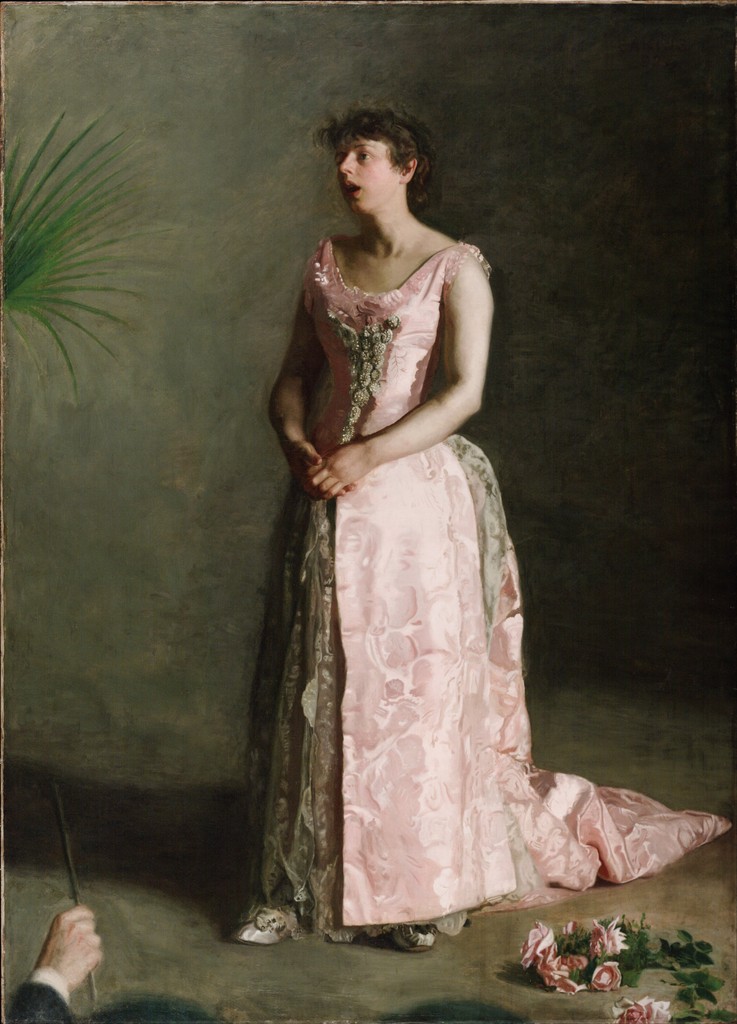
| Sketch for The Concert Singer | 1892 | Painting |
| Sketch for The Fairman Rogers Four-in-Hand | 1879 | Painting |
| Sketch for The Gross Clinic | 1875 | Painting |
| Sketch for the Surrender of General Lee to General Grant at Appomatox | Date unknown | Painting |
| Sketch for William Rush and His Model | 1908 | Painting |
| Sketch of a Landscape | 1882 | Painting |
| Sketch of a Man and Study of Drapery | 1882 | Painting |
| Sketch of Harry | 1892 | Painting |
| Sketch of Max Schmitt in a Single Scull | 1874 | Painting |
| Sketches for “Home-Spun”, (recto and verso) | 1881 | Painting |
| Sketches (Four on one panel) | Date unknown | Painting |
| Spinning | 1881 | Painting |
| Spinning | 1882 | Sculpture |
| Spinning: Sketch | 1881 | Painting |
| Starting Out After Rail | 1863 | Painting |
| Starting Out After Rail | 1874 | Painting |
| Study for Arcadia: Youth Playing Pipes | 1883 | Painting |
| Study for "Cowboys in the Badlands | 1887 | Painting |
| Study for "Negro Boy Dancing": The Banjo Player | Date unknown | Painting |
| Study for "Negro Boy Dancing": The Boy | Date unknown | Painting |
| Study for Portrait of John McClure Hamilton | 1895 | Painting |
| Study for Salutat | 1898 | Painting |
| Study for 'The Meadows, Gloucester' | 1882 | Painting |
| Study for "William Rush Carving His Allegorical Figure of the Schuylkill River | 1876 | Painting |
| Study of a Groom | 1879 | Painting |
| Study of a Nude Man | 1869 | Painting |
| Study of a Nude Man (The Strong Man) | 1869 | Painting |
| Study of a Seated Nude Woman Wearing a Mask | 1863 | Drawing |
| Study of a Young Woman | 1868 | Painting |
| Study of Dr Samuel David Gross | 1875 | Painting |
| Study of Horse for The Fairman Rogers Four-in-Hand | 1879 | Painting |
| Swimming | 1885 | Painting |
| Taking the Count | 1898 | Painting |
| Taking the Count, study | 1898 | Painting |
| Taking Up Net | 1881 | Painting |
| Talcott Williams | 1889 | Painting |
| That's a New Game Down in Frisco": Study for the Central Standing Figure | 1878 | Painting |
| The Agnew Clinic | 1889 | Painting |
| The Art Student (James Wright) | 1890 | Painting |
| The Artist's Wife and His Setter Dog | 1884 | Painting |
| The Biglin Brothers Racing | 1872 | Painting |
| The Biglin Brothers Turning the Stake | 1873 | Painting |
| The Black Fan (Portrait of Mrs. Talcott Williams) | 1891 | Painting |
| The Bohemian (Portrait of Franklin Louis Schenck) | 1890 | Painting |
| The Brinton House | 1878 | Painting |
| The Cello Player | 1896 | Painting |
| The Champion Single Sculls (Max Schmitt in a Single Scull) | 1871 | Painting |
| The Chaperone | 1908 | Painting |
| The Chess Players | 1876 | Painting |
| The Concert Singer | 1890–1892 | Painting |
| The Courtship | 1878 | Painting |
| The Crucifixion | 1880 | Painting |
| The Dancing Lesson | 1878 | Painting |
| The Dean's Roll Call | 1899 | Painting |
| The Fairman Rogers Four-in-Hand | 1879 | Painting |
| The Fairman Rogers Four-In-Hand (A May Morning in... | 1899 | Painting |
| The Meadows, Gloucester | 1882 | Painting |
| The Model | 1908 | Painting |
| The Oarsmen (The Schreiber Brothers) | 1874 | Painting |
| The Oboe Player (Portrait of Dr. Benjamin Sharp) | 1903 | Painting |
| The Old-Fashioned Dress (Portrait of Helen Montanverde Parker) | 1908 | Painting |
| The Pair-Oared Shell | 1872 | Painting |
| The Pathetic Song | 1881 | Painting |
| The Pianist | 1896 | Painting |
| The Poleman in the Ma'sh | 1881 | Drawing |
| The Red Shawl | 1890 | Painting |
| The Spinner | 1876 | Painting |
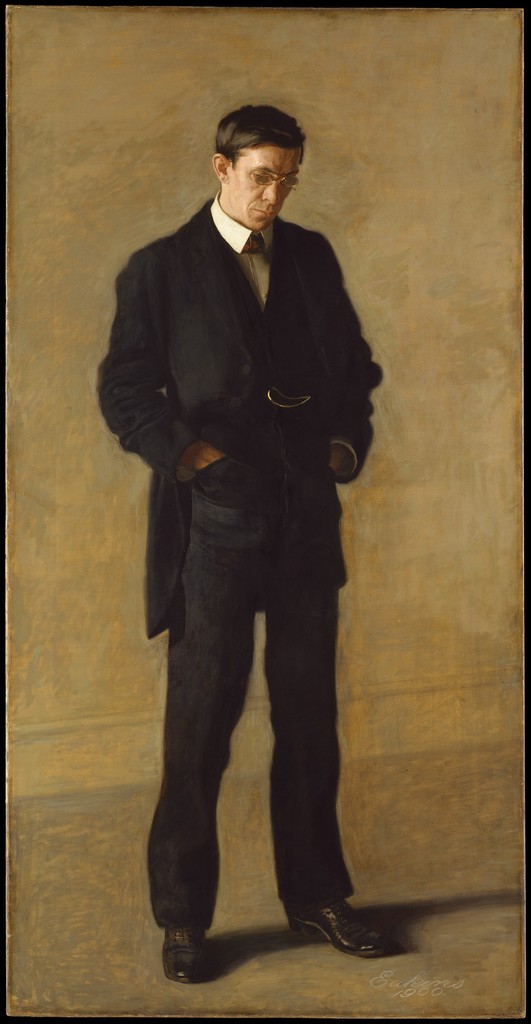
| The Thinker: Portrait of Louis N. Kenton | 1900 | Painting |
| The Timer | 1879 | Painting |
| The Translator, Portrait of Monsignor Hugh T. Henry | 1902 | Painting |
| The Veteran (Portrait of George Reynolds) | Date unknown | Painting |
| The Writing Master | 1882 | Painting |
| The Young Man (Portrait of Kern Dodge) | 1898 | Painting |
| Thomas Eakins and John Laurie Wallace on a Beach | 1883 | Photography |
| Three Boys Wading in a Creek | 1883 | Photography |
| Trenton Battle Monument | 1893 | Sculpture |
| Two Pupils in Greek Dress | 1883 | Photography |
| Views of Harry | 1885 | Painting |
| Walt Whitman | 1887 | Painting |
| Whistling for Plover | 1874 | Painting |
| William H. Macdowell | 1884 | Photography |
| William H. Macdowell and Margaret Eakins in Saltville (or Clinch Mountain), Virginia | 1875 | Photography |
| William Hance Macdowell (1816-1906) | 1897 | Painting |
| William Rush and his Model | 1908 | Painting |
| William Rush and His Model | Date unknown | Painting |
| William Rush Carving His Allegorical Figure of the Schuylkill River | 1876 | Painting |
| William Rush Carving His Allegorical Figure of the Schuylkill River | 1908 | Painting |
| William Rush Carving His Allegorical Figure of the Schuylkill River, Study | 1876 | Painting |
| William Rush's Model | 1908 | Painting |
| Wrestlers | 1899 | Painting |
| Young Girl Meditating | 1877 | Painting |
Frequently Asked Questions
He taught drawing and painting through a programme that emphasised the living figure, anatomy, dissection, perspective, mechanical drawing, and practical modelling. These elements were intended to work together: structural study informed observation, while perspective tested whether bodies and objects occupied coherent space.[3][4]
Anatomy gave him a way to understand the structures that support weight and movement. He paired that general knowledge with direct observation because no diagram can supply the posture, proportions, or expression of a particular person. In his medical and athletic pictures, credible bodies support larger questions about action and authority.[2][11]
The camera could preserve poses, support comparison, and sharpen attention to figure-ground relationships. Eakins also expected students to engage with its technical processes. It was one resource among life drawing, dissection, modelling, and perspective, and most surviving photographs were not simply templates copied into paintings.[6][7]
He removed a male model’s loincloth during an anatomy class that included women, after broader tensions about his use of the nude. Complaints led PAFA’s board to require his departure. The educational importance of figure study does not resolve the separate issue of how he used institutional authority and observed classroom boundaries.[1][3]
No. A group of students established the Art Students’ League of Philadelphia, where he taught in 1886–87, and he continued lecturing at other institutions in Philadelphia and New York. This continuation demonstrates substantial support, but it should not be mistaken for agreement from every former student.[1][8]
Discussion
Use this evidence-led guide as a starting point for close looking rather than a final verdict.
Share an observation about Teaching and Anatomy or a source that adds useful context.
Reader Insights
Which work most clearly complicates the familiar image of Eakins as a strictly literal realist?
Where do Philadelphia, Paris training, anatomy, photography or institutional life most productively alter your reading?
Which source or surviving object would you investigate next?
Join the Conversation
Add your reading below, keeping observations specific and evidence clear.
References
- Philadelphia Museum of Art, Thomas Eakins: American Realist, accessed 30 August 2026.
- The Metropolitan Museum of Art, Thomas Eakins: Exhibition Overview, accessed 30 August 2026.
- Pennsylvania Academy of the Fine Arts, Fernando Orellana: His Study of Life, accessed 30 August 2026.
- Philadelphia Museum of Art, A Drawing Manual by Thomas Eakins, accessed 30 August 2026.
- Philadelphia Museum of Art, Thomas Eakins and Students at the Pennsylvania Academy of the Fine Arts, accessed 30 August 2026.
- The Metropolitan Museum of Art, Thomas Eakins (1844–1916): Photography, 1880s–90s, accessed 30 August 2026.
- Pennsylvania Academy of the Fine Arts, PAFA Presents Thomas Eakins: Photographer, accessed 30 August 2026.
- The Metropolitan Museum of Art, Bill Duckett Nude, at the Art Students’ League of Philadelphia, accessed 30 August 2026.
- Amon Carter Museum of American Art, Swimming, accessed 30 August 2026.
- Smithsonian American Art Museum, Thomas Eakins, accessed 30 August 2026.
- Philadelphia Museum of Art, Portrait of Dr. Samuel D. Gross (The Gross Clinic), accessed 30 August 2026.
- University of Pennsylvania School of Nursing, Eakins and Clymer, accessed 30 August 2026.
More EAKINS Artworks
The Agnew Clinic image: gallery photograph by Miguel Hermoso Cuesta, cropped and perspective-corrected, under CC BY-SA 4.0.