 by Tom Gurney
Tom Gurney BSc (Hons) is an art history expert with over 20 years experience
Page Created: / Page Updated:
Email: tomgurney1@gmail.com / Phone: +44 7429 011000
A Room in the Artist's Home in Strandgade: Introduction
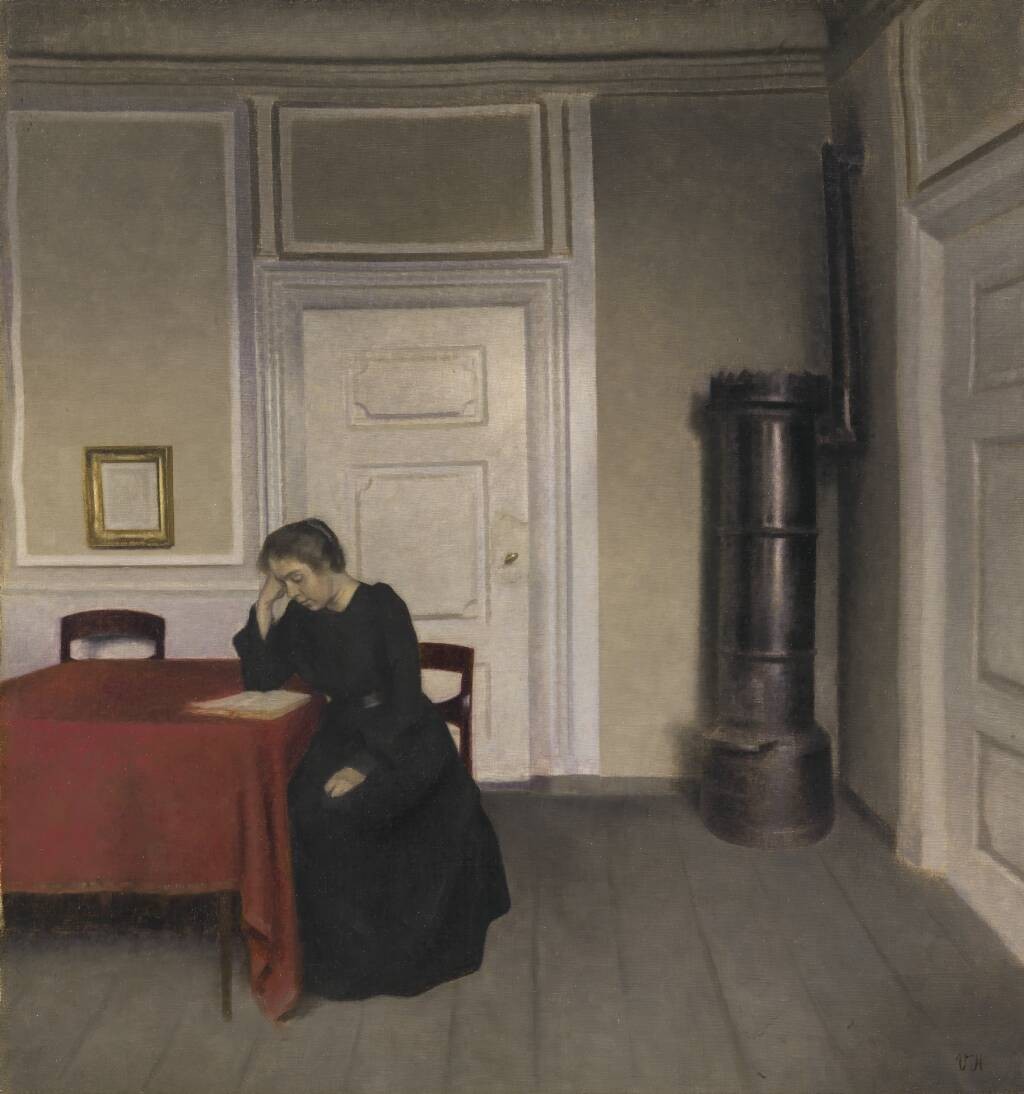
Vilhelm Hammershøi's 1902 KMS3697 is recorded by SMK under the extended title A Room in the Artist's Home in Strandgade, followed by the qualifier Copenhagen, with the Artist's Wife. It is a painting of sustained attention. Ida Hammershøi sits beside a table, her head supported by one hand as she reads a book lying open before her. A brown-red cloth occupies much of the left foreground; beyond it, pale doors, grey walls and a tall black stove give the room its measured architecture. Nothing visibly happens beyond the act of reading, yet the arrangement keeps the eye moving between figure, furniture and thresholds.
Painted in 1902, the work belongs to the long sequence of interiors that Hammershøi made at Strandgade 30, the Copenhagen home he and Ida occupied from 1898 to 1908. The Vilhelm Hammershøi Digital Archive associates about 66 interiors with the apartment, seen from different rooms and angles.[1] This exact canvas is SMK inventory KMS3697, survey number 238. Its red-covered table, reading figure and almost square format distinguish it from the artist's many related domestic scenes.
The painting rewards close looking without supplying a single story. Ida can be identified and her activity can be named, but her lowered gaze does not document sadness, weariness or isolation. Hammershøi gives ordinary reading a firm pictorial structure while leaving its emotional register open.
At a Glance
- Date and settingHammershøi painted the oil-on-canvas interior in 1902 at Strandgade 30.
- Collection identityIts collection identity is SMK KMS3697, corresponding to ViHDA survey number 238.
- DimensionsSMK records 63.5 × 60 cm, while ViHDA records 63.9 × 60 cm.
- FigureIda reads at a table covered by a conspicuous brown-red cloth.
- Spatial structureA central door, a nearer right-hand door and the black stove organise depth.
- Technical evidenceTechnical study shows that the figure, table and stove preceded the walls and floor.
Vilhelm Hammershøi in context
Contents
- Introduction
- The Full Title, Inventory Number and Two Heights
- What the Painting Shows
- Ida Reading, Not Posing for a Verdict
- The Red Tablecloth as an Optical Marker
- Stove, Doors and the Construction of Depth
- A Painting Built in Stages
- Quiet Action Without a Fixed Plot
- How KMS3697 Differs from Related Interiors
The Full Title, Inventory Number and Two Heights
The shorter label Interior. Strandgade 30 appears in ViHDA. SMK's current open record expands A Room in the Artist's Home in Strandgade with the words Copenhagen, with the Artist's Wife.[1][2] The extended form identifies both place and sitter, but neither title should be used without the inventory number when similar Hammershøi interiors are being compared. KMS3697 fixes the exact object.
The two institutional records also preserve slightly different heights. SMK gives the oil painting as 63.5 centimetres high by 60 centimetres wide; ViHDA gives 63.9 by 60 centimetres.[1][2] The four-millimetre variation should not be averaged away or taken to indicate two pictures. It is a difference between current measurement records for the same canvas. Both agree on the date, medium, owner and width.
The work's proportions matter visually. It is only a little taller than it is wide, so neither the upright figure and stove nor the broad table and floor dominate by format alone. Hammershøi makes vertical and horizontal elements compete within a compact field.
What the Painting Shows
Ida sits left of centre in a black dress. Her body faces slightly into the room rather than directly towards the viewer; her right elbow rests on the table and her hand supports the side of her face. The open book lies on the cloth near her, while her other hand settles in her lap. Two dark wooden chairs are partly visible around the table.
Behind her stands a pale panelled door. A small gilt-framed picture hangs on the left wall, separated from the figure by a broad expanse of grey-green paint. On the right, a cylindrical black stove and its narrow pipe rise almost to the ceiling. Another pale door enters abruptly from the near right edge. Long floorboards run back towards these upright forms, making the unoccupied right half feel spacious without turning it into an empty void.
No window is visible inside the composition. Illumination is diffuse, sufficient to distinguish Ida's face, the book and the panel mouldings without producing the sharp sunlight found in other Strandgade paintings. The guide to Hammershøi's light, colour and technique follows how such restrained value changes create structure without eliminating colour.
Ida Reading, Not Posing for a Verdict
ViHDA identifies the interior as the couple's apartment and the woman as Ida reading at the table.[1] Her face is neither entirely concealed nor presented frontally. Seen at an angle and directed downwards, it belongs to the action of reading rather than to a conventional portrait encounter. The hand at her temple extends that diagonal from face to book.
The pose invites narrative guesses, but the image does not decide among them. It might resemble concentration, fatigue or absorption to different viewers. None of those impressions is evidence about Ida's state of mind. The visible facts are more limited: she is seated, she supports her head, and she attends to a book.
That restraint does not make her incidental. Her dark dress supplies the picture's largest near-black shape and joins the red table to the paler door. Her bent arm and inclined head break the room's grid of panelling, floorboards and stove pipe. For Ida's documented roles as wife, recurring sitter and later steward of individual works, see the Ida Hammershøi guide.
The Red Tablecloth as an Optical Marker
The cloth is the painting's strongest colour concentration. It spreads horizontally across the left side, then drops in a long fold towards the floor. Dark red and brown vary across its surface, while a narrow fringe marks its lower edge. Against the controlled greys, whites, blacks and browns of the room, that area announces itself before the smaller book, picture frame and flesh tones.
ViHDA describes this cloth as a significant optical marker in some Strandgade interiors, a colour accent that separates them from the more whitish rooms in the sequence.[1] The description is compositional, not symbolic. There is no source-led basis for declaring red a sign of passion, danger or marital feeling here. Its demonstrable task is to hold the foreground, sharpen the contrast with Ida's dress and lead attention towards the book.
The cloth also changes how the table behaves. Its top remains a broad horizontal plane, but the hanging textile obscures much of the furniture beneath. One vertical fold descends near Ida, visually tying her seated body to the table's edge. Saturated colour therefore becomes a way of organising distance as well as attracting the eye.
Stove, Doors and the Construction of Depth
Three strong uprights divide the rear and right side: the central door, the stove and the cropped foreground door. They do not sit on a single flat line. The central door belongs to the far wall; the stove occupies the corner; the nearer door projects from the right edge at a steeper angle. Floorboards and the base of the walls clarify those intervals.
The stove acts as both household object and tonal anchor. Its stacked cylindrical sections are darker than the adjoining wall, while slender highlights make its rounded surface legible. The pipe draws the gaze upwards, countering the downward movement of the tablecloth. Because the stove stands between the two doors, it also interrupts any easy passage from one opening to the next.
Doors elsewhere in the Strandgade interiors frequently offer glimpses into connected spaces. Here, the central door is closed and the right-hand one is shown so near the picture edge that it reveals no complete adjoining room. Depth arises from overlap and oblique placement rather than from a long vista. The room seems connected to a larger apartment, but those extensions remain outside the image.
A Painting Built in Stages
Technical examination makes the apparent calm more concrete. ViHDA records a white, industrially applied ground on an irregular open-weave canvas. A thin transparent brown underpaint occurs locally in the panelling and doors, and faint black-pencil drawing can be seen in the doorframe behind Ida. The visible paint is of moderate thickness, largely worked wet-in-wet with little raised texture.[1]
The order of application is especially revealing: Hammershøi painted the figure, table and stove before the walls and floor.[1] He therefore established the main dark and coloured masses, then worked the architecture around them. Small areas were reserved or left with the ground locally exposed. Raised touches are limited to such details as the gilt frame, tablecloth fringe and doorknob.
There was revision as well as planning. ViHDA reports that a possible brass plate around the doorknob was covered with paint.[1] The black dress now has an opaque, greyed appearance in places, but the conservators leave open whether that effect was intentional or results from material change. This uncertainty is important: current appearance, original choice and later ageing cannot always be separated by looking at a reproduction.
Instrumental analysis identified bone or ivory black, cadmium yellow, cobalt blue, lead white and vermilion among the materials.[1] That evidence explains how a restrained image can contain a varied palette. For a wider account of recurring subjects and technical differences between objects, the paintings overview places this room beside portraits, landscapes and architectural views.
Quiet Action Without a Fixed Plot
Reading gives the scene an action, but not a plot. The book has already been opened; Ida's gaze remains lowered; no second figure enters; the doors reveal no event beyond the room. Time can be inferred only as duration—the interval required to remain with a page and, for the viewer, to inspect the painting.
This incompleteness is productive. The viewer can follow Ida's inclination towards the book, then move across the wall to the stove and near door, but cannot recover the text she reads or her response to it. Hammershøi withholds those particulars while making bodily position and spatial relations exact. “Quiet” describes the absence of visible commotion; it should not be converted into a claim about the sitter's inner life.
How KMS3697 Differs from Related Interiors
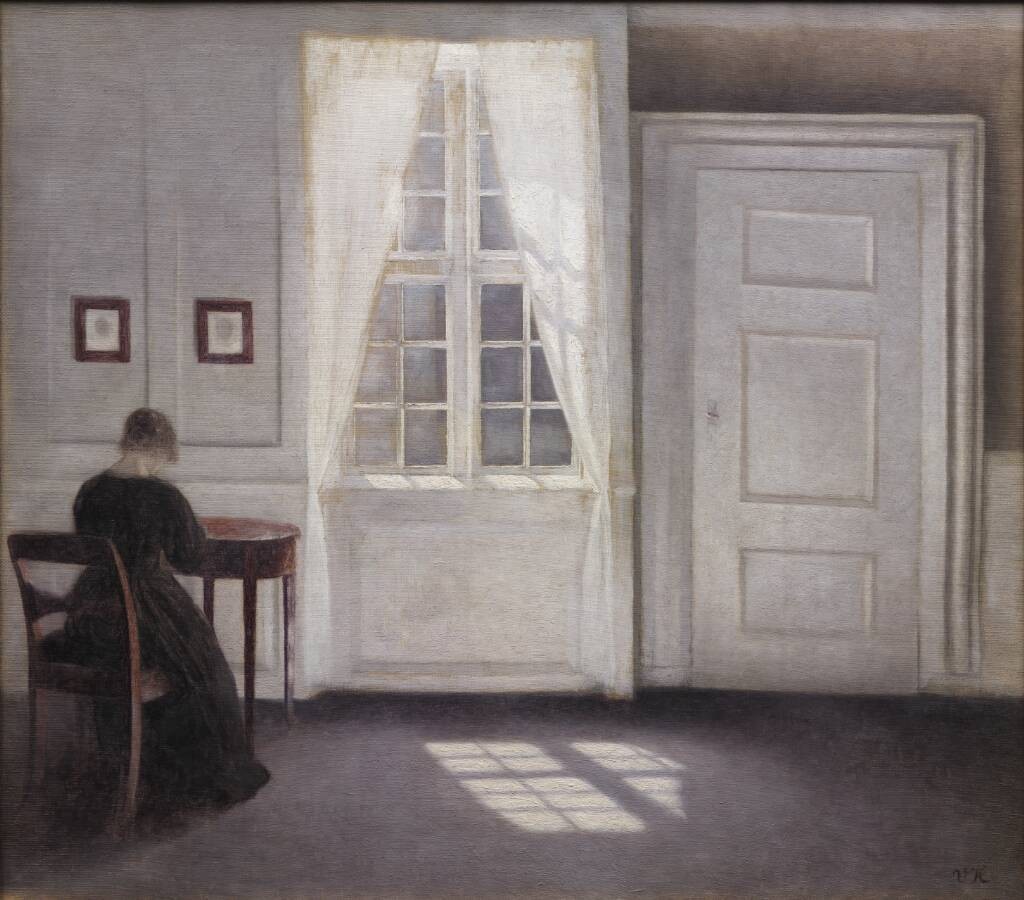
The closest comparison in this group is the 1901 Interior in Strandgade, Sunlight on the Floor, KMS3696. That separate, wider canvas measures 46.5 by 52 centimetres. It includes a window and a bright patch across the boards, with a seated woman probably identifiable as Ida near a small oval table.[3] KMS3697 instead concentrates on a reading figure, a large covered table, the stove and two doors. Its red accent and near-square format create a different visual balance.
The distinction is more than a matter of alternative titles. The works carry different inventory numbers, dates, measurements and arrangements. Treating them as interchangeable would erase the very variations that made Strandgade 30 useful to Hammershøi. One apartment generated repeated experiments rather than one generic room.
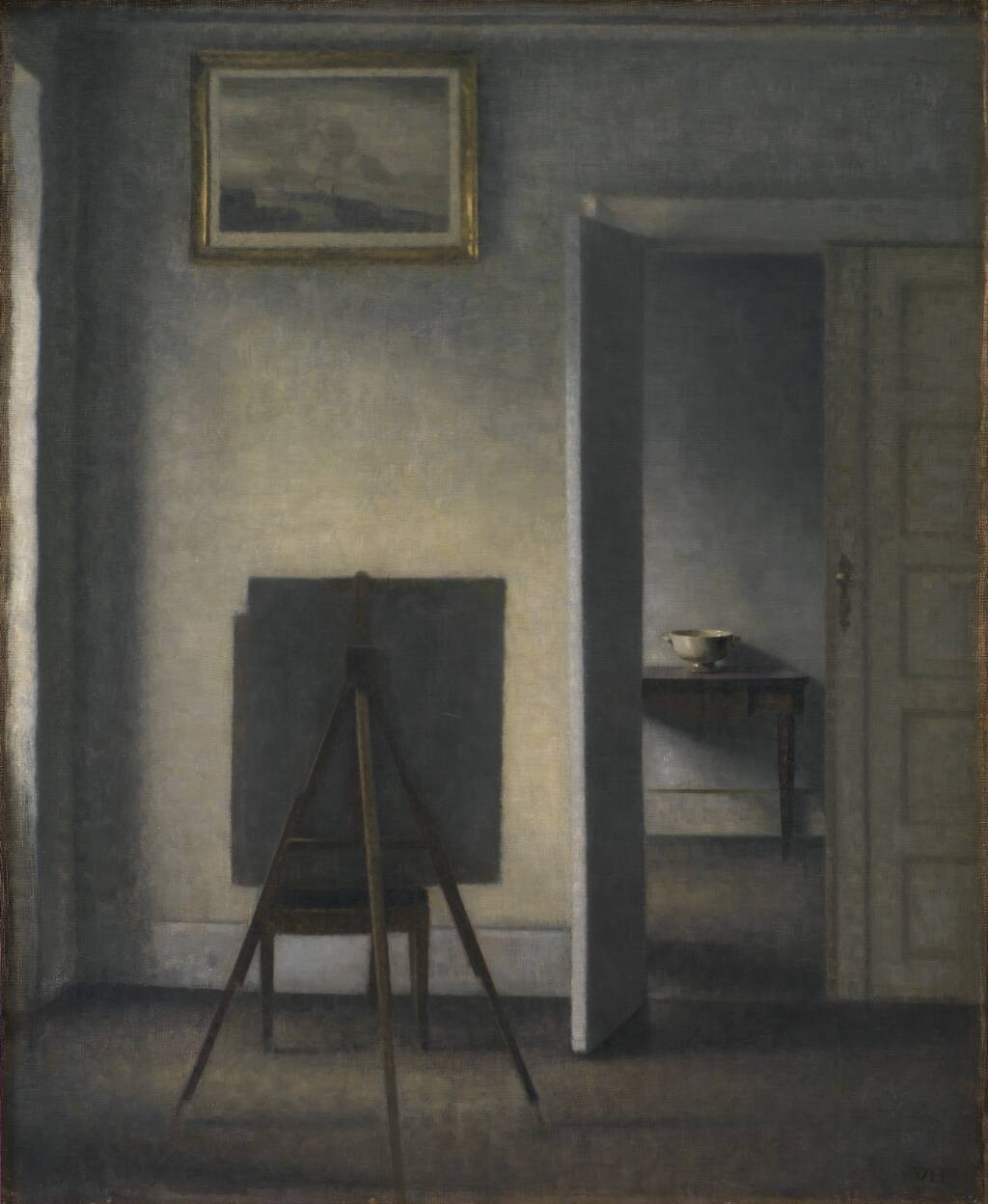
Later interiors changed address as well as configuration. The 1910 Interior with the Artist's Easel, KMS7444, belongs to Bredgade 25 and places the artist's working equipment inside another architecture.[4] Seen beside it, KMS3697 retains the particular conditions of Strandgade 30: Ida's reading, the cloth's concentrated colour and the compressed relation between stove, doors and table.
Researched works directory
This directory covers the 133 paintings currently published by the Vilhelm Hammershøi Digital Archive (ViHDA). It is a researched platform census, not a complete catalogue raisonné of the artist's oeuvre.
| Name | Date | Medium |
|---|---|---|
| A Bakery Shop. Study | 1888 | Painting |
| A Greek Relief. Louvre | 1892 | Painting |
| Amalienborg Square | 1896 | Painting |
| An Ancient Relief. Study | 1878 – 1881 | Painting |
| An Old Woman | 1886 | Painting |
| An Old Woman Standing by a Window | 1885 – 1886 | Painting |
| Artemis | 1893 – 1894 | Painting |
| Bedroom | 1890 | Painting |
| Church of Christiansborg Palace, Copenhagen | 1910 | Painting |
| Church of Sankt Petri, Copenhagen | 1906 | Painting |
| Double Portrait. Vilhelm and Ida Hammershøi | 1892 | Painting |
| Evening in the Drawing Room. Strandgade 30 | 1904 | Painting |
| Evening in the Sitting Room. | 1904 | Painting |
| Evening Interior. Artificial Light. Ida and Frederikke Hammershøi | 1891 | Painting |
| Farm. Refsnæs | 1900 | Painting |
| Five Portraits. Study | 1901 | Painting |
| Frederiksborg Castle | 1893 | Painting |
| From Christianshavns Canal | 1905 | Painting |
| From Frederiksholms Kanal | 1893 | Painting |
| From Kvæsthusbroen | 1908 | Painting |
| From the British Museum. London, Winter | 1906 | Painting |
| From the Church Santo Stefano Rotondo in Rome | 1902 – 1903 | Painting |
| From The Greenlandic Trade Dock. Christianshavn | 1908 | Painting |
| From the Old Christiansborg Palace | 1907 | Painting |
| Hammershøi's palette | Uncertain/Unknown | Painting |
| Head of a Woman. Study for Artemis | 1893 | Painting |
| Houses. Arresødal near Frederiksværk | 1904 | Painting |
| Interior | 1898 | Painting |
| Interior in Louis Seize style. Rahbeks Allé | 1897 | Painting |
| Interior. 'The Four Rooms'. Strandgade 25 | 1914 | Painting |
| Interior. A Young Man Reading | 1898 | Painting |
| Interior. Artificial Light | 1909 | Painting |
| Interior. Attic Room with Table and Chair | 1883 – 1885 | Painting |
| Interior. Frederikke and Anna Hammershøi | 1884 | Painting |
| Interior. From The Great Hall of Lindegården | 1909 | Painting |
| Interior. Ida Hammershøi at a Sewing Table | Uncertain/Unknown | Painting |
| Interior. Living Room in Louis-Seize-Style. Rahbeks Allé 26 | 1893 – 1896 | Painting |
| Interior. Looking out on the Exterior. Strandgade 30 | 1905 | Painting |
| Interior. Strandgade 30 | 1901 | Painting |
| Interior. Strandgade 30 | 1902 | Painting |
| Interior. Strandgade 30 | 1905 | Painting |
| Interior. Study in Sunlight. Strandgade 30 | 1906 | Painting |
| Interior. Sunshine in the Drawing Room III | 1903 | Painting |
| Interior. The Music Room. Strandgade 30 | 1908 | Painting |
| Interior. The Old Stove. Albertinelyst | 1888 | Painting |
| Interior. The Tall Windows | 1913 | Painting |
| Interior. With Empire Sofa. Strandgade 30 | 1907 | Painting |
| Interior. With Four Etchings. Strandgade 30 | 1904 | Painting |
| Interior. With Table, Cupboard and Windsor Chair. Strandgade 25 | 1913 | Painting |
| Interior. With the Artist's Easel | 1910 | Painting |
| Interior. With the Artist's Easel. Bredgade 25 | 1912 | Painting |
| Interior. Woman knitting | 1889 | Painting |
| Interior. Woman Reading | 1910 | Painting |
| Interior. Woman Reading. Bredgade 25 | Uncertain/Unknown | Painting |
| Interior. Woman Sitting Behind a Table | 1910 | Painting |
| Interior. Woman Sweeping | 1899 | Painting |
| Job | 1887 | Painting |
| Job. Study | 1887 | Painting |
| Landscape. At Lyngby Lake | 1888 | Painting |
| Landscape. Early Spring | 1909 | Painting |
| Landscape. Gentofte | 1906 | Painting |
| Landscape. Grønsund, Falster | 1890 | Painting |
| Landscape. Gundsømagle near Roskilde | 1885 | Painting |
| Landscape. Gundsømagle near Roskilde | 1886 | Painting |
| Landscape. Kongevejen near Gentofte. Study | 1892 | Painting |
| Landscape. Near Fortunen | 1901 | Painting |
| Landscape. Near Lejre | 1905 | Painting |
| Landscape. Ryet near Farum Lake | 1896 – 1897 | Painting |
| Landscape. Summer. Near Lejre | 1905 | Painting |
| Landscape. Søndermarken Park in Winter | 1895 – 1896 | Painting |
| Landscape. The Rowan Avenue at Snekkersten | 1906 | Painting |
| Landscape. With a Farmhouse | 1878 – 1879 | Painting |
| Landscape. Young Forest, Trørød, Summer | 1907 | Painting |
| Morning Toilette. Study. Strandgade 25 | 1914 | Painting |
| Nude Female Model | 1884 | Painting |
| Nude Female Model | 1910 | Painting |
| Open Doors. Strandgade 30 | 1905 | Painting |
| Portrait of a Young Girl. Anna Hammershøi | 1885 | Painting |
| Portrait. Anna Hammershøi | 1883 | Painting |
| Portrait. Anna Hammershøi. Profile | Uncertain/Unknown | Painting |
| Portrait. Daniel Jacobson Salter | 1901 | Painting |
| Portrait. Elisabeth Dorothea Rentzmann | Uncertain/Unknown | Painting |
| Portrait. Elisabeth Wandel | 1890 | Painting |
| Portrait. Fini Henriques | Uncertain/Unknown | Painting |
| Portrait. Frederikke Hammershøi | Uncertain/Unknown | Painting |
| Portrait. Frederikke Hammershøi. Study | 1894 | Painting |
| Portrait. Henry Madsen. Study | 1904 | Painting |
| Portrait. Henry Madsen. Study | 1904 | Painting |
| Portrait. Ida Hammershøi | 1894 | Painting |
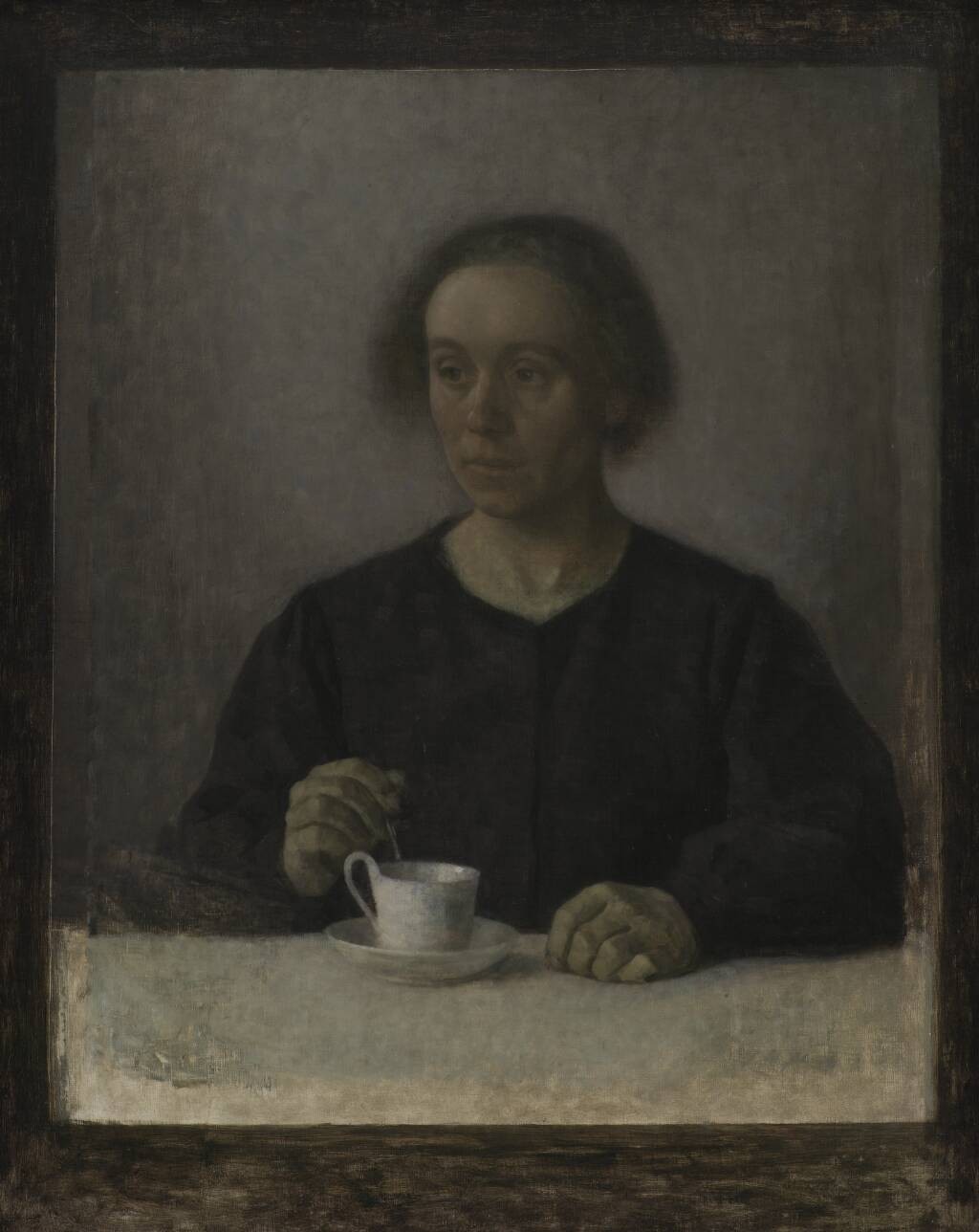
| Portrait. Ida Hammershøi with a Teacup | 1907 | Painting |
| Portrait. Ida Ilsted | 1890 | Painting |
| Portrait. Ida Ilsted. Study | 1890 | Painting |
| Portrait. Ida Ilsted. Study | 1890 | Painting |
| Portrait. J.F. Willumsen. Study for Five Portraits | 1901 | Painting |
| Portrait. J.F. Willumsen. Study for Five Portraits | 1901 – 1902 | Painting |
| Portrait. Karen Malm | 1914 | Painting |
| Portrait. Karl Madsen | 1890 | Painting |
| Portrait. Kristian Zahrtmann | 1889 | Painting |
| Portrait. Kristian Zahrtmann | 1889 | Painting |
| Portrait. Svend Hammershøi | 1881 | Painting |
| Portrait. Svend Hammershøi | 1892 | Painting |
| Portrait. Svend Hammershøi | 1903 – 1904 | Painting |
| Portrait. Svend Hammershøi. Study for Five Portraits | 1901 | Painting |
| Portrait. Thora Bendix, née Anne Victoria Sundberg | 1896 | Painting |
| Portrait. Thora Bendix. Study | 1896 | Painting |
| Portrait. Thorvald Bindesbøll. Study | 1904 | Painting |
| Portrait. Woman. Possibly Frederikke Juncker-Jensen | 1878 – 1881 | Painting |
| Portrait. Woman. Profile | 1888 | Painting |
| Seated Female Nude | 1889 | Painting |
| Self- Portrait | 1891 | Painting |
| Self-Portrait | 1890 | Painting |
| Self-Portrait | 1914 | Painting |
| Self-Portrait. Spurveskjul, Frederiksdal | 1911 | Painting |
| Self-Portrait. Spurveskjul, Frederiksdal | 1911 | Painting |
| Standing Female Model | 1909 – 1910 | Painting |
| Street in London. Montague Street at the British Museum | 1905 – 1906 | Painting |
| Study of a Model. A Woman seen from the Back | 1888 | Painting |
| Sunbeams or Sunshine. "Dust motes dancing in the sunbeams" | 1900 | Painting |
| The Buildings of the Asiatic Company, seen from St. Annæ Street | 1902 | Painting |
| The Cello Player. Henry Bramsen | 1893 | Painting |
| The Coin Collector. Strandgade 30 | 1904 | Painting |
| The Garden Room. Frederiksberg Allé | 1887 | Painting |
| The Tuesday Forest | 1893 | Painting |
| Three Sailing Boats. Christianshavns Canal | 1905 | Painting |
| Tree Trunks. Arresødal near Frederiksværk | 1904 | Painting |
| View of Christiansborg Palace. Late Autumn | 1890 – 1892 | Painting |
| View of Gentofte Lake . 'Sunshower' | 1903 | Painting |
| View of Gentofte Lake . 'Sunshower'. Study | 1903 | Painting |
| View of Jægersborg Allé. Study | 1892 | Painting |
| White Doors. Strandgade 30 | 1899 | Painting |
| Woman Knitting. Frederikke Hammershøi | 1889 | Painting |
| Young Beechwood. Arresødal near Frederiksværk | 1904 | Painting |
| Young Girl Sewing. Anna Hammershøi | 1887 | Painting |
Frequently Asked Questions
SMK's English form begins A Room in the Artist's Home in Strandgade and adds Copenhagen, with the Artist's Wife. ViHDA uses Interior. Strandgade 30.[1][2] KMS3697 is the binding inventory number shared by the records.
They record the same width but slightly different heights. SMK gives 63.5 × 60 centimetres and ViHDA 63.9 × 60 centimetres.[1][2] The records do not explain the four-millimetre difference, so both measurements should be stated without inventing a resolution.
Yes. ViHDA identifies Ida as the seated woman reading a book on the table.[1] Her lowered face and hand-supported head describe a pose, however; they do not establish a particular emotion or psychological condition.
No documented symbolic meaning is supplied by the institutional record. ViHDA instead calls it an optical marker that distinguishes this arrangement from Hammershøi's more whitish Strandgade interiors.[1] Its supported role is visual and spatial.
No. KMS3697 is this 1902 reading scene with the red-covered table. KMS3696 is a distinct 1901 composition organised around a window and sunlight crossing the floor.[3] Their formats, dimensions, dates and inventory numbers are different.
Discussion
Use this evidence-led guide as a starting point for close looking rather than a final verdict.
Share an observation about A Room in the Artist's Home in Strandgade or a source that adds useful context.
Reader Insights
Which detail most changes your reading of A Room in the Artist's Home in Strandgade?
How do scale, surface or the current technical evidence shape the encounter?
What remains uncertain when visual inference is separated from documented fact?
Join the Conversation
Add your reading below, keeping observations specific and evidence clear.
References
- SMK, Vilhelm Hammershøi Digital Archive, Interior. Strandgade 30 (KMS3697), accessed 31 August 2026.
- SMK Open, A Room in the Artist's Home in Strandgade, Copenhagen, with the Artist's Wife (KMS3697), accessed 31 August 2026.
- SMK, Vilhelm Hammershøi Digital Archive, Interior. Strandgade 30 (KMS3696), accessed 31 August 2026.
- SMK, Vilhelm Hammershøi Digital Archive, Interior with the Artist's Easel (KMS7444), accessed 31 August 2026.