 by Tom Gurney
Tom Gurney BSc (Hons) is an art history expert with over 20 years experience
Page Created: / Page Updated:
Email: tomgurney1@gmail.com / Phone: +44 7429 011000
Hammershøi's Light, Colour and Technique: Introduction
Vilhelm Hammershøi’s paintings can appear almost colourless at first sight. Look longer, however, and their differences begin to assert themselves: a floor shifting from purplish grey towards brown, a wall warmed inside shadow, a red cloth holding one side of a room in place, or candle flames sounding a small yellow note against near-black furniture. Restraint in these pictures is not the absence of colour. It is the control of colour’s temperature, value, saturation and position.
Their surfaces can also disguise how actively they were made. Technical study has found drawing beneath paint, forms that were shifted or suppressed, thin preparatory washes, passages worked while still wet and objects introduced late. The five-year Vilhelm Hammershøi Digital Archive (ViHDA) project brought conservators, scientists, imaging specialists and art historians together to examine about 140 paintings through visual study, multiband imaging and material analysis.[1] SMK’s public overview and account of the findings place those methods behind a more exact understanding of Hammershøi’s choices.[3][4]
That evidence does not turn every picture into the product of one recipe. It reveals differences between paintings as well as recurring habits. The most reliable way to understand Hammershøi’s technique is therefore to move between the visible image and what has been established for the exact object.
At a Glance
- PaletteHammershøi’s greys range between warm, cool, purplish, greenish and brown-inflected tones.
- LightDaylight, reflection and candlelight organise space differently in individual interiors.
- Paint layersThin paint is common in the selected works, but some passages and pictures have more complex layering.
- BrushworkWet-in-wet handling lets adjacent tones merge without eliminating the direction of the brush.
- RevisionsUnderdrawing, covered forms and adjusted outlines record decisions made during painting.
- Evidence limitTechnical images establish material changes; they do not prove a mood or private intention.
Contents
- Introduction
- Beyond “Grey Paintings”
- Daylight as Structure
- Artificial Light and Darkness
- Thin Layers, Underpainting and Wet-in-Wet Handling
- Drawing, Correction and Late Additions
- Colour Accents and Visual Rhythm
- What Technical Imaging Changes
Beyond “Grey Paintings”
“Grey” is useful only if it begins a description rather than ending one. Hammershøi could bring together colours close in value while keeping them distinct in temperature. A cool wall can sit beside a warmer door; a brown form can read as darker than a neighbouring blue-grey without becoming a hard silhouette. These small intervals allow a limited palette to carry depth, emphasis and rhythm. The wider range of subjects in the guide to Hammershøi’s paintings also shows that muted colour served portraits, landscapes and architectural views as well as domestic rooms.
SMK’s project-wide findings identify extensive use of cobalt blue in creating cool tones, darkness and variations within greys and whites.[4] That conclusion is important, but it should not be turned into a pigment label for every bluish or grey passage. A colour perceived in a reproduction is not, by itself, a chemical identification. The individual ViHDA records distinguish visual observations from instrumental analysis, and a responsible account keeps that distinction visible.
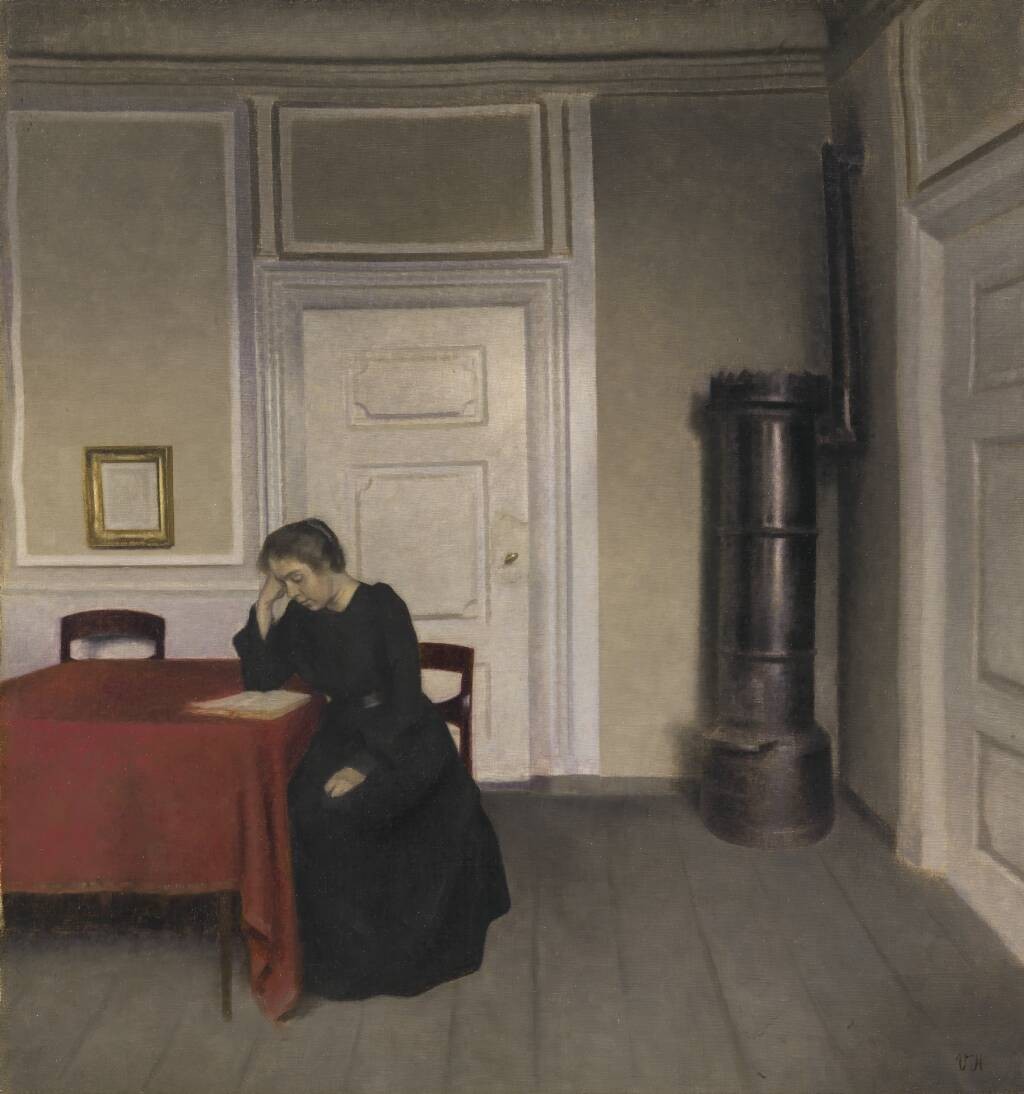
The 1902 Strandgade room with Ida makes the point without requiring a pigment inventory. Its recorded visible colours include black, white, brown, blue, red, yellow, orange and dark red. The saturated table covering is therefore not an exception pasted onto an otherwise colourless art. It is the strongest member of a deliberately unequal colour arrangement, balanced by Ida’s dark dress, the stove, the floor and the pale wall.[6]
Daylight as Structure
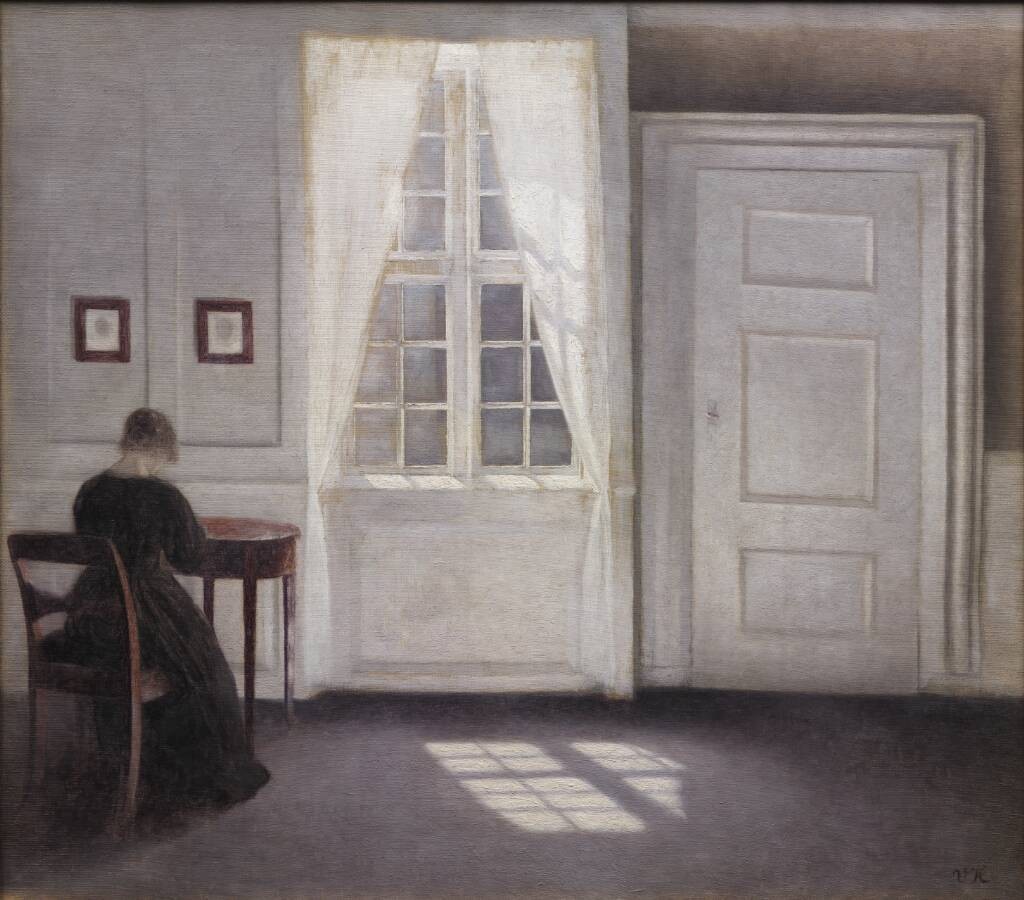
In the 1901 Interior in Strandgade, Sunlight on the Floor, daylight is both illumination and geometry. The bright patch across the boards interrupts a field of purplish grey, while window, curtain, panelling and door divide the upper half into narrow intervals. Warmer greys occur in shadow, and greenish-grey and brown enter the darker wall. These transitions prevent light and shade from separating into a simple white-versus-black scheme.[5]
The physical sequence helps explain the effect. ViHDA records an off-white industrial ground, then a greenish-brown layer beneath the floor and warm grey beneath parts of the wall, door and window. This underpainting is described as a thinned transparent wash. Above it, a relatively simple, thin paint structure was worked largely wet-in-wet, generally progressing from darker passages towards lighter ones.[5] The preparation remains active beneath the visible colour rather than functioning as a blank surface.
Surface relief gives the light another register. Brush marks rise most noticeably in the window whites, curtains and reflection on the floor, although the texture of the canvas remains perceptible elsewhere. Raking light suggests that the sunlit shape may have been shifted slightly right and reduced in height.[5] The beam can look like an instantaneous observation, yet its boundary was subject to adjustment. For comparisons with other rooms and times of day, the Strandgade interiors guide keeps the repeated architecture and distinct objects separate.
Artificial Light and Darkness
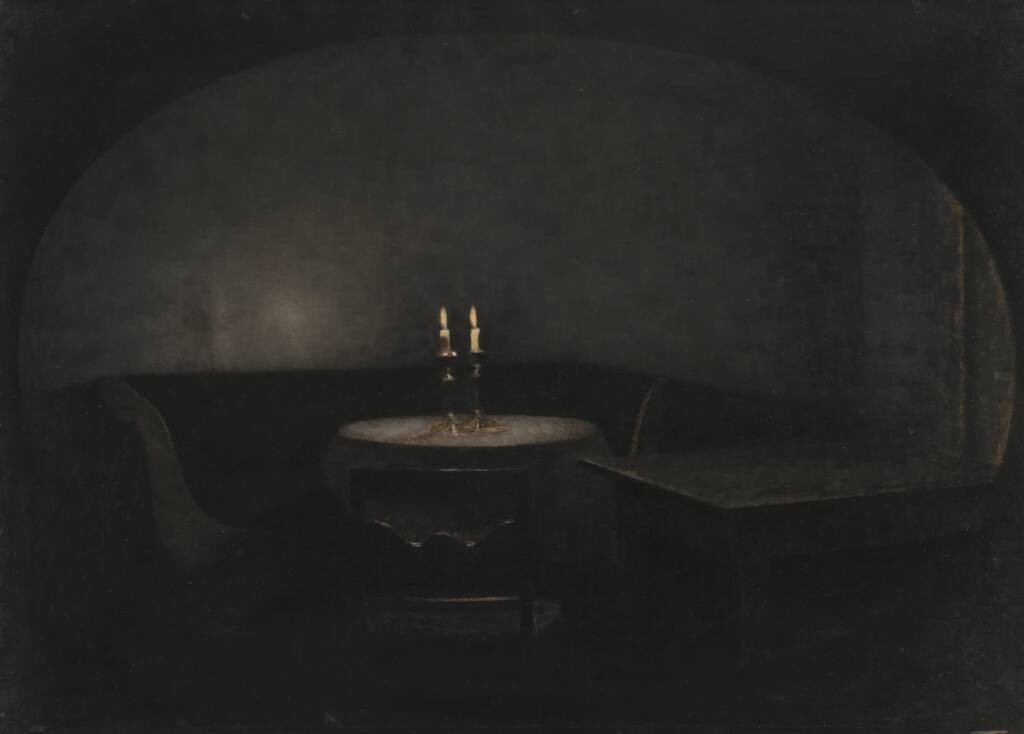
The 1909 Interior. Artificial Light changes the problem. Two candles do not flood the room; their greyish and brighter yellows operate inside a field of black, brown and layered grey. The viewer must read smaller changes across the wall, sofa and tabletops. Darkness is not an empty surround but a set of adjoining painted zones, while the flames and candlesticks concentrate the highest contrast.[8]
The record for KMS8677 describes paint applied thinly, with almost no impasto. A dark first layer in the background appears to have been brushed mainly vertically; greys above it were set down more often in separated horizontal strokes. Lighter tones were generally placed over darker ones, and the candles and central tabletop carry slightly greater relief.[8] Direction, thickness and value work together: the room’s subdued appearance depends on differences that are small but materially present.
The square table at the right foreground was added late enough for its paint to overlap the chair and central table.[8] That insertion compresses the foreground and changes the path into the room. It also warns against equating visual calm with an unchanged design. The finished arrangement may look stable precisely because competing possibilities were resolved during painting.
Thin Layers, Underpainting and Wet-in-Wet Handling
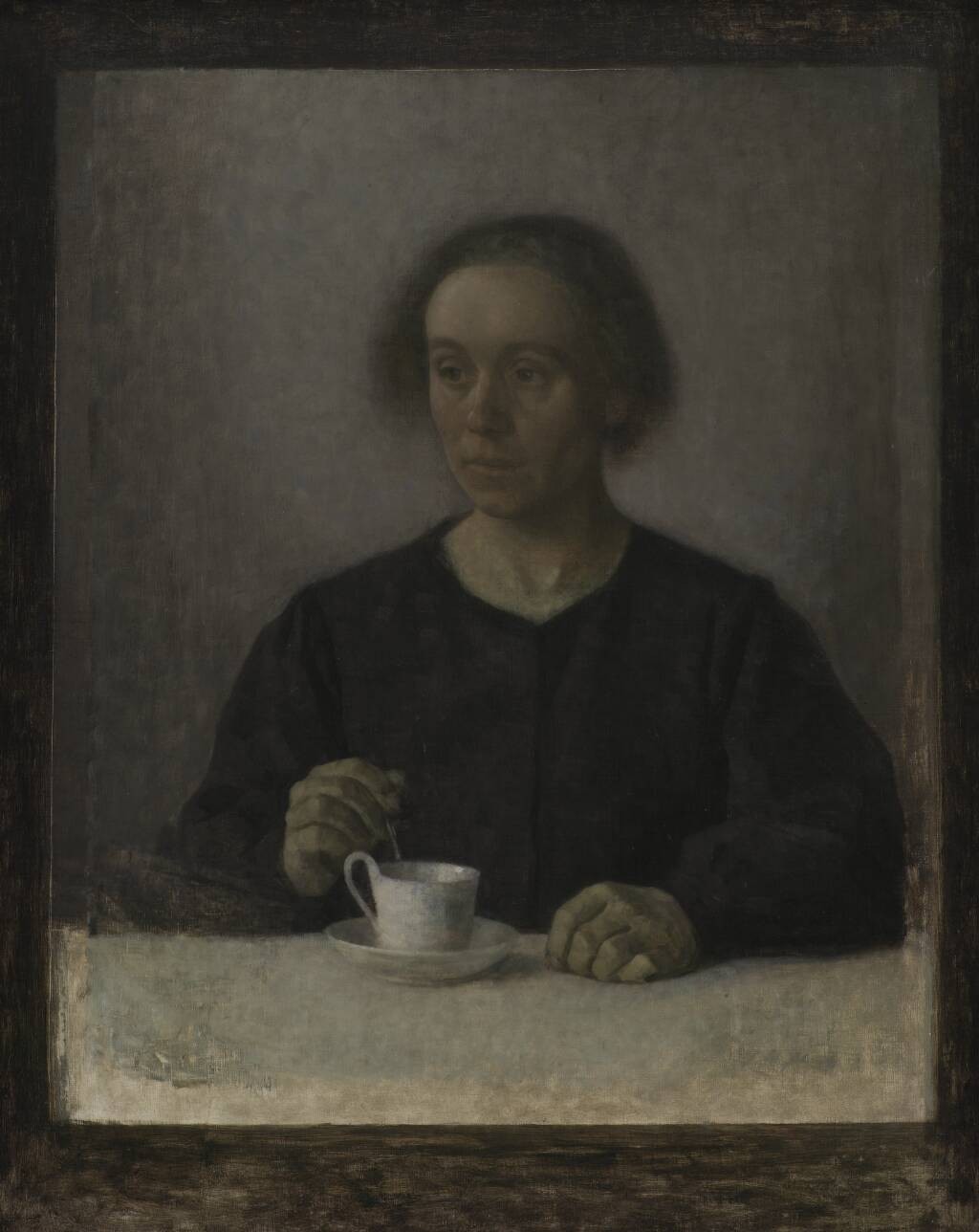
Several selected works make economical use of paint, but “thin” does not describe them all in the same way. KMS3696 has a thin, comparatively simple build. KMS8677 allows the ground to remain discernible through passages including tabletops and the far-right wall or door. In the 1907 portrait of Ida Hammershøi with a teacup, the foreground and dark painted border are locally transparent, while the face was modelled wet-in-wet and the background became denser near the figure.[5][8][10]
The 1902 Strandgade interior with the red cloth is different again. Its paint is of moderate thickness and was also handled largely wet-in-wet, with little impasto. ViHDA records a transparent brown underpainting in parts of the panelling and door. The figure, table and stove preceded the walls and floor, so the surrounding room was not simply completed first and furnished afterwards.[6] The visible unity of the picture emerged from an ordered but interdependent sequence.
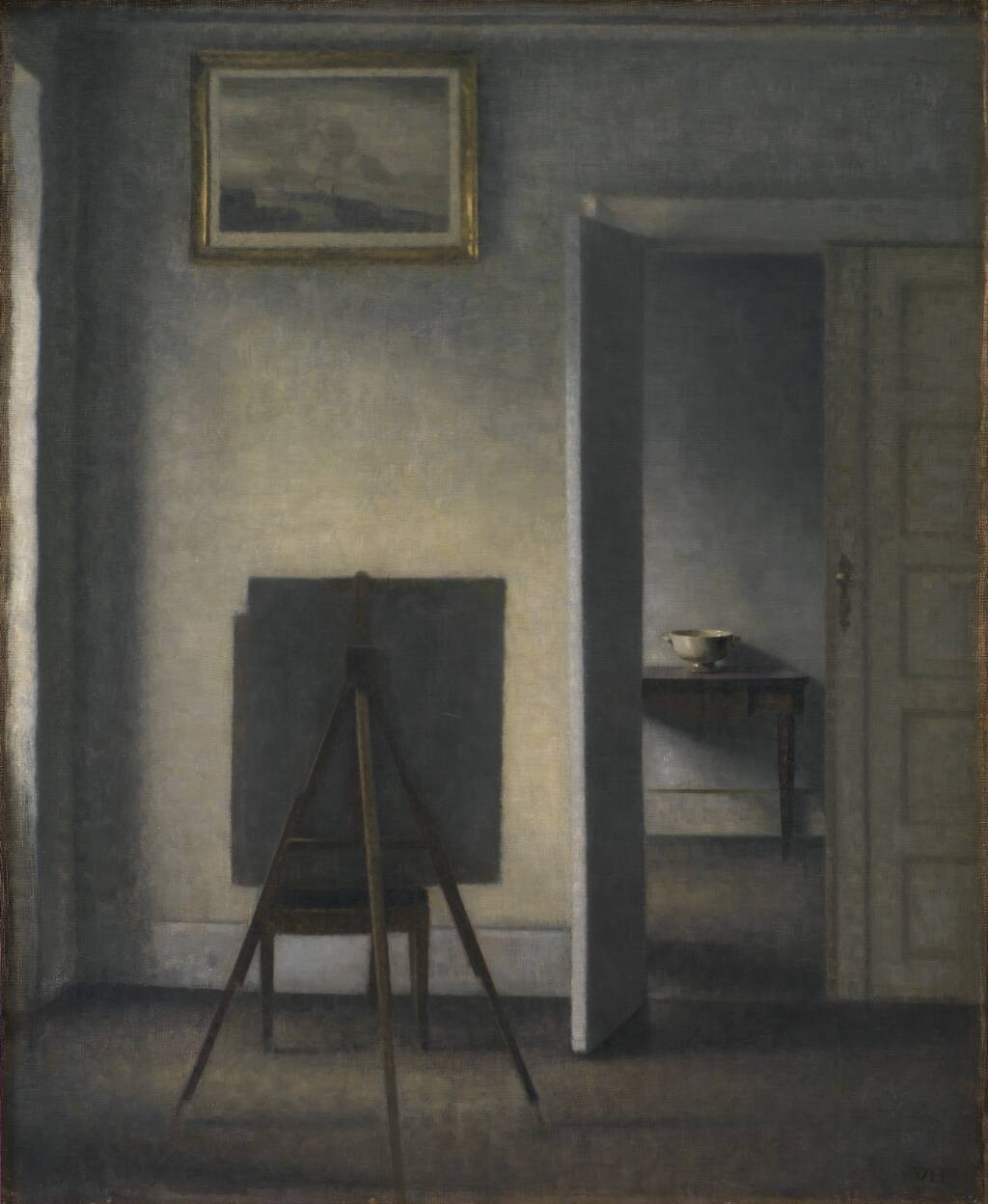
Wet-in-wet means that one application meets another before it has dried. In Hammershøi’s hands it could soften transitions while leaving a brush’s direction legible. It should not be confused with blur or spontaneity across an entire canvas. In Interior with the Artist’s Easel, for example, successively lighter wall and floor colours were worked wet-in-wet, yet short horizontal strokes remain part of the surface organisation.[7]
Nor is an underpainting merely a hidden monochrome duplicate of the finished design. It can establish broad tonal relations, provide warmth or coolness beneath later paint, and sometimes belong partly to an abandoned arrangement. ViHDA notes that beneath KMS7444, material resembling preparation for the present image may instead be paint from an earlier, related composition.[7] Layer names are most useful when the evidence for a particular canvas determines their meaning.
Drawing, Correction and Late Additions
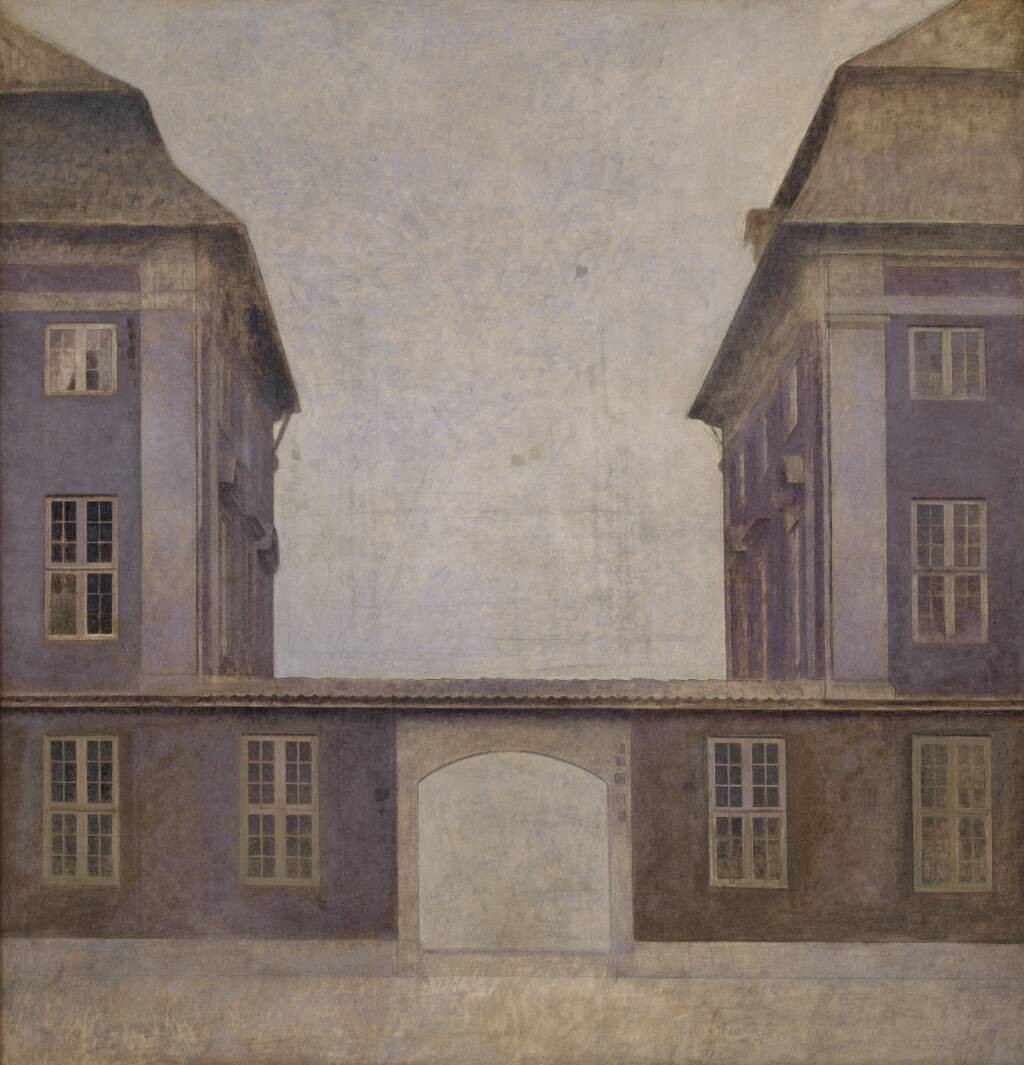
The unfinished 1902 Asiatic Company study exposes planning with unusual clarity. Grey and black linear drawing remains visible across the architecture. Some horizontal lines continue onto the tacking edges, indicating an initially wider field, while faint uprights and cross-lines between the buildings suggest ships’ masts and yards. Narrow grey lines and broader dark ones appear to mark successive stages of establishing the design.[9]
This canvas is a preliminary work for a separate finished picture, not a completed cityscape. ViHDA describes it as abandoned while still largely at the underpainting stage; a few small square touches may have tested intended tonal values.[9] Its open state shows why every exposed line should not automatically be called underdrawing in another painting. Here, the technical record and the incomplete surface together identify which marks belong to preparation.
Changes can be present even where a painting looks fully resolved. Beneath the 1910 Interior with the Artist’s Easel, an earlier version placed the open door and the distant table farther left; the easel itself may not have formed part of that first arrangement. In the visible layer, wall paint trims the contours of the easel, chair and framed print.[7] These are different kinds of evidence: one concerns a substantially altered composition, the other the refinement of edges as the current image developed.
The teacup portrait records correction at a more intimate scale. A sugar bowl remains detectable beneath pale tablecloth paint; Ida’s V-shaped neckline was lowered, and the hand resting on the table appears to have moved slightly upwards. Later background paint overlaps and clarifies the profile of her head and shoulders.[10] None of those facts supplies a psychological explanation. They demonstrate that pose, clothing, still-life detail and figure-ground boundary remained negotiable.
Colour Accents and Visual Rhythm
Hammershøi’s strongest accents often gain force because they are scarce. The red cloth in KMS3697 carries broad chromatic weight, but tiny highlights on its fringe, a gilt frame and a doorknob articulate a finer rhythm.[6] In KMS8677, candle yellow is restricted to a few compact forms. In KMS3696, the brightest relief accompanies the reflected daylight rather than a coloured object. Each painting distributes emphasis differently.
KMS7444 shows how much variation can exist inside an apparently subdued harmony. ViHDA describes yellowish whites and greys in the walls, olive-green and yellow-grey in the floor, brown and olive across the easel and chair, purplish brown on the distant tabletop, and warm highlights on the framed print.[7] These colours are not equally saturated or equally extensive. Their intervals lead the eye from the large planes of the room towards the equipment, the open doorway and the small bowl beyond.
Colour therefore works with placement and scale. A narrow warm edge can separate two close values; a cool dark can deepen an opening; a single high-key stroke can make a surface seem to catch light. Hammershøi’s restraint depends on this hierarchy. If every note were equally emphatic, the slow adjustment of vision demanded by the paintings would disappear.
What Technical Imaging Changes
ViHDA combines normal viewing with infrared reflectography, X-radiography, ultraviolet and other multiband images, canvas study and material analysis. Infrared can reveal some carbon-containing drawing beneath light paint; X-rays can disclose structural or compositional information; raking illumination makes surface relief and certain alterations easier to inspect. MA-XRF maps chemical elements that can support pigment identification.[1][3] No single method answers every question, and absence in one kind of image is not proof that no preparation occurred.
The archive’s faithful artwork reproductions and its technical image types are also distinct resources, published under different reuse terms.[2] More importantly for interpretation, a technical capture is evidence produced under specified conditions, not a replacement for looking at the painting. False-colour images and X-radiographs are analytical views; their tones do not report the surface exactly as a visitor sees it.
What changes, then, is the kind of account that can be given. The viewer can connect a visible edge with a documented revision, distinguish a late addition from an original reserve, or understand how a warm preparatory layer participates in a cool wall. What remains open is why Hammershøi preferred a particular arrangement and what emotional meaning a viewer finds there. Material evidence narrows some questions and makes others more precise; it does not abolish interpretation.
Researched works directory
This directory covers the 133 paintings currently published by the Vilhelm Hammershøi Digital Archive (ViHDA). It is a researched platform census, not a complete catalogue raisonné of the artist's oeuvre.
| Name | Date | Medium |
|---|---|---|
| A Bakery Shop. Study | 1888 | Painting |
| A Greek Relief. Louvre | 1892 | Painting |
| Amalienborg Square | 1896 | Painting |
| An Ancient Relief. Study | 1878 – 1881 | Painting |
| An Old Woman | 1886 | Painting |
| An Old Woman Standing by a Window | 1885 – 1886 | Painting |
| Artemis | 1893 – 1894 | Painting |
| Bedroom | 1890 | Painting |
| Church of Christiansborg Palace, Copenhagen | 1910 | Painting |
| Church of Sankt Petri, Copenhagen | 1906 | Painting |
| Double Portrait. Vilhelm and Ida Hammershøi | 1892 | Painting |
| Evening in the Drawing Room. Strandgade 30 | 1904 | Painting |
| Evening in the Sitting Room. | 1904 | Painting |
| Evening Interior. Artificial Light. Ida and Frederikke Hammershøi | 1891 | Painting |
| Farm. Refsnæs | 1900 | Painting |
| Five Portraits. Study | 1901 | Painting |
| Frederiksborg Castle | 1893 | Painting |
| From Christianshavns Canal | 1905 | Painting |
| From Frederiksholms Kanal | 1893 | Painting |
| From Kvæsthusbroen | 1908 | Painting |
| From the British Museum. London, Winter | 1906 | Painting |
| From the Church Santo Stefano Rotondo in Rome | 1902 – 1903 | Painting |
| From The Greenlandic Trade Dock. Christianshavn | 1908 | Painting |
| From the Old Christiansborg Palace | 1907 | Painting |
| Hammershøi's palette | Uncertain/Unknown | Painting |
| Head of a Woman. Study for Artemis | 1893 | Painting |
| Houses. Arresødal near Frederiksværk | 1904 | Painting |
| Interior | 1898 | Painting |
| Interior in Louis Seize style. Rahbeks Allé | 1897 | Painting |
| Interior. 'The Four Rooms'. Strandgade 25 | 1914 | Painting |
| Interior. A Young Man Reading | 1898 | Painting |
| Interior. Artificial Light | 1909 | Painting |
| Interior. Attic Room with Table and Chair | 1883 – 1885 | Painting |
| Interior. Frederikke and Anna Hammershøi | 1884 | Painting |
| Interior. From The Great Hall of Lindegården | 1909 | Painting |
| Interior. Ida Hammershøi at a Sewing Table | Uncertain/Unknown | Painting |
| Interior. Living Room in Louis-Seize-Style. Rahbeks Allé 26 | 1893 – 1896 | Painting |
| Interior. Looking out on the Exterior. Strandgade 30 | 1905 | Painting |
| Interior. Strandgade 30 | 1901 | Painting |
| Interior. Strandgade 30 | 1902 | Painting |
| Interior. Strandgade 30 | 1905 | Painting |
| Interior. Study in Sunlight. Strandgade 30 | 1906 | Painting |
| Interior. Sunshine in the Drawing Room III | 1903 | Painting |
| Interior. The Music Room. Strandgade 30 | 1908 | Painting |
| Interior. The Old Stove. Albertinelyst | 1888 | Painting |
| Interior. The Tall Windows | 1913 | Painting |
| Interior. With Empire Sofa. Strandgade 30 | 1907 | Painting |
| Interior. With Four Etchings. Strandgade 30 | 1904 | Painting |
| Interior. With Table, Cupboard and Windsor Chair. Strandgade 25 | 1913 | Painting |
| Interior. With the Artist's Easel | 1910 | Painting |
| Interior. With the Artist's Easel. Bredgade 25 | 1912 | Painting |
| Interior. Woman knitting | 1889 | Painting |
| Interior. Woman Reading | 1910 | Painting |
| Interior. Woman Reading. Bredgade 25 | Uncertain/Unknown | Painting |
| Interior. Woman Sitting Behind a Table | 1910 | Painting |
| Interior. Woman Sweeping | 1899 | Painting |
| Job | 1887 | Painting |
| Job. Study | 1887 | Painting |
| Landscape. At Lyngby Lake | 1888 | Painting |
| Landscape. Early Spring | 1909 | Painting |
| Landscape. Gentofte | 1906 | Painting |
| Landscape. Grønsund, Falster | 1890 | Painting |
| Landscape. Gundsømagle near Roskilde | 1885 | Painting |
| Landscape. Gundsømagle near Roskilde | 1886 | Painting |
| Landscape. Kongevejen near Gentofte. Study | 1892 | Painting |
| Landscape. Near Fortunen | 1901 | Painting |
| Landscape. Near Lejre | 1905 | Painting |
| Landscape. Ryet near Farum Lake | 1896 – 1897 | Painting |
| Landscape. Summer. Near Lejre | 1905 | Painting |
| Landscape. Søndermarken Park in Winter | 1895 – 1896 | Painting |
| Landscape. The Rowan Avenue at Snekkersten | 1906 | Painting |
| Landscape. With a Farmhouse | 1878 – 1879 | Painting |
| Landscape. Young Forest, Trørød, Summer | 1907 | Painting |
| Morning Toilette. Study. Strandgade 25 | 1914 | Painting |
| Nude Female Model | 1884 | Painting |
| Nude Female Model | 1910 | Painting |
| Open Doors. Strandgade 30 | 1905 | Painting |
| Portrait of a Young Girl. Anna Hammershøi | 1885 | Painting |
| Portrait. Anna Hammershøi | 1883 | Painting |
| Portrait. Anna Hammershøi. Profile | Uncertain/Unknown | Painting |
| Portrait. Daniel Jacobson Salter | 1901 | Painting |
| Portrait. Elisabeth Dorothea Rentzmann | Uncertain/Unknown | Painting |
| Portrait. Elisabeth Wandel | 1890 | Painting |
| Portrait. Fini Henriques | Uncertain/Unknown | Painting |
| Portrait. Frederikke Hammershøi | Uncertain/Unknown | Painting |
| Portrait. Frederikke Hammershøi. Study | 1894 | Painting |
| Portrait. Henry Madsen. Study | 1904 | Painting |
| Portrait. Henry Madsen. Study | 1904 | Painting |
| Portrait. Ida Hammershøi | 1894 | Painting |
| Portrait. Ida Hammershøi with a Teacup | 1907 | Painting |
| Portrait. Ida Ilsted | 1890 | Painting |
| Portrait. Ida Ilsted. Study | 1890 | Painting |
| Portrait. Ida Ilsted. Study | 1890 | Painting |
| Portrait. J.F. Willumsen. Study for Five Portraits | 1901 | Painting |
| Portrait. J.F. Willumsen. Study for Five Portraits | 1901 – 1902 | Painting |
| Portrait. Karen Malm | 1914 | Painting |
| Portrait. Karl Madsen | 1890 | Painting |
| Portrait. Kristian Zahrtmann | 1889 | Painting |
| Portrait. Kristian Zahrtmann | 1889 | Painting |
| Portrait. Svend Hammershøi | 1881 | Painting |
| Portrait. Svend Hammershøi | 1892 | Painting |
| Portrait. Svend Hammershøi | 1903 – 1904 | Painting |
| Portrait. Svend Hammershøi. Study for Five Portraits | 1901 | Painting |
| Portrait. Thora Bendix, née Anne Victoria Sundberg | 1896 | Painting |
| Portrait. Thora Bendix. Study | 1896 | Painting |
| Portrait. Thorvald Bindesbøll. Study | 1904 | Painting |
| Portrait. Woman. Possibly Frederikke Juncker-Jensen | 1878 – 1881 | Painting |
| Portrait. Woman. Profile | 1888 | Painting |
| Seated Female Nude | 1889 | Painting |
| Self- Portrait | 1891 | Painting |
| Self-Portrait | 1890 | Painting |
| Self-Portrait | 1914 | Painting |
| Self-Portrait. Spurveskjul, Frederiksdal | 1911 | Painting |
| Self-Portrait. Spurveskjul, Frederiksdal | 1911 | Painting |
| Standing Female Model | 1909 – 1910 | Painting |
| Street in London. Montague Street at the British Museum | 1905 – 1906 | Painting |
| Study of a Model. A Woman seen from the Back | 1888 | Painting |
| Sunbeams or Sunshine. "Dust motes dancing in the sunbeams" | 1900 | Painting |
| The Buildings of the Asiatic Company, seen from St. Annæ Street | 1902 | Painting |
| The Cello Player. Henry Bramsen | 1893 | Painting |
| The Coin Collector. Strandgade 30 | 1904 | Painting |
| The Garden Room. Frederiksberg Allé | 1887 | Painting |
| The Tuesday Forest | 1893 | Painting |
| Three Sailing Boats. Christianshavns Canal | 1905 | Painting |
| Tree Trunks. Arresødal near Frederiksværk | 1904 | Painting |
| View of Christiansborg Palace. Late Autumn | 1890 – 1892 | Painting |
| View of Gentofte Lake . 'Sunshower' | 1903 | Painting |
| View of Gentofte Lake . 'Sunshower'. Study | 1903 | Painting |
| View of Jægersborg Allé. Study | 1892 | Painting |
| White Doors. Strandgade 30 | 1899 | Painting |
| Woman Knitting. Frederikke Hammershøi | 1889 | Painting |
| Young Beechwood. Arresødal near Frederiksværk | 1904 | Painting |
| Young Girl Sewing. Anna Hammershøi | 1887 | Painting |
Frequently Asked Questions
No. Grey is prominent, but the exact records describe purplish, greenish, yellowish and warm greys alongside white, black, brown, blue, red, yellow, orange, green and other observed colours.[5][6][7][10] The palette is restricted through proportion and relationship, not reduced to one neutral paint.
It means that fresh paint was worked into or beside paint that had not yet dried. ViHDA records this handling in several selected works, including KMS3696, KMS3697, KMS7444 and parts of KMS3352.[5][6][7][10] The method can merge close tones while preserving purposeful brush direction.
There was no single device. In KMS3696, preparatory greenish-brown and warm-grey layers, darker-to-lighter paint application, differentiated greys and slightly raised highlights all contribute to the sunlit floor and surrounding room.[5] The reflection itself may have been repositioned and made shorter during painting.
They can make certain hidden lines, covered forms and structural features legible. Across Hammershøi’s works, such evidence helps identify earlier arrangements and compositional changes.[1][3] Results depend on materials and imaging conditions, so these methods do not expose every mark or explain the artist’s intention automatically.
Planning and revision both occurred. KMS6657 preserves extensive linear preparation, whereas KMS7444 covers a related earlier arrangement and KMS8677 gained a foreground table late.[7][8][9] The evidence supports neither pure improvisation nor a claim that every visible decision was fixed in advance.
Discussion
Use this evidence-led guide as a starting point for close looking rather than a final verdict.
Share an observation about Hammershøi's Light, Colour and Technique or a source that adds useful context.
Reader Insights
Which work most clearly turns an ordinary room, face or building into a newly measured pictorial structure?
Where do Copenhagen, Ida, training or exhibition history productively alter your reading?
Which source or surviving object would you investigate next?
Join the Conversation
Add your reading below, keeping observations specific and evidence clear.
References
- About the Vilhelm Hammershøi Digital Archive, SMK – National Gallery of Denmark, accessed 31 August 2026.
- Use This Data, SMK – National Gallery of Denmark, accessed 31 August 2026.
- The Vilhelm Hammershøi Digital Archive (ViHDA), SMK – National Gallery of Denmark, accessed 31 August 2026.
- Groundbreaking New Research Sheds Light on Vilhelm Hammershøi’s Materials and Working Methods, SMK – National Gallery of Denmark, accessed 31 August 2026.
- Interior. Strandgade 30, 1901, SMK – National Gallery of Denmark, accessed 31 August 2026.
- Interior. Strandgade 30, 1902, SMK – National Gallery of Denmark, accessed 31 August 2026.
- Interior. With the Artist’s Easel, SMK – National Gallery of Denmark, accessed 31 August 2026.
- Interior. Artificial Light, SMK – National Gallery of Denmark, accessed 31 August 2026.
- The Buildings of the Asiatic Company, Seen from St. Annæ Street, SMK – National Gallery of Denmark, accessed 31 August 2026.
- Portrait. Ida Hammershøi with a Teacup, SMK – National Gallery of Denmark, accessed 31 August 2026.