 by Tom Gurney
Tom Gurney BSc (Hons) is an art history expert with over 20 years experience
Page Created: / Page Updated:
Email: tomgurney1@gmail.com / Phone: +44 7429 011000
Ida Hammershøi: Introduction
Ida Hammershøi (1869–1949), born Ida Ilsted, occupies an unusual place in the surviving record of Vilhelm Hammershøi’s life and art. She was the sister of the painter Peter Ilsted, Vilhelm’s wife from 1891 and his most persistent adult sitter. She travelled with him, lived in the Copenhagen rooms that became his subjects and, after his death, made documented decisions about paintings that remained in her possession.[1]
Her repeated appearance can create an illusion of familiarity. Viewers see her facing forward in formal portraits, standing with her back turned in interiors, reading at a table or sitting before a teacup. Yet these pictures do not disclose her thoughts. They show how Vilhelm positioned and painted a known person, while museum records, letters and provenances establish only parts of her history.
Ida is therefore best approached as a person in several evidenced roles: wife, traveller, sitter and later steward of works. She was not the co-author of Vilhelm’s paintings, and every pose should not be treated as proof of her wishes. Separating those roles from speculation makes her presence more, rather than less, substantial.
At a Glance
- FamilyIda Ilsted was born in 1869 and was the sister of painter Peter Ilsted.
- Engagement and marriageShe became engaged to Vilhelm Hammershøi in 1890 and married him in September 1891.
- HoneymoonThe newlyweds travelled through the Netherlands and Belgium before a long stay in Paris.
- Double portraitVilhelm painted their wide-format double portrait in Paris during the winter of 1891–92.
- SitterIda repeatedly sat for portraits and domestic interiors, although identifications remain object-specific.
- StewardshipShe gave her 1907 teacup portrait to SMK in 1916 and sold another painting in 1918.
Contents
- Introduction
- Ida Ilsted Before Marriage
- Marriage, Travel and the Paris Double Portrait
- A Recurring Sitter in Copenhagen Rooms
- Turned Backs and Withheld Expression
- The 1907 Teacup Portrait
- Letters, Health and Careful Attribution
- Donation, Sale and Stewardship
Ida Ilsted Before Marriage
Ida entered Vilhelm’s circle through a family already connected to painting. Her brother Peter Ilsted had known Hammershøi at the Royal Danish Academy of Fine Arts. The David Collection records Ida’s dates as 1869–1949 and identifies that relationship when discussing the couple’s later double portrait.[1] This is firmer ground than trying to reconstruct her personality from painted expressions.
Before Ida’s engagement, Vilhelm’s sister Anna was among his most frequent models. The Hirschsprung Collection dates the engagement to the summer of 1890 and notes that Anna is probably the woman in Bedroom of that year.[3] The change from Anna to Ida was not an abrupt exchange of one anonymous figure for another. Both women appear in identifiable works, and the family relationships belong to the histories of those particular pictures.
Vilhelm also made a large engagement portrait of Ida in 1890. Its existence establishes that she was already a sustained portrait subject before the marriage. It does not establish how she felt about sitting, how much she chose the pose or whether the finished likeness reflected her own preferred self-presentation. A responsible account can identify the sitter and occasion without inventing an unrecorded partnership in the painting process.
Marriage, Travel and the Paris Double Portrait
Ida and Vilhelm married in early September 1891. A museum account of Bedroom places the wedding at the point when Vilhelm left the Frederiksberg Allé household where he had lived with his mother and siblings.[3] Their honeymoon was extensive rather than a brief visit: the David Collection traces their journey towards Paris through the Netherlands and Belgium and gives their French stay as six months.[1]
Two paintings anchor that journey. The Hirschsprung Collection owns a self-portrait made in Paris in 1891, when Vilhelm was twenty-seven and honeymooning with Ida.[4] A separate painting from 1892 represents husband and wife together. ViHDA identifies the couple as newly married and locates the work in their long Paris stay during the winter of 1891–92.[5]
The double portrait is broad and shallow, with Ida and Vilhelm presented shoulder to shoulder. Both look out from the picture, an arrangement unlike the later domestic scenes in which Ida commonly turns away. Their equal horizontal placement can be described directly; it should not be made to certify either harmony or distance within the marriage. Format, clothing, orientation and date are evidence. An emotional verdict is not.
For the couple’s wider chronology, the Vilhelm Hammershøi biography sets Paris beside their later moves around Copenhagen. Ida’s travel is part of that history, not merely a picturesque interval before she entered the interiors.
A Recurring Sitter in Copenhagen Rooms
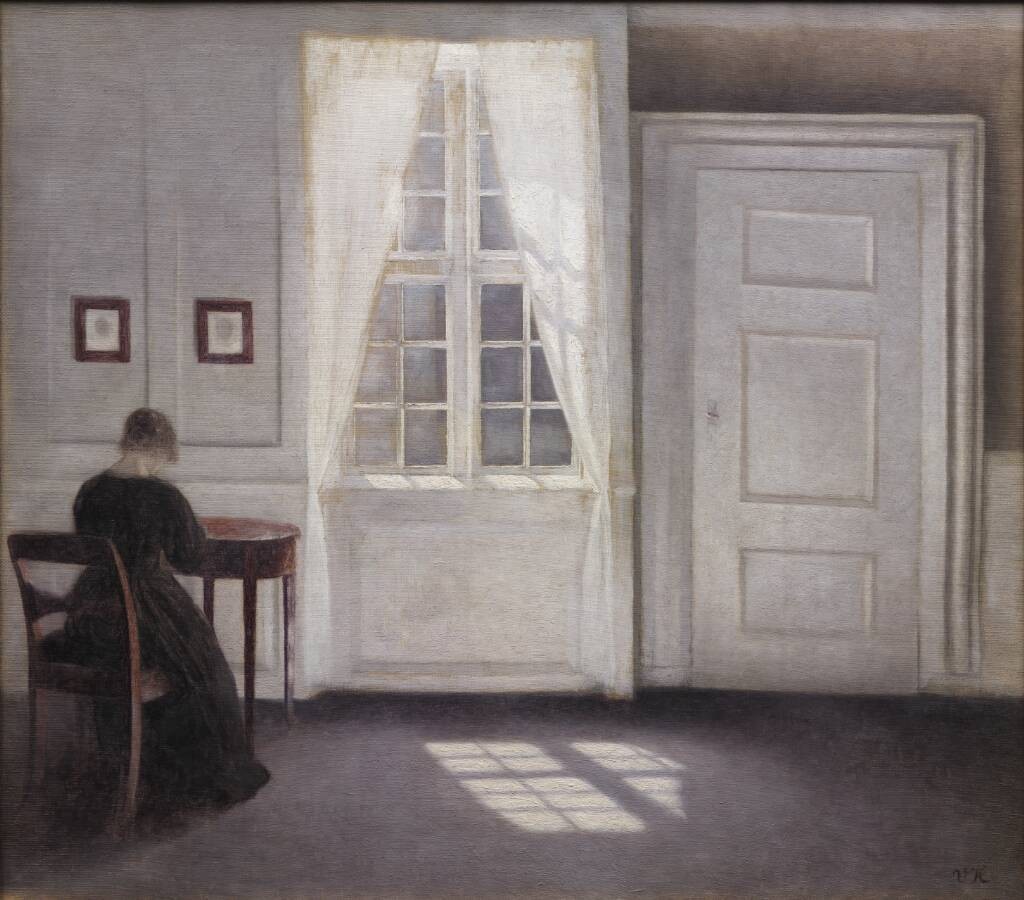
The married couple lived at several addresses, and those domestic settings supplied Vilhelm with a changing repertoire of walls, doors, windows and furniture. The Hirschsprung Collection states that he occupied seven Copenhagen addresses and describes interiors as carefully staged arrangements rather than neutral records.[2] Ida’s recurrence belongs to this repeated reworking of inhabited space.
At Strandgade 30, where the couple moved in 1898, she appears in numerous paintings. The National Gallery’s 1899 Interior identifies Ida as the model for its dark-clothed figure and notes that she is often represented reading a book or letter.[6] Technical observation of that exact canvas also shows that Vilhelm added her late and reduced the table. Her presence was thus one element in a composition that changed during painting.
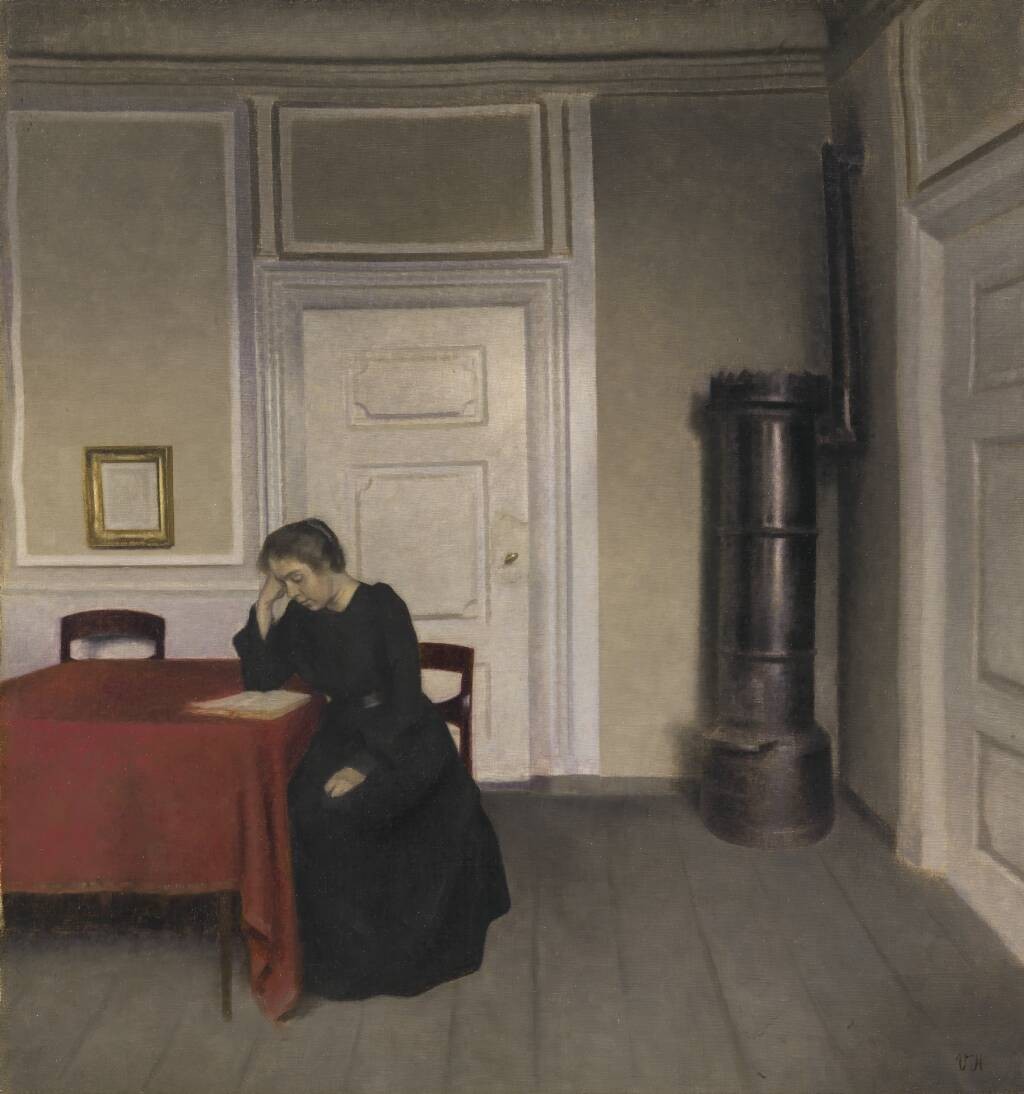
No single pose summarises the series. In Interior in Strandgade, Sunlight on the Floor, KMS3696, a seated woman identified by ViHDA as most likely Ida is grouped with a small table beside the window.[7] In A Room in the Artist’s Home, KMS3697, she reads at a covered table within a taller, differently organised image.[8] These are separate objects from 1901 and 1902, not interchangeable versions of “Ida in a grey room”.
The Strandgade interiors guide follows these variations across exact works, while the broader paintings guide places the domestic figures alongside landscapes, portraits and architectural views. Together they show why Ida’s visibility matters without making her the explanation for every interior.
Turned Backs and Withheld Expression
A figure seen from behind performs clear pictorial work. The dark dress supplies weight against pale walls; an upright body can answer the verticals of doors; the head directs attention towards a book, window or surface beyond the viewer’s sight. These effects are observable. “Lonely”, “resigned” or “emotionally absent” are interpretations, not facts about Ida.
The National Gallery’s description of its Interior demonstrates the needed restraint. It identifies Ida as the model, but treats the unseen activity cautiously, proposing that she may be reading something.[6] Even a familiar sitter does not make an obscured action certain. Nor does a turned back grant access to her mental state.
Facing away also needs to be considered beside Ida’s frontal portraits. In the Paris double portrait she meets the outward direction of the picture; in the engagement portrait she is presented formally; in the 1907 teacup canvas her face is fully visible. Vilhelm did not impose one unchanging formula upon her image. What persists is controlled access: a viewer may study pose and setting while a narrative remains incomplete.
The 1907 Teacup Portrait
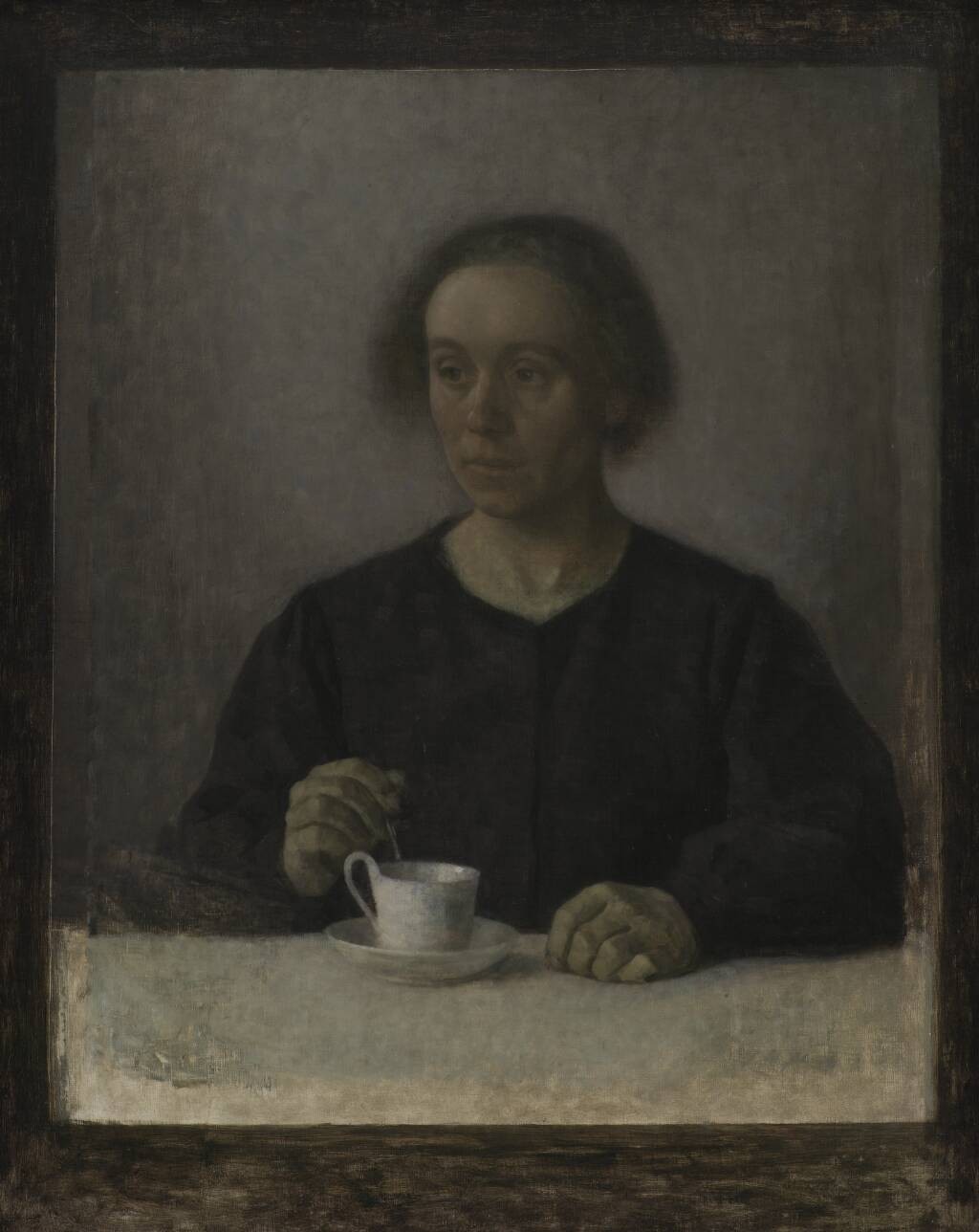
The principal later likeness is Ida Hammershøi, the Artist’s Wife, with a Teacup, SMK KMS3352. Painted in 1907, it measures 91 by 73.5 centimetres. Ida sits frontally behind a pale table covering, with one hand near the cup. Her dark dress, hair and the painted border concentrate attention upon face, neck and hand.[9]
Object identity is especially important here. ViHDA identifies KMS3352 as the earlier of two full portraits; the more highly finished example belongs to ARoS. It also notes a much smaller 1907 study that has not been located.[9] The three should not be collapsed into one teacup picture. The SMK canvas is the first version and the exact work discussed here.
Technical examination replaces assumptions of a single fixed conception with material evidence. ViHDA records a sugar bowl now visible beneath the table area, a lowered neckline and a slight change to the hand’s position. The face and clothing were worked largely wet-in-wet, while the background was clarified later around the head and shoulders.[9] Those revisions concern Vilhelm’s construction of the image; they do not prove Ida directed them.
Letters, Health and Careful Attribution
ViHDA connects the 1907 portrait with letters recording that Ida spent an extended period in hospital in 1906. Its contextual note interprets her appearance in relation to convalescence.[9] The wording needs to remain attributed. The correspondence supports a hospital stay; it does not supply a diagnosis in the object record, and the painting cannot independently confirm one.
The distinction also protects Ida from being reduced to a medicalised reading of her face. A pale table, teacup, still pose and direct gaze may encourage viewers to imagine recovery or fatigue, but such impressions are not equivalent to documented symptoms. The safest conclusion is limited: a museum source relates the portrait to a known period of hospital care, while the precise meaning of the chosen pose remains open.
This same discipline applies throughout her representations. Letters can establish events. Provenance can establish ownership or transfer. Imaging can reveal altered paint. None of those evidence types gives unrestricted access to intention, emotion or marital dynamics.
Donation, Sale and Stewardship
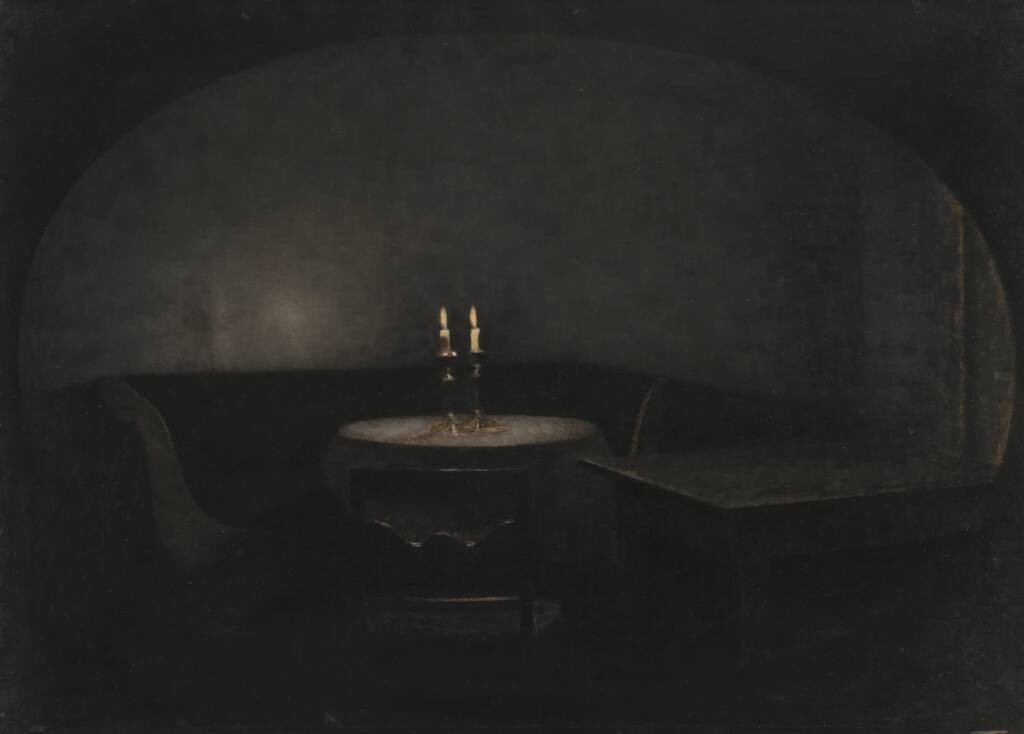
Vilhelm died in 1916; Ida lived until 1949.[1] Her later connection to the paintings is visible through concrete transfers. ViHDA states that she donated KMS3352, her first teacup portrait, to SMK in 1916.[9] Its record for Interior. Artificial Light states that she sold that canvas in 1918; the museum acquired it much later, in 2012.[10] A gift and a sale are different actions, but both show her handling works after the artist’s death.
“Steward” is useful here if it remains precise. Ida retained, transferred and helped determine the early posthumous paths of particular paintings. She should not be credited alone with preserving the whole archive. The Hirschsprung Collection’s holdings—letters, photographs, scrapbooks, furniture and art—came partly from its founders’ collecting and partly through later gifts from the Hammershøi family.[2]
Institutional care has continued to change access. SMK now describes its holding as the world’s largest collection of Hammershøi’s works, strengthened by recent donations and studied through ViHDA.[11] Ida’s 1916 gift sits near the beginning of that museum history. It preserved a specific likeness in a public collection while also recording her as a donor, not only the woman represented on the canvas.
Researched works directory
This directory covers the 133 paintings currently published by the Vilhelm Hammershøi Digital Archive (ViHDA). It is a researched platform census, not a complete catalogue raisonné of the artist's oeuvre.
| Name | Date | Medium |
|---|---|---|
| A Bakery Shop. Study | 1888 | Painting |
| A Greek Relief. Louvre | 1892 | Painting |
| Amalienborg Square | 1896 | Painting |
| An Ancient Relief. Study | 1878 – 1881 | Painting |
| An Old Woman | 1886 | Painting |
| An Old Woman Standing by a Window | 1885 – 1886 | Painting |
| Artemis | 1893 – 1894 | Painting |
| Bedroom | 1890 | Painting |
| Church of Christiansborg Palace, Copenhagen | 1910 | Painting |
| Church of Sankt Petri, Copenhagen | 1906 | Painting |
| Double Portrait. Vilhelm and Ida Hammershøi | 1892 | Painting |
| Evening in the Drawing Room. Strandgade 30 | 1904 | Painting |
| Evening in the Sitting Room. | 1904 | Painting |
| Evening Interior. Artificial Light. Ida and Frederikke Hammershøi | 1891 | Painting |
| Farm. Refsnæs | 1900 | Painting |
| Five Portraits. Study | 1901 | Painting |
| Frederiksborg Castle | 1893 | Painting |
| From Christianshavns Canal | 1905 | Painting |
| From Frederiksholms Kanal | 1893 | Painting |
| From Kvæsthusbroen | 1908 | Painting |
| From the British Museum. London, Winter | 1906 | Painting |
| From the Church Santo Stefano Rotondo in Rome | 1902 – 1903 | Painting |
| From The Greenlandic Trade Dock. Christianshavn | 1908 | Painting |
| From the Old Christiansborg Palace | 1907 | Painting |
| Hammershøi's palette | Uncertain/Unknown | Painting |
| Head of a Woman. Study for Artemis | 1893 | Painting |
| Houses. Arresødal near Frederiksværk | 1904 | Painting |
| Interior | 1898 | Painting |
| Interior in Louis Seize style. Rahbeks Allé | 1897 | Painting |
| Interior. 'The Four Rooms'. Strandgade 25 | 1914 | Painting |
| Interior. A Young Man Reading | 1898 | Painting |
| Interior. Artificial Light | 1909 | Painting |
| Interior. Attic Room with Table and Chair | 1883 – 1885 | Painting |
| Interior. Frederikke and Anna Hammershøi | 1884 | Painting |
| Interior. From The Great Hall of Lindegården | 1909 | Painting |
| Interior. Ida Hammershøi at a Sewing Table | Uncertain/Unknown | Painting |
| Interior. Living Room in Louis-Seize-Style. Rahbeks Allé 26 | 1893 – 1896 | Painting |
| Interior. Looking out on the Exterior. Strandgade 30 | 1905 | Painting |
| Interior. Strandgade 30 | 1901 | Painting |
| Interior. Strandgade 30 | 1902 | Painting |
| Interior. Strandgade 30 | 1905 | Painting |
| Interior. Study in Sunlight. Strandgade 30 | 1906 | Painting |
| Interior. Sunshine in the Drawing Room III | 1903 | Painting |
| Interior. The Music Room. Strandgade 30 | 1908 | Painting |
| Interior. The Old Stove. Albertinelyst | 1888 | Painting |
| Interior. The Tall Windows | 1913 | Painting |
| Interior. With Empire Sofa. Strandgade 30 | 1907 | Painting |
| Interior. With Four Etchings. Strandgade 30 | 1904 | Painting |
| Interior. With Table, Cupboard and Windsor Chair. Strandgade 25 | 1913 | Painting |
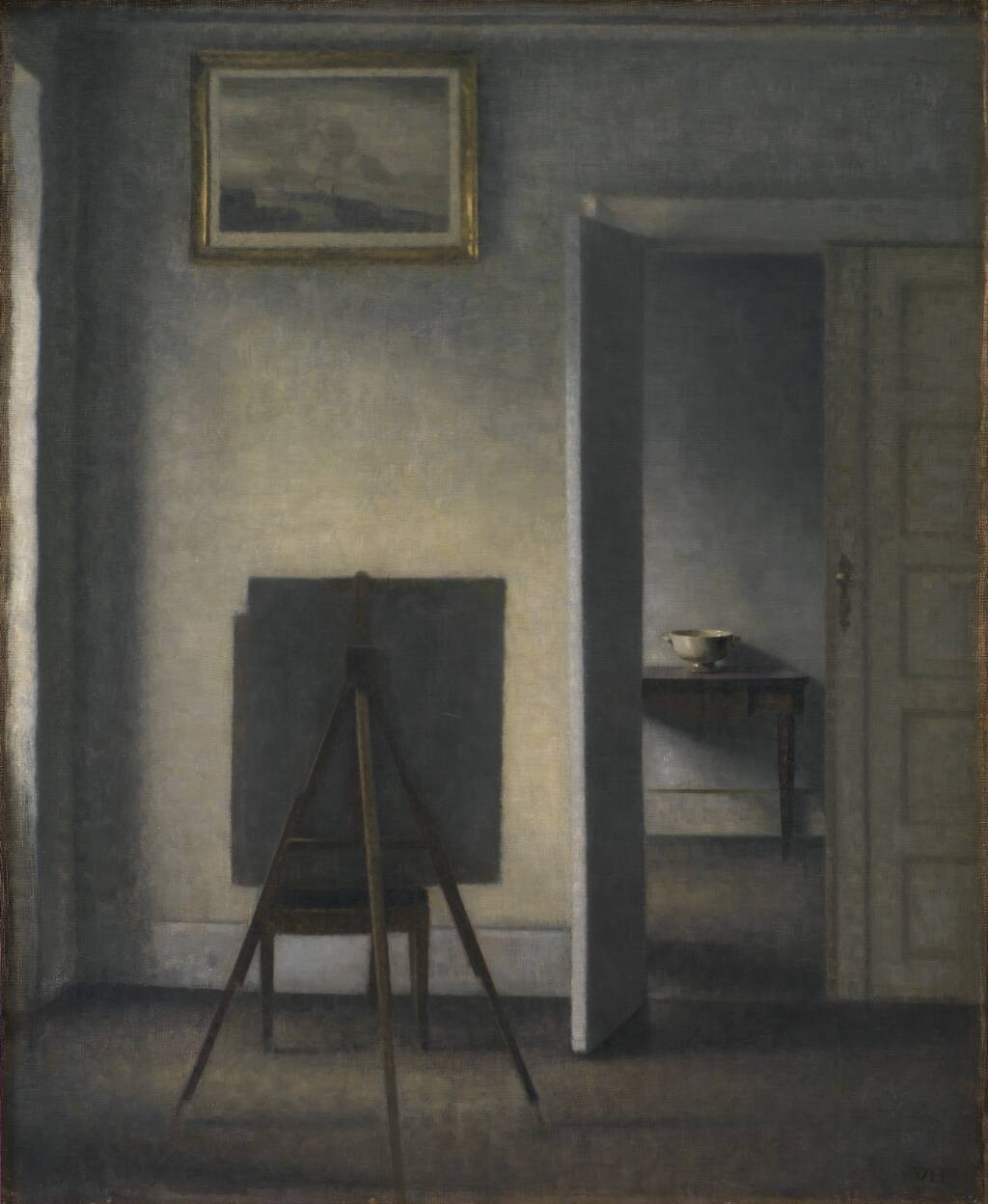
| Interior. With the Artist's Easel | 1910 | Painting |
| Interior. With the Artist's Easel. Bredgade 25 | 1912 | Painting |
| Interior. Woman knitting | 1889 | Painting |
| Interior. Woman Reading | 1910 | Painting |
| Interior. Woman Reading. Bredgade 25 | Uncertain/Unknown | Painting |
| Interior. Woman Sitting Behind a Table | 1910 | Painting |
| Interior. Woman Sweeping | 1899 | Painting |
| Job | 1887 | Painting |
| Job. Study | 1887 | Painting |
| Landscape. At Lyngby Lake | 1888 | Painting |
| Landscape. Early Spring | 1909 | Painting |
| Landscape. Gentofte | 1906 | Painting |
| Landscape. Grønsund, Falster | 1890 | Painting |
| Landscape. Gundsømagle near Roskilde | 1885 | Painting |
| Landscape. Gundsømagle near Roskilde | 1886 | Painting |
| Landscape. Kongevejen near Gentofte. Study | 1892 | Painting |
| Landscape. Near Fortunen | 1901 | Painting |
| Landscape. Near Lejre | 1905 | Painting |
| Landscape. Ryet near Farum Lake | 1896 – 1897 | Painting |
| Landscape. Summer. Near Lejre | 1905 | Painting |
| Landscape. Søndermarken Park in Winter | 1895 – 1896 | Painting |
| Landscape. The Rowan Avenue at Snekkersten | 1906 | Painting |
| Landscape. With a Farmhouse | 1878 – 1879 | Painting |
| Landscape. Young Forest, Trørød, Summer | 1907 | Painting |
| Morning Toilette. Study. Strandgade 25 | 1914 | Painting |
| Nude Female Model | 1884 | Painting |
| Nude Female Model | 1910 | Painting |
| Open Doors. Strandgade 30 | 1905 | Painting |
| Portrait of a Young Girl. Anna Hammershøi | 1885 | Painting |
| Portrait. Anna Hammershøi | 1883 | Painting |
| Portrait. Anna Hammershøi. Profile | Uncertain/Unknown | Painting |
| Portrait. Daniel Jacobson Salter | 1901 | Painting |
| Portrait. Elisabeth Dorothea Rentzmann | Uncertain/Unknown | Painting |
| Portrait. Elisabeth Wandel | 1890 | Painting |
| Portrait. Fini Henriques | Uncertain/Unknown | Painting |
| Portrait. Frederikke Hammershøi | Uncertain/Unknown | Painting |
| Portrait. Frederikke Hammershøi. Study | 1894 | Painting |
| Portrait. Henry Madsen. Study | 1904 | Painting |
| Portrait. Henry Madsen. Study | 1904 | Painting |
| Portrait. Ida Hammershøi | 1894 | Painting |
| Portrait. Ida Hammershøi with a Teacup | 1907 | Painting |
| Portrait. Ida Ilsted | 1890 | Painting |
| Portrait. Ida Ilsted. Study | 1890 | Painting |
| Portrait. Ida Ilsted. Study | 1890 | Painting |
| Portrait. J.F. Willumsen. Study for Five Portraits | 1901 | Painting |
| Portrait. J.F. Willumsen. Study for Five Portraits | 1901 – 1902 | Painting |
| Portrait. Karen Malm | 1914 | Painting |
| Portrait. Karl Madsen | 1890 | Painting |
| Portrait. Kristian Zahrtmann | 1889 | Painting |
| Portrait. Kristian Zahrtmann | 1889 | Painting |
| Portrait. Svend Hammershøi | 1881 | Painting |
| Portrait. Svend Hammershøi | 1892 | Painting |
| Portrait. Svend Hammershøi | 1903 – 1904 | Painting |
| Portrait. Svend Hammershøi. Study for Five Portraits | 1901 | Painting |
| Portrait. Thora Bendix, née Anne Victoria Sundberg | 1896 | Painting |
| Portrait. Thora Bendix. Study | 1896 | Painting |
| Portrait. Thorvald Bindesbøll. Study | 1904 | Painting |
| Portrait. Woman. Possibly Frederikke Juncker-Jensen | 1878 – 1881 | Painting |
| Portrait. Woman. Profile | 1888 | Painting |
| Seated Female Nude | 1889 | Painting |
| Self- Portrait | 1891 | Painting |
| Self-Portrait | 1890 | Painting |
| Self-Portrait | 1914 | Painting |
| Self-Portrait. Spurveskjul, Frederiksdal | 1911 | Painting |
| Self-Portrait. Spurveskjul, Frederiksdal | 1911 | Painting |
| Standing Female Model | 1909 – 1910 | Painting |
| Street in London. Montague Street at the British Museum | 1905 – 1906 | Painting |
| Study of a Model. A Woman seen from the Back | 1888 | Painting |
| Sunbeams or Sunshine. "Dust motes dancing in the sunbeams" | 1900 | Painting |
| The Buildings of the Asiatic Company, seen from St. Annæ Street | 1902 | Painting |
| The Cello Player. Henry Bramsen | 1893 | Painting |
| The Coin Collector. Strandgade 30 | 1904 | Painting |
| The Garden Room. Frederiksberg Allé | 1887 | Painting |
| The Tuesday Forest | 1893 | Painting |
| Three Sailing Boats. Christianshavns Canal | 1905 | Painting |
| Tree Trunks. Arresødal near Frederiksværk | 1904 | Painting |
| View of Christiansborg Palace. Late Autumn | 1890 – 1892 | Painting |
| View of Gentofte Lake . 'Sunshower' | 1903 | Painting |
| View of Gentofte Lake . 'Sunshower'. Study | 1903 | Painting |
| View of Jægersborg Allé. Study | 1892 | Painting |
| White Doors. Strandgade 30 | 1899 | Painting |
| Woman Knitting. Frederikke Hammershøi | 1889 | Painting |
| Young Beechwood. Arresødal near Frederiksværk | 1904 | Painting |
| Young Girl Sewing. Anna Hammershøi | 1887 | Painting |
Frequently Asked Questions
Ida Hammershøi, born Ida Ilsted in 1869, was the sister of painter Peter Ilsted and the wife of Vilhelm Hammershøi. She travelled with Vilhelm, repeatedly sat for portraits and interiors, and later transferred works through documented gifts and sales. She died in 1949.[1]
They married in early September 1891, following an engagement announced the previous summer.[3] Their honeymoon took them through the Netherlands and Belgium to Paris, where they remained for several months and were painted together in the 1892 double portrait.[1][5]
No. Ida can be identified in many works, but each attribution depends on its own record. The National Gallery identifies her as the model for its 1899 Interior, and ViHDA regards her as the most likely seated figure in KMS3696.[6][7] A dark dress or turned back alone is insufficient evidence.
The pose lets a figure shape the composition while withholding a fully legible action or expression. Ida’s dark silhouette can balance a pale room and guide the eye towards another part of it. Any further claim about sadness, alienation or choice would require evidence beyond the painted pose.
Surviving provenances document particular decisions rather than a complete inventory. She donated KMS3352 to SMK in 1916 and sold Interior. Artificial Light in 1918.[9][10] These acts support describing her as a steward of works, but not as their co-author or the sole guardian of the wider family archive.
Discussion
Use this evidence-led guide as a starting point for close looking rather than a final verdict.
Share an observation about Ida Hammershøi or a source that adds useful context.
Reader Insights
Which work most clearly turns an ordinary room, face or building into a newly measured pictorial structure?
Where do Copenhagen, Ida, training or exhibition history productively alter your reading?
Which source or surviving object would you investigate next?
Join the Conversation
Add your reading below, keeping observations specific and evidence clear.
References
- The David Collection, Double Portrait of the Artist and his Wife, accessed 31 August 2026.
- The Hirschsprung Collection, “Vilhelm Hammershøi”, accessed 31 August 2026.
- The Hirschsprung Collection, “Important Painting by Hammershøi Returns to Denmark”, accessed 31 August 2026.
- The Hirschsprung Collection, “Vilhelm Hammershøi’s Self-Portrait”, accessed 31 August 2026.
- Vilhelm Hammershøi Digital Archive, Double Portrait. Vilhelm and Ida Hammershøi, accessed 31 August 2026.
- The National Gallery, London, Interior, accessed 31 August 2026.
- Vilhelm Hammershøi Digital Archive, Interior. Strandgade 30 (KMS3696), accessed 31 August 2026.
- Vilhelm Hammershøi Digital Archive, Interior. Strandgade 30 (KMS3697), accessed 31 August 2026.
- Vilhelm Hammershøi Digital Archive, Portrait. Ida Hammershøi with a Teacup, accessed 31 August 2026.
- Vilhelm Hammershøi Digital Archive, Interior. Artificial Light, accessed 31 August 2026.
- SMK, “Vilhelm Hammershøi Donation”, accessed 31 August 2026.