 by Tom Gurney
Tom Gurney BSc (Hons) is an art history expert with over 20 years experience
Page Created: / Page Updated:
Email: tomgurney1@gmail.com / Phone: +44 7429 011000
Vilhelm Hammershøi Biography: Introduction
Vilhelm Hammershøi (1864–1916) built a career from subjects that were close at hand: members of his family, the rooms in which he lived, Copenhagen buildings and landscapes pared down to their essential forms. Born and buried in Copenhagen, he spent much of his working life in the city, but his art was never simply a record of domestic routine. Doorways become structures for looking, pale walls hold shifting light, and a familiar sitter may be turned away from the viewer.
The documented life is more eventful than the stillness of the pictures can suggest. Hammershøi received formal and independent training, provoked controversy at the beginning of his career, helped establish an alternative exhibition culture and travelled with his wife, Ida. He also attracted collectors during his lifetime. His biography therefore illuminates the conditions in which the paintings were made without supplying a single psychological explanation for them.
This account separates evidence from inference. Addresses, exhibitions, relationships and surviving objects can be established from museum records. Feelings such as loneliness or unease belong to viewers’ responses unless a source identifies them as a historical interpretation. That distinction is central to understanding the artist introduced in the Vilhelm Hammershøi overview.
At a Glance
- LifeBorn in Copenhagen in 1864 and died there in 1916.
- TrainingBegan studying at Copenhagen’s Royal Danish Academy of Fine Arts in 1879, aged fifteen.
- Early exhibitionExhibited the controversial portrait of his sister Anna at Charlottenborg in 1885.
- MarriageMarried Ida Ilsted in September 1891 and spent a long honeymoon in Paris.
- Copenhagen homesLived at seven Copenhagen addresses; his homes repeatedly became subjects and studios.
- Known forIs best known for interiors, but also painted portraits, landscapes and architectural views.
Vilhelm Hammershøi in context
Danish Golden Age legacy
c. 1830–1860European Realism
c. 1840–1900European Symbolism
c. 1880–1910James McNeill Whistler
1834–1903P. S. Krøyer
1851–1909Vilhelm Hammershøi
1864–1916Peter Ilsted
1861–1933Carl Holsøe
1863–1935Edvard Munch
1863–1944Contents
- Introduction
- Childhood and Training, 1864–1884
- Anna’s Portrait and the Early Rejections
- Ida, Marriage and the Paris Honeymoon
- Travel, Connections and European Reception
- Seven Copenhagen Addresses
- Strandgade and the Mature Interiors
- Bredgade, the Final Years and Death
- Ida and the Posthumous Record
Childhood and Training, 1864–1884
Getty’s authority record identifies Hammershøi as a Danish painter born and deceased in Copenhagen, and links him to his artist brother Svend and his wife, Ida Ilsted Hammershøi.[1] The bare facts matter because later spellings and transliterations can obscure the continuity of the record: the public name is Vilhelm Hammershøi, while forms such as Hammershoi are useful for search rather than as replacements for his Danish name.
At fifteen, in 1879, Hammershøi began formal study at Copenhagen’s Royal Danish Academy of Fine Arts. From 1883 he also attended the Artists’ Independent Study Schools, studying under P. S. Krøyer. The independent school supplemented academic instruction, while the National Gallery notes that it offered experience of painting studies in the open air.[2][3] These overlapping forms of education help explain the breadth of his output. The artist later associated above all with enclosed rooms also made landscapes, portraits and views of monumental buildings.
The National Gallery identifies James McNeill Whistler as an influence on Hammershøi’s early work.[3] That comparison is useful when considering restricted colour, tonal organisation and the refusal of conventional anecdote, but it should not turn Hammershøi into a Danish copy of another painter. His training took place within a Copenhagen art world whose institutions, juries and younger artists would soon be tested by his own submissions.
Anna’s Portrait and the Early Rejections
Hammershøi made his Charlottenborg debut in 1885 with a portrait of his younger sister Anna. He was twenty-one. The work met the Academy exhibition’s assigned format for the Neuhausen Prize—a life-size, knee-length portrait of a woman—but its muted handling and withdrawn sitter did not receive the award. According to the Hirschsprung Collection, the decision prompted a protest signed by forty-one artists, among them Krøyer, Theodor Philipsen, L. A. Ring and Bertha Wegmann.[2]
The episode is sometimes simplified into the story of a solitary genius rejected by an uncomprehending establishment. The surviving evidence describes something more social. Fellow artists publicly defended the painting, and the dispute became part of a wider challenge to the Academy exhibition’s jury system. That movement contributed to the formation of Den Frie Exhibition in 1891.[2] The controversy therefore placed Hammershøi within a network of artists seeking different conditions for showing new work.
His early career combined refusal with recognition. The National Gallery records further rejection in 1888, yet Heinrich Hirschsprung bought An Old Woman of 1886 directly from Hammershøi in 1888.[2][3] An influential private collector was supporting him while official selection remained uncertain. The result was neither steady institutional approval nor complete exclusion.
Another defining rejection came in 1890. Hammershøi submitted Bedroom, a view of the family home in Frederiksberg Allé with a woman believed to be Anna standing at the window. Charlottenborg declined it. By the following year Den Frie offered an artist-run alternative, and Hammershøi exhibited there thereafter.[4] The room, the turned figure and the thin promise of narrative already anticipate later interiors, but the painting belongs to the artist’s childhood household, before his marriage and before Strandgade.
Ida, Marriage and the Paris Honeymoon
Anna was a frequent early model; Ida Ilsted became the central sitter of Hammershøi’s married life. The couple became engaged in the summer of 1890 and married in early September 1891. Until the wedding, Hammershøi had continued to live with his mother and siblings in Frederiksberg Allé.[4] Ida’s importance is both personal and visible: she appears in portraits and in numerous interiors, often seen from behind or occupied with reading and other domestic actions. The Ida Hammershøi guide follows that role without treating her as an artistic co-author.
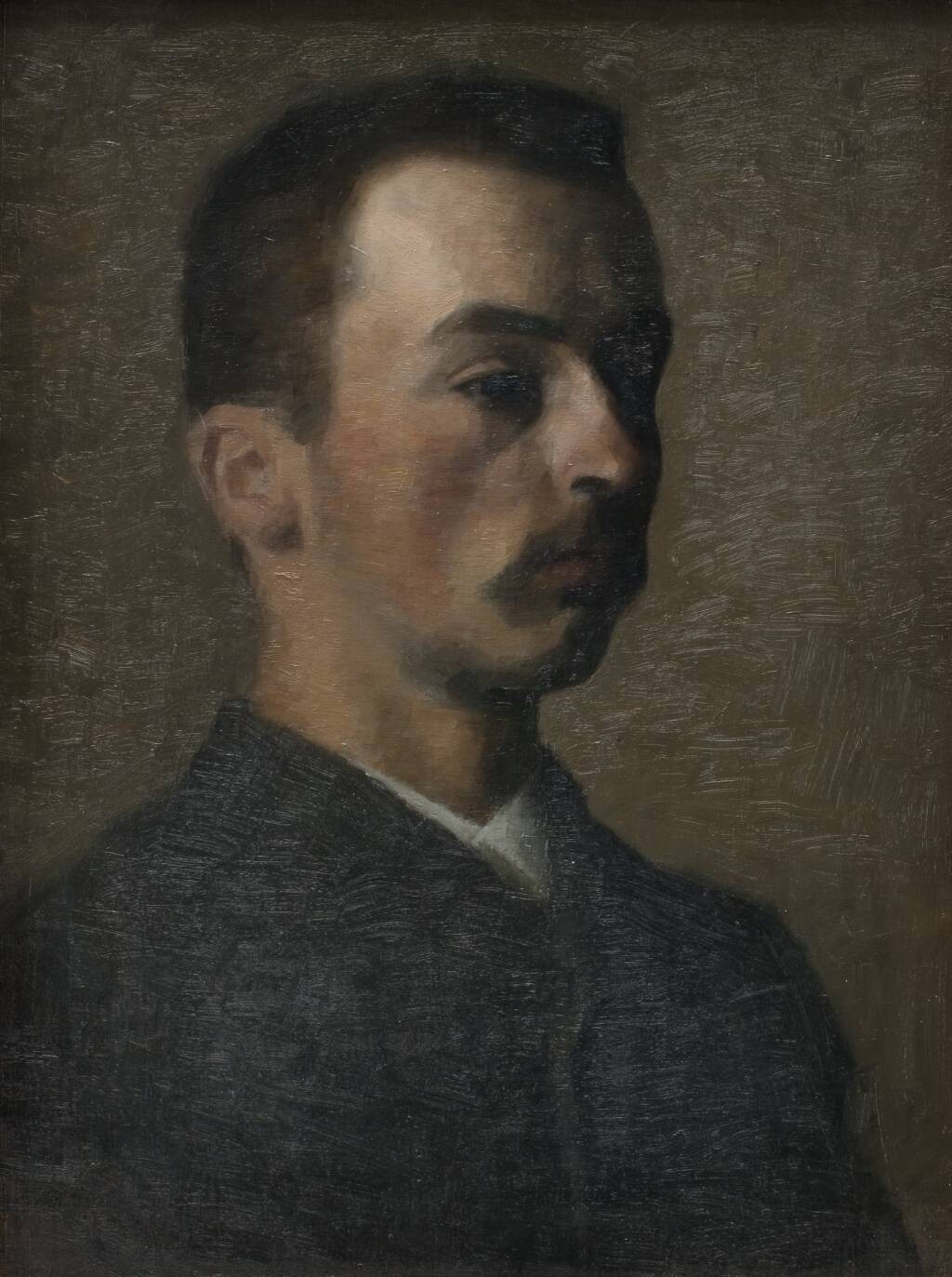
Two self-portraits from this moment must be kept distinct. SMK’s KMS6692 is a self-portrait dated 1890, made before the marriage.[5] A different self-portrait, now at the Hirschsprung Collection, was painted in Paris in 1891 when Hammershøi was twenty-seven and travelling with Ida on their honeymoon.[6] Similar titles do not make the objects interchangeable, and the Paris work should not be used to relabel the 1890 painting.
The honeymoon extended through the winter of 1891–92. In Paris Hammershøi also made a double portrait of the newly married couple, placing their heads and shoulders side by side across a broad horizontal canvas. ViHDA dates the work to 1892 and identifies the long Paris stay as its setting.[7] It is a rare image in which husband and wife face outward together, yet it still resists easy biography: pose and format are visible facts, while any claim about the emotional character of the marriage would go beyond the object record.
Travel, Connections and European Reception
Paris placed the couple in a major European art centre, but Hammershøi’s career continued to be organised from Copenhagen. His international reception developed through paintings, exhibitions, collectors and personal connections rather than through permanent expatriation. The restricted palette and carefully controlled compositions could be read alongside Whistler and older northern European interior painting, although such comparisons should clarify his choices rather than dissolve their specificity.
One documented link with Britain began through an image in circulation. The English concert pianist Leonard Borwick saw a reproduction of Hammershøi’s 1899 Interior on a Christmas card while visiting Copenhagen in 1903. He bought the painting from the artist and the two became friends.[8] The episode shows how an apparently private Copenhagen room could enter an international collection through reproduction, encounter and purchase.
Hammershøi was therefore not wholly unrecognised in his lifetime. Early patronage from Heinrich Hirschsprung, the independent platform of Den Frie and Borwick’s acquisition all complicate a simple rise-from-obscurity narrative. Reception was uneven, however: the same decades contain juried rejections, advocacy by fellow artists and support from individual collectors.
Travel and reception are related here, but they are not identical. The Paris portraits securely document Hammershøi’s presence abroad, whereas the Borwick episode records a work crossing borders through reproduction and purchase. Together they show international contact without implying that Copenhagen ceased to be the practical centre of his life. They also remind us that circulation can begin with a modest printed image as readily as with a major exhibition.
Seven Copenhagen Addresses
The Hirschsprung Collection records that Hammershøi lived at seven addresses in Copenhagen.[2] This figure is a useful correction to the idea that every interior depicts one unchanging home. The rooms were residences and working spaces, but also flexible raw material. Furniture could be moved, doors opened or shut, and a repeated viewpoint reorganised for another canvas.
Several addresses define the most legible stages. Frederiksberg Allé was the family home of the unmarried artist and the setting for Bedroom of 1890.[4] Later, Vilhelm and Ida spent roughly a year in a newly built property on Aaboulevarden. The Hirschsprung Collection notes that they preferred older buildings and moved on to Strandgade 30, a seventeenth-century merchant house in Christianshavn.[2]
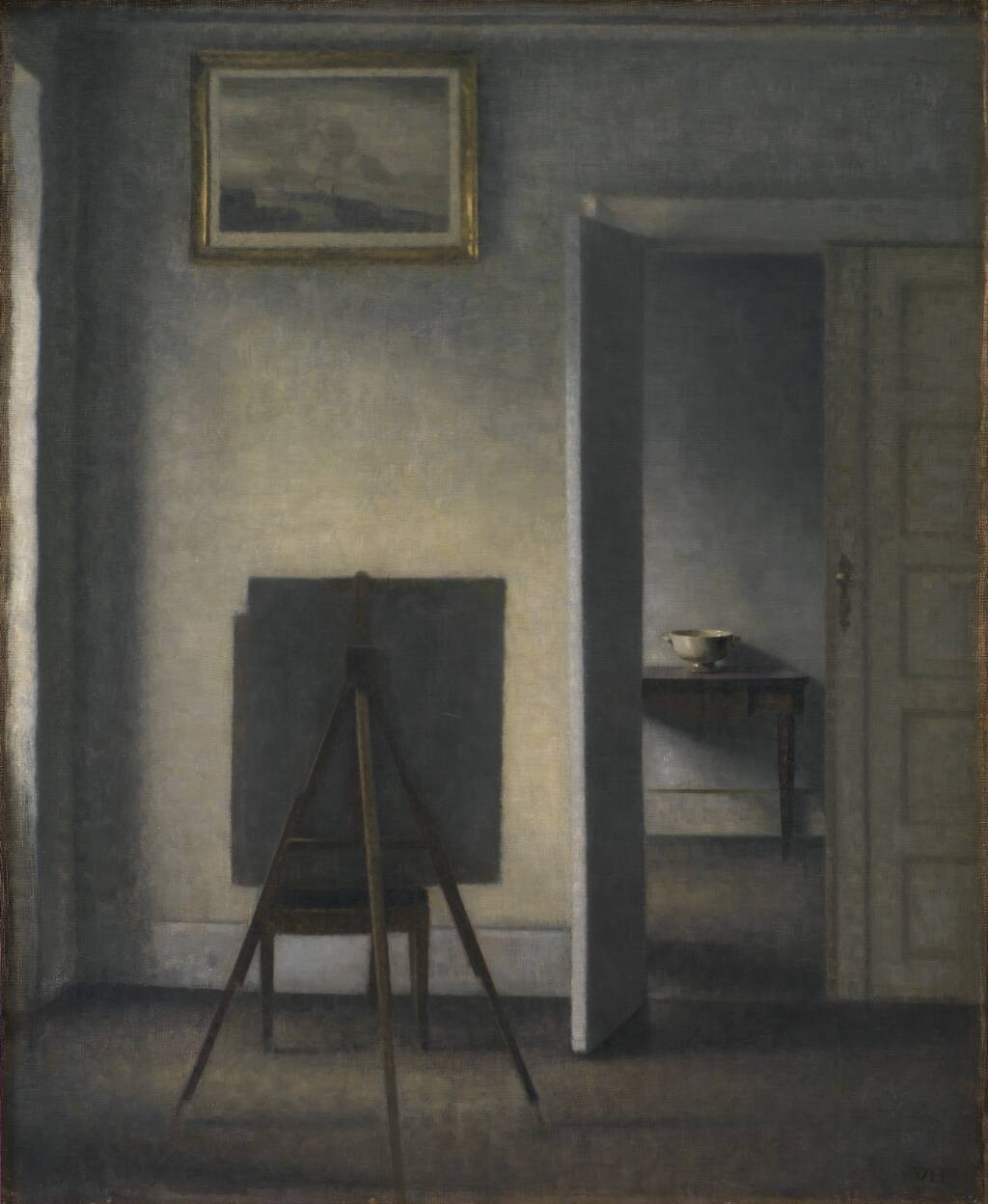
They entered Strandgade 30 in December 1898. Its sequence of rooms, panels, doors and windows became the basis of more than sixty interiors.[8] Around 1909 the couple moved to Bredgade 25, where they lived until 1913. ViHDA locates the 1910 Interior with the Artist’s Easel in that apartment and records related versions of its composition.[9]
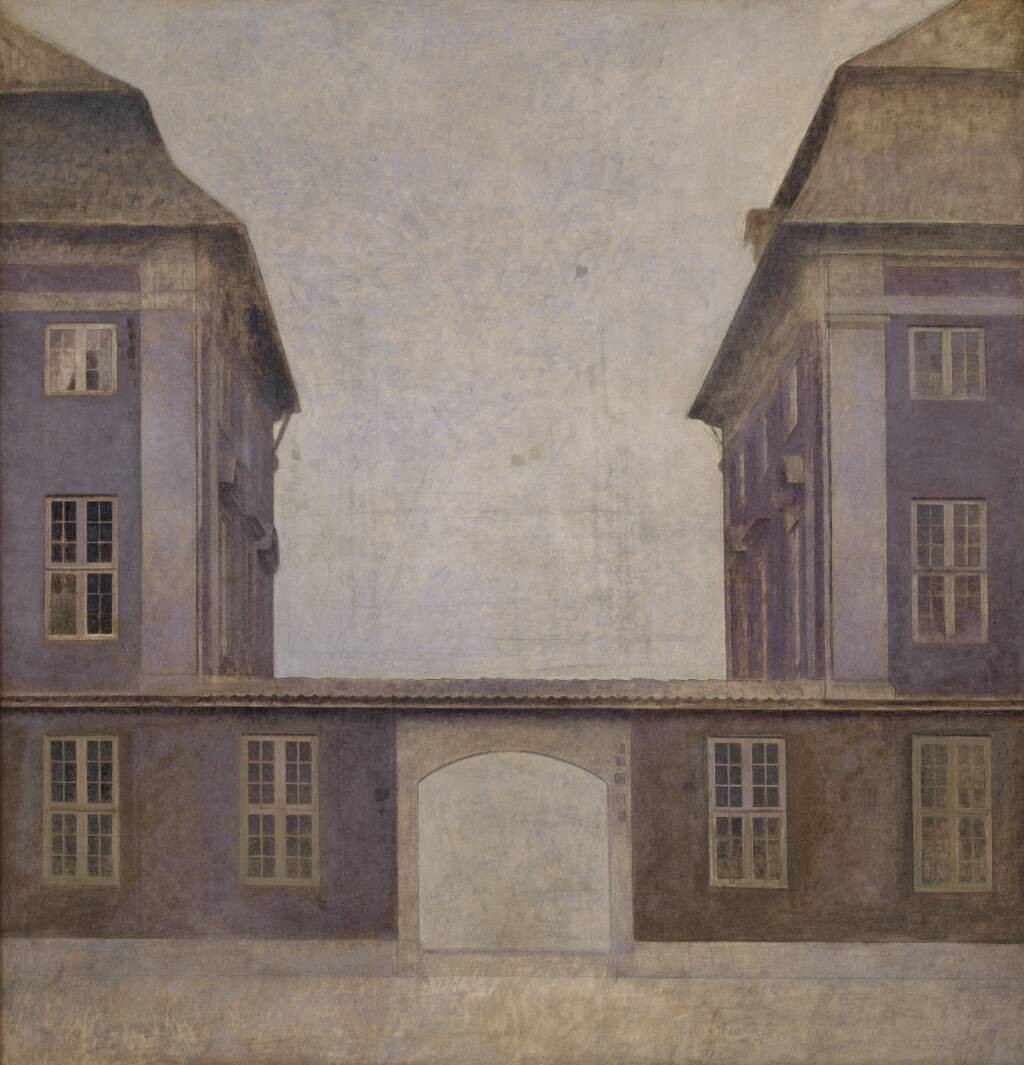
In 1913 Vilhelm and Ida moved to Strandgade 25, the former Asiatic Company building opposite their earlier home. Hammershøi had already studied this architecture while living across the street. ViHDA records that the couple had hoped to live there and finally occupied a large first-floor flat until his death in 1916.[10] The move joins biography and motif with unusual clarity: a building once observed became the artist’s last home. The Copenhagen and architecture guide traces that relationship and distinguishes the unfinished SMK study from the separate finished version at Ordrupgaard.
Strandgade and the Mature Interiors
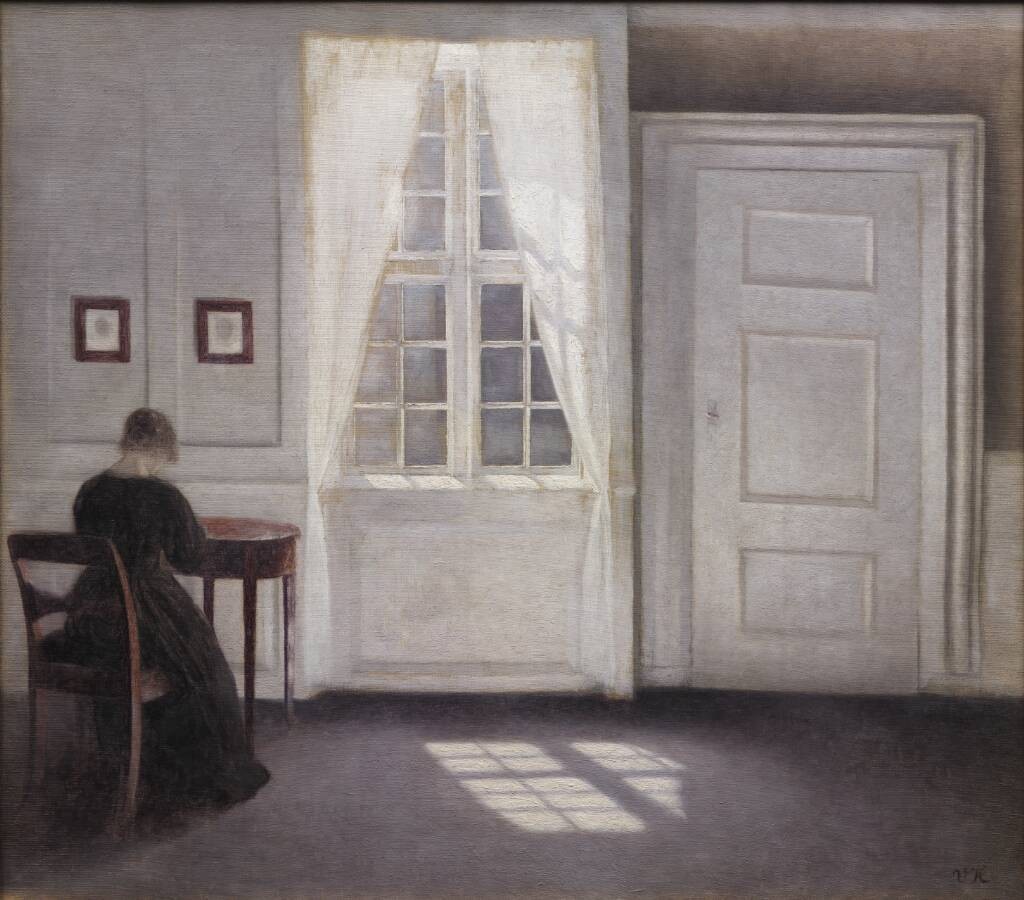
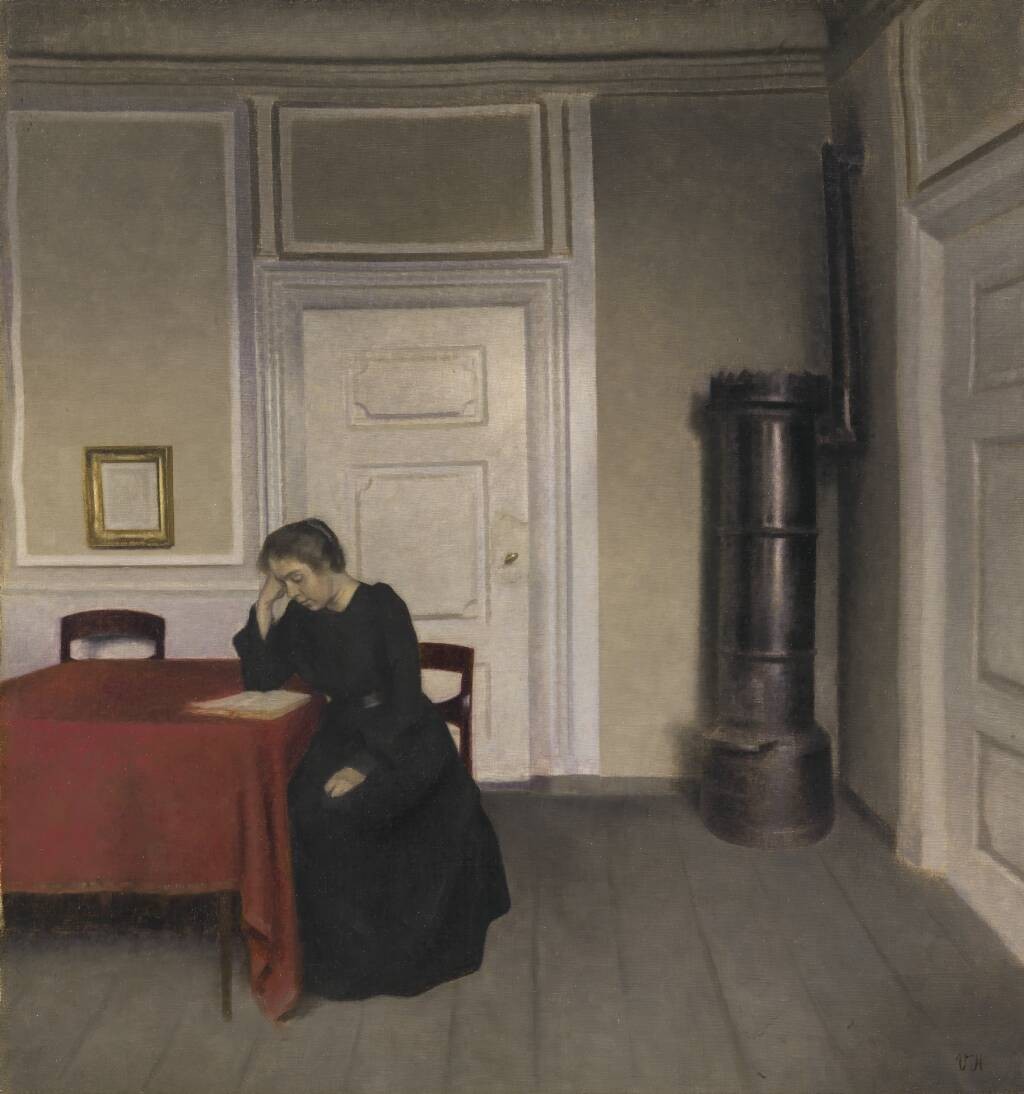
Strandgade 30 is the address most closely associated with Hammershøi, but it should be treated as a place of sustained experimentation rather than a backdrop automatically charged with silence or sorrow. He used the same connected rooms in changing combinations. A door might become a pale rectangle, a wall a field of modulated grey, and Ida a dark vertical form within the architecture. Empty and occupied versions belong to the same long inquiry into light, interval and alignment.
The artist did not merely copy what was before him. The National Gallery’s examination of its 1899 Interior indicates that he reduced the table during painting and added Ida late.[8] Such revisions show deliberate construction. Furniture and figure answer compositional needs, even when the result preserves the credibility of an ordinary room.
This is why the mature work cannot be reduced to a diary of married life. Ida’s repeated presence is historically important, but her turned back does not document alienation. Empty rooms do not prove loneliness. Those responses may be powerful, yet they are produced by choices of framing, spacing, tone and withheld action. The dedicated Strandgade interiors guide considers the series across distinct objects rather than treating all grey rooms as versions of one picture.
Bredgade, the Final Years and Death
The move to Bredgade 25 did not end Hammershøi’s interest in domestic interiors. Interior with the Artist’s Easel of 1910 uses the new apartment’s doorways, wall and studio equipment, and ViHDA’s technical study reveals that the opening and table initially occupied different positions. The easel may have been introduced after that earlier arrangement.[9] The late picture therefore embodies revision rather than passive transcription.
Hammershøi returned to Christianshavn in 1913 when the couple moved into Strandgade 25. He continued working, although his career ended only three years later. Getty’s authority record fixes his death in Copenhagen in 1916.[1] He was fifty-one. The documentary record does not require the paintings to be read as premonitions of illness or death; late interiors remain material, spatial and pictorial decisions in their own right.
Ida and the Posthumous Record
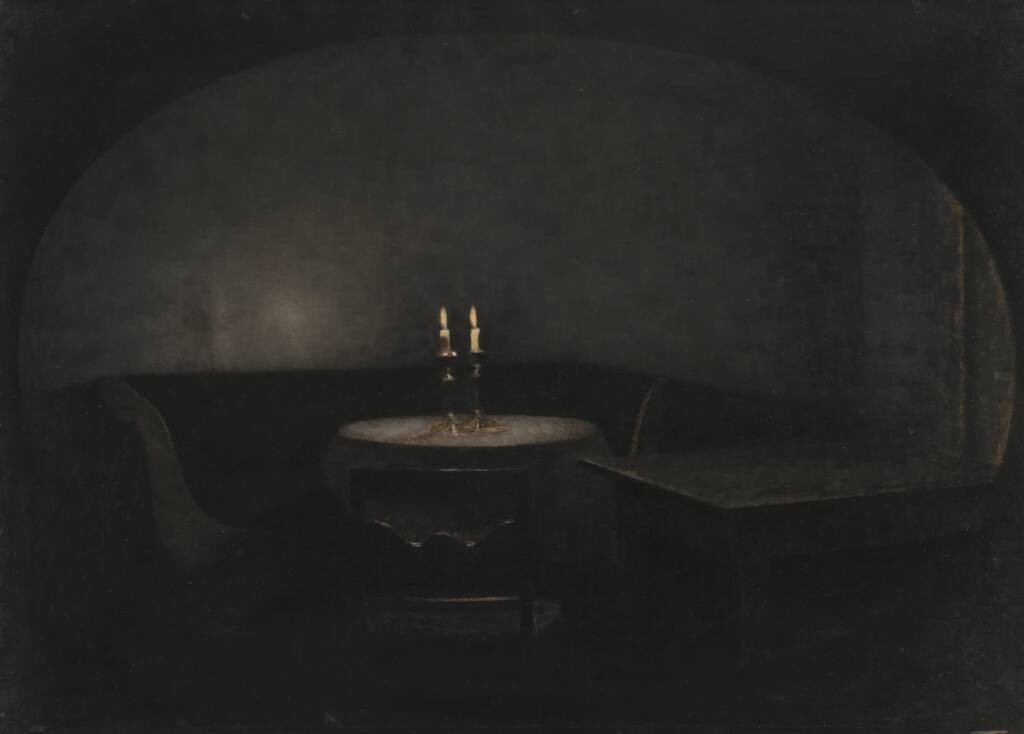
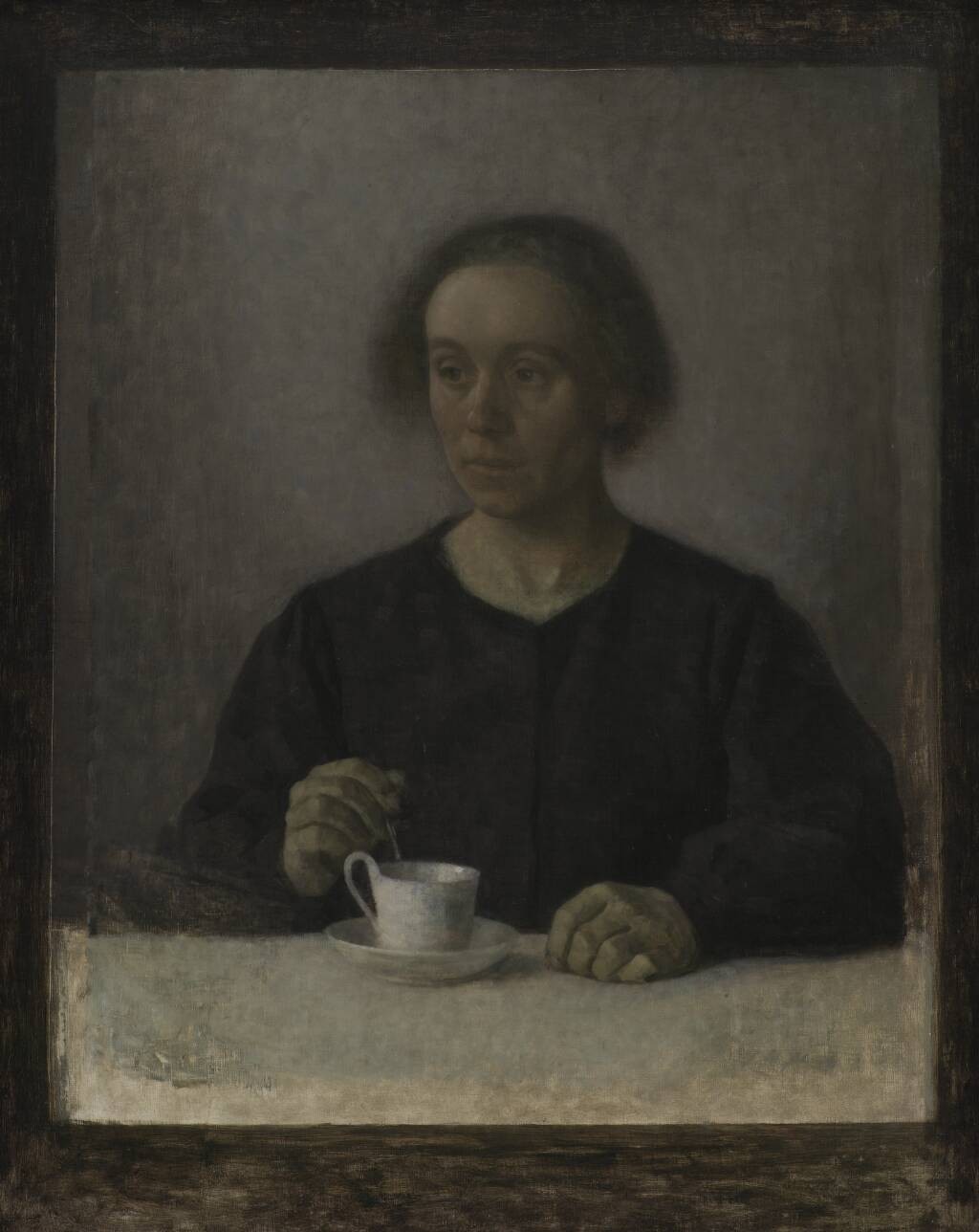
Ida outlived Vilhelm by more than three decades. Her role after 1916 can be described concretely through provenance. She donated the 1907 Portrait. Ida Hammershøi with a Teacup to SMK in 1916.[11] In 1918 she sold Interior. Artificial Light, a 1909 candlelit room that SMK later acquired in 2012.[12] These actions form part of her stewardship of the works; they do not imply authorship of them.
The wider family also helped preserve an unusually rich body of evidence. The Hirschsprung Collection now holds paintings and drawings as well as letters, photographs, exercise books, scrapbooks, the artist’s palette and furniture. Some originated with Heinrich and Pauline Hirschsprung’s collecting, while further material came from the Hammershøi family.[2] The archive lets a biography be built from more than later legend.
Institutional collecting has continued to reshape access to Hammershøi. SMK’s recent acquisition of three Bredgade paintings strengthened a collection it describes as the world’s largest holding of his work.[13] ViHDA adds a different kind of afterlife: the five-year initiative led by SMK examined about 140 paintings through visual, technical and scientific study, bringing conservators, imaging specialists, scientists and art historians together.[14]
That evidence makes the modern Hammershøi both more knowable and less reducible to a nickname. His life can be anchored in dates, people, rooms and objects. His paintings still leave interpretive space, but biography works best when it identifies the conditions of their making rather than pretending to settle what their stillness means.
Follow Vilhelm Hammershøi's career through four stages
Academy study, portrait training and an early challenge to official taste
Born in Copenhagen, Hammershøi entered the Royal Danish Academy of Fine Arts in 1879 and also studied with P. S. Krøyer. Early portraits and figure studies established the restrained tonal language that drew attention even when official juries rejected important works.
Independent display, marriage to Ida and encounters beyond Denmark
Exhibitions, rejection controversies and the independent context around Den Frie shaped Hammershøi's public position. He married Ida Ilsted in 1891, travelled with her and developed portraits, architecture, landscapes and rooms into closely related fields of experiment.
One apartment becomes a changing system of doors, walls, light and figures
At Strandgade 30, Hammershøi repeatedly rearranged a small set of rooms and furnishings. Daylight, open and closed doors, bare walls and Ida's recurring presence generated dozens of distinct interiors rather than records of an unchanging home.
Bredgade rooms, architectural motifs and a final period of revision
Later interiors at Bredgade and other Copenhagen subjects continued the serial method with altered scale, furniture and illumination. The artist worked until illness curtailed production; after his death in 1916, Ida helped preserve and transfer important works and records.
Researched works directory
This directory covers the 133 paintings currently published by the Vilhelm Hammershøi Digital Archive (ViHDA). It is a researched platform census, not a complete catalogue raisonné of the artist's oeuvre.
| Name | Date | Medium |
|---|---|---|
| A Bakery Shop. Study | 1888 | Painting |
| A Greek Relief. Louvre | 1892 | Painting |
| Amalienborg Square | 1896 | Painting |
| An Ancient Relief. Study | 1878 – 1881 | Painting |
| An Old Woman | 1886 | Painting |
| An Old Woman Standing by a Window | 1885 – 1886 | Painting |
| Artemis | 1893 – 1894 | Painting |
| Bedroom | 1890 | Painting |
| Church of Christiansborg Palace, Copenhagen | 1910 | Painting |
| Church of Sankt Petri, Copenhagen | 1906 | Painting |
| Double Portrait. Vilhelm and Ida Hammershøi | 1892 | Painting |
| Evening in the Drawing Room. Strandgade 30 | 1904 | Painting |
| Evening in the Sitting Room. | 1904 | Painting |
| Evening Interior. Artificial Light. Ida and Frederikke Hammershøi | 1891 | Painting |
| Farm. Refsnæs | 1900 | Painting |
| Five Portraits. Study | 1901 | Painting |
| Frederiksborg Castle | 1893 | Painting |
| From Christianshavns Canal | 1905 | Painting |
| From Frederiksholms Kanal | 1893 | Painting |
| From Kvæsthusbroen | 1908 | Painting |
| From the British Museum. London, Winter | 1906 | Painting |
| From the Church Santo Stefano Rotondo in Rome | 1902 – 1903 | Painting |
| From The Greenlandic Trade Dock. Christianshavn | 1908 | Painting |
| From the Old Christiansborg Palace | 1907 | Painting |
| Hammershøi's palette | Uncertain/Unknown | Painting |
| Head of a Woman. Study for Artemis | 1893 | Painting |
| Houses. Arresødal near Frederiksværk | 1904 | Painting |
| Interior | 1898 | Painting |
| Interior in Louis Seize style. Rahbeks Allé | 1897 | Painting |
| Interior. 'The Four Rooms'. Strandgade 25 | 1914 | Painting |
| Interior. A Young Man Reading | 1898 | Painting |
| Interior. Artificial Light | 1909 | Painting |
| Interior. Attic Room with Table and Chair | 1883 – 1885 | Painting |
| Interior. Frederikke and Anna Hammershøi | 1884 | Painting |
| Interior. From The Great Hall of Lindegården | 1909 | Painting |
| Interior. Ida Hammershøi at a Sewing Table | Uncertain/Unknown | Painting |
| Interior. Living Room in Louis-Seize-Style. Rahbeks Allé 26 | 1893 – 1896 | Painting |
| Interior. Looking out on the Exterior. Strandgade 30 | 1905 | Painting |
| Interior. Strandgade 30 | 1901 | Painting |
| Interior. Strandgade 30 | 1902 | Painting |
| Interior. Strandgade 30 | 1905 | Painting |
| Interior. Study in Sunlight. Strandgade 30 | 1906 | Painting |
| Interior. Sunshine in the Drawing Room III | 1903 | Painting |
| Interior. The Music Room. Strandgade 30 | 1908 | Painting |
| Interior. The Old Stove. Albertinelyst | 1888 | Painting |
| Interior. The Tall Windows | 1913 | Painting |
| Interior. With Empire Sofa. Strandgade 30 | 1907 | Painting |
| Interior. With Four Etchings. Strandgade 30 | 1904 | Painting |
| Interior. With Table, Cupboard and Windsor Chair. Strandgade 25 | 1913 | Painting |
| Interior. With the Artist's Easel | 1910 | Painting |
| Interior. With the Artist's Easel. Bredgade 25 | 1912 | Painting |
| Interior. Woman knitting | 1889 | Painting |
| Interior. Woman Reading | 1910 | Painting |
| Interior. Woman Reading. Bredgade 25 | Uncertain/Unknown | Painting |
| Interior. Woman Sitting Behind a Table | 1910 | Painting |
| Interior. Woman Sweeping | 1899 | Painting |
| Job | 1887 | Painting |
| Job. Study | 1887 | Painting |
| Landscape. At Lyngby Lake | 1888 | Painting |
| Landscape. Early Spring | 1909 | Painting |
| Landscape. Gentofte | 1906 | Painting |
| Landscape. Grønsund, Falster | 1890 | Painting |
| Landscape. Gundsømagle near Roskilde | 1885 | Painting |
| Landscape. Gundsømagle near Roskilde | 1886 | Painting |
| Landscape. Kongevejen near Gentofte. Study | 1892 | Painting |
| Landscape. Near Fortunen | 1901 | Painting |
| Landscape. Near Lejre | 1905 | Painting |
| Landscape. Ryet near Farum Lake | 1896 – 1897 | Painting |
| Landscape. Summer. Near Lejre | 1905 | Painting |
| Landscape. Søndermarken Park in Winter | 1895 – 1896 | Painting |
| Landscape. The Rowan Avenue at Snekkersten | 1906 | Painting |
| Landscape. With a Farmhouse | 1878 – 1879 | Painting |
| Landscape. Young Forest, Trørød, Summer | 1907 | Painting |
| Morning Toilette. Study. Strandgade 25 | 1914 | Painting |
| Nude Female Model | 1884 | Painting |
| Nude Female Model | 1910 | Painting |
| Open Doors. Strandgade 30 | 1905 | Painting |
| Portrait of a Young Girl. Anna Hammershøi | 1885 | Painting |
| Portrait. Anna Hammershøi | 1883 | Painting |
| Portrait. Anna Hammershøi. Profile | Uncertain/Unknown | Painting |
| Portrait. Daniel Jacobson Salter | 1901 | Painting |
| Portrait. Elisabeth Dorothea Rentzmann | Uncertain/Unknown | Painting |
| Portrait. Elisabeth Wandel | 1890 | Painting |
| Portrait. Fini Henriques | Uncertain/Unknown | Painting |
| Portrait. Frederikke Hammershøi | Uncertain/Unknown | Painting |
| Portrait. Frederikke Hammershøi. Study | 1894 | Painting |
| Portrait. Henry Madsen. Study | 1904 | Painting |
| Portrait. Henry Madsen. Study | 1904 | Painting |
| Portrait. Ida Hammershøi | 1894 | Painting |
| Portrait. Ida Hammershøi with a Teacup | 1907 | Painting |
| Portrait. Ida Ilsted | 1890 | Painting |
| Portrait. Ida Ilsted. Study | 1890 | Painting |
| Portrait. Ida Ilsted. Study | 1890 | Painting |
| Portrait. J.F. Willumsen. Study for Five Portraits | 1901 | Painting |
| Portrait. J.F. Willumsen. Study for Five Portraits | 1901 – 1902 | Painting |
| Portrait. Karen Malm | 1914 | Painting |
| Portrait. Karl Madsen | 1890 | Painting |
| Portrait. Kristian Zahrtmann | 1889 | Painting |
| Portrait. Kristian Zahrtmann | 1889 | Painting |
| Portrait. Svend Hammershøi | 1881 | Painting |
| Portrait. Svend Hammershøi | 1892 | Painting |
| Portrait. Svend Hammershøi | 1903 – 1904 | Painting |
| Portrait. Svend Hammershøi. Study for Five Portraits | 1901 | Painting |
| Portrait. Thora Bendix, née Anne Victoria Sundberg | 1896 | Painting |
| Portrait. Thora Bendix. Study | 1896 | Painting |
| Portrait. Thorvald Bindesbøll. Study | 1904 | Painting |
| Portrait. Woman. Possibly Frederikke Juncker-Jensen | 1878 – 1881 | Painting |
| Portrait. Woman. Profile | 1888 | Painting |
| Seated Female Nude | 1889 | Painting |
| Self- Portrait | 1891 | Painting |
| Self-Portrait | 1890 | Painting |
| Self-Portrait | 1914 | Painting |
| Self-Portrait. Spurveskjul, Frederiksdal | 1911 | Painting |
| Self-Portrait. Spurveskjul, Frederiksdal | 1911 | Painting |
| Standing Female Model | 1909 – 1910 | Painting |
| Street in London. Montague Street at the British Museum | 1905 – 1906 | Painting |
| Study of a Model. A Woman seen from the Back | 1888 | Painting |
| Sunbeams or Sunshine. "Dust motes dancing in the sunbeams" | 1900 | Painting |
| The Buildings of the Asiatic Company, seen from St. Annæ Street | 1902 | Painting |
| The Cello Player. Henry Bramsen | 1893 | Painting |
| The Coin Collector. Strandgade 30 | 1904 | Painting |
| The Garden Room. Frederiksberg Allé | 1887 | Painting |
| The Tuesday Forest | 1893 | Painting |
| Three Sailing Boats. Christianshavns Canal | 1905 | Painting |
| Tree Trunks. Arresødal near Frederiksværk | 1904 | Painting |
| View of Christiansborg Palace. Late Autumn | 1890 – 1892 | Painting |
| View of Gentofte Lake . 'Sunshower' | 1903 | Painting |
| View of Gentofte Lake . 'Sunshower'. Study | 1903 | Painting |
| View of Jægersborg Allé. Study | 1892 | Painting |
| White Doors. Strandgade 30 | 1899 | Painting |
| Woman Knitting. Frederikke Hammershøi | 1889 | Painting |
| Young Beechwood. Arresødal near Frederiksværk | 1904 | Painting |
| Young Girl Sewing. Anna Hammershøi | 1887 | Painting |
Frequently Asked Questions
Vilhelm Hammershøi was born in Copenhagen in 1864 and died in the same city in 1916.[1] Copenhagen remained the centre of his education, exhibiting life and mature practice, even though he travelled abroad. Its apartments, streets and monumental buildings supplied many of his subjects, while landscapes and portraits extended his range beyond the urban interior.
He entered the Royal Danish Academy of Fine Arts in Copenhagen in 1879, aged fifteen, and remained there until 1884. From 1883 he also studied under P. S. Krøyer at the Artists’ Independent Study Schools.[2][3] The combination gave him academic instruction and experience beyond the Academy’s conventional structure.
Ida Ilsted Hammershøi was the artist’s wife, a frequent sitter and later steward of paintings after his death. They married in September 1891 and spent an extended honeymoon in Paris.[4][7] She appears in portraits and interiors, but the evidence does not support describing her as a co-author of Vilhelm’s art.
No. Strandgade 30 generated more than sixty interiors and remains his best-known address, but he lived at seven Copenhagen homes.[2][8] Earlier rooms include the family residence at Frederiksberg Allé, while later interior paintings came from Bredgade 25 and Strandgade 25. Titles, dates and object records are essential when identifying a particular room.
No. His career included significant rejections, but it also brought support from artists and collectors. Forty-one artists protested when his 1885 portrait of Anna failed to win the Academy prize; Heinrich Hirschsprung bought work in 1888; and Leonard Borwick acquired an interior in 1903.[2][8] Recognition was real, although it did not follow a smooth institutional path.
Discussion
Use this evidence-led guide as a starting point for close looking rather than a final verdict.
Share an observation about Vilhelm Hammershøi Biography or a source that adds useful context.
Reader Insights
Which work most clearly turns an ordinary room, face or building into a newly measured pictorial structure?
Where do Copenhagen, Ida, training or exhibition history productively alter your reading?
Which source or surviving object would you investigate next?
Join the Conversation
Add your reading below, keeping observations specific and evidence clear.
References
- Getty Research Institute, ULAN 500000827: Hammershøi, Vilhelm, accessed 31 August 2026.
- The Hirschsprung Collection, “Vilhelm Hammershøi”, accessed 31 August 2026.
- The National Gallery, London, “Vilhelm Hammershøi”, accessed 31 August 2026.
- The Hirschsprung Collection, “Important Painting by Hammershøi Returns to Denmark”, accessed 31 August 2026.
- SMK Open, Self-Portrait, KMS6692, accessed 31 August 2026.
- The Hirschsprung Collection, “Vilhelm Hammershøi’s Self-Portrait”, accessed 31 August 2026.
- Vilhelm Hammershøi Digital Archive, Double Portrait. Vilhelm and Ida Hammershøi, accessed 31 August 2026.
- The National Gallery, London, Interior, accessed 31 August 2026.
- Vilhelm Hammershøi Digital Archive, Interior. With the Artist’s Easel, accessed 31 August 2026.
- Vilhelm Hammershøi Digital Archive, The Buildings of the Asiatic Company, seen from St. Annæ Street, accessed 31 August 2026.
- Vilhelm Hammershøi Digital Archive, Portrait. Ida Hammershøi with a Teacup, accessed 31 August 2026.
- Vilhelm Hammershøi Digital Archive, Interior. Artificial Light, accessed 31 August 2026.
- SMK, “Vilhelm Hammershøi Donation”, accessed 31 August 2026.
- Vilhelm Hammershøi Digital Archive, “About the Project”, accessed 31 August 2026.